The French Dispatch (2021) **** – Seen at the Cinema

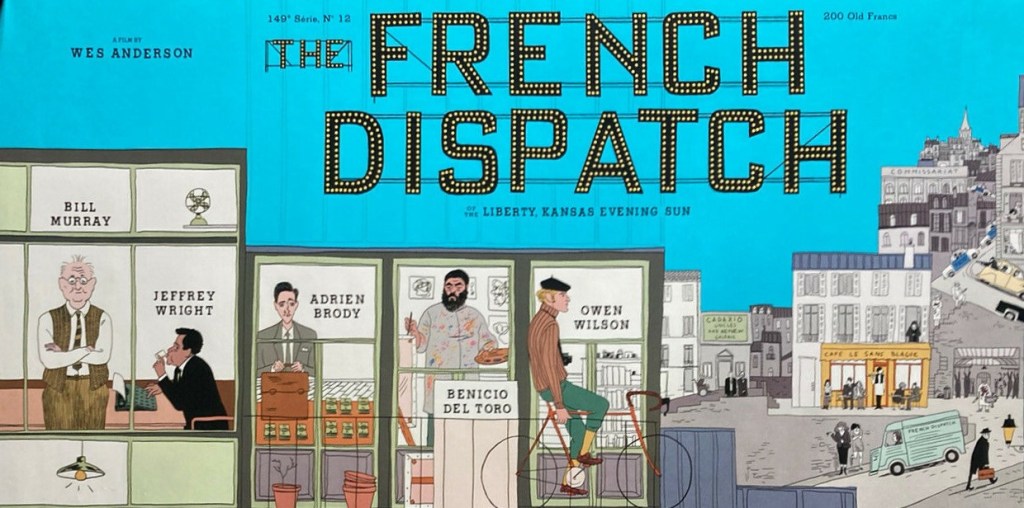
It can only be ironical that Wes Anderson’s wonderfully idiosyncratic, evocative, often hilarious, picture – featuring ex-pats writing for an American magazine in the style of the New Yorker – is located in the French town of Ennui (translation: “boredom”) because it is anything but, a continuous stream of imaginative and inventive scenes, settings and characters. Where other directors make aspects of history their own (Ridley Scott, David Lean) and others lay claim to greatness by inverting genres (Quentin Tarantino), Anderson’s genius lies in creating worlds nobody else could lay claim to. Although this particular film covers just a triptych of tales, you can easily imagine Anderson has another hundred or so stories at his fingertips, all contained in his own unique universe.

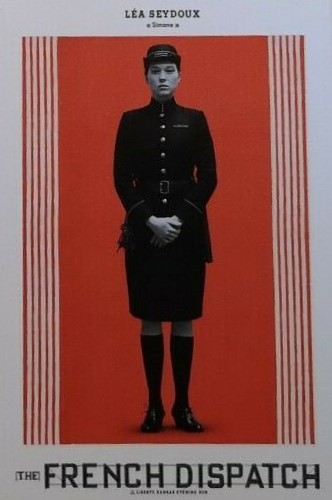
You can see why actors queue up to work with him for he allows them to develop highly-individual characters far removed from their denoted screen personas.  Some like Timothy Chamalet, Benicio del Toro, Jeffrey Wright and Lea Seydoux take advantage of this freedom to conjure deliciously realised human beings, while others such as Owen Wilson and Tilda Swinton let the opportunity slip or appear  in the picture so briefly (Elisabeth Moss, Henry Winkler, Bob Balaban) as to make little impact. Even headliner Bill Murray, who bookends the show, is given to more inventiveness than usual, breaking up his usual deadpan  delivery to make an occasional emphatic point.
While mostly this zips along, when Anderson occasionally stops for breath the effect is electric, for example a static camera taking in the back of a tenement through which we see by virtue of various windows a waitperson’s exhausted ascent. Mostly, the tales follow their own internal logic, but when forced into a genre corner, such as a shoot-out, Anderson resorts to pure zest. And while the narrative is mostly driven by voice-over, this takes on different aspects, from a loquacious raconteur (Jeffrey Wright) to a droning lecturer (Tilda Swinton).

Clearly planning to keep one step ahead of critics who claim his movies run out of steam, Anderson heads off that issue by filming three short unconnected stories. Del Toro and Seydoux head up the best item which sees a psychotic murderer embark on an artistic career that hooks art dealer (Adrien Brody).  Those who expect Anderson to spring surprises might still be taken aback when it transpires that the nude model (Seydoux) of the prisoner (Del Toro) is in fact his gaoler. Having opened a box of twists, Anderson continues in this wild vein. Narrators attempting to impose a semblance of normality generally find themselves at odds with their subject matter. In the second tale, as off-beat a student revolutionary as you could find, Chamalet breathes as much life into the character as he appeared stultified in trying to create a real person in the misfiring Dune (2021). Crime is not usually best served best by asides and droll self-importance but Wright, in the final story, manages to tie up in knots what should a taut kidnapping tale.   
If you come looking for star turns by Bill Murray and Oscar-winner Frances McDormand, you will be sorely disappointed but if you willing to settle for an energetic, fresh, nostalgic take on an imaginary France, with plenty laugh out loud moments, you should come away well satisfied. Of course whether the French will feel as insulted as by television show Emily in Paris remains to be seen but I’m sure the Hungarians did not take The Grand Budapest Hotel (2014) too literally.

I notice that this received a platform release in the States and broke per-cinema box office records in the process and I wonder what might have been the fate of The Last Duel (2021), regardless of its budget, had it opted for a similar launch approach.

The Last Duel (2021) **** – Seen at the Cinema

A surprisingly contemporary core, bolstered by a quartet of excellent performances, drives Ridley Scott’s bold Rashomon-style historical tale. Despite its length it’s less of a historical epic in the style of Gladiator (1999) and more of an intimate and intricate exploration of power – and its lack. Each of the main characters, including and especially the women, while exerting some kind of power nonetheless are in thrall to a superior being whose word is absolute law. Challenging that authority could result in instant death. It’s a slow-burn for sure but exerts a tenacious grip as the story unfolds from three points-of-view to a double climax, both riveting for different reasons.   

And it’s far from typical Ridley Scott except in attention to historical detail. The battle scenes are almost perfunctory – in fact few end in victory – and except to demonstrate bravery do not follow the usual heroic template. There’s none of the trademark Scott cinematic sweep although the duel itself is exceptional.

Scarred to the point of facial disfigurement Damon has never played a character like this before.

In 14th century France Marguerite (Jodie Comer), wife of Sir Jean de Carrouges (Matt Damon), accuses Jacques Le Gris (Adam Driver) of rape, the accusation finally settled by duel to the death. All three characters are given the chance to give their version of the story and this is where it becomes fascinating as shades of personality are filled in.

At the outset Jean comes across as brave, impulsive, marrying Marguerite to save her honour (her father is a traitor), and when wronged willing to challenge authority. But as other perspectives unfold he is revealed as blustering, ambitious, more interested in his wife’s sizeable dowry than her honour, over-proud, and a poor manager of his estate. While brave, educated and charming Le Gris turns out to be a greedy, conniving bed-hopper. Initially presented as a grateful wife and little more than an adornment Marguerite is revealed as the most courageous of all, an able estate manager, challenging the King, accepting the prospect of death rather than, as was apparently the custom of the times, allowing the rape to go unremarked.

Comer is a revelation and you could argue she steals the picture from her more experienced colleagues. There is an astonishing scene where she realises that, her husband’s bravery notwithstanding, he has condemned her to a terrible death should he lose the duel.

The sexual mores of the era are examined in depth, the worst examples of male prerogative sometimes just touched upon in passing, for example, since a wife is her husband’s property, in law he is the one besmirched not her. In taking sexual power as his central theme rather than the triumphs and woes of the men, Scott takes a huge risk in alienating a following expecting more action and cinematic bravura, but the bold story-telling pays off and although starting with Alien (1979) the director has a record of strong female characters this has more in common with Thelma and Louise (1991) where wronged women are backed up into a cul de sac.

Rejecting the heroism route allows Scott to present far more rounded characters. None of the four principals conforms to type. Damon is neither the common man nor the action hero, but a boor. Driver is neither charming seducer nor outright villain but somewhere in between, living on his wits. Comer cannot rely on female machismo or cleverness but must remain stout in the face of an onslaught of humiliation. And mention must be made of Ben Affleck as Pierre d’Alencon, employer of Le Gris and master of Carrouges, who is cocky, immoral, amoral, greedy, shifty and cunning. Other standout performances feature Alex Lawther (The Imitation Game, 2014) as a gleeful king and Harriet Walter (Atonement, 2007) as a loathsome and cruel mother-in-law. I just hope Oscar voters recognise at least some of these perfomances.

A blond and goateed Affleck as you have never seen him before, cockiness running riot, with a mean streak a mile wide, the epitome of Middle Ages entitlement.

It’s worth paying attention to the screenplay by Nicole Holofcener (Oscar-nominated for Can You Ever Forgive Me, 2018) and Damon and Affleck (their first joint effort since Good Will Hunting, 1997) and note how the language the characters employ changes according to the perspective. Words that we imagine in one section that appear to be spoken by one character in another section are delivered by someone else entirely.

I am a huge fan of Ridley Scott and while I came looking for adventure in the style of Gladiator (2000) or his other historical masterpiece Kingdom of Heaven (2005) I came away more than satisfied in the way he altered his style to suit the story almost in the same manner as he had done with American Gangster (2007), another picture about power.

You will probably be aware by now that this has been a colossal box office bomb and although the film has enormous merit you can see why audiences looked the other way. Oddly enough, I think it will acquire a bigger audience through small-screen streaming since it is really a drama.  I would still recommend catching it at the cinema but there’s fair chance it will not last for its full 45-day window.

I tend to judge directors not by critical acclaim but by a more rudimentary measure – how often I watch their pictures. I have seen Alien, Blade Runner (1982), Thelma and Louise, Gladiator, Kingdom of Heaven, American Gangster, the Martian (2015)  and even the flawed Prometheus (2012) and Black Hawk Down (2001) more than half a dozen times each – often three or four times at the cinema – and I have a notion that The Last Duel will comfortably fit into this elite.

Annette (2021) * – Seen at the Cinema

Contender for the weirdest film of the year and a truly bonkers misfire, this is a musical only in the sense that much of it is sung in the vein of Tommy (1975) but completely lacking in the kind of memorable songs that would make it qualify for the genre. It is the most over-ripe of conceits, actors who can’t sing, a story that doesn’t fly, characters whose characteristics are endlessly laboured, little development, and a director who clearly believes audiences will swallow anything.

World-famous soprano Ann (Marion Cotillard) marries agent provocateur stand-up comic Henry (Adam Driver). Her stage act consists of dying and bowing, his of heckling his audience. The relationship soon hits the rocks but not before she has given birth to Annette. This is where it becomes even more tricky because Annette more closely resembles an offspring of Chucky, the horror doll, rather than, as was clearly intended, Pinocchio. The story takes an odd turn, which I won’t reveal, but it fails to redeem the project.

While Driver (Star Wars: The Rise of Skywalker, 2019) is quite convincing as the bonkers comedian – especially in one skit where he has the audience believing he has killed his wife – and it is virtually impossible for Cotillard (La Vie en Rose, 2007) to be bad in anything, the film needs more than repetitive scenes of her singing and him upbraiding the audience. Cotillard actually has a reasonable voice – and has cut a few albums – but what she is given to sing here makes a mockery of her talents.

With names such as director Leos Carax (Holy Motors, 2012) and screenwriters/ composers Ron and Russell Mael of Sparks fame this was clearly always going to err on the side of cult. It might have worked if the director could have seen his way to a bit of brevity. At 90 minutes or so it might have been an interesting trifle. At 140 minutes, it outstayed it welcome.

Shang-Chi and the Legend of the Ten Rings (2021) **** – Seen at the Cinema

While sharing similarities to Black Widow with family to the fore, warring siblings,  understated love interest and greater emphasis on character than action, this is a bolder origin story.  Shang-Chi (Simu Liu), living as a car valet driver in America under the pseudonym Shaun, is drawn home by his father Xu Wenwu (Tony Leung), who gave up global domination for love. Shang-Chi is somewhat surprised to discover that the mother he believed dead is instead being held prisoner.

Family reunion is complicated by the fact that Shang-Chi shamed his father and abandoned his sister Xialing (Meng’er Zhang). Shang-Chi’s not-quite-girlfriend Katy (Awkwafina), when not aiding exposition, mostly provides comic relief until superceded in that department by  wacky thespian Trevor (Ben Kingsley). As the story picks up it also drops back to explain the family dynamics but without losing any tension. On paper the tale sounds a tad overcomplicated but it works like a dream on screen and we only really enter Marvel territory filled with mythical Chinese creatures in the last reel. So on the one hand it works as an interesting drama while on the other delivers innovative bang for your buck.

There’s a brilliant sequence on a runaway bus in San Francisco, Shang-Chi battling a group of thugs led by the appropriately-named Razor Fist (Florian Munteanu) while Katy tries to control the vehicle. Then there’s a terrific battle on skyscraper scaffolding. Throw into the mix a drive through a terrifying forest and a return to their mother’s village to confront the evil that threatens the world. And in keeping with Marvel dynamics pendants that hold the secret of finding the hidden village.

The set-up is particularly well-done with clever twists to audience expectations, what appear at first to be expository voice-overs turning into conversations, the undefined Shang-Chi/Katy relationship causing grief among parents and friends, their driving skills put to superb use in the plot, while the father’s backstory, lust for power being assuaged by love, is not given short shrift. The story more than toys with the audience in other ways, setting up different expectations which prove unfounded.

All the main characters have great story arcs –  Xu Wenwu from ruthless villain to romantic softy and back to ruthless when training his son, Shang-Chi from apparent waster to unwillingly accepting a different path, Xialing the girl who had to learn skills her father refused to teach her, and, her driving apart, Katy from mere observer in action scenes to participant.

Primarily a television actor and stuntman Simu Liu makes massive impact in the leading role, adding a fresh face to the MCU. Asian superstar Tony Leung (Infernal Affairs, 2003) makes a comfortable leap into the Hollywood big time. The relatively unknown Meng’er Zhang (In the Mood for Love, 2019) comes up trumps and rapper Awkwafina (Jumanji: The Next Level, 2019) brings a welcome touch of normality to the proceedings. Look out for Michelle Yeoh (Crouching Tiger, Hidden Dragon, 2000), Florain Munteanu (Creed II) and Benedict Wong (Doctor Strange, 2016).  Oscar-winner Ben Kingsley almost steals the show.

Destin Daniel Cretton (Just Mercy, 2019) does a brilliant job of marshalling not just the visuals but the drama and brings clarity to the storyline. Special mention to an unusual score by Joel P. West.

The Last Bus (2021) *** – Seen at the Cinema

As we saw with Stillwater, great performances can rescue films. And there are two stunning performances on show in this alternative road trip, one from star Timothy Spall (Mr Turner, 2014) and another in a blink-and-you’ll-miss-it scene from supporting actress Grace Calder. The story here is pretty slim, Tom, aged over 90, sets out on 800-mile pilgrimage by bus from John O’Groats at the very top of Scotland to Land’s End at the very south of England. The trip’s purpose is concealed until the climax but hardy cinemagoers will easily guess it. He has various encounters along the way. That’s it, pretty much.

Most films about the old have redeeming features, a charming character and if grouchy with a last chance at redemption, and if played by a star generally bring with their performance a whole parcel of screen memories that have an audience rooting for them. Tom ain’t like that. He’s old the way really old people are old. He’s not an attractive sight. His bottom lip sticks out most of the time like an aged trout. He shuffles along, in battered old clothes clutching a battered old suitcase. Most of the time he’s out of his depth, occasionally rescued by passersby, occasionally not.  

The most you can say about him is he has grit, standing up to a drunk abusing a Muslim, fixing a broken-down bus, offering a shoulder to cry on to a weeping teenager. In another time, in another place, such characteristics would have propelled a story. Here, they are mere makeweights. He’s so self-effacing he’s easy to ignore.  

Scottish director Gillies Mackinnon (Whisky Galore, 2016) takes the bold decision not to make him overly sympathetic. Scenes that would have been played for all they were worth in any other film almost pass without comment, just minor ingredients in a larger tapestry. The most Tom achieves is retaining dignity at a time when body and mind are starting to betray him.

That this is just the smallest of small pictures is amply demonstrated when, trapped between a bunch of rowdy boys enjoying rowdy banter with a hen party, he starts singing “Amazing Grace.” Tom doesn’t have an amazing voice. He doesn’t even seem to recognise that he gradually attracts an audience. He is in a world of his own. And the director lets him stay there.

I was so convinced by Timothy Spall’s performance that I hoped they had used a stunt double to film a scene when he has to gingerly negotiate a path down rugged rocks. I had not realised that Spall is only 64 and not close to the aged specimen I had been watching. Spall has that quiet genius of the great actors even though rarely given a leading role and if you recognise him at all, unless you are an arthouse devotee, it will be from The Last Samurai (2003) or Vanilla Sky (1999).  

What of Grace Calder? Occasionally I deliver lectures on film and in one of these I use the final scene of Greta Garbo in Queen Christina (1933) to demonstrate the power of female close-ups, how women far more than men are capable of a greater range expression, showing a shifting series of emotions through their eyes. And I saw that same astonishing quality in Grace Calder (Love Sarah, 2020). She appears as the lover of an arrogant male who taunts Tom in a B&B. As she reins her lover in, her eyes rapidly change in a matter of seconds to conveying a depth of different emotions.  None of the other actors, who are all fleeting two-dimensional cameos, come anywhere close in a part that was not a part until she made it so memorable.

Most critics have been pretty sniffy about The Last Bus and you can see why. Television writer Joe Ainsworth making his movie debut tries too hard for diversity, the social media trope sticks out like a sore thumb, affords overmuch footage of glorious Scottish landscape to recompense Creative Scotland for its financial input, and never quite resolves the question of how a 90-year-old guy who can hardly manage a bus pass manages to work out a convoluted route in at least a dozen local buses to retrace a route he took 70 years before.

But it is all held together by a stunning performance by Spall.  

Censor (2021) ** – Seen at the Cinema

From video nasty to video laughty in one easy move. I was laughing out loud when the picture started to get nasty and I doubt this was the intention of director Prano Bailey Bond, making her movie debut. The movie is set in the uber-drab 1980s, where color was apparently in short supply, and all the characters inhabited offices or houses that appeared to belong to the black-and-white era.  The notion that iconic characters like Boy George, Madonna and Princess Diana might have been around at the same time is largely ignored in the bid to make every character flat and conformist.

In fairness, working in the British film censorship department was hardly likely to provide a bundle of laughs. As well as being as being as buttoned-down as they come, Enid (Niamh Algar) is also riddled with guilt since she was in charge of her younger sister when she went missing two decades previously. A chunk of the film is almost a spoof of The Office, with characters hidebound by officialdom.

And there are a few excellent set pieces. As with The Night House, the scenes that deal with grief, Enid’s parents finally coming to terms with their daughter’s disappearance, are very well done. The dialogue among the various censors, judging whether to reject movies or heavily edit them, rings very true and there is a terrific scene involving film-making where the director is kept off-camera while an actress is literally standing in the spotlight.

Tight-lipped Enid becomes obsessed with the idea that her sister is not only alive but actually an actress in a video nasty.  To that end, she tracks down smarmy producer Doug Smart (Michael Smiley). As I said, it may have been the director’s intention that Smart is killed by ironically managing to have an award statuette rammed down his throat, but I’m not so sure and at that point I began to lose faith in the picture. It goes on to a perfectly bonkers climax which had me in stitches, again not entirely a recommendation.

The Courier (2021) **** – Seen at the Cinema

A brilliant example of how to control your material, this low-budget old school espionage picture, virtually a two-hander, based on a true story and set against the 1960s cold War paranoia, delivers thrills against the background of a murky business. Smarmy businessman Greville Wynne (Benedict Cumberbatch) is inveigled into picking up rolls of film from Russian intelligence office Oleg (Merab Ninidze), giving away his country’s secrets in a bid to prevent nuclear war.

An anti-James Bond scenario sees Wynn employing little bits of tradecraft and spending almost every minute fearing capture while he develops a friendship with his foreign counterpart. On the domestic front, the pressure tells on Wynn, already a nervy character and relying too much on alcohol to sustain his own possibly failing business. Wife Sheila (Jessie Buckley) suspects he is engaging in another extra marital affair. Doting father Oleg wilts under the burden of betrayal, hoping that his assistance in the Western cause will lead to a successful defection, aware of the impact on his family if caught.

In the background Wynne’s ruthless handlers, Dickie Franks (Angus Wright) representing MI6 and CIA operative Emily (Rachel Brosnahan), are like circling sharks. While tense enough, this is all straightforward Tinker, Tailor… territory but in the second act the stakes suddenly rise and the movie shoots into quite different, far more realistic territory, that takes its toll on both protagonists.

It’s a very lean film and in concentrating on character rather than extraneous thrills in the manner of other recent offerings like Stillwater, The Night House or Censor, comes up triumphant in terms of plot. And without attempting to impose background through artistry as with Censor perfectly captures the mood of the times. The background characters are all well developed but the unexpected friendship that develops between the two spies and leads to the climax is exceptionally well done.

Oscar nominated Benedict Cumberbatch (The Imitation Game, 2014) drops all his mannerisms to bring alive a fascinating character who has, in any case, in his business life, had to develop an alien persona.  Merab Ninidze (Jupiter’s Moon, 2017) is every bit his equal, living a lie, trying to keep one step ahead of his own suspicious compatriots. Rachel Brosnahan (Change in the Air, 2018) is excellent as the one backroom character with an ounce of empathy and a pithy line in dealing with stuffy Brits and Jessie Buckley (Wild Rose, 2018), adding another decent accent to her collection, adds some pathos.

Director Dominic Cooke (On Chesil Beach, 2017) does an excellent job of marshalling his material and his concentration on character pays off in spades. Versatility could find no better expression than through writer Tom O’Connor who went down a completely different route in his previous movie The Hitman’s Bodyguard (2017).

I do have one slight niggle. When the British were outraged at Burgess, Philby and MacLean and the Americans Klaus Fuchs et al, the arguments given by these various traitors was that, in giving away state secrets, they were merely realigning the nuclear status quo. These characters were all roundly vilified, but not Oleg here. And although the film concentrates on a few exchanges between Oleg and his courier, in reality more than 5,000 military secrets went from Russia to Britain in this fashion.

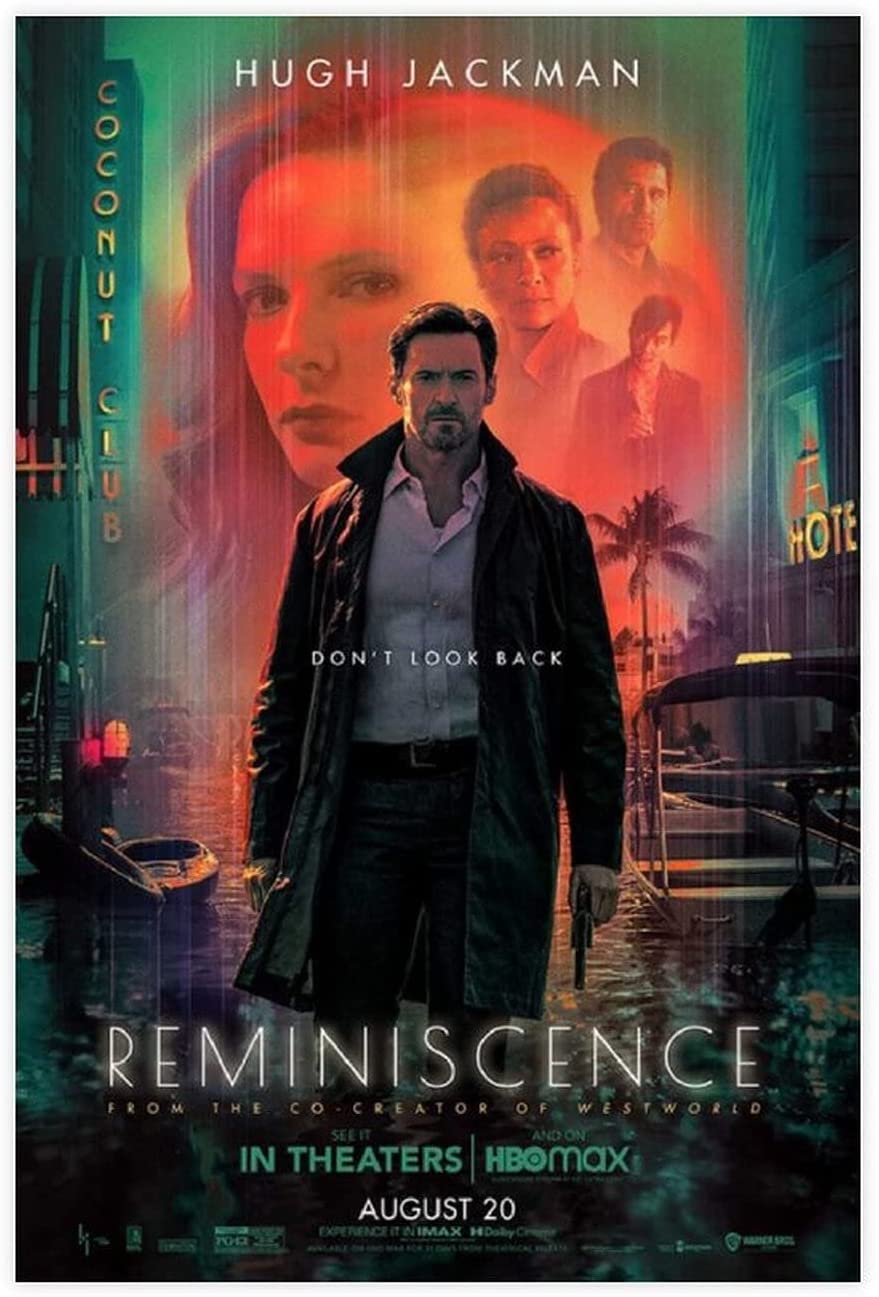
Reminiscence (2021) ** – Seen at the Cinema

Hollywood has been running shy of genuine film noir for some time now so it makes little sense to give it a waterlogged futuristic setting despite the impressive track record, albeit not in the movies, of writer-director Lisa Joy best known as co-creator of television hit Westworld (2016-2021). Ecologic disaster dominates this future, floods reducing cities to rivers, skyscrapers and buildings existing as islands in a wet landscape. Dystopia is also rampant with the masses close to riot and big business, as you might expect, nonetheless able to exploit the situation.

Nick Bannister (Hugh Jackman) is a private eye of sorts, but concentrating his practice on infiltrating the mind, operating some kind of giant bathtub immersion which, plus a  headset that looks borrowed from a Marvel supervillain, allows him to penetrate secrets. Enter statuesque femme fatale Mae (Rebecca Ferguson) who has – wait for it – lost her keys! Yep, that’s the set-up. Some amazing technological gizmo that can be turned into a key-hunting device.

Of course, that’s not the whole story. To fill out the film noir aspect, Mae is some kind of nightclub singer, rehashing the Rodgers & Hart standard “Where or When,” singing into a  1940s mike. And there’s a voice-over reminiscent of the awful voice-over that besmirched the original release of Blade Runner, with some lines so bad that the director sees fit to run them twice.

Soon Bannister is plunged (pardon the pun) into a mystery that takes in businessman Walter Sylvan (Brett Cullen) and family and there’s other bad guys like Cyrus Boothe (Cliff Curtis) and a shoal of red herrings lying in wait. Instead of Bannister being the alcoholic as is usually the private eye trope, it’s his sidekick Watts (Thandiwe Newton).

Left alone, this might have made a decent mystery, and there is enough intrigue to be going along with, family secrets to expose, but the setting destroys any possibility that the picture might actually take off.  The city is in some cases flooded to probably the first ren or twenty storeys of a skyscraper but in other sequences Bannister skips through what look like little more than a few inches of water. There is an absolutely peculiar scene where Bannister escapes his enemy by trapping him in a grand piano and sending him into a watery grave only to change his mind and try to rescue him.

There’s some interesting material about how to capture memory and keep it on permanent rewind but it’s kind of lost in the general flotsam and jetsam and there’s a sweet line about finishing a story at the good part before it turns into a sad ending. But there’s really no justification for the futuristic setting even if Bannister had invented a gizmo that opened up the mind, more of an electronic psychiatrist than a gumshoe.

Hugh Jackman (The Front Runner, 2018) does his best but the risible voice-over, striving too hard for memorable lines, does for him. Rebecca Ferguson (Mission Impossible: Fallout, 2018) is satisfactory without being electrifying but Thandiwe Newton (Solo: A Star Wars Story, 2018) is wasted.

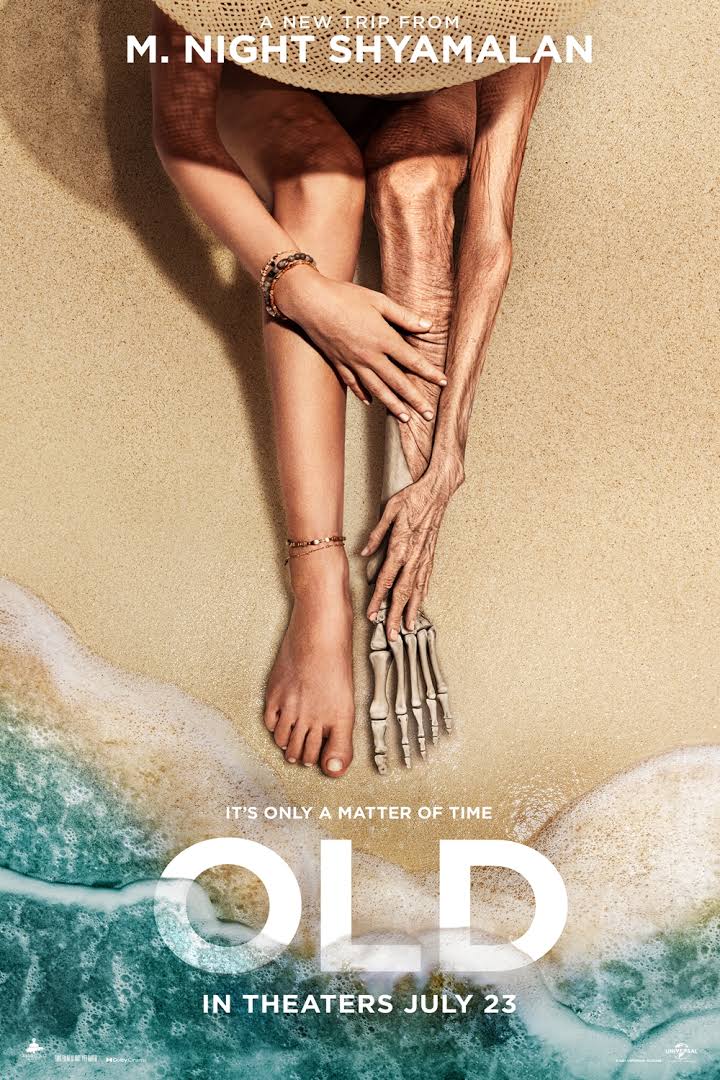
Old (2021) *** – Seen at the Cinema

Surely no director has cut his cloth according to his means more than M. Night Shyamalen. After a series of big-budget failures, he returned with a series of low-budget numbers like The Visit (2015) and Split (2016) with a couple of forays into television to keep his hand in. And although his movies sometimes don’t work, usually from over-ambition, he is still a brand name and as a triple-hyphenate one of the few working directors to completely control his output.

So the starting point is you don’t know what you’re going to get, except there will be twists and occasional shocks along the way. Even the Glass films aren’t a trilogy in the accepted sense of the word. 

Old is a neat idea. A group of strangers on vacation end up on a strange beach where time moves along at quite a clip and they can’t escape. Most of the action involves the characters responding to one calamity after another and despite a couple of gruesome moments Shyamalan seems intent on swapping jump-out-of-your-seat moments for a continual slow burn. He takes the disaster trope of who’s gonna die next – the bad old guy or the cute younger person – and inverts it until nothing makes any sense except impending apocalypse, at least for all stranded in this apparent paradise.

Speeded-up life makes for speeded-up dread. While wounds heal in seconds and pregnancy might last, oh, a half hour or so, the malfunctioning body malfunctions at lightspeed.

The great thing about Shyamalan is he is a writer first so the characters here are all very well drawn. He gives a geeky kid the geekiest of all character traits, going up to everyone he meets to ask their name and job. But it’s an ensemble picture so nobody is more important than anybody else. And the characters bring along a hamper full of tensions – there’s an epileptic, a couple on the verge of divorce, a doctor on the verge of a breakdown. He also has a distinctive visual style, preferring to track the camera from one character to another rather than using cuts.

It slightly runs out of steam as the body count mounts and it might have been an idea to introduce the shock ending – which asks significant questions about the direction society is heading – a bit sooner

There’s a solid cast, good actors rather than A-list stars, a bundle of whom are best-known for television. Gael Garcia Bernal (The Motorcycle Diaries, 2004) takes pole position in the credits, supported by Rufus Sewell (The Man in the High Castle television series, 2015-2019), Luxembourg actress Vicky Krieps (Das Boot, 2018- 2020), Ken Leung (Lost, 2008-2010), and Abbey Lee (Lux Aeterna, 2019).  Scions of Hollywood royalty get a leg-up here – Francesca Eastwood being the daughter of Clint and Alexa Swinton cousin to Tilda – and there are cameos from the likes of Embeth Davidtz (Schindler’s List, 1993)

Otherwise it’s a decent addition to the Shyamalen oeuvre, enough at least to keep him chugging along until he gets the next big idea or budget. While the chances of him alighting on another Sixth Sense (1999) or Unbreakable (2000) might appear remote bear in mind the guy has barely passed 50, an age when top directors are just coming into their prime – Hitchcock was a few years older when he hit the hot streak of Rear Window, Vertigo and North by Northwest.

There’s a fair chance the ending is uncomfortably close to science fact rather than fiction and if Shyamalan can activate social media along those lines the picture could build up enough of a head of steam to bring the director back into the big-budget Hollywood fold or ensure at least that he is never cast aside.

Saw this at the cinema as part of my Monday double bill. – but on the previous week to Suicide Squad/Jungle Cruise.

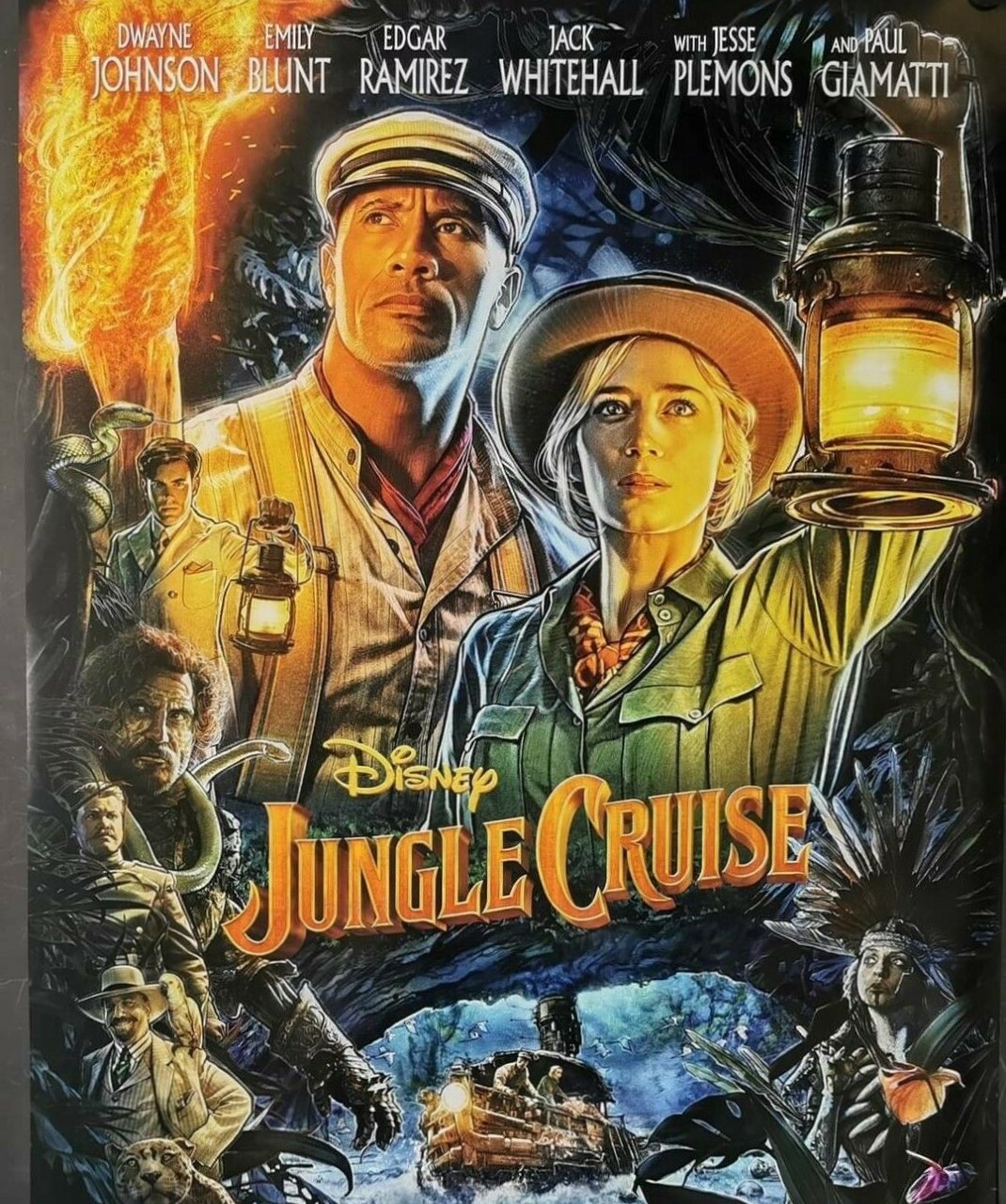
Jungle Cruise (2021) **** – Seen At The Cinema

Can’t believe this romp is getting such sniffy reviews. But the reason is simple enough. Critics don’t watch it with an audience (except possibly of other critics) – on Rotten Tomatoes critics scored this at 63% while audiences rated it 93%. I saw it as part of my Monday Night Cinema Double Bill – along with Suicide Squad which critics adored. But while I thought Suicide Squad was a blast and very original, I laughed more at Jungle Cruise and I was much more involved. The difference – Suicide Squad is slick and cynical with hardly a single empathetic character, which is an easier target these days, but Jungle Cruise goes for something more difficult to achieve, a genuine warm-hearted movie that doesn’t disappear into romantic slush.

Sure, Jungle Cruise recycles not just Raiders of the Lost Ark (1981) – which itself recycled just about everything – but Ghost (1990), Highlander (1986), The African Queen (1951), Romancing the Stone (1984) and Pirates of the Caribbean (2003), but I don’t think that took away from its originality. The story made sense and the clues involved in the treasure hunt aspect of the picture were well worked out, delivering quite a few surprises. But mostly, there was terrific charisma between Dwayne Johnson and Emily Blunt.

Roguish Frank Wolff (Dwayne Johnson), with a line in lame jokes (which, by the way, had the audience roaring), operates an Amazon river cruise before the First World War where most of what the passengers see is manufactured. Explorer and accomplished burglar Lily Houghton (Emily Blunt) mistakes him for riverboat magnate Nilo (Paul Giametti) but after Frank saves her from a tiger (his tame beast, it turns out) she hires him to find a fabled treasure. Also in the hunt are ruthless German Prince Joachim (Jesse Plemons) and Spaniard Aguirre (Edgar Ramirez).

Both Wolff and Houghton are given great opening scenes, he proving what a con man he is, she more than capable in a man’s world, where such is the antipathy to female archaeologists that her brother MacGregor (Jack Whitehall) has to deliver her lecture for her. There’s action by the bucketload, quite a few Indiana Jones-type escapes, shooting the rapids, encounters with dangerous animals – snakes, piranha fish etc – and natives. Prince Joachim has one hell of a river vessel and quite a few tricks up his sleeve. It’s not just that the pace never lets up, but it is generally delivered with verve.  

Interestingly, there is a nod towards diversity in that MacGregor is gay, a fact accepted by Wolff. Equally interesting, MacGregor has a pivotal transitional moment as his character starts out in one mode and ends in another.  And Lily gives the finger to the male-dominated academic world.

Paul Giamatti (TV’s Billions, 2016-2021) only has a small part but it’s a delight to see him make any big screen appearance at all and Jesse Plemons (Judas and the Black Messiah, 2021) takes on the rather unusual role of the German bad guy. Even though Edgar Ramirez (Yes Day, 2021) spends most of the movie in disguise one way or another, his intensity still shines through.

Jaume Collet-Sera made his name directing Liam Neeson thrillers like Unknown (2011) – one of my favorite pictures – and Non-Stop (2014), Run All Night (2015) and The Commuter (2018) but this is a big step up not just in terms of budget and the occasionally complex story line but also in the romance and comedy elements and in my eyes he more than delivers. Michael Green (Blade Runner 2049, 2017), Glen Ficarra (Focus, 2013) and John Requa (The Bad News Bears, 2005) all had a hand in the screenplay and James Newton Howard (News of the World, 2020) has written a great score.  

I’ve no idea whether Jungle Cruise has anything in common with the ride at the Disney theme park and I didn’t care. This is not just great family viewing but for audiences of all ages who just want to be – wait for it – entertained. But Disney may well have shot itself in the foot by streaming this at the same time as opening it in cinemas for I bet you this will get terrific word-of-mouth and they should have let it sit in cinemas for months to gather the benefits. An ideal summer movie of the old-fashioned kind.

Discover WordPress

A daily selection of the best content published on WordPress, collected for you by humans who love to read.

The Atavist Magazine

by Brian Hannan

WordPress.com News

The latest news on WordPress.com and the WordPress community.