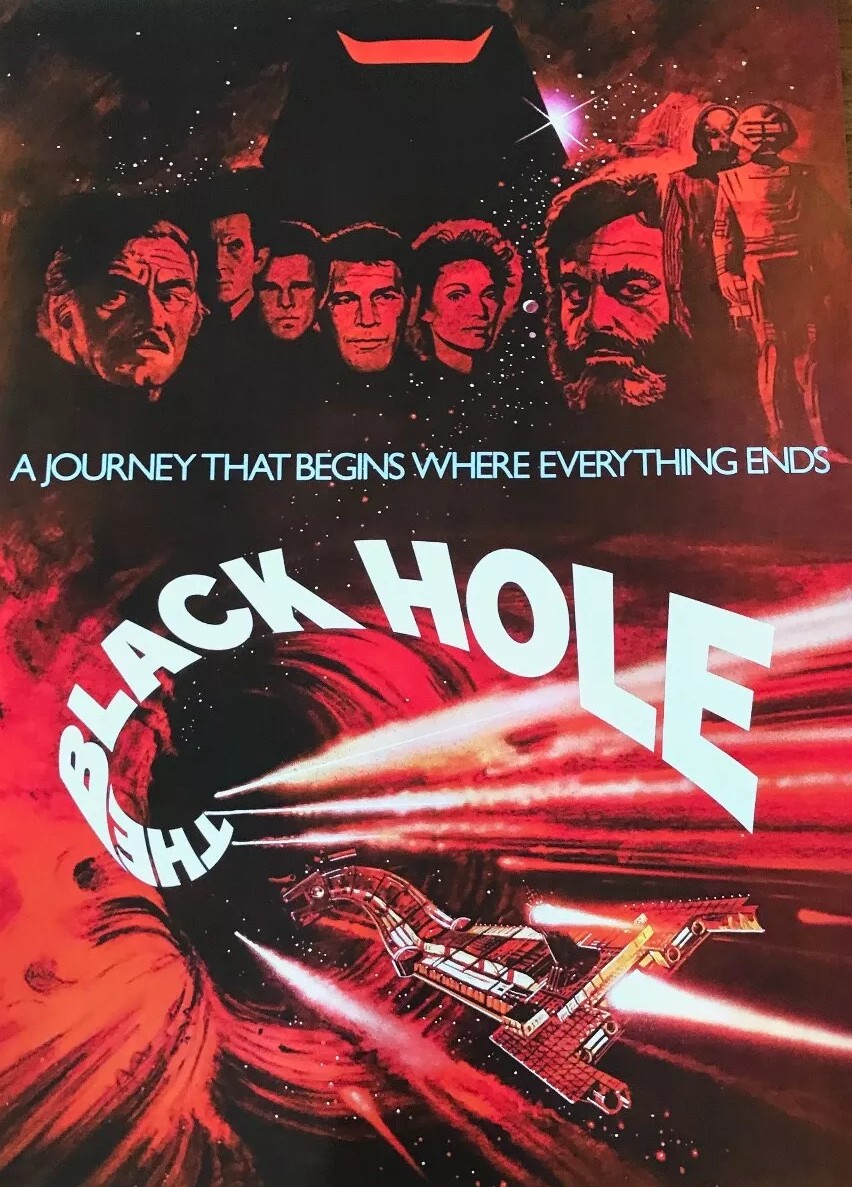
The Black Hole (1979) ***

Think of this as having been made before Star Wars (1977), Close Encounters of the Third Kind, Alien (1979), heck even Star Trek (1979), changed the sci fi world forever and imagine it’s a huge advance SFX-wise on the 1950s vanguard of sci fi pictures and you’ll probably come away very happy. A lot to admire in the matte work and some groundbreaking effects and actually the story – mad scientist lost in space – has a bit more grit than was normal for the genre.

But it’s laden down with talk and the action when it comes resembles nothing more than a first draft stab at the light sabers of  Star Wars and clunky robotic figures that come across like prehistoric Stormtroopers. A bit more light-hearted comedy than in the other three mentioned, various quips at the expense of the robots.

Scientists aboard space ship USS Palomino, a research vessel looking for life in space, is astonished to discover, hovering on the edge of a black hole, a missing spaceship USS Cygnus and are even more astonished to find out it’s not uninhabited, still on board is heavily-bearded Dr Hans Reinhardt (Maximilian Schell) and an army of robots that he has miraculously fashioned during his time lost in space.

This is a bit of an emotional blow to Dr Kate McCrae (Yvette Mimieux) whose father had been part of the crew of the Cygnus. Dr Reinhardt seems kosher enough except for his idea of, in the true spirit of space adventure, blasting off through the black hole. Although Reinhardt has been exceptionally clever in monitoring the invasion from the visitors and nullifying any threat with a blast from invisible laser, once they are on board that monitoring capability appears to vanish, allowing the visitors to search the ship where they find out that Reinhardt’s story doesn’t seem to add up.

Apart from Dr McCrae, the other personnel from the Palomino comprises Capt Dan Holland (Robert Forster), Dr Durant (Anthony Perkins) – the most inclined to follow Reinhardt into the greatest danger in the universe – quip merchant  Lt Pizer (Joseph Bottoms)  and dogsbody Harry (Ernest Borgnine). Plus there’s a cute robot Vincent (Roddy McDowall) constructed along even more rudimentary lines than R2-D2.

Vincent turns out to be a whiz at a basic version of a computer game, something between Space Invaders and Kong. But his main task is to wind up the crew with a head teacher’s supply of wisdom, spouted at the most inopportune moment. Except for the chest-bursting appearance of Alien, this might have garnered more kudos for the creepy mystery element – Reinhardt has lobotomized his crew members, turning them into these jerky robots, after they mutinied in revolt against his plan to dive into the black hole. Dr McCrae nearly joins the lobotomy brigade. And once she’s rescued it’s a firefight all the way. A stray meteor is on hand to add further jeopardy. And in the end the good guys are forced to plunge into the apparent abyss of the black hole, only to be guided by some angelic light and come out the other end unscathed, no worse for enduring the kind of phantasmagoric light show Stanley Kubrick put on in 2001: A Space Odyssey (1968).

By this point Maximilian Schell (Judgement at Nuremberg, 1961) was an accomplished bad guy, covering up inherent malignancy with charm and scientific gobbledegook. Joseph Bottoms (The Dove, 1974) is the pick of the incoming crew but that’s because he’s been dealt a stack of flippant lines. Anthony Perkins at least gets to waver from the straight-laced. But everyone else is a cipher, even Yvette Mimieux (Light in the Piazza, 1962) who might have been due more heavy-duty emotion.

This was the 1970s version of the all-star cast, all the actors at one point enjoying a spot in the Hollywood sun, but now all supporting players. Schell was variably billed in pictures like St Ives (1976), Cross of Iron (1977) and Julia (1977). Robert Forster (Medium Cool, 1969) hadn’t been in a movie in six years. Anthony Perkins was waiting for a Psycho reboot to reboot his career – only another four years to go. Yvette Mimieux had only made four previous movies during the 1970s including Jackson County Jail (1976). The most dependable of these dependables was Ernest Borgnine (The Adventurers, 1970), for whom this was the 24th movie of the decade, including such fare as Willard (1971), The Poseidon Adventure (1972) and Hustle (1975).

It didn’t prove a breakout picture for director Gary Nelson (Freaky Friday, 1976), Screenplay credits went to Jeb Rosebrook (Junior Bonner, 1972) and female television veteran Gerry Day.

Sci fi the Disney way.

Pendulum (1969) ****

It’s better to come at this as a drama rather than the thriller it was marketed as. That the name of George Schaefer, the last to make a movie of the directors who shot to fame in television in the 1950s, should be indication that this is character- and issue- rather than action-driven. It’s more about people being sucked into the system, about the vulnerable members of society, who, whether cop or criminal, have no recourse to some kind of higher power to sort their lives out. As such, it’s a satisfying drama.

A-list male stars playing emotionally vulnerable characters was a growing trend in the late 60s. Think of Rock Hudson in Seconds (1966), Burt Lancaster in The Swimmer (1968), Frank Sinatra in The Detective (1968), Kirk Douglas in The Arrangement (1969) – all reviewed on the Blog, incidentally. Here top Washington detective Frank Matthews (George Peppard) goes through the personal and professional ringer, suspecting wife Adele (Jean Seberg) of an affair then becoming a suspect himself in a murder case. Underlying these plot-driven aspects is an exploration of the political issue of civil liberties, in particular the constitutional rights of criminals, setting this up as one of the earliest law’n’order movies, a trope that would take center stage in films like Dirty Harry (1971).  

At a peak of professional success, having been awarded a medal and promoted to a consultant to a subcommittee on Law and Order headed by Senator Augustus Cole (Paul McGrath), Matthews’ ethics come under scrutiny when alleged murder/rapist Paul Sanderson (Robert F. Lyons), whom Matthews had arrested, is freed on a technicality thanks to the efforts of civil liberties attorney Woodrow Wilson King (Richard Kiley).

Matthews appears distracted much of the time trying to keep track of his wife’s whereabouts.  After delivering a speech in Baltimore, he walks the streets in a fug of depression. Meanwhile, King is disturbed by the fact that a man he clearly believes guilty refuses to seek psychiatric help. The question in the audience mind is where he will strike next. There’s an excellent scene in King’s office where his secretary Liz (Marj Dusay), delighted at the lawyer’s success in overturning Sanderson’s case, instinctively pulls away from the freed man.

When Adele and lover are murdered in Matthews’ bed, he finds himself on the opposite side of the law, undergoing the treatment he has meted out to so many criminals, quickly aware that circumstantial evidence could find him guilty. Front-page news himself now, suspended from his job by a quick-to-judge senator, emotionally isolated and a laughing stock, he retreats further inside himself. Naturally, he evades subsequent arrest, setting out to track down the killer himself, that leads him into the murkier depths of society from which emotionally-abused villains easily spring. 

Other issues are explored in passing, the independent woman for a start, whether it is wanting to have her own career and not play the stay-at-home wife or considering it fair game – as with Karen (Lee Remick) in The Detective or Gwen (Faye Dunaway) in The Arrangement – to upturn accepted morality and take a lover.

But the focus remains squarely on Matthews struggling to cope with life running away from  him, falling deeper into despair and into the maw of the criminal justice system which has the knack of bending its own rules. He has never been the saintly cop and there are moments where violence seems the best option, although not the vicious kind later espoused by Inspector Callahan. It’s ironic that the only solid detection the cop does in the first part of the film is tracking down his wife’s whereabouts.

George Peppard (Tobruk, 1967), generally a much-maligned actor, excels in a part where he can neither charm his way to an audience’s heart, nor confide in someone else about his marital problems, nor resort to action to define his character. That his pain is all internalised shows the acting skills he brings to bear. Oddly enough Jean Seberg (Moment to Moment, 1966), a specialist in emotional pain, takes a different path, coming across as a devious minx, keeping Matthews on the hook while enjoying relations with an ex-lover, whose career, as it happens, has panned out a lot better than her husband.

I only knew Richard Kiley, an American theatrical giant and primarily in the 1960s a television performer, through that mention in Jurassic Park (1993), but he is solid as the attorney who has qualms about releasing a prisoner he knows is guilty. Robert F. Lyons, making his movie debut, brings jittery danger to the unbalanced criminal. Look out also for Charles McGraw (The Narrow Margin, 1952) as the cop determined to take Matthews down and Frank Marth (Madigan, 1968) as the subordinate who gives the suspect too much leeway – to his cost. Madeline Sherwood (Hurry Sundown, 1967) is excellent as the disturbed, needy mother.

George Schaefer, at this point a four-time Emmy award-winner, specialized in thought-provoking drama such as Inherit the Wind (TV, 1965) and Elizabeth the Queen (TV, 1968).  This fits easily into that pattern. The title is a giveaway, too, referring to the pendulum swinging, “perhaps too far,” from all-powerful police to the rights of the accused taking prominence.

This was the only screenplay from Stanley Niss, who died shortly after the film’s release. He was also the producer. And better known as the writer-producer of television series like Jericho (1966-1967) and Hawaiian Eye (1959-1961).

Say hello to a different Peppard.

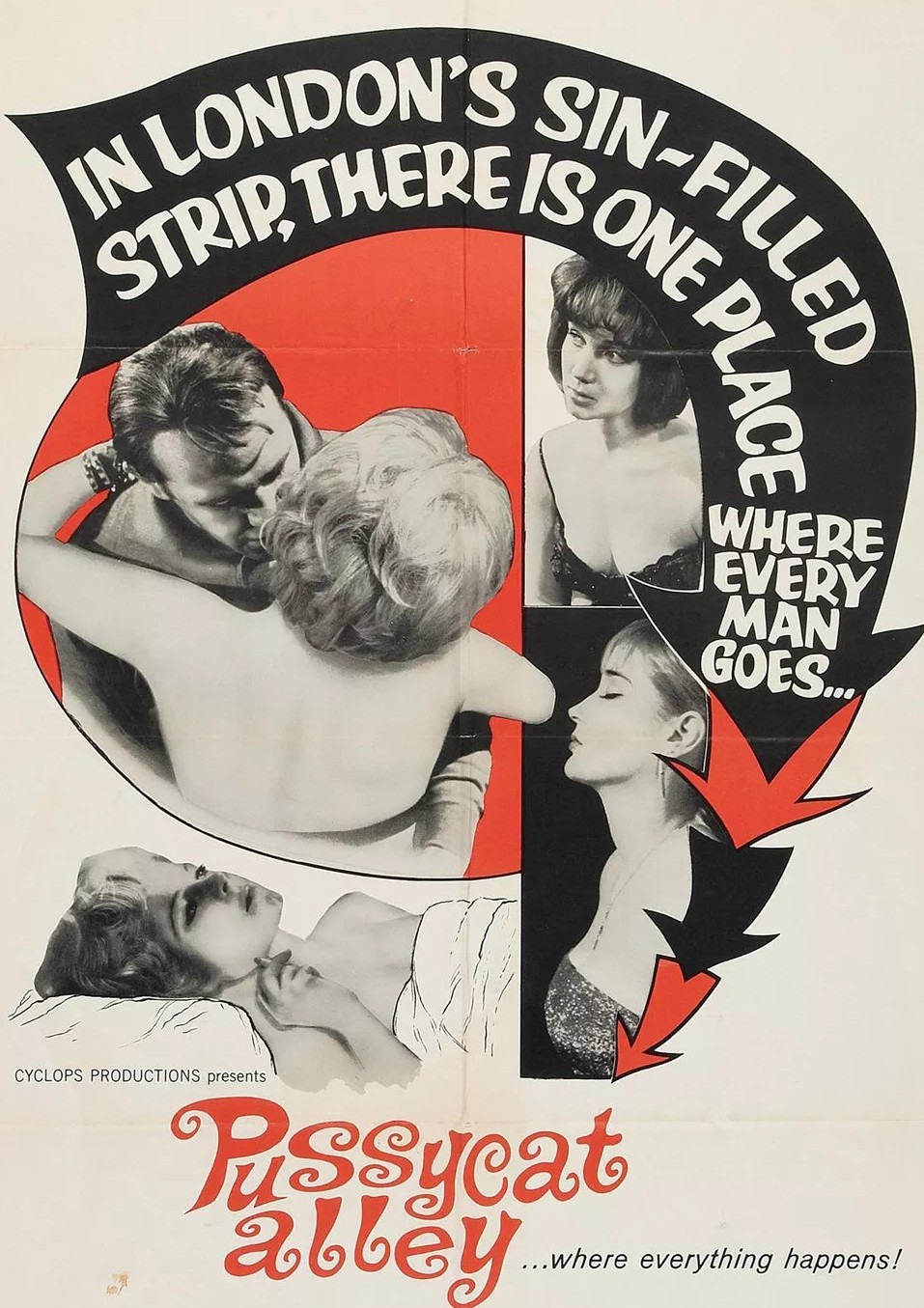
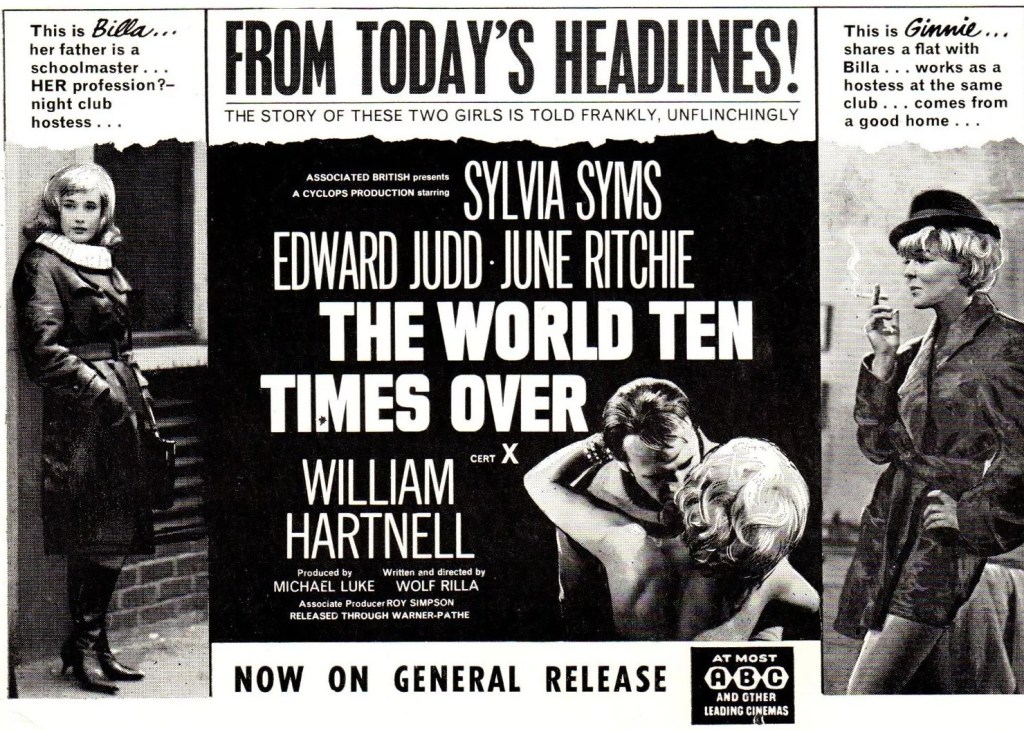
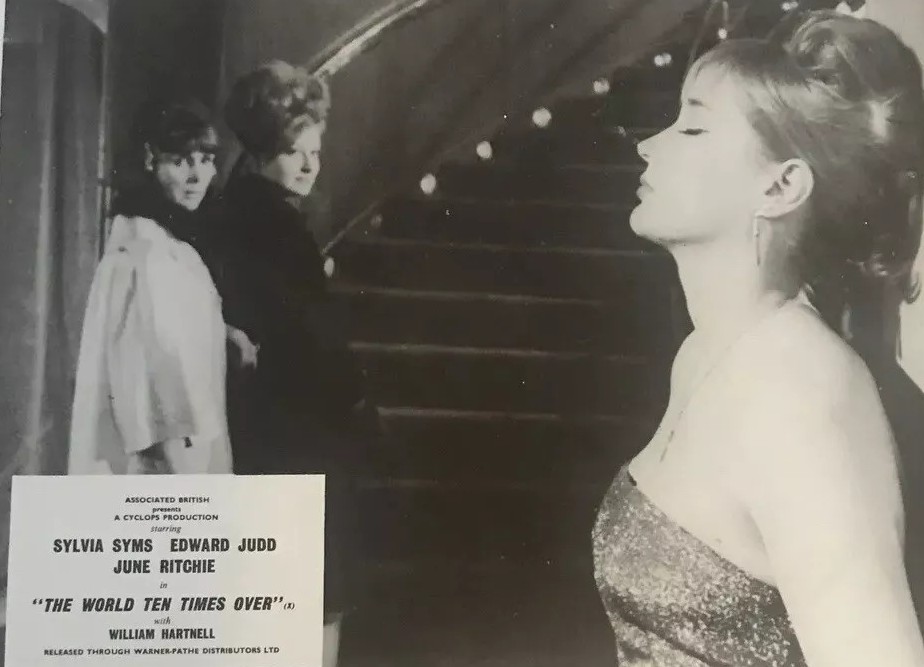
Pussycat Alley / The World Ten Times Over (1963) ***

Sold as sexploitation fare, this is more of a chamber piece as flatmates Billa (Sylvia Syms) and Ginnie (June Ritchie) face up to crises in their lives. For two-thirds of the picture we steer clear of their place of occupation, a Soho nighclub, and only go there for a scene of unsurpassed male humiliation. Unusually, since the expectation would be that the two girls, supplementing their official income with some part-time sex working (implicit rather than explicit), would be treated as victims of wealthy males, in reality they serve up several plates of juicy revenge, but in accordance with their characters rather than as noir femme fatales.

In a very drab London, shorn of tourist hallmarks and red buses and royal insignia, Ginnie sets the tone, furious at lover Bob (Edward Judd), pampered son of a wealthy industrialist, for bringing mention of “love” into what she views as either (or both) an expression of pure pleasure or financial transaction. Bob is the old cliche, the client fallen in love with the girl. Attracted as she is by the pampering and the fact that she can twist him round her little finger, she values her independence too much to commit to such a weak man. In addition, she is so used to getting her way and so wilful that she delights in running rings around him, humiliating him in front of his entire office. 

A contemporary picture like Anora (2024) would find space to excuse or explain her choice of employment, but here, beyond the fact that she left school aged 15 and has no qualifications, we are given nothing to work on, except that her predilection for doing exactly what she wants to do most of the time means she she might find steady employment a drain on her spritely personality.

Billa’s problem is she’s pregnant with no idea who the father might be and becomes infuriated by her widowed teacher  father  (William Hartnell) who can’t let go of his childlike notions of his beloved daughter. Thankfully, no  notions of abuse, but just a dad not coming to terms with a grown-up daughter, shocked that she can knock back the whisky, and whose idea of a treat is taking her to one of the most difficult of the Shakespeare plays. Eventually, suspicions aroused, he tracks her down to the nightclub where she takes great delight in behaving disgracefully, refusing to leave at his presence, parental authority cut stone dead, the staff treating the father like any other punter, even setting him up with a girl (though on the house and he doesn’t take them up on the offer). 

Meanwhile, the over-entitled Bob, failing to get his father to offer Ginnie a job except as an escort for the company’s clients, decides to leave his wife, books plane tickets for an exotic holiday only to be spurned. Ginnie recognizes more easily than him what a disaster marriage would be. She enjoys the fancy restaurants and fast cars but draws the line at commitment. She’s at her best when prancing around, indulging her whims, and yet there is a price to pay for her lifestyle as we discover in more sober fashion at the end.

Billa is sober pretty much all the way through, thoughtful, withdrawn, unable to connect with her father, her biggest emotional support being Ginnie. Despite her failure to go along with her father’s vision of her as an innocent child, her apartment is bedecked with childish paraphernalia, teddy bears, dolls etc. 

Not quite a harder-nosed version of Of Human Bondage, and not far off as far as the males are concerned, but more of a character study of the two women.

Although she has the less showy part, Sylvia Syms is the peach here, and if you consider her portfolio from The World of Suzie Wong (1960) through to East of Sudan (1964) this shows the actress at the peak of her ability. June Ritchie (A Kind of Loving, 1962) is excellent as the flighty piece and Edward Judd (The Day the Earth Caught Fire, 1961) steps away from his normal more heroic screen persona. This was William Hartnell’s last movie before embarking on his time travels for Doctor Who and it’s a moving portrait of an old man whose illusions are shattered.

Directed by Wolf Rilla (Village of the Damned, 1960) from his own screenplay.

Low-life never looked so glam and so shoddy at the same time.

Behind the Scenes: Mirisch Bros at the Box Office 1965-1969

Sinful Davey (1969) was a rare black spot during the second half of the 1960s for acclaimed independent production outfit Mirisch Brothers. With a loss of $2.57 million – counting domestic and foreign rentals –  it was only beaten in the red ink stakes by Blake Edwards war comedy (always a dangerous combination) What Did You Do in the War, Daddy? (1966) starring James Coburn which lost $2.75 million.

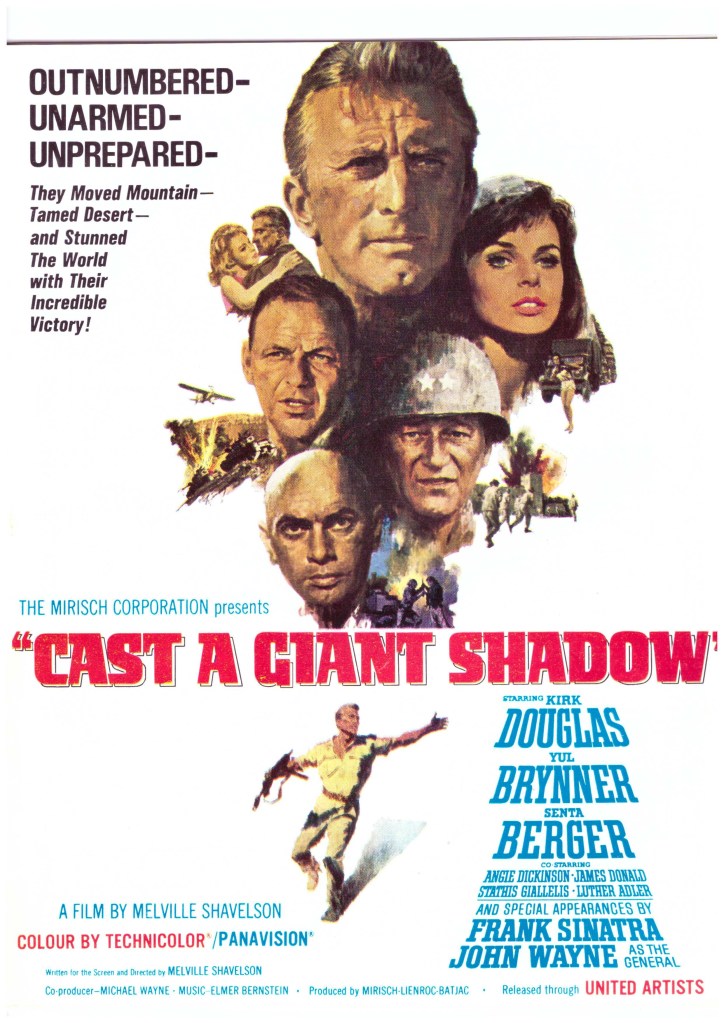
But otherwise this was a banner period for the mini-studio which made a profit of $36.1 million on an expenditure of $69.4 million. Except for the Blake Edwards, its biggest gambles turned out winners or at least scraped by into the black. Hawaii (1966) with Julie Andrews and Max von Sydow, budgeted at $13.9 million, produced $4.9 million profit and the all-star Cast a Giant Shadow (1966) steered clear of disaster, if only just, with a profit of $890,000 on its $5.51 million budget.

That Mirisch came racing home in triumph was largely down to a pair of less conspicuous projects. Getting by on the third-lowest budget of the period, the Oscar-winning In the Heat of the Night (1967) transcended its miserly budget of $2 million to carve out a $16 million notch on the box office rentals bedpost. Norman Jewison Cold War comedy The Russians Are Coming, The Russians Are Coming (1966) pulled in nearly $8 million profit on a $3.9 million budget. Romantic heist thriller The Thomas Crown Affair (1968), pairing Steve McQueen and Faye Dunaway, with double the budget of In the Heat of the Night, scored just shy of $7 million profit.

The sequel Return of the Seven (1966), with Yul Brynner leading a new team of gunslingers, shot up $3.62 million profit on a paltry budget of $1.78 million. A second Blake Edwards comedy The Party (1968), with Peter Sellers, made a profit of $1.5 million on a $3 million.

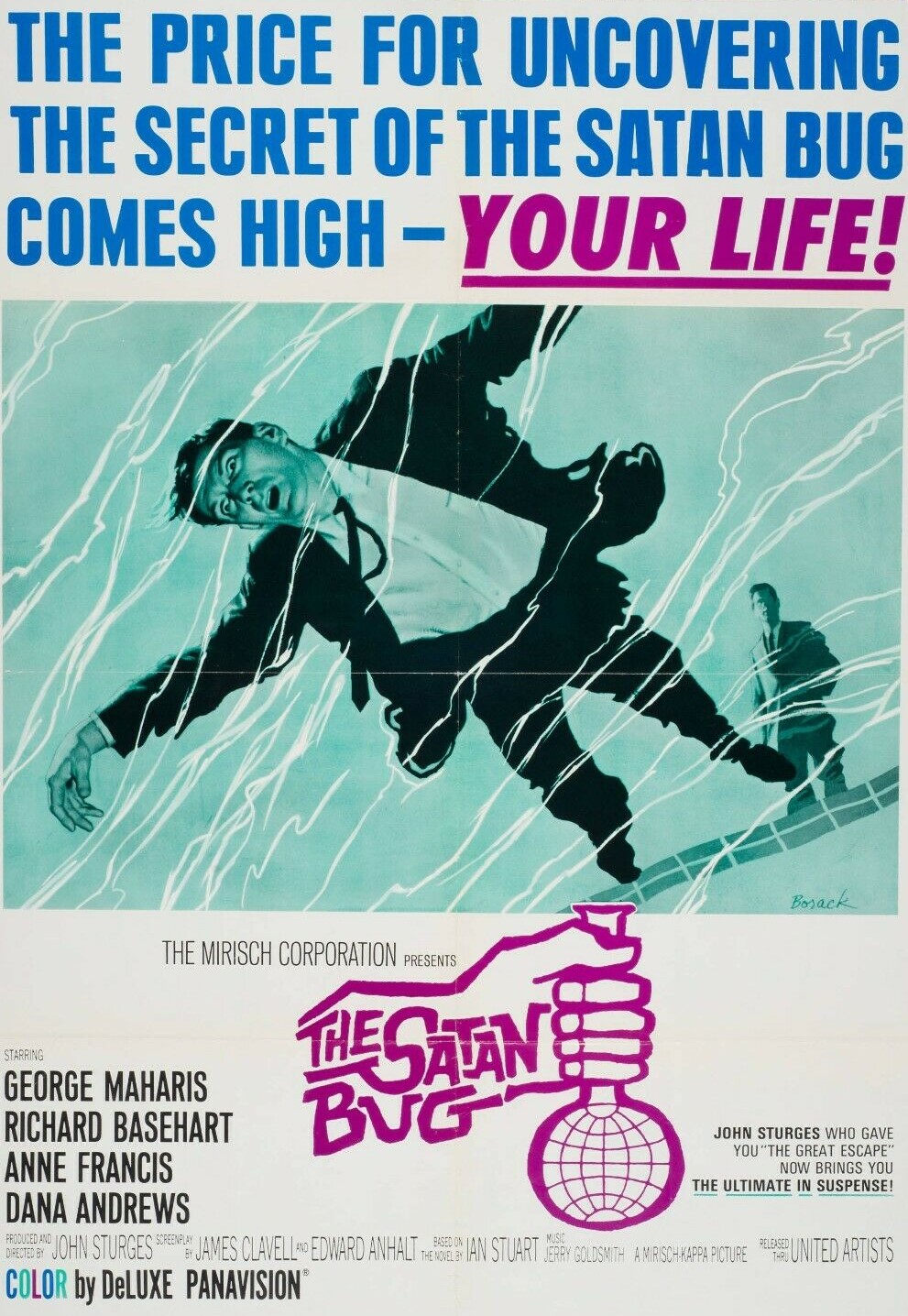
With only four out of 18 movies registering as official flops, the rest of the pack broke even or better. There would be some sighs of relief that John Sturges 70mm western The Hallelujah Trail (1965) starring Burt Lancaster and Lee Remick, limped home with $385,000 in the black after an expenditure of $7.15 million. Sturges did better with the lower-budgeted The Satan Bug, based on the Alistair MacLean bestseller. Making do with a budget of $1.78 million, it was profitable to the tune of $822,000. Billy Wilder’s The Fortune Cooke (1966) with Walter Matthau and Jack Lemmon, made $900,000 on a $3.7 million budget.

Two of the smallest-budgeted items – Return from the Ashes (1965) with Maximilian Schell and Samantha Eggar and Suzanne Pleshette melodrama A Rage to Live (1965) both brought in around $180,000 profit on budgets of $1.56 million and $1.32 million, respectively. The two other outright flops were Fitzwilly/Fitzwilly Strikes Back (1967) starring Dick van Dyke and another John Sturges western Hour of the Gun (1967) with James Garner and Jason Robards heading back to the OK Corral – $300,000 loss for the former ($2.9 million budget) and $600,000 for the latter ($3 million budget). Scraping home, literally by the skin of its box office teeth was the adaptation of Broadway musical How to Succeed in Business without Really Trying (1967) which managed a whole $5,000 profit on a $3.7 million budget.

However, Hollywood had become accustomed to downgrading foreign box office expectations, a caution borne out by the proportionately poor overseas response to the likes of Hawaii which only managed $2.8 million on foreign rentals. The Russians Are Coming, The Russians Are Coming made four times as much in rentals in the U.S. compared to abroad, In the Heat of the Night’s domestic contribution was double that of foreign.

On the other hand, foreign was the major reason Return of the Seven did so well. It pulled in $3.9 million in rentals overseas – the fourth biggest result of the period – compared to a disappointing $1.5 million at home. Similarly, Hour of the Gun would have been an even greater flop after the domestic market delivered only $900,000 in rentals, allowing redemption of a sort with $2.4 million abroad. Even The Hallelujah Trail had foreign audiences to thank for $4.5 million compared to $3 million at home. The Satan Bug did twice as much business away from home as in the U.S.

Of course, when I talk about profit that’s only in reference to rentals compared to budget. Other costs have to be added in before movie is considered a genuine success. That’s best exemplified by earlier Mirisch picture The Great Escape (1963). Budgeted at $3.75 million, it brought in global rentals of $11 million but only made $326,000 in final profit. Some Like It Hot (1959) amassed rentals of $12.9 million on a $2.8 million budget. Profit? Just $487,000.

Who’d be a movie producer?

.SOURCE: “Mirisch First 20-Picture Deal” and “Mirisch Second 20-Picture Deal,” United Artists Archive, Wisconsin Center for Film & Theater Research.

The Russia House (1990) ****

The amateur spy – the innocent caught up in espionage malarkey – had scarcely graced the screen for a couple of decades, Hot Enough for June/Agent 8¾ (1964) or Masquerade (1965) possibly the highpoints of that subgenre. That it turns up at all is probably due to spymaster John le Carre’s Cold War comfort zone evaporating following glasnost and perestroika in Russia in the late 1980s. Of course, the West didn’t entirely trust the Soviets to reform, and had no intention of pensioning off its battalions of secret agents.

The plotline is largely irrelevant here, acting more as a MacGuffin than anything else, because audiences will have long forgotten what was sacred to the West three decades ago. And the picture is devoid of the usual car chase and there’s not even the kind of foot-race that became de rigeur to prove our ageing superstars could still physically hack it – Clint Eastwood in In the Line of Fire (1993) or Liam Neeson in Taken (2008).

So what we’re left with is probably what le Carre was hoping for in the first place – a character study. It may have passed your notice that among the highest ranks of the superstars only Sean Connery could match Tom Hanks in actually changing his appearance – different hairstyle, different beard (yep, you didn’t think that could define character, did you) – to depict character. Of course, nobody was expecting Stallone or Schwarzenegger to alter their look; Harrison Ford got a buzzcut once; but Paul Newman, Burt Lancaster, Kirk Douglas, even going further back to James Stewart, Gary Cooper, their hairstyle remained untouched, and until Connery made it part of his persona Hollywood believed that moustaches were box office disaster.

Barley (Sean Connery) is an upmarket publisher whose business is on the slide, so much so that he doesn’t attend an annual book fair in Moscow. So when Russian single mother Katya (Michelle Pfeiffer) turns up looking for him, she ends up handing a manuscript to Penguin’s representative who, naturally, turns it over to MI6.

Takes a while what with interrogation and flashback to work out why Barley has been selected. Unwittingly, on a previous sojourn to Russia, he had made the acquaintance, over a drunken dinner, with Dante (Klaus Maria Brandauer) who turns out to be Katya’s long-ago first love and, more importantly, a nuclear scientist with secrets to sell or give away. Barley is hooked into returning to Russia to gain the confidence of both Katya and Dante and provide access to secrets  the British Secret Service and their Yank counterparts desire.  

That it doesn’t go the way the high-ups want is because Barley is a “decent human being” and when he realizes he has compromised Katya, and endangered the lives of her two young children, he turns traitor and trades their safety for secrets.

Given the plot and counter-plot thesis, and the various axes that need to be ground over nuclear weapons accumulation and inherent corruption, this cinematic enterprise could have proved way too unwieldy for a contemporary audience. Instead, the very fact that much of the background is now meaningless clears the way for the movie to stand on its own two feet, as yet another wonderful character study in the largely unheralded Sean Connery (The Hill, 1965) portfolio. And with Michelle Pfeiffer turning in a Golden Globe-winning performance, the  movie hinges more on the characters than the espionage.

There’s a fabulous scene where the initial narrative is just turned on its head. You’re already thinking MI6 must be hard put to be even thinking of employing Barley, given he’s a bit of a boozer, the kind of guy who knocks one whisky straight down before sipping the next. Katya, attempting to establish his bona fides and suspicious that he’s actually a spy, asks him, “Are you alone?” Meaning, has he come alone, is he acting independently?

Barley takes a different meaning from the question. “Never been more alone,” he replies, barely concealing the despair in his eyes. “I let people down,” he confesses at another point.

His life is headed in all the wrong directions. He’s fluffed too many lines and no guarantee he’s even capable of looking for redemption. And Katya’s way too wary. He’s like an enthusiastic schoolboy when he falls in love with her. When he dives in for a kiss, she tilts her head so he can only kiss her cheek in the Russian fashion.

His romancing comes unstuck when instead of responding to his ardor she recounts her experiences with Dante. It’s her scene and yet Connery steals it with his slow-burn despair. Her wariness shows in her face. The purported new freedoms her country promotes mean little more than citizens can more freely complain.

While you might not go along with his self-deprecating description of himself as a “large unmade bed” – his physical grace always going to make this unlikely – nonetheless he is a shambles of a man. Even Connery can’t make fashionable the duffel coat, his perennial outfit of choice, an item of clothing that to generations epitomized the unfashionable, a garment worn by those who couldn’t care less about their appearance.

Connoisseurs of Connery’s hair and beard will notice a certain rumpled element compared to the stylish beard he wore in Rising Sun (1993) or the confident full version of The Hunt for Red October (1990).

Outside of the Connery-Pfieffer axis, although the narrative stumbles in accommodating their manoeuvring, the movie boasts a phalanx of interesting supporting actors, some fallen from the marquee heights like Roy Scheider (Jaws, 1975) and James Fox (Thoroughly Modern Millie, 1967), others who would make their mark in television like John Mahoney (Frasier, 1993-2004), Martin Clunes (Men Behaving Badly, 1992-2014), David Threlfall (Shameless, 2004-2013) and Michael Kitchen (Foyle’s War, 2002-2015) and topped up with a wild-eyed indulgent performance from director Ken Russell (Billion Dollar Brain, 1967).

Rather devoid of screenwriter Tom Stoppard’s (Shakespeare in Love, 1998) trademark humor except in a couple of aural jokes about odd sounds emanating from hidden microphones. The first movie to be filmed in Russia after glasnost so a bit more authentic location work than usual. To his credit director Fred Schepisi (The Chant of Jimmie Blacksmith, 1978) allows Connery and Pfeiffer full rein rather than getting bogged down in the inescapable politics and office backstabbing.

Watch it for Connery and Pfeiffer.

Be warned: I feel a Connery binge coming on.

Uptight (1968) ****

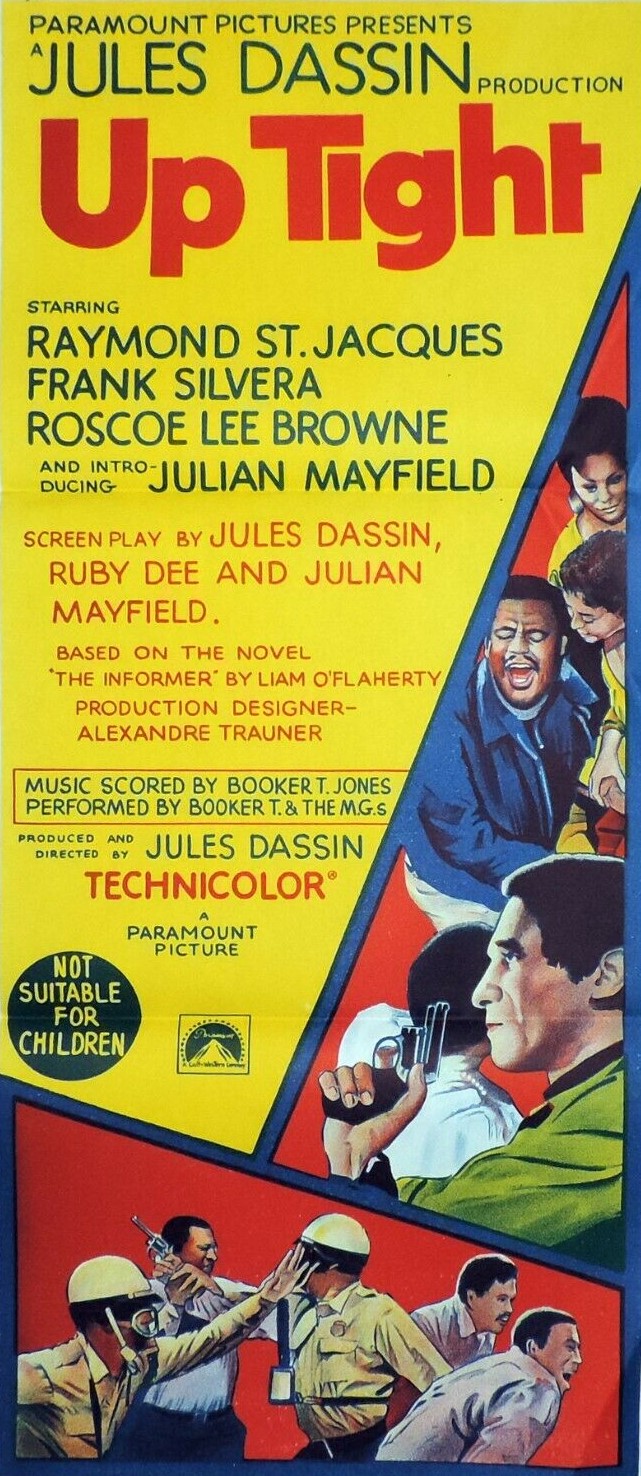
While a misplaced attempt to relocate John Ford’s Oscar-winning The Informer (1935) to Cleveland, Ohio, after the funeral of Martin Luther King, director Jules Dassin more than makes up for it with his exploration of black militancy and racial conflict. The basic story of unemployed alcoholic Tank (Julian Mayfield) trying to regain the favor of local activist committee led by B.G. (Raymond St Jacques) is less interesting than the revolutionary backdrop.

Dassin was suited to uncovering the seamy side of life having helmed film noirs Brute Force (1947) and The Naked City (1948) and while mostly concentrating on dramas he remained best-known for heist pictures Rififi (1955) and Topkapi (1964) so it was almost a given that this movie would feature a robbery.  Tank was supposed to be part of a team, led by Johnny Wells (Max Julien), hijacking guns, but he’s too drunk to help, and during the robbery after a guard is killed the finger points at Johnny. 

Assailed for his lack of maintenance by Laurie (Ruby Dee), mother of his kids, who subsists on welfare and prostitution, Tank considers informing on Johnny and picking up the $1,000 reward. So the story becomes a question of whether he will succumb to temptation.

But that’s really just a MacGuffin for an insight into the problems facing the poverty-stricken black population and the armed response many feel is the only way to resolve such issues. Several outstanding sequences depict the raw emotions of people trapped in this lifestyle. The opening scene, showing the funeral of Martin Luther King, became a clarion call for violence. Laurie is humiliated by the welfare officer. Police attempting to arrest Johnny are met with a fusillade of bottles.

The case for armed insurrection is made abundantly clear. The black population is continually oppressed, not just by police violence, but being told they lack the skills for a rewarding job. “When you’re born black, you’re born dead.” B.G. rejects the offer of assistance of white civil rights activists.

Not all the locals are underdogs. Clarence (Roscoe Lee Brown), with an apartment lined with bookshelves and wearing fine clothes, does very well out of his arrangements with the police and the black welfare officer clearly gets a kick out of his power to possibly disbar Laurie from receiving welfare.

While it might have proved more incendiary at the time, it’s impossible to miss the injustice portrayed. It was almost a wake-up call for the ruling authorities that there existed a growing underground force determined to achieve equality through violence if necessary. The idea of an organized group, rather than a shambolic mob, is the other clear message.

Any actor would balk at the prospect of matching the Oscar-winning performance of Victor McLaglen in the Ford original and surely no director would entrust the task to an inexperienced actor like Julian Mayfield whose only previous screen credit was a decade before in Virgin Island (1958). Mayfield finds it impossible to conjure up the pathos required and mostly appears as a bumbling fool.

This is despite the movie going out of its way to make Tank appear more sympathetic. He could easily claim he was blackmailed into informing by wealthy stool pigeon Clarence who holds compromising photographs. But, equally, the brotherhood, should it become aware of Clarence’s activities, would surely come down on him hard. Johnny absolves Tank of responsibility for not participating in the robbery, recognizes that while the man’s bulk was useful in the past, he lacks the mind-set for robbery. And he must stay away from Laurie otherwise she will lose her welfare.

But the rest of the cast is outstanding. Raymond St Jacques (If He Hollers, Let Him Go, 1968) stands supreme as an imposing Malcolm X figure. Roscoe Lee Brown (Topaz, 1969) is persuasive as confident gay informer. Activist Ruby Dee (The Incident, 1967) is good, too. And there is strong support from Frank Silvera (Guns of The Magnificent Seven, 1969), Max Julien, best known later for The Mack (1973), and in her movie debut Janet MacLachlan giving a hint of the acting skills that would win her an Oscar nomination for Maurie (1973)

Perhaps the most important element of the picture was the screenplay, a collaboration between Julian Mayfield, Ruby Dee and Jules Dassin, the involvement of the first two ensuring that the main targets were well and truly hit. With Dassin at the helm, the movie never loses its way, tension kept high by the hunt for Johnny, the personal dilemma of Tank and the various confrontations with B.G.

This is a movie that still stands up, not just because of its fearless delineating of the times, but from the suspicion that not enough has changed in the abject poverty to which so many are condemned.

Delivers a social sting.

Behind the Scenes: Mirisch Bros at the Box Office 1960-1964

The Mirisch Brothers, the first of what would be called the “mini-majors,” ushered in a Hollywood production revolution in the 1950s and 1960s by not just paying over-the-odds for top directors and actors – $750,000 apiece for John Wayne and William Holden for The Horse Soldiers (1959) plus $250,000 for John Ford, for example – but giving them far greater freedom in the choice of scripts, control of pictures and a bigger share of the profits. This approach went down very well with the talent, less so with rival studios who complained their approach was driving up costs at a time when Hollywood was on the brink of collapse with  major studios teetering on the edge of bankruptcy as audiences plummeted.

Walter Mirisch was the name best known to moviegoers since he worked as producer on the company’s output. Harold Mirisch was best known to the studios since he was the guy who set up the deals and found the funding. Marvin Miriasch was the backroom boy who ensured the whole process kept ticking over.

Mirisch had secured a deal with United Artists to supply a series of pictures, the first contract calling for 20 movies. Generally, the company was lauded by the trade press as innovative thinkers producing a stream of noteworthy movies such as Some Like it Hot (1959), The Magnificent Seven (1960), The Great Escape (1963) and Irma La Douce (1963) .As independent producers they had more than their fair share of Oscar successes.

But like every player in Hollywood, they employed sleight of hand, convincing the media that they were highly successful operators when the reality was exactly the opposite. The Wisconsin Center for Film and Theater Research, part of the University of Wisconsin, holds a vast archive relating to United Artists. Within that archive, I was able to source the materials that cast an alternative light on the Mirisch Brothers’ initial foray into the Hollywood big-time.

The figures revealed that the first 20 pictures – including Some Like it Hot, The Great Escape and Irma La Douce – in the Mirisch-United Artists deal racked up a cumulative $8 million loss.

In fact, one of the factors driving down the company’s potential profitability was the amount of money it gave away in profit-share. In addition, the bigger profits were often to be found in distribution and exhibition. For a start, about 50% of box office revenue found its way into the exhibitor’s pockets. From what was left over, another big chunk went to the distributor, in this case United Artists, and once profit-participants had been paid off, there was sometimes remarkably little finding its way back to the Mirisch Brothers’ coffers.

For example, Some Like it Hot, which according to these figures generated a total of $12.9 million in domestic and foreign rentals* (i.e. what’s left after exhibitors have taken their share), racked up less than half a million dollars in profit for the Mirisch Brothers. The Magnificent Seven earned three times as much overseas as in the U.S. so though viewed as a flop at home it ended up with $321,000 in the bank. The Great Escape brought in a profit of $326,000 on total rentals of $11 million while Irma La Douce topped that with $440,000. The Apartment (1960) delivered Mirisch’s biggest profit of $1.09 million.

But those were the only films – out of the 20 launched in Mirisch’s first few years of operation – to turn a profit. The other 15 all hit the buffers. That was not a good ratio at all. That three-quarters of the Mirisch picks turned into losers was hardly cause for celebration.

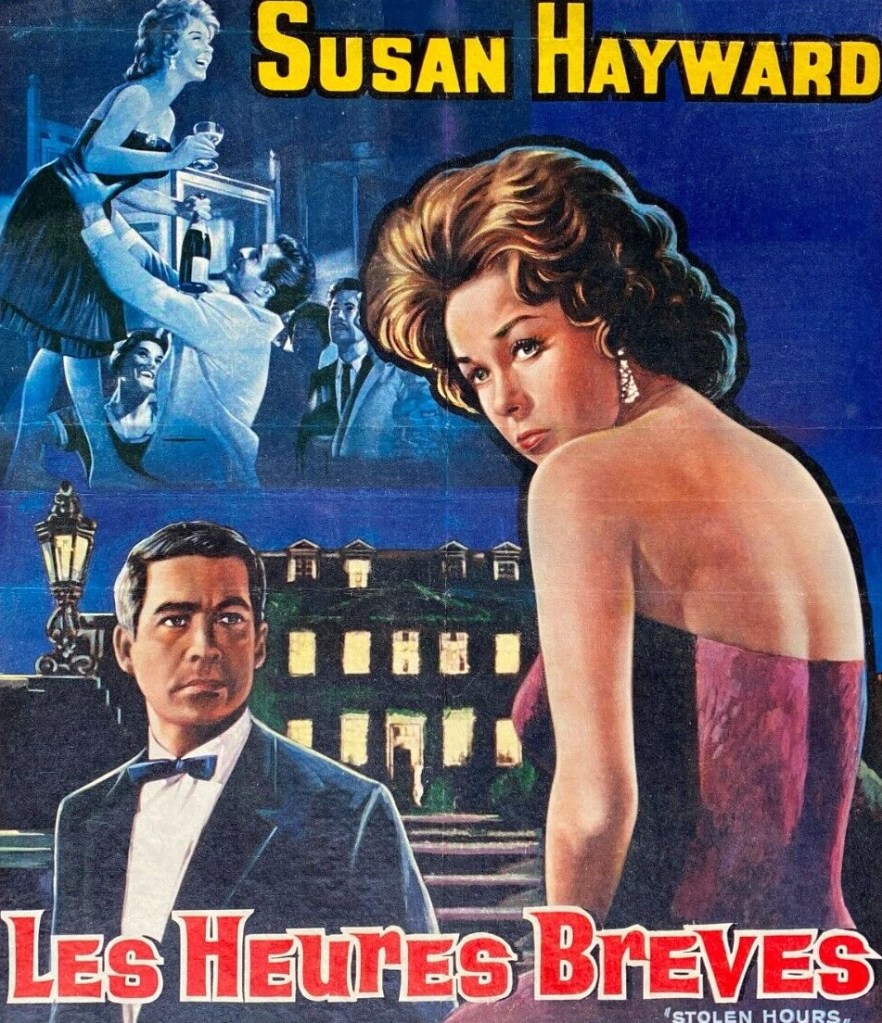
Some of the losses were stratospheric for the time. The Children’s Hour (1961), with Audrey Hepburn picking up a colossal upfront fee, was in the red to the tune of $2.7 million. The loss on The Horse Soldiers amounted to $1.8 million with Billy Wilder’s ill-fated One, Two, Three suffering a $1.5 million loss with Toys in the Attic turning into a $1.2 million liability.  Stolen Hours with Susan Hayward added nearly $1 million to the company’s overall debt. Even Elvis Presley, at that point a guaranteed box office draw, offered no respite – the loss on Kid Galahad above $430,000 and that of Follow That Dream $195,000.

So you might be wondering with such a poor ratio of hits to flops why the Mirisch Brothers managed to stay in the game. Well, before the final figures were in on the contract to deliver the first 20 pictures, United Artists were already committed to a further 20 movies, some of which were already in production. But there were two other elements acting in Mirisch’s favor. The first was that exhibitors were desperate for new movies, the industry only beginning by 1963 to turn a financial corner, and it was expected that Mirisch would have learned from its mistakes and stop underwriting expensive pictures (which turned out to be untrue).

But second, and more importantly, the Mirisch losses did not impact so badly on United Artists. That studio made the bulk of its revenue from distribution. Even if a picture was a flop, UA’s 30% distribution fee was based on the gross, so a movie that maybe ended up as an overall financial flop could still generate enough revenue to keep UA happy.

Also, UA, now seeing record profits from the likes of its investment in Tom Jones (1963) and on the brink of a James Bond bonanza could afford to carry its production partner. So Mirisch kept on pretending it was a huge success and the trade press kept on believing it.

*These figures do not including television sale or future reissues. But initial television sales in the early 1960s averaged about half a million dollars for successful movies. What television would pay was based on the original domestic gross (i.e. perceived popularity). Only a couple of pictures, most notably The Magnificent Seven, significantly added to their initial release income through reissue. So it is extremely unlikely that the Mirisch Brothers would have gone into profit on those first 20 pictures through reissues and television sales in the 1960s, and doubtful if they would have even halved the losses. 

SOURCE:  “Mirisch Pictures First 20 Picture Deal,” Appendix II, United Artists Archive, Wisconsin Center for Film and Theater Research.

Crooks Anonymous (1962) ***

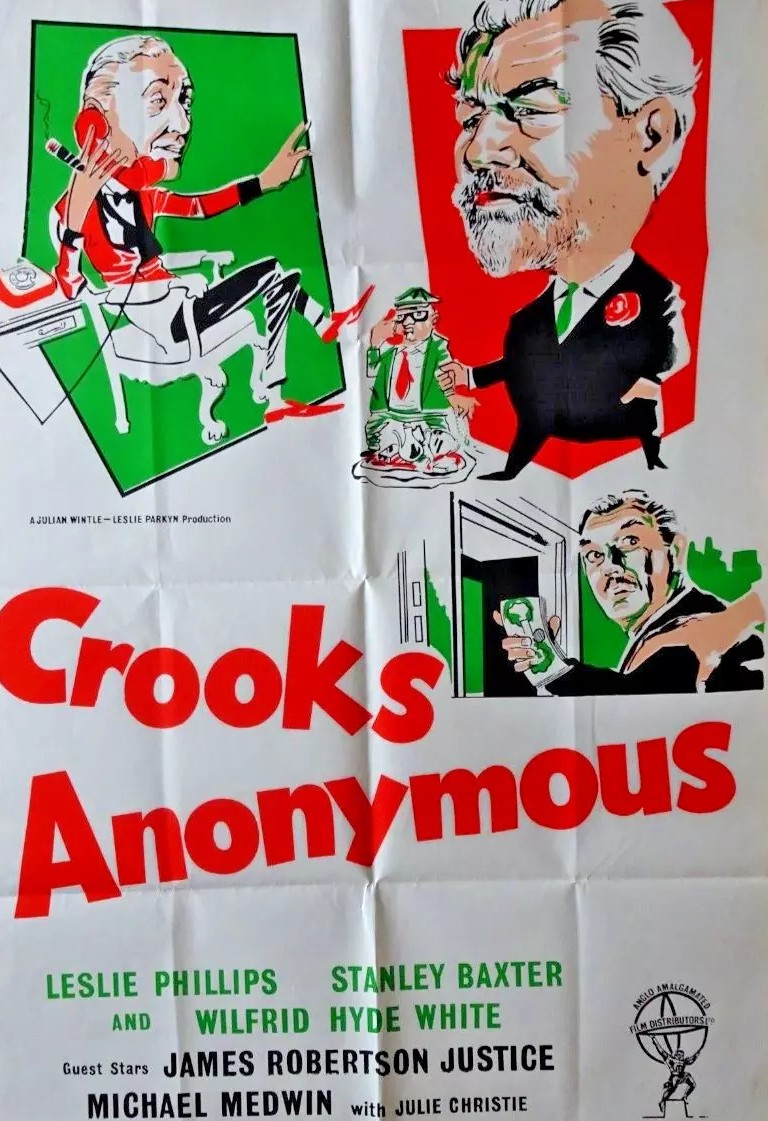
Charm was in short supply in the 1960s. sure, for a period you still had Cary Grant but David Niven was as often to be found in an action picture (The Guns of Navarone, 1961) or a drama, and others of the ilk, like Tony Curtis, veered more towards outright comedy. Britain had something of what would today be called a “national treasure,” admittedly a term more likely to be accorded females of the standing of Maggie Smith or Judi Dench; maybe a space might be found for the idiosyncratic Ralph Richardson. Dare I put Leslie Phillips into contention for such an honor?

Once into his mellifluous stride and with his trademark appreciation of female beauty, “Ding dong!” a more welcome remark than the more common “Cor!” or “Strewth” or sheer inuendo, Leslie Phillips, not so well known perhaps in the USA and foreign parts, would fit that definition. He had charm in spades.

Unfortunately, you could split his career into those roles where “ding dong” entered the equation and those it did not. This is one of those, and I have to confess I’m both disappointed and delighted. Dissatisfied because the charm appeared part of his screen persona, but pleased whenever I found out he wasn’t tied down to it and could essay other characters just as well.

Here, here’s shifty criminal Dandy, whose only redeeming feature is that somehow he has acquired a beautiful girlfriend, stripper Babette (Julie Christie), who, despite her profession

appears to have steered cleared of seediness and insists he goes straight before she consents to marriage. And that would be fine, except what can Dandy do when faced with such obvious temptation and jewels left idly on a counter in a jewellery?

When she catches him out, he is sent to the criminal version of Alcoholics Anonymous where he is at the mercy of a particularly sadistic “guardian angel” Widdowes (Stanley Baxter – in a variety of disguises). He is locked in a cell full of safes. Food, cigarettes etc are hidden inside the safes, so to eat and satisfy his smoking habit, he must open them. The logic, presumably, is that he will grow sick and tired of opening so many safes for so little reward.

Maybe it’s the hidden punishments – a touch of electrocution and various other booby traps – that do the trick. Or, it could be the glee of Widdowes. When Dandy finds cigarettes, they come without any means of lighting them. He pleads with Widdowes to point him in the direction of a safe containing means of ignition.Replies the “angel”, “I’m glad you asked that because I’m not going to tell you.”

There’s a whole raft of comedy skits revolving around temptation, mostly involving Widdowes in one guise or another. And when the movie stays with Widdowes and a bunch of other reformed criminals, it fairly zips along. But once Dandy is released and plot rears its ugly head it falls back on more cliché elements.

Dandy manages to go straight, employed as a Santa Clause in a department store, while Babette decides to give up her job so both can start afresh. Unfortunately, temptation raises its ugly head to the tune of a quarter of a million pounds and all those goody-two-shoes reformed criminals line up to take a crack at it. The twist, which you’ll already have guessed, is that they have to break into the vault again to return the money they have stolen.

Scottish comedian Stanley Baxter was going through a phase of attempting to become a movie star and was given a fair old crack at it – The Fast Lady (1962) and Father Came Too (1964) followed, the former with both Philips and Christie, the latter with just him.

But what was obvious from Crooks Anonymous was that Baxter was better in disguise – and the more the merrier – than served up straight. He steals the show here where in the other movies his character is more of an irritant.

A well-meaning Leslie Phillips somehow snuffs out the charm and there’s not enough going on between him and Babette when he’s full-on straightlaced. Heretical though it might be, there’s not enough going on with Julie Christie either to suggest she might be Oscar bait. Here’s she’s just another ingenue.

Wilfrid Hyde-White (P.J. / New Face in Hell, 1967), another who generally traded on his charm (in a supporting category of course), is also in the disguise business, so he steals a few scenes, too. James Robertson Justice (Father Came Too) would have stolen the picture from under the noses of Baxter and Phillips had he been given more scenes.

Directed by Ken Annakin (Battle of the Bulge, 1965) from a screenplay by Jack Davies and Henry Blyth (Father Came Too).

I might have preferred Phillips in “ding dong” persona, but this works out okay, especially in the scenes set in the criminal reform school.

Ding dong-ish.

Behind the Scenes: “Sinful Davey” (1969)

The first sign of a movie in trouble is the elongated gap between production and release. This picture took two years. Filmed in summer 1967, but not released till May 1969, this proved a disaster for all concerned, a colossal flop.

It should have been anything but. Director John Huston was Hollywood royalty, for over two decades a top-ranked director, hits like The Maltese Falcon (1941), The Treasure of the Sierra Madre (1948), The Asphalt Jungle (1950), The African Queen (1952), Heaven Knows, Mr. Allison (1957), The Night of the Iguana (1964) and The Bible in the Beginning (1966) were interwoven with cult numbers like Beat the Devil (1953) and The Misfits (1960). Huston was a double Oscar-winner with 10 nominations besides (including one for acting, in The Cardinal, 1963)

Producer Walter Mirisch was no slouch himself, credits including The Magnificent Seven (1960), The Great Escape (1963), Hawaii (1966) and In the Heat of the Night (1967) which would win him the Oscar. The independent production outfit celebrated its tenth anniversary with its biggest-ever slate, five pictures going in front of the cameras. As well as the Huston venture, Mirisch lined up The Thomas Crown Affair (1968), Inspector Clouseau (1968), Peter Sellers in The Party (1968) and low-budget war picture Attack on the Iron Coast. So the prospect of a movie about a Scottish rebel flouting British authority, penned by James R. Webb, Oscar-winner for How the West Was Won (1962), seemed dandy.

That it was to be filmed on location fitted in with the director’s lifestyle. An Irish citizen, he had been resident there for several years after falling in love with the country following a visit in 1951. However, Huston was a ready-made exile, one of a flood of actors and directors taking advantage, much to the fury of the Hollywood guilds, of a U.S. Government tax loophole originally intended to spur employment in the Middle East oil industry. He’d been only too delighted to skip out of America to make The African Queen, Beat the Devil, Moulin Rouge (1952), Moby Dick (1956) and others. In fact, he was able to exploit another loophole, as in Ireland he paid no taxes at all.

Ireland was his bolthole and he was disinclined to leave. In an earlier Blog I’d recounted how Arthur Miller, writing the screenplay for The Misfits, had to fly to Ireland to work with Huston.

“When I make a picture,” averred Huston, “it’s because I believe the story is worth telling…with a tendency to choose stories whose point is the irony of man’s pursuit of an impossibly elusive goal.” The narrative here was of a thief who expected to follow in his father’s footsteps to the extent of ending up on the gallows. Huston perceived it as “a light-hearted romp…an altogether delightful affair.”

That it was not welcomed by the critics he put down to interference by producer Walter Mirisch who “ruined” it after the director had delivered his final cut. He accused the producer of “giving full sway to his creative impulses,” by tacking on a voice-over and turning the straightforward narrative into a story told in flashback by the simple expedient of switching a scene from the end to the beginning.

Mirisch, of course, had a different take. Huston’s cut was a massive disappointment for Mirisch. He had previous both with Huston and Webb, even when their work together had not proved successful at the box office. With Huston, as a producer for Allied Artists and Moulin, Mirisch had paired on Moulin Rouge and Moby Dick, even though escalating costs on the latter nearly bankrupted Moulin. Despite that experience, since then the producer had been chasing the director for over a decade. With Webb it was Kings of the Sun (1962), also a financial failure.

Webb proposed a “Scottish period romance about a lovable rascal” called The Sinful Adventures of Davey Haggart. Huston demanded the film, despite its Scottish setting, be shot in Ireland (a good chunk of Braveheart was filmed in Ireland). The movie benefitted from Eady money, a tax loophole courtesy of the British Government, and Mirisch pronounced himself “delighted to get a world-class director.”

Huston was in messianic form. He saw the movie as a promotional tool to help set up the Irish film industry. Although such films as The Blue Max (1966) had been filmed at Ardmore Studios, and Huston shot parts of The Bible and Casino Royale (1967) in the country there was no generic industry as such. With the help of the Irish Government, Huston argued “a market could be built for Irish films.” With 81 speaking roles for Irish actors, Huston felt the picture would put Ireland on the map

Mirisch flew to London to work with the director on preparation and casting. They had a major fall-out over casting Huston’s daughter Angelica (A Walk with Love and Death, 1969) as the female lead. Mirisch argued, “Her appearance was rather more Italian than Scottish and in stature she towered over John Hurt.” Huston agreed to do a test with Angelica and Hurt, which proved Mirisch’s point. “I’ve always regretted having put John into the position of having to tell his daughter she wasn’t going to get the role,” said Mirisch. John Hurt, aged 26, was hired on the basis of his stint in A Man for All Seasons (1966).

A Scottish village was built in Ireland. Mirisch appeared satisfied with progress although a John Barry score was rejected as too serious and replaced with “a lighter score” by Ken Thorne. However, previews were disastrous. Huston both refused to attend previews and to re-cut the film, despite United Artists, the distributor and prime funder of the Mirisch Bros operation, “insisting we must try and help the picture play better.”  As far as Huston was concerned, “the picture was to his liking and he wasn’t going to be influenced by the preview audiences.” In fact, his opposition to a recut owed much to his experience on The Barbarian and the Geisha (1958), re-edited against his wishes.

So Mirisch took it upon himself to try and save the picture, supervising re-editing, and while previews “improved considerably” the Scottish accents “bothered the audience” and the finished item – either version – “wasn’t as entertaining as it needed to be” while he counted the casting of John Hurt a failure.

Marketeers worked overtime to come up with an outlandish premise for the British premiere – title now contracted to just Sinful Davey – asking guests to arrive in “sinful costumes.” Contestants vied for a £100 prize, the winner dressed in a black bikini “swathed in chain.” For some reason, the marketing department had managed a tie-up with Raleigh bicycles.

Having spent over $3 million on the movie, even Mirisch must have been staggered by the box office. The box office never recovered from an “unbelievably pathetic” $13,000 gross in its opening week at 16 New York cinemas.  It only collected a total of $300,000 in U.S. rentals (what studios retain once cinemas have taken their cut) and another $200,000 abroad. So a loss of over $2.5 million.

SOURCES: John Huston, An Open Book (Columbus Books, 1988), p336-337; Walter Mirisch, I Thought We Were Making Movies, Not History (University of Wisconsin Press, 2008) p90, 278-281; “Mirisch Marks 10th Anniversary with Record Line-Up,” Kine Weekly, March 18, 1967, p27; “Davey Invites That Sinful Urge,” Kine Weekly, May 17, 1969, p22; “Huston Blueprint for Irish Film Industry,” Kine Weekly, July 15, 1967, p14; “Picture Grosses,” Variety, June 11, 1969, p10; “Mirisch Second 20-Picture Deal,” United Artists Archive, Wisconsin Center for Film & Theater Research.

Missing You (2025) ***

A well-off good-looking couple trying to adopt a puppy are challenged by po-faced bureaucrat over the name they have chosen for said animal. Their purported good deed ends in disaster when he shows them a photo of the woman caught in a clinch with another man. We never see the couple again. But the prissy fella, Titus (Steve Pemberton) turns up. He’s some kind of farmer. But he runs a strange kind of operation. In his barn we catch a glimpse of a lot of guys in orange prison-style outfits kept in stalls and handcuffed to the ceiling.

And that would be wow and double wow except the algorithms have gone crazy and none of this gripping stuff occurs until episode two by which time you are bored to death by the insane amount of time devoted to Detective Kat Donovan’s (Rosalind Eleazar) woeful love life and her decade-old grieving for murdered cop father Clint (Lenny Henry).

We know more about Clint than anyone else for about every give minutes she gets all doe-eyed and we cut to flashbacks of the wonderful old dad all huggy and fun. And if that’s not enough every two minutes a colleague or relative or friend interrupts her doe-eyed contemplation to tell her to give up trying to find out why her father was murdered.

As to her love life, I can give you chapter and verse. After Josh (Ashley Walters) skipped out on her eons ago, she’s given up on commitment. She uses men for sex, pretending to be an air hostess in case the idea of dating a cop puts them off. She’s pulled up for the lack of commitment by buddy Jessica (Stacey Embalo) and various others, the same ones giving her grief about her extended grieving. But when Josh comes back into her life, albeit on a dating app, she goes all doe-eyed again – wouldn’t it be such fun to hook up again with that two-timing rat?

Luckily, Jessica is a private detective specializing in the honeytrap to expose errant husbands and even more fortunately one of her grateful clients is a prison guard who can sneak Kat into the prison where her father’s killer, doing life for two other murders, is dying. Although the killer was caught, Kat has driven herself crazy wanting to know why her father was fingered. And, luckily, there’s a prison nurse to hand who will dope up the killer with scopolamine – the old truth drug you might remember from The Guns of Navarone – so he will cough up about the murder, although we have already guessed, as our intrepid cop has not, that he didn’t kill her father just took the rap because he was already facing life for the other two killings.

In the old days, the chief cop either had no love life worth mentioning or had a different blonde/blond on his/her arm in every episode or was going through some hellish break-up, and audiences didn’t have to suffer having to empathize with the poor detective’s awry sex life. But in the old days all love life would have been shoved onto the back burner only popping up at a critical moment as some sort of narrative relief to the question in hand which was solving some horrendous case. Here, it’s the other way round, said case only pops up as a brief intermission to Kat’s awry love life and grief.

This is a Harlan Coban Netflix number but it seems very Coban-lite, a far cry from Tell No One (2006). I was a big fan of the books which seemed set in very realistic worlds with authentic plots and double-edged characters you could root for despite their failings. And mystery was the watchword. But proper mystery, a character caught up in some malfeasance, or the past coming back to haunt them, and rarely were his novels police procedurals.

The quality tailed off after a while but even then Coban knew how to hook the reader and generally the plots, though increasingly far-fetched, had sufficient spice to grip.

You are probably wondering when am I going to get to the juicy part – the case Kat is working on. Well, you see, I was wondering the same. When the heck are we going to get past all the personal angst and devote some time to the case of the missing bloke? He’s the guy who fell off a horse while riding in the lush countryside and after stumbling over said lush countryside is rescued by a fella in a tractor who stabs him with a taser.

As I said, it’s not until episode two that bad guy Titus turns up with his home-made prison and extortion racket but even then it’s hard to drag Kat away from her love life and her grieving.

Golly gosh, I just can’t wait to find out what happened with Josh and whether she will give him another chance. But is that what is meant to keep me going for the next three episodes?

Algorithms go home.

Discover WordPress

A daily selection of the best content published on WordPress, collected for you by humans who love to read.

The Atavist Magazine

by Brian Hannan

WordPress.com News

The latest news on WordPress.com and the WordPress community.