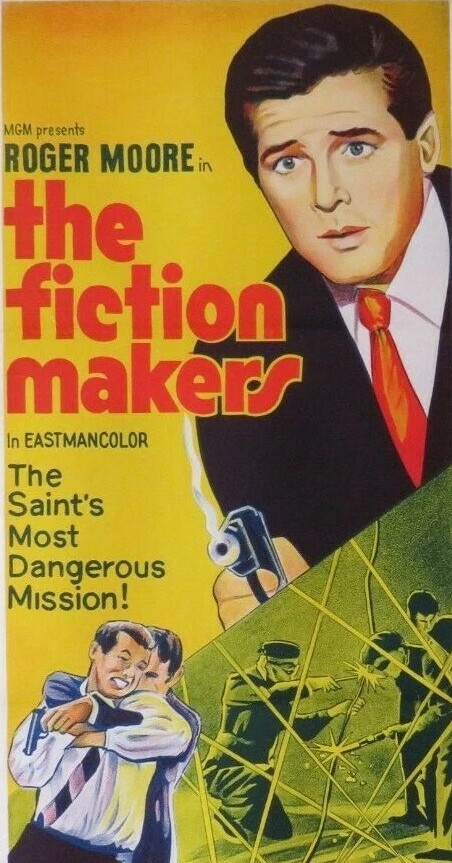
Hugely enjoyable. Takes high concept to the Moon and back. Deliriously wild idea that, as with the best of movies that riff on the imagination, sticks to its own internal logic. The notion sounds so barmy it shouldn’t work – but it does. I enjoyed it even more than Vendetta for the Saint (1969), which it preceded, because it’s a lot more fun.
A criminal mastermind has taken the work of mysterious bestselling thriller author Amos Klein and not only adopted the characteristics of the author’s characters but follows the plot of the books and utilizes many of the clever ideas. For example, the author has invented a second ignition starter button for cars. And also invented a way to stop cars by fitting them with a technological device. People are so taken with being characters in these books that they want to know what happens to them next. I know, shouldn’t have worked, but it does, and it’s not even really set up as fitting into the sci-fi genre any more than James Bond with all its out-of-this-world machines and gadgets is.
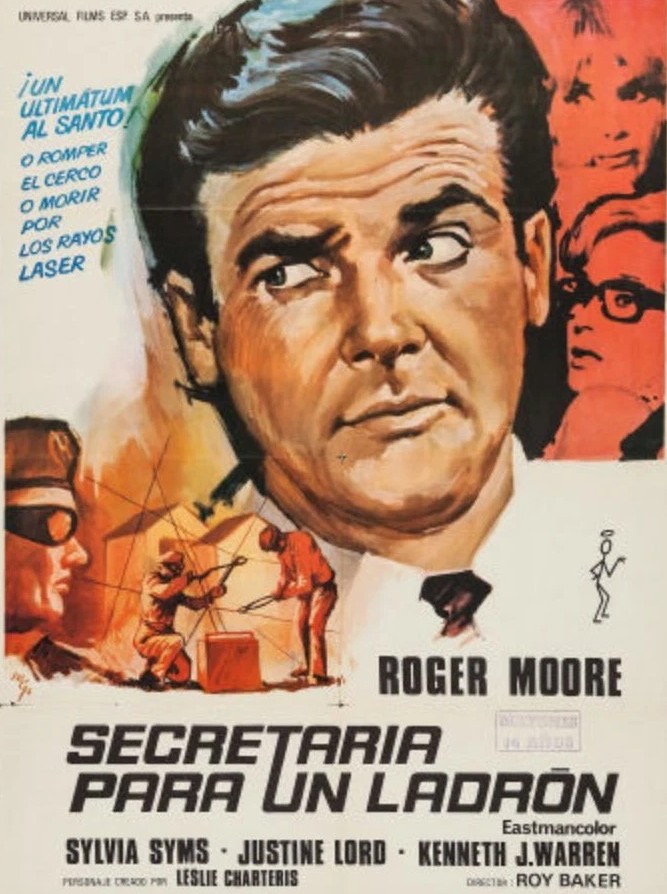
Simon Templar (Roger Moore), aka The Saint, is hired to protect Amos Klein whose publisher believes the author is in danger. It doesn’t help that Klein lives in such anonymity that nobody knows the real name, not even the publisher. Turns out she’s a woman (Sylvia Syms), presumably adopting a male name because she writes such male-oriented books, filled with ingenious ideas.
She nearly shoots Templar because he arrives in the middle of her testing out scenarios for her new book – everything she writes has to work and she’s the one that tries them out. Anyway, Templar proves to be little defense against Warlock (Kenneth J. Warren), who has adopted the main villain of her book who runs a criminal organization called S.W.O.R.D. Warlock assumes Templar is Amos Klein and that she is his secretary.
The members of Sword, excepting Warlock, are an indifferent bunch apart from femme fatale Galaxy Rose (Justine Lord) who not only, following the premise of the books, intends to seduce Templar but believes that he, as the author, can alter her future, by making it a plot point in an as-yet-unwritten book that they fall in love that she will then marry him and live happily ever after.
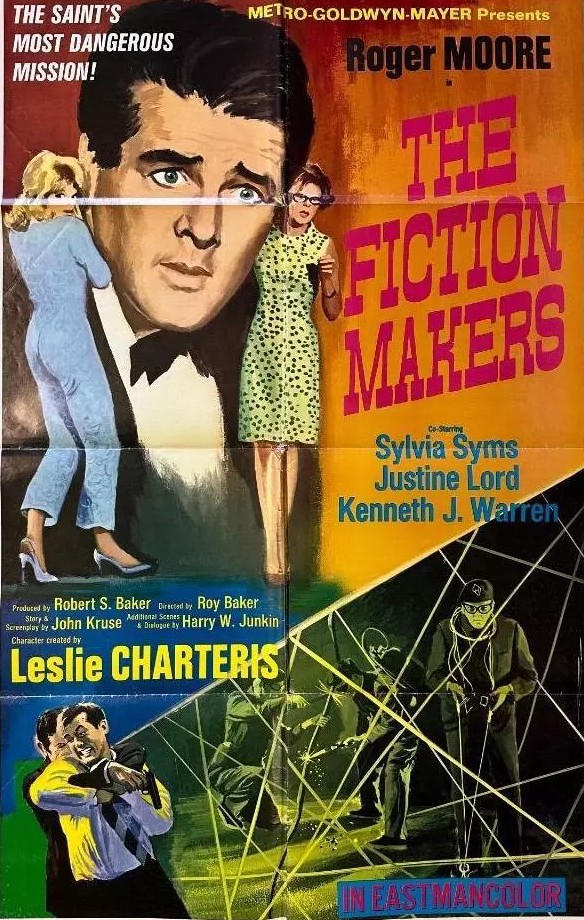
Using Klein’s imaginative brain, Warlock wants the author’s help to plot a major heist from Hermetico, a giant secret vault which is to diamonds what Fort Knox is for gold. Hermetico is thief-proof, packed with amazing security devices including infra-red beams.
Although watched via CCTV cameras, Templar and Klein make a decent attempt at escape from Warlock’s mansion, tunneling upwards if you like, through the ceiling and the roof, clambering down a drainpipe and escaping in the car containing the second starter button, but also the one, it transpires, with the tech device that can stop it.
When they turn up at a remote cottage covered in mud and seeking help, the inhabitants think they are lunatics and delay them long enough till Warlock and his gang arrive to sedate them. Klein is kept prisoner, threatened with laser extinction, so Templar is coerced in assisting in the heist. In fact, Klein has come up with an ingenious method of ensuring they can find their way through the maze of infra-red beams.
This sequence is really well done, especially the method of getting all the gang through once Templar has negotiated it. Using an oxy-acetylene torch, they cut the top off an extractor vent and enter the vault, overcome the guards, and using another clever device one person manages to do something that usually requires two people.
Naturally, Templar is intent on spoiling the operation, which he does, but then has to get back to the mansion before the alarm is raised and Klein is incinerated. There’s a fisticuffs climax and a very fitting payoff for the villain.
I never thought this would work. It seemed such an improbable idea. But then Hollywood’s full of those. The fact that the S.W.O.R.D. gang are entirely believable as physical incarnations of Klein’s imagination is what makes it work. Plus Klein herself. Instead of being the standard moll or helpless heroine of so many spy pictures, she’s central to the story, and halfway between slinky and sensible.
Roger Moore (Vendetta for the Saint) – and his raised eyebrows – is, as usual, excellent in a role that very much suits his screen persona, and Sylvia Syms (Run Wild, Run Free, 1969) has a ball. Kenneth J. Warren (A High Wind in Jamaica, 1965) is given a more varied character than the normal villain while Justine Lord (Night after Night after Night, 1969) exerts a winsome appeal outside her overt sexiness.
Directed by Roy Ward Baker (Moon Zero Two, 1969) from a script by John Kruse (Vendetta for the Saint) and Harry W. Junkin (Vendetta for the Saint) adapting a novel by Leslie Charteris.
This was originally conceived as a two-parter for television that was then released as a movie instead of someone just editing together two random episodes as was usually the case with The Man from U.N.C.L.E.
Talking Pictures has this so check it out.

 The Magnificent 60s
One thought on “The Saint: The Fiction-Makers (1968) ****”