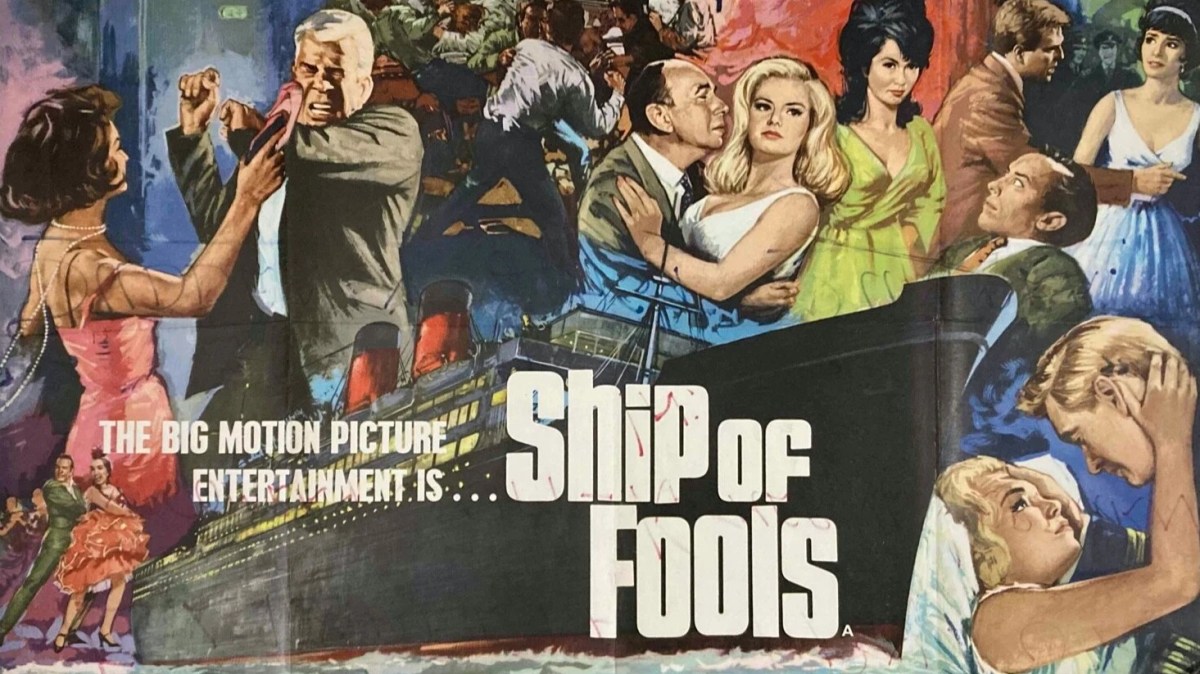
Too easily dismissed as soap opera masquerading as a movie making a serious point, this is redeemed and, in some respects, elevated by the performances. If anything, the two political aspects are underdone. The heavy air that hangs over proceedings given the German passengers are heading back to Nazi Germany at the start of Hitler’s reign in 1933 with no idea of the outcome is only there in the audience’s mind. That the racism is underplayed is in part due to the fact that those victimized, a Jew and a disabled man, refuse to act as victims and indeed bond.
The other political aspect, of Spaniards being deported from Cuba for economic reasons, would have more resonance today. But they, too, are heading for consequence and the Spanish Civil War which would break out a few years later. Director Stanley Kramer was noted, indeed often ridiculed, for tackling weighty subjects in movies like The Defiant Ones (1958), On the Beach (1959), Judgement at Nuremberg (1961) and Inherit the Wind (1961). That was tempered somewhat when he went off-piste for It’s a Mad, Mad, Mad, Mad World (1963) and although that’s generally remembered for its hilarity what’s often overlooked is the director’s dexterity in handling a busload of characters and narratives, his pacing and his understanding of character.
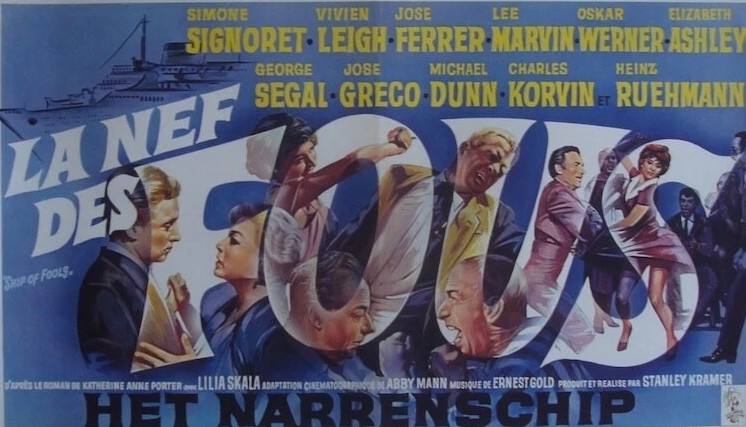
Deduct the comedy and you have a similar approach here, the meshing of various narrative arcs while allowing character to flourish so the general smorgasbord of, if I’m allowed such an obvious notion, ships passing in the night is what gives this more heft. And the fact that the audiences knows more than the characters about what the future holds permits the director just to concentrate of character interaction.
Unusually, for a historical movie of the period, it’s the females who dominate and have the best storylines. The ship is so full that upscale single passengers who might otherwise have the choice of dining alone are thrown together thus divorcee Mary Treadwell (Vivien Leigh) shares a table with former baseball player Bill Tenny (Lee Marvin).
Their paths unexpectedly cross in unusual fashion. Both are seeking love, though in reality Tenny is happy to settle – and pay for – sex. Mary finds Captain Thiele (Charles Korvin) ignoring her subtle advances while in turn she dismisses the lieutenant. When a drunken Tenny without warning bursts into her cabin, she responds with ardor until she realizes he thinks she’s a prostitute.
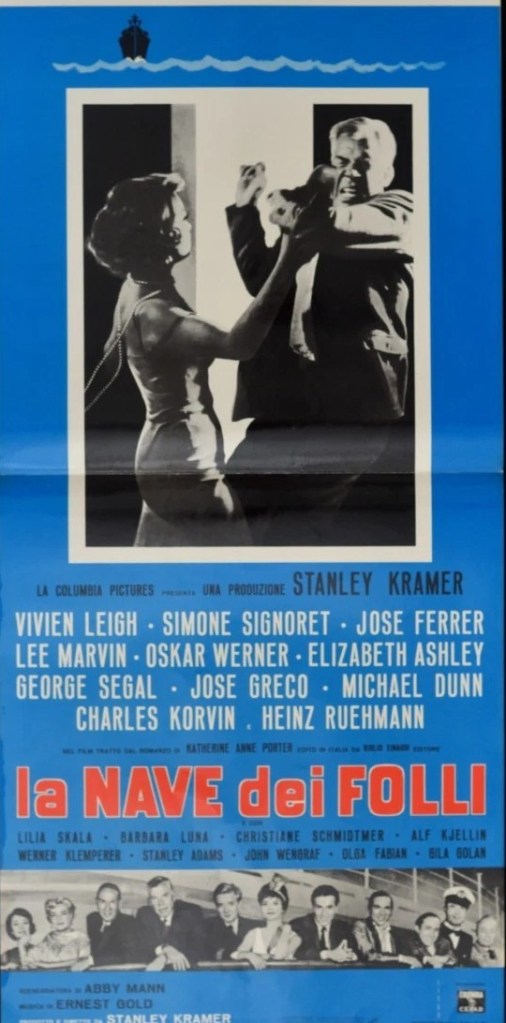
La Condesa (Simone Signoret) is a civil rights activist who finds a fellow traveler in Dr Schumann (Oskar Werner). Although, initially, she mines him to feed her opiate addiction, it’s soon apparent they are falling in love, although that doesn’t end well. Not much ends well in the romance department, Jenny (Elizabeth Ashley), while initially supportive of artist David (George Segal), soon realizes that his art will take dominance in their relationship.
The older Rieber (Jose Ferrer), with the most pronounced Nazi sympathies, has taken up with younger blonde Lizzi (Christiane Schmidtmer), among whose physical attractions is that she’s a great table tennis player, until she discovers he’s married.
Flamenco dancer Elsa (Gila Golan) is pimped out by her father Pepe (Jose Greco). Social exclusion leads Jew Lowenthal to bond with Glocken who suffers from dwarfism and when German World War One hero Freytag is forced to join them that permits most of the discussion about the state of Germany.
Otherwise, the fact that a mastiff is permitted to sit at table is more to do with aristocratic entitlement than any other social condition.
For once, Kramer is more interested in character than scoring points. So what might have been heavy going turns into an acting class. To accommodate its portfolio of ageing superstars Hollywood had returned to the subgenre of movies about ageing beauties. Double Oscar-winner Vivien Leigh’s previous outing The Roman Spring of Mr Stone (1961) belonged in that category but this latest reincarnation was a class above, a truly tender examination of loss. However, it was Simone Signoret (The Deadly Affair, 1967) who was Oscar nominated.
Michael Dunn (Justine, 1969) and Oskar Werner (Interlude, 1968) were nominated and while Lee Marvin (Point Blank, 1967) and George Segal (The Bridge at Remagen, 1968) were overlooked the latter two clearly scored points judging by their future acceptance in the Hollywood hierarchy, Marvin in particular alerting the industry to untapped talent, a point made more emphatically in his next picture Cat Ballou for which he won Best Actor. Ship of Fools missed out to The Sound of Music for Best Film. Nominated for eight awards it picked up two, ernest Laszlo for Cinematogrpahy and Robert clatworthy and Joseph Kish foir Art Direction
You might also spot Alf Kjellin (Ice Station Zebra, 1968), Barbara Luna (Firecreek, 1968) and Gila Golan (The Valley of Gwangi, 1969).
Even without the political overhang, this holds together as Grand Hotel on the high seas with Stanley Kramer in his element employing compelling characters to flesh out an interesting narrative. Written by Abby Mann (Judgement at Nuremberg) from the Katherine Anne Porter bestseller.
While the politics add a contemporary veneer, watch it for the acting.

 The Magnificent 60s
Here you go:
“According to the 25 Apr 1962 NYT, independent producer-director Stanley Kramer purchased screen rights to Katherine Anne Porter’s recently released 1962 novel, Ship of Fools, for a $500,000 minimum, “with provisions for increased payments depending on the book’s sales.” Kramer planned to shoot the picture as a lavish production, with several million allotted for the budget, and a big-named cast. A news item in the 25 Apr 1962 DV indicated that Kramer paid a flat fee of $375,000 for film rights, and announced that Porter’s novel was already a bestseller after only two weeks in release. Filming was scheduled to begin in 1963.
An article in the 2 Aug 1964 LAT explained Porter’s decision to accept Kramer’s bid for her novel, which took her thirty years to write. She wrote a letter to him, expressing her admiration for his 1961 picture, Judgment at Nuremberg (see entry), and stating: “‘It is hard to express how tremendously I was impressed by its terrible boldness and beauty, though I was full of horror and tears at parts of it. Remember, I was in Berlin when Hitler was coming to power…’”
The 22 May 1962 DV reported that Kramer contributed $25,000 to the novel’s advertising campaign, in order to maintain the book’s popularity and ensure the success of his forthcoming film.
Peter Falk was the first casting choice announced by Kramer, as noted in the 29 May 1962 DV. Theodore Bikel was also in negotiations for a lead role, according to the 3 Aug 1962 DV. Ultimately, neither Falk nor Bikel appeared in the film.
On 13 Jun 1962, NYT reported that Kramer was returning to Columbia Pictures for distribution of his independently produced Ship of Fools, after a long-time collaboration with United Artists. Columbia reportedly dropped their overhead costs to 22.5 % the previous week, the lowest of any major studio, in order to attract independent productions. The article noted that Kramer was granted a $4 million budget and “complete artistic freedom” by Columbia. Six months later, the 22 Jan 1962 DV indicated a 15 Apr 1963 start date.
Following his big budget production of It’s a Mad, Mad, Mad, Mad World (1963, see entry), Kramer changed his mind about doing the same with Ship of Fools, and decided to produce the picture with a cast of newcomers, on a small budget. In the end, however, he hired mostly well-known stars for the leading roles.
Production was delayed several times, with the 11 Dec 1963 DV announcing an Apr 1964 start date, and the 2 Jan 1964 DV noting that principal photography would begin in May 1964. Filming finally got underway on 22 Jun 1964, according to that day’s DV.
In the months leading up to filming, multiple casting announcements were made. The 20 Feb 1964 DV reported Greer Garson was in talks for the “La Condesa” role. However, the 9 Mar 1964 DV announced that Simone Signoret was given the part. According to the 26 Feb 1964 DV, Jane Fonda was favored for a role, and the 3 Mar 1964 NYT noted that actor Michael Dunn would be making his feature film debut as “Glocken.” On 6 Apr 1964, DV reported the casting of James MacArthur, and the 4 Jun 1964 DV announced plans for Spencer Tracy to star in a leading role, but neither Fonda, MacArthur, nor Tracy appeared in the picture.
According to the 3 Jun 1964 Var, the Screen Actors Guild (SAG) made complaints about the casting of five Spanish actors who were non-union: José Santiago Martinez, Maribel DeCirez Garcia, Carmen Robles Quintero, Justo Robles Quintero, and Manuella de Jerez. SAG argued that the actors were given roles in Ship of Fools, at the cost of denying work to SAG members. Columbia vice president Mike Frankovich responded that the claims were “unfair and unfounded,” and that the casting decisions had been cleared by the Immigration Bureau, which SAG ceded to in casting disputes.
With production underway on 22 Jun 1964, Stanley Kramer told the 14 Jul 1964 NYT about the difficulties he and screenwriter Abby Mann encountered due to the novel’s “maze of plots and characters,” resulting in “two years of arduous preparation.” Mann noted that novelist Porter had offered her support, telling the filmmakers: “Don’t be blocked by the book. Do the film in your own style – and do a good film.”
Filming on an actual ship had been considered by Kramer, but was deemed too problematic, according to NYT. Instead, a boat set was built at the Columbia Studios in Hollywood, CA, with background scenes filmed at sea by a second unit. According to the 2 Aug 1964 LAT, the ship set took over four sound stages and consisted of four levels. Special effects sequences were filmed “a nautical mile away” at Paramount Studios, where the ship was transported in forty-four sections, each measuring sixteen-by-twelve feet.
The 9 Sep 1964 DV announced that principal photography completed that day.
Five months later, Kramer held a screening for test audiences at the Warfield Theatre in San Francisco, CA, as reported in the 8 Feb 1965 DV. A Sep 1965 release date was announced. However, Ship of Fools received an earlier release, on 6 Aug 1965.
The 23 Mar 1965 DV noted that Ned Washington had been hired to write the lyrics to Ernest Gold’s title song, “Ship Of Fools,” and an advertisement in the 7 Jul 1965 Var stated that composer Arthur Fiedler of The Boston Pops was arranging the score.
The 2 Jul 1965 LAT reported that the West Coast premiere would be held on 4 Aug 1965 at the Warner Beverly Hills Theatre, with a benefit premiere the following night in support of the Cardiac Research Foundation for St. Joseph and St. John’s hospitals. Marlon Brando was listed as the honorary chairman of the foundation. An exclusive engagement was to follow at the same theater on 6 Aug 1965, according to an advertisement in the 29 Jul 1965 DV.
Ship of Fools was praised by critics and audiences, and the 26 Dec 1965 NYT deemed it one of the “Ten Best Films of 1965.” The picture won two Academy Awards for Cinematography (Black-and-White) and Art Direction (Black-and-White) Six additional nominations included: Writing (Screenplay -based on material from another medium); Costume Design (Black-and-White); Actor in a Supporting Role (Michael Dunn); Actor (Oskar Werner); Actress (Simone Signoret); and Best Picture.”
LikeLiked by 1 person
Thanks, I’ve got a Behind the Scenes tomorrow.
LikeLike