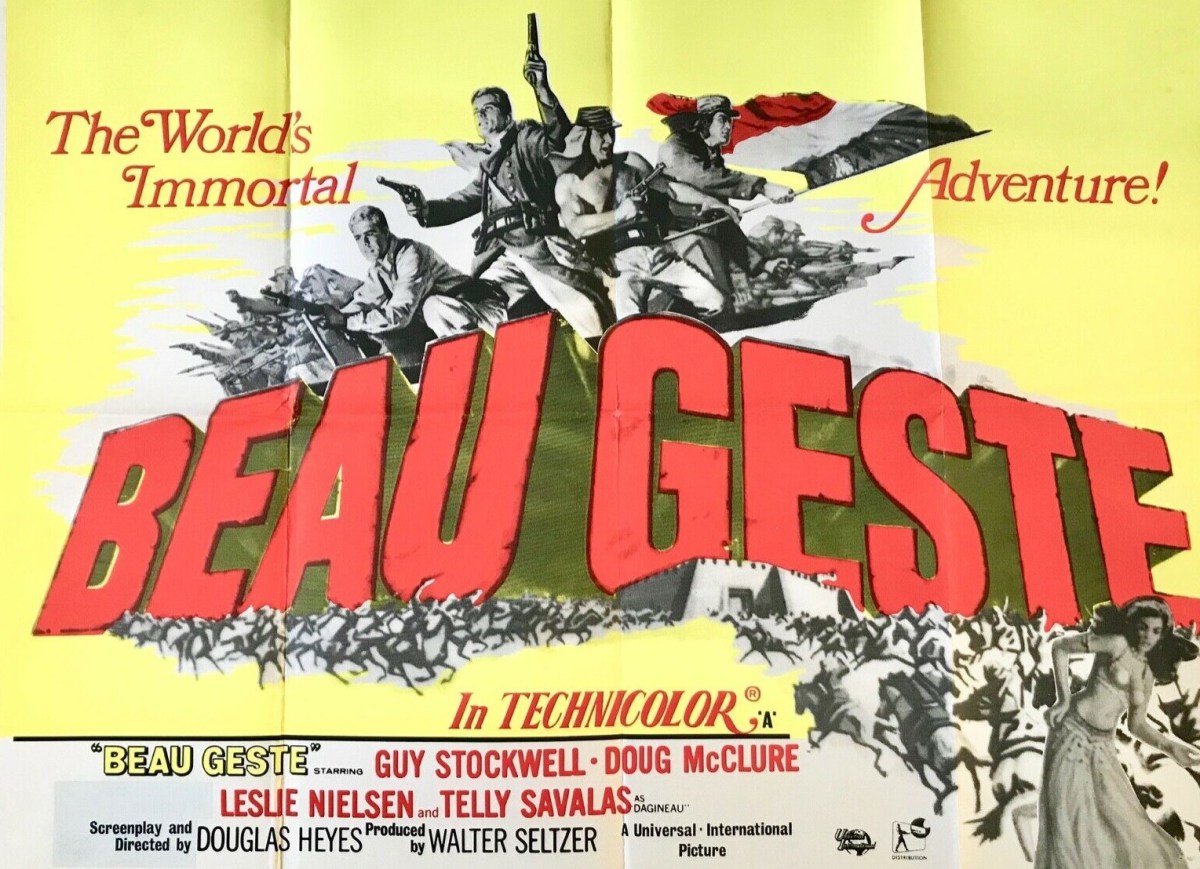
Two brothers battle inhospitable terrain, warring tribes and a sadistic sergeant major in a remake of the classic tale. The title translates as “noble and generous gesture” and is a pun on the name of hero Michael Geste (Guy Stockwell), an American hiding out in the French Foreign Legion in shame for being involved, innocently as it happens, in embezzlement. His attitude is markedly different to the “scum of the earth” who make up the battalion and his quick wit and refusal to kowtow make him a target for Sgt Major Dagineau (Telly Savalas), a former officer busted to the ranks.
Dagineau delights in imposing hardship and devising mental torture, making some recruits including Geste walk around blindfold at the top of a cliff. Geste’s resistance to his superior is almost suicidal and he even volunteers to take a whipping on behalf of his comrades. “It’s me he wants,” says Geste, “if not now the next time.” At another point he is buried up to his neck in the blazing sun.
Joined by his brother John (Doug McClure), the battalion sets out as a relief force for a remote fort but when commanding officer Lt De Ruse (Leslie Nielsen) is seriously wounded, the sergeant-major takes charge. Under siege from the Tuareg tribe, honor, treachery, mutiny, fighting skills and courage all come into play in a final section.
The action and the various episodes and confrontations are strong enough and Geste has a good line in witty retort, but blame the casting for the fact that it turns into Saturday afternoon matinee material. It was always going to be a stretch to match Gary Cooper, Ray Milland and Susan Hayward from the 1939 hit version.
Stagecoach, remade the same year, was able to rustle up a bona fide box office star in Ann-Margret (Viva Las Vegas, 1964) and a host of supporting players with considerable marquee appeal including Bing Crosby (Robin and the 7 Hoods, 1964), Robert Cummings (Promise Her Anything, 1965) and Van Heflin (Cry of Battle, 1963). Nobody in the cast of Beau Geste could compare. Apart from the Spanish-made Sword of Zorro (1963), Guy Stockwell usually came second or third in the credits, as did Doug McClure (Shenandoah, 1965) while Telly Savalas, despite or because of an Oscar nomination for The Birdman of Alcatraz (1962), was viewed as a character actor.
But that was the point. Universal gambled on turning the latest graduates from its talent school into major box office commodities. The set pieces and the action are well handled and while there are excellent lines especially in the verbal duels between hero and villain, it’s not helped by the most interesting character being Dagineau, who, despite his failings, accepted his fall from grace, worked his way back up the career ladder, believing brutality the only way to control the soldiers, and in the end out of the two is the one who has the greater sense of honor, refusing to allow a lie to befoul the truth, rejecting the notion of when the legend becomes fact print the legend, And it’s a shame that the movie has to present his character in more black-and-white terms rather than invest more time in his background or accept his version of reality.
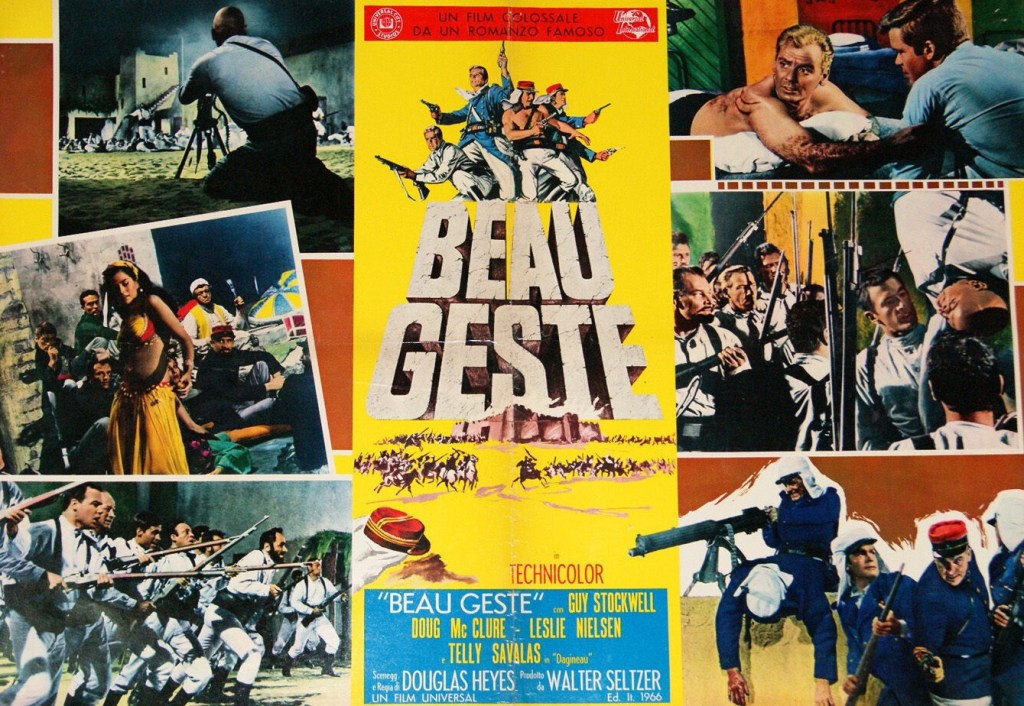
Telly Savalas (The Scalphunters, 1968) steals the show with a performance of considerable subtlety. Guy Stockwell (Tobruk, 1967) is little more than a stalwart, the heroic hero, with little sense of the irony of his situation. Doug McClure (The King’s Pirate, 1967) presents as straighforward a matinee idol. If you only know Leslie Neilsen from his later spoof comedies like Airplane! (1980) you will be surprised to see him deliver a dramatic performance as the drunken commander who still insists, in an echo of El Cid, in rising from his sick bed to lead his troops. Normally this kind of macho movie – The Magnificent Seven (1960) and The Dirty Dozen (1967) prime examples – throws up burgeoning talent who go on to make it big. It’s one of the disappointments here that this does not occur.
This was the second and final movie of Douglas Heyes (Kitten with a Whip, 1964).

 The Magnificent 60s
I can’t say I’ve seen this, but with McClure and Nielsen alongside Savalas, you’ve got a full house of cult actors for sure…
LikeLiked by 1 person
Picked for future generations to enjoy.
LikeLike
I distinctly remember watching this on TV in the 60’s and being disappointed with the back lot feel it had, that also hampered many Universal films made at that time.
For you:
“Douglas Heyes’s screen version of Percival Christopher Wren’s 1925 novel, Beau Geste, marked the third film adaptation, after Paramount Pictures’ 1926 and 1939 versions, also titled Beau Geste (see entries). An item in the 12 Dec 1962 DV reported that Paramount had sold the property rights “several years ago” to the Music Corporation of America (MCA), and Universal Pictures had come to own them after its 1962 merger with MCA. Dean Martin, Charlton Heston, Tony Curtis, and Warren Beatty were initially attached to co-star, according to the 13 Sep 1962 and 26 Nov 1962 issues of DV. By Dec 1962, George Englund was set to produce and Frank Gilroy was on board to adapt the screenplay.
The 31 Jan 1963 DV noted that Neil Hamilton, who had appeared in the 1926 version, would play a role. The following year, an item in the 29 May 1964 DV announced that Gene Kelly would direct. In order to focus his energy on Beau Geste, Kelly left another Universal project, That Funny Feeling (1965, see entry). Millard Kaufman signed on as screenwriter, as stated in the 16 Jun 1964 DV, and early the next year, a 25 Jan 1965 DV brief reported that Kelly had submitted a $7-million budget to the studio. Nine months passed, and the 3 Nov 1965 Var announced that Douglas Heyes, who had written the most recent script, was hired to direct. No mention of Kelly’s departure was made in the item.
Russell Birdwell served as publicist, and Orin Borsten as his publicity aide, as noted in various contemporary sources including the 11 Nov 1965 DV. Birdwell headed up the search for ex-French Foreign Legionnaires to serve as background actors, the 6 Oct 1965 DV reported. Classified advertisements were placed in twenty-seven U.S. daily newspapers in eighteen cities, with the following message: “Wanted, at once, former members of the French Foreign Legion to fight with Beau Geste at Fort Zinderneuf. Forget home, anxieties and tedium and hit the high road once more to adventure, romance and escape.” Louis Gallosher, the Los Angeles, CA-based head of the French Veterans of Foreign Wars, aided Birdwell in his search. Henry Rico Cattani, Peter Ortiz, and Abraham Raya were named in DV items as veterans who were being considered for roles. The 3 Nov 1965 DV listed their potential compensation as: $27.31 per day for brigade members; $35.38 per day for those riding horses or mules; $49.65 per day for those leading camels; $68.29 for those riding camels; and $100 per day for anyone with a speaking part.
A production chart in the 26 Nov 1965 DV stated that principal photography began on 12 Nov 1965 in Yuma, AZ, where the two previous Beau Geste productions had also been shot. A “Fort Zinderneuf” set was built at an estimated cost of $350,000 in an area of the Imperial Sand Dunes, outside Yuma, known as Buttercup Valley. There, in late Nov 1965, heavy rains caused production to halt. The company moved to the Universal studio lot in Universal City, CA, for interior shooting, and was scheduled to resume location shooting in Indio, CA (and later in Buttercup Valley), on 27 Dec 1965, according to the 22 Dec 1965 DV. Rain further delayed the completion of filming until mid-Jan 1966. The 10 Jan 1966 DV named the following crew members as part of a two-unit, final push to complete location filming: additional unit production manager Wally Worsley ; assistant directors James Welch and Wendell Franklin; cameramen Hal Stine and Rexford Wimpy; operating cameramen George Le Picard, Spec Jones, Orville Hallberg and Albert Berkson.
During production, lead actor Doug McClure’s father, Don McClure, passed away. A 3 Dec 1965 DV obituary for Don McClure listed his occupation as “flagman” for Universal pictures, and noted that Doug continued his acting duties following the news of his father’s death “at [his] family’s request.” The next month, a 19 Jan 1966 Var item reported that a sniper had shot at a bus carrying twenty-nine crewmembers and extras on a stretch of road fifteen miles west of Yuma. No injuries occurred, but driver Bill Johnson was forced off the road when the bus’s windshield shattered.
The 18 Jan 1966 LAT listed the final cost of production as $2.5 million, with an additional $1.5 million designated for prints and advertisement. However, an item in the 28 Feb 1966 DV reported that re-shoots would require another $100,000. Doug McClure and Guy Stockwell were called back for the re-shoots, the 3 Feb 1966 DV noted. Stockwell had since dyed his hair blond for the production of Tobruk (1967, see entry), and was forced to hide his hair under his character’s Legionnaire’s cap, a.k.a. a kepi. Meanwhile, as a promotion for the film, milliner Leon Bennett designed a women’s kepi, slated to be sold in 168 stores around the U.S. in conjunction with theatrical release, the 28 Jul 1966 Los Angeles Sentinel reported.
After filming ended, the Yuma Chamber of Commerce made efforts to preserve the Fort Zinderneuf set, according to the 24 Nov 1965 Var. With Universal’s permission, the local organization petitioned the U.S. Bureau of Reclamation to keep the structure “as a permanent tourist lure.” Plans included the display of costumes and prop weapons. Var claimed it was the “first time a film set has been sought as a permanent desert installation.”
A premiere and simultaneous opening at twenty-five-theaters was scheduled to take place on 20 Jul 1966 in Detroit, MI, as announced by DV exactly one month earlier; however, the Detroit release date could not be confirmed. An advertisement in the 4 Aug 1966 [Mansfield, OH] News-Journal listed a scheduled opening the following day at the local Madison Theatre, and later that month a citywide opening occurred on 24 Aug 1966 in Los Angeles, CA. Mixed-to-positive reviews were published in the 20 Jul 1966 DV, 26 Aug 1966 LAT, and 8 Sep 1966 NYT. An article in the 18 Jan 1966 LAT stated that the most recent Beau Geste differed from the first two film versions in that “Beau” only had one brother (“John”) instead of two; the story lacked a female love interest; the French Foreign Legionnaires were portrayed as Americans, not British; and an “ironic footnote” was tacked on, in which the decision to abandon Fort Zinderneuf “because ‘it isn’t worth the cost of holding’” was announced by “Lieutenant De Ruse.”
An item in the 18 Jan 1967 Var cited the picture’s cumulative film rentals, to date, as $1.5 million.
Beau Geste marked the American feature film debut of Dutch actor Robert Wolders. Martin Landau and Melodie Johnson were considered for roles, according to the 9 Sep 1965 and 23 Sep 1965 issues of DV. Stanley Baker, Danny Dowling, and Ronnie Rondell (said to have played an extra in the 1926 Beau Geste), were named as cast members in DV and Var items published between Oct 1965 and Jan 1966. Rondell’s son, Ronnie Rondell, Jr., served as a stuntman, according to the 11 Jan 1966 DV.
LikeLike