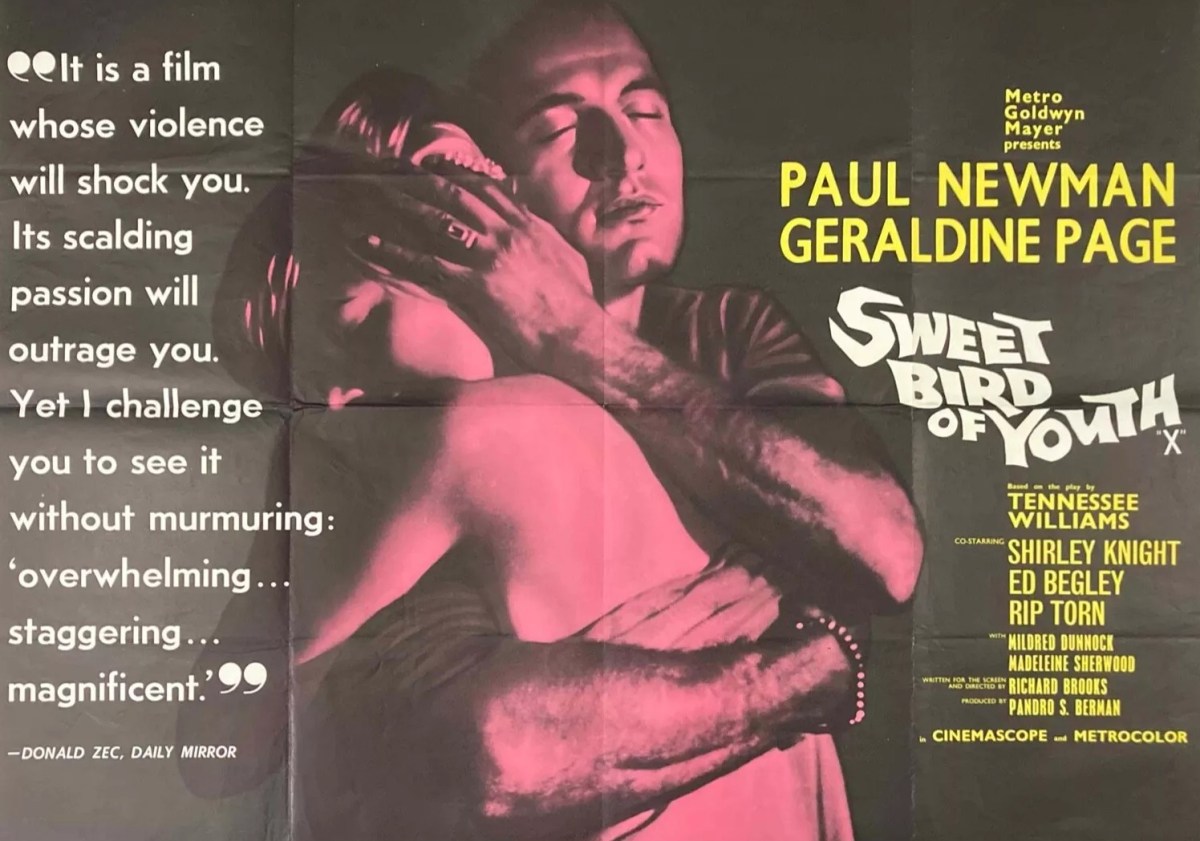
Tennessee Williams wrote better parts for women than he did for men. You can start with Vivien Leigh, Oscar-winner for A Streetcar Named Desire (1951) – Marlon Brando only nominated – and Anna Magnani Oscar-winner for The Rose Tattoo (1955) with Maria Pavan nominated and star Burt Lancaster left out of gong consideration. Carroll Baker and Mildred Dunnock were nominated for Baby Doll (1956) with star Karl Malden ignored. Paul Newman did receive an Oscar nomination for Cat on a Hot Tin Roof (1958) as did Elizabeth Taylor.
Montgomery Clift was frozen out of Oscar consideration for Suddenly, Last Summer (1959) while both Elizabeth Taylor and Katharine Hepburn scored nominations. Marlon Brando received no Oscar recognition for The Fugitive Kind (1960). Ditto Laurence Harvey for Summer and Smoke (1961) though Geraldine Page and Una Merkel received nominations. Lotte Lenya was recognised with a nomination for The Roman Spring of Mrs Stone (1961).

So the omens were not particularly good for Paul Newman when he repeated the role he had essayed on Broadway of Chance Wayne in Sweet Bird of Youth. In the stage version, while he received respectable notices, it was Geraldine Page who picked up the glory, winning the New York Drama Critics Award and nominated for a Tony.
So it was going to be a long shot that Newman could outshine her in the film version, even though he received considerably more screen time – Page and Shirley Knight were nominated, Newman was not.
The flaws in the tale are more obvious in the screen version. On stage, sheer force of personality can win over an audience, on screen that’s more difficult. And in truth Chance was another of Williams’ male losers. The main difference between Williams’ male and female characters is that not only are the women more reflective and aware of their shortcomings while the men simply bulldoze ahead but they are more able to express their feelings without dialog.
Chance is a failed actor turned gigolo taking advantage of alcoholic over-the-hill movie actress Alexandra Del Lago (Geraldine Page), running away from what she believes will be her final and calamitous movie, who half the time doesn’t know where she is or who he is. Chance has dreams of using her to hustle his way into the movie business, blackmailing Del Lago over her drugs abuse to front a new picture, and begins knocking on doors, but long-distance, since he’s returned to his home town in the hope of winning back his childhood sweetheart Heavenly Finley (Shirley Knight), planning to set her up as a movie star.
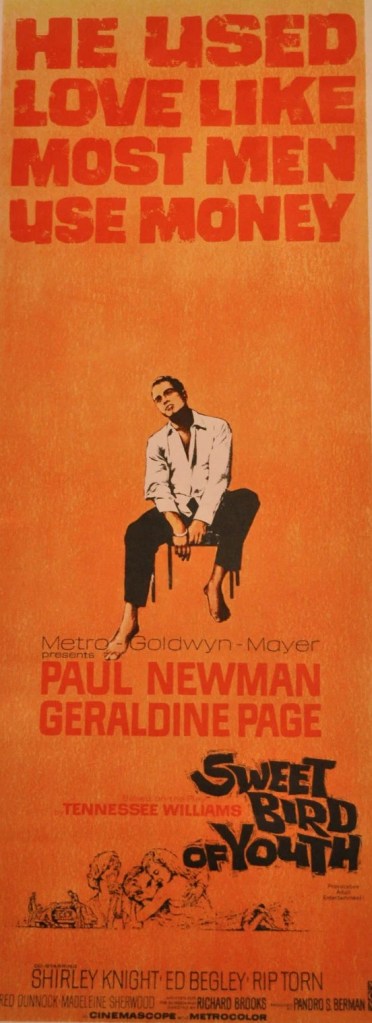
Expectations that there might be a welcome for a young man made good are dashed when everybody continues to treat him as the waitperson he once was or wants to run him out of town. To protect his daughter from such an unworthy suitor, the town’s most prominent citizen and political heavyweight Tom Finley (Ed Begley) had previously managed to pay Chance to leave town. His son Tom Jr (Rip Torn) shares his father’s aspirations.
Despite the odds Chance determines to woo Heavenly but his Hollywood dream is scuppered when Del Lago realizes that her last picture looks like becoming an unexpected success and she can once again write her own ticket rather than rely on a con man like Chance.
It doesn’t end well though, for reasons best known to him, writer-director Richard Brooks tacked on a happy ending – the play had an unhappy ending – that doesn’t ring true.
There’s nothing wrong with Paul Newman’s acting even if it didn’t attract the attention of the Oscar voters, but there’s not enough meat on the character. On the other hand, Geraldine Page and Shirley Knight (The Group, 1966) in part excel because their characters are better written. Rip Torn (Beach Red, 1967) develops his screen menace. Ed Begley’s (Warning Shot, 1966) over-the-top performance snagged him an Oscar.
The story’s just too thin and the hard edges of the play have been trimmed back so it was less appealing to an audience.
Lacks the usual Tennessee Williams bite but the female performances are well worth a watch.
I’m doing a Behind the Scenes article tomorrow so look out for that.

 The Magnificent 60s
Here is something:
The 21 Oct 1960 LAT reported that Metro-Goldwyn-Mayer Pictures (MGM) acquired rights to the controversial 1959 play by Tennessee Williams. As stated in the 17 Aug 19 DV, Williams received $400,000 with a guarantee of three percent of gross receipts exceeding $2.8 million.
In the 29 Feb 1960 LAT, columnist Hedda Hopper suggested actress Bette Davis for the role of “Alexandra Del Lago,” originated on Broadway by Geraldine Page. However, director Richard Brooks told the 20 Jun 19 1960 DV that Greta Garbo was his only choice for the role. Aware that the long-retired Garbo was not likely to accept, Brooks admitted his own disinterest in the project, saying, “I’ve had Tennessee Williams up to my ears.” Vincente Minnelli was being considered as Brooks’s replacement, according to the 7 Jul 1960 DV. Rumors that Ava Gardner would assume the part were disputed by the 13 Oct 1960 DV, which revealed that producer Pandro S. Berman had other actresses in mind. On 16 Jun 1960, LAT reported that Paul Newman, who played “Chance Wayne” on Broadway, had competition for the film version from actors Burt Reynolds and Rip Torn, both of whom assumed the role in other stage productions. The 3 Oct 1960 DV noted that John Michael Hayes was writing the screenplay, but he did not remain with the project.
Months later, the 13 Jan 1961 DV announced Brooks as director and screenwriter. Geraldine Page would reprise her award-winning Broadway role after facing competition from established film actresses Melina Nercouri, Maria Schell, Lana Turner, and Rita Hayworth. On 15 Feb 1961, DV reported Newman’s withdrawal from the project. Brooks was considering Elvis Presley and Dean Stockwell as possible replacements. Three months later, Newman returned, as stated in the 22 May 1961 LAT. Rip Torn and Madeleine Sherwood, also members of the Broadway cast, appeared as “Thomas J. Finley, Jr.” and “Miss Lucy,” respectively. The 14 Jun 1961 DV noted that Brooks was negotiating with Hedda Hopper to appear in the film as herself, in place of the fictional columnist “Sally Powers.”
A 22 Jun 1961 DV news item stated that the Motion Picture Association of America (MPAA) approved Brooks’s script, and hinted that the castration scene from the stage play had been excluded. Principal photography began 6 Jul 1961, according to that day’s DV. As reported in the 22 Aug 1961 DV, Brooks ordered the cast and crew not to discuss the picture with the media, fearing unfair comparisons to the stage play. Although Brooks confirmed the MPAA’s approval his shooting script, he was aware that it could be revoked, depending on revisions made during production. The filmmaker added that “several themes by Williams” not included in the play would appear in the picture. The 4 Oct 1961 DV noted that photography was completed that week. The 7 Sep 1961 DV estimated the final budget at $2.9 million, including $600,000 for the play and $700,000 for the cast.
On 27 Oct 1961, LAT announced that Tennessee Williams was debuting a revised version of his play on 14 Nov 1961 at the Civic Playhouse in Los Angeles, CA. Several changes were made to the story, including a “happy ending” in place of the original “tragic conclusion.” The article noted that it may have been the first instance of a playwright significantly altering his work following its Broadway run and national tour. The revised play received a negative notice in the 16 Nov 1961 LAT.
The film premiered 23 Mar 1961 at the Egyptian Theatre in Hollywood, CA, followed by 28 Mar 1961 openings at several New York City theaters. Reviews were generally positive.
Sweet Bird of Youth was nominated for three Academy Awards: Actress in a Leading Role (Geraldine Page), Actor in a Supporting Role (Ed Begley), and Actress in a Supporting Role (Shirley Knight). The 9 Apr 1963 DV noted that Begley thanked his agent upon winning the award. Geraldine Page received a Golden Globe for her performance, along with Italy’s David of Donatello and England’s British Academy of Film and Television Arts (BAFTA) awards for best foreign actress. Newman, Knight, and Begley were also nominated for Golden Globes. Brooks won Belgium’s Prix Femina Belge Du Cinema for “best directed picture of the year,” as reported in the 10 Jul 1962 DV. Paul Newman was voted “best actor” by readers of Exhibitor, a trade magazine for theater owners and film buyers.
The 21 Jan 1963 DV announced the picture’s re-released in Los Angeles on 27 Feb 1963, double-billed with Lolita (1962, see entry), as part of MGM’s Academy Awards campaign.
Casting announcements included musician Eddy Samuels (7 Jul 1961 DV), Michael Ferris and John Gallaudet (11 Jul 1961 DV), and Eugene Jackson (12 Sep 1961 DV). According to the 14 Jun 1961 LAT, William Mims was considered for the role of “Dr. George Scudder” before the part went to Philip Abbott. A news item in the 1 Feb 1961 DV noted the possibility that actor-singer Burl Ives would join the cast.
LikeLiked by 1 person
Wasn’t aware of the Garbo connection oe that Brooks was going to be replaced. Excellent.
LikeLike