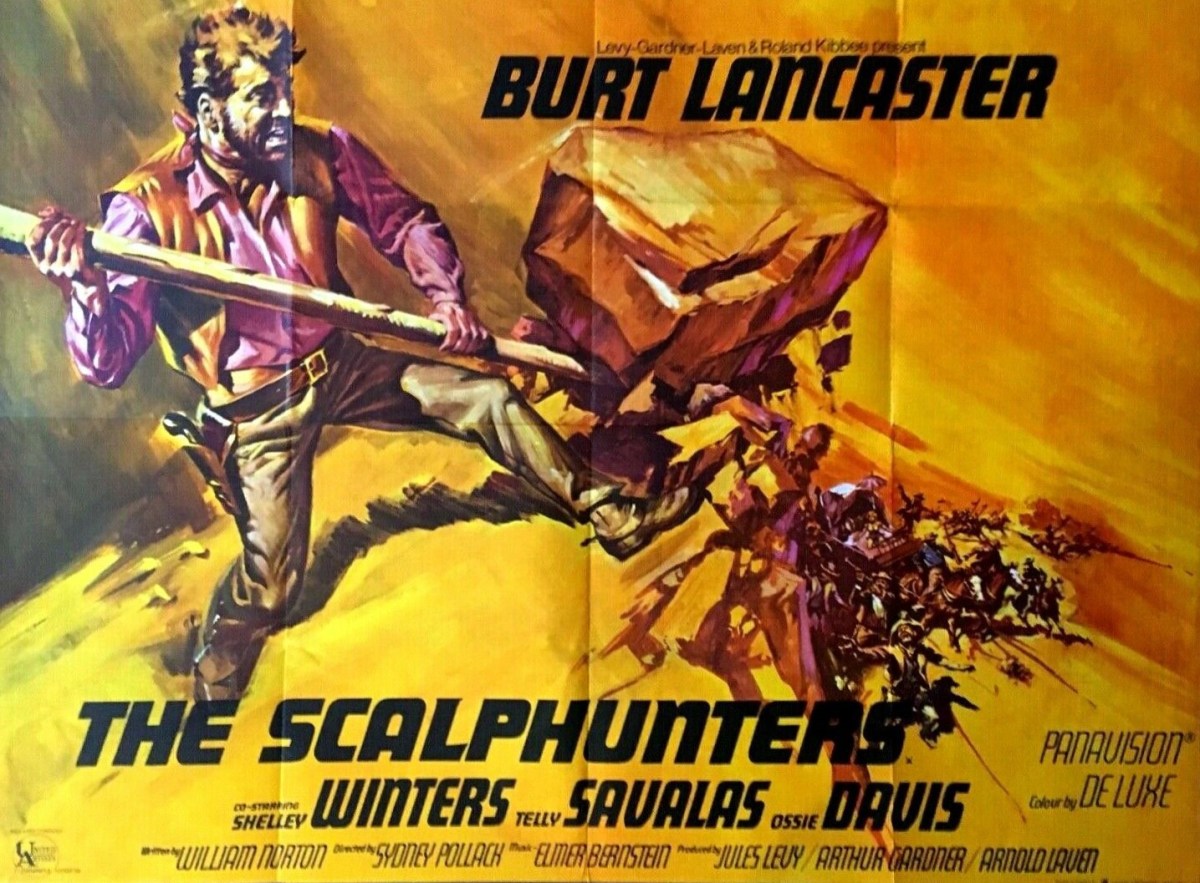
If ever a film deserves reassessment, this is it. This western, marketed as a vehicle for Burt Lancaster in the wake of hugely successful The Professionals (1966), sees the star playing cussed trapper Joe Bass trying to retrieve furs stolen first by Native Americans and then by outlaws. That the serious race issues tackled here were dressed up in very broad comedy and typical western action ensured it missed out on the kind of recognition that critics would assign a straightforward drama and lost its rightful place as a pivotal picture of the decade.
In theory, a somewhat unusual Burt Lancaster western. In reality something else entirely. For large chunks of the movie Lancaster is absent as the story follows the fortunes of Black slave Joseph Lee (Ossie Davis) as he achieves not just freedom but genuine equality. Joseph is introduced as a slave of the Kiowa, left behind when the Indians steal Joe Bass’s furs. In compensation for his loss, Bass plans to sell Lee in the slave market in St Louis and in the meantime enrols him to help recover his furs.

However, a band of outlaws, specializing in collecting Native American scalps (hence the title) and selling them at $25 a time, get to the furs first as a by-product of a raid on the Kiowas. In pursuit with Bass, Lee falls into a river at the outlaw encampment and becomes the slave of Jim Howie (Telly Savalas) who also aims to sell him. Lee plans to escape until discovering Howie’s large troop is headed for Mexico where the slave would automatically become free. With clever talk, beauty-treatment skills and knowledge of astrology and ecology, Lee insinuates himself into the wagon of Howie’s paramour Kate (Shelley Winters).
With Bass still in pursuit, there are several excellent action scenes as the outnumbered trapper seeks to outwit Howie who turns out to be just as devious. But the main question is not whether Bass will recover his stolen property but which side will Lee pick. Will he act as spy to help Bass get back his furs or will he disown Bass and remain with the murderous genocidal gang who could provide a prospct of freedom? Either in the company of Bass or Howie, he is constantly reminded of his status, taking a beating from one of Howie’s thugs, Bass refusing to share his whisky because he views him not just as a slave who “picked his master” but as a coward refusing to fight back when attacked and beaten up.
The film comes to a very surprising ending but by that time through his own actions Lee is accepted as an equal by Bass and the issue of slavery dissolved. In effect, it is a tale of self-determination. Lee effects liberty by taking advantage of situations and standing up for his own cause.

Lee is one of the most interesting characters to appear on the western scene for a long time. Exactly where he acquired his education is unclear and equally hazy are how – and from where – he escaped and how he ended up as slave of the Commanches before they traded him to the Kiowa. However he came to be in the thick of the story, his tale is by far the most original. But he’s not the only original. The fearless Bass was an early ecological warrior with an intimate understanding of living off the wild, not in normal genre fashion of killing anything that moves, but in knowing how to find sustenance from plants. That in itself would endear him to modern lovers of alternative lifestyles.
Normally the derogatory term “scalphunters” would be reference to Native Americans, but here it is American Americans who exploit this market. Despite being the leader of a vicious bunch, Howie turns out to be a bit of a romantic and Kate a bit more interested in the world than your average female sidekick.
Director Sydney Pollack (The Slender Thread, 1965) does a marvelous job not just in fulfilling action expectations and taking widescreen advantage of the locations but in allowing Lee to take center stage when, technically, according to the credits, Ossie Davis was only the fourth most important member of the cast. Burt Lancaster was approaching an acting peak, following this with The Swimmer (1968) and Castle Keep (1969), happy to take risks on all three pictures, especially here where for most of the movie he is outwitted and ends up in a mud bath.
Both Telly Savalas (Sol Madrid, 1968) and Shelley Winters (A House Is Not a Home, 1964) rein in their normal more exuberant personas. Savalas, in particular, cleaves closer to his straightforward work in The Slender Thread than the over-the-top performance of The Dirty Dozen (1967). Winters, usually feisty, is here more winsome and vulnerable, apt to be taken in by sweet-talking men.
But Ossie Davis (The Hill, 1965) is the standout, his repartee spot-on. It is a hugely rounded performance, one minute wheedling, the next sly, boldness and cowardice blood brothers, and while his brainpower gives him the advantage over all the others he is only too aware that such superiority counts for nothing while he remains a slave.
It’s dialog rich and it’s a shame it wasn’t a big hit for that would have surely triggered a sequel – especially in the wake of the following year’s buddy-movie Butch Cassidy and the Sundance Kid – because the banter between Lee and Bass is priceless. For the dialog thank the original screenplay by future convicted gun-runner William W. Norton (Brannigan, 1975), father of director Bill Norton (Cisco Pike, 1971).
Go see.

 The Magnificent 60s
Hello Brian,
Another great discovery you made with “the scalphunters”. The association Pollack and Lancaster is certainly marvelous.
I will soon talk about a western myself. The old “Apache drum”, a very colorful and strange western produced by the shadowy Val Lewton. Terrific.
LikeLiked by 1 person
Apache Drum is a good ‘un but as you say strange. Look forward to your review. Pollack was hitting a peak at this time and his partnership with Lancaster really paid off.
LikeLiked by 1 person
As a fan of The Professionals, a very underrated film, I’d check this out…terrible DVD jacket, it that a pipe or a toffee apple?
LikeLiked by 2 people
Not sure if Burt had a sweet tooth so I’d guess a pipe. Interesting about The Professionals, it did very good business and got good reviews at the time but somehow it’s slipped down in the western rankings.
LikeLike
A tidbit:
“Several contemporary sources referred to The Scalphunters as screenwriter William Norton’s feature film debut. However, Norton had previously been credited on The Rotten Apple (1963, see entry) and The Farmer’s Other Daughter (1965, see entry). The writer had toiled for many years before meeting with any success, working as a truck driver, a hod carrier, and a park ranger at Morro Bay and William Rogers State Park, the 7 Apr 1967 LAT noted. A young agent submitted his script for The Scalphunters to Levy-Gardner-Laven Productions, who then sent it to Burt Lancaster. After signing on to produce the film, Levy-Gardner-Laven enlisted Norton to work on at least five more scripts, as stated in the 7 Feb 1968 Var.
Telly Savalas was announced as Burt Lancaster’s co-star in the 23 Nov 1966 DV, which claimed that filming would take place entirely on location beginning mid-Jan 1967. Savalas and Lancaster had previously acted together in 1962’s Birdman of Alcatraz (see entry).
The start of principal photography was delayed by re-shoots on Lancaster’s previous picture, The Swimmer (1968, see entry), according to a 20 Jan 1967 DV brief. The 26 Jan 1967 DV reported that shooting would begin in Durango and Torreón, Mexico, on 23 Feb 1967, but a 3 Mar 1967 DV production chart later stated that production began earlier, on 15 Feb 1967. Some filming may have taken place in Guaymas, Mexico, where producer Jules Levy and director Sydney Pollack had scouted locations, as noted in the 28 Nov 1966 DV.
United Artists ultimately spent $4 million on the production in Mexico, according to a 9 Jan 1968 DV brief.
The film was scheduled to premiere on 12 Mar 1968 as the opening-night attraction at the newly built Fox South Coast Theater in Costa Mesa, CA. A New York City benefit premiere followed on 2 Apr 1968, raising money for Union Settlement, a community center in Harlem where Lancaster had spent time as a boy, the 10 Mar 1968 NYT noted. Critical reception was mixed. Commenting on the recent opening in Philadelphia, PA, the 10 Apr 1968 Var stated that The Scalphunters had taken in $20,000, an estimated forty-to-fifty percent less than anticipated due to “emergency measures” that had been taken in the city following Martin Luther King, Jr.’s assassination on 4 Apr 1968, which had stirred racial tension and prompted riots in various U.S. cities. An article in the 1 Jun 1967 Los Angeles Sentinel had previously pointed to The Scalphunters as one of a recent spate, along with Guess Who’s Coming to Dinner and Hotel (1967, see entries), of films addressing racial bigotry “with both seriousness and humor.” Ossie Davis, who played the slave “Joseph Winfield Lee,” had been quoted in the Los Angeles Sentinel article as saying that The Scalphunters “could do as much in its own way for civil rights through humor as the valuable efforts of Roy Wilkins and Martin Luther King.”
The picture was listed in the 8 Jan 1969 Var as one of the “Big Rental Films of 1968,” with cumulative film rentals of $2.8 million, to date.
Fawcett Gold Medal Books published an initial 250,000 copies of a novelization of The Scalphunters written by Ed Friend, according to a 3 Apr 1968 Var item.
An item in the 21 Dec 1966 DV named Dennis Weaver as a potential cast member; the 22 Mar 1967 Var stated that Pancho Villa, Jr. served as Burt Lancaster’s stand-in; and the 25 Jul 1967 LAT noted that Michael Scheff served as producer Jules Levy’s assistant on the picture.”
LikeLiked by 1 person
Great stuff once again. Terrific detail. I hadn’t known much about Norton. The movie did about the same again overseas.
LikeLike