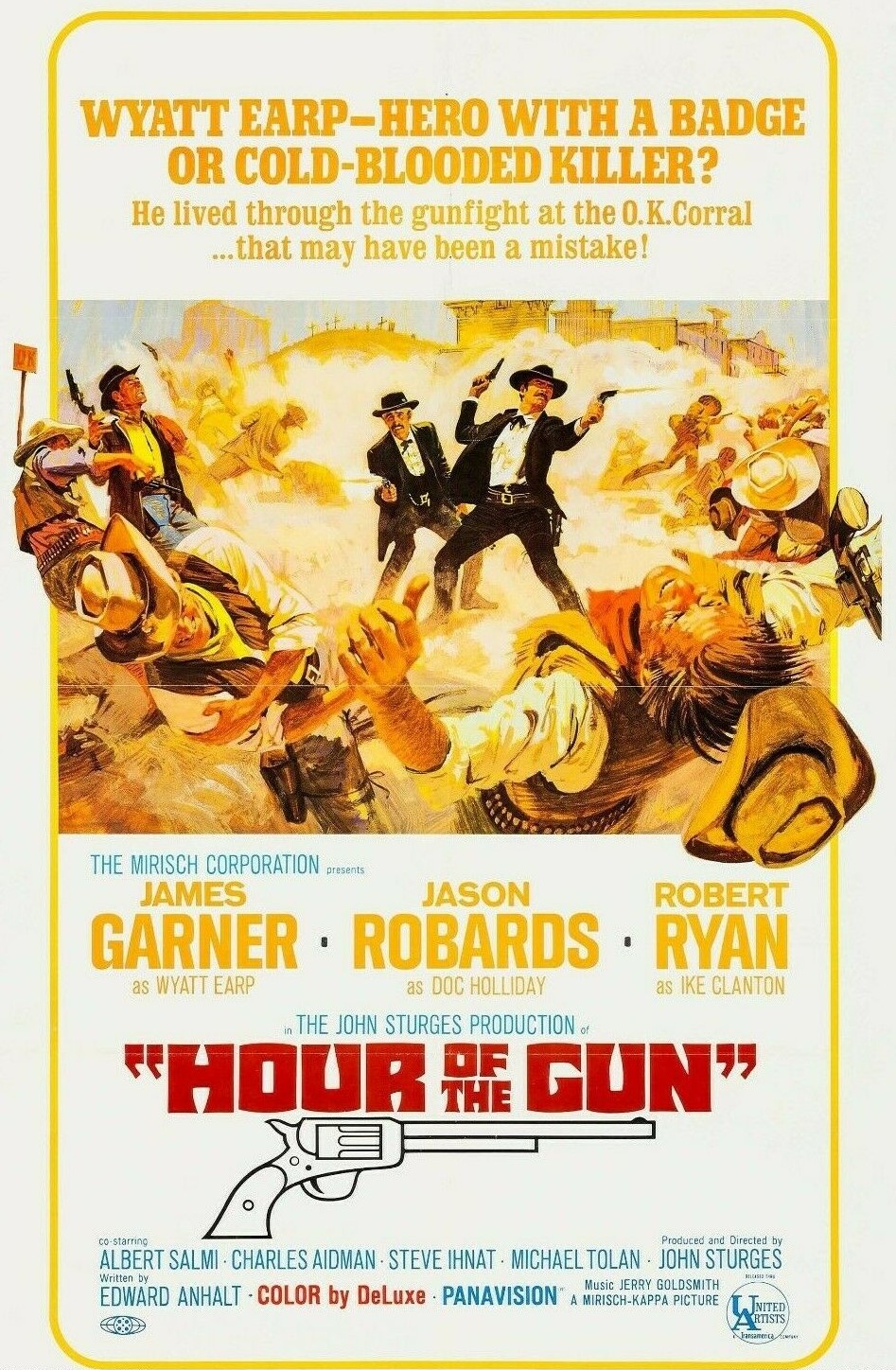
The second version of the Gunfight at the O.K. Corral follows on from the Burt Lancaster-Kirk Douglas 1957 version also directed by John Sturges and precedes Doc (1971) reviewed yesterday. Good chance to compare the differing approaches.
Destroy a legend at your peril. Mythic western hero Wyatt Earp (James Garner) goes down’n’dirty after the death of his brother, spurning law and order to turn bounty hunter, which is legitimate, and then vigilante, which is not, in pursuit of Ike Clanton (Robert Ryan). A revisionist western, then, with director John Sturges substantially reimagining the image of Earp he had been instrumental in creating through Gunfight at the O.K. Corral (1957), a box office smash starring Lancaster as Earp and Douglas as sidekick Doc Holliday.
The first change is to keep Clanton alive, having been a casualty in the previous picture. The opening sequence sets the record straight. But corruption and the law acting in conjunction pull Earp and Holliday (Jason Robards) up on criminal charges though they are found innocent. When corrupt law fails to work, Clanton resorts to ambush, killing Earp’s brother. Clanton organises a posse of twenty men to kill Earp while the lawman sets up his own, smaller, team of bounty hunters.

It soon transpires Earp’s warrants are little more than “hunting licenses” and although marginally he errs on the side of fairness the odds, courtesy of his superior gunplay, remain substantially stacked in his favour and he picks off the villains one by one, pursuing Clanton into Mexico.
This is the story of Wyatt Earp in transition, shifting into lawlessness, at a time – 1881 – when the West itself was undergoing dramatic change, big business from the East forcing greater acceptance of the law (and using it for their own purposes), the growth of the cattle barons and the gradual elimination of the gunslinger, gunfighter and criminal gangs. There’s no room for romance as there was in O.K. Corral and The Magnificent Seven (1960) just pitiless determination to revenge. But there’s little of the all-male camaraderie that informed The Great Escape (1963). Earp and Holliday remain tight but the others in their gang have been somewhat forcefully enlisted.
gun-toting movie rather than one of somber reflection.
The best scenes are the result of Earp conniving, revealing a streak Machiavelli would have envied, even duping Holliday, until it’s clear the Earp of legend has been vanquished. Sturges congratulates himself on telling the “truth.” But that’s the problem. The truth involves a lot of background that slows the picture down. And presenting Earp as transitioning is pretty much a blatant lie. Earp was clearly as ruthless killer at the O.K. Corral as he is now and no amount of pointing to corrupt law can eliminate the fact that the lawman prefers to kill villains rather than see them face justice. So there’s really no transition. Earp is a more civilized version of The Man With No Name. But at least he accepts it. There’s no hypocrisy involved.
The two principals are superb, shucking off the mannerisms that previously defined their screen personas. Gone is the trademark James Garner cheeky chap, the grin and even the slicked-back hairstyle. He is your father in a continually bad mood now rather than your favorite uncle full of japes. How much Sturges pinned back Robards’ capacity for over-acting can be seen by comparing this with the actor’s performance in Once Upon a Time in the West (1968).
Full marks for Sturges in trying to tell a complex, morally ambivalent, story, and he avoids the more grandiose approach to changes in the West as instanced in Once Upon a Time in the West. The early courtoom scenes slow down the narrative when a couple of lines of dialog could have done the same job. But it is exceptionally true in its depiction of Earp. There is not a bone of redemption in his body. He is going on a killing spree and he doesn’t care who knows it or how it damages his reputation, still high enough before the final episode of the revenge hunt for him to be touted as a future lawman-in-chief for Arizona.
Nor does Doc Holliday offer anything in the way of consolation. This isn’t like The Wild Bunch where a ruthless band of robbers convince themselves they have a code of honor and provide rough camaraderie as a way of filling in the emotional gaps in their lives. Holliday mistakenly sees Earp as man who could not exist outside the law without destroying himself, but that would only concern an Earp who was still interested in rules. Holliday, a self-confessed killer, over 20 deaths to his name, seeks redemption by saving Earp from himself. But in keeping with the raw truth, he is wasting his time. “I’m through with the law,” proclaims Earp, somewhat redundantly, once he dispatches his final victim.
It was a different kind of western at a time when in mainstream Hollywood there was no such thing. Although elegiac in tone, it cuts to the mean. And it was the forerunner of other, more critically acclaimed, westerns like Will Penny (1968), The Wild Bunch (1969) and Pat Garrett and Billy the Kid (1973) and in a sense it was precursor to Dirty Harry (1971) where in order to obtain justice Harry Callahan has to throw away his badge.
Many reasons have been advanced for the film’s commercial failure, most erroneously assuming that the genre had fallen into disrepair and was not revived until the glory year of 1969, but as I point out in my book The Gunslingers of ’69, that was far from the case. The same year as Hour of the Gun, John Wayne had ridden high on the box office hog with The War Wagon to follow the previous year’s El Dorado and Paul Newman as Hombre had been a big hit. The first two spaghetti westerns, only released in the U.S. in 1967, were also given as instrumental in the failure of Hour of the Gun, but neither was a massive box office hit. Revisionism had not quite hit the target with the public either as witness Cheyenne Autumn (1964).
The most likely reason was the fact that Sturges set out to dispel a myth that the public were happy with, that the movie was slow moving, and the characters essentially unlikeable. John Ford averred that when the legend became fact you printed the legend, but the opposite was patently not true here. Edward Anhalt (The Satan Bug, 1965) wrote the screenplay based on the straight-shooting biography Tombstone’s Epitaph by Douglas D. Martin. who had previously written about the Earps.
It might be cold, and at times meandering, but it offers up a fascinating character study and although Earp’s transition could be construed as tragedy, the destruction of a good man, Sturges takes no refuge in such an idea. This is Sturges boldest, most courageous, picture and he does nothing to soften the killing. Where The Magnificent Seven, another bunch of killers, ride into Mexico on the back of a bombastic theme tune, this is a much leaner effort, and all the richer for it.

 The Magnificent 60s
I did not watch this as I could not accept James Garner in a western even though the subject surrounding the characters Wyatt Earp n Doc Holliday etc. could be interesting.
LikeLiked by 1 person
Did you see Support Your Local Sheriff?
LikeLike
No. The only time I saw James in a western was Shootup At Medicine Bend (Randolph Scott and a very young Angie Dickinson). Lol.
LikeLiked by 1 person
He’s brilliant in Support, much more his normal screen persona but played to comic effect. It’s hilarious. Forgot Angie was in Shoot up. Am reviewing Sins of Rachel Cade shortly.
LikeLike
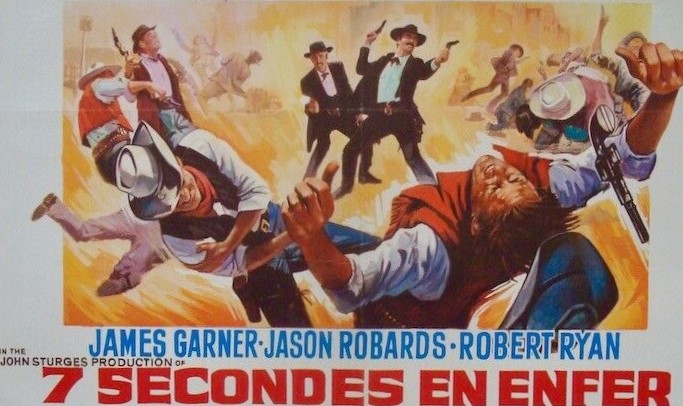
I have a soft spot for this film’s gritty take on Wyatt Earp compared to more cinematic and flamboyant renditions (insert pretty much any other Earp movie here). Those “hunting licenses” you mention produce perhaps my favorite moment; it’s hard to get grittier than Jason Robards hacking out a lung in the dust of a corral. I think “Hour of the Gun” bookends kind of thoughtfully with “Sunset,” where James Garner plays an older Earp with hints of melancholy – not a great movie, but still recommended for that reason. I had no idea this film was a flop, although I can’t say I’m surprised. Also, that poster looks suspiciously spaghetti, with its poppin’ late 60s paint job. Does not look like the movie I remember. Haw. Thanks for this write-up.
LikeLiked by 1 person
some of the posters for Gunfight at the OK Corral have the same feel but you are right the designers are channeling spaghetti westerns. It stands up well after all this time but I guess a bit of a shock to western traditionalists at the time.
LikeLiked by 1 person
Undersrated at the time, still underrated today, and I think you’re right to suggest it was the forerunner of more brutal films to come…
LikeLiked by 1 person
I think it’s reputation is growing but only slowly.
LikeLike
A bit:
“Several contemporary sources, including the 11 Oct 1967 LAT review, noted that Hour of the Gun was a continuation of director John Sturges’s 1957 film, Gunfight at the O.K. Corral (see entry), which starred Burt Lancaster and Kirk Douglas as “Wyatt Earp” and “John ‘Doc’ Holliday.” Sturges’s intention to develop a story based on the events after the legendary 1881 Tombstone, AZ, shootout were reported in the 25 Sep 1963 DV. At the time, sources alternately referred to the title as Law and Tombstone and The Law and Tombstone, and Sturges hoped to have Douglas and Lancaster reprise their roles. Although Gunfight at the O.K. Corral was produced and released through Paramount Pictures, The Law and Tombstone officially began development at the Mirisch Co. shortly after DV’s announcement. Early the next year, a 27 May 1964 Var article noted that Edward Anhalt had signed on to write the script following his collaboration with Sturges on the Mirisch Co.’s The Satan Bug (1965, see entry). Although not corroborated by other sources or credits listed in reviews, a 25 Feb 1965 DV list of acquired properties claimed that the screenplay was based on a historical book by Douglas D. Martin, published in 1951 as Tombstone’s Epitaph.
On 23 Jul 1966, LAT reported that James Garner had agreed to assume the role of famed lawman Wyatt Earp after starring in Sturges’s The Great Escape (1963, see entry), while Jason Robards, Jr. later stepped in as Doc Holliday.
Principal photography began 9 Nov 1966, as stated in an 18 Nov 1966 DV production chart. According to a 9 Aug 1966 DV item, Sturges felt that the real Tombstone had since become too modern for the nineteenth-century story, so location work was moved to Torreón, Mexico, with interiors completed in Mexico City. A 23 Aug 1970 NYT article also indicated that The Law and Tombstone was one of many motion pictures to shoot in Durango. The 8 Feb 1967 Var stated that filming concluded the weekend of 4-5 Feb 1967, after an earlier 24 Jan 1967 DV report cited a temporary delay due to unexpected snowfall.
Items in the 22 Nov 1966 DV and 2 Dec 1966 and 6 Dec 1966 LAT noted the involvement of several locals as background actors, including former Hollywood actor Ivan Scott, who had since been working as the proprietor of a Mexico City television repair shop; Rolane Greb, an English teacher from Denver, CO; and Argentina Echavarri, who was cast as the wife of “Vigil Earp.” Jon Voight made his motion picture debut in the role of “Curly Bill Brocious.”
As the film entered post-production, the title was temporarily changed to Day of the Guns and Hour of the Guns before beginning its official publicity campaign as Hour of the Gun. Additional sources referred to an opening date in San Francisco, CA, on 4 Oct 1967, while the Los Angeles, CA, release followed one week later. The New York City engagement began at several theaters on 1 Nov 1967.
According to a 15 May 1968 Var article detailing James Garner’s box-office status, returns were apparently low, as Hour of the Gun was included among a group of five recent Garner films that earned combined domestic rentals of just $6.5 million.”
LikeLiked by 1 person
Garner was one of several stars whose marquee value was in question. Great stuff. Thanks once again.
LikeLike