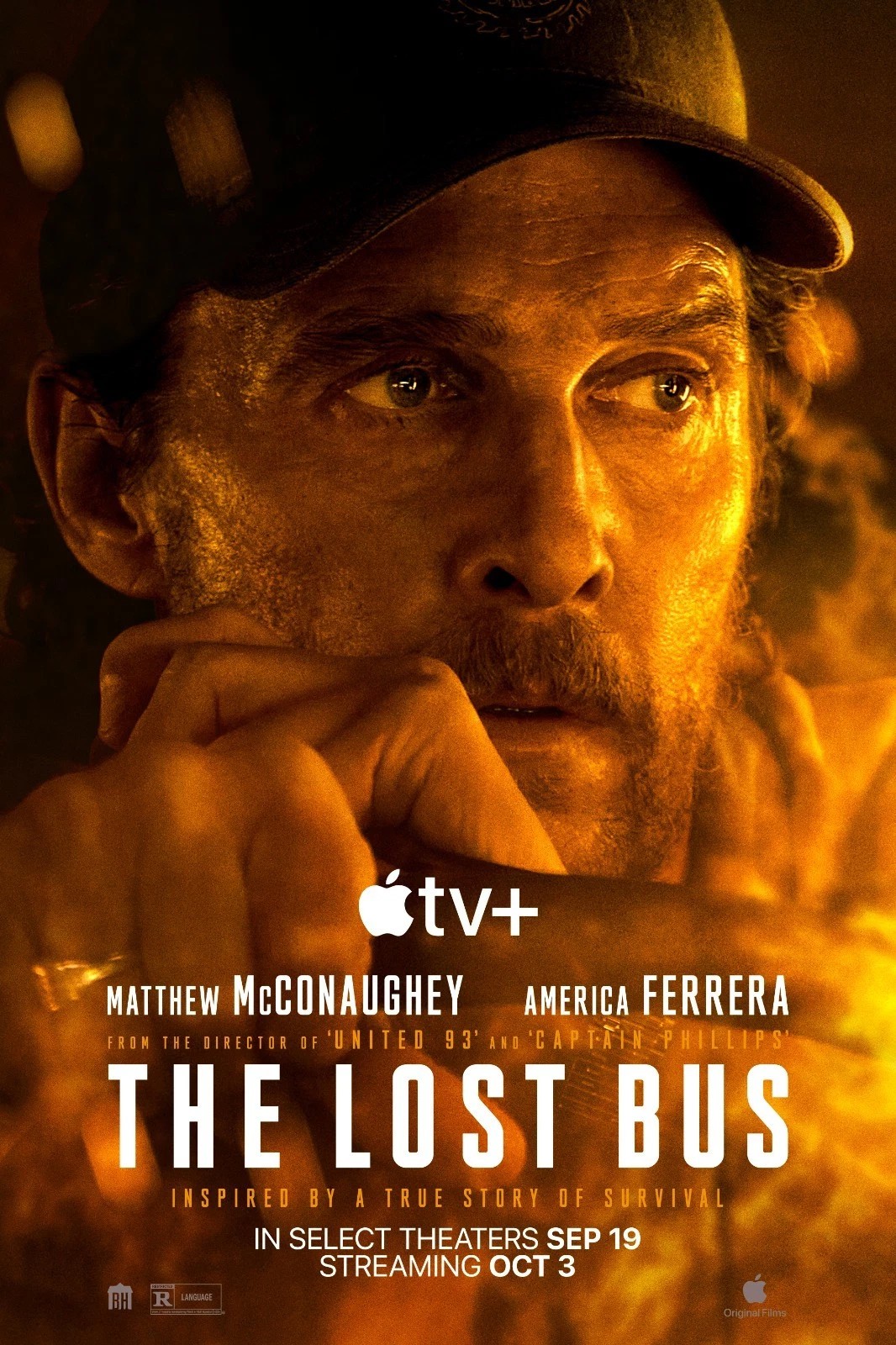
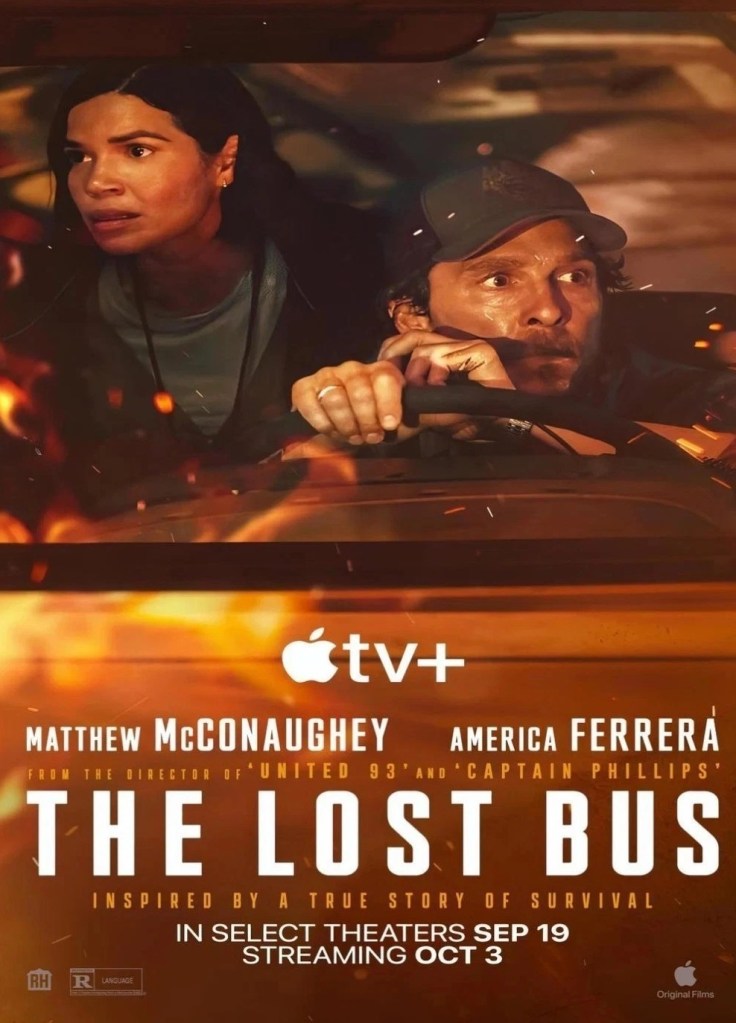
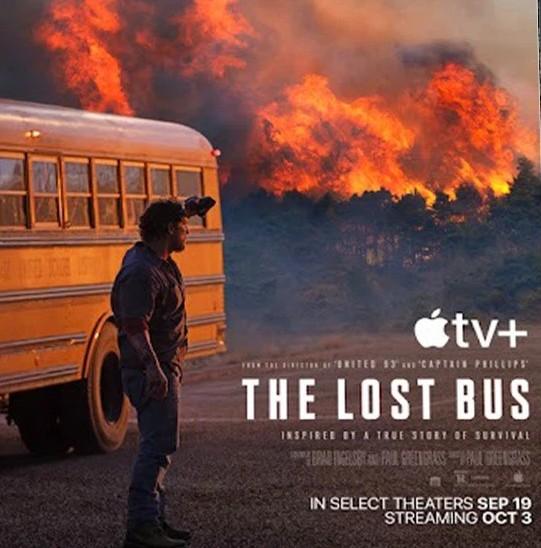
What a blast! Director Paul Greengrass (he of the shaky camera) has revived the 1970s disaster movie – and how! I’m not a huge fan of Matthew McConaughey (Interstellar, 2014) but he puts in a terrific shift as an ordinary joe. But you’re going to have to hurry to catch this in cinemas – where it absolutely belongs – because it hits the streamer on Oct 3. And without doubt Apple has made a major blunder in not sticking a huge wodge of dough behind the cinematic release and finding a few Imax screens. The special effects won’t have anything like the required impact on the small screen.
It’s generally considered that The Towering Inferno (1974) was the biggest of the disaster cycle at the box office because it paired superstars Paul Newman and Steve McQueen. But, actually, the real reason was fire. Any other disaster – cyclone, tsunami – doesn’t just spring out of nowhere. No matter that these are natural disasters, they do follow a largely designated path and through for cinematic purposes twisters can shift around a bit, generally they are not going to switch direction dramatically.
Fire is a primal fear. Smoke itself is bad enough, it can suffocate you in an instant, but fire will just rip through you and destroy everything in its path. And of all the terrible aspects of nature, it’s the most horrific visually – the thick clouds of smoke rising ominously and the red red – bad enough in the distance but close-up looking like some mad archer has unleashed a thousand bolts in a hundred different directions all at once. Backdraft (1991), by comparison, largely dealt with containable fires rather than wildfire.
This doesn’t follow the usual template of sticking a bunch of disparate people in jeopardy and allowing character exposition to suck up a good chunk of the running time. Instead, almost documentary style, we follow harassed fire chief Martinez (Yul Vazquez) as he sets about the impossible task of getting enough waterpower up into the mountains to quell the flames and in the end decides to switch off the hoses and concentrate on getting 30,000 people to safety. There’s an interesting amount of detail on the strategy of containing a fire, but mostly you can see that once the fire takes hold they are fighting a losing battle. We don’t learn a single thing about the personal life of Martinez or any other fireman, so it’s action, action, action.
School bus driver Kevin McKay (Mathew McConaughey) isn’t exactly loaded down with trauma, but he does have an ailing mother and a disaffected son, Shaun (Levi McConaughey), whose unexplained illness can be treated by over-the-counter medicine so he’s not on the point of death. Kevin has clearly relied too much in the past on his charm to get him out of sticky situations and here he’s trying to wheedle his way round boss Ruby (Ashlie Atkinson) whose giving him a hard time for his lack of attention to managing his vehicle.
But he doesn’t really come into the story until he’s given the job of rescuing a bunch of stranded schoolkids who, thankfully, don’t have any back stories either and we’re e not having to worry about kids who’ll die without expert care. And they come with eminently sensible teacher Mary (America Ferrara), who, despite the immediate threat of fire, has them line up in twos to board the bus. Mostly, the kids contribute a soundtrack of squealing while Mary spends her time calming them down and acting as navigator.
Eventually, Kevin finds himself stranded in the heart of the fire, but that looks like the best place to be, like the calm at the heart of a storm, until it doesn’t.
It’s a heck of a terrifying ride and I found myself gripping my seat on occasions. Of course, I knew they’d get out, nobody’s going to barbecue a bunch of small kids on screen, but Kevin’s maneuvers and the storm of flame all round was a very scary experience.
Apparently, this is based on a true story and there’s some unnecessary virtue-signalling at the end when it turns out the fire wasn’t caused by a careless camper but by a careless energy company which was fined billions.
McConaughey is superb. He’s flustered throughout, initially by domestic issues, and then by the task. For the most part he looks worn down to the bone and it’s not heroics but sheet determination that gets him through. And the director avoids the temptation of trying to add romance into the equation. America Ferrara (Dumb Money, 2023) is pretty good, too, as the nit-picking schoolteacher and Yul Vazquez (Tin Soldier, 2025), a new name to me, certainly lends strength to his role. But this picture belongs to Paul Greengrass (The Bourne Ultimatum, 2007), shouldering a disaster tour de force. Screenplay by the director, Brad Inglesby (Mare of Easttown, 2021) and Lizzie Johnson in her debut.
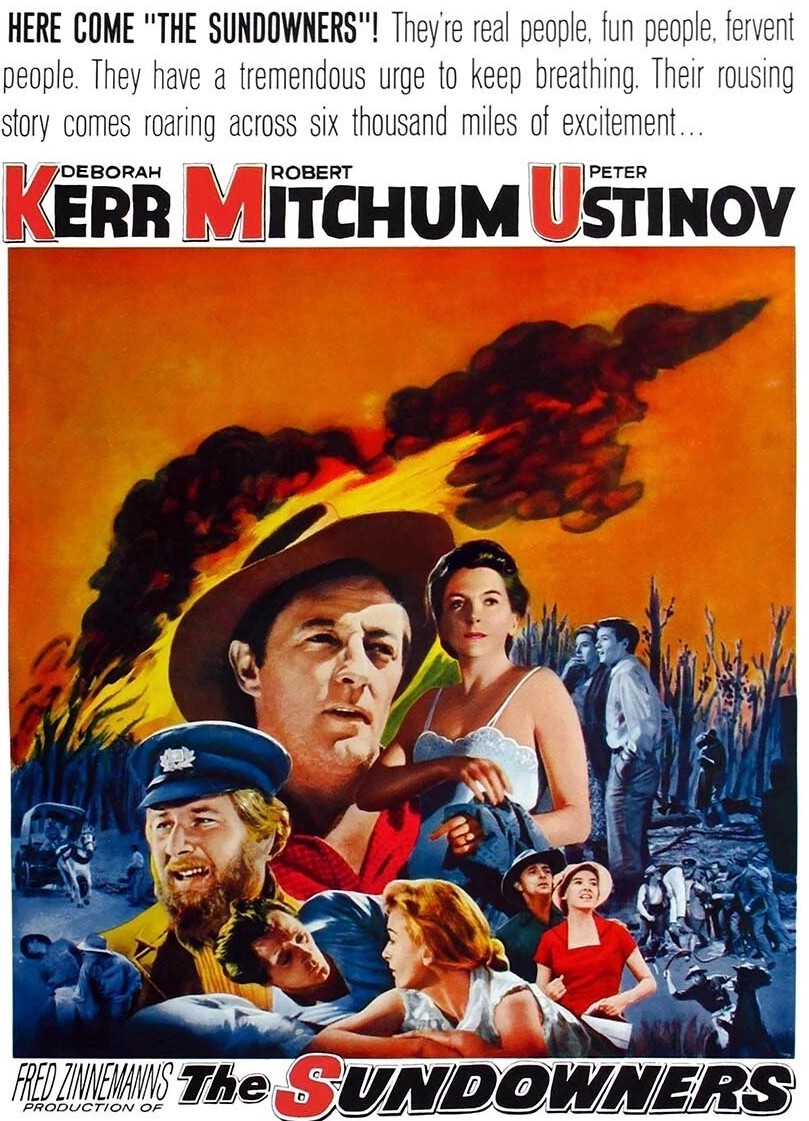
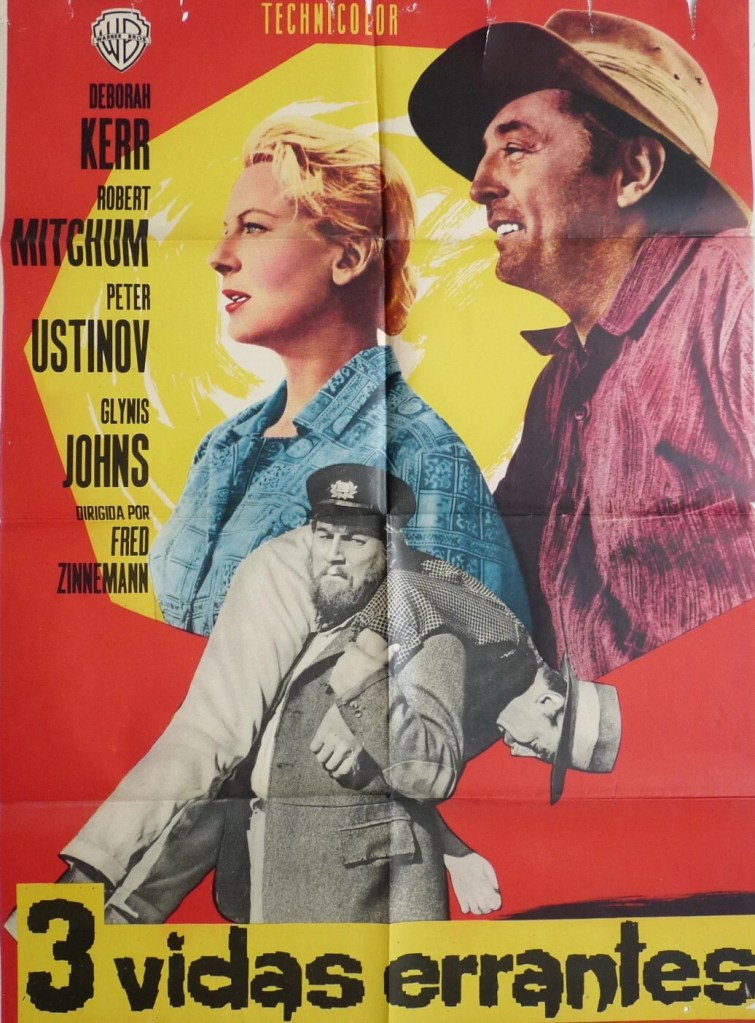
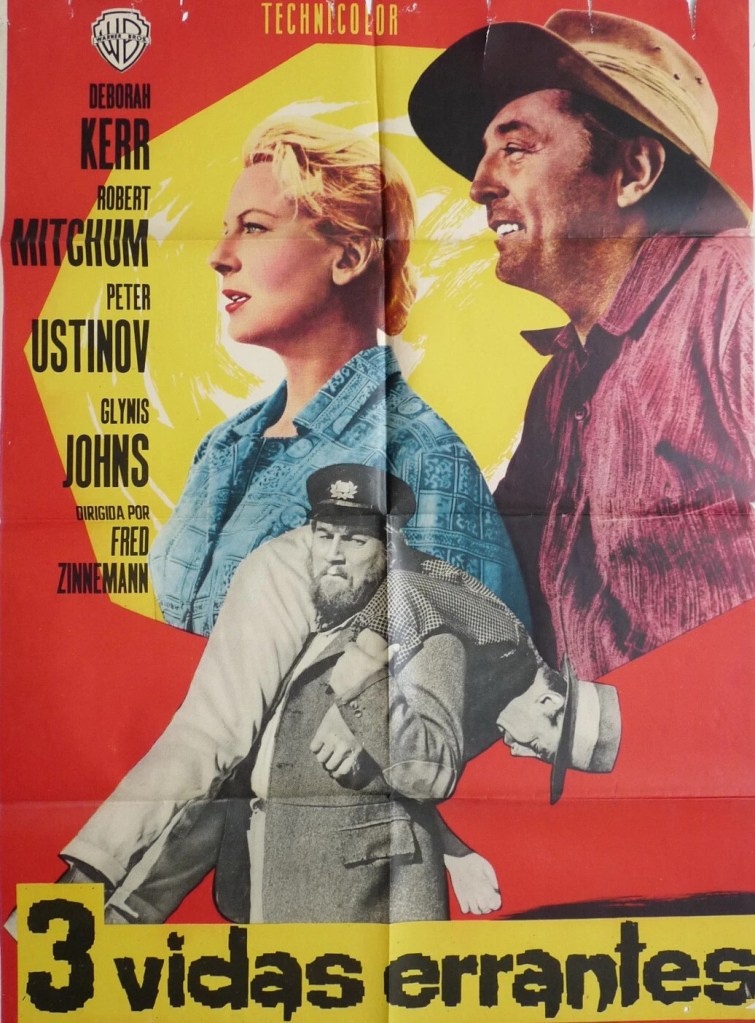
Whereas Deborah Kerr had always been first choice from the moment in 1957 Fred Zinnemann – he had directed her in From Here to Eternity (1953) – announced plans to film the Jon Cleary bestseller about itinerants in the Australian Outback, Robert Mitchum was third choice. Despite having been successfully paired with Kerr for John Huston’s box office hit Heaven Knows Mr. Allison (1957), he was passed over in favor of, initially, William Holden with whom she had starred in the equally successful The Proud and the Profane (1956). When Holden dropped out, he was immediately replaced by Gary Cooper who had scored a big success with William Wyler’s Oscar-nominated Friendly Persuasion (1956)
And rather than Peter Ustinov (Topkapi, 1964) and Glynis Johns (The Cabinet of Caligari, 1962) in the major supporting roles, Zinnemann had hoped to secure the services of Claudette Colbert and Errol Flynn, both of whom had once been substantial box office attractions, though Colbert had been offscreen since Texas Lady (1955) and Flynn’s marquee appeal was spotty to say the least, though he had just signed up John Huston’s Roots of Heaven (1958). That decision was taken out of Zinnemann’s hands by Flynn’s premature death in 1959.
At this point Peter Ustinov was an all-purpose supporting actor and had not appeared in a major Hollywood production in six years but was just about to make a name for himself in Spartacus (1960) while Glynis Johns, at one time a major British star, had lost much of her marquee allure. Kerr and Johns had worked previously on Perfect Strangers (1945) and remained friends.
Nor was Zinnemann first to pounce on the tale. After the novel – based on the lives of the author’s parents – was published in 1952, rights were acquired by producer Joseph Kaufman who commissioned a screenplay from Kay Keavney. But when he failed to secure funding, Zinnemann scooped the rights after being persuaded by Tasmanian-born Dorothy Hammerstein, wife of the lyricist, that Australia would be a great location.
Screenplay duties then fell to Aaron Spelling (Guns of the Timberland, 1960), best known later as an uber-producer in television. After his draft was deemed “unsatisfactory,” he was replaced by Isobel Lennart (Please Don’t Eat the Daisies, 1960), though Zinnemann later claimed that her dialog was “not Australian enough” and author Jon Cleary (uncredited) was called in to solve “these problems.” .
Studio boss Jack Warner wanted Arizona to stand in for Australia but gave in to Zinnemann’s insistence on reality in part because the director had shot the successful The Nun’s Story (1959) in Africa, even though it added $500,000 to the budget. In fact, Warner gave in relatively easily. He understood that “were we to shoot in Arizona,” Zinnemann explained, “it would emerge as a half-assed Western with bars instead of pubs, cowboys instead of sheep-drovers – they move differently, walk and react differently.” It was the first major Hollywood film to be shot there.
In the second half of 1959 the director spent 12 weeks in advance of the stars arriving filming scenery and most of the scenes involving the sheep – 2,000 of them transported 800 miles to the location. Rather than hiring them, Warner Brothers bought them wholesale and afterwards sold them for a profit. Despite their reputation for docility, sheep proved difficult to wrangle. A whole day was lost when the leader of the sheep just decided he would move no further and the entire flock did the same.
The crew was initially based in Cooma, a small town in New South Wales. Second unit camera operator Nicolas Roeg would return to Australia a decade later to director Walkabout (1971). The movie was hit by unseasonal bad weather – heavy rain and hailstones – which added several weeks to the schedule.
“There’s a good deal of Ida in me,” said Kerr, “I can settle anywhere and call it home.” Her second husband, screenwriter Peter Viertel (The Old Man and the Sea, 1958), made life more palatable by venturing out into the backs streets and finding German and Italian makers of foodstuffs and thereafter the stars took turns to cook for each other. “Bob Mitchum had a way with steaks,” noted Kerr, “but we all decided Peter was the best and most imaginative cook.”
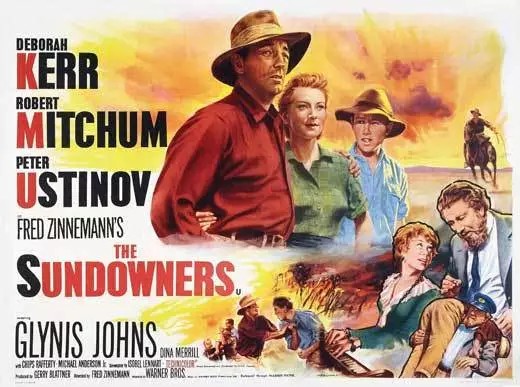
It’s worth killing off the canard that Kerr only gained top-billing in this picture thanks to the generosity of Robert Mitchum. In fact, Kerr was by far the bigger star. She had been top-billed in Heaven Knows Mr. Allison ahead of Mitchum, The King and I (1956) ahead of Yul Brynner, Count Your Blessings (1959) ahead of Rosanna Brazzi, The Journey (1959) ahead of Brynner again, Bonjour Tristesse (1958) ahead of David Niven, Tea and Sympathy (1956) and The End of the Affair (1955) ahead of Van Johnson. She only ceded top billing to the likes of William Holden and Cary Grant (An Affair to Remember, 1957). Although many commentators these days assume that Elizabeth Taylor was the top British star of the decade, Kerr was easily her equal and outranked her – five versus two – in terms of Oscar nominations.
In fact, in terms of marquee appeal, Robert Mitchum could not compete with Kerr. Heaven Knows Mr. Allison was his biggest hit since River of No Return (1954) with Marilyn Monroe. The work with which he is most commonly associated, Night of the Hunter (1955), was a flop, and he was in the main reduced to a diet of westerns and war films.
He was more associated with the wrong sort of headlines than box office. His previous film The Night Fighters / A Terrible Beauty (1960) attracted more attention from journalists for his fight in a bar than from audiences. But Zinnemann was a fan and had tried to hire him for From Here to Eternity.
Mitchum’s notoriety went ahead of him and at the airport he was deluged by reporters, most determined to know, for such a renowned hard drinker, what he thought of Aussie beer. He crossed swords with journalists a few days later, complaining that he was misunderstood and nothing like his screen personality. “I’m no tough guy,” he argued, “all the public knows is some silver, chromium-plated jerk. How could they know what I’m really like?” When he pointed out that his marijuana bust had been expunged from the record, one frustrated newspaperman recorded, “He isn’t a jailbird, he isn’t a drunk, he isn’t a brawler.”
Mitchum had no trouble with cast and director. Zinnemann was astounded by the actor’s mastery of the accent, pronouncing it “perfect” and adding “he had the uncanny knack of making any accent sound as though he had been born with it.” Mitchum and Kerr renewed their non-sexual love affair. “It was an honor to feed her lines,” said Mitchum. Zinnemann summed him up, “He has a problem with people who take themselves too seriously.”
But Mitchum was hounded by fans and autograph hunters. An audience gathered to watch him eat in local restaurants, his mood not helped by the solitary confinement imposed when rain prevented filming. One journalist, having inveigled his way into Mitchum’s rented home, was astonished to discover the actor could cook. Jon Cleary sprung to his defense. “Robert Mitchum is anything but a droopy-eyed slob once you get to know him. He is extremely well read and writes beautiful poetry.
When it came to horses, Ustinov was the bigger problem. “He was scared of them and they of him,” said Zinnemann, “and the moment he got in the saddle he would forget all his lines.”
Shooting a bush fire was relatively straightforward since they were a “frequent and devastating occurrence”, so the second unit simply flew near to the area in question, hired a taxi and started shooting. But these fires, fueled by the eucalyptus trees they were burning, moved at terrific speed, jumping along the tops of trees “and scattering their burning fragments fast and wide like projectiles.” But if the fire suddenly switched direction – and it moved at 30 miles per hour – there was a danger, as once occurred, that the crew could be cut off.
When the unit headed for Port Augusta in the south, it was a 45-minute commute to the sheep station at Iron Knob where many scenes were shot. Mitchum had had enough of being an object of curiosity and chartered a luxury cruiser, although he was still fending off young ladies who took to swimming out to the boat.
There was little scenic in the journey to the location. “The dust flew along the whole road,” said co-star Dina Merrill, and Mitchum was taken aback by the size of the sheep and found daunting the task of shearing a 400lb Merino sheep in one go. One mistake and you could cut into a vein and the animal would bleed to death. Mitchum relied on Dutch courage. Interiors were filmed in the more hospitable atmosphere of a London studio. There was an unwelcome sting in the tail for Mitchum – he was sent a tax demand from the Australian authorities which he refused to pay.
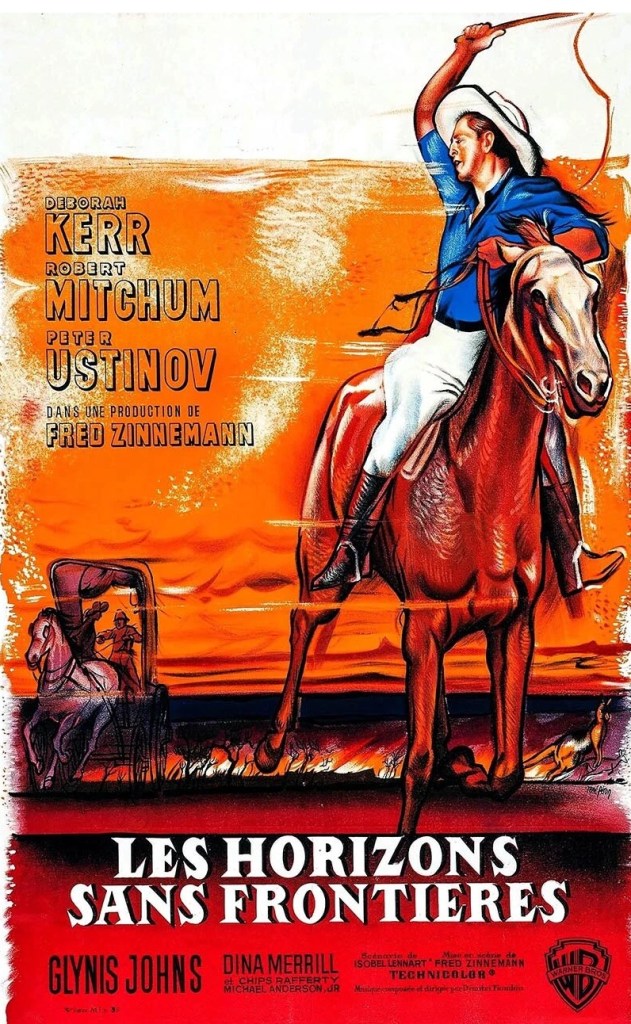
Although Jack Warner had given his assent to the overseas shoot, he was incapable of directing the advertising department to produce a poster that didn’t focus on the notion that this was the frisky Deborah Kerr of From Here to Eternity, “a highly-sexed lady who could harldy wait for the sun to go down so she could lay her hands on Bob.” Audiences were naturally disappointed when the projected love affair failed to materialize.
While the critics were generally in favor of the movie and audiences in the U.S. big cities responded well, its attraction faded as it set out across the U.S. However, it did better abroad and not surprisingly was a massive hit in Australia. Mitchum and Kerr re-teamed for Stanley Donen comedy The Grass Is Greener (1960) – with Kerr again billed before Mitchum.
SOURCES: Eric Braun, Deborah Kerr (WH Allen, 1977) pp173-177; Lee Server, Robert Mitchum, Baby I Don’t Care (Faber & Faber, 2001) pp422-429; Fred Zinnemann, An Autobiography (Bloomsbury, 1992) pp173-183.
I kept waiting for Deborah Kerr to turn up and it was a good 20 minutes before I realized that the actress had so immersed herself in the dowdy Ida Carmody that she was turning in what would be recognized as an Oscar-nominated performance. I was less convinced by Robert Mitchum’s Oirish accent but after a time, he, too, buried his normal screen persona under a feckless wanderer. And I was expecting some meaningful point-making stuff from director Fred Zinnemann given he had nursed home such purposeful features as High Noon (1952), From Here to Eternity (1953), A Hatful of Rain (1957) and The Nun’s Story (1959) and would soon be heading back in that virtue-signalling direction with Behold a Pale Horse (1964) and A Man for All Seasons (1966). However, like Day of the Jackal (1973), though for other reasons, this is very much an outlier in the Zinnemann portfolio.
It’s groundbreaking work from the stars. In the first place, Deborah Kerr does the unthinkable for a star of her magnitude – five Oscar nominations so far and a string of hits including From Here to Eternity, The Proud and the Profane (1955) opposite William Holden, The King and I (1956) top-billed ahead of Yul Brynner, An Affair to Remember (1957) opposite Cary Grant and Heaven Knows, Mr Allison (1958) leading Robert Mitchum a merry dance. Here, she is shorn of make-up. Her freckles are everywhere and her cheekbones look as if they are there from hunger not for reasons of fashion. These days, that down-to-the-wire approach would suggest an actress desperately trying to revive her career – Demi Moore in The Substance (2024) or Pamela Anderson in The Last Showgirl (2024) – rather than a star at the top of her game.
Robert Mitchum, too, dumps his screen persona, and provides his most relaxed and naturalistic performance.
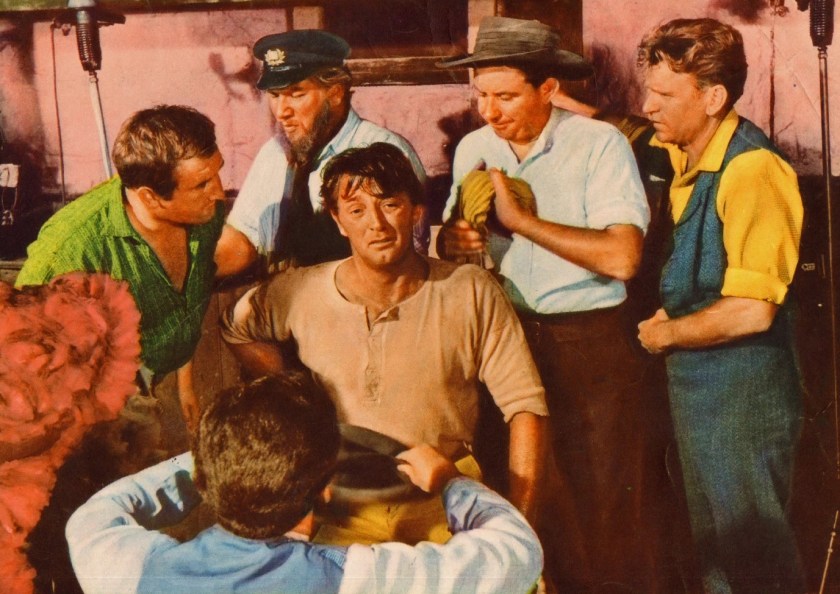
The story is pretty straightforward. Ida wants to settle down, husband Paddy (Robert Mitchum), a born drifter, does not. Paddy enjoys drinking and gambling and wandering through the Australian Outback and ekes out enough as a drover to keep them solvent. The plot, therefore, is episodic. But what could have been a series of loosely-linked sequences is held together by a concentration of the reality of an existence revolving around sheep – droving, shearing, rearing – and trundling along in a horse-drawn caravan, putting up a tent at night, cooking over an open fire, other aspects bordering on the primitive. You can be sure that every minor triumph will be torpedoed.
You could be forgiven for thinking that Wyler had set out to make a western what with the preponderance of sweeping location. Make it sheep instead of cattle and you have Red River (1948) in a minor key with the usual shenanigans once the drover makes his destination.
Livening up proceedings are equally responsibility-resistant itinerant Rupert Venneker (Peter Ustinov), whose more basic skills including pugilism belie his posh accent, and innkeeper Mrs Firth (Glynis Johns) who makes a good stab at trying to hold onto him.
The bulk of the emotion plays through the eyes of Ida, desperately trying to save up enough money to buy a house. A bushfire that temporarily separates the couple unexpectedly acts to strengthen their relationship. While Ida is helping deliver a baby, Frank is getting roaring drunk. The tension between the pair is also a metaphor for growing civilization out of a wilderness, the men who tamed the land becoming redundant, a new educated class taking over. Ida wants to be settled to provide her ambitious son Sean (Michael Anderson Jr) with an education as much as she doesn’t want to be a traveller in her old age.
Offers much about a civilization in the making still relying on the old-timers to put in the hard yards while the guys doing all the work don’t have the sense to seek greater or more stable reward. What’s life if it doesn’t go wrong once in a while? Freedom is its own reward. As Paddy points out, he has no restrictions, the entirety of Australia is his bailiwick.
Wyler makes much of what he’s got, the tensions between the couple undercutting the strength of their affection for each other, and just when it looks as if Ida has got her way Paddy manages to cut loose and destroy her dreams.
There’s drama a-plenty, not just the terrifying bushfire, but a pretty engrossing horse race or two. Paddy’s idea of heaven is to hold court in a saloon singing old Irish songs. Sometimes Ida has little but heartbreak to nurse her along.
And while the various episodes make it a tidy drama, really it’s what one critic described as “a no-story movie – an observation of life” and in that regard more concerned with fallibility and vulnerability. Had it been made by a European director, it would remain one of the most talked-about movies of the decade.
Wyler keeps up a tidy pace. Deborah Kerr (The Arrangement, 1969) steals the show and her peers agreed, putting her up for an Oscar, but it was a close-run thing because Glynis Johns (The Cabinet of Caligari, 1962) was also nominated. Peter Ustinov (Topkapi, 1964) was equally impressive, as was Robert Mitchum (El Dorado, 1967). Wyler was also nominated as was screenwriter Isobel Lennart (Fitzwilly / Fitzwilly Strikes Back, 1967) adapting the Jon Cleary bestseller.
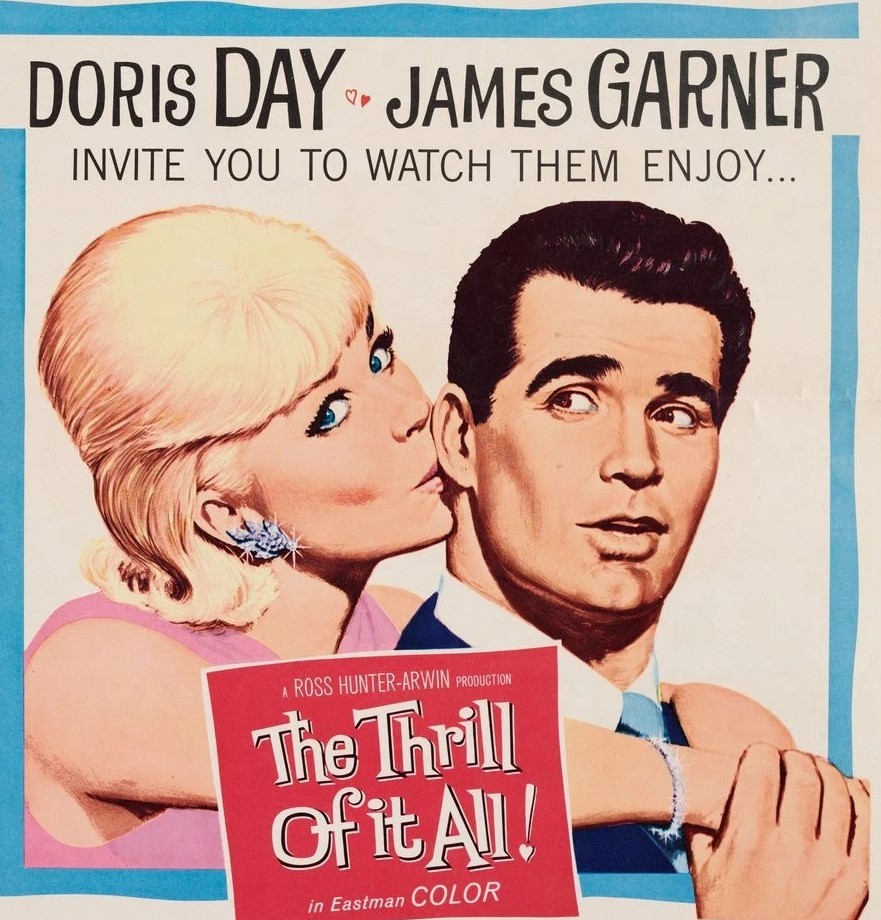
Has three unusual distinctions for a Doris Day comedy. First of all, it’s feminist. Secondly, it’s prophetic. Third, and perhaps most interesting of all, is that it plays exactly into expectations – for completely different reasons – for audiences sixty years apart. Only the ending would split the audiences.
And this is a somewhat mature Doris Day. Having shucked off Rock Hudson and Cary Grant, she was no longer stuck in a relatively mindless, however charming, love story following the usual formula of girl-meets-boy girl-loses-boy girl-gets-boy. Here she’s contented housewife Beverly Boyer married to successful obstetrician Dr Gerald Boyer (James Garner) with two kids apt to cause disruption but whose main purpose, equally unusually, is to make caustic comment about grown-up behavior. There is one magnificent outlandish set-piece involving soap powder but the slapstick is toned down and there’s a gentle satire of the television industry and advertising.
There’s only one downside to the marriage, her husband is being called out at all hours to deliver babies and that’s such a worthy calling what decent wife could complain about such absences even if it means spoiled dinners and missing events.
However, everything is turned upside down when by pure chance Beverly takes on the role of becoming the onscreen spokesperson for a brand of soap called Happy Soap. This being in the days of live television – so this is set strictly in the 1950s hence the more pronounced tone of a woman’s place being in the home – she has to do the advertisement live on air and her fumbling and inexperience touch a chord with audiences who respond with such vigor that she is offered a contract that puts her in the position of earning substantially more than her husband. How dare she?
Naturally, the demands placed upon her by the advertising company turns the domestic tables. She’s the one coming home late and he’s the one seen as her adjunct. The soap powder boss is so determined to keep her he fulfills every whim – even when such wishes are not made with any seriousness. So she wakes up one morning with a swimming pool in the back yard which virtually demands that a car drive straight into it.
The battle of the sexes comes down a battle of women’s rights (yes, they are mentioned) against men’s rights, in other words freedom vs toeing the line. Rather than delighted at her extra dough, he’s infuriated that she’s infringing on his perceived role as being the sole provider for the family.
Eventually, he decides the only way to bring her to her senses is to arouse her jealousy by being seen in the company of other women. But that only works up to a point. And she only gives in when she is made to realize – by the only narrative misstep as far as the contemporary audience is concerned – that his job is much more important than hers.
While this is the first of two pairings – the other being Move Over, Darling the same year – between Doris Day and James Garner (Hour of the Gun, 1967) is lacks the purer screen chemistry she found with Cary Grant and Rock Hudson and you feel the plot has been written to accommodate this deficit. There’s little requirement for intimacy or proper wooing, much less for the misunderstandings that fueled the previous pairings.
Doris Day’s haplessness is put to a different use, as it is initially the reason why she proves so appealing to television audiences.
Whether women in the 1960s had to keep to themselves their rooting for the career women in Beverly being given a chance to shine, or whether – the beginnings of the modern feminist movement dating from the publication of The Feminine Mystique by Betty Friedan published in 1963 – she was seen as a poster girl for the movement I’m not qualified to judge.
These days, however, Beverly would be viewed as an early champion of women’s rights and that, regardless of how important it was that a man tasked with delivering babies had a woman at home to make his dinner and mop his brow, his demands should not take priority.
While there aren’t as many outright laffs as in previous Doris Day comedies, the feminist angle provides the picture with an unusual worthiness, not something you’d go looking for in Day’s portfolio.
Directed by Norman Jewison (The Thomas Crown Affair, 1968) and written by Carl Reiner (The Art of Love, 1965).
Passage of time has made this more important than the material might suggest. Gets extra marks for serious intent.
I’ve never been a big fan of either Jude Law (Firebrand, 2023) or Jason Bateman (Game Night, 2018) so I admit I’m coming to this Netflix series with some hesitation. Despite his deuce of Oscar nominations I’ve never been convinced by Jude Law as an actor – he always seems to me one of the actors who “acts.” And sticking a beard on Jason Bateman and growing his hair long does not turn him into a badass. He’s directing himself here, at least for the two opening episodes, so I’m not sure he’s cracked that skill either.
And I can’t be the only one fed up with these movies or series that start at the end. You get some decent piece of action – here a robbery – and no sooner have you become interested than the action stops dead and up pops the legend “one month earlier” or “one week earlier” or “one day earlier” as if someone has got it into their heads that that automatically adds a hefty dose of tension.
So, basically, this looks like some sort of whodunit. Not revolving around murder as would normally be the case. But around the aforementioned robbery which has the hallmarks of an inside job. Possibly the finger won’t point at Jake Friedkin (Jude Law) who is after all the restaurant co-owner. More likely, you’d suspect his hustler brother Vince (Jason Bateman) who you learn in short order has stolen his father’s collection of rare coins, taken out loans against the family property, killed a guy and owes $140,000 to loan sharks.
But that last large debt brings Jake solidly into the frame. He’s had to, according to one of those unwritten laws that get trotted out at convenient times in gangster pictures, assume his brother’s debt. Worse, he’s not able to pay his own bills, a born hustler, has his eye on a bigger prize and just has to raise the presumably insignificant sum of $5 million to set up another more upmarket operation in a building built by Mies van der Rohe (famous architect in case you don’t know).
He’s planning to take his head chef Roxie (Amaka Okafur) with him so you’d think she wouldn’t bear a grudge. But, in fact, she’s pretty pissed off at her boss because he’s taken no action to prevent the sexual predatory activities of his partner Wes (Sope Dirisu), a successful recording artist who drinks the place dry (of high-priced champagne I should add). Wes has raped bartender Anna (Abbey Lee) and she’s been sacked and already taking revenge on TikTok.
Hey guys, I’d just like to point out that two guys running ain’t exactly poster material.
Jake has hired Wes’s interior designer girlfriend Estelle (Cleopatra Coleman) to give the new place a decent lick of paint, but Wes, who’s not in on the deal, has discovered his partner is soon going to be his ex-partner.
So from there on, every possible attempt to jack up the stakes occurs. Vince wins enough ($150,000) at the gambling tables to pay off his debt, but that wouldn’t make much of a story nor be true to his character, and he loses it all. And when the sale of the family property falls through he’s back to square one and the digital accounting begins – as in digit accounting as a hot-headed gangster saws off his little finger. Oh, and promises that next on the hit list would be Vince’s estranged daughter Gen (Odessa Young) a tattoo artist.
There’s a big chunk of back story to be fitted in. Jake was originally Wes’s manager, Vince was responsible for coming up with the idea of turning a derelict dump into a trendy bar and restaurant. So emotional debt is owed all round never mind the $140,000 outstanding plus whatever else Jake has clocked up.
So part The Bear, part sub-Scorsese with psychopathic hoods, and part the double-dealing that comes with running any business and soon enough I guess there will be a proper murder to deal with because glancing down the cast list I see a detective so that will be more suspects.
I’m not entirely sure there’s enough here to keep me pinned down in my seat for another six episodes. And part of the problem, I guess, is the all-action beginning which had me believing this wouldn’t just degenerate into a slow, draggy family saga (more family based than usual given the restaurant we are told is one big family). Created by Zach Beylin (Creed III, 2023).
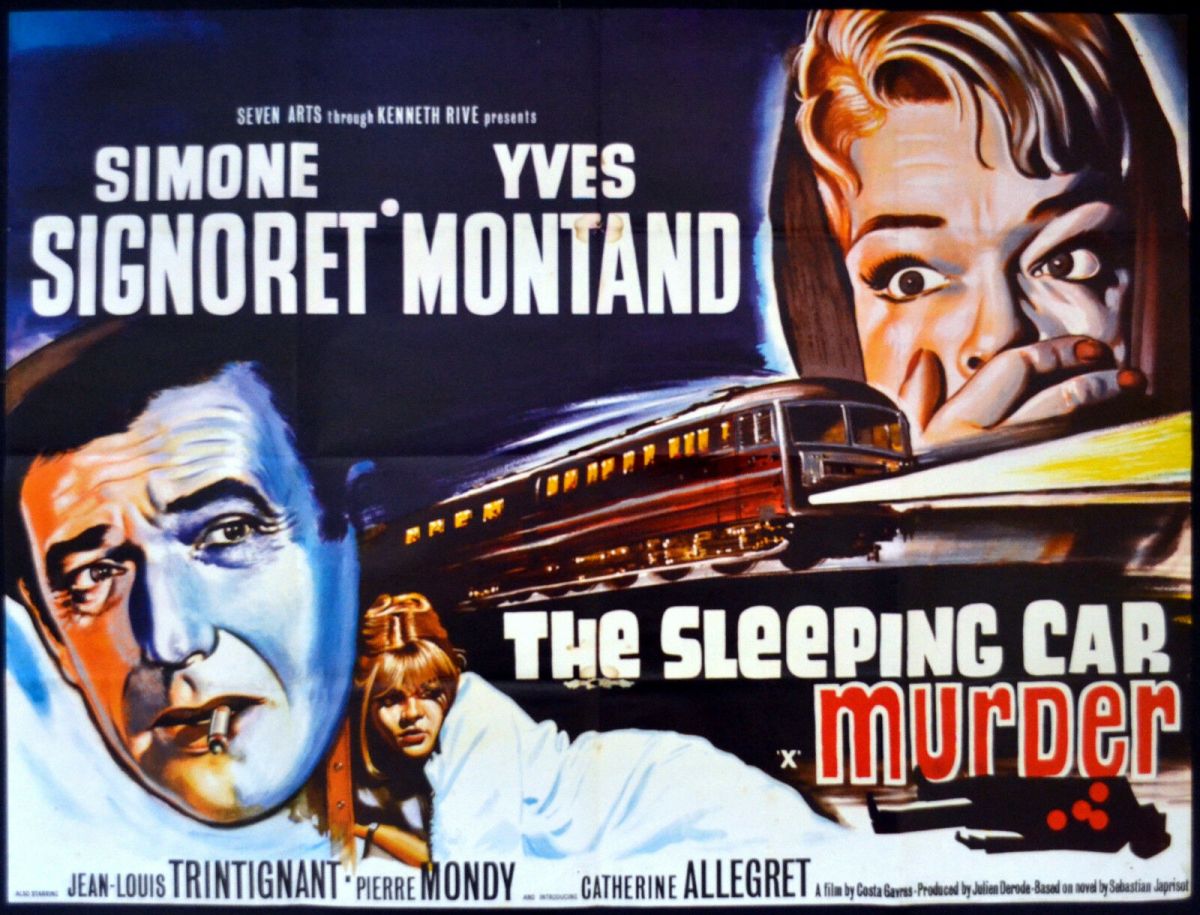
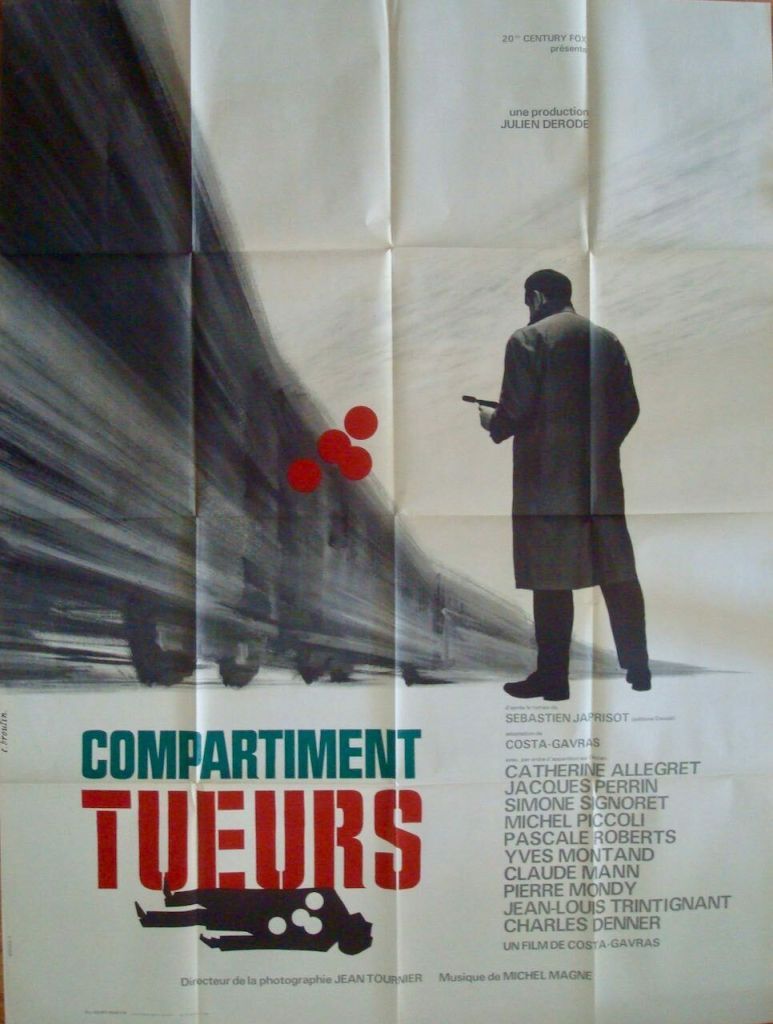
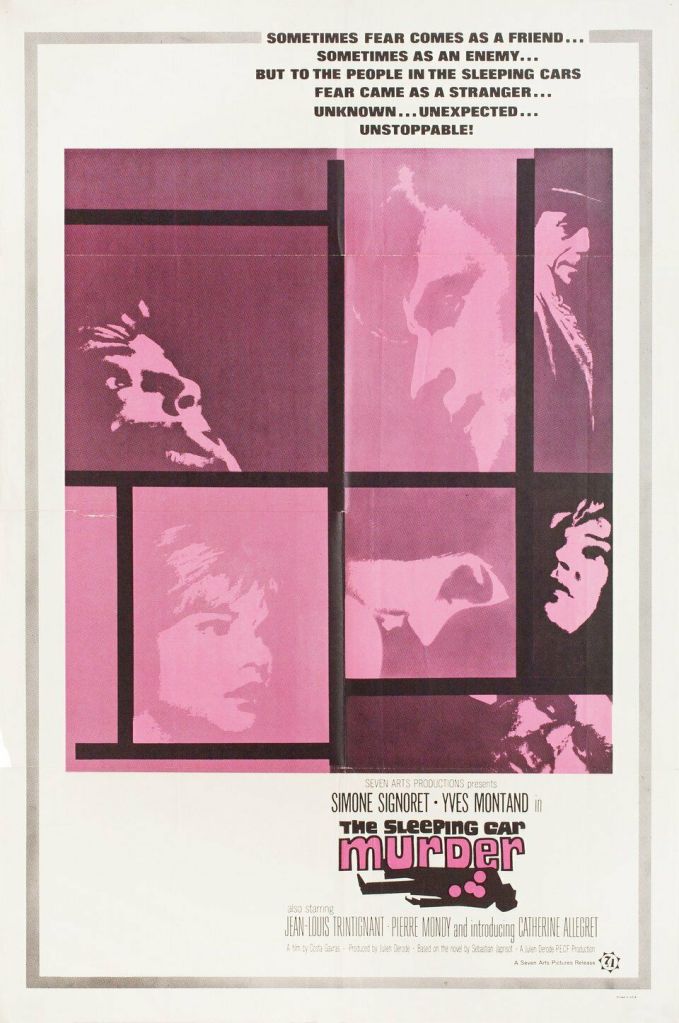
Absolutely brilliant thriller. Even after a half a century, still a knock out. A maniac on the loose, baffled cops, glimpses into the tattered lives of witnesses, victims and relatives, told at break-neck speed by Greek director Costa-Gavras (Z, 1969) on his debut and concluding with an astonishing car chase through the streets of Paris. Not just an all-star French cast – Yves Montand (Grand Prix, 1966), Oscar-winner Simone Signoret (Is Paris Burning?, 1966), Jean-Louis Trintignant (Les Biches, 1968) and Michel Piccoli (Topaz, 1969) – but directed with a Georges Simenon (creator of Maigret) sensibility to the frailties of humanity.
As well as the twists and turns of the narrative, what distinguishes this thriller are the parallel perspectives. Where most whodunits present an array of suspects, inviting the audience to work out the identity of the killer, here virtually all the characters are presented both objectively and subjectively. Some are delusional, others highly self-critical, occasionally both, and we are given glimpses into their lives through the characters’ internalized voice-over and dialog.
Tiny details open up worlds – the wife of a dead man bewailing that he would not be able to wear the fleecy shoes she had just bought him to keep out the cold during his night-time job, a policeman revealing he wanted to be a dancer, a vet who wants to create a new breed of animals, a witness whose parents committed suicide. But just as many, the flotsam and jetsam of the police life, irritate the hell out of the cops: Bob Valsky (Charles Denner) constantly berates their efforts, relatives bore the pants off their interviewer, not to mention self-important police chief Tarquin (Pierre Mondy) who has an answer for everything.
A young woman Georgette (Pascale Roberts) is discovered dead in the second-class sleeper compartment of a train after it has pulled into Paris. Initial suspicion falls on the other occupants including aging actress Eliane (Simone Signoret) in the thrall of her much younger lover Eric (Jean Louis Trintignant), impulsive blonde bombshell Bambi (Catherine Allegret), low-level office worker Rene (Michel Piccoli) and Madame Rivolani (Monique Chaumette). Weary Inspector Grazziani (Yves Montand), suffering from a cold and wanting to spend more time with his family, is handed the case. But before he can interview the suspects, they start getting knocked off.
So convinced are the police of their own theories that they ignore the testimony of Eliane and instantly home in on fantasist Rene, treated with contempt, a dishevelled lecherer who on the one hand misinterprets signals from women and on the other realizes that no one in their right mind would ever date him. Eliane is tormented by the prospect of being abandoned by her controlling lover.
It’s a race against time to find the passengers before the killer. In the middle of all this there is burgeoning romance between Bambi and clumsy mummy’s boy Daniel (Jacques Perrin), who may well hold the key to the murders. Their meet-cute is when he ladders her stockings.
I won’t spoil it for you by listing all the red herrings, surprises, mishaps, tense situations and explorations of psyche, but the pace never abates and it keeps you guessing to the end. And while all that keeps the viewer on tenterhooks what really makes the movie stand out is the depiction of the inner lives of the characters.
So often cast as a lover Yves Montand is outstanding as the diligent cop. Signoret captures beautifully the life of a once-beautiful woman who now enjoys the “empty gaze of men,” Trintignant essays a sleazier character than previously while Michel Piccoli who often at this stage of his career played oddballs invites sympathy for an unsympathetic character. Catherine Allegret (Last Tango in Paris, 1972) and Jacques Perrin (Blanche, 1971) charm as the young lovers. In tiny roles look out for director Claude Berri (Jean de Florette, 1986), Marcel Bozzuffi (The French Connection, 1971) and Claude Dauphin (Hard Contract, 1969),
Costa-Gavras constantly adds depth to the story and his innovative use of multiple voice-over, forensic detail, varying points-of-view, plus his masterful camerawork and a truly astonishing (for the time) car chase points to an early masterpiece. Sebastian Japrisot (Farewell, Friend / Adieu L’Ami, 1968) wrote the screenplay based on his novel.
Can’t remember where I got my DVD, perhaps second-hand, but there is an excellent print, taken from the 2016 restoration, available on YouTube.
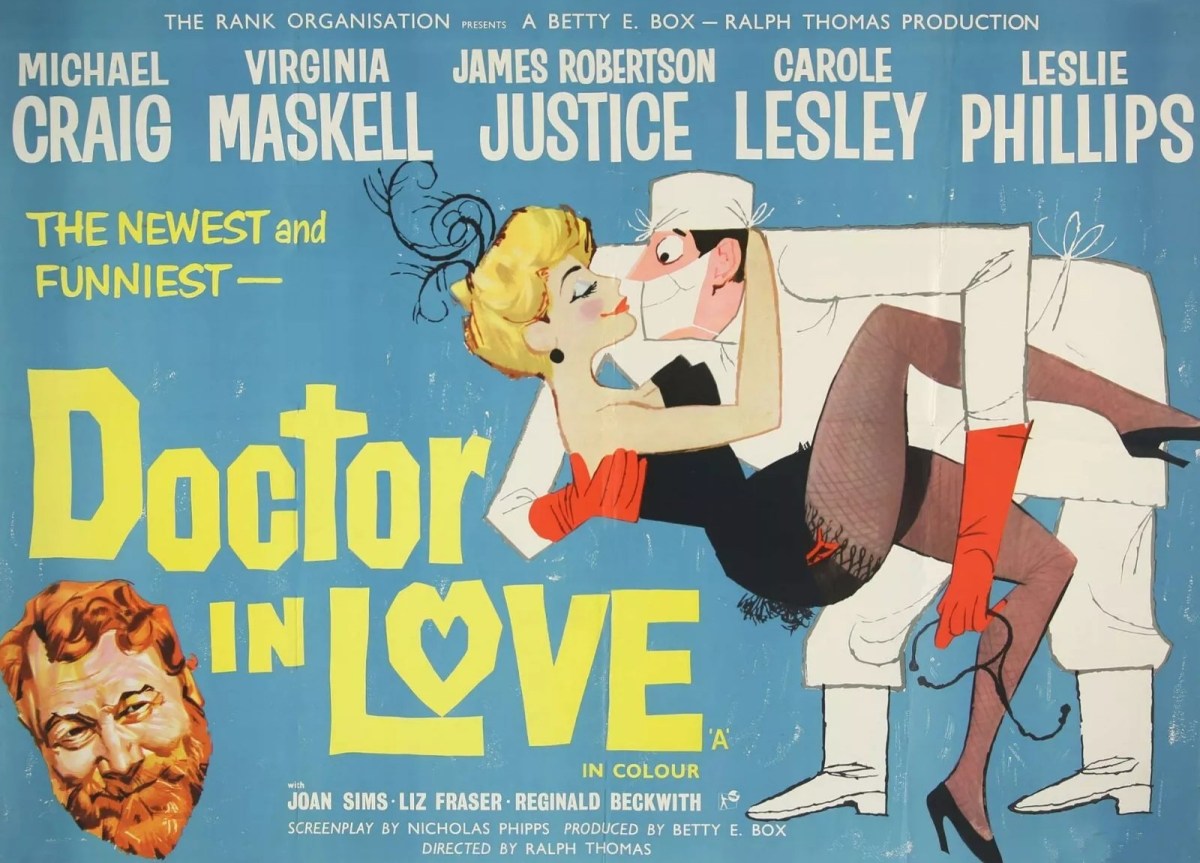
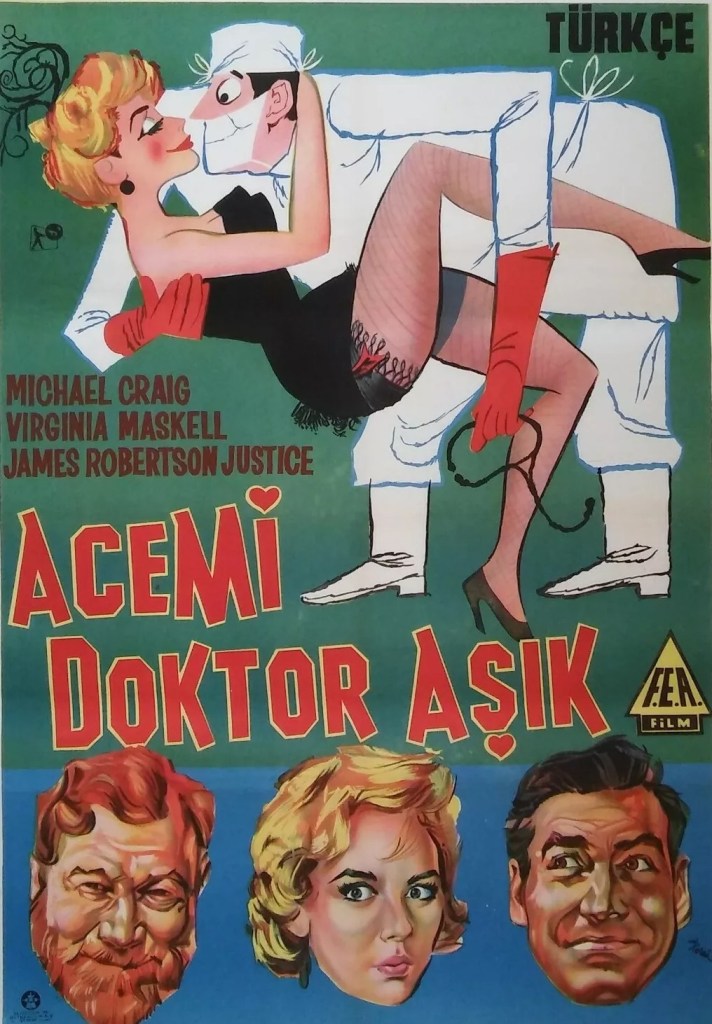
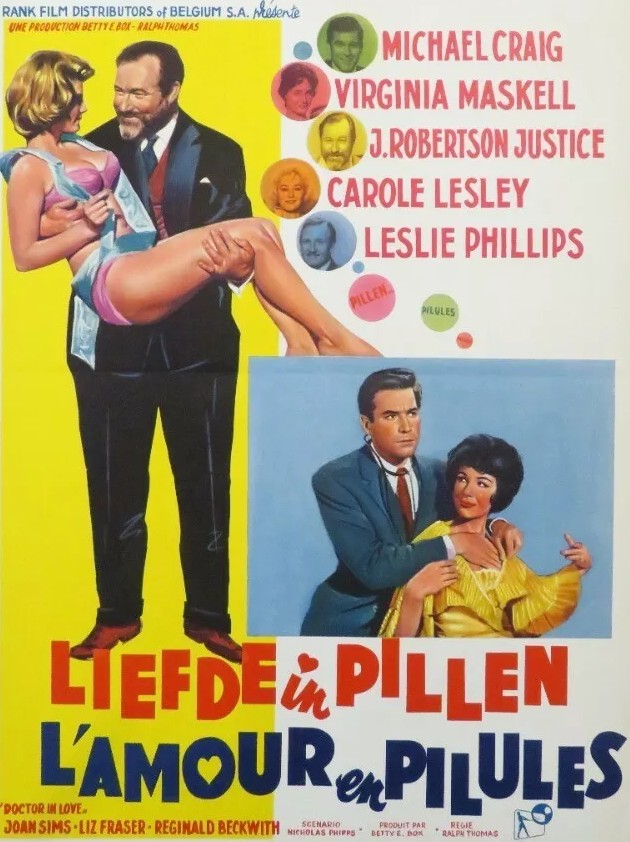
Chortled all the way through. You can see why it was the biggest film at the British box office in 1960. Dirk Bogarde had turned up his nose at repeating the character for the fourth time and went off to make more serious pictures like Victim (1961) which, it transpired, dented his box office appeal. Replacement Michael Craig (Mysterious Island, 1961), while brawnier, passes this particular screen test with flying colors though he has his work cut out to hold his own against such practised scene stealers as James Robertson Justice (Mayerling, 1968) and Leslie Phillips (The Fast Lady, 1962) and once Virginia Maskell (The Wild and the Willing, 1962) enters proceeding her coolness makes the camera her own.
I was surprised how much this relied on innuendo. But this is a gentler exercise in smut than the sniggering guffawing Carry On approach. And there’s little chance of it descending into misogyny since the females hold all the aces. The plot is episodic and none the worse for that and even a diversion into a strip club, which might suggest a narrative clutching at straws, proves a surprising highpoint.
Basic story shifts Dr Hare (Michael Craig) out of hospital and into general practice which provides ample comedic opportunity via patients and colleagues. But, first of all, just to confuse matters and as if the producers were worried the series might not survive outside the boundaries of St Swithins Hospital, the tale begins with him returning to hospital with what turns out to be jaundice.
Cue the booming interventions of Sir Lancelot Spratt (James Robertson Justice) and the first of the love stories wherein Hare and Dr Hinxman (Nicholas Parsons) are rivals for flighty Nurse Sally Nightingale (Moira Redmond), who, in the first of many knocks to the male ego, while playing off one against the other goes off with another man. Before she does, Dr Hinxman takes revenge by prescribing all sorts of medications which will leave Hare so indisposed he is unable to respond to the nurse’s ardor.
Back in civvy street, as a GP, Dr Hare has to fend off predatory female patients and secretary Kitten Strudwick (Carole Lesley) and deal with standard comedic issues such as the boy who gets his head jammed in a cooking pot and the less common task of explaining the facts of life to a 40-year-old virgin. His boss Dr Cardew (Nicholas Phipps) is under the thumb of a wife who has shipped out to California only to summon her husband every now and then. The ever-amorous Dr Burke (Leslie Phillips) fills in and is the prime mover in an episode that involves strippers Dawn (Joan Sims) and Leonora (Liz Fraser). There’s a particularly good reversal in a drunken scene where the totally inebriated Wildewinde (Reginal Beckwith) completes all the police drunk tests (if that’s what they’re called) with ease.
When Dr Burke is incapacitated, his place is taken by Dr Nicola Barrington (Moira Redmond). And that should have been enough of a plot to see the picture through but the movie doubles down on complication. Dr Barrington fends off Dr Hare and when Nurse Nightingale reappears Barrington in due course quits. Dr Spratt is also on board for further scene-stealing duties including ruling the roost in a strip club and undergoing an operation.
The romantic situation is resolved, Dr Spratt is put in his place temporarily and our hero effects a return to the hospital.
I wouldn’t say the writing (by Nicholas Phipps) is of the highest caliber but the jokes come at an assembly line pace and the cast are superb, barely a cast member incapable of stealing a scene. You hire James Robertson Justice and Leslie Phillips at your peril. Without Dirk Bogarde hogging the scenery, this flows much better than others in the series, with the supporting cast being more than just foil to a star who was a major box office attraction at the time. And it helps that the women – Moira Redmond (Nightmare, 1964), Virginia Maskell, Carole Lesley (Three on a Spree, 1961), and Carry On regulars Joan Sims and Liz Fraser – are even more adept at scene-stealing than the men and not merely foil for misogynist jokes as in the Carry On series.
Director Ralph Thomas (The Wild and the Willing) seems to have found a new lease of life without having to deal with Dirk Bogarde and brings a certain verve to proceedings, especially in tripping up male ego.
Comedy is such an odd one to judge. Many a time I have sat through with scarcely a titter movies I’ve been told are hilarious. Other times I’ve been told to give them a free ride because they are making a point. So I stick to my own rule.
Make me laugh – I don’t care how – and this had me laughing all the way through.
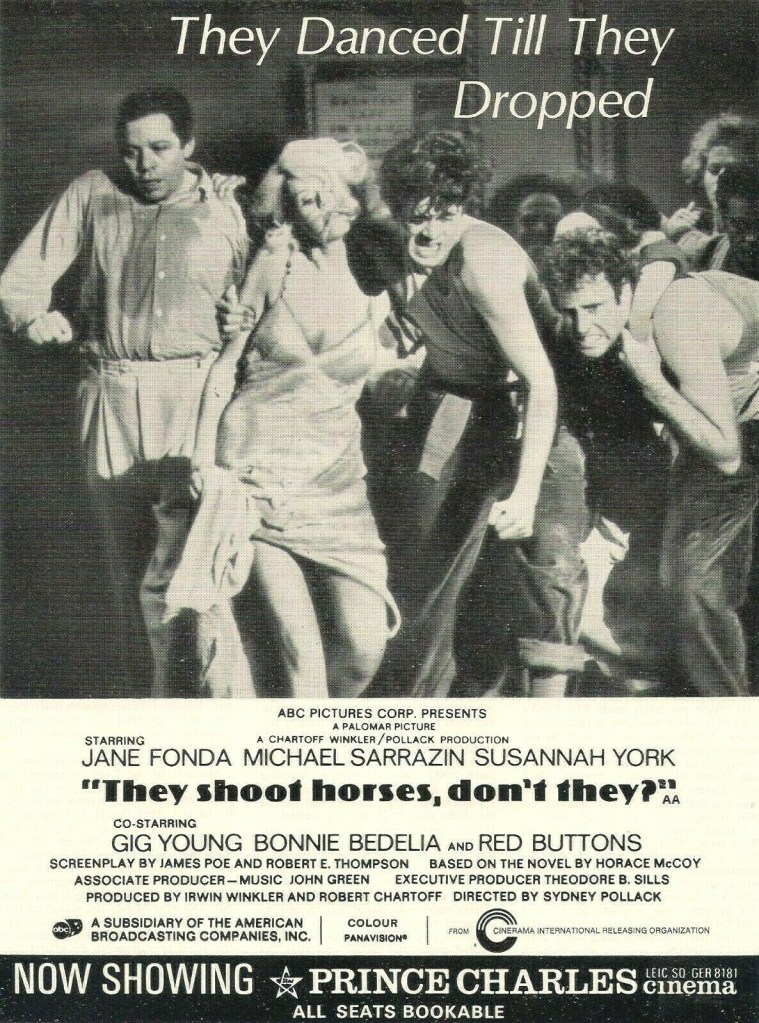
Fans of reality television shows will be only too aware how participants volunteer for ritual humiliation, but swallowing a few locusts and being stuck with a couple of snakes has nothing on the realities facing individuals during the Great Depression who would literally dance non-stop for days on end with a ten-minute break every two hours. It’s impossible to imagine that anybody could think of dreaming up such a degrading circus to take advantage of the desperate. But then this is America, land of opportunity and the MC Rocky (Gig Young) continues to spout aphorisms and continues to promote the American Dream even as it disintegrates in front of him.
When the partner of Gloria (Jane Fonda), out-of-work actress and one of the more physical and cynical of the candidates hoping to scoop the $1,500 first prize (no prizes for coming second, of course), is ruled out through bronchitis – in case he passes it on to others rather than more any humane consideration – she pairs up with dreamer Robert who initially wanders in as spectator rather than participant. Glamorous platinum blonde aspiring actress Alice (Susannah York) is already coming apart. Sailor (Red Buttons) is a former war hero and James (Bruce Dern) drags his heavily pregnant wife (Bonnie Bedelia) around the dance floor.
There is not a great deal of story except to watch everyone grow mentally and physically incapacitated. There is betrayal and lust and survival instinct leads characters into sexual situations. When Alice seduces Robert, in retaliation Gloria dumps him and then has sex with Rocky, while attempting to retain control of that situation, but clearly needing at the very least consolation and confirmation of her attractiveness and at best some sign of favoritism.
As well as non-stop dancing, Rocky throws in stunts to keep the audience, who can sponsor a pair, interested. So there are 10-minute races, the last three to be eliminated. So determined are some of the competitors they will even lug their dead partner over the finishing line. Another of Rocky’s wheezes is to have Gloria and Robert marry, worth $200 in terms of the gifts they will receive from a sentimental audience, in the middle of the dance floor.
They are literally dancing for hours, over 1,000 in over 40 days so gradually the dance floor becomes less crowded as dancers collapse from exhaustion or cannot take it anymore. The spectators, we are reminded, are only there because “they want to see someone worse than them.” Just when you think nothing can shock you any more, it is revealed that the first prize is minus the cost of feeding, sheltering and looking after the winner.
Those who think they are tough find that the demands of mental and physical endurance are beyond them. This is a shocking film and there’s no doubt it will stay with you for a long time. I saw it first when it came out but not again until now and thank goodness for forgetfulness otherwise I doubt if I would have chosen to sit through it again.
It’s doubtful if any actress had achieved such a speedy transition from glamorous leading lady to serious actress as Jane Fonda. From stripping in space in Barbarella (1968) to stripping away the last vestiges of her humanity here. Suddenly, she appears in a brand-new screen persona with the grating voice, the chip on the shoulder, the feistiness and worthy inheritor of father Henry’s acting genes. It’s also a bold role for Susannah York, in an extension of the weak character she essayed in Sands of the Kalahari (1965) but far more delusional, believing in a rainbow that will never appear. Michael Sarrazin (In Search of Gregory, 1969) initially appears out of his league but his character calls for a gentle innocence that is well within his scope.
Gig Young steals the picture, offered the opportunity to bring alive a multi-faceted character, as big a spiel-merchant who ever crossed the screen, but engaging in a marathon of optimism, and at some points, such as when coaxing a demented Alice out of the shower, earning our sympathy. Red Buttons (Stagecoach, 1966), Bruce Dern (Castle Keep, 1969) and Bonnie Bedelia (Die Hard, 1988) also put in sterling work.
The movie received nine Oscar nominations but was ignored in the Best Picture category. Only Gig Young won for Best Supporting Actor. Jane Fonda and Susannah York both received their first Oscar nominations, for Fonda the first of many, for York the one and only. It was also a debut nomination for Pollack, a future winner.
Sydney Pollack directs with simplicity, concentrating on the indignities of the event and focusing mostly on the personalities draining away, and even the drama is undercut, most of those scenes directed in straightforward style. However, Pollack plays around with the innovative fast forward – flashes into scenes that have not yet taken place. James Poe (Lilies of the Field, 1963), at one time down to direct, and Robert E. Thompson, a television writer making his first venture on the big screen, wrote the screenplay from the Horace McCoy novel.
Check out the Behind the Scenes article on this one.
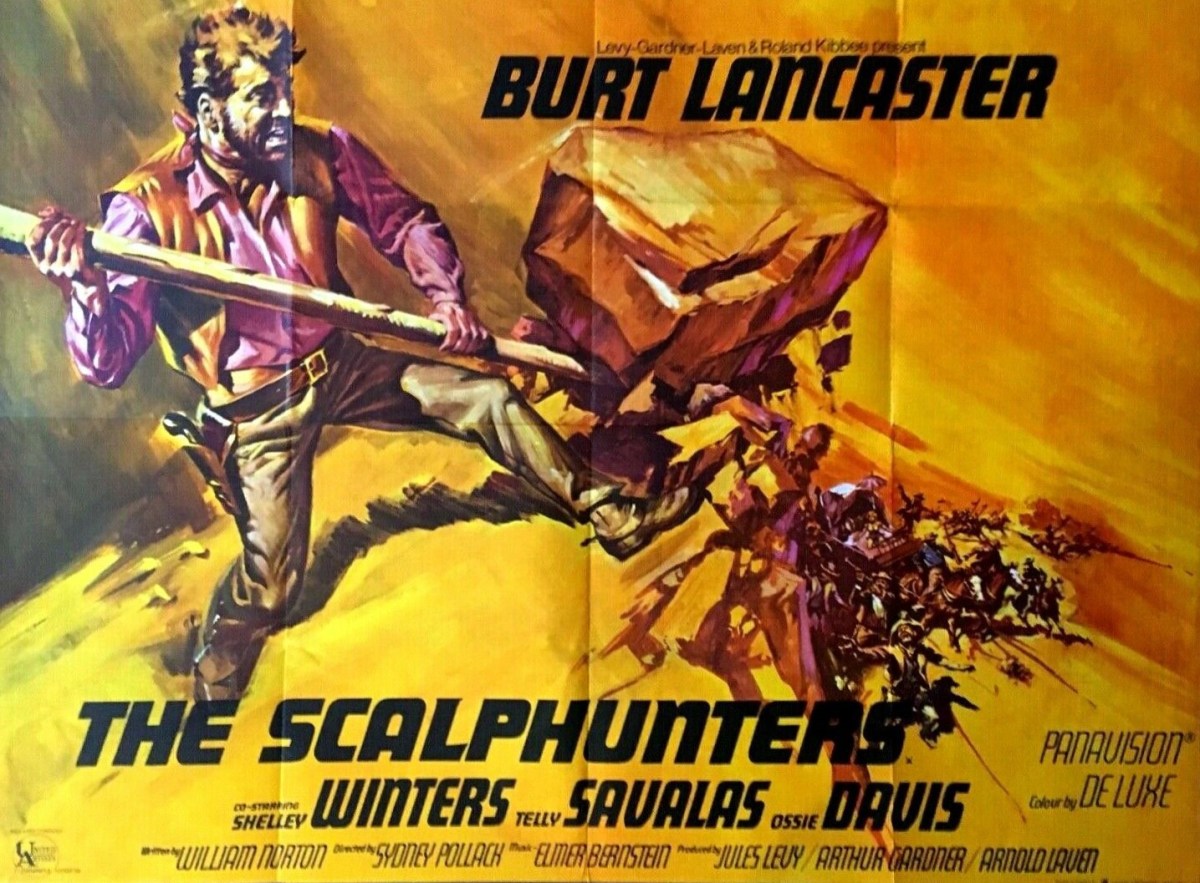
If ever a film deserves reassessment, this is it. This western, marketed as a vehicle for Burt Lancaster in the wake of hugely successful The Professionals (1966), sees the star playing cussed trapper Joe Bass trying to retrieve furs stolen first by Native Americans and then by outlaws. That the serious race issues tackled here were dressed up in very broad comedy and typical western action ensured it missed out on the kind of recognition that critics would assign a straightforward drama and lost its rightful place as a pivotal picture of the decade.
In theory, a somewhat unusual Burt Lancaster western. In reality something else entirely. For large chunks of the movie Lancaster is absent as the story follows the fortunes of Black slave Joseph Lee (Ossie Davis) as he achieves not just freedom but genuine equality. Joseph is introduced as a slave of the Kiowa, left behind when the Indians steal Joe Bass’s furs. In compensation for his loss, Bass plans to sell Lee in the slave market in St Louis and in the meantime enrols him to help recover his furs.
However, a band of outlaws, specializing in collecting Native American scalps (hence the title) and selling them at $25 a time, get to the furs first as a by-product of a raid on the Kiowas. In pursuit with Bass, Lee falls into a river at the outlaw encampment and becomes the slave of Jim Howie (Telly Savalas) who also aims to sell him. Lee plans to escape until discovering Howie’s large troop is headed for Mexico where the slave would automatically become free. With clever talk, beauty-treatment skills and knowledge of astrology and ecology, Lee insinuates himself into the wagon of Howie’s paramour Kate (Shelley Winters).
With Bass still in pursuit, there are several excellent action scenes as the outnumbered trapper seeks to outwit Howie who turns out to be just as devious. But the main question is not whether Bass will recover his stolen property but which side will Lee pick. Will he act as spy to help Bass get back his furs or will he disown Bass and remain with the murderous genocidal gang who could provide a prospct of freedom? Either in the company of Bass or Howie, he is constantly reminded of his status, taking a beating from one of Howie’s thugs, Bass refusing to share his whisky because he views him not just as a slave who “picked his master” but as a coward refusing to fight back when attacked and beaten up.
The film comes to a very surprising ending but by that time through his own actions Lee is accepted as an equal by Bass and the issue of slavery dissolved. In effect, it is a tale of self-determination. Lee effects liberty by taking advantage of situations and standing up for his own cause.
Lee is one of the most interesting characters to appear on the western scene for a long time. Exactly where he acquired his education is unclear and equally hazy are how – and from where – he escaped and how he ended up as slave of the Commanches before they traded him to the Kiowa. However he came to be in the thick of the story, his tale is by far the most original. But he’s not the only original. The fearless Bass was an early ecological warrior with an intimate understanding of living off the wild, not in normal genre fashion of killing anything that moves, but in knowing how to find sustenance from plants. That in itself would endear him to modern lovers of alternative lifestyles.
Normally the derogatory term “scalphunters” would be reference to Native Americans, but here it is American Americans who exploit this market. Despite being the leader of a vicious bunch, Howie turns out to be a bit of a romantic and Kate a bit more interested in the world than your average female sidekick.
Director Sydney Pollack (The Slender Thread, 1965) does a marvelous job not just in fulfilling action expectations and taking widescreen advantage of the locations but in allowing Lee to take center stage when, technically, according to the credits, Ossie Davis was only the fourth most important member of the cast. Burt Lancaster was approaching an acting peak, following this with The Swimmer (1968) and Castle Keep (1969), happy to take risks on all three pictures, especially here where for most of the movie he is outwitted and ends up in a mud bath.
Both Telly Savalas (Sol Madrid, 1968) and Shelley Winters (A House Is Not a Home, 1964) rein in their normal more exuberant personas. Savalas, in particular, cleaves closer to his straightforward work in The Slender Thread than the over-the-top performance of The Dirty Dozen (1967). Winters, usually feisty, is here more winsome and vulnerable, apt to be taken in by sweet-talking men.
But Ossie Davis (The Hill, 1965) is the standout, his repartee spot-on. It is a hugely rounded performance, one minute wheedling, the next sly, boldness and cowardice blood brothers, and while his brainpower gives him the advantage over all the others he is only too aware that such superiority counts for nothing while he remains a slave.
It’s dialog rich and it’s a shame it wasn’t a big hit for that would have surely triggered a sequel – especially in the wake of the following year’s buddy-movie Butch Cassidy and the Sundance Kid – because the banter between Lee and Bass is priceless. For the dialog thank the original screenplay by future convicted gun-runner William W. Norton (Brannigan, 1975), father of director Bill Norton (Cisco Pike, 1971).
I always approach cult with some unease. You never know why a film has fallen into the category. It could simply be awful and resurrected with glee because someone has cleverly constructed a sub-genre called So Bad It’s Good – check out Orgy of the Dead (1965) or Can Hieronymus Merkin Ever Forget Mercy Humpeand Find True Happiness? (1969). Or it’s been a surprising flop first time round and discovered an audience through VHS and DVD – The Shawshank Redemption (1994) the forerunner in that field. But the plusses – well-made, great characters, some standout scenes – in the Stephen King adaptation were so obvious and the studio put a lot of dough behind re-marketing it to the at-home audience that it was not so surprising that it found a better response second time around.
But Harley Davidson and the Marlboro Man did not, as with The Shawshank Redemption, come garlanded with seven Oscar nominations, and the stars had considerably less marquee appeal and peer acceptance than Tim Robbins (The Player, 1992) and Morgan Freeman (Driving Miss Daisy, 1990). Mickey Rourke (9½ Weeks, 1986) and Don Johnson (The Hot Spot, 1990) had not only mostly blown their status in the Hollywood hierarchy but only seemed one newspaper headline away from further notoriety.
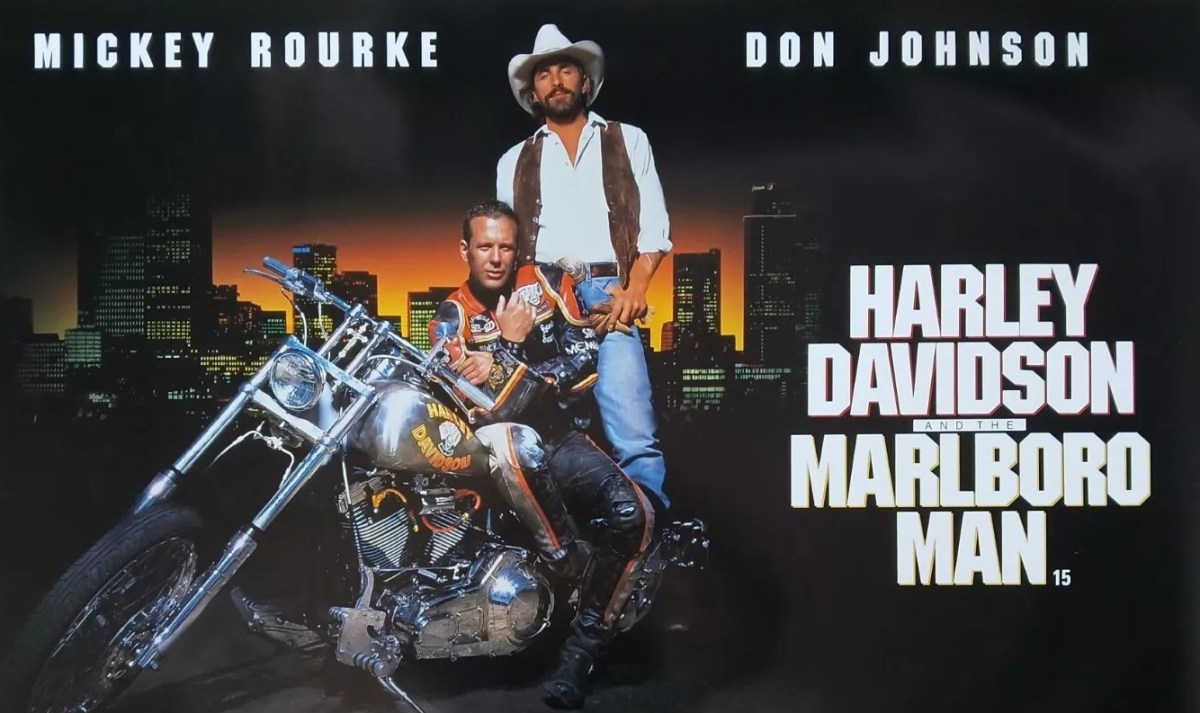
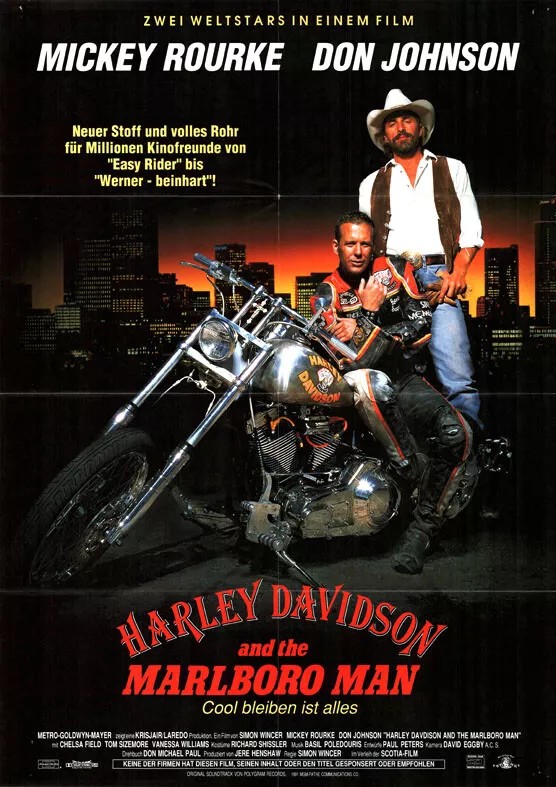
That it works – and so well- relies on mix of several ingredients. In the first place it’s a throwback to the buddy movie, the easy camaraderie between Harley Davidson (Mickey Rourke) and the Marlboro Man (Don Johnson) has obvious precedents from Butch Cassidy and the Sundance Kid (1969) and clearly is some kind of homage to the Paul Newman-Robert Redford picture since it pinches three of the elements that made the western such a box office smash.
Secondly, our fellas do bad for a good – if somewhat lopsided – reason so aren’t true criminals and, in any case, earn a get-out-of-jail-free card because it turns out they’ve robbed from proper bad guys. Thirdly, there’s a terrific robbery and street shoot-out. Fourthly, it draws on the spaghetti western in the costume department, repurposing the top-to-toe dusters into black leather, an idea that would be snatched up by the likes of The Matrix and quintet of bad guys toting machine guns and dressed in black picked up not only by The Matrix but also by Men in Black (1997).
You could argue that a better director than Simon Wincer (Harlequin, 1980) would have done more visually with the leather-clad gangsters emerging from a vehicle and producing a solid wall of lead – perhaps through slo-mo or taking more time to concentrate on their sudden appearance – and made it a scene that might stand up to the ambulatory episodes in The Wild Bunch (1969) or Reservoir Dogs (1992). Even so, quite simply, it is a stunningly arresting piece of cinema.
But the real reason this works is that the two main characters are so human. Harley is given to philosophizing and wondering (in the manner, it might be said, of Butch Cassidy) and Marlboro loses out in love. While they fall into the category of endless drifters, an aversion to commitment, living easy, and more in love with their bikes than anything else, they are almost winsome in their innocence, as if everyone else will just fall into line with their world view.
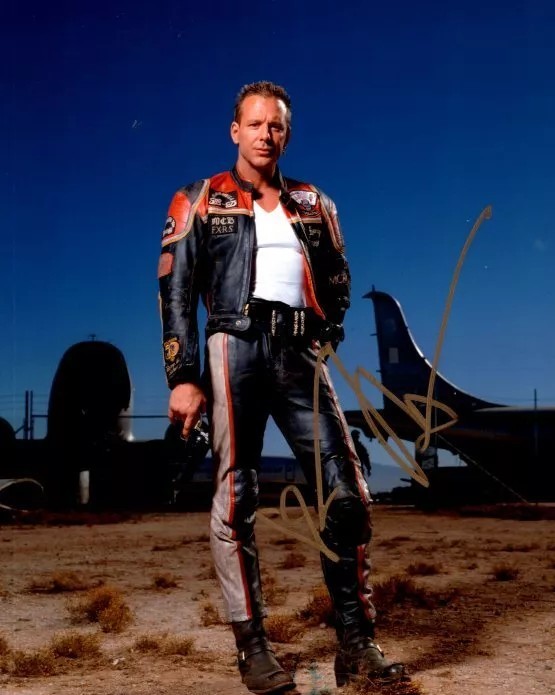
Signed photo of Mickey Rourke in this piacture will set you back three hundred bucks. That’s cult for you.
Anyways, we are duped into thinking this is going to be a John Wick-Die Hard wild ride from the opening scenes where both dudes prove mighty handy with their fists, Harley preventing a gas-station robbery, Marlboro taking on poolroom cheats in a bar. The plot only kicks in when they discover that the bank is planning to foreclose on their favorite bar. Needing to get their hands on a quick $2.5 million, the boys decide to do a bit of foreclosing themselves, taking the required sum from the bank in question, organizing a neat heist only to discover they’ve not stolen money but drugs.
Being smarter than your average hood, they swap the drugs for the dough but don’t take into account that the villains are smarter than the average thug and aren’t in the business of donating to good causes. The gangsters hunt them down. Harley and Marlboro could just disappear, especially once they dispose of the hidden tracking device, because they are A-grade students in the art of hiding away. Instead, honor is at stake so they set up an ambush in an airplane graveyard.
Since you’re asking, the Butch Cassidy the Sundance Kid grace notes are: Marlboro is the equal of The Sundance Kid is the shooting stakes and, in fact, like his predecessor, Marlboro manages the same trick of shooting off a character’s gunbelt; in the gunfighting stakes, Harley is the equivalent of Butch, never killed a man, absolutely useless with a pistol; and, the piece de resistance, when trapped they jump off an exceptionally high ledge into water.
Mickey Rourke and Don Johnson take the opportunity to shift well away from their existing screen personas and are thoroughly engaging. Simon Wincer keeps to a tidy pace. Written by Don Michael Paul (Half Past Dead, 2002) in his debut.
The action is top-notch, all the characters are well-drawn, the women not just bed fodder, usually brighter than the men. Terrific roster of supporting cast including Chelsea Field (The Last Boy Scout, 1991), Tom Sizemore (Saving Private Ryan, 1998), Robert Ginty (The Exterminator, 1980), Daniel Baldwin (Mulholland Falls, 1996), pop star Vanessa Williams (Eraser, 1996), Giancarlo Esposito (Megalopolis, 2024), Tia Carrere (Rising Sun, 1993) and Kelly Hu (X-Men 2, 2003).
The kind of movie where you wish they would do it all over again. Had the movie been a success a sequel would have been a shoo-in. As it is, we’ve only got this, so enjoy it while you can.





 The Magnificent 60s