
Inventive screenplay by William Goldman (Masquerade, 1965), the ideal combination of witty lines and others that strike to the heart, and Paul Newman’s most naturalistic performance, and a family at each other’s throats, create a genuine addition to the private eye genre. Punch-ups are limited, generally the sleuth comes out worse, his skull an easy target apparently for any villain wanting to give him a good biff.
Most people remember the celebrated credit sequence. But, in fact, most people do not. They remember that this is a guy who will reuse old coffee grinds, which is as good a character definition as you’re going to get. But the opening sequence says much more – he sleeps in a pull-out couch, he falls asleep with the television on, dunking his face in ice suggests a hangover, and – the killer – he sleeps in his office. You won’t forget the ending either, the freeze frame, as fed-up Harper (Paul Newman) just gives up on the stupidity of mankind. And just before that there’s a delicious moment when crippled mother Elaine Sampson (Lauren Bacall) trills to the daughter she loathes Miranda (Pamela Tiffin) in a voice that would denote happiness but is anything but, “I’ve got some news for you,” as she looks forward to informing the child that the father she adores and that Elaine equally loathes is dead.

Not surprisingly, Harper’s on the verge of divorce from wife Susan (Janet Leigh), but he still hankers after being a knight in shining armor, those few days every year when he puts the world to rights rather than chasing down errant husbands in seedy hotel rooms.
The tale is a tad convoluted, involving initially tracking down Elaine’s estranged missing millionaire husband that turns into kidnapping and then murder with a side order of a fake cult headed by Claude (Strother Martin) that’s a front for an illegal immigrant operation, and going through the gears, character-wise, with malicious wife, an extremely flirtatious Miranda who gets her come-uppance when she tangles with Harper, faded alcoholic star Fay Estabrook (Shelley Winters) and junkie Betty (Julie Harris) sometime lover of lothario pilot Allan Taggert (Robert Wagner).
Two distinctive thugs Dwight Troy (Robert Webber) – Fay’s husband – and Puddler (Roy Jenson) offset the dumbest of dumb cops led by Sheriff Spanner (Harold Gould) and lovesick attorney Albert Graves (Arthur Hill), Harper’s longtime buddy, who pines for Miranda.
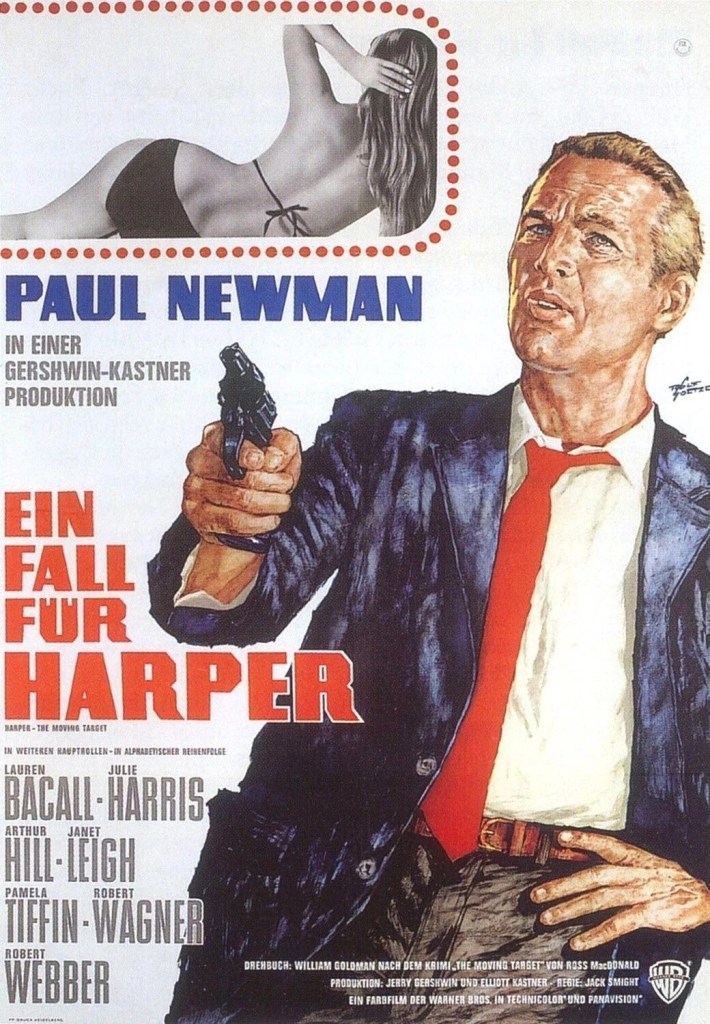
Torture comes in two guises – the junkie gets the treatment from Dwight and Harper is put through the wringer listening to the endless whining of Fay as he tries to pump her for information. Harper avoids beatings and takes beatings and various characters bounce through doors with a gun – both Taggert and Graves save Harper from being shot.
Harper’s got a slick way about him, but mostly his charm is used to weasel information. He hasn’t got enough of it left to work on his wife.
When Harper’s not racing his sports car along twisting mountain roads, the action shifts to a cult temple, the docks and an abandoned oil tanker. Even when Harper works out who’s in on the kidnapping, it turns out he’s now got a murder to solve since someone’s bumped off the kidnappee.
Despite the endless complications, this whizzes along, helped enormously by Paul Newman’s (Cool Hand Luke, 1967) winning characterization. He’s brought a new trick to his acting arsenal, mastering a method of not listening to a conversation by tilting his head away from the speaker, and there’s a number of novel gestures. The scene where he rejects Miranda is a cracker. Tough guy running short of a soft center, he makes a very believable human being. And he’s got his work cut out because Lauren Bacall (Shock Treatment, 1964) is on scene-stealing duties. As is Pamela Tiffin (The Pleasure Seekers, 1964) though she can hardly match the older woman for arch delivery.
It’s a top-notch cast all the way down. Fans of Strother Martin (Cool Hand Luke) will enjoy his fake healer, Arthur Hill (Moment to Moment, 1966) is engaging, Robert Wagner (Banning, 1967) adds another notch to his rising star bow while Robert Webber (Don’t Make Waves, 1967) emanates menace with his “old stick” routine. Shelley Winters (The Scalphunters, 1968) is a great lush, Julie Harris (The Split, 1968) a junkie trying to pretend she’s not and Janet Leigh (Psycho, 1960), having kicked her husband out, still hoping he might come back in more acceptable form.
Jack Smight (The Third Day, 1965) directs with some zap. This should have had everyone singing the praises of crime writer Ross MacDonald, who in inventing the character (Lew Archer in the original) had inherited the Raymond Chandler mantle, but instead they came away whistling Dixie for screenwriter William Goldman.
Class act.

 The Magnificent 60s
An absolutely delicious movie. This remains my favorite Newman movie and the one solid Jack Smight effort I’ve seen to date who otherwise has perhaps the most half-baked filmography of any director to set foot in Hollywood.
The novel is fine and curiously timeless unlike most of the genre from its era but Goldman adds just enough low wattage oomph to make it all come to life. One of my favorite summer watches.
LikeLiked by 1 person
Hasn’t seen this in a long time so was surprised how well it had stood up.
LikeLike
More:
“The 29 Mar 1965 DV announced that producer and Raymond Chandler aficionado Jerry Bick had acquired film rights to mystery writer Ross MacDonald’s The Moving Target, the first of eighteen novels that featured Southern California private detective “Lew Archer.” Published in 1949, The Moving Target had introduced Archer as a successor to Raymond Chandler’s “Philip Marlowe,” the subject at that time of four 1940s films, including The Big Sleep (1946, see entry). The 18 Aug 1965 LAT described MacDonald as “Chandler’s heir apparent as master of the complex plot and the eloquent evocation of the Southern California scene, high life and low life.” Jack Smight, who was picked to direct, told the 21 Apr 1965 Var that The Moving Target “will have flavor and style of mid-40s features.” It was set to be shot on the Warner Bros.’s Studio lot in Burbank, CA, where The Big Sleep, starring Humphrey Bogart as Marlowe, was filmed twenty years earlier, and would feature that film’s co-star, Lauren Bacall. Other locations would include the CA beach cities of Santa Barbara, CA (where Lew Archer was based), Newport Beach, and Hermosa Beach (where Smight hoped to film a jazz scene at the famous Lighthouse Club)—although none of them were ultimately used. The budget was $3 million, according to the 19 May 1965 Var, and Paul Newman was slated to star as Lew Archer at a salary of $750,000 “against 10%” of the film. By that time, the title had been changed to Archer. Producer Jerry Bick left the project during pre-production.
Principal photography began 7 Jun 1965 on the Warner Bros. lot, according to that day’s DV and a studio production chart in the 4 Jun 1965 DV. More than two months later, Jack Smight told the 20 Aug 1965 DV he expected to finish shooting that day. Smight claimed he filmed on twenty-three locations in the Los Angeles area and used the Burbank studio mostly for interiors. Among the locations were Malibu Canyon and “the old Marion Davies mansion” at 1011 N. Beverly Drive in Beverly Hills, whose grounds the production refurbished at a cost of $7,000 instead of paying rental. (Also, Davies’s widower, Horace Brown, was given a small role as a bartender.) Other Los Angeles-area locations, as listed in the 14 Jul 1965 DV, 4 Aug 1965 Var, and 23 Feb 1966 LAT, included the Moonfire Temple at 2200 Tuna Canyon Road in Topanga Canyon, Westwood, Bel-Air, Trancas Beach in Malibu, Wrigley Field (a minor league baseball stadium south of downtown Los Angeles), Newhall, San Pedro, Terminal Island, and the Huntington Beach oil fields. Some location action scenes were filmed by assistant director James H. Brown with a second unit crew, while Smight filmed interiors with the “first unit” at the studio. By the time the film was completed, the budget had increased to $3.5 million.
Harper was William Goldman’s first American-produced screenplay. He created Janet Leigh’s “Susan Harper” character, which did not exist in MacDonald’s book.
Andre Previn was originally signed to score the film, but he stepped aside for Johnny Mandel, according to the 8 Sep 1965 DV. However, the film used Previn’s song, “Livin’ Alone,” written with his wife, Dory Previn.
The 22 Oct 1965 DV reported that Warner Bros. retitled the film Paul Newman Is Harper, although this may have been a misprint. The name of Paul Newman’s character had in fact been changed from Lew Archer to “Lew Harper,” and the studio would use the tag line “Paul Newman Is Harper” to echo Paramount Pictures’ earlier “Paul Newman Is Hud” line promoting Hud (1963, see entry). Screenwriter William Goldman later suggested that the producers did not own the Lew Archer name beyond the one novel, and therefore could not have used it in sequels without buying the rights to further books. In any event, the title was ultimately shortened to Harper for the North American market, but remained The Moving Target elsewhere.
The film opened in Los Angeles on 22 Feb 1966, as listed in the 20 Feb 1966 LAT, and in New York City on 30 Mar 1966, according to the review in the following day’s NYT.
According to a 4 Jan 1967 Var list of “Big Rental Pictures of 1966,” Harper grossed $5.3 million in its first ten months of release.
The hoped-for series of Lew Harper films did not materialize, and Newman reprised the role in only one other film, 1975’s The Drowning Pool, based on a Lew Archer novel of the same title. Producer Elliott Kastner later joined Jerry Bick, the original producer of The Moving Target, to make three Philip Marlowe films adapted from Chandler’s novels: The Long Goodbye (1973), Farewell, My Lovely (1975), and The Big Sleep (a 1978 remake, see entries).”
LikeLike
Thanks once again. Have got a Behind the Scenes tomorrow which draws on producer Kastner’s unpublished memoirs.
LikeLike
Have you seen this?
https://cinephiliabeyond.org/the-fruitful-collaboration-between-novelist-alistair-maclean-and-film-producer-elliott-kastner/
LikeLike