Dangerous Animals (2025) *** – Seen at the Cinema

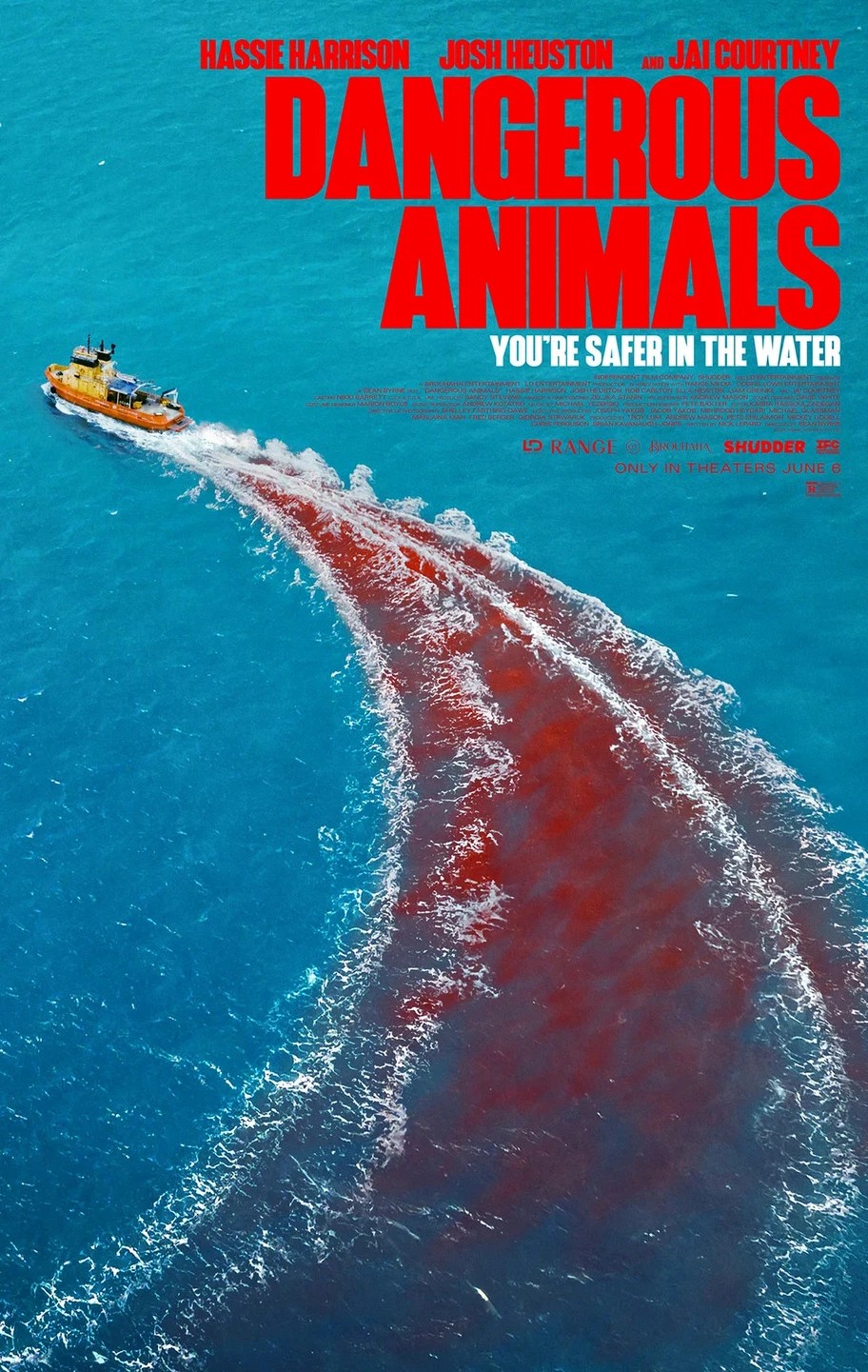
Steven Spielberg made his reputation dangling human bait to sharks and audiences lapped it up. I’m surprised it’s taken this long for a psychotic serial killer to understand the visceral thrill of watching victims die screaming as they are torn apart by sharks and churn up the sea in a froth of blood and guts. As you know I’m partial to a sharkfest and though this isn’t on the same epic scale in terms of destruction as Sharks under Paris (2024), given I was pretty fed up watching the dire Ballerina (let’s hope she’s excommunicated from the John Wick universe), I toddled off to see this without much in the way of expectation.

It’s pretty much in the Old Dark House line of horror pictures, good-looking young men and women imprisoned by a nutcase of the intelligent version of the species that recently surfaced in Heretic (2024). Aussie boat skipper Tucker (Jai Courtney) has a legitimate business taking tourists out shark-watching in a cage. And he’s got a side hustle in picking up vulnerable tourists – on gap years and the like or trying to escape the confines of the past or hiding out from consequence. He either catches his unwitting prey on land or waits till they turn up on his boat singly or in couples and not part of an organized tour from which their absence would be automatically noticed.
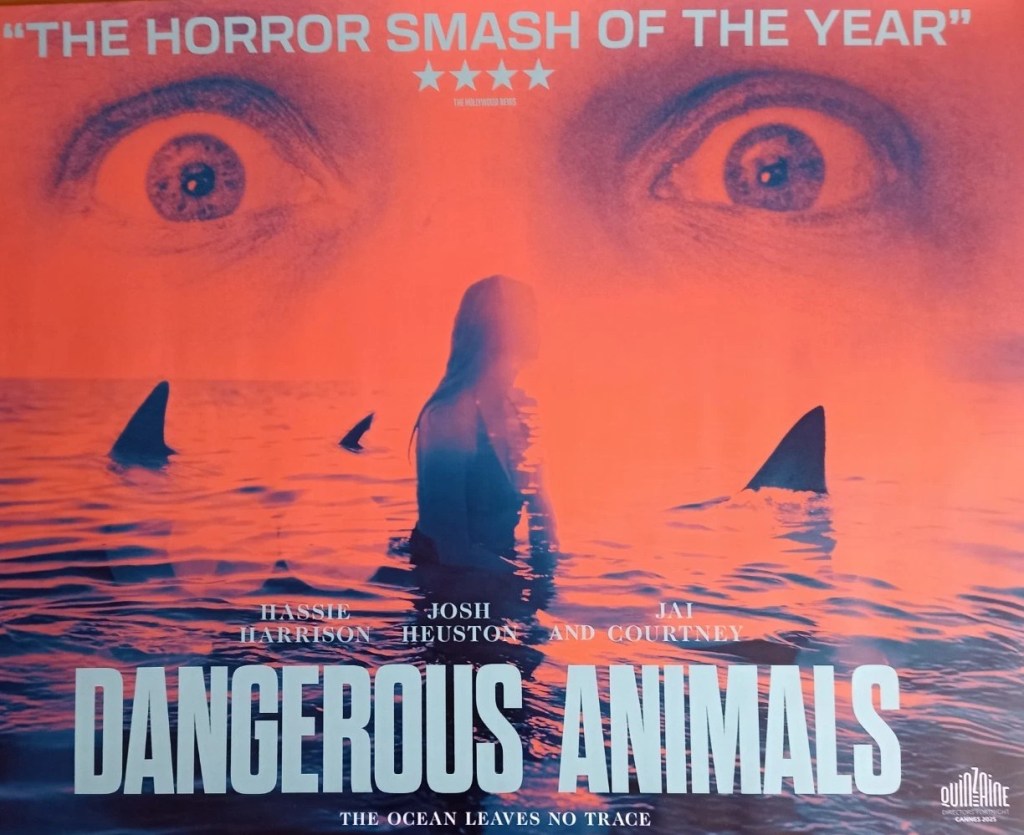
Heather (Ella Newton) and Greg (Liam Greinke) fall into the unannounced category. They get the shark experience but then Greg makes more intimate acquaintance with the predators after he’s knifed in the throat and tossed overboard.

Not only does Tucker like to watch he likes other victims to watch – someone dying. In full Spielberg mode he films the deaths. So he goes on the prowl for another victim, kidnapping the  more sassy Zephyr (Hassie Harrison) in the middle of the night. She’s got a good deal more fight in her than the hapless Heather and manages to find a device to unlock the handcuffs chaining her to a bed, makes a makeshift shank from a broken piece of plastic and is adept at wielding a frying pan or harpoon or any other device that comes within range.

In between delivering homilies on the wonder of the shark, Tucker indulges in his dangling, the screaming Heather chopped to ribbons while Zephyr, strapped to the best seat in the house, is unwilling witness.

Luckily for Zephyr, she has smitten Moses (Josh Heuston), a one-night stand, and he has more detection skill than the cops who are not really interested in yet another beach bum who’s gone off without telling anyone. He tracks down the boat and invites himself to the party. Turns out between them they have more than a smattering of shark lore and when Josh is lowered into the water knows that the sharks will leave him alone if he doesn’t thrash about.
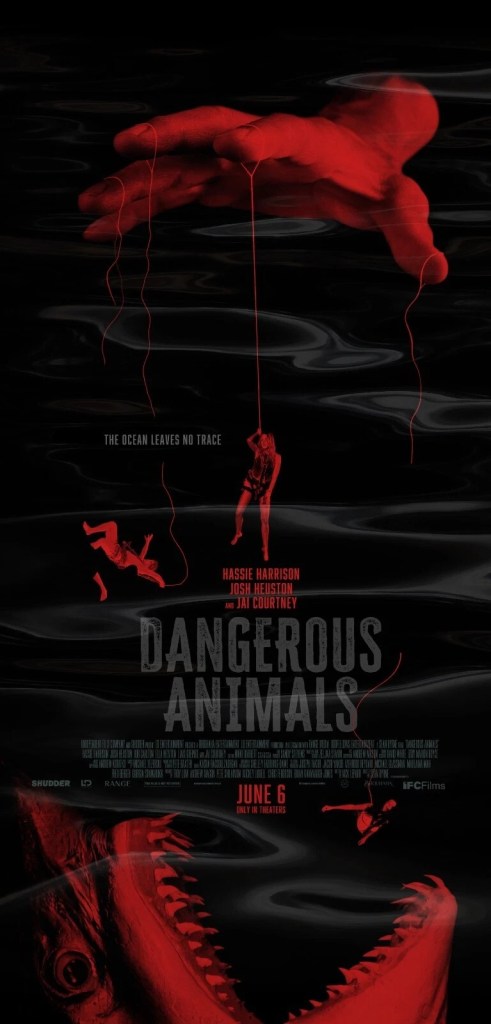
But drugged and chained up the pair have little chance of escape unless the doughty Zephyr goes full tilt escapologist boogie and gnaws off her thumb off to facilitate the cuffs slipping over her hand.

Unfortunately for her this picture is so full of twists there’s very little chance of a clean getaway and even when she makes it to the shore by swimming Tucker, thanks to a dinghy with an outboard motor, is on top of her.

It’s not as gruesome as it sounds, though you will want to avert your eyes when Zephyr starts gnawing on her thumb, and director Sean Byrne (The Devil’s Candy, 2015) emulates his idol Spielberg by turning less into more, ratcheting up the tension through anticipation and some terrific footage of marauding sharks. It helps that he doesn’t have a lascivious bone in his body, there’s no sexual assault, no drooling over half-naked women, no wet t-shirt nonsense.

Hassie Harrison (Yellowstone, 2020-2024) is the latest in a bunch of feisty women who refuse to conform to the scream queen norm. Jai Courtney (The Suicide Squad, 2021) is exceptionally creepy as the learned soft-spoken psychopath. Written by Nick Leppard in his debut.

Sean Byrne knows how to turn the screws.
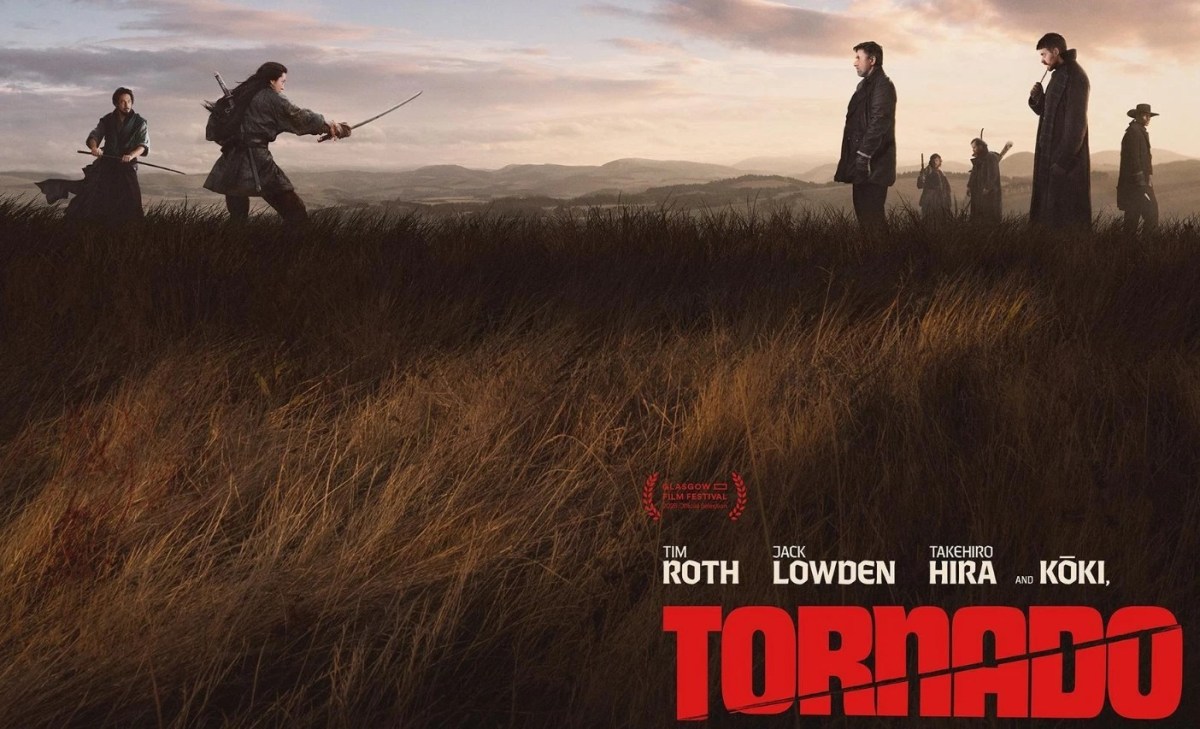
Tornado (2025) **** – Seen at the Cinema

Cult’s a strange creature. Try to cultivate it from the outset and chances are you’ll strike out – the days of Quentin Tarantino hitting a bulls-eye are long gone. So, basically, what you’re left with these days is a picture that flopped on initial release but gradually developed exceptional word-of-mouth and maybe found a welcome home in streaming or on the retrospective circuit if that still exists. But that process takes several years, and the best hope these days is that it gives the director or star a lift. In this case, the door’s been left open for a sequel.

And on paper this sounds an awful conceit. Samurai swordsmen on the loose in antique Scotland? We’re talking 1790, for goodness sake. Were they shipwrecked, enslaved? We never find out. Back story here is in short supply and that’s all to the good because tension never dissipates.

There are only a couple of tropes – a pair of mewling nepo babies suffused with entitlement is as far as that goes.

The rest is original, intriguing and directed with authority. You’ve got gangsters, puppeteers, a circus troupe, and skeletons playing the violin. Twists are in short supply – the expectation that a knife thrower might turn into a male lead is dashed, and dust settling on the top of a piano which should give away the presence of a fugitive is ignored.

The tale is one of greed. And of the greedy feeding upon the greedy. By chance, travelling samurai puppeteer Tornado (Koki) spots the theft of a thieves’ haul of gold by a young pickpocket (Nathan Malone). She helps the boy secrete the two bags of gold in the caravan of her father Fujin (Takehiro Hira). But then she tosses him out of the moving caravan with only one gold piece for his trouble.

When the thugs led by Sugarman (Tim Roth) catch up, her father, unaware of his daughter’s complicity in the theft, is killed protecting her. So the girl and the boy go on the run. There’s none of the usual bonding of thieves.

Sugarman’s son Little Sugar (Jack Lowden) knows the girl has stolen the gold and in rebellion against his father determines to have it all to himself and not above killing off a colleague who gets in his way. Sugarman is a ruthless thug, setting fire to the encampment of the circus troupe for hiding the girl, and not above knifing his son to death.

Tornado doesn’t show the slightest sign of remorse at being the reason for her father and the boy and a strongman who protected her being killed nor for being the cause of the circus troupe being rendered homeless. She’s as amoral as the rest of them. But in the end she does put them all to the sword.

So, theoretically – and this is how it’s being marketed – it’s a revenge thriller or a samurai western (which has already been done with Red Sun, 1971) and both attempts at categorization are way off the mark. It has much more in common with Tarantino, of infighting among gangsters, but it’s so splendidly done, with terrific composition and use of the widescreen that it touches the cult mother lode, in that it is indescribable, creating a world of its own, set in a lawless world where the strong dominate and the weak run for cover. And it’s also a world where you better not get wounded, because that will be cue for someone else to take advantage.

Tornado transitions from rebellious daughter – “who put you in charge” she complains to her father – moaning about being bored and can’t take the job of being a puppeteer seriously, and she’s not that good either at paying attention when her old man tries to teach her more swordfighting. And, of course, she’s to blame for the death of her father. Her instinct is to run and hide and wait till the brouhaha dies down. And it’s only when she realizes that she can’t effectively carry two heavy sacks of gold that she decides to cut and run – with the emphasis on the cutting, slicing and dicing the gang till there’s only Sugarman left and he’s, ironically, dying anyway from a wound inflicted by her father.

So not your ideal heroine. In the old days she’d have been an innocent, guiltless, only taking up the sword or gun after her father was killed by ruthless villains. It’s all the more interesting for not going down that route.

The choices director John MacLean (Slow West, 2015) doesn’t make define the picture. There’s no love interest, Little Sugar and Tornado could as easily have conspired to make off with the dough, or some narrative device could have thrown them together. But both want all the gold for themselves. The knife expert you think is being introduced to come to her rescue. But no go there either.

Tim Roth (Rob Roy, 1995) is superb as the cold-eyed gang boss and Jack Lowden (Slow Horses, 2022-2024) as his shifty son and MTA Koki makes a startling debut.

It’ll be gone from cinemas by the time you read this review but look out for it on a streaming platform and I hope it will prick your interest as much as mine.

Impasse (1969) ***

The kind of desultory B-movie Burt Reynolds was relegated to before Deliverance (1972) sent him on his way into the superstar stratosphere. And you could see why he might as easily have ended up at the lower level. This was his third stab at top billing and he’d have another two goes before Hollywood gave up on him and he tried again (he’d been in the shortlived Hawk series in 1966)  in television as Dan August (1970-1971). In what could have been a career breakout – 100 Rifles (1969) – he was left trailing the wake of the incendiary combo of Raquel Welch and Jim Brown.

When you’re at this lowly level in the Hollywood pecking order, you are destined just to take what comes your way. This is set up as mission-picture-cum-heist but it takes way too long to get under way and there’s little tension on what passes for the heist.

More time is spent on chief thief Pat Morrison (Burt Reynolds) organizing his love life with main squeeze Mariko (Miko Mayama) who happens to be the wife of one of his recruits Jesus (Vic Diaz). He’s on board because he was present at the World War Two secret mission on Corregidor where the Yanks stashed away $3 million in gold. Morrison has tracked down two others who were present – Apache Draco (Radolfo Acosto) and racist Hansen (Lyle Bettger). But there’s a complication – they were blindfolded during the operation.

Morrison could have found the gold just through the medium of Jones (Clarke Gordon) who led the expedition. But there’s a complication. He’s too ill to make the trip. And just when Morrison needs him there’s a further complication – he’s kidnapped by The Wombat (Jeff Corey) who wants his share.

Meanwhile, to further delay the team getting going, there’s a further complication. Jones’s daughter Bobby (Anne Francis), a tennis champ, becomes involved. But there’s a complication and we’ve got wait a while till she sorts out how she’s going to deal with hippie tennis groupie-cum-stalker Penny (Joanne Dalsass) and we find out whether she swings both ways. That factor is never properly determined but just to complicate things further – and set up the climax – Morrison beds Bobby much to the anger of Mariko. And the fact that Morrison was in a relationship with Mariko sets up another complication when, once the trip gets underway, Jesus finds out.

There’s some colourful background to while away the time in between Morrison getting his shirt off and the various fisticuffs and shootouts that delay the mission getting started. Eventually, the reach their destination. The loot is hidden in a tunnel and is found by the trio re-enacting the previous circumstances, blindfolded as before and counting off the individual number of steps each took in the tunnel. There’s another complication – what did you expect? – because before the final steps are completed they hit a wall and it does take them way too long to work out that the edifice must have been constructed after the gold was hidden.

And just when they’re making their getaway there’s a complication. Philippine soldiers are waiting and they’re all shot except Morrison who is captured. And it’s then he discovers the price of his two-timing Mariko, in revenge she’s informed on him.

Way too complicated to be set up as a star-making vehicle for Burt Reynolds (Sam Whiskey, 1969), but he does exhibit some of the persona that would later be his trademark, the smug grin and the naked chest, easy with fists and charm. Anne Francis (The Satan Bug, 1965) adds sparkle but she’s not in it long enough and she’s distracted by father and groupie. Jeff Corey (Seconds, 1966) is otherwise the pick.

Directed by Richard Benedict (Winter a Go-Go, 1965) from a script by John C. Higgins (The File of the Golden Goose, 1969). The complications don’t have the black comedy feel of The Hellbenders (1967) and mostly hold up the story up rather than adding tension.

Come at it as a supporting feature and it would be more enjoyable than if you had paid your hard-earned dollar to see it as the main feature.

Behind the Scenes: Selling The Western As Art: The Pressbook for “The Sons of Katie Elder” (1965)

“Don’t ever make the mistake of looking down your nose at westerns. They’re art,” said John Wayne in probably the most provocative statement he ever made about the genre, especially given this was the mid-1960s, and outside of a few accepted classics mostly of the John Ford vintage plus perhaps High Noon (1952), few American critics were taking that line.  

“Sure, they’re simple,” said Duke, reinforcing the message, “But simplicity is art. They’re made of the same raw material Homer used. In Europe they understand that better than we do over here. They recognize their relationship to the old Greek stories that are classics. But I don’t think that’s the reason they love ‘em.”

“We love ‘em, too, but not because of anything we stop to think about.” Clearly, the Big Man had given this some thought and had analyzed the genre. “A horse is the greatest vehicle for action there is. Planes, automobiles, trains, they’re great, but when it comes to getting the audience’s heart going, they can’t touch a horse.”

(These comments were made prior, of course, to the likes of the vehicle-driven Bullitt and The French Connection and the disaster movies that started with Airport, but let’s not allow that to take away from his point.)  

“He’s basic, too,” continued Wayne. “Put a man on him and you’ve got the makings of something magnificent – physical strength, speed where you can see and feel it, heroism. And the hero, he’s big and strong. You pit another big strong man against him with both their lives at stake and there’s a simplicity of conflict you can’t beat.

“Maybe we don’t tell it with poetry like Homer did but in one way we’ve even got him beat. We never let Hector turn tail and run from Achilles. There’s got to be a showdown.

“Westerns are folklore, just the same as The Iliad is. And folklore is international. Our westerns have the same appeal in Germany and Japan and South America and Greece that they have in this country.”

I’m not sure how much of this made it into the newspapers for which it was intended. John Wayne spouting on about art was not the kind of headline newspaper editors thought the public wanted to read. But this is far and away the most interesting piece I’ve ever read in a Pressbook so someone must have caught Duke on a good day for him to open up so much.

As it happened, producer Hal Wallis was on the same page. “Good westerns,” he said, “are a legitimate art form.” Wallis had more critical plaudits than Wayne, his previous picture Becket (1964) clocking up a raft of Oscar nominations and himself twice winner of the Irving G. Thalberg award.

This was a fairly hefty Pressbook/Merchandising Manual promoting one of Paramount’s biggest pictures of the year. It ran to 20-pages of A3 including a thick glossy cover plus an extra 2pp miniature herald. The section devoted to the stars and promotional ideas is larger  than usual, running to over two-thirds of the total.

In part this is because Wayne is so voluble. He’s given two articles on the first two pages. In the other article, he assesses what he’s looking for in a character.

“He’s usually outside the law as its written in the books,” explained Wayne, “but that’s not always his fault and anyway it’s not easy for him to cross back over the line but meanwhile he’s doing his best. He’s a man of his place and time, and maybe a victim of circumstance or past mistakes. But he’s living by a moral code of his own just as rigid in its fashion as the one in the books.

“Like in Katie Elder I kill a few guys but I’ve already notified ‘em I’m going to do it just as soon as I can get the goods on ‘em. Because they’re crooks and murderers and they’re out to get me as well as some other folks and what I’m doing is serving justice the only way a man in my position can do it. Nobody says the end justifies the means or anything like that because it never does. And that’s why I say I don’t play heroes – good guys. I’m not what you’d call a villain either. But one thing I make sure of – the guys I play are believable human beings.”

The other article is the more quotable, I guess. But that’s not the only meat in the Pressbook. As usual, some of what’s written is intended for features, others for snippets. For example, wardrobe man Frank Beetson reveals the secret of the much-copied shirt worn by John Wayne in all his westerns, the blue flannel number with the double-breasted ‘plaster-on’ front – it’s an old-fashioned fireman’s shirt. Female lead Martha Hyer discovered 20-year-old designer Camerena at the art school in Durango. Hyer’s wardrobe in the film is confined to gingham and such, but she is wearing three of the designer’s frocks in a photographic fashion feature for Glamour magazine.  Turns out Dean Martin is a gourmet and when what was available on the catering front was not to his taste, he arranged for Frank Sinatra to send, by air express, 40 steaks from the Las Vegas Sands while Sammy Davis Jr. obliged with rare cheese and sausages.

The marketeers had found some unusual promotional tie-ups. Coppertone, anyone? Martha Hyer was modelling the suntan lotion in an advertisement that would feature in magazines with a total circulation of 20 million. At the other end of the audience spectrum, Dell was publishing a special comic book. In addition the publisher placed ads in other comic books with a combined circulation of five million. Naturally, since westerns attracted children as much as adults, Paramount suggested cinemas run a coloring contest featuring an illustration from the movie. The studio also suggested promotional ideas themed round the idea of sons.

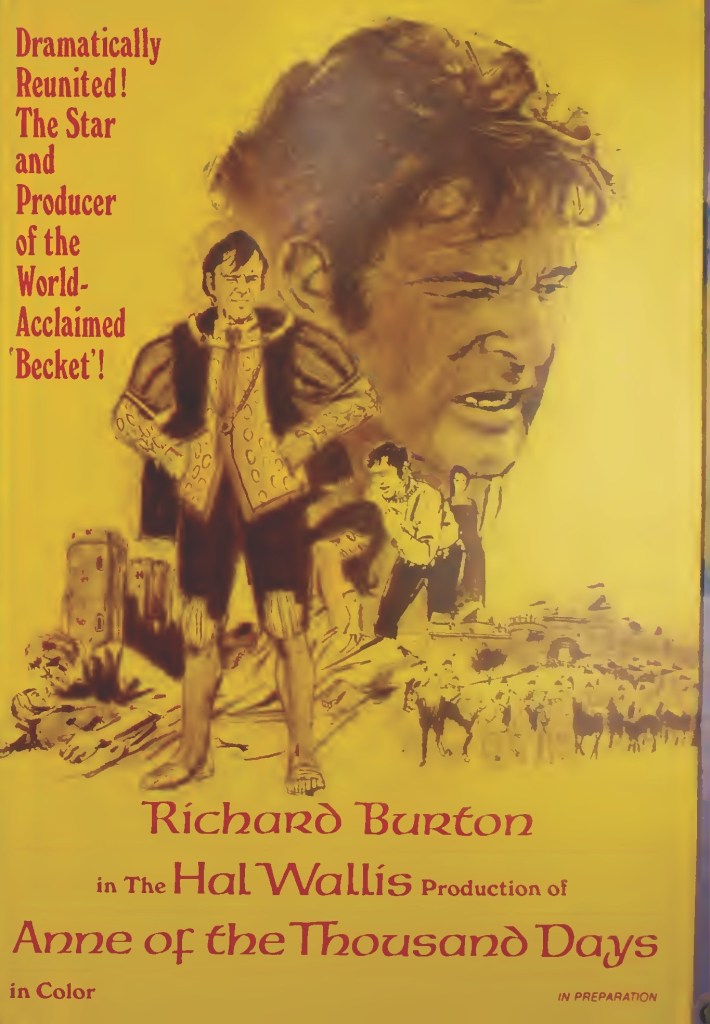
Anne of the Thousand Days (1969) ****

You can keep your Succession dramas with families squabbling over a mere business empire. And even the more woke Snow White (2025) doesn’t remotely tackle the realities of marriage in medieval times when the role of a woman, in an era when more children died in childbirth or soon after than actually survived, was to produce an heir. And not just random in gender. But male.

So, on the one hand, you can sympathize with the dilemma of English King Henry VIII whose Spanish wife Katherine, while eminently fertile – several babies died in childbirth – had managed only one male offspring, who died shortly after birth, and one female, Mary. All the queen had given him, rails Henry (Richard Burton), are “dead sons.” So with the future of one of the biggest kingdoms in the world at stake, Henry isn’t keen to leave it in the hands of a woman. Even if he can arrange a suitable marriage, it would inevitably mean letting the kingdom fall into the hands of someone he doesn’t trust.

But in the twisted world of inheritance, here’s the rub. Henry shouldn’t be king. His elder brother Arthur should have, except he died before he could succeed to the throne. And Katherine, married to Arthur, should have been Queen.  But Spain at that point was as powerful, if not more so, than England, so Henry decided to marry his sister-in-law, on the basis that the marriage was never consummated, and the Pope, the authority in such matters, gave the go-ahead, glossing over the technicality of what was considered in those days incest.

So, Henry comes up with a cunning plan. He will go trophy-hunting and marry a younger wife. This isn’t just because he’s fallen in love with Anne Boleyn (Genevieve Bujold). He doesn’t have to marry her to have sex with her. He’s already having sex with her mother (Valerie Gearon) with the tacit approval of her father (Michael Hordern) who receives benefits in kind.

To add complication, Anne is promised in marriage already, and deeply in love. Siring a bastard son would inevitably cause an inheritance battle. So legitimizing the relationship seems the only way forward. This time the Pope isn’t keen, mostly because the Spanish have invaded the Vatican and if he wants to survive he can hardly annoy his captors.

But when the Pope refuses, Henry takes the nuclear option, and splits from the Catholic Church, not just taking advantage of the old church vs state argument, but also made aware by Thomas Cromwell of the sudden increase in wealth acquiring the items of the Catholic Church would bring.

Sorry to bore you with a history lesson but this intriguing backdrop – as well as the dazzling performances – is what twists this away from lush costume confection into riveting drama. This was the peak of a trend in historical movies that shifted the emphasis from heroic action to the down’n’dirty. Camelot (1967) to some extent had begun the trend but only dealt with infidelity and was given something of a free pass because it focused on the iconic Knights of the Round Table and a legendary love affair. The Lion in Winter (1968) primarily concentrated on  inheritance.

Depending where your sympathies lay this was either corruption writ large or a battle to free the ordinary man from the yoke of religion.

Primarily, it works because it revolves around the human drive, the king refusing to bow the knee to anyone, Anne Boleyn seduced not just by gifts but by this older man who is much more virile and passionate than her younger somewhat effete fiancé (and who couldn’t be dazzled by a man risking his kingdom for her love?) – and the courtiers looking after number one, always seeking a way of winning the king’s favor, and as importantly, not losing it, for that could lead to banishment or execution.

No one dares stand in Henry’s way – except Sir Thomas More (William Squire) and here he’s merely a small subplot (not center stage as in A Man for All Seasons, 1966) – not even the religious hierarchy, especially Cardinal Wolseley (Anthony Quayle), head of the Catholic Church in England, who keeps a mistress.

The tragedy is that the cunning plan unravels. While Anne is fertile enough, she gives birth to a girl, Elizabeth (the later Virgin Queen). Convinced she’s not going to present him with the male heir he so desperately desires, he hatches a conspiracy that sees her executed for adultery and treachery, leaving him free to marry again and continue his mad obsession.

So we’ve got all the back-biting and bitching we expect from court, plus regal revelry, costumes, castles, and in the middle of it all a driven king and a feisty woman, not by any means a pushover, and not either going unwillingly into his bed. This would be a match made in heaven except that’s probably the last place, the way things stand, the king would be welcome. He’s very aware of excommunication and it shows the power of the Catholic Church that its teachings are so embedded in his brain that he fears that consequence.

This is rich in performance – Richard Burton (The Spy Who Came in from the Cold, 1965), Canadian Genevieve Bujold (The Thief of Paris, 1967) and Anthony Quayle (East of Sudan, 1964) were Oscar-nominated. The only significant figure in the production not to receive one of the movie’s ten nominations – including for Best Picture – was director Charles Jarrott who pulled the whole thing together. Maybe it was thought he was rusty, not having helmed a picture since Time to Remember seven years previously.

The acting is particularly well-judged by the two principals, Burton could easily have lurched into cliché, and Bujold into passivity. Others worth noting are Irene Papas (The Guns of Navarone, 1961), Michael Hordern (Khartoum, 1966), Valerie Gearon (Invasion, 1966)  and Peter Jeffrey (The Fixer, 1968).

Based on the play by Maxwell Anderson (The Bad Seed, 1963), screenwriters John Hale in his movie debut and Bridget Boland (Gaslight, 1940) manage to balance what could be dry subject matter with fragility and tragedy.

There couldn’t be a better demonstration of women used as pawns and collateral damage in male power struggles.

Totally absorbing.

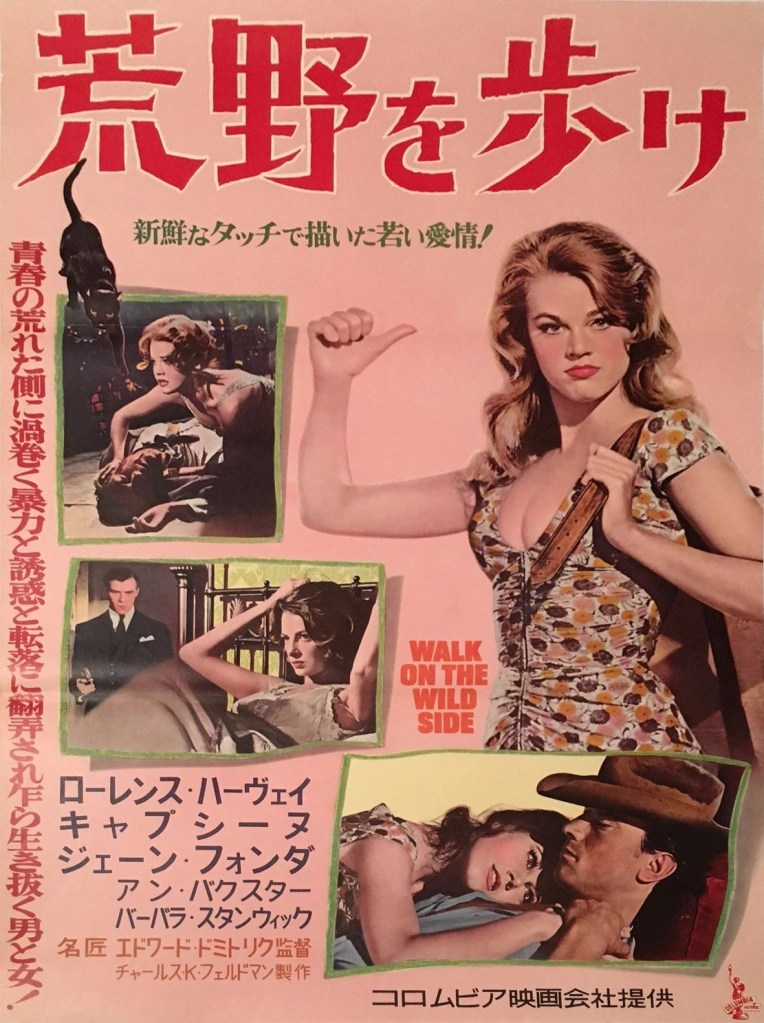
Walk on the Wild Side (1962) ***

As much as the censor would permit – would be the subtitle. While not as harsh as the Nelson Algren source novel, it’s still, wrapped up in a bitter romance, a more brutal than heretofore expose of the sex worker, far removed from the gloss of Butterfield 8 (1960) or the romantic comedy of Never on Sunday (1960) and Irma La Douce (1963).

The initial thwarted romance lacks the tragic element. It falls apart due to the mundane. After a four-month affair Dove (Laurence Harvey) can’t commit to artist Hallie (Capucine) because his father is too ill to leave. So she ups sticks and heads for New York, hooks up with buyer Jo (Barbara Stanwyck) who turns out to invest in more than art, and ends up in a New Orleans brothel where as well as servicing the clients she can continue making sculptures.

After his father dies three years later, Dove heads to New Orleans to find her, but with no idea where to look. He falls in with vagabond-cum-thief Kitty (Jane Fonda) and eventually having dumped her due to her thieving ways takes refuge in a café whose owner Teresina (Anne Baxter), a victim of Kitty, offers him employment. She suggests he puts an advert in a New Orleans newspaper and just when he’s giving up hope and Teresina is getting up her hopes that she can win him over romantically he gets a phone call.

He’s clearly unaware that Hallie is a sex worker and after romancing her sets them up in an apartment. Hallie abandons the reunion after a night or possibly just an idyllic afternoon. Hallie’s reluctance is twofold. She’s become accustomed to the relative laziness of her life, she’s a high-class lady and is not worked too hard, plus she’s got accommodation and a studio to work in and she knows her boss Jo is sweet on her. On the other hand, it would be difficult to quit, the brothel employs tough guy Oliver to keep the girls in line and nobody’s going to want her to be giving it away for free.

Kitty, now working in the establishment, annoyed that he previously rejected her advances, gives Dove a full run-down on his lover. And there’s a legal catch that Jo is quick to take advantage of. Since Kitty is now a sex worker and it was Dove who took her with him to New Orleans he could be prosecuted for sex trafficking of a minor. When that doesn’t work, Dove receives a beating.

Kitty now decides Dove isn’t so bad after all, feels remorse at her role in his downfall, and helps him get back to café where Teresina cares for him and gets her hopes up once again. Then she helps Hallie escape and then fesses up to Oliver where she is. It doesn’t end well – although the censor would be pleased since after the climactic fracas the brothel is closed down and Jo and Co jailed.

It’s got a Tennessee Williams feel, though everything set in the South appeared to come into his bailiwick, but most of the realism is understated, as it would have to be in those times. Jo’s a groomer of the vulnerable, and for all Hallie’s artistic ambition she’s every bit as easy pickings as Kitty who is grateful to be freed from prison where she was arrested as a vagrant and reckons being given money for fancy clothes and having a roof over her head is good enough reward for selling body and soul. Her role in the denouement is a mite too convenient from the narrative perspective but it will do as a means of tacking on a tragic ending.

It helps enormously that most of the performances are understated. Laurence Harvey (A Dandy in Aspic, 1967), more commonly a scene-stealer, is good value and Barbara Stanwyck (The Night Walker, 1964) only requires a stare to make her feelings known. Though Capucine (Song without End, 1960) was criticized at the time I felt her performance was measured. Jane Fonda (Barbarella, 1968) was more of a wild card and it didn’t seem believable that such a flighty piece was going to become principled.

You can thank director Edward Dymytryk (Shalako, 1968) for keeping the actors in line and maintaining an even tone without spilling over into the melodramatic. John Fante (My Six Loves, 1963) and Edmund Morris (The Savage Guns, 1961) adapted the book. Special nod of appreciation to Saul Bass for the credits.

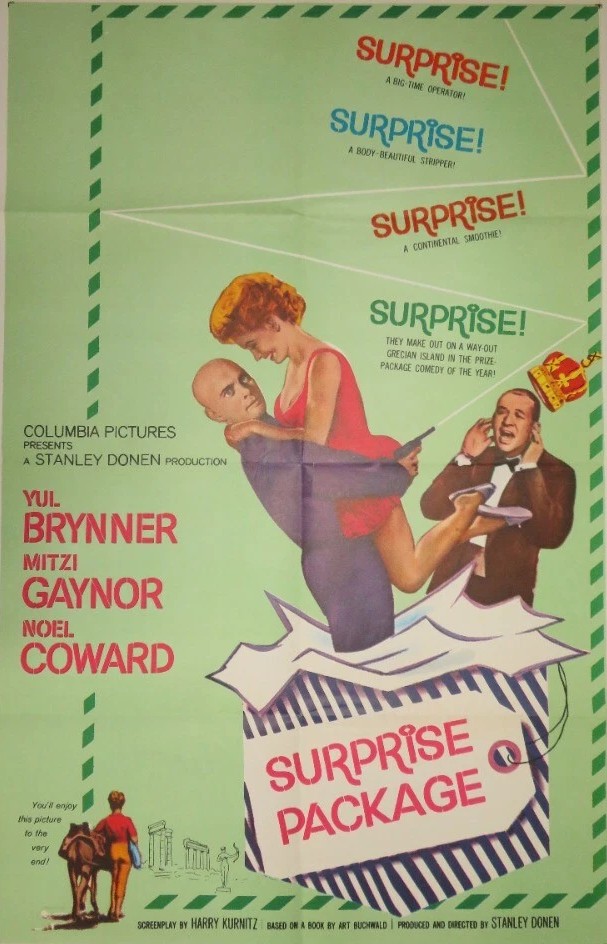
Surprise Package (1960) **

Poses two questions. Is this every bit as bad as Once More with Feeling, Stanley Donen’s previous picture? Yep, sorry, it’s every bit as wretched. The second question is: how on earth did Donen go from this mess to sublime romantic thriller Charade three years later? Well, the answer might simply be in the casting. Yul Brynner is no Cary Grant. And in this movie he’s not even Yul Brynner.

My guess is he’s meant to be a humorous twist on the Brynner screen persona. But playing a gangster with a thick Noo Yoik accent was always the preserve of the dumb supporting actor not the star. And since Yul Brynner isn’t any more convincing in this than in Once More with Feeling the project is in trouble from the start.

We’re given too much of this faux gangster drivel at the start when mob kingpin Nico (Yul Brynner) is collecting tributes from his underlings. Then, for no particular reason, he is deported, sent back into exile to his homeland of Greece. There he encounters the only smart guy in the picture, the corrupt chief of police Stefan (Eric Pohlmann) who’s so astute in the bribery department that all Nico receives in return for his thousand dollar bribe is to be told he won’t be arrested for bribery.

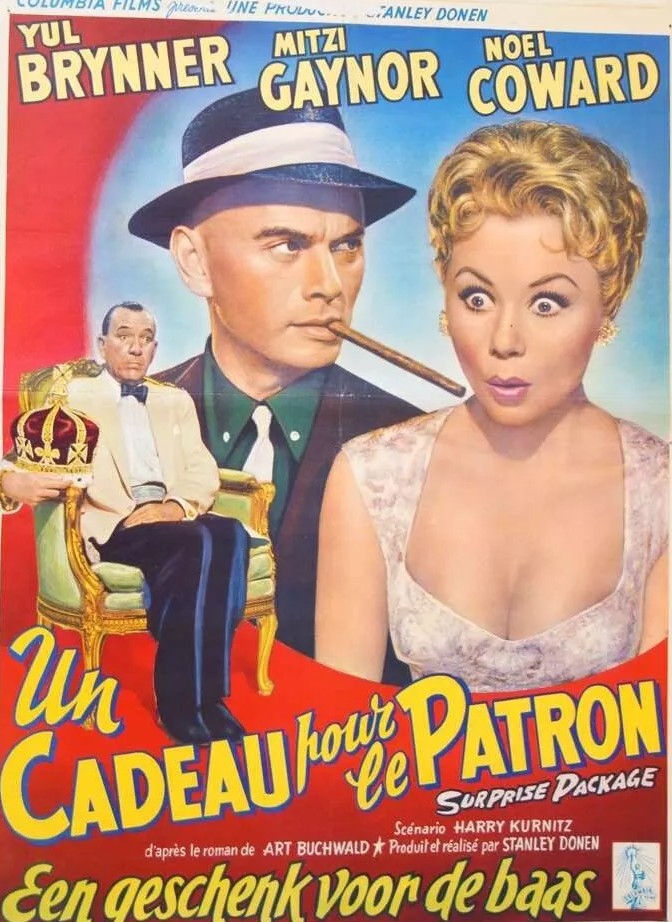
Stefan sets up Nico to meet another exile, deposed King Pavel II (Noel Coward), whose accent makes no sense either unless he was exclusively raised in high class British society, schooled at Eton, a member of upper class clubs etc etc, otherwise how to explain the plummy tones unless this is also meant to be as over-the-top gag as Nico’s Noo Yoik accent. Nico plans to buy the king’s crown for a million bucks. But the boys back home stiff him and instead of the cash send him instead his girlfriend – the surprise package of the title – mob moll Gabby (Mitzi Gaynor), and the ongoing gag here is that, what with Nico trying to elevate himself in society, Gabby’s table manners and speech let him down.

So with no cash forthcoming, what’s a gangster to do to pad out his exile? So Nico decides to steal the crown. And if there had been either a hint of the classic heist a la Grand Slam (1960) or Topkapi (1964) or its alternative, the totally inept thief, then we might have been onto something. But instead we’ve got much what we might expect from such a poor piece – not much. And in any case, the laffs are meant to come from another party, representing the king’s citizens, and led by Dr Panzer (George Coulouris) who wants the crown restored to its proper home. Two crooks chasing the same prize? What a crazy idea. But this works as well as the rest of the picture.

Thanks to Gabby’s principles, the crown goes in neither’s pockets. To make a buck, Nico and the king transform the latter’s villa into a casino with Gabby, now Mrs Nico, employed as the hat check girl.

Stanely Donen made three pictures in 1960 and then not another man for three years, which suggested he was a) working on too many projects at once and b) that break sure refreshed his cinematic skills. Just like Once More with Feeling he gets wrong virtually most of the directorial decisions, beginning with the accents and ending up with the storyline and characters you don’t care a button for, which wouldn’t have mattered if they could generate a laugh.

Yul Brynner followed this up with his iconic performance in The Magnificent Seven (1960) so perhaps he can be excused. This pretty much killed off the career of Mitzi Gaynor (South Pacific, 1958) – it was another three years till she appeared on screen again, and that was her final picture. It took Noel Coward (Bunny Lake Is Missing, 1965) four years to get another screen role.

Written by Harry Kurnitz (Once More with Feeling) from the Art Buchwald novel so I am assuming this was greenlit before the results of the previous Donen-Brynner teaming were known.

At least Charade revived Donen’s career.

Dr Crippen (1963) ***

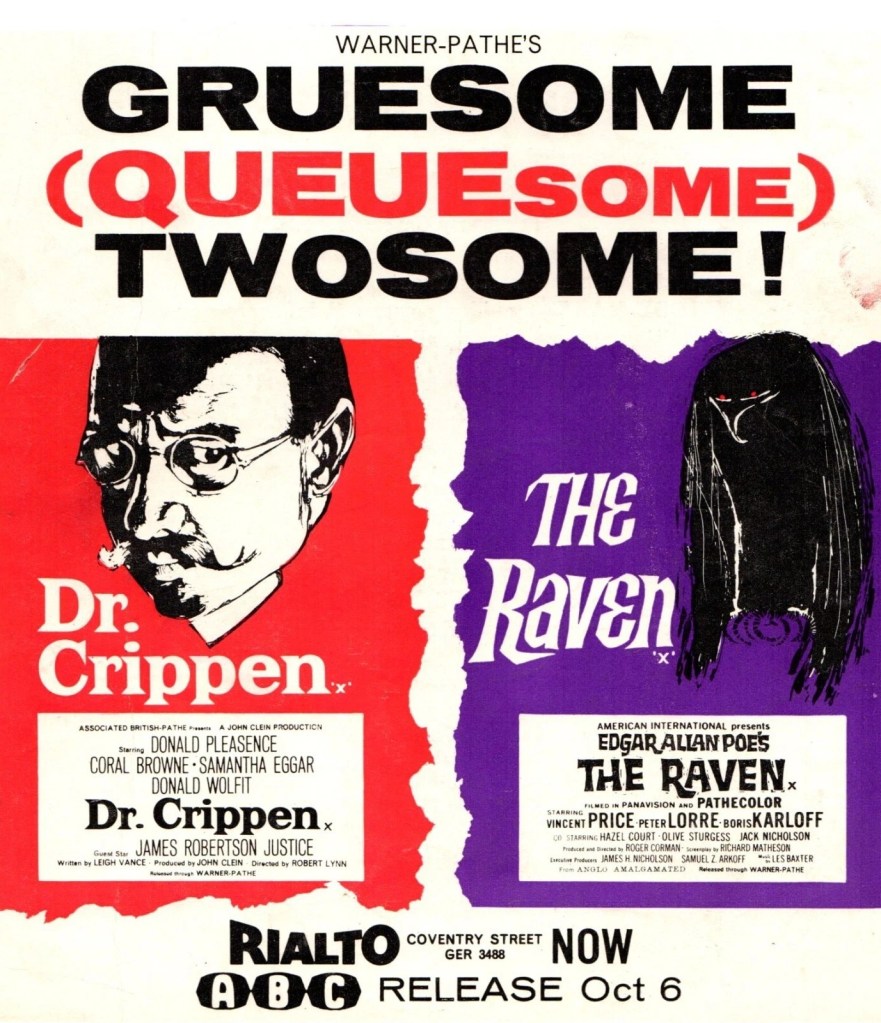
I have to confess my ignorance of this infamous British murderer. I knew the name and that he had hacked up his wife and buried her under the floorboards, so I just assumed a nutcase in the vein of Jack the Ripper, a sadist with a bent for mutilation. So I was quite surprised by this biopic which tended more towards explanation – perhaps going as far as expiation – rather than exploitation.

Mostly, this is set around a court case with flashbacks to fill in the story. This is one of these pictures where the victim is completely unsympathetic. Mrs Crippen (Coral Browne) as portrayed here was just awful. An ex-music hall artiste, she not only slept around but taunted Dr Crippen (Donald Pleasence) about how much better her, invariably younger, lovers were in bed. She treated him as her servant, always on the lookout for the opportunity to humiliate him and was at her most venomous when drunk, a common occasion.

He had fallen for a much younger woman, his secretary Ethel Le Neve (Samantha Eggar), who, despite the age difference adored him. Though the notion of her apparently inept husband consorting with a woman was hilarious to Mrs Crippen, his wife wanted to use the opportunity to humiliate him further. Divorce is out of the question. In 1908 the scandal would ruin an outwardly respectable man. In innocent fashion, Ethel plants in the doctor’s head the potential solution.

Crippen poisons his wife, chops her up, buries her in the cellar and comes up with a fantastical tale to account for her disappearance, namely that she had run off to America to take up with a previous lover. The police think he’s lying – assuming she has just run off – but don’t believe this innocuous little man could be guilty of murder. The situation only becomes dicey when Crippen and lover flee the country and this creates a hue and cry, front page news across the world, and they are apprehended on board a steamship where they maintain the charade of being father and son, a cover blown by the fact her male outfit hardly conceals her figure and that he can’t resist squeezing her hand in public..

Ethel believes Crippen is innocent and although he is found guilty, there is a coda where it might appear that the crime should be manslaughter rather than murder. He intended the poison to be used as a sedative, to stop her verbally abusing him, and he only accidentally gave her an overdose.

So it’s far from drawing a lurid picture of a terrible murderer in part due to the portrayal of his philandering, drunken, abusive wife; in part due to the meekness of the doctor; in part due to being shown exactly how the overdose could have occurred in unintentional fashion; and in part because we do not see him butchering the body. It comes across as a more sympathetic portrait of one of the most demonized figures in British criminal history.

The only problem is it’s impossible to see the attraction of a vibrant young women to this fuddy-duddy older fellow. Maybe it was his intellect – a young woman dazzled by his brain.

He’s not exactly creepy, but he lacks an ounce of charisma. But that does square with him not being a murderer, and only wishing to sedate his wife – still a crime – to give him some peace.

Resulted in Donald Pleasence (Soldier Blue, 1970) being typecast as a villain which, while limiting his range, ensured career longevity. Samantha Eggar (The Collector, 1965) continued to burnish her growing reputation. Coral Browne (The Killing of Sister George, 1969) steals the show with a vigorous performance, but, oddly enough, didn’t do her career much good, another four years would pass before she was seen again on the big screen. Inveterate scene-stealer Donald Wolfit (Life at the Top, 1965) hams it up but there’s a more measured performance from the normally ebullient James Robertson Justice (The Fast Lady, 1962).

Directed by Robert Lynn (Mozambique, 1964) from a screenplay by Leigh Vance (The Frightened City, 1961).

More than competent biopic.

Born Free (1966) ***

Unusual mix of the sentimental and the unsentimental, mixing soft-centered animal features like That Darn Cat (1966) where cute beasts cause mayhem with the kind of realism espoused by Sir David Attenborough (Planet Earth, 2006) where nature is red in tooth and claw, though skipping the irony of game warden-cum-conservationist George Adamson (Bill Travers) bringing up the cubs of the leonine parents he has shot dead.

With wife Joy (Virginia McKenna) they decide to rear the baby animals. Joy is most attracted to the runt of the litter, Elsa. Cue much hilarity as the animals destroy their house, knocking over anything standing, pulling down curtains, breaking plates, and like any youngsters resisting bedtime. Joy is so distraught at having to get rid of the grown-up cubs, despatched to zoos, that her husband holds onto Elsa.

If Joy can’t face shipping the cub overseas, she’s unwilling to face up to the fact that the only other alternative is to groom her for a life in the wild. A tame animal let loose would hardly survive a minute. So they’ve got to train Elsa to hunt. This doesn’t work out, Elsa finding herself at the wrong end of the hunting business – attacked by a warthog – or too inexperienced to know not to go near a herd of wild elephants. When she crawls home nursing her wounds, George is on the verge of giving up, but Joy wishes to persevere, resulting in scenes of the cute Elsa now suddenly red in tooth and claw and savoring her kill.

Now, all that’s left is finding her a willing mate. When that’s achieved, it’s job done, though when Elsa returns for a visit she’s accompanied by her own cubs.

And if you’re occasionally bored by the cutesy elements and wish the movie would get a move on, you can always savor, as I did, the Oscar-winning music by John Barry. It’s what these days would be deemed a feel-good movie but that’s only if you wriggle out of the irony.

The problem for the big cats in Kenya was that they were prey to illicit big-game hunters and if that had been the reason for the cubs being orphaned it would be a better fit for the general theme. But, basically, what lions don’t seem to realize is that they can’t treat humans like any other prey. There’s some weird supposition that they can prefer the taste of human flesh, rather than the more obvious reason why humans are attractive being that, unless armed, they can neither run away nor defend themselves like all the other jungle occupants.

There’s an unspoken rule – to which the lions are obviously not privy – that if you get a reputation as a man-eater then that friendly game warden who’s otherwise on your side is going to come after you and shoot you dead. It would only be luck that your offspring might end up with a couple of friendly humans rather than as dinner for other predators.

So being “born free” comes with the proviso of not getting in the way of humans.

Real life couple Bill Travers (The Bridal Path, 1959) and Virginia McKenna (Carve Her Name with Pride, 1958) were considered well past their sell-by date, neither having made a picture in five years. But they seem to embody the characters well, McKenna’s acting recognized by the Golden Globes.

James Hill (A Study in Terror, 1965) directs from a screenplay by Lester Cole (Operation Eichmann, 1961), blacklisted as one of the Hollywood Ten, and Joy Adamson, author of the eponymous bestseller.

While you’re probably not as nit-picky as me, you might well figure this is well past its sell-by date or, equally, you might hail it as the precursor of an animal rights campaign.

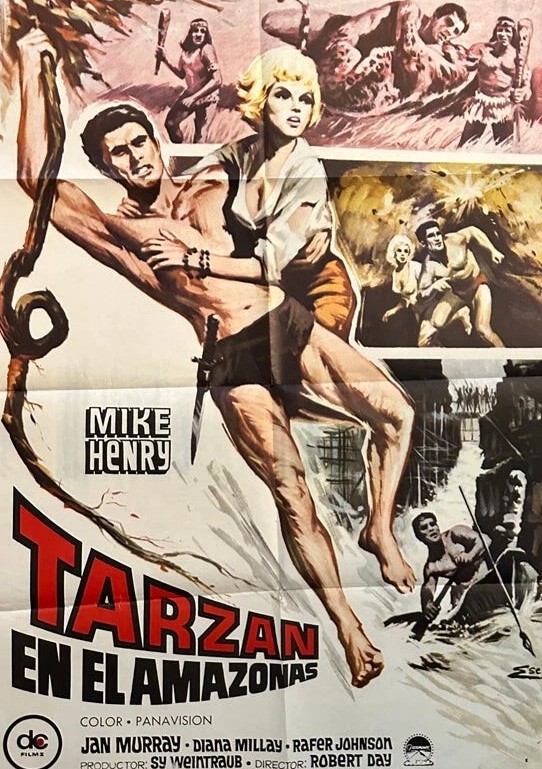
Behind the Scenes: Wrong, Wrong, Wrong: “Tarzan and the Great River”(1967): Pressbook

It’s easy to forget that the main purpose of the Pressbook/Marketing Manual is simply to provide a cinema manager which a range of advertisements in various sizes that they can cut out and take along to their local newspaper to be reproduced, plus a synopsis of the picture, list of the cast, billing credits and that other essential – running time. Most Pressbooks were not upscale A3 or even A2, printed in color, with fold-outs, and running to 20-plus pages with extensive cast bios, journalistic snippets and promotional ideas.

They were produced long before the movies went into release, sent out weeks or even months in advance, as a studio promotional tool, to lure cinema managers into booking the picture. Big studios employed marketing teams or farmed the job out to PR specialists before there was a finished film to view – and even that might be considered too time-consuming a task.

So there was a fair chance marketeers were working from a synopsis. And no guarantee they would even have the time to read that. For a picture like Tarzan and the Great River, there were obvious default promotional ideas – tie-ups with travel agencies, or camera stores for people to submit photos of their travels, or lobby gimmicks.

But it’s not going to help your chances if you – as the cinema manager – haven’t read the synopsis either and plan your promotional agenda on the information available in the “Exploitation Tips” section of this particular Pressbook.

Out of seven such ideas, three assume the movie is set in Africa rather than South America. So camera stores, whose managers wouldn’t have seen the synopsis either and were relying on the cinema manager’s advice, might end up asking customers to submit photos “suggesting African scenes.” Similarly, travel agencies would be instructed to “take advantage of the African background” to organise a window display “with African tour backgrounds.” You would be ordering in safari outfits for the ushers to wear or find African motifs to decorate the lobby.

Outside of these blatant errors, the advertising agency had done a good job of trying to reposition Tarzan’s public image. He was now “America’s Number One Hero” in possibly an attempt to challenge James Bond.

To interest editors, the marketers compiled a list of other athletes turned actors. Current Tarzan Mike Henry had been a “bruising line-backer” with the Los Angeles Rams and the Pittsburgh Steels. The villain of Tarzan and the Great River is played by decathlon champion Rafer Johnson. John Wayne and Jim Brown had also been pro footballers.

Babe Ruth put in  a screen appearance, playing himself, in Pride of the Yankees (1942) starring Gary Cooper. Mickey Mantle and Roger Maris played themselves and for a full-length feature in  Safe at Home (1962). Former Rams star Elroy Hirsch also played himself, but this more than a cameo, as he was the star of his biopic Crazylegs, All-American (1953). Subsequently, he starred in the non-sports offerings Unchained (1955) and Zero Hour (1957)

With not much to interest the newspapers in Mike Henry beyond beefcake photos, the marketeers majored on producer Sy Weintraub, who had begun his career in television syndication, and was credited with originating the concept of the “Late Show.” As president of Motion Pictures for Television, he ushered in the gold rush of buying up old movies for small screens. He also owned a TV and radio station, but he sold up all these interests to finance the purchase of the rights to Tarzan in 1958.

Tarzan had been around for so long on the silver screen that one of the more interesting promotional ideas was to offer a free ticket to anyone who could recall seeing the first Tarzan Elmo Lincoln  back in 1918..

The advertising taglines emphasized danger: “barehanded combat with a wild jaguar,” “vicious man-eating piranhas,” “blazing volcano”, “savage tribes,” and “risking his life to save his woman.” It was rather a bold claim that the picture offered “more heart-stopping adventure than anything on the screen now.”

While the Pressbook was A3 in size, it was limited to just six pages. There were only two advertisements rather than the half-dozen-plus that were common. Having said that, the character must already have been imprinted on the public mind so possibly there was little point trying to say more.

Discover WordPress

A daily selection of the best content published on WordPress, collected for you by humans who love to read.

The Atavist Magazine

by Brian Hannan

WordPress.com News

The latest news on WordPress.com and the WordPress community.