Zulu (1964) *****

The technical excellence is substantially under-rated. Not just the aural qualities – the approaching enemy sounding like a train – and the reverse camera and uplifted faces registering awe that later became synonymous with Steven Spielberg, but the greatest use of the tracking camera in the history of the cinema. So what could otherwise be a rather static movie given it revolves around a siege is provided with almost continuous fluidity.

It’s perhaps worth pointing out, in relation to accusations of jingoism, that the British had relatively few battles to celebrate – Agincourt in the Middle Ages, Waterloo in 1815, El Alamein in 1942. But the Crimean War, in which Britain was on the winning side, was remembered for the disastrous Charge of the Light Brigade. Dunkirk in 1940 was a defeat and in cinematic terms D-Day was seen as heavily favoring of the Americans. Although there had been a corps of British World War Two pictures, these generally focused on individual missions (The Dam Busters, 1955) or characters (Reach for the Sky, 1956). And in fact the defense of Rorke’s Drift was preceded by a resounding defeat at the hands of the Zulus at Isandlwana.

Tactically, too, the Zulus are smarter. Their leader is only too happy to sacrifice dozens of his troops in order to gauge the British firepower, their snipers probe for weaknesses in the British defences, their troops feint to attract fire and waste bullets.  The Zulus are too clever to attack where the British want.

This is not even your normal British army. Rorke’s Drift is a supply station and hospital. Its upper class commander Lt Bromhead (Michael Chard) idles his time away going big game hunting. The more down-to-earth Lt Chard (Stanley Baker) is there in his capacity as an engineer, erecting a pontoon bridge over the river. Neither has been in battle.

It’s surprisingly realistic in its depiction of the common soldier as having other interests beyond fighting. Private Owen (Ivor Emmanuel) is more concerned about the company choir, Byrne (Kerry Jordan) more focused on his cooking than bearing arms, and farmer Private Thomas (Neil McCarthy) spends his time cuddling a calf. Hook (James Booth) is a troublemaker and slacker and surgeon Reynolds (Patrick Magee) inclined to mouth off to his superior officers. The Rev Witt (Jack Hawkins) turns out to be a drunken hypocrite. His pious daughter (Ulla Jacobsen) is shocked when the men try to steal a kiss

Beyond a fleeting glimpse of victorious forces at Isandlwana, the Zulus are introduced in a sequence of harmony, a tribal ritual preceding a marriage ceremony, lusty singing and dancing scarcely setting up what is to come. It’s more like the by-now traditional section where the main characters in a movie set in an exotic land are introduced to aspects of local culture. Various characters attest to their military exploits.

But after that, tension cleverly builds. Witt raises the alarm, a bunch of cavalry irregulars refuse  to stay and fight, the sound of the pounding “train” of the approaching army (an idea imitated for the oncoming unseen German tanks in Battle of the Bulge, 1965) and then the awesome shot of the thousands of Zulus adorning a hilltop make it unlikely the garrison can survive, especially given the inexperience of Chard and Bromhead, the latter of the civil “old boy” old school, and their inherent rivalry. Nor are the commanders typical. Chard may be gruff but he’s not arrogant and the soft-spoken Bromhead is the antithesis of every British officer you’ve ever seen on screen.

As the camera continues its insistent prowl, many sequences stand out – the battle of the battle hymns (“Men of Harlech” from the Brits); the bandage unravelling from the leg of wounded Swiss; the blackened wisps of canvas on the burning wagons at Isandlwana; the trembling voice of Color Sgt Bourne (Nigel Green) in the post-battle roll call; “he’s a dead paperhanger now”; the frantic bayonets digging holes in the walls of the hospital to escape; the final “salute” by the defeated Zulus; the torrential firepower the defenders inflict when three units fire in turn.

There’s a scene you’ll remember from The Godfather (1972) when Michael Corleone and the baker’s son stand guard outside the hospital and the baker’s hand shakes when he tries to light a cigarette whereas Michael notes that his own is perfectly steady. That has its precedent here. Chard’s hand shakes loading bullets into his pistol but later, battle-hardened, it does not.

There’s no glory in war as the surgeon constantly reminds the leaders and Bromhead, expecting to exult in triumph, instead feels “sick and ashamed.”

Terrific performances all round, mighty score by John Barry, written by director Cy Endfield (Sands of the Kalahari, 1965) and Scottish historian John Prebble (Culloden, 1964). The high point of Endfield’s career. Despite his character’s prominence Michael Caine was low down the billing, and despite the movie’s success stardom did not immediately beckon and he had to wait until The Ipcress File (1965) and Alfie (1966) for that.

I hadn’t see this in a long while and expected to come at it in more picky fashion. Instead, I thought it was just terrific.

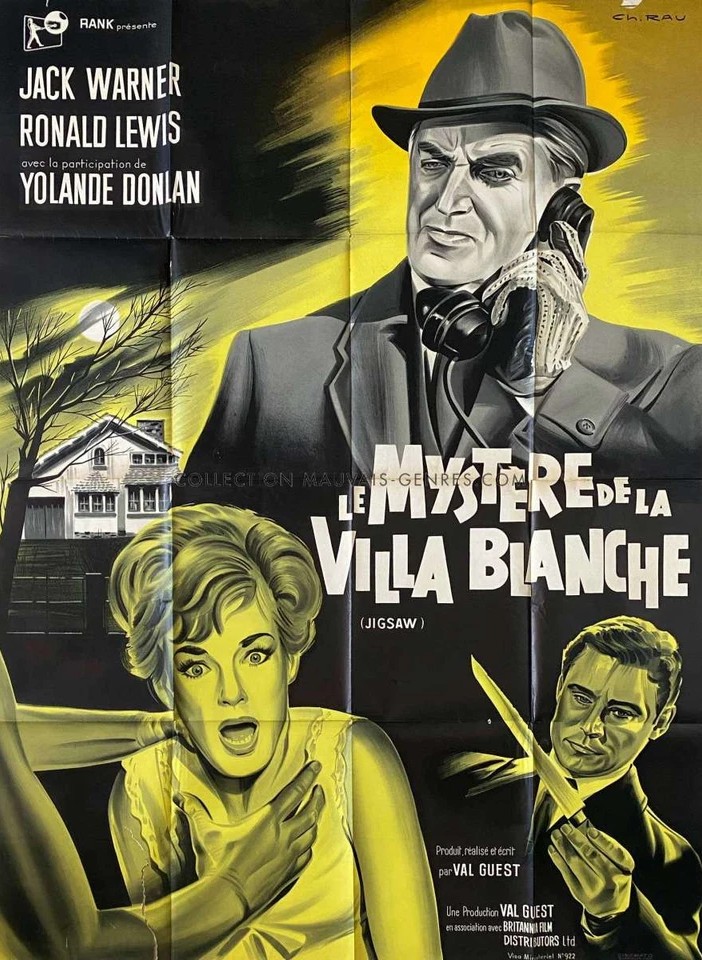
Jigsaw (1962) ***

Unusual crime picture even for the period. Most of these British pictures focused on the crime or an innocent caught up in nefarious activity, not just a straightforward police procedural before the term was even invented. In fact, the plodder was more likely to be a private eye or gifted amateur like Hercule Poirot or Miss Marple.

The title doesn’t refer to mystery but the painstaking element of putting all the pieces together and most likely still not being able to complete the puzzle – as occurs here until the very last scene and even then by pure accident. There are no sudden sparks of insight and the detectives don’t have the luxury of gathering all the suspects in a room Agatha Christie style. In fact for most of the movie not only can they not settle on a suspect they’re struggling to identify the victim. And this being when forensics didn’t exist except for fingerprints, there’s nothing even from that area to help.

At first Detective Inspector Fred Fellowes (Jack Warner) and Det Sgt Jim Wilks (Ronald Lewis) are investigating a break-in at a real estate office. Nothing’s been taken except leases, which suggests someone who either wants to get out of a lease or who doesn’t want their handwriting identified. After an exceptionally long haul it proves to be the latter. A lead takes them to a house in Brighton where they find the corpse of a woman with the initials JS.

I doubt if any police pictures of the period went into as much detail in following clues as this. Hunting for the killer the police interview taxi drivers, delivery men, garage mechanics, grocery clerks, truck drivers working construction, hardware and vacuum cleaner salesmen. Searching for the victim they check out beauty parlors, factories, pawnbrokers, airlines and hairdressers. The only clues are a gray car with a bent wing mirror – but even when they can identify the make it turns out there are thousands in the country – the contents of a vacuum, perfume smells on a pillow, particles of bone found in a furnace. Finally, with an old-fashioned trick Fellowes finds a name – Jean Sherman (Yolande Donlan) – and an address.

But Jean Sherman isn’t dead, though it transpires that she had a one-night stand in the murder house with a man she identifies as Campbell. But they can’t find Campbell either. They do alight on dodgy vacuum cleaner salesman Clyde Burchard (Michael Goodliffe), who has a previous conviction for indecency. Despite being identified by the delivery driver, it turns out he just had sex with the dead woman and nothing else.

Eventually, Fellowes finds Ray Tenby (John Barron) who is identified by Jean. He had picked her up after killing the other woman, Joan (Moira Redmond), and had sex with her in the next room to the corpse. But they can’t prove Tenby didn’t act in self-defense, and it’s only by that piece of unexpected luck that they can pin it on him.

Although most of the dialog focuses on the investigation there are some clever remarks. A journalist pressing a beat cop for information is told that leaving his car running unattended is an offence. Jean’s hardline father (John Le Mesurier) initially decries his daughter’s behaviour as immoral to the point of almost disowning her until, discovering she is dead, he bursts into tears.

With the amount of mileage the investigation covers, this could be done within the usual hour-and-a-bit of the standard British B-movie so it stretches a proper feature length. As written and directed by Val Guest (Assignment K, 1968), it’s not particularly stylistic, nor does it stretch tension too far, but it is still engrossing in the accumulation of detail.

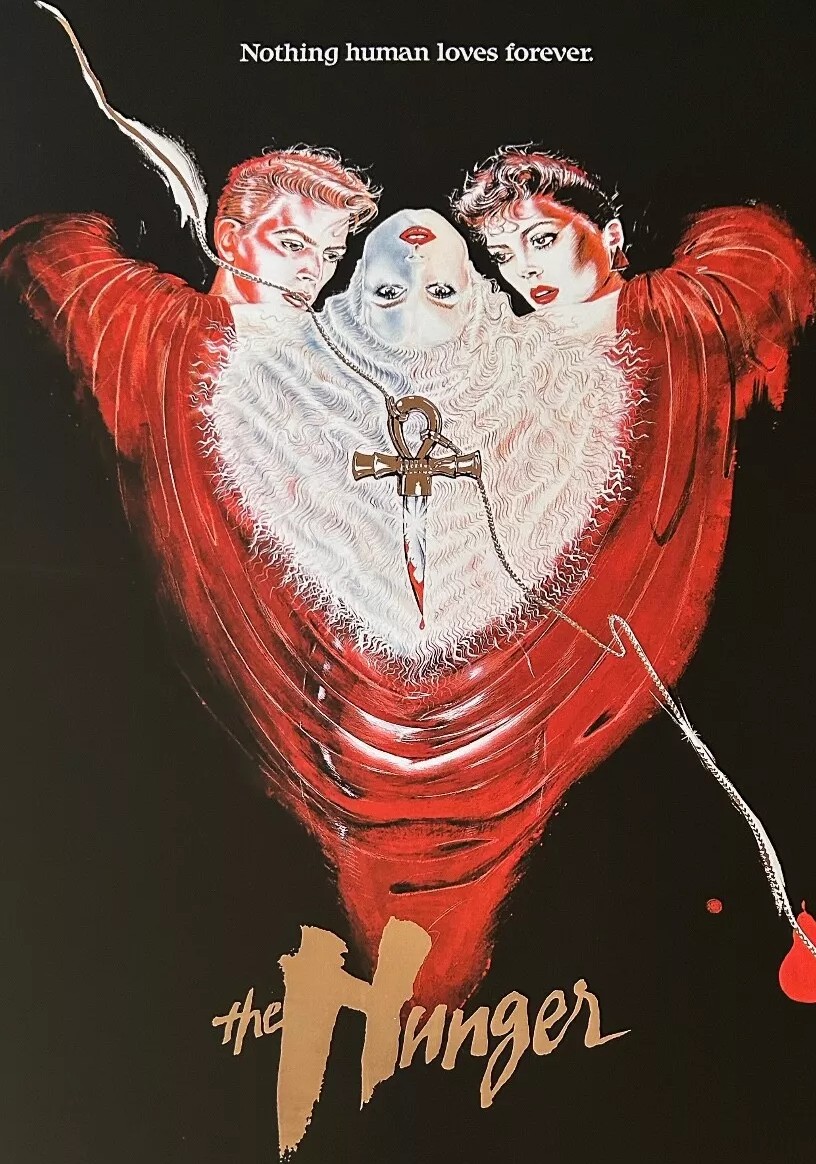
The Hunger (1983) ****

With this weekend’s Sinners claiming to reinvent the vampire picture, I thought it time to look back at a movie that genuinely did reimagine the vampire genre, though hardly acclaimed at the time.

Elegant, atmospheric, subtle. Never thought I’d be stringing those words together to describe an offering from uber-director Tony Scott (Top Gun, 1986). Add in “slow” and this is a director reinvented. Did I mention “short?” This clocks in just over the hour-and-a-half mark. So what  might have driven an audience to distraction if stretched out over a languorous two hours twenty minutes, say, or longer, as would be par for the course in these more self-indulgent times, is not an issue.

If this has become a cult, it’ll be for all the wrong reasons. A vampire picture that doesn’t play by the rules, a lesbian vampire movie that steers clear of Hammer sexploitation, a lesbian movie featuring two top marquee names, or just any picture that features David Bowie.

There’s an inherent sadness to the whole exercise, an elegiac feel comparable to the likes of The Wild Bunch (1969).  Miriam Blaylock (Catherine Deneuve) and husband John (David Bowie) are so stylish and have no truck with growing those oh-so-out-dated fangs that you are willing them to succeed especially as there’s no sign of a crucifix-wielding vampire hunter.

You might wonder why the cops haven’t been alerted to a spate of killings, throats cut in serial killer modus operandi fashion, but really there’s so much else going on – emotional, not action, you understand – that its absence isn’t worth commenting upon.

So first up is betrayal – and from a serial betrayer at that – as John realizes that while he has been promised eternal life by Miriam, who’s somewhere in the region of two millennia old, she can’t guarantee eternal beauty. So when he starts to suffer from ageing, cracks begin to show in their relationship. And whether he’s aware of this or not, she’s already lining up a replacement, the classical music student Alice (Beth Ehlers) they both tutor. And when John knocks her out of the equation, his pursuit of eternal youth or at least a reversal of the ageing process leads Miriam to a spare, scientist Sarah (Susan Sarandon).

The connection between the two women is initially so subtle that Sarah picks up the telephone imagining Miriam on the other end when the phone hasn’t even rung. Sarah is perturbed/excited to discover she has gay tendencies, especially when she’s already in a strong heterosexual relationship. And she’s not that keen, either, on discovering that she has been co-opted into the vampire fraternity.

Most of this has moved along in almost dreamy style so, that come the end, a sudden burst of twists  takes you by surprise. You’ll find echoes to  the priestess in Game of Thrones when the aged John seeks to kiss his lover. And John’s discovery at the end that’s he’s part of an undead harem carries over to the climax of Christopher Nolan’s The Prestige (2006).

Anyone looking for cheap kicks from the lesbian sex scene is going be disappointed, this is sex arthouse-style with wafting curtains getting in the way, and pleasure delivered in subtle rather than orgiastic fashion.

Tinged with a sense of loss, and pervaded by sadness, this is a complete outlier in the Tony Scott portfolio, especially the pace which is completely at odds with the fast-editing style for which he is best known. At the same time, tension remains high, in part because you don’t really know what Miriam is up to, and because these are new ground rules by which the vampires play, not least in their enjoyment of style and fashion, the kind of garb favored by the likes of Christopher Lee only employed as pretense and not by one of the main players.

Catherine Deneuve (Mayerling, 1968) was a Hollywood irregular, not seen there in six years since March or Die (1977), and it’s surprising, never mind her choice of couture, what sophistication a French accent brings to a vampire movie. Susan Sarandon was an ideal fit for the European feel of the picture, having cut her teeth with Louis Malle on Pretty Baby (1978) and Atlantic City (1981). David Bowie spends most of the movie under a sheet of make-up so you need to get in quick for your Bowie fix, and for that short period he is quintessential Bowie.

Written by debutant James Costigan and Michael Thomas (Ladyhawke, 1985) from the Whitley Streiber bestseller.

But this is Tony Scott’s (Enemy of the State, 1998) triumph, work that you’ve never seen before and never seen since, making you wonder why he never continued in this vein.


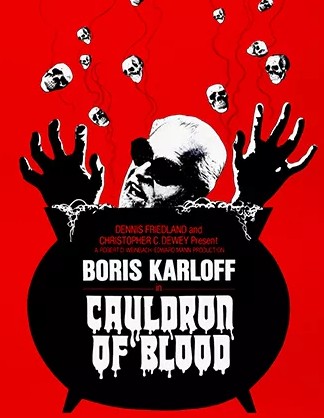
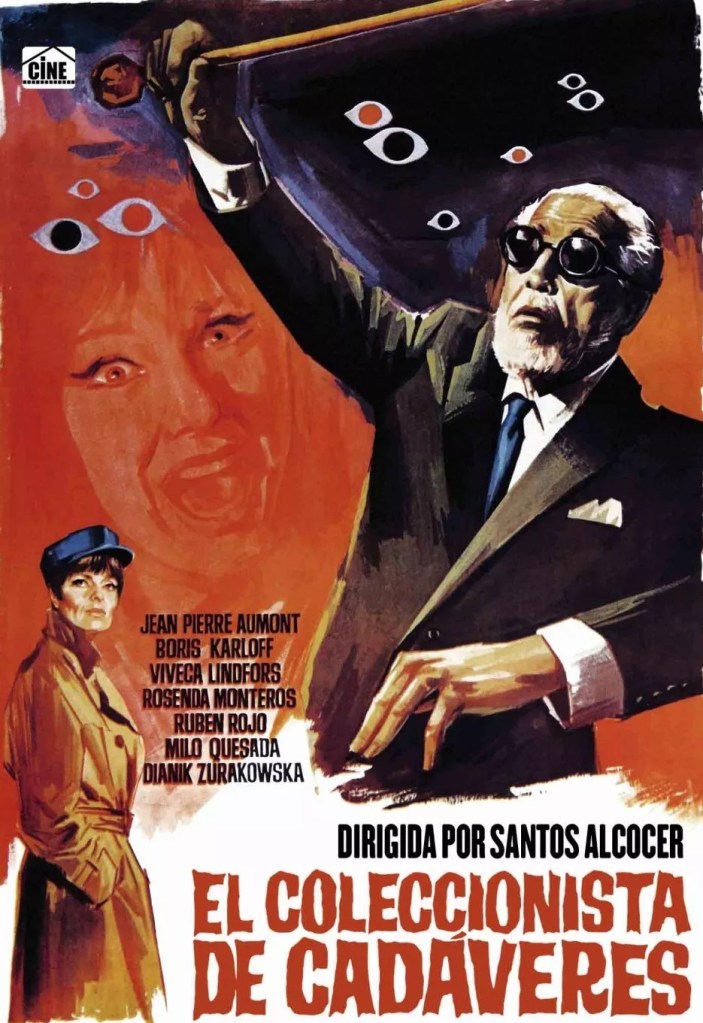
Cauldron of Blood / Blind Man’s Bluff / The Corpse Collector (1968) ***

Superior “lost” horror picture that suffered from minimal initial release and is now rapidly entering the cult dominion. Effective and occasionally very stylish entry to the genre. Apart from Boris Karloff (The Sorcerers, 1967) playing against type, it’s not populated by the usual horror actors but a surprisingly mainstream cast including suave Frenchman Jean-Pierre Aumont (Castle Keep, 1969), Swede Viveca Lindfors (Sylvia, 1965) and Mexican Rosenda Monteros (The Magnificent Seven, 1960). In keeping with a new trend mostly personified in the espionage division, a woman is the villain of the piece.

Begins with an excellent sequence that twists on audience expectation. A young woman sunbathing on a deserted beach is viewed through a telescope. A hand touches her cheek, arousing her from her slumber. You expect her to react, and she does but not as much as you would imagine. It’s only the old guy who rents out beach umbrellas telling her he’s closing shop. We cut to someone in a trench coat with a garotte. It’s not the girl he stalks, but the old fella.

Surprising number of effective scenes beginning with a terrifying nightmare sequence of a young girl being whipped and then attacked by a skeleton. Outside of the dream landscape, a mute maid is whipped.  And a clever note when a young woman pours a glass of red wine, like blood, into her bath, prefiguring trouble to come. There’s a monkey crouched in the beams of a mansion impervious to various nefarious episodes taking place below. And some trick photography of a girl running only to disappear, captured in an overhead shot. A killer dresses up in a skeleton costume.

Journo Claude (Jean-Pierre Aumont) arrives to interview blind sculptor Franz (Boris Karloff) who lives in seclusion and is cared for by wife Tania (Viveca Lindfors). Claude tackles the rumor that the reason for Franz’s very realistic sculpture is that he uses human bones, a suggestion that is batted away.

Claude makes the acquaintance of artist Valerie (Rosenda Monteros) and her nude model Elga (Dyanik Zurakowska), encounters old drunken buddy Pablo (Ruben Rojo) and unleashes his entrepreneurial instinct, planning with other villagers to buy up all the property and cash in on the tourist boom he expects to generate by his coverage of the sculptor.

It’s not just poor old guys who are disappearing; Pablo’s dog is also for the garotte. And all is not well in the sculptor’s household. He accuses his wife of trying to kill him, but botching the job, resulting in his blindness. “I am not your prisoner, you are mine,” he claims, pointing to the fact that he now requires so much care. Later, he accuses her of salting away his money.

The mansion has an underground lair where Tania bleaches bones in a cauldron (like the scene in Jaws, 1975, where sharks undergo similar treatment) and where she meets her lover Shanghai (Milo Quesada) who carries out the killings as well as the occasional rape. Franz believes his wife is merely indulging in a bit of grave robbing to supply him with carcasses for his art.

Suspicions are not raised in the village though Valerie, who turns out to have practical experience of the mechanics of sculpture, reckons too much smoke emanates from the Franz chimney. Elga and Pablo are next to fall victim. When Valerie discovers Pablo’s body, she is added to the list.

And that sets up a quite splendid three-part climax. Racing to the rescue, Claude uses his car as a battering ram to enter the house and then engages in fisticuffs with Shanghai. But, in another twist, that fight takes a helluva time to reach a conclusion so that Valerie remains trapped and with legs bound and drugged must tackle Tania on her own. Meanwhile, the blind sculptor tries to take on his wife. This is a marvelous section where she dupes him with various noises.

Jean-Pierre Aumont is outshone by both Viveca Lindfors and Rosenda Monteros.

Quadruple hyphenate Edward Mann (Island of Terror, 1966) – writer, producer, director and composer of the theme tune – has a splendid time leading the audience astray and producing some moments of sheer terror.

Buona Sera Mrs Campbell (1968) ****

Works a treat. And works like clockwork, the set-up so meticulous, it doesn’t put a comedic foot wrong and even allows space, at exactly the right time, for the ticking timebomb to be sorted out. Gags galore. Sight gags, sound gags and observational gags, but most, unusually, are snippy, the kind of sharp remarks that people make under tension. And, heaven help us, there’s farce, and that works, too. It rarely does in American movies because it’s usually an adaptation of a Broadway play and the movie director feels hidebound by stage conventions. Here, this is an original screenplay, so writer-director Melvin Frank (Strange Bedfellows, 1963) works to his own beat.

You’ll remember the “who’s the father” narrative ploy from Mamma Mia (2008) – though this preceded the Abba bash by four decades. Twenty years after the Yanks liberated an Italian village in World War Two they are back to commemorate the event. Amongst the soldiers, three men desperate to meet the daughter, Gia (Janet Margolin), they each think they sired with Carla (Gina Lollobrigida) and have been supporting with monthly cheques ever since. They don’t know about each other’s involvement but between them have provided an excellent upbringing for Gia who speaks perfect English, having attended American School in Geneva, with enough left over for Carla to live in a fancy house with a maid.

The guys are a disparate bunch. Justin (Peter Lawford) is a philanderer whose wife Lauren (Marian McCargo) dare not let him out of her sight. Phil (Phil Silvers) has a brood and hardly escapes emotional Shirley (Shelley Winters) without one – or all – being attached. The loudmouth exuberant Walter (Telly Savalas) has to bite his tongue when wife Fritzie (Lee Grant) constantly reminds him she hasn’t provided her with a child, when, secretly, he believes she’s the infertile one and Gia the proof.

Initially, this goes the way you expect – and then it doesn’t, confounding all audience expectations. Carla, who had planned to skip town until the celebrations are over, is forced by other circumstances to remain. She’s involved in two subplots – Gia is planning to run off with an older married man to Brazil, and Gina can’t resist the opportunity to get one over on the sniffy local Contessa (Giovanna Galletti). Actually, there’s three subplots if you include Gina trying to keep hold of handsome lover Vittorio (Phillipe Leroy), who initially fears one of the returning soldiers will sweep Carla off her feet and whisk her off to the States, but then becomes very dismissive of her taste in men.

When the secret is revealed, rather than turning on their deceitful husbands, the women are full of praise for them. But that’s only because it’s not the whole secret. They think they discover that out of the goodness of their hearts the men have been sending cash to Carla in memory of their (fictitious) colleague Eddie Campbell who died in the war. The guys, meanwhile, turn against Carla when they become aware of each other’s existence and the fact that not so much just that they have been rooked, collectively, out of $200,000 but that they have individually been helping to bring up what could be another man’s child. Gia, too, on learning of the deceit, is furious and runs away, leaving Carla distraught.

When the true secret emerges, naturally there’s one almighty bust up, with wives and husband and daughter all railing against Carla until Vittorio steps in and explains just what a wonderful mother she has been.  This neatly steps over the timebomb, just what possessed Carla to have sex with three men in ten days beyond that they pumped up her ego and brought her food and treats.

There are some brilliant scenes – the streetwalker, the hospital, the car horn that doesn’t work, the missing laundry, the mean Contessa finding a clever way to put down Carla – but mostly it’s held together with the stiffest of glues by an inspired performance by Gina Lollobrigida. Telly Savalas (The Assassination Bureau, 1969) is the pick of the others, playing against type.

Class act from Melvin Frank.

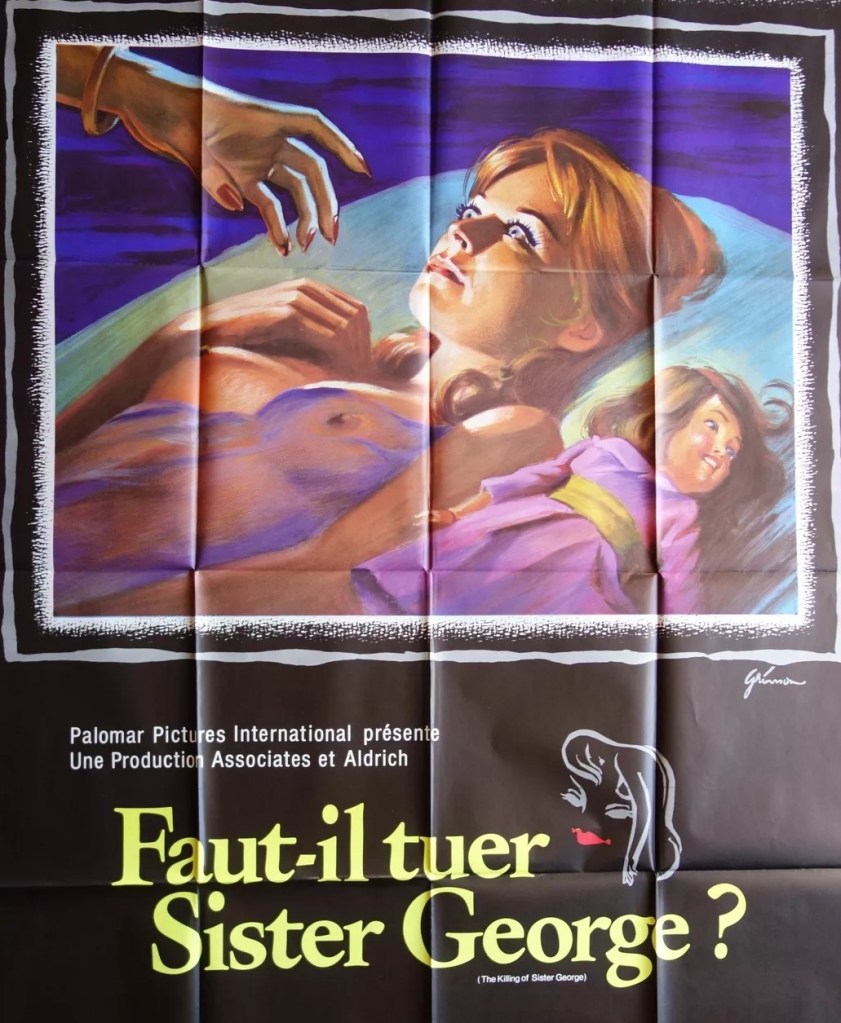
The Killing of Sister George (1968) ***

Somewhere between camp classic, hilarious comedy and bitchiness-on-speed, loaded down with a May-December narrative, too much of the genuine soap opera element of the filming of a soap opera but lifted up by some very touching moments. This started life as a black comedy and its stage antecedents are only too obvious, many scenes running way too long for a movie, and in the unlikely hands of director Robert Aldrich – at this point best known for male actioner The Dirty Dozen (1967) rather than the equally bitchy Whatever Happened to Baby Jane (1962) – asks audiences to ingest a great deal more seriousness.

The sex scene was so shocking in its day that, in the reformed U.S. censorship system, earned one of the first mainstream X-certificates, thus torpedoing its box office potential as newspapers routinely refused to accept adverts for such. Yet while it is tender, and to some extent galvanized by the astonishment of older lesbian Mercy Croft (Coral Browne), a high-ranking television executive, at having such a young and adorable lover as Alice (Susannah York), it is sabotaged by Alice’s gurning.

Whereas Beryl Reid’s performance as aging soap opera actress June (aka Sister George) about to be cut adrift by the television production which has made her name is pretty much spot on as a drunken, insecure, needy, dominant, older lover. Susannah York (They Shoot Horses, Don’t They, 1969) just seems out of control as the bonkers dumb blonde. While same sex relationships between men had only just become legal in England, and the specter of blackmail, public scandal or imprisonment that had hung over many generations now removed, there had never been a correlative for women. Though a newspaper headline might well kill a career.

The best sequence in terms of the harmonious gay relationship comes in the gay club where women hold each other for a slow dance and it seems so normal and touching. Of course, relationships, straight or gay, don’t necessarily run smoothly, but the longstanding affair between June and Alice belongs to the Who’s Afraid of Virginia Woolf (1966) playbook. Alice may well be a gold-digger for all she does, but since the May-December aspect of male-female relationships was a standard Hollywood trope it seems fair enough to apply the same rationale to a single-sex partnership.

There’s some uncomfortable sadism when, as punishment for mild misdemeanor, Alice is forced to eat a cigar butt and told in no uncertain terms just how stupid she is. There had been a recent rash of on-set bitchiness, star tantrums and studio power struggles from pictures like The Carpetbaggers (1964), Harlow (1965), Inside Daisy Clover (1965), The Oscar (1966) and Aldrich’s own The Legend of Lylah Clare (1968), so none of production shenanigans bring anything new to the table.

However, when June lets rip, embarrassing management or forcing her fellow actors to laugh during a tragic scene, this is comedy gold. Her alcohol intake and arrogance aside, it seems a step too far for June to attempt to sexually assault two nuns in a taxi – this unseen sequence key to her downfall. You might be inclined to question how Alice came into the sexual orbit of June and Mercy in the first place, and wonder if the two older women are not guilty of what would be termed these days inappropriate behavior in taking advantage of clearly a vulnerable young woman.

Beryl Reid (The Assassination Bureau, 1969) walks a fine line between self-indulgence and character insight. I felt Susannah York’s over-acting got in the way. The tight-lipped Coral Brown (The Legend of Lylah Clare) was too close to the cliché for my liking.

Robert Aldrich just about gets away with it. Lukas Heller (The Dirty Dozen) adapted Frank Marcus’s play.

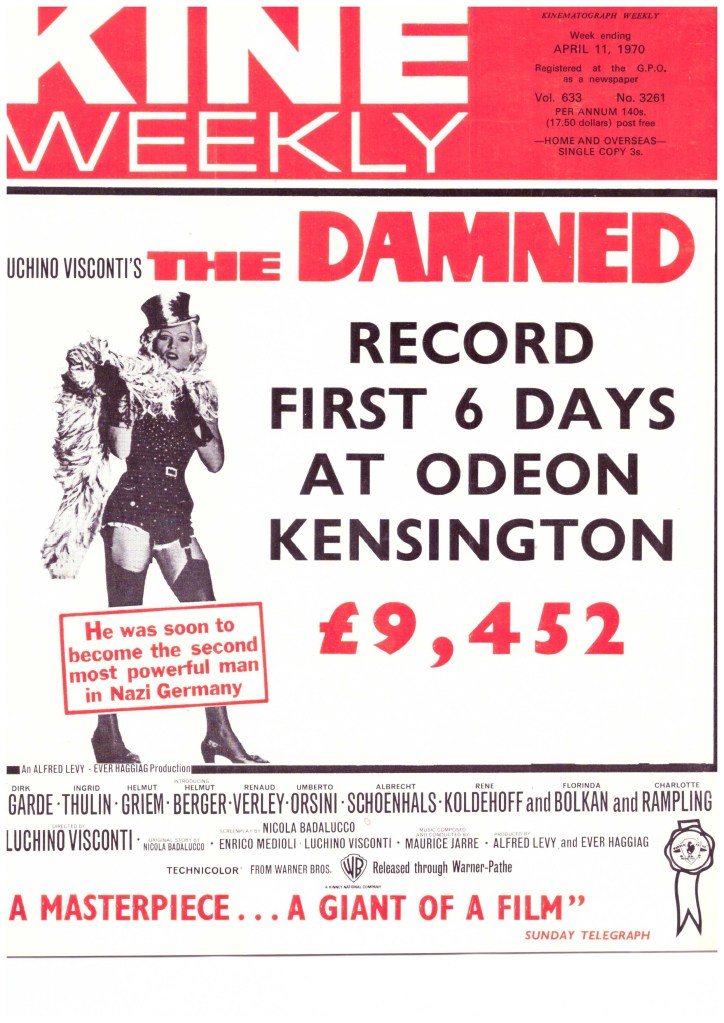
The Damned / Gotterdammerung / Twilight of the Gods (1969) **

Ponderous, gratuitous, offensive. Let’s start with the pedophile, spoiled grandson Martin (Helmut Berger) of industrialist patriarch Joachim (Albrecht Schonhals). We already guess he has this kind of predilection for young girls as that’s suggested during a game of hide-and-seek at the family mansion and by a scream in the night that is ignored. He keeps a mistress Olga (Florinda Balkan) and is drawn to the young girl in the apartment next door, bringing her the kind of expensive present that her impoverished mother believes she must have stolen. So we know what he’s all about. It’s discreetly enough stated without the inclusion of a scene which I doubt would pass the censor these days and should the young actress be still alive in these MeToo times might be considering legal action for being taken advantage of.

Although the storyline is similar to the director’s earlier The Leopard (1963) of the powerful – there a wealthy landowner, here an arms manufacturer – trying to hold onto their status in times of change (then the invasion of Sicily by forces wanting to unite Italy, now the rise to eminence of Hitler), there’s little of the cinematic flair of the latter. Long scenes are played out at dinner tables or in bedrooms. And most of that is machination, someone or other wanting to take over the family firm or be the power behind the throne.

You need some knowledge of German history to understand the significance of some events. Hitler, then the German Chancellor, burned down the Reichstag (the German Parliament) in 1933 in a ruthless bid for power. Hitler employed two factions, the predominantly working class brownshirts (the SA) and the mainly middle class blackshirts (the SS), the former a paramilitary organization committed to actions against Jews and backing his early bid for power. In 1934, in the Night of the Long Knives, the SS obliterated the SA.

The first section of the picture straddles these two events with a Succession-style drama. In reaction to the burning of the Reichstag, Joachim replaces Herbert (Umberto Orsini), his top executive and outspoken anti-Nazi, with boorish nephew Konstantin (Reinhard Koldehoff) who is a high-ranking member of the SA.

This doesn’t sit well with Friedrich (Dirk Bogarde), who expected preference. Urged on by lover Sophie (Ingrid Thulin), Joachim’s widowed daughter-in-law,  and Aschenbach (Helmut Griem), Joachim’s nephew and an ambitious high-ranking SS official, Friedrich kills Joachim but pins the blame on Herbert who has to flee.  

Konstantin is thwarted because although technically in charge it’s now Martin who owns the business and nudged by Sophie gives Friedrich the top management role. So Konstantin resorts to blackmail, having uncovered the pedophile. In steps Sophie who uses Aschenbach to thwart him again. Though there’s not much need because Konstantin is eliminated as one of the SA members executed in 1934 at some kind of gathering where the attendees all appear to have homosexual tendencies.

Aschenbach and Martin nurse grievances. Aschenbach feels Friedrich isn’t ostentatious enough in support of Hitler and Martin is furious that Sophie manipulated his difficulties with Konstantin to Friedrich’s benefit. So the SS man and the dissolute conspire. In the way of this kind of heightened melodrama it’s revealed that Friedrich killed Joachim. That doesn’t send Friedrich to trial, instead wins him a get-out-of-jail-free card by turning into a radical Nazi.

Martin, meanwhile, is also a member of the SS. He rapes Sophie, Friedrich loses his way and in one of those moments Francis Ford Coppola would appreciate Martin kills them on their marriage day.

There are a couple of oddities. It’s hard to believe a young girl – we’re talking a 7-8-year-old – would actually manage the mechanics of hanging herself. And when Friedrich is drawn into joining the slaughter of the SA members, there is over-emphasis on his perceived sensitivity  when previously he had cold-bloodedly despatched Joachim.

So glorified soap opera with too much virtue signalling for its own good. Excepting Herbert and wife Elizabeth (Charlotte Rampling) and another grandson, who play minor roles, there’s not  a single character to care for.

Despite the unusual backdrop, there’s nothing particularly unusual about the succession/inheritance scenario. The tough self-made millionaire or latest head of a wealthy family seeks to maintain power and guard against diminishing its status and lineage by ensuring the correct successor is groomed and that capital is not dissipated through unsuitable marriage or indulging weaker offspring. Thomas Mann, who fled the Nazis in the 1930s, covered this ground more successfully in his debut novel Buddenbrooks, although admittedly with less decadence.

Setting The Damned against the rise of the Nazis is an attempt to give it more artistic status than it merits because it’s really not much more than a standard study of ambition and ruthlessness.  

Peeping Tom (1960) *****

You could hardly get a more prescient movie, almost in the 1984 class in depicting the future. Not dystopian, but the contemporary obsession with filming every inch of a child’s life. You do wonder what kind of reaction this will generate further down the line when Generation ZZZ realizes how little privacy it has been afforded.

Director Michael Powell – thrice Oscar-nominated and at the time after such hits as The Red Shoes (1948) regarded as on a par with the likes of David Lean (Oscar-winner of Bridge on the River Kwai, 1957) and Carol Reed (The Third Man, 1949) – lost his shirt and his reputation on this, and it took decades before Peeping Tom was accepted as nothing short of a masterpiece.

The narrative cleverly links up several strands. With a portable movie camera landlord Mark (Carl Boehm) obsessively records everything in the vicinity, including posing as a journalist to join a police murder investigation and rigging his apartments to check out the goings-on. He’s also, it transpires, a serial killer, the terror registered on corpses’ faces not aligning with the knife wounds that killed them. Into his world comes a young woman Helen (Anna Massey) who is attracted to this intriguing shy figure. Her mother (Maxine Audley) is less accepting.

In the background are the visual memories of Mark’s childhood, perhaps explaining his current compulsions, the films his psychiatrist father made of how his son reacted to fear, most of which episodes are triggered by the father. And the whole movie takes place in another world of make-believe, that of movie making, where directors are driven to distraction by incompetence and Mark can play on ambition by luring wannabe actress Vivian (Moira Shearer) into making an after-hours movie with him, which ends in her death. Even Helen, a children’s writer, has taken as her subject a magic camera.

Although Mark is interviewed by the police and, in a very modern trope, films himself being interviewed, he is not considered a major suspect. He screens his snuff movies for the blind mother. Murder is perceived as an almost erotic act, correlating with the very modern idea of violence as pornography. Clearly, it’s the progenitor of the slasher film. And Helen would be viewed as the first “final girl.”

But it’s also beautifully made, the color palette, use of light and shadow, the mise en scene, all speak to a master at work, and the delving into the mind of a killer is shown, unusually, in visual rather than verbal terms in the dry tones of a psychiatrist such as parlayed by Alfred Hitchcock at the end of Psycho the same year. Quite why only Hitchcock’s film was acclaimed, given they cover similar personality defects, you would have to go ask the critics.

And the big reveal – why the victims died in such fright – would surely be noted by today’s moviegoer as inspired genius. Carl films his victims dying and he has attached a mirror above the camera so the victims can see themselves die in horrific fashion.

Audience and critical revulsion was as possibly triggered by the scenes of the young Carl being tortured by his father, such aspects of society treated in far more discreet fashion, if at all, in those times. The voyeuristic aspects of the murders are only sexual on the surface, and really harbor back to the tormented childhood where a young boy grows up believing all acts of violence are not only permissible but must be recorded. Written by Leo Marks (Sebastian, 1968).

The raw power must be seen to be believed. Martin Scorsese has promoted many movies he believes under-rated but in this one he gets it right.

Identity Unknown (1960) ***

The disaster picture in embryo. Well, the disaster picture without the actual disaster, but setting up the disaster narrative formula of who lives and who dies.

But before we go on to that, spot the deliberate mistake – in the poster I mean. At least I’ve realized it comes from an entirely different movie whereas imdb and Rotten Tomatoes clearly do not. But I’m using it as I guess for the same reason they did – due to the lack of a genuine poster for this picture.

Just to confuse you further, this is a lobby card from the wrong picture,
the one from 1945 not the one being reviewed.

Regarding the survival lottery, your card is somewhat marked, this being the innocent start of the 1960s and not a few decades later where screenplays adopted a more cynical – and shock-bait – approach to narrative. The minute you know that the lives of four children depend on the survival of various adults involved in a plane crash in the Swiss Alps then you can guess pretty much who will come out of the disaster scot-free.

But as would later be de rigeur for the disaster movie, the narrative concerns itself with a limited number of characters. There are only ten people on board the plane. We know from the outset only three have survived. So the question is – who?

But instead of following the survivors as they battle the crash and the snowbound mountains and fierce storms and freezing cold and whatnot, instead we focus on the back stories of the passengers and crew through John (Richard Wyler) and Jenny (Pauline Yates), seasoned and novice reporter, respectively, as they go through their door-stepping paces.

So, essentially, it’s an expanded portmanteau, ten stories, ten families’ lives in the balance.

Our cross-section of society includes a few who might benefit from someone not surviving – lawyer Jamieson (John Gabriel) hoping the main witness against his villainous client won’t be able to testify, adulterous wife Mrs Sylvester hoping her husband’s death will leave her free to marry lover Ray (John Carson). To counter those conniving characters, we have the heart-tugging tales of two child refugees from Poland awaiting the arrival of their adoptee mother Mrs Phillips, parent Ken (Vincent Ball) whose child will die if an eminent surgeon doesn’t return, and pilot’s wife Pam (Nyree Dawn Porter) in a maternity ward with a newborn baby.

Movie agent Charlie (Martin Wyldeck) takes advantage of unexpected publicity for his ageing client, praying survival will boost her fading career. But he’s cynical enough to already be imagining headlines: “Farewell Performance” if she dies, “Return Farewell Performance” if she lives.

The journalists are not as hard-bitten as they imagine. Sure, Ken does report fraudster Philbert (Peter Elliott) to the police, but he stops short of revealing the fact that her daughter is on the plane to a blind mother whose family are keeping the news from her. In theory, Jenny, is the more conscience-stricken of the journalists, but that’s only if you excuse the tape recorder hidden in her handbag.

By the time our motley crew head out to Switzerland to meet the rescuers coming down the mountain and find out if their loved ones have made it, some home truths have been spelled out. Mrs Sylvester discovers her lover only seduced her to win a job from her husband. “Think I’ve been hanging around here for the pleasure your company?” snarls Ray. “If your husband’s dead you’re no use to me.” Not one to take a put-down lying down, she chats up a smooth gangster in Switzerland. “I’ll ring you some time,” he says when they part. “You don’t know my number,” she wails.

By the time the journos and those waiting are assembled in the bar at the Swiss airport, you might have expected Hercule Poirot to waltz through the door and start interrogating them – generally the only reason for such an assembly.

By this point, John and Jenny have cosied up, at least she’s cooked him a meal, though that proves not a precursor to seduction. But the movie skips past the joy of the child-related survivors and ends on a couple of telling visuals: the welcome home cake for the daughter who won’t return and the tape unspooling from the recorder as Jenny decides being a hard-nosed journalist isn’t for her. While in some senses Mrs Sylvester gets her come-uppance, husband dead, lover fled, this is no morality tale – the villain gets off with murder.

As usual, with these trim British B-pictures, don’t expect much in the acting department, but the story is well told, sufficient and interesting variety of characters, especially when the narrative goes outside the point-of-view of the reporters and focuses on facial expression of those involved.

Pauline Yates (Darling, 1965) has more spark than Richard Wyler (The Ugly Ones, 1966) while Nyree Dawn Porter (BBC’s The Forsyte Saga, 1967) and Vincent Ball (Echo of Diana, 1963) flesh out minor roles. Valentine Dyall (The City of the Dead/ Horror Hotel, 1960) plays a grumpy newspaper editor.

Directed with occasional nifty touches by Frank Marshall (A Guy Called Caesar, 1962) from a screenplay by Brian Clemens (The Corrupt Ones / The Peking Medallion, 1967).

Another plum on Talking Pictures TV.

Can Heironymus Merkin Ever Forget Mercy Humpe and Find True Happiness? (1969) **

I’ve been revisiting this oddity in the hope that maybe I was too quick to condemn what was, in some respects, one of the quirkiest pictures ever made. Alas, time has been no kinder.

One of the biggest-ever movie follies, an overblown vanity project with Fellini-esque overtones – written, directed, produced and starring British crooner Anthony Newley (Doctor Dolittle, 1967) – that turned into the first X-rated musical. Bob Fosse mined a similar, almost as seedy, sex-obsessed autobiographical vein in All That Jazz (1979) to critical acclaim whereas the Newley effort met critical coruscation.

Although primary known as a Broadway star (Stop the World, I Want to Get Off), he had a small but reasonable movie portfolio, star of The Small World of Sammy Lee (1963) and male lead to Sandy Dennis in Sweet November (1968), so in a sense he was ready for the leap into movie stardom, though perhaps not in such grandiose fashion. Had the movie shown the slightest touch of irony, that might have been its saving grace, but the main theme is that women queue up to bed a star who is fed up with bedding women yet appears to revel in his own moral decadence.

The story is so slim it defies belief or arrogance. Hieronymus Merkin (Newley) is preparing to make a film about his own life though he feels he has been controlled from the outset, his child view is that of a marionette with someone else pulling the strings. Once Goodtime Eddie Filth (Milton Berle) sets him on a stage career beauties flock to his side. Although married to Polly Poontang (Joan Collins) he longs to be reunited with earlier lover Mercy Humpe (Connie Kreski). Basically, he keeps asking the universal question besetting all men – if I can all the sex in the world, why am I not happy?

On the plus side it is certainly audacious, surreal, pretentious, unconventional and gives a good idea of what would happen if a director turned up on a beach in Malta with a cast of whoever happened to be available plus assorted nudes and rolled the camera to see what would happen and then argued with his crew or critics about what was taking place. One big minus is the songs. Newley was a talented lyricist (Goldfinger) and composer as well as performer. But the material here is poor and Newley, despite his Broadway experience, has no idea how to stage a musical.

Cameos abound. You can spot famed comedian George Jessel, singer Stubby Kaye, British entertainer Bruce Forsyth, Tom Stern (The Devil’s Brigade, 1968), and British character actors Patricia Hayes (The Terrornauts, 1967) , Victor Spinetti and Judy Cornwell. You may be surprised to learn that the script written in tandem with Herman Raucher (Sweet November, 1968) was named Best British Original Screenplay by the Writers Guild of Great Britain.

Theoretically, this is now regarded as a cult classic but I’ve yet to come across a review that treats it as anything other than a self-indulgent curiosity rather than a must-see.

Studio Universal was so embarrassed by the final outcome that it released it in the U.S. under its Regional Film unit “which handles product Universal doesn’t care to go out under its own banner.” The $1.25 million picture was not quite the box office disaster many anticipated. After poor runs in New York and Los Angeles and helped along by a 10-page spread in Playboy, it scored substantial business in cities as diverse as Detroit, Louisville and Minneapolis. In the US it grossed $1.3 million and coupled with overseas income went into profit.

Given Newley did not make another picture for six years, you might have imagined Hieronymos Merkin spelled the death-knell for his career. But that was not so. After the film opened, he signed a $1 million four-year deal at Caesar’s Palace in Las Vegas, was lining up a Broadway musical about Napoleon and Josephine with Barbra Streisand and was in talks to star in a movie adaptation of his hit musical The Roar of the Crowd.

SOURCES: “Newley Making Vegas Bow Aug 7 at Caesar’s Palace,” Variety, June 11, 1969, p76; “Newley-Streisand for B’way Tuner on Nappy-Josie,” Variety, July 2, 1969, p1; “Merkin Dates Overcome Jink,” Variety, July 9, 1969, p3; “Jack Haley Jr. Setup To Produce, Direct,” Variety, December 24, 1969, p6; “Variety B.O. Charts’ 1969 Results,” Variety, April 29, 1970, 26.   

Discover WordPress

A daily selection of the best content published on WordPress, collected for you by humans who love to read.

The Atavist Magazine

by Brian Hannan

WordPress.com News

The latest news on WordPress.com and the WordPress community.