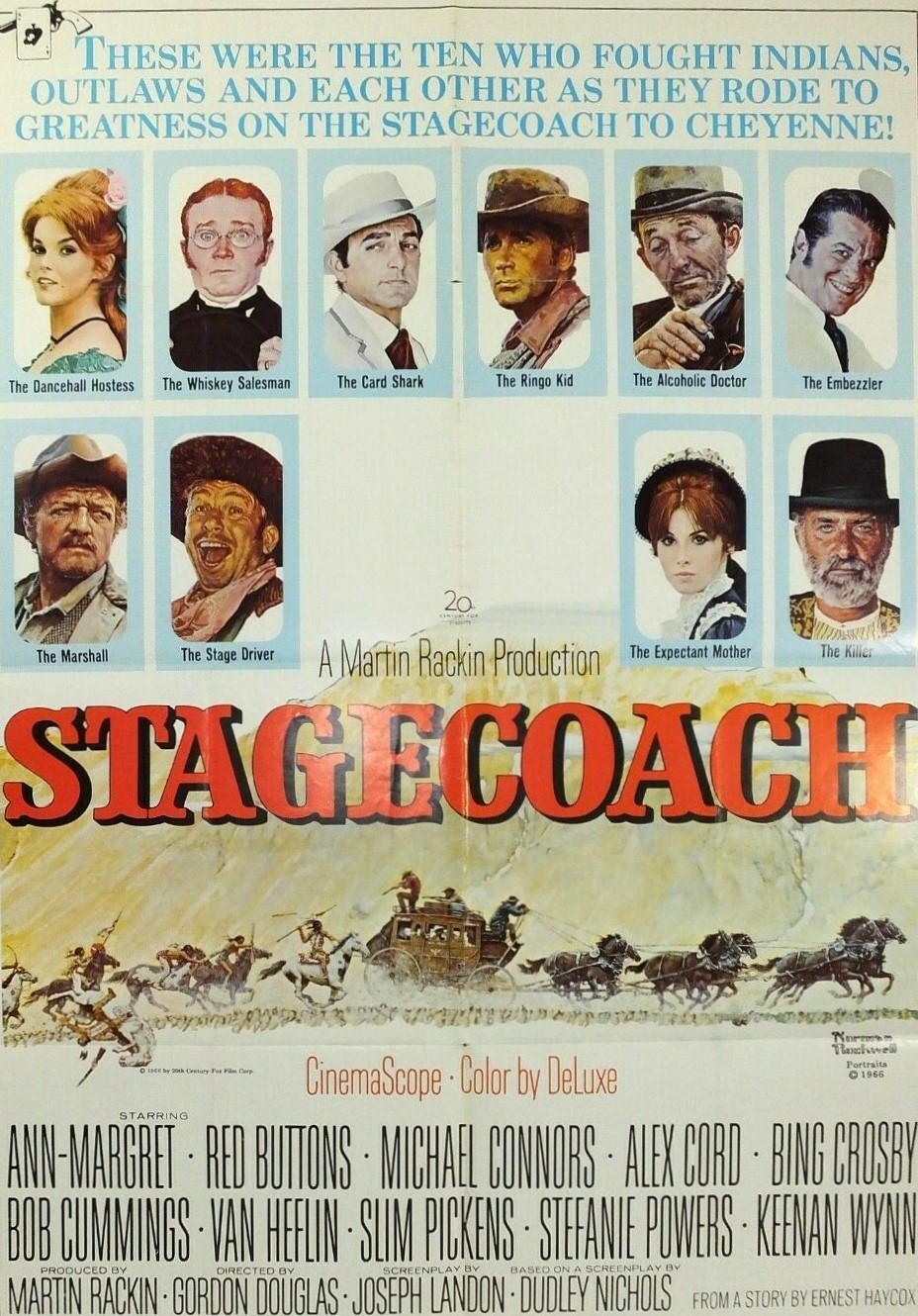
It’s probably sacrilege to admit that I quite enjoyed this. Also it’s been so long since I’ve seen the John Ford original that I could remember very little of the specifics and I haven’t seen the remake before so this was just like watching a new movie. Basically, it’s the story of a group of six passengers taking the stagecoach to Cheyenne for different reasons who are joined by an escaped murderer and shepherded along by the driver and a town marshal. There is some excellent action but mostly it’s a relationship picture, how the characters react to one another and their response to crisis.
Good-time girl Dallas (Ann-Margret) is on the run, banker Gatewood (Bob Cummings) is hiding a stash of stolen money, alcoholic doctor Boone (Bing Crosby) is penniless, liquor salesman Peacock (Red Buttons) is a coward, gambler Hatfield (Mike Connors) has Civil War secrets, pregnant Lucy Mallory (Stefanie Powers) is meeting her cavalry husband in Cheyenne. The ornery Buck (Slim Pickens) is the driver and Curley (Van Heflin) is riding shotgun and when he comes upon stranded escaped murderer the Ringo Kid (Alex Cord) promptly arrests him.
The passengers have heard rumors of the Sioux on the warpath. The audience knows it’s not a rumor because the picture starts with the Sioux slaughtering camped cavalry. Soon enough, the passengers know it, too, coming across a patrol dead at a staging post, and of course they are soon battling for their lives when ambushed.
The drama unfolds as the characters confront each other or their own weaknesses. Dallas, who has a high old time as a saloon girl, is way out of her depth in respectable company, feeling out of place even dining with the others, hiding the secret of her affair with the married Gatewood. Ringo coaxes her along, bringing her out of her shell, giving her back self-respect, and of course falling in love. Curley, with his eyes on the $500 reward for bringing Ringo in, has no intention of letting the gunslinger take his revenge in Cheyenne on Luke Plummer (Keenan Wynn) who killed his family. Boone and Peacock are the most fun, the doctor spending most of his time separating the salesman from his cargo of booze.
There are endless permutations with a story like this, the kind of material that was mined in the disaster movies of the 1970s like Airport (1970) and The Towering Inferno (1974), a group of disparate characters forced to battle for survival. The action is only part of the deal. The picture only truly works if the characters are believable. For that, you need a heap of good acting. The audience could certainly rely on old dependables like Bing Crosby (The Road to Hong Kong, 1962) in his big screen swansong, Van Heflin (Shane, 1953), Red Buttons (Oscar-winner for Sayonara, 1957), Robert Cummings (Saboteur, 1942) and cowboy picture veteran Slim Pickens to put on a good show. But the main dramatic load was to be carried by relative newcomers Ann-Margret and Alex Cord.
Ann-Margret has made her name with sassy light-hearted numbers like The Pleasure Seekers (1964) and had only just stepped up to the dramatic plate with Once a Thief (1965). This was Alex Cord’s sophomore outing after Synanon (1965) and he was stepping into some mighty big boots, the odds stacked against him playing the role John Wayne made famous – and which turned John Wayne into a star.
Amazingly, the casting works. Ann-Margret moves from feisty to restrained, meek to the point of being cowed, and for most of the film, far removed from the false gaiety of the saloon, seeks redemption. The trouble-making minx emerges only once, to knock the wind out of Mrs Mallory, but, after taking a tumble down the humility route, gradually steers her way towards a better self, preventing Gatewood from causing chaos, nursing Mallory and inching her way towards true feelings for Ringo. As in the best movies, it’s not for her to open up about her woeful life but for another character, in this case Ringo, to identify her flaws: “What you doin’ about your scars, you got ‘em even if they don’t show…when you goin’ to stand up and stop crawlin’?” When they finally kiss it is one of the most beautiful tender kisses you will ever see and most of that is down to Ann-Margret’s reaction.
I had already taken back all my reservations about Alex Cord’s acting skills that were mostly due to his moustachioed performance in Stiletto (1969) after seeing him in The Scorpio Letters (1967) and this is another completely different portrayal. As much as he can deliver on the action front, it’s in the dramatic scenes that he really scores, gentle, vulnerable, caring. He certainly matches the Duke’s trademark diffidence in terms of romance. There’s a point where the camera just holds on their faces to nine depth of expression and we are not disappointed.
Gordon Douglas (The Detective, 1968) is the director who had the gall to take on the remake, and he delivers a character-sensitive picture shaded with action. Written by Joseph Landon (Von Ryan’s Express, 1965) based on the original by Dudley Nichols and Ernest Haycox.
Pretty damn good effort.

 The Magnificent 60s
2 thoughts on “Stagecoach (1966) ****”