Top 30 2024

Ever since I’ve started writing this Blog, a film starring a female has taken pole position in the Annual Top 30. And this year is no exception though it has gone down to the wire with Sandy Dennis literally pipping John Wayne at the post. I was somewhat surprised to see some movies that featured on this list last year so prominent again. These include Stagecoach, Fireball XL5, Fraulein Doktor and The Sisters.

  1. Thank You Very Much/A Touch of Love (1969). Singleton Sandy Dennis comes to terms with pregnancy in London. Ian McKellen is the male lead.
  2. In Harm’s Way (1965). Otto Preminger war epic based around Pearl Harbor. John Wayne and Kirk Douglas duke it out.
  3. The Appointment (1969). Unusual Sidney Lumet drama set in Italy with Omar Sharif becoming mixed up with Anouk Aimee.
  4. Stagecoach (1966). There’s no stopping Ann-Margret. Interest remains high in remake of John Ford classic also starring Alex Cord and Bing Crosby.
  5. Young Cassidy (1965). Talking of John Ford, he was meant to direct this biopic of Irish playwright Sean O’Casey but took ill, leaving Jack Cardiff in charge. Rod Taylor and Julie Christie star.
  6. Diamond Head (1962). Charlton Heston as hypocritical racist landowner in Hawaii. Co-stars George Chakiris and Yvette Mimieux.
  7. Prehistoric Women/Slave Girls (1967). Martine Beswick is no Raquel Welch in One Million Years B.C. knock-off.
  8. The Chalk Garden (1964). Hayley Mills sheds her puppy fat as wild child brought to heel by Deborah Kerr as a governess with a secret past. Co-stars John Mills and Edith Evans. Directed by Ronald Neame.
  9. Fireball XL5. The colorised version of the Gerry and Sylvia Anderson futuristic classic British television series.
  10. Pharoah / Pharon (1966). Polish epic – religion vs state in ancient Egypt.
  11. Go Naked in the World (1961). Gina Lollobrigida finds out how difficult it is for a sex worker to fall in love. Fine Ernest Borgnine turn as a doting father.
  12. The Swinger (1966). Ann-Margret again. She sings, she dances – she writes? Who cares about a barmy plot when she shakes her booty.
  13. The Beekeeper (2024). Jason Statham kicks off a new action franchise with scintillating turn as black ops operative brought out of retirement. Jeremy Irons tries to keep the peace.
  14. La Belle Noiseuse (1991). French drama in which Jacques Rivette explores relationship between painter Michel Piccoli and model Emmanuelle Beart.
  15. Baby Love (1969). Teenager Linda Hayden unintentionally causing turmoil in dysfunctional middle class family in London.
  16. Pressure Point (1962). Psychiatrist Sidney Poitier coming to terms with racist patient Bobby Darin.
  17. Farewell Friend / Adieu L’Ami (1968). Charles Bronson had to go to France to find stardom in this heist thriller co-starring Alain Delon.
  18. Fraulein Doktor (1969). Suzy Kendall’s finest hour as World War One German spy outwitting Kenneth More.
  19. Immaculate (2024). Sydney Sweeney dons nun garb and encounters horror in Italian convent.
  20. The Count of Monte Cristo (2024). Splendid adaptation of the classic Dumas novel of a wrongly-imprisoned man seeking revenge.
  21. Fear No More (1961). Mentally disturbed Mala Powers mixed up in murder plot.
  22. Woman of Straw (1964). Gina Lollobrigida takes on Sean Connery in Hitchcockian thriller.
  23. Claudelle Inglish (1961). Thwarted bride Diane McBain exploits male desire in the Deep South.
  24. Carry On Up the Khyber (1968). Innuendo gets a cloak of satire as the team make light work of the British in India.
  25. The Trouble with Angels (1966). Hayley Mills again, another wild child, this time challenging Mother Superior Rosalind Russell in convent school.
  26. Lilith (1964). War veteran Warren Beatty bewitched by troubled Jean Seberg at a mental institution.
  27. The Sisters / My Sister, My Love (1969). Another French drama with Nathalie Delon and Susan Strasberg too tangled up with each other to bother with the likes of Giancarlo Giannini.
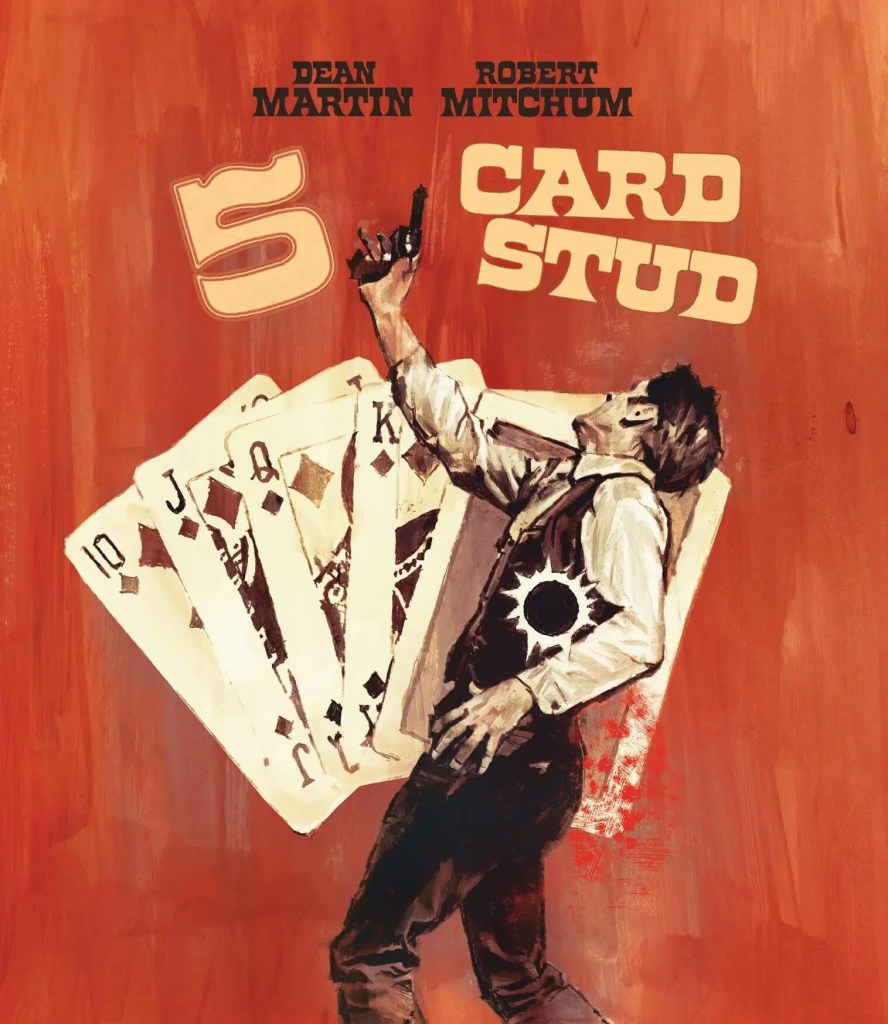
  28. Five Card Stud (1969). Poker player Dean Martin turns detective as the body count mushrooms in Henry Hathaway western co-starring Robert Mitchum and Inger Stevens.
  29. The Undefeated (1969). John Wayne chases defeated Confederate Rock Hudson into Mexico.
  30. Villain (1971). Heist thriller with Richard Burton and Ian McShane as bisexual gangsters.
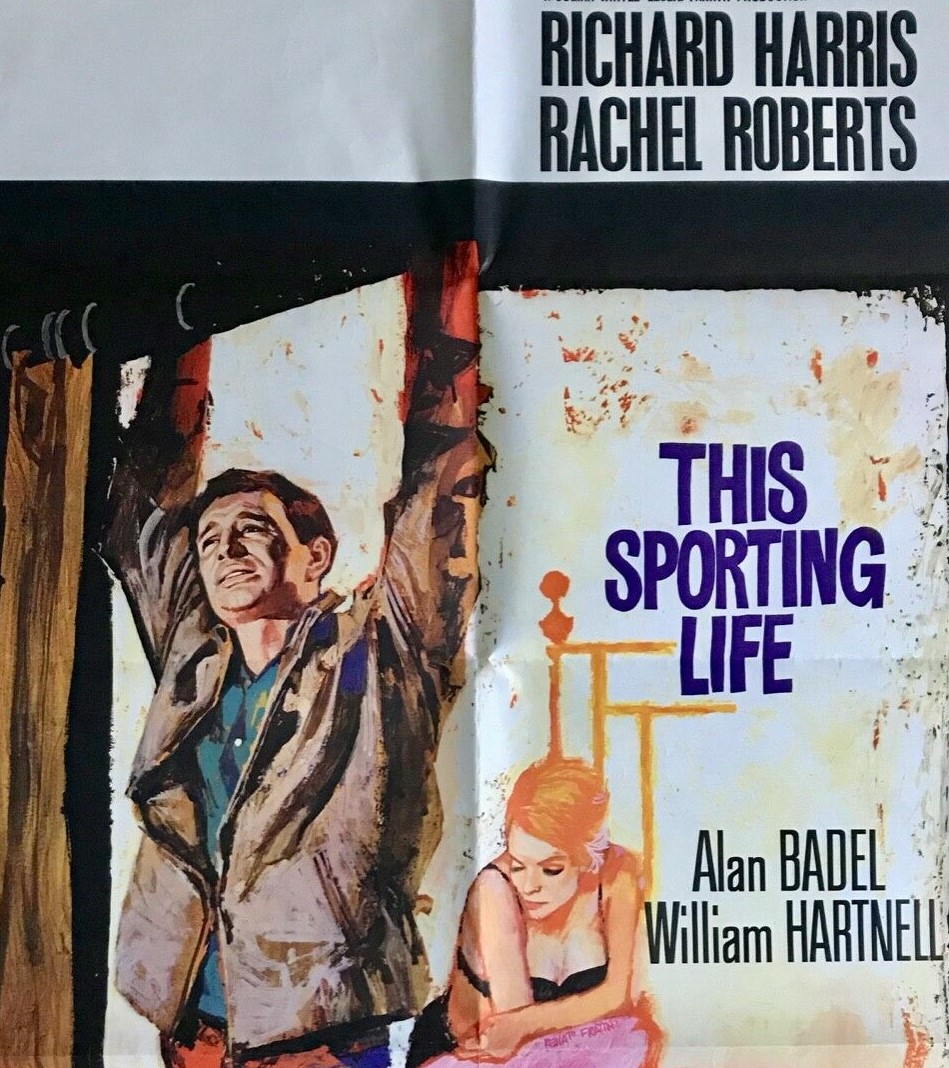
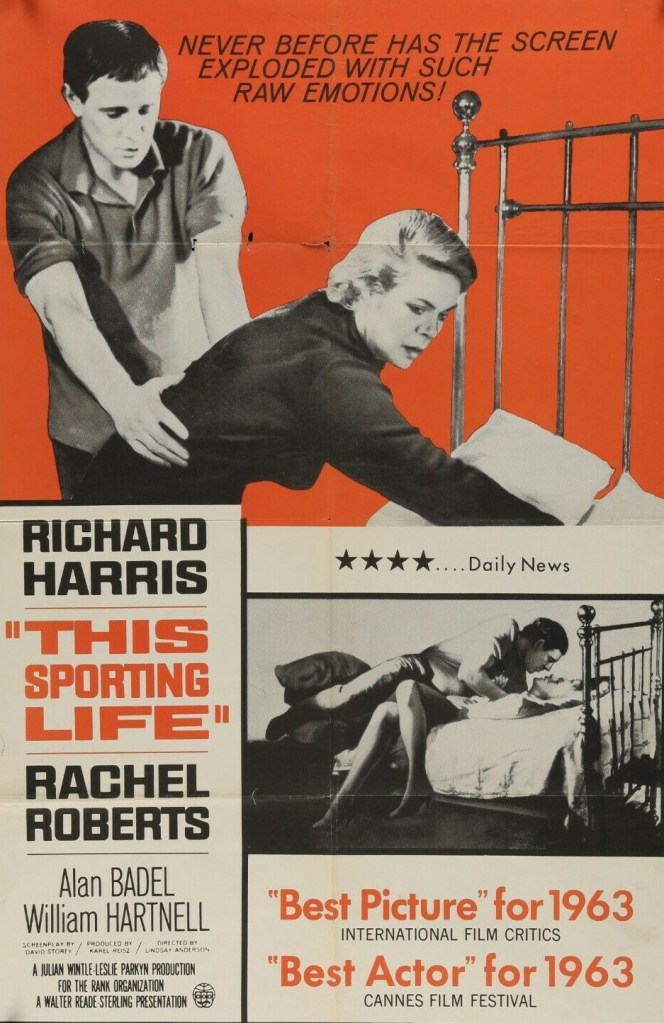
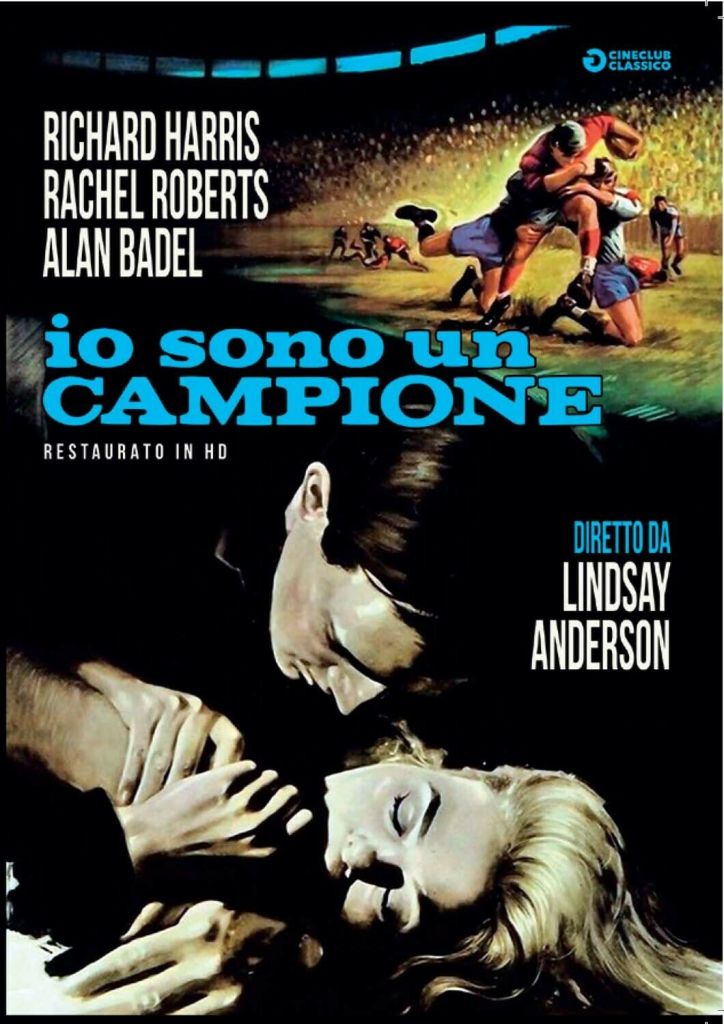
This Sporting Life (1963) ****

What began as the last gasp of the British New Wave working class kitchen sink drama has now after a six-decade gap resolved into a struggle over political and sexual ownership. Macho athlete Frank Machin (Richard Harris) jibes against his paymasters at a Yorkshire rugby league club – in similar fashion to Charlton Heston in Number One (1969) – while trying to hold sway over widowed landlady Margaret (Rachel Roberts). While documenting the class divide over which British writers and directors obsess, Lindsay Anderson’s debut takes a wry look at power.

Machin belongs to the Arthur Seaton (Saturday Night and Sunday Morning, 1960) class of loudmouth boors, determined to take as much as they can, riding roughshod over anyone who gets in their way, even attacking players of his own team. Although a fan favorite, his position at the club still requires backing from the moneyed directors, support that appears go awry when he rejects overtures from Mrs Weaver (Vanda Godsell), wife of a board director (Alan Badel). While Margaret eventually succumbs, her actions fill her with shame, the presents he buys making her feel like a kept woman.

Both Machin and Margaret are the rawest of creatures, forever appearing ready to topple into some emotional crevasse of their own making. At a time when marriage was the rock of society and women had little independence, a woman could dwindle away from the scorn of neighbors, while a man lacking emotional intelligence would crumble in the face of his own fears.

The non-linear narrative blurs some aspects of the story. There is no reference to Machin’s background save that he was once a miner and still works somewhere unspecified to supplement his footballer’s income. He rejects the paternalism of ageing scout Johnson (William Hartnell) while appearing to be seeking to resolve maternal issues, the widow with two small children at least a decade older, and although he could easily afford better accommodation refuses to move out.

His obsession with Margaret is never properly explained, except by her, who sees him as acting like an owner. Equally, Margaret is the opposite of the women in virtually every movie of the period, for whom marriage is the sole ambition. Whether she still grieves the loss of her factory worker husband, who may have committed suicide, or loathes Machin’s dominant nature is never explained. It might have been better if both had married for unhappy husbands and wives tend to give each other both barrels, emotions never concealed. Or she could be in the throes of an undiagnosed depression expressed as anger.

Machin is the other side of the British Dream – that anyone who escapes going down the pits or the mindless grind of the factory will automatically enjoy happiness. While Machin revels in his celebrity, he has no idea how to make his life happier. This is in contrast to the other footballers who either enjoy womanizing and drinking or are married or engaged and accept the unwritten rules of the game rather than fighting everyone.

There is plenty grime on show, and the football field has never been so pitiless, and as a social document it fits in well to the small sub-genre of films depicting working class life, but the picture’s thrust remains that of two opposites who will clearly never meet except in the delusional head of Machin.

Power is demonstrated in various ways. Weaver has the clout to give Machin a hefty signing-on fee against the wishes of the board, his wife takes her pick of the footballers to satisfy her sexual needs, Machin believes he is entitled to berate waiters in an upmarket restaurant, while Margaret is demeaned by accepting his present of a fur coat.

As ever with these films of the early 1960s there is a wealth of acting talent. Both Harris and Roberts were Oscar-nominated. Others making a splash in the cast were Alan Badel (Arabesque, 1966), Colin Blakely (The Vengeance of She, 1968), Jack Watson (The Hill, 1965), and if look closely you will spot double Oscar-winner Glenda Jackson (Women in Love, 1969). Future television stalwarts included William Hartnell (the first Doctor Who), Arthur Lowe (Dad’s Army, 1968-1977), Leonard Rossiter (Rising Damp, 1974-1978), Frank Windsor (Softly, Softly, 1966-1969) and George Sewell (Paul Temple, 1969-1971).

Lindsay Anderson (If… 1969) no doubt believed he was making an excoriating drama about the class struggle, but in fact has delivered a classic thwarted love story. David Storey wrote the screenplay based on his own novel.

Dark Intruder (1965) ***

Sumerian demons, Siamese twins separated at birth, a serial killer, oceans of fog, the flower of the mandrake, a climax that revolves around “it’s in his kiss” and a picture so shorn of light it could easily have been titled Dark Fiancé or Dark Wedding. Thematically truncated, too, and you get the feeling that with a little bit more narrative expertise and budget this could have been spun out into something that fitted in with the decade’s later spurt of horror a la Rosemary’s Baby (1968). There’s the bonus of Leslie Nielsen (Airplane, 1980) in a straight part though one which allows him a fair quota of quips.

In San Francisco 1890, occult expert and straight-down-the-line man-about-town toff Brett Kingsford (Leslie Nielsen) is surreptitiously engaged by the cops to investigate a series of brutal murders. Beside each corpse, the killer has left a memento, a tiny statuette that is traced back to Sumerian times, a demon – similar to the larger kind that turn up at the archaeological dig at the start of The Exorcist (1973) – banished from Earth and which attempts to return by entering another person’s body though presumably none of the four victims coming up to scratch.

Among the dead is Hannah, who had been involved in an archaeological expedition and later adopted a mysterious child. She has a connection to Brett’s friend, antiques dealer Robert Vandenburg (Mark Richman) who is engaged to be married to Evelyn Lang (Judi Meredith), another friend of Brett. Though Brett consults Chinese expert Chi Zang (Peter Brocco) and is attacked by the titular intruder who leaves him with claw marks on his shoulder, the bulk of the detection falls to Robert, who exhibits odd behaviour, standing in a daze, sleepwalking, going off in the wrong direction, suffering from blurred vision, and with a strange scar on his spine. He encounters the mysterious Professor Moloki (Werner Klemperer), face concealed, who tells him all will be revealed on the eve of his wedding.

The killings don’t stop, Brett no closer to catching the killer, and no further evidence forthcoming and the tale falls on the shoulders of Robert who is convinced from his own odd behavior that he is the killer. Eventually, he starts to work out the strange elements of his own life and the “invisible force” he is constantly fighting.

Turns out he was the Siamese twin separated at birth, and that Hannah had brought up the other, deformed, twin, who now wants his twin’s life – and wife. All we see of the creature is the claw, the rest of him hidden under a cloak or shuffling along behind curtains. The pair grapple in the darkness and it appears the bad twin is slain.

But is he? It’s Evelyn who gives him away, revolted by his kiss, and the matter is resolved. So really no more than the assembly of an interesting horror story. The claw is well done but as I said most of the detection comes from the mind of Robert rather than the occult detective working up the clues. But the dapper Brett is good value, keeping chatterbox Evelyn in check, and putting on his best Basil Rathbone impersonation.

As a bonus it’s insanely short, barely an hour long, which would have put it squarely in the B-feature category – but of two decades before, not of the mid-1960s. Turns out this was a pilot for a television horror series that wasn’t picked up by any of the three U.S. networks so was extended enough to be feature-length. The actors try desperately to add characterisation to their thin parts, Leslie Nielsen (Beau Geste, 1966) and Judi Meredith (Queen of Blood, 1966) best at that.

Harvey Hart (Bus Riley’s Back in Town, 1965) directed from a script by Barre Lyndon. The movie was released by Universal, who had Nielsen on an exclusive seven-year contract.

The sum of its parts without much else, but intriguing tale calling out to be extended – or remade.

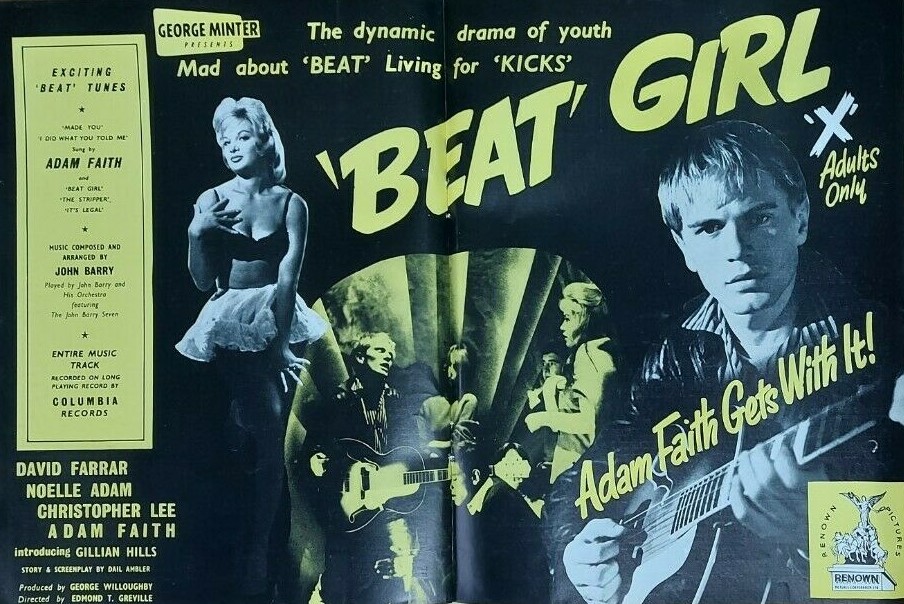
Beat Girl / Wild for Kicks (1960) **

More social document than drama, but that aspect somewhat diluted by the moviemakers’ attempts at exposing rebellious youth while taking for granted more sordid adult behavior. Narrative flow is interrupted now and then to showcase Adam Faith’s singing and to accommodate a few striptease acts. Probably more interesting is the array of new talent on show.

Spoiled teenager Jennifer (Gillian Hill) heads for the wild side of town to experience the beatnik lifestyle in Soho coffee shops and cellars. That there are no drugs involved, and that alcohol is considered “square” – as for that matter is violence – may come as a surprise to students of the period. Apart from one episode of road-racing and playing “chicken” along a railway track, most of the time the gang listen to music or dance until Jennifer gets it into her head that ejoining a striptease show might give her life the thrill it is missing.

This is prompted by the discovery that her new too-young stepmother Nichole (Noelle Adams) has been a stripper and most likely a sex worker in Paris before marrying wealthy architect Paul (David Farrar), cueing a round-robin of confrontations. Strangely enough, from the narrative perspective, none of the young bucks appear romantically interested in the provocatively dressed Jennifer and so it is left to creepy club owner Kenny (Christopher Lee) to make a move.

The gaping hole left by lack of narrative drive is not offset by immersion in the beatnik or striptease scene. Back in the day the British censors took the editing scissors to the striptease but although restored versions available now contain nudity you are left wishing that there was some lost element to the beatnik sections that would have given the picture the energy it required.

Gillian Hill (Les Liaisions Dangereuses, 1959), comes over as a cross between Brigitte Bardot and Diana Dors without having an ounce of the sex appeal of either. All pout and flounce, she is unable to inject any heart into her two-dimensional character, although given her youth and inexperience this was hardly surprising. Former British star David Farrar (Black Narcissus, 1947) was coming to the end of his career and in a thankless role as a frustrated father could do little to rescue the project.

French actress Noelle Gordon (Sergeant X of the Foreign Legion, 1960) could have been Jennifer’s mother given her own tendencies towards wiggle and pout but at least she makes a stab at trying to overcome her step-daughter’s hostility.

In the main, the picture’s delight is bringing to the fore a whole chorus of new faces. Pick of the supporting cast is Shirley Anne Field (Kings of the Sun, 1963) who doesn’t just have a knowing look but looks as if she knows what’s she doing acting-wise. Making his movie debut was teen pop idol Adam Faith, who had made his name playing in coffee bars. He had already notched up a couple of number one singles, but doesn’t quite set the screen on fire. Peter McEnery (The Fighting Prince of Donegal, 1966) plays his inebriated pal.

You can also spot Oliver Reed (Women in Love, 1969), Julie Christie (Doctor Zhivago, 1965), Claire Gordon (Cool It, Carol, 1970) and Nigel Green (Jason and the Argonauts, 1963).

Perhaps the most important debut belonged to composer John Barry. He had already been working with Adam Faith. Barry’s music for the film was the first British soundtrack album ever released, reaching number eleven on the charts, and opening the doors for future soundtrack albums, not least of which was the rich vein of theme tunes produced by Barry in the next few years. 

French director Edmond T. Greville, who brought little panache to the subject matter, would redeem himself with his next picture The Hands of Orlac (1960). 

This doesn’t fall into the “so-bad-it’s-good” category, nor has it been unfairly overlooked, and probably is better known as an example of the kind of exploitation B-picture that the Americans do so much better and a reminder that, except on rare occasions such as The Wild One (1953), older moviemakers seem incapable of capturing the essence of youth.

The Switch (1963) ***

Dr No (1962) was more famous for kick-starting nascent careers – step forward Sean Connery and Ursula Andress – rather than reviving careers that had looked dead and buried as was the case with Zena Marshall. I had just come across Ms Marshall in her last picture, The Terrornauts (1967), a cult sci fi from Amicus, that I had been asked to provide an audio commentary for (you’ll have to wait till next year for that) and was intrigued to discover that, while never becoming a big star, she had managed to eke out a decent living since her debut in Caesar and Cleopatra in 1945. She’d never achieved much more than rising star status, B-movies more her line. She hadn’t made a picture in five years until Dr No but thereafter managed leading lady once a year until her retirement.

Director Peter Maxwell (Serena, 1962) fell into much the same movie backwater but still had the knack of generating interesting narratives. The screenplay turns on some interesting realism, an unusual gadget (especially for this genre)  as well as a couple of entertaining happenstances and in  Zena Marshall one of two very self-assured females who light up a picture otherwise peppered with dour males.

The eagle-eyed among you will have noted that I’ve used a still from “Dr No” as the main picture. Similarly, this is one of Zena Marshall’s earlier movies.
Extant posters of “The Switch” are non-existent, it appears.

A joint police and customs operation has snared a smuggler in a sting. But, almost immediately after Inspector Tomlinson (Dermot Walsh) and Customs Agent Bill Craddock (Anthony Steel) latch onto their prey, their informant ends up in the River Thames and they hit a dead end trying to find the Mr Big behind the high-class watch smuggling racket.

Meanwhile model Carolyn (Zena Marshall), on holiday in France, is taken for a romantic meal by seductive Frenchman Lecraze (Arnold Diamond) while his colleagues stuff her petrol tank with watches.

Takes a while for Carolyn to become a suspect. There’s quite a lot of fun to be had from unexpectedly inept gangsters. When she returns home, she finds her flatmate’s cousin John Curry (Conrad Phillips) having a bath. With his car parked in her garage, she finds somewhere else to stay. His car is mistakenly stolen, as is the car she exchanges at the garage while the original one she brought back from France is in for repairs. The crooks repeatedly steal the wrong car.

Eventually, the cops break open her petrol tank and find the hidden watches. Although under suspicion she is freed, and, being a confident young lass, and quite accustomed to men of all ages taking her out for dinner and buying her presents, is nonetheless surprised when her latest admirer John presents her with his firm’s latest invention, a miniature radio transmitter hidden inside a cigarette case.

Which is just as well because the Frenchman reappears and kidnaps Carolyn hoping to find out from her what happened to her car. Meanwhile, the cops dig up gangster’s moll Janice (Dawn Beret) whose boyfriend is mixed up in the villainy and has herself unwittingly brought stolen goods into the country in her petrol tank after being chatted up by a smooth Frenchman. She’s a cheeky young thing,  as self-assured as Carolyn, suggesting to the straight-laced inspector that if he’s not doing anything at the weekend they could get married.

Meanwhile, John has teamed up with the good guys while they manage to survive Janice’s stream of quips and attempt to track down the kidnapped Carolyn. She doesn’t manage to hold out for long, not when Mr Big removes the gloves.

All in all, it’s cleverly done, playing all the time with audience expectation, not just the cocky confidence of the two women, who are clearly accomplished at leading men astray, but the quirks of the storyline – including a failed escape up a chimney – the details of the smuggling operation, and the introduction of the James Bond-style gadget. There’s even some cheeky self-awareness, John seen sitting up in bed reading the movie tie-in edition of Dr No which features Zena Marshall on the cover.

Apart from Zena Marshall, there’s an interesting cast. Anthony Steel (The Story of O, 1975), husband of Anita Ekberg, was just back from a stint in Rome. Conrad Phillips (The Secret Partner, 1961) had played William Tell in the television series and Dermot Walsh Richard the Lionheart in similar. It marked the last screen appearance of Susan Shaw (Fire Maidens from Outer Space, 1956) and perky Dawn Beret (Victim, 1961) looked promising. In bit parts look out for Carry On regular Peter Butterworth  and Rose Alba (Thunderball, 1965)

This sat on the shelf for a year before going out on the Odeon circuit as support to spy picture Hot Enough for June/Agent 8¾ (1964) starring Dirk Bogarde.

Except for horror, Britain didn’t stoop to having B-Movie Queens, but if they had Zena Marshall would wear the crown.

Bye, Bye, Birdie (1963) ***

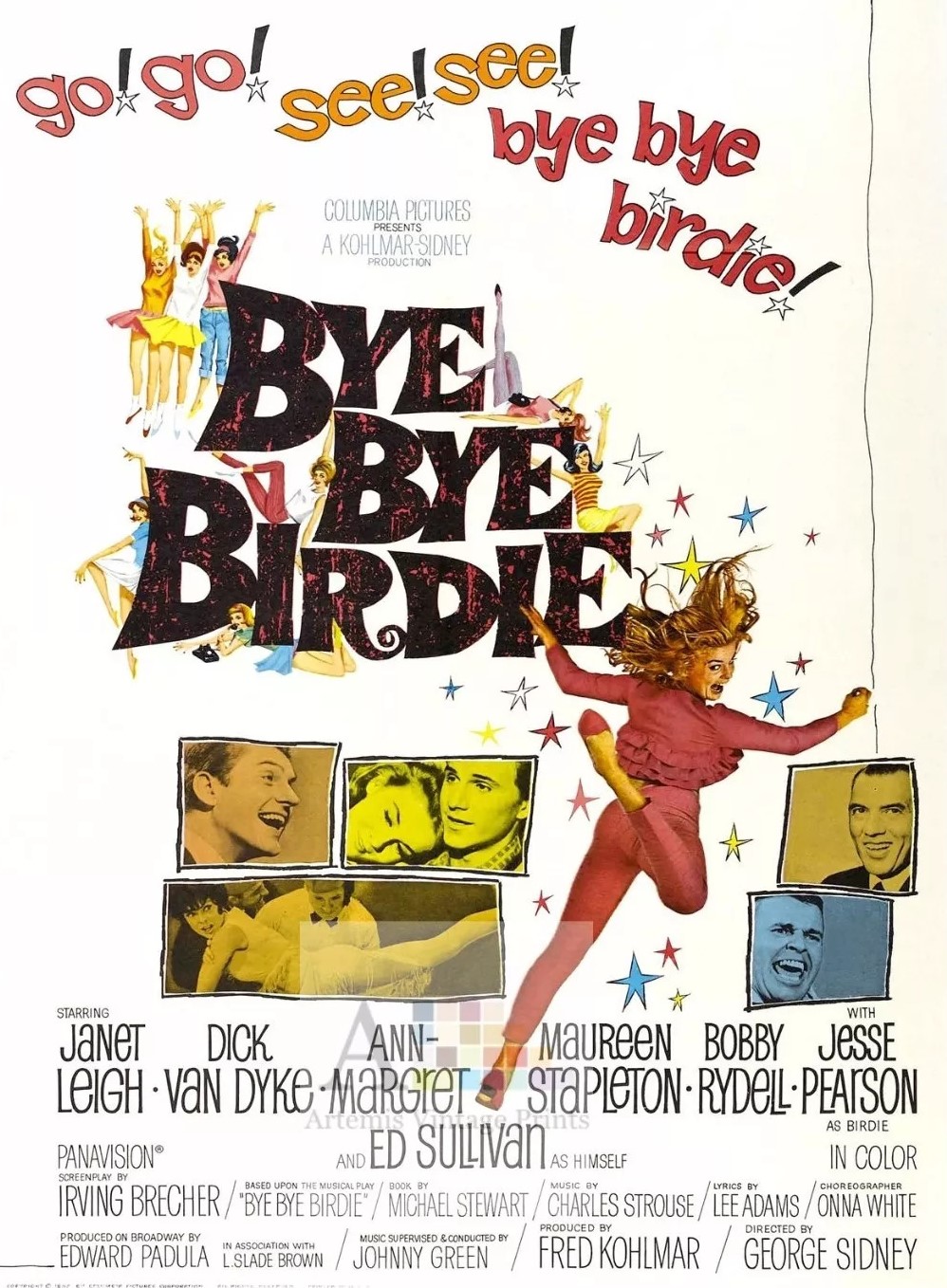
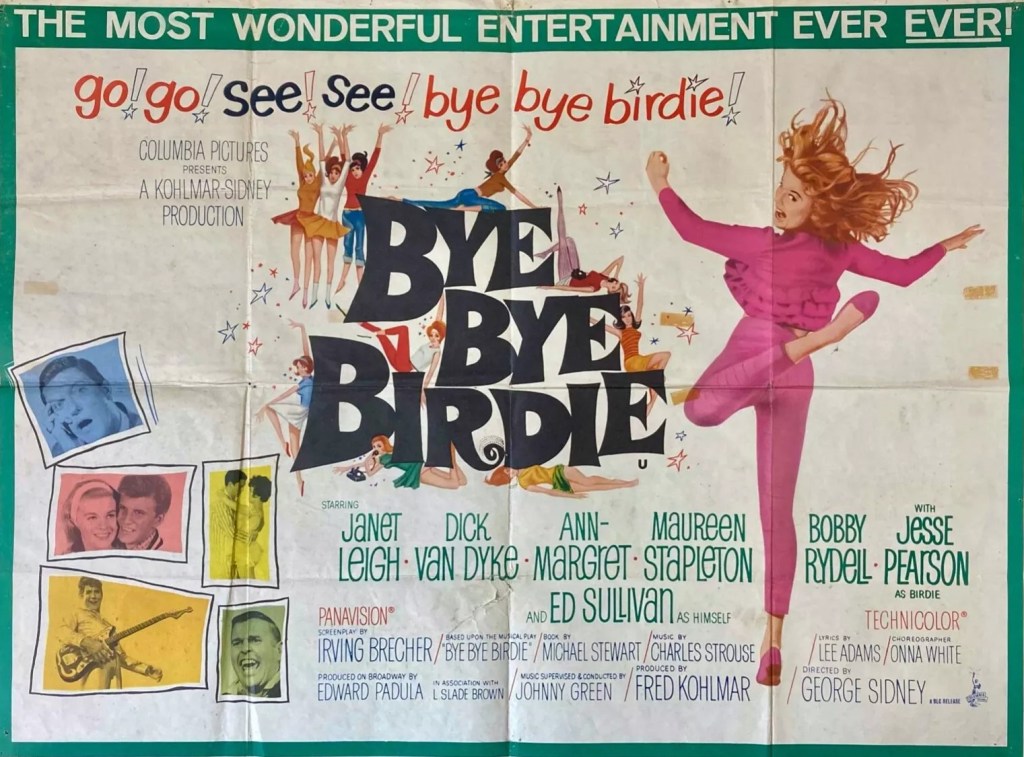
Marketeers employ a cute trick to get round the contractual billing required on movie posters. The position and size of a star’s name in any movie – even now – is stipulated long before a single camera rolls. This is where all the “name above the title” malarkey stems from comes from, that stipulation setting the reals stars apart from the wannabes.

However, whoever was in charge of drawing up the standard boilerplate template was only concerned with names, not images. That left a loophole to be exploited. Should you have a female rising star, whose face or figure might be a darn sight more attractive than the top-billed male, well, by heck, there was nothing to stop you plugging the contractually-less-dominant person all over the poster at the expense of the top-billed star.

The marketeers did it with Marilyn Monroe, they did it with Audrey Hepburn, and now they’re stooping to the same loophole to promote Ann-Margret as virtually the only star of any importance. Admittedly, this was before top-billed Dick Van Dyke achieved much of a reputation as a hoofer in such spectaculars as Mary Poppins (1964). But his second-billed female lead, Janet Leigh, whose features the camera had very much taken a shine to, was also elbowed out of poster prominence.

And small wonder. Excepting Monroe, no actress ever in the last decade burst onto the screen with such pizzazz. By the time Bye Bye Birdie  – her third movie – opened Ann-Margret’s asking price had zoomed to $250,000 and she had struck a two-picture deal with MGM, was contracted to five for Twentieth Century Fox, three for Columbia and another three for Frank Sinatra’s movie production arm.

So a heck of a lot was in the balance. And, boy, does she deliver. Her energy is untouchable and, excepting again Monroe, there was never a sexier singer.

Shame the musical itself is so trite, at its best in homage to those innocent days of the 1950s, that were a more Technicolor version of those 1940s musicals that invariably were sugary confections. The story rips off the Elvis Presley legend. Conrad Birdie (Jesse Pearson) is a pop singer who has been drafted. Songwriter’s secretary Rosie (Janet Leigh) comes up with a publicity gimmick, Conrad singing a song, “One Last Kiss,” written by Albert (Dick Van Dyke) sung on the Ed Sullivan Show, his last gig before joining the Army, with a specially-chosen gal to be recipient of said smooch.

To fill you in, Rosie has had a tough time getting boyfriend Albert, eight years into their relationship, across the wedding finishing line. Bridie fan Kim (Ann-Margret) also has a boyfriend Hugo (Bobby Rydell) who naturally objects to his beloved kissing the pop singer on air in front of millions even it is a publicity stunt. Meanwhile, Albert’s Mama (Maureen Stapleton) is trying to drive a wedge between Rosie and her son. The out-of-sorts Rosie and Hugo conspire to sabotage the television show.

So pretty much the will-she-won’t-she is delivered in wishy-washy style with the plot (call that a plot!) interrupted every few minutes for a song. The narrative seems out of place for a section involving arrest for statutory rape and racism, but that gives the movie some much-needed muscle.

No question that Ann-Margret (The Swinger, 1966) steals the show. That would hardly be surprising given the lack of competition. But she certainly has the song-and-dance chops, and her energy is second to none. She gets a march on everyone by singing the title number over the credits, the credits themselves very much pushed into the background. The other prospective breakout musical star Dick Van Dyke only has one solo and Janet Leigh (Psycho, 1960) wasn’t going to effect a change of screen persona any time soon.

George Sidney directed from a screenplay by Irving Brecher (Oscar-nominated for Meet Me in St Louis, 1944) and Michael Stewart (Hello, Dolly!, 1969) from the original Broadway hit by Charles Strouse (music), Lee Adams (lyrics) and Stewart (book).

Refreshingly lightweight. Ann-Margret lights up the screen.

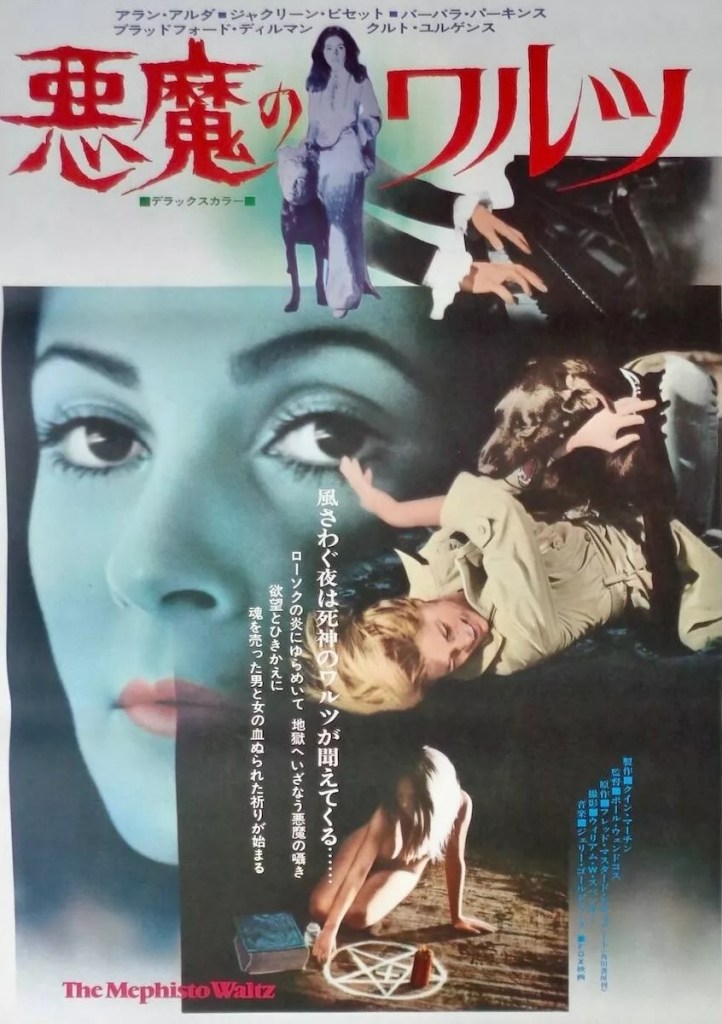
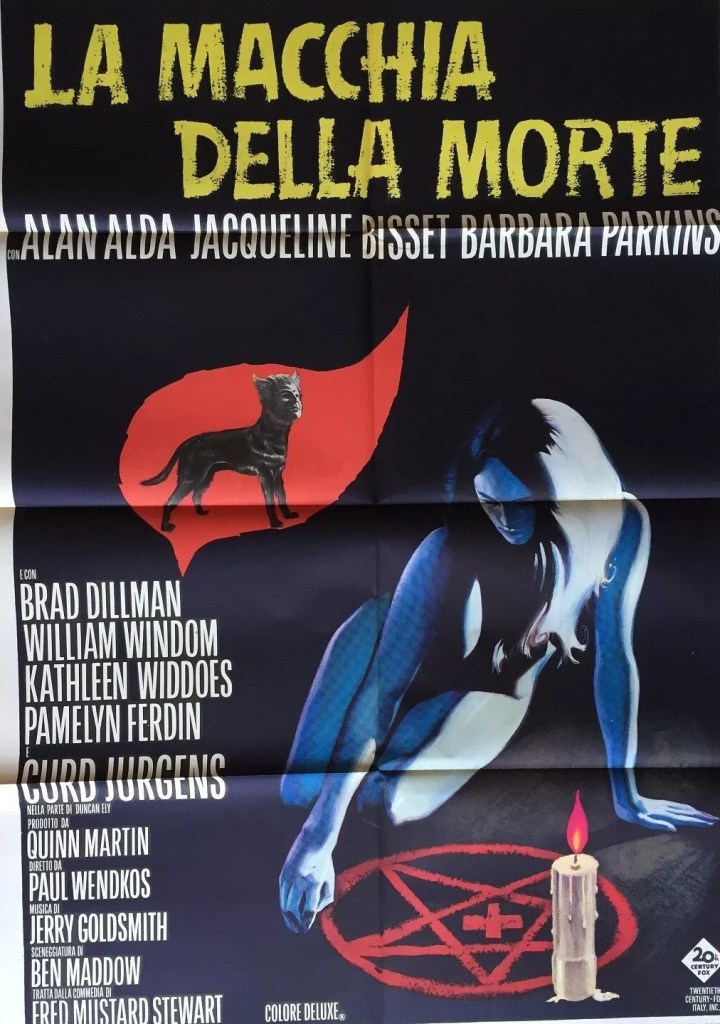
The Mephisto Waltz (1971) ****

Jacqueline Bisset’s good looks often got in the way of her acting. Or, more correctly, in the way of producer perception about what she could do.  Too often she was the female lead that simply hung on the arm of the male lead. But, here, to my surprise, she is not only the narrative fulcrum, but steals the show from Alan Alda, mostly remembered these days for TV’s M*A*S*H (1972-1983) but at the start of the 1970s being heralded in Hollywood as the next big thing and top-billed.  

Alda’s character here is little more than his screen persona in embryo – glib, wise-cracking, cocky. In an earlier Hollywood he would have been the smooth-talking gangster beefing up B-pictures.

Appearing between the demonic high-spots of Rosemary’s Baby (1968) and The Omen (1976), director Paul Wendkos (Cannon for Cordoba, 1970) escapes his journeyman roots to suffuse the picture with nightmarish scenes, and clever use of the fish-eye lens, treating Satanism with the most subtle of brushes, restricted to a mark daubed in a forehead and a pentagram on the floor but minus any chorus of witches or warning from priests or sundry other holy persons.

Myles (Alan Alda), piano prodigy who never made the cut, now a journalist, is encouraged by interviewee, concert pianist Duncan Ely (Curt Jurgens), to take it up again. Under the older man’s tutelage, he thrives, promising career beckons, plus an entrée into quite a heady world of parties, sex and wealth. Wife Paula (Jacqueline Bisset) is more sceptical especially once Duncan and his buddies start buying up everything in sight in her new antiques emporium. She’s especially perturbed to see Duncan sharing an intimate kiss with his married daughter Roxanne (Barbara Parkins) never mind wondering whether her husband is going to fall prey to the daughter’s seductive technique.

Just what’s going on is never entirely obvious, making the audience work rather than bombarding them with shock scenes. I’m not sure what you’d call it in demonic terms, some kind of transference, body and soul. Once Duncan dies, Myles’s life is transformed, not just thanks to an extremely generous bequest in the old man’s will, but a dramatic increase in his piano-playing prowess, plus, almost as a bonus, the increased attentions of Roxanne.

True scares are limited, mostly a huge drooling black mastiff who may or may not be a killer, and so the tale remains more subtle and eventually boils down to whether Paula will follow her husband on his satanic journey or lose him to the wiles of Roxanne and, perhaps more importantly, never enjoy him as the personality he once was.

We all know that, where money and career is concerned, Myles has a cynical bone in his body and has already demonstrated a capacity for the finer things in life, whether they be animate or inanimate. So his character carries little dramatic tension. And so Paula carries the dramatic burden and she bears that, too, with surprising subtlety.

There’s almost a reverse Gaslight vibe to the whole exercise, Paula convincing herself that she must take this step into what would otherwise be considered madness. It’s worth noting that nobody’s pushing her. She makes the decision herself, although takes you a while (that subtlety again) before you cotton on to consequence. And while we’re on the subject of subtlety, full marks to Wendkos for treating two scenes in particular of Bisset nudity with commendable restraint.  

Quite where Satan’s apparent mission to bring classical music to the masses fits into his plans for global domination is never made clear, leanings of such an esoteric nature rarely a prerequisite of the evil mastermind.

Still, a much classier feast than I was expecting, Bisset (The Sweet Ride, 1968) the standout. Her performance served to give Hollywood notice of a classier star than merely the barely seen girlfriend of Steve McQueen in Bullitt (1968). From here on in she would catch the eye of a better grade of director, including Francois Truffaut in Day for Night (1974) though it can be arguedthat it was her looks that sent her into the stratosphere after the wet t-shirt modelling in The Deep (1977).

Alda, meanwhile, jumped straight into M*A*S*H and didn’t resurface as a creditable movie marquee name until California Suite (1978) and The Seduction of Joe Tynan (1979).  Curt Jurgens (Psyche ’59) as ever is good value, Barbara Parkins (Puppet on a Chain, 1970) his rather slinky associate and Bradford Dillman (The Bridge at Remagen, 1969) also pops up.

Wendkos in top gear. Screenplay by Ben Maddow (The Way West, 1967) from the Fred Mustard Stewart bestseller. Excellent Jerry Goldsmith score.

Well worth a look.

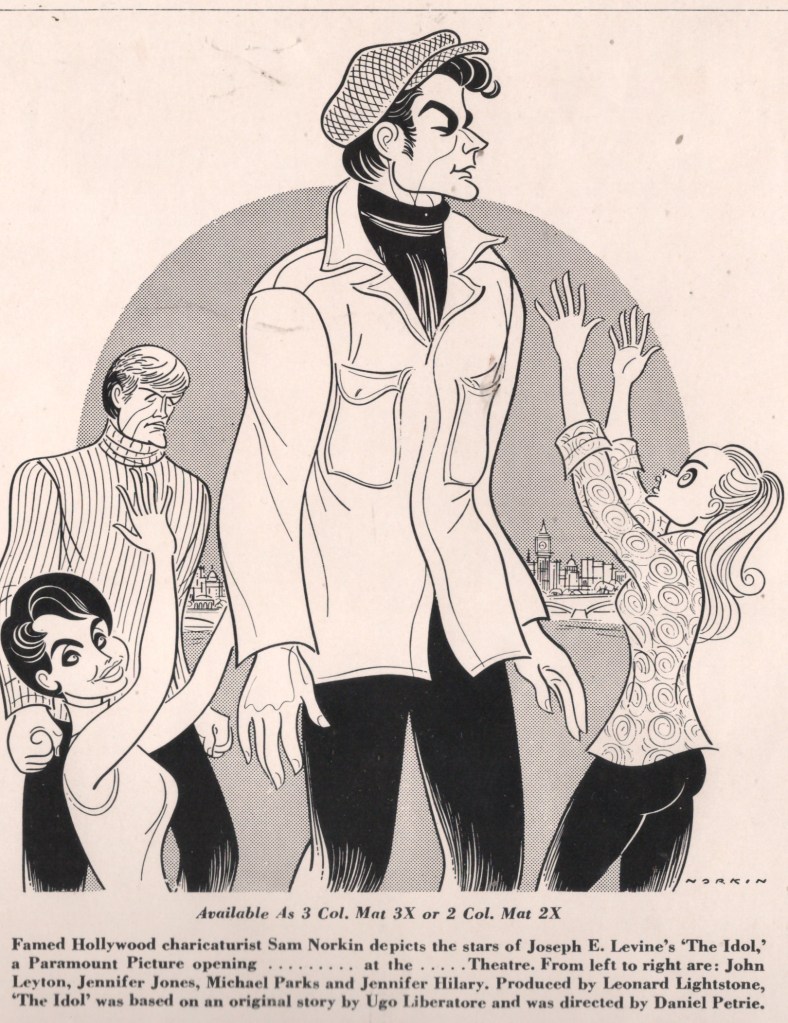
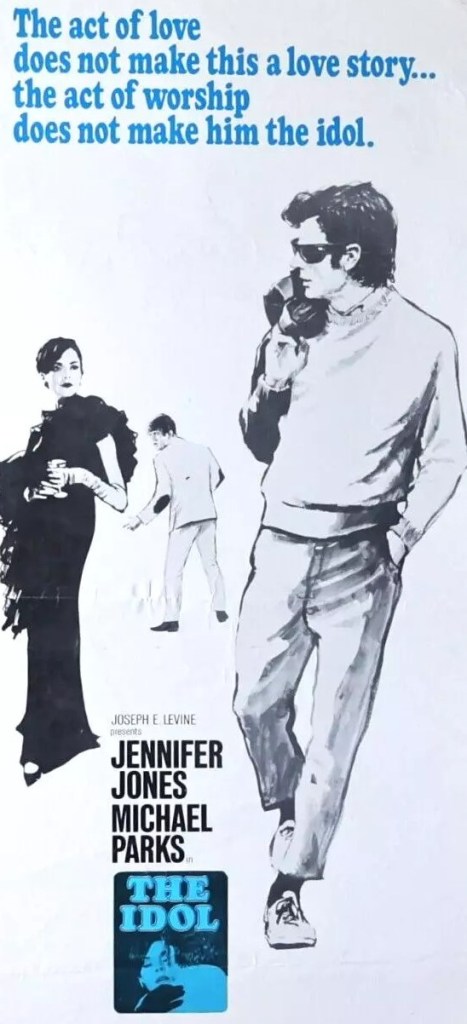
Behind the Scenes: Selling the Age Gap – “The Idol” (1966) Pressbook

“At what age should a woman stop loving?” is one of the least used of the tag lines for The Idol and yet is the one that provides the strongest narrative thread. Had the movie been filmed from the perspective of Carol, the mother, the answer to the tagline – “when her hate becomes stronger than her hunger…when her pride overcomes her passion” – might have offered audiences something with greater depth than the final movie that appeared.

The movie took a heck of a time to arrive at the May-December reversal brief love affair and the Pressbook/Marketing Manual spends more time playing up the “generation gap.” It’s one of those Pressbooks where it appears the publicity masterminds were watching a different picture to the audience.

“Highlighting the lack of communication between the younger and older generations,” spouts the Pressbook, “director Petrie shows young people as lacking in values, while pointing out it is not necessarily their fault. He thinks parents today are unwilling or unable to pass along to their children a concept of truth (“recollections vary” perhaps) – because they themselves are no longer sure of what is true, what is right and wrong.”

Really? That’s not the movie I saw. The Pressbook is on surer ground when providing background to the filming. Much of the picture was shot in unusual locations like the 300-year-old Queen’s Inn in Chelsea and Brad’s Club in the West End, redecorated for the occasion with zebra skins, spears, shields and jungle foliage, the revamp so successful with existing customers the club wanted to buy the props from the production company. Star Jennifer Jones wore creations made by Italian fashion designers Galitzino and Emilio Pucci.

Michael Parks, heralded as a great new star after his role in The Bible (1966), preferred his part here. “I’d much rather be judged by my performance in The Idol – as a complicated young man with tremendous problems.” At least his characterization echoed his own impoverished life, attending 21 schools in a peripatetic childhood. At one high school his grades prevented him taking drama classes. He lived as a hobo for a time after leaving home, then worked as a door-to-door salesman.

The 14-page landscape A3 Pressbook offers relatively few marketing ideas for prospective exhibitors. There was a paperback book tie-in by Frances Rickett from Popular Library and an album of the score from composer Johnny Dankworth and an instrumental single. Oddly enough, singer John Leyton doesn’t sing.

There was an attempt to push the fashion angle, the Pressbook arguing that “many of these fashions typify the ‘mod’ look so popular with today’s clothes-conscious women.” Exhibitors in America were urged to use travel posters of England in their lobbies, even though since the movie was shot in black-and-white it hardly presents an appealing version of the country.

Parks has supposedly competition from John Leyton as the next big thing. Leyton came from English theatrical stock, mother an actress, father an owner of music halls and trained at the Actor’s Workshop in London. “Had Leyton not catapulted to fame as a singer, it would only have been a matter of time before the public would have singled him out for stardom as a fine actor.”

Jennifer Jones, on the other hand, required no puffery to be accepted as an actress. Her breakthrough came in Song of Bernadette (1943), one of six actresses tested but the only one who could convincingly look as if she had seen “a vision.” She had married legendary producer David O. Selznick and despite her box office marquee and Oscar recognition had largely been off-screen to fulfil the same role as she does in the picture – of a mother.

The Idol (1966) ***

By this point in the 1960s the use of black-and-white photography was a statement of artistic intent. So no bright red London buses or other colorful tourist features here. Instead, there’s an overall drabness, lack of bite and energy and a curious tale headlined by a purportedly rising star and a faded Hollywood marquee name. We’re back in rebel territory without much to distinguish it, a poor American studying art on a scholarship who gets in with a wealthier crowd, an under-explored Oedipal theme. On the other hand, the gender-reversed May-December episode is treated with more realism. There’s one superb scene of spite.

The impoverished Marco (Michael Parks), friendly with medical student Timothy (John Leyton), quickly appropriates his girlfriend Sarah (Jennifer Hilary), the cuckolded one too spineless to object, too needy of the arrogant buddy’s attention. They move into an apartment together. Timothy’s over-protective widowed mother Carol (Jennifer Jones), seeing the dangerous influence Marco wields, tries to separate them. She’s worried about how her son will react to her plan to marry confident businessman Martin (Guy Doleman).

Marco is theoretically at least the kind of pushy character who’s had to pull himself up by the bootstrings and despises his friends who merely inherited their good luck. He’s less of an Alfie (1965) than a self-destructive version of the rough-hewn Albert Finney character in Saturday Night and Sunday Morning (1960) but minus any genuine redemptive working class credentials. We never learn much about him.

When he makes an ill-advised play for Carol she dismisses his “schoolboy attempts at flirtation” and humiliates him. When she catches him in a bedroom in her house with Sarah. she wipes the lipstick from his mouth with a linen handkerchief and tosses said item out of the window. This scene taking place in front of a bunch of partygoers being given a tour of her grand house. He is thrown out.

Later, he wins back her favor after saving Timothy from being beaten up in a fight. What begins as a demonstration of maternal instinct soon leads to bed. But in the morning, in a reversal of the scene at the party, his draws lipstick on her lips, then wipes it off with a linen handkerchief and tosses the item out of the window. He was just using her. One of the best revenge scenes you’re likely to come across and carrying contemporary reverberation, not so much of the older woman falling for the younger man (an ongoing trope these days) but of the foolish woman trusting a man who has little interest in being faithful and treats her either as a sex object or an extension of his domination over the opposite sex.

Doting mother, spineless son.

It doesn’t end well, once Tomothy gets wind of his act, but the climax, especially the minor twist, feels tacked on. Marco’s the kind of character who romances them and leaves them, no love involved (except for himself), relatively little consequence, only tripped up by happenstance, and without engendering any empathy or sympathy from the audience.

In part this is because Michael Parks was an inexperienced movie actor, a rising talent after landing the male lead in Bus Riley’s Back in Town (1965) opposite Ann-Margret, which had a much better script, was in color (natch) and any time the plot slackened the camera could turn to the actress to save the day.

And in part it fails because Jennifer Jones was attempting one comeback too many, her first picture in four years, and only in her second in a decade, the marquee appeal that won her an Oscar for Song of Bernadette (1943) and a quartet of nominations besides long gone. Like contemporary Olivia de Havilland in Light in the Piazza (1962) she’s on relatively solid ground as a mother, but it’s quite a stretch for her to fall, even in a moment of weakness – unlike de Havilland who resists blandishments – for the churlish Marco.

It’s not helped by the weakness of the rest of the acting. John Leyton (The Great Escape, 1963) never managed the leap from pop star to movie star and Jennifer Hilary (The Heroes of Telemark, 1965) was merely another ingenue.

Daniel Petrie (Stolen Hours, 1963) is out of his depth with material that doesn’t quite fit together and doesn’t get a tune out of his male lead. Script by Millard Lampell (Escape from East Berlin, 1962).

The lipstick-wiping scenes stand out, and Jones is always watchable, but this is hardly memorable.

The Annual (Shameless) Xmas Plug For My Books

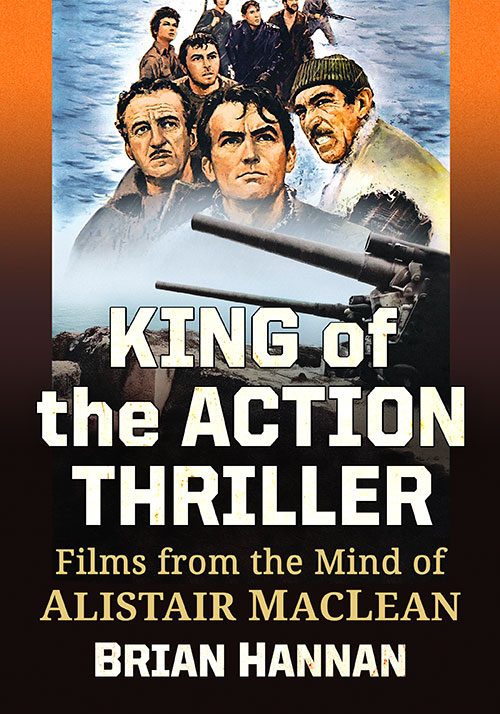
It’s coming! My latest book – King of the Action Thrillers – is on the films of Alistair MacLean. Regular readers will know movies based on the thrillers of the Scottish bestselling author are very close to my heart. As it would appear to be to yours. For, as you will be aware, readers of the Blog have responded massively to my behind-the-scenes tales of the making of a few of the MacLean movies.

The new book is based on exclusive access to many rare archives so I am able to tell – for the first time – the real story behind MacLean’s rise to movie prominence. In addition, I’ve tracked down a hitherto unknown screenplay. His books were turned into both big-budget blockbusters like The Guns of Navarone (1961), Where Eagles Dare (1968) and Ice Station Zebra (1968) as well as the more modestly budgeted Puppet on a Chain (1970) and Fear Is the Key (1972) which set new standards for all kinds of chase sequences.

Stylish cover for the Vinegar Syndrome DVD.

MacLean was an absolute phenomenon in Hollywood terms. Between 1961 and 1979 a total of 13 of his books were turned into movies, an unprecedented hit rate. Another four began in television, and there was one final movie in 1989.  Given he only wrote 28 works of fiction that is some achievement.

This book isn’t published until November next year but is currently available for pre-order on Amazon so there’s no reason why it wouldn’t make a great Xmas present this year.

I’ve diversified somewhat in my activities. Vinegar Syndrome, one of the top DVD re-packagers, has called twice on my services for an audio commentary. So if you want to know what I sound like or you just find the Scottish accent soothing, check out my work on Henry Hathaway western Five Card Stud (1968). Although it starred the fairly macho likes of Robert Mitchum and Dean Martin, I also detected considerable feminist aspects which, it appears, others have overlooked. That’s already out. You can get it direct from Vinegar Syndrome.

Coming soon is my audio commentary on British cult sci fi The Terrornauts (1967), an Amicus production starring Simon Oates, Zena Marshall, Charles Hawtrey and Patricia Hayes and based on a bestseller by Murray Leinster, considered second only to H.G. Wells for his speculative imagination.

I’ve been paid a rather unique compliment by the highly esteemed Cinema Retro magazine. They are putting out a “Special Edition” – in magazine format with dozens of stills and posters – of my Making of The Magnificent Seven book, which covers the original series.

But that’s not out till January. The full version of the book is also available from Amazon at a very reduced price. If you’re a fan of the “making-of” books – as, judging by the views of my behind-the-scenes articles, many of you are – then you may well be interested in The Making of The Guns of Navarone (Revised Edition) and The Making of Lawrence of Arabia. For that matter, there is ample “behind the scenes” material in two other books. The Magnificent 60s examines in detail the  top 100 movies of the decade and could easily be retitled “how the decade was born.” The  Gunslingers of ’69 examines the western in a pivotal year that saw the release of The Wild Bunch, True Grit, Once Upon a Time in the West and Butch Cassidy and the Sundance Kid among others.

My research into The Magnificent Seven spawned two other books. I came to write Coming Back to a Theater Near You, A History of Hollywood Reissues 1914-2014 as a direct result of discovering that the western had flopped on initial U.S. release and only became profitable there after several revivals. Equally, the movie enjoyed an unusual release pattern, going out in a what you’d call these days a rudimentary form of wide release and that led me to In Theaters Everywhere: A History of the Hollywood Wide release 1913-2017.

Since I’ve now written over a dozen books on the movies I’m not going to bore you with them all. You can check me out on Amazon.

I would beg you, however, to pass on to anyone you can think of the information regarding the Alistair MacLean book. It would be great if thanks to pre-orders it could open at No 1 in the Amazon movie chart.

Discover WordPress

A daily selection of the best content published on WordPress, collected for you by humans who love to read.

The Atavist Magazine

by Brian Hannan

WordPress.com News

The latest news on WordPress.com and the WordPress community.