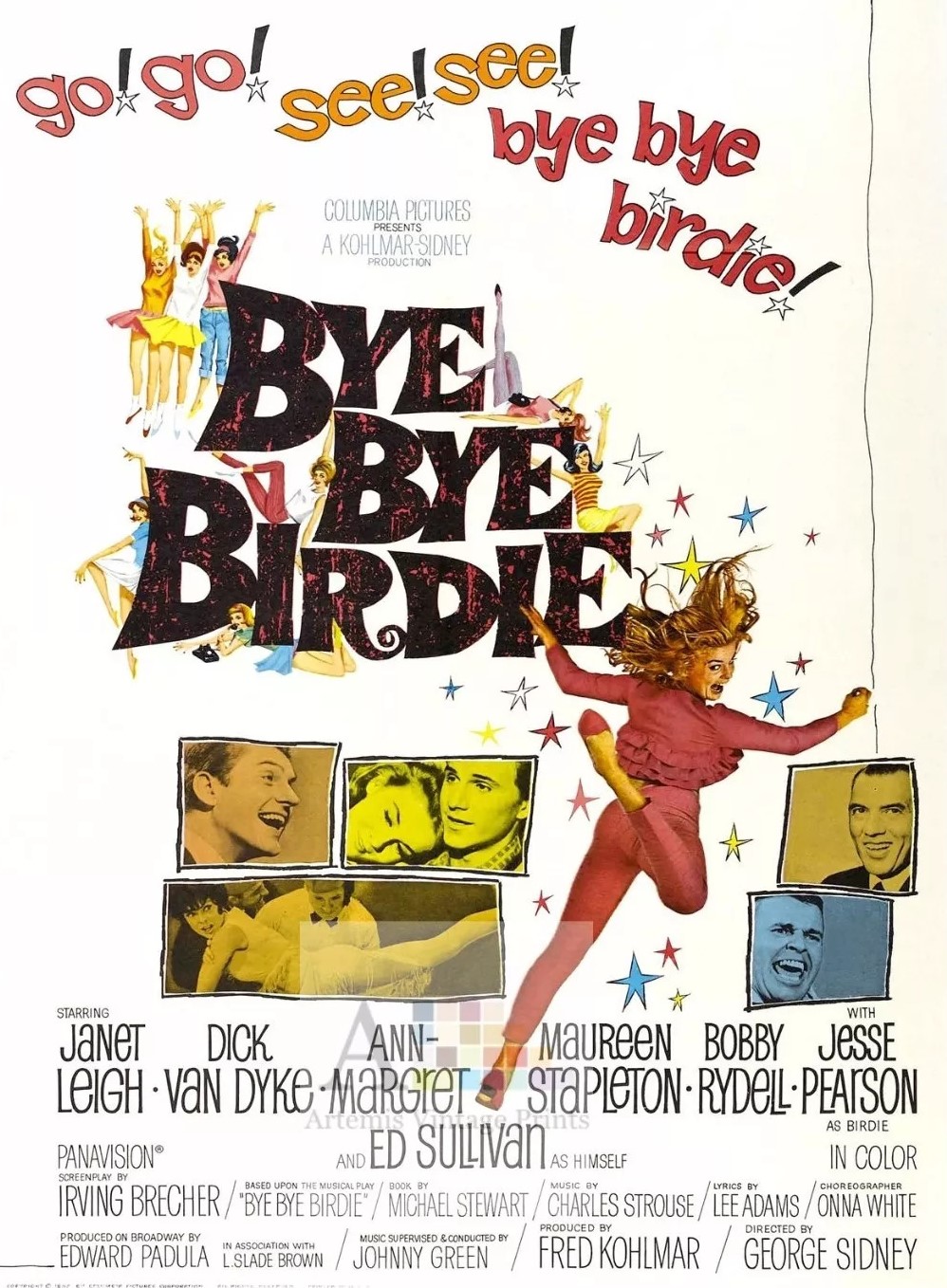
Marketeers employ a cute trick to get round the contractual billing required on movie posters. The position and size of a star’s name in any movie – even now – is stipulated long before a single camera rolls. This is where all the “name above the title” malarkey stems from comes from, that stipulation setting the reals stars apart from the wannabes.
However, whoever was in charge of drawing up the standard boilerplate template was only concerned with names, not images. That left a loophole to be exploited. Should you have a female rising star, whose face or figure might be a darn sight more attractive than the top-billed male, well, by heck, there was nothing to stop you plugging the contractually-less-dominant person all over the poster at the expense of the top-billed star.
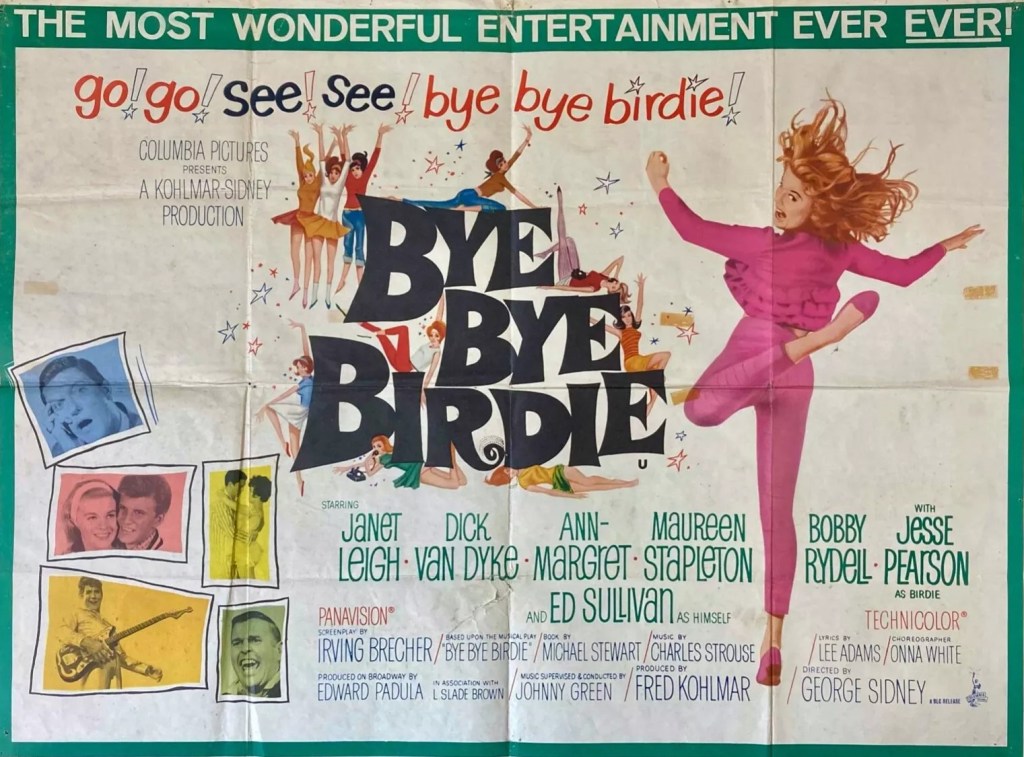
The marketeers did it with Marilyn Monroe, they did it with Audrey Hepburn, and now they’re stooping to the same loophole to promote Ann-Margret as virtually the only star of any importance. Admittedly, this was before top-billed Dick Van Dyke achieved much of a reputation as a hoofer in such spectaculars as Mary Poppins (1964). But his second-billed female lead, Janet Leigh, whose features the camera had very much taken a shine to, was also elbowed out of poster prominence.
And small wonder. Excepting Monroe, no actress ever in the last decade burst onto the screen with such pizzazz. By the time Bye Bye Birdie – her third movie – opened Ann-Margret’s asking price had zoomed to $250,000 and she had struck a two-picture deal with MGM, was contracted to five for Twentieth Century Fox, three for Columbia and another three for Frank Sinatra’s movie production arm.
So a heck of a lot was in the balance. And, boy, does she deliver. Her energy is untouchable and, excepting again Monroe, there was never a sexier singer.
Shame the musical itself is so trite, at its best in homage to those innocent days of the 1950s, that were a more Technicolor version of those 1940s musicals that invariably were sugary confections. The story rips off the Elvis Presley legend. Conrad Birdie (Jesse Pearson) is a pop singer who has been drafted. Songwriter’s secretary Rosie (Janet Leigh) comes up with a publicity gimmick, Conrad singing a song, “One Last Kiss,” written by Albert (Dick Van Dyke) sung on the Ed Sullivan Show, his last gig before joining the Army, with a specially-chosen gal to be recipient of said smooch.
To fill you in, Rosie has had a tough time getting boyfriend Albert, eight years into their relationship, across the wedding finishing line. Bridie fan Kim (Ann-Margret) also has a boyfriend Hugo (Bobby Rydell) who naturally objects to his beloved kissing the pop singer on air in front of millions even it is a publicity stunt. Meanwhile, Albert’s Mama (Maureen Stapleton) is trying to drive a wedge between Rosie and her son. The out-of-sorts Rosie and Hugo conspire to sabotage the television show.
So pretty much the will-she-won’t-she is delivered in wishy-washy style with the plot (call that a plot!) interrupted every few minutes for a song. The narrative seems out of place for a section involving arrest for statutory rape and racism, but that gives the movie some much-needed muscle.
No question that Ann-Margret (The Swinger, 1966) steals the show. That would hardly be surprising given the lack of competition. But she certainly has the song-and-dance chops, and her energy is second to none. She gets a march on everyone by singing the title number over the credits, the credits themselves very much pushed into the background. The other prospective breakout musical star Dick Van Dyke only has one solo and Janet Leigh (Psycho, 1960) wasn’t going to effect a change of screen persona any time soon.
George Sidney directed from a screenplay by Irving Brecher (Oscar-nominated for Meet Me in St Louis, 1944) and Michael Stewart (Hello, Dolly!, 1969) from the original Broadway hit by Charles Strouse (music), Lee Adams (lyrics) and Stewart (book).
Refreshingly lightweight. Ann-Margret lights up the screen.

 The Magnificent 60s
Hello Brian
A film I saw at my favourite city theatre, the Regent, which I thoroughly enjoyed. However, when I watched it during lockdown, it seemed to have lost its appeal.
BTW DARK OF THE SUN 1968 was released here as THE MERCENARIES.
Best wishes, Allan
LikeLiked by 1 person
Hi Allan
I saw it in the UK as The Mercenaries too.
Brian
LikeLike
Dick Van Dyke and Paul Lynde both reprised their roles from the original Broadway production. With hindsight, the idea of Lynde as the father of Ann-Margret really seems absurd!
The title song was not in the original Broadway score and was written solely as a way of exploiting Ann-Margret’s sex appeal and on that point succeeded. The screen version also removed a number of edgier elements of the original production (such as Rosie’s ethnicity and the fact that Albert’s mother is a racist) and that’s why you often hear fans of the stage version hating the screen version because of all the changes (though structurally and commercially they were quite understandable) whereas if you saw the film first and then a stage version, you tend to prefer the film.
LikeLiked by 1 person
I knew that song was written for her but was anaware of the other changes, though there are always arguments of stage vs screen.
LikeLiked by 1 person
More stuff:
“The 10 Feb 1961 NYT announced that theater director Gower Champion signed a multi-picture deal with Columbia Pictures. His first assignment was a film version of the 1960 musical, Bye Bye Birdie, which Champion directed for the Broadway stage. Ten months later, the 9 Sep 1961 LAT reported that Champion’s obligations to four touring companies of Birdie and an upcoming stage production forced him to withdraw from the picture. The 1 Dec 1961 LAT noted that Columbia hoped to cast Debbie Reynolds in the film, but she declined unless Champion was directing. On 26 Jan 1962, LAT announced George Sidney as the new director, and his choice of Bill Hayes for the lead role. Three weeks later, the 20 Feb 1962 DV noted that Mary Jane Saunders was doing a screen test for the role of “Kim MacAfee.” The 23 Feb 1962 DV reported that musical arranger and conductor Johnny Green was expected to begin recording in late May 1962. George Sidney and producer Fred Kohlmar were scouting locations and interviewing prospective cast members in New York City. Tentative plans to film a musical number in Pennsylvania Station would be decided during their visit. Upon their return to California, the 6 Mar 1962 DV stated that Sidney and Kohlmar had made sixteen screen tests of teenaged actors. No decision had been made on filming in Pennsylvania Station, which was scheduled for demolition later that year. As reported in the 27 Mar 1962 DV, Kohlmar and Sidney cast British actor Michael Evans as “Claude Paisley,” a character created for the film as a romantic rival for “Albert Peterson,” played by Dick Van Dyke in a reprise of his Broadway role. The picture marked Van Dyke’s screen debut, and Evans’s first appearance in an American feature. According to the 26 Apr 1962 LAT, the film was actress Ann-Margret’s first for Columbia under her two-picture deal with the studio. The 21 May 1962 DV noted that singer Jesse Pearson, who was under exclusive contract to Columbia, was set to reprise his stage role as “Conrad Birdie.” News items in the 23 May 1962 DV and 1 Apr 1963 LAT revealed that singer Bobby Rydell postponed nightclub engagements at the Copacabana in New York City, and the Sands in Las Vegas, NV, to make his first motion picture. His commitment to the production was expected to last twelve weeks. Principal photography began 4 May 1962, as stated in the 3 May 1962 DV. The 18 May 1962 DV estimated the budget at $5 million.
The 13 May 1962 NYT reported that the “Spanish Rose” number, featuring Janet Leigh, was extended for the film, utilizing an entire ballroom set. Her character, “Rosie DeLeon,” intrudes on a convention of “Sultans,” an organization modeled on the Shriners. The character was named “Rosie Alvarez” in the stage production. Van Dyke, who enters the scene by falling down a flight of stairs, admitted that a stand-in performed the stunt.
An article in the 16 May 1963 LAT revealed that images of dance rehearsals were captured by still photographer Mel Traxel. The developed prints were assembled into storyboards, which aided George Sidney and director of photography Joseph Biroc in expediting the processes of staging, lighting, and deciding camera angles, among others. On 1 Jun 1962, DV announced that the production was moving temporarily to the Revue (Universal) Studios backlot to film the musical number, “Honestly Sincere.” In addition to principal cast members, 300 background actors were required. The 19 Jun 1962 DV reported that a musical sequence, filmed over two days at Hollywood High School, featured 200 of the school’s students, all of whom were members of the Screen Extras Guild (SEG).
The 10 Jul 1962 DV noted that Van Dyke needed to complete his role by the end of the month, so he could begin filming the next season of his weekly television series, The Dick Van Dyke Show (CBS, 3 Oct 1961 – 1 Jun 1966). According to the 27 Jul 1962 LAT, Columbia Pictures promised the actor an around-the-world trip, with the provision that he made promotional appearances in thirty-two cities.
A news item in the 3 Jul 1962 LAT stated that 300 gallons of artificial smoke were used for the Hymn For A Sunday Evening sequence, shot on Stage 1 at Columbia Studios. When residual smoke poured onto the street, a passing “air pollution prevention officer” instructed the company to channel it through an unoccupied neighboring stage and release it gradually, rather than in a large cloud. Weeks later, the 10 Aug 1962 DV reported that Ed Sullivan, host of the weekly variety series, The Ed Sullivan Show (CBS, 20 Jun 1948 – 6 Jun 1971), was expected in Los Angeles, CA, that day. His scenes were filmed on 13 and 14 Aug 1962, as noted in the latter day’s DV. Sullivan explained that comedian Jack Benny had convinced him to appear in Bye Bye Birdie, as it would be good publicity for the television series. Clips from the picture would be shown on the program during its upcoming season.
On 15 Aug 1962, DV announced that Kohlmar and Sidney were flying to New York City for eight days of exterior filming. Included among the sites would be the Statue of Liberty and Hunter College. Afterward, the unit moved to Washington, DC, to shoot footage of television journalist John Daly. The company returned to the Columbia lot on 24 Aug 1962, as stated in that day’s DV. Photography was scheduled to resume three days later.
On 13 Sep 1962, DV reported that auditions for twenty dancers were being held that day for “The Telephone Hour” sequence. The following week, the 17 Sep 1962 DV noted that Van Dyke and Leigh returned to Columbia to re-record their final vocal duet in the picture, which was lost due to a “mechanical problem.” Leigh was on her honeymoon at the time. Within the month, a 12 Oct 1962 DV news item stated that George Sidney was directing both Birdie at Columbia, and the Metro-Goldwyn-Mayer (MGM) production, A Ticklish Affair (1963, see entry), known at the time by its working title, Moon Walk.
The 9 Nov 1962 DV reported that Sidney would produce and direct Ann-Margret’s Scrapbook, an eight-minute promotional short subject scripted by Jack Atlas and Joe Anson, featuring highlights of the actress’s career. The footage was intended for both “theatrical distribution” and as part of a television trailer, to be released in the spring of 1963. According to the 16 Nov 1962 DV, the studio also planned to make trailers in Swedish and French, featuring Ann-Margret singing in both languages and demonstrating a popular dance called the “twist.” Filming was scheduled for the following week. Meanwhile, Fred Kohlmar contracted with animation company Hanna-Barbera Productions to create seven minutes of “cartoon effects” for the picture, as stated in the 19 Nov 1962 DV.
Casting announcements included Peter and Paul Pepper (23 Jul 1962 DV); Walter Rode and George Zoritch (6 Aug 1962 DV); Frances O’Farrell (14 Aug 1962 DV); Toni Basil, Kathy Gayle, Elaine Joyce, Karen Keutsch, Paula Martin, Teri Robinson, Sandra Bonner, Pat Tribble, Ann Consoli, Judy Van Wormer, Lorene Yarnell, Jacqueline Gregory, Susan Luckey, Ellen Plasschaert, Rene Jarmon, Robert Banas, John Moore, Gary Scharff, David Sutherland, Bruce Hov, James Bates, Jimmy Hibbard, Pete Menafee, Lynn Ready, Lou Zeldis, Alex Plasschaert, Gildo Denuzio, Currie Pederson, and Tod Miller (16 Aug 1962 DV); Sally Mason and Gary Nenteer (19 Sep 1962 DV); George Spicer and Tony Benson (27 Sep 1962 DV); Kathy West (28 Sep 1962 DV). The picture marked the screen debut of Beverly Yates, according to the 28 May 1962 DV, and the final screen role for actor Frank Albertson, who died 29 Feb 1964. The 13 Apr 1962 DV credited Art Sarno as unit publicist.
Nearly three months later, the 8 Feb 1962 DV revealed that Sidney returned to the Columbia lot to film an addition musical number with Ann-Margret. A premiere was tentatively scheduled at Radio City Music Hall in New York City over the Easter weekend. On 15 Feb 1963, DV announced that the final scene would be completed the next day. Johnny Green completed recording the soundtrack album on 26 Feb 1963, as noted in that day’s DV.
The 1 Apr 1963 DV reported enthusiastic audience response to a 28 Mar 1963 preview screening at the Paramount Theatre in Hollywood, CA. Among the attendees were Kohlmar, Sidney, and screenwriter Irving Brecher. Bye Bye Birdie opened 4 Apr 1963 in New York City, and 5 Apr 1963 in Los Angeles, CA, to positive reviews. The 8 and 9 Apr 1963 DV estimated weekend box office receipts of $120,000 and $39,000 for New York City and Los Angeles, respectively. The film received two Academy Award nominations for Sound and for Music—Scoring of Music, Adaptation or Treatment. It was also nominated for two Golden Globe Awards: Best Motion Picture—Comedy or Musical, and Best Actress—Comedy or Musical (Ann-Margret). Music sales charts in the 13 Nov 1963 Var listed the soundtrack album at number five, after twenty-nine weeks in release.”
LikeLiked by 1 person
Very hefty lot of “stuff.” very many thanks.
LikeLike