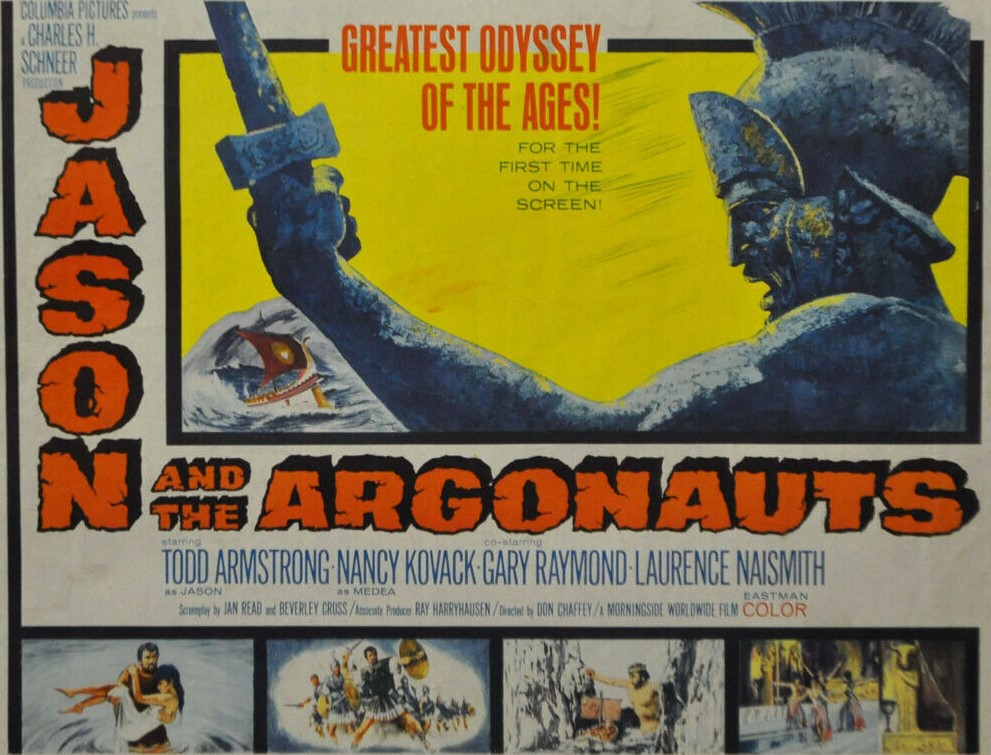
An absolute delight, great storytelling married to groundbreaking special effects produces an adventure picture of the highest order. Though mostly known for its Ray Harryhausen stop-motion animation, its success also relied heavily on the direction of Don Chaffey (The Viking Queen, 1967) and a great script. It’s one of the few films to benefit from not being viewed in its original size, the small screen minimizing the flaws of the special effects. In essence it’s a combination of three genres – the Italian peplum, the men-on-a-mission picture and the classic detective story.
Plus there are interesting stabs at philosophy – if man refuses to believe in the gods, do they cease to exist? And if the golden fleece brings peace and prosperity to a nation what will happen to that country when it is stolen? And if various people call on their own gods for help will that not create conflict in heaven as much as on earth? And the ultimately question – what can man achieve without celestial interference?
While the episodic structure derives from the clues meted out piecemeal to hero Jason (Todd Armstrong) during his long voyage to find the golden fleece these often come minus vital pieces of information ensuring that surprise remains a key element.
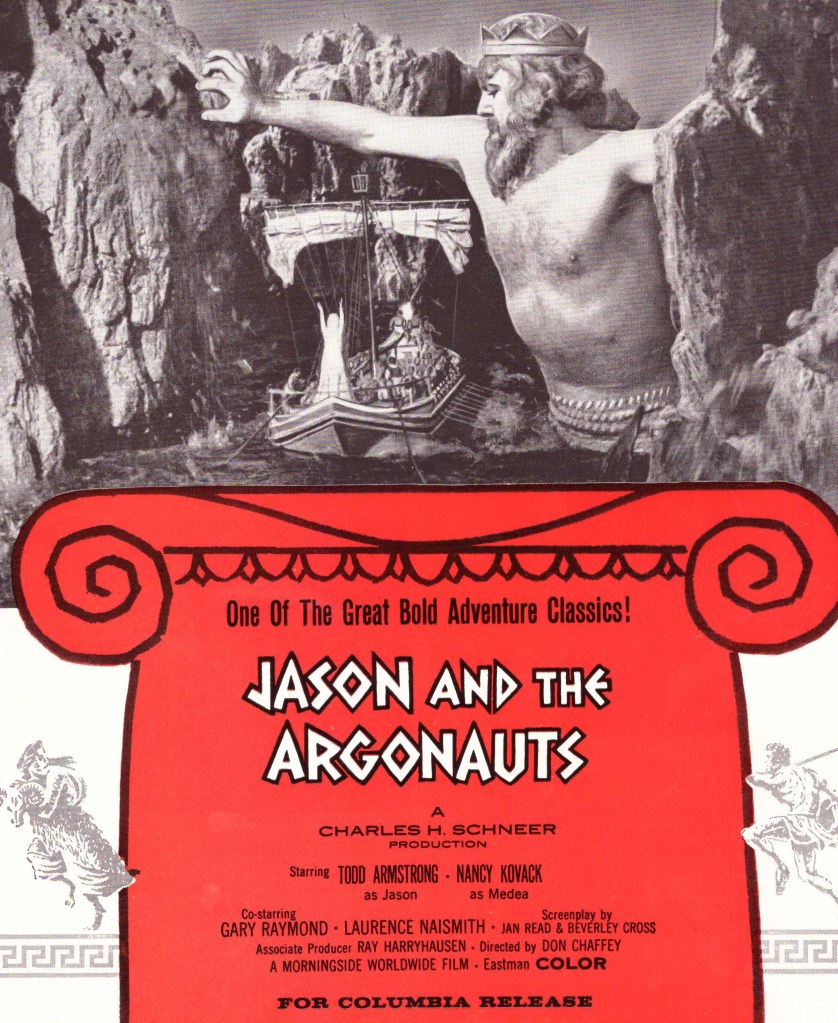
Without doubt special effects are the triumph, although some work better than others. The highlights for me were the towering bronze statue of Talos and the skeleton warriors. I can’t be the only one who thinks that some of the visuals in Game of Thrones were inspired by the sight of Talos astride two land masses separated by the sea. Talos is not so much a man-mountain as an actual mountain, first viewed coming round the corner of a cliff top, his head topping it. But where, except for cunning Jason, the crewmen are viewed primarily in miniature in relation to the giant Talos, the skeletons are the same size as the adventurers and the fight scene all the more impressive as the ensuing battle appears completely real.
Scale allows Harryhausen to wriggle out of the problems of contact. If the creatures are out of reach anyway, there’s little need to attempt to bring them into close proximity. The way the Harpies are utilized, close enough to strip clothes from a blind man but otherwise hovering just out of reach, is a classic example of clever direction. The multi-headed Hydra, on the other hand, is the least convincing monster simply because it is impossible for Jason to get close to the beast. Scale is also one of the film’s best weapons. The scenes where a miniaturized Jason is transported to Mount Olympus to face the gods are well done as are the occasions when the gods peer down on tiny man.
Outside of the special effects and the varying degrees of excitement aroused, in the background there is constant intrigue. Jason is the son of the King of Thessaly slain by the usurper Pelias (Douglas Wilmer) and his crew includes Acastus (Gary Raymond), son of Pelias, whose task is to cause trouble and if Jason succeeds in his endeavor to kill him. On top of that, there is a heavenly battle over Jason’s fate. Jason, having defied Zeus (Niall MacGinnis) by first of all refusing to believe he exists and that his life is determined by fate, becomes enmeshed in a battle between the king of the gods and his wife Hera (Honor Blackman) who grants Jason a get-out-jail-free card, the ability to call on her help, but only five times.
Jason determines to recruit his own team and in the manner of The Guns of Navarone (1961) and The Professionals (1966) they are all experts in their fields but unlike that film and The Dirty Dozen (1967) are willing conscripts. The team also includes Hercules (Nigel Green) and Hylas (John Cairney) and in the first of the film’s many surprises and reversals, the weedy latter is able to beat the muscular former in a contest of strength.
There is enough incident to keep the story ticking along but Don Chaffey fills in the blanks with montage, the various essentials of a ship – sails, oarsmen, sides, stern, figurehead, pace set by drumbeat – and a full color palette from the bright blue sky, to dawn and dusk and sunset and night, a wonderful image of rowers at sunset on the sea the pick. He also makes great use of the sea – pounding surf, storms, the sea turned tempest by the clashing rocks, a shipwreck. And we have dancing girls, colorful costumes, ancient backdrops and the sense that the budget has been well spent
Some scenes call for immense skills in coupling special effects with real characters. For the clashing rocks sequence five elements are simultaneously in play: the crew in danger, a tempest, rocks crashing into the water, the ship itself and Neptune.
And the romance is well handled dramatically: if Jason rescues Medea (Nancy Kovack) then she too rescues him. Love produces conflict. To love Jason, Medea must betray her country. There is hardly a moment when Jason, confronted either by monsters or kings, does not face death.
In addition, there is a stunning score by Bernard Herrmann (Psycho, 1960).
Any top-notch acting would have been over-shadowed by the special effects. Which is just as well because the entire cast is drawn from the lower strata of the stardom ladder. Todd Armstrong, from the Manhunt tv series (1961), needs only not to mess up, which he manages adequately. Nancy Kovack (Diary of a Madman, 1963) does well to make an impact given she does not appear until the final third. This did not turn out to be much of a star-making vehicle for either. Honor Blackman drops the slinky persona with which she had made her name in The Avengers tv series (1962-1964) and instead plays a confident goddess willing to out-maneuver husband Zeus.
The rest of the cast comprises a regiment of future movie supporting actors – Nigel Green (Tobruk, 1967), Niall MacGinnis (The Viking Queen, 1967) and Douglas Wilmer (The Brides of Fu Manchu, 1966). Future television stars range from Patrick Troughton (the second Dr Who) and Scottish actor John Cairney (This Man Craig, 1966-1967) to Laurence Naismith (The Persuaders, 1971), Gary Raymond (The Rat Patrol, 1966-1968), Mike Gwynn (Poison Island, 1965) and Andrew Faulds (The Protectors, 1964).
The screenplay was written by Jan Read (First Men on the Moon, 1964) and Beverley Cross (The Long Ships, 1964), husband of Maggie Smith. Cross returned to ancient worlds again for producer Charles H. Schneer for Sinbad and the Eye of the Tiger (1977) and Clash of the Titans (1981)
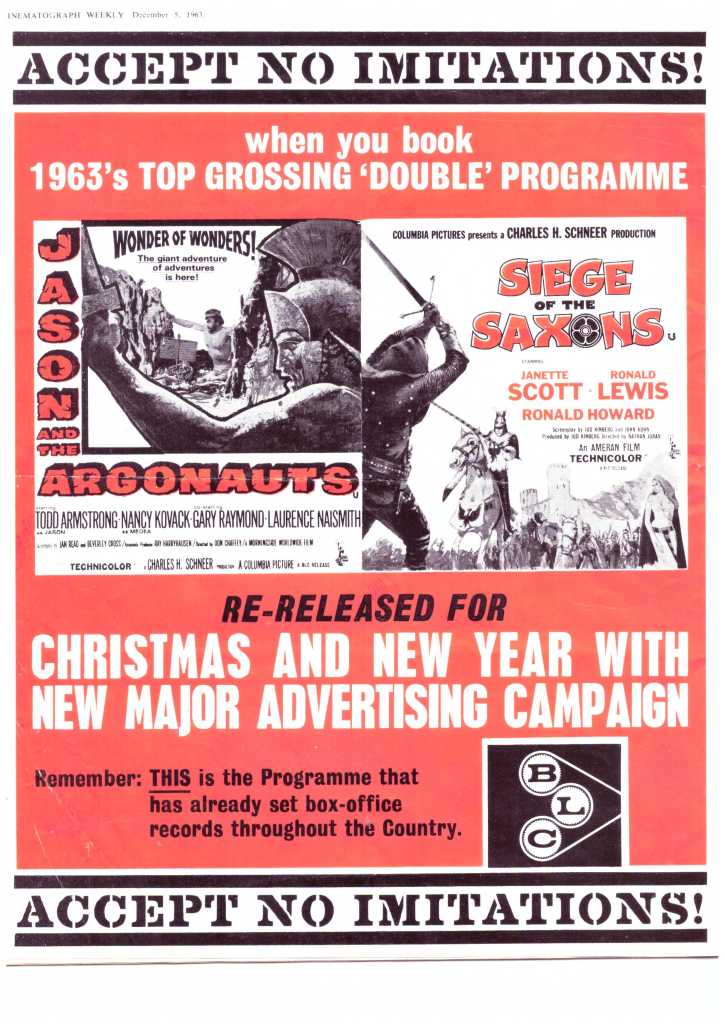
Although the ending appeared to leave the door open for a sequel, none was made. A huge box office hit in Britain, it did not repeat its success elsewhere.
I first saw this film as a boy and was so enthralled I wouldn’t have noticed if there was anything awry with the special effects. I have not seen it since. Coming at with some degree of skepticism I found that attitude misplaced. I was equally enthralled.


As it comprised a cast of unknowns, it was not a hit here. The 7th Voyage of Sinbad and Jack the Giant Killer, both helmed by Kerwin Mathews were box office hits.
LikeLiked by 1 person
Not sure why it did so well in Britain. It flopped in the US.
LikeLike
The first Harryhausen film I ever saw. It played on network television when I was very young and took my breath away. “First Men in the Moon” remains my favorite but this is easily my second favorite. I sometimes think it was a pity a big Hollywood studio didn’t throw enough money at Harryhausen to take over their special effects department at the time. It would have been fascinating to see what he could have done with a bigger budget since he created such impressive work on a shoestring.
I remember when Herrmann released all those Phase 4 recordings on Decca in the seventies with the “Jason” suite being a standout.
LikeLiked by 1 person
We were taken to see it because John Cairney was my mother’s cousin. A very rare outing. We grew up in a town wihtout a cinema so it was one film at xmas and one film in the summer. But this was a fabulous treat. You are right – Harryhausen would have made a huge impact with abig budget.
LikeLike
Magical Ray’s power of wonder is still strong, for sure ! And you prove it with your review inprinted in the ink of gods.
LikeLiked by 1 person
He was a genius.
LikeLiked by 1 person
I can certainly agree with most things penned here for this winner of its genre – but must fill in some missing details re-certain aspects of its history. I was working for Greater Union when it was released in Australia, no-one was sure what to expect from attendances but it received huge advertising coverage on local TV.
When we opened with this film we were taken by surprise at the long lines of patrons waiting to get into the theatre – we had to call in extra staff to manage the unexpected crowd. These Full House attendances were repeated in Theatres all around Australia. So big were the crowds it was held over for and extra week in the Suburban circuits (rare indeed back then). So, Jason was one of the biggest box office hits all over Australia, and thats a mighty lot of Theatres and revenue.
Sadly, it seems possibly some distributor skulduggery may have cheated Mr Harryhausen out of his much deserved returns, but appears things like this did happen more than we might like to admit. Yes, Jason should have had another adventure! And all that can, and has been said, about Bernard Herman’s momentous score is absolutely true! Add to all the talent involved, lets not forget the sterling director of photography; the great Willkie Cooper working so well with director Don Chaffey. Quite a masterpiece.
LikeLiked by 1 person
It was brought back for a second week on the circuits in Britain as well. Fascinating to hear about your Greater Union experience. did you have a circuit like the ABC and Odon chains here?
LikeLike
Yes, Brian, I worked in two, Bexley and Rockdale Odeon (among others). Some wonderful memories between those two!
LikeLiked by 1 person
Nancy Kovack’s guest shot on “Star Trek” several years later was directly influenced by her role in “Jason” and offers a hint of how she might have played an evil version of Medea if there had been a sequel to “Jason”. She just turned 90 recently.
LikeLiked by 1 person
There would have been a sequel if it had done better in the USA. Huge success in Britain but lack of Transatlant0ci sucess scuppered its chances. Didn’t know about her turn on Star Trek. Thanks.
LikeLike