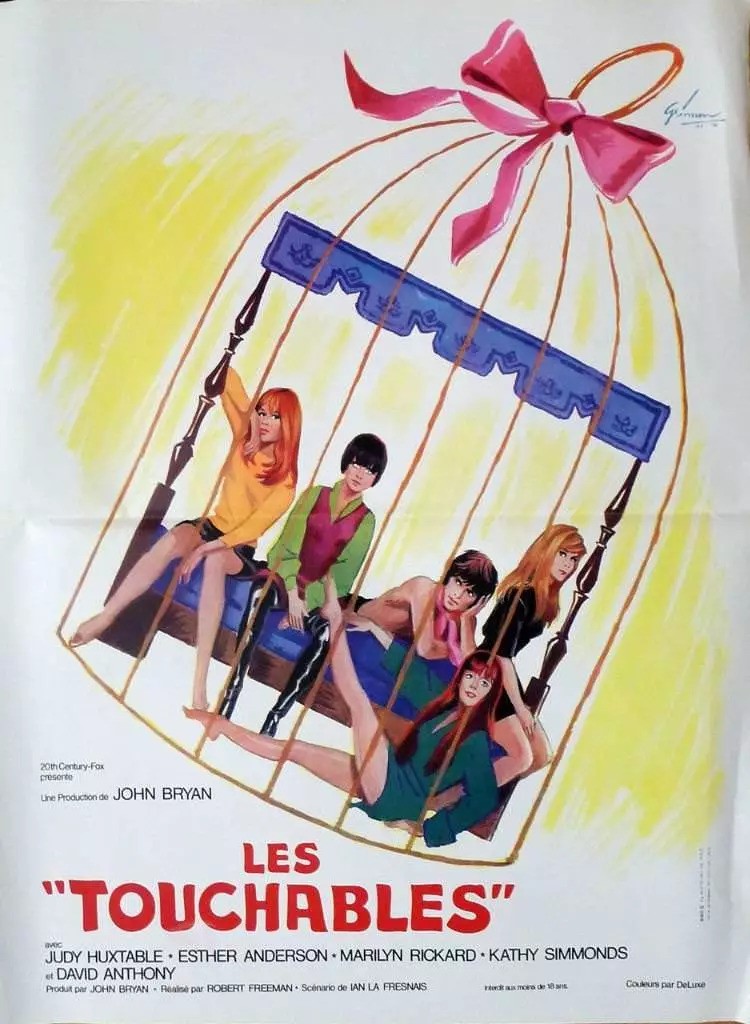
The Touchables (1968) **

Take a giant bubble, yellow Mini, an abundance of mini-skirts, Michael Caine waxwork,  one pop star, four models, a masked wrestler, nuns, table football, a pinball machine, a circular bed, various sunsets, a shotgun and a lass milking a fake cow. And what do you get? Not much? A dry run for Performance (1971), given Donald Cammell’s involvement, but otherwise a largely soporific feature hoping for redemption on the cult circuit. But with the unsavory subject matter, even with a proto-feminist outlook, that might struggle might to win approval from a contemporary audience.

Unlike Privilege (1967) it’s not saved by ironic comment on the music scene or even anything in the way of decent performances and looks more like an attempt to guy up the nascent careers of a bunch of young actresses and get by with a day-glo pop art sensibility. At no point are we invited to disapprove of the model quartet who decide, having tried out their kidnapping skills on a Michael Caine waxwork, that they might as well go the whole hog and abduct pop star Christian (David Anthony) and tie him to a bed and take their turns having their wicked way with him.

This is all purportedly acceptable stuff because a) it’s a gender switch and b) the poor pop singer is only too happy to escape the drudgery of making millions and not have to even consort with groupies and c) is presented as if he is thoroughly enjoying the whole experience. That is, if you ignore him being chloroformed, shot, and whacked over the head, then of course it’s all very pleasant.

Naturally, these being cunning wenches, they hide him in plain sight. Who would think to look for him in a giant transparent bubble?

Although drawn with villainous strokes, as were all the managers in Privilege who put unnecessary pressure on the pop star they have created, it’s hard to view Anthony’s upper class manager Twynyng (James Villiers) as a bad guy for wanting his safe return.

So what happens once the ladies take charge of their victim? Beyond sex, not much, playing with the various items mentioned, not even any jealousy rearing its ugly head, just the kind of cinematography that might well pass for advertising.

It’s hard to see what the point of it all was. Screenwriter Ian La Fresnais (The Jokers, 1967) might have been brought in to add a touch of levity to what otherwise – kidnap, rape – was a dodgy subject based on an original by Donald and David Cammell. Even taking a comedy approach wasn’t going to work if it was saddled with little interaction between characters and nobody, to put it bluntly, who could act.

I would tend to think with the “talent” involved that this was made by a neophyte producer. But, in fact, this is the oddest part of the whole debacle. John Bryson was an Oscar-winner – admittedly for art direction for Great Expectations (1948) – but also an experienced producer, this being the last of the dozen he made. But they included Man with a Million (1954) and The Purple Plain (1954), both toplining Gregory Peck, The Spanish Gardener (1956) with Dirk Bogarde, The Horse’s Mouth (1958) starring Alec Guinness, Tamahine (1963) – reviewed in this Blog – and Peter Sellers in After the Fox (1966).

It didn’t do anything for anyone’s career, which was the least you could expect for the actors forced into such mindless cavorting. Judy Huxtable appeared in a similar lightweight advertising-led concoction Les Bicyclettes de Belsize (1968) and bit parts in the likes of Die Screaming, Marianne (1971) and Up the Chastity Belt (1972). Ester Anderson did somewhat better, female lead to Sidney Poitier in A Warm December (1973), her last movie. For Kathy Simmonds this was her first and last movie, but she was better known as a genuine pop star’s girlfriend, dating George Harrison, Rod Stewart and Harry Nilsson. Only movie of David Anthony. Seems it’s too easy to confuse Marilyn Rickard with German Monica Ringwald so she may or may not have a string of bit parts in sexploitationers. Arts presenter Joan Bakewell put in an appearance as did Michael Chow, later a famous restaurateur and artist, and wrestler Ricki Starr.

Director Roger Freeman made one more picture, Secret World (1969) with Jacqueline Bisset which at least had a decent premise.

File under awful.

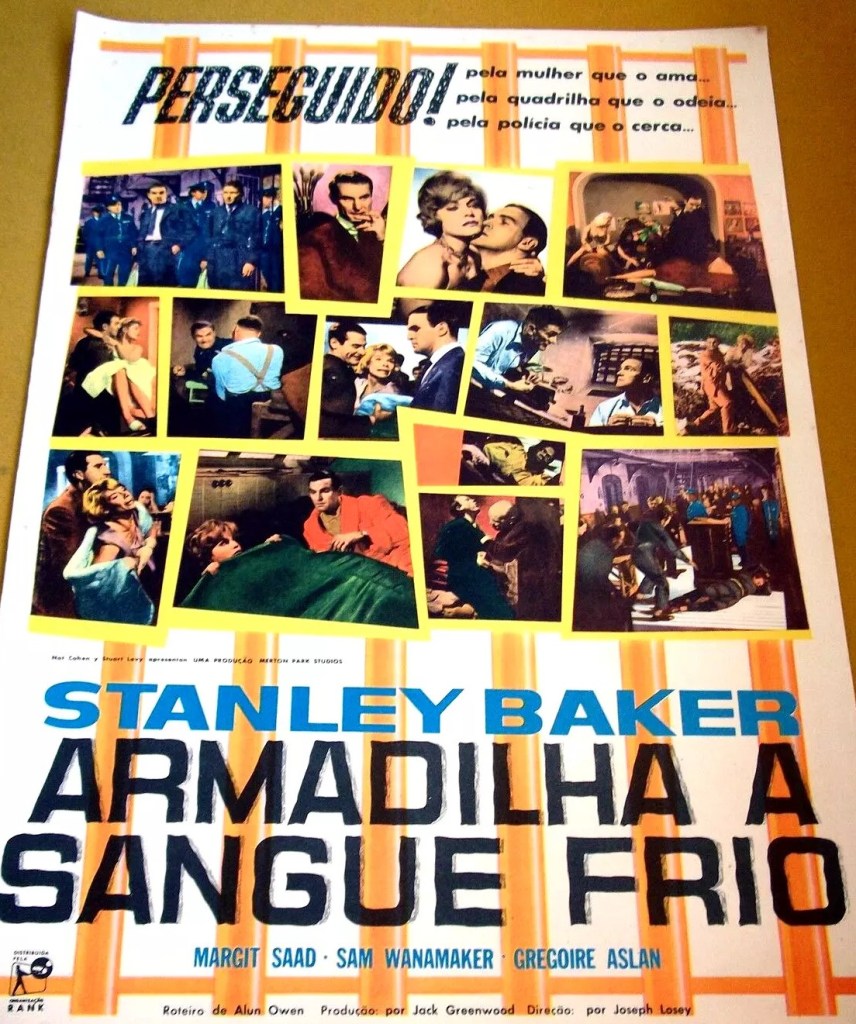
The Criminal / The Concrete Jungle (1960) ****

You’d be hard put to imagine from this hard-nosed gangster picture that both director Joseph Losey and star Stanley Baker would be capable of a more discreet arthouse offering like Accident (1966). Except for the director’s penchant for introducing a jazz score more often than suits the material – witness a brutal beating in a prison – this is an exceptionally gruelling blast through the British underworld, as though the domestic film industry had suddenly inhaled a narcotic comprised of Cagney and Bogart at their meanest.

With hardly a redemptive character in sight, it makes terrific demands of both director and star that anyone comes out achieving audience sympathy. Hollywood usually fell back on the trope of the innocent prisoner to instigate character empathy, but there’s no question from the outset that career criminal Bannion (Stanley Baker) is as tough as they come. In the opening section he arranges for rival Kelly (Kenneth Cope) to be viciously beaten with prison guard Barrows (Patrick Magee) turning a blind eye.

Out after a three-year stretch, Bannion plans a robbery of a race track with a partner, American Mike (Sam Wanamaker). But it turns out the track is owned by another gangster. After that, the double-crosses come thick and fast, nobody to be trusted, everyone out for themselves. He ends up back in prison, wanted by both sides of the law, the gangsters desperate to get their hands on the hidden loot.

Inside, he is protected by Italian mob boss Saffron (Gregoire Aslan), ruling his empire from prison, in return for a share of the loot. In due course, he instigates a riot, and double-crossing the other inmates, secures a shift to a low-security prison, and he is rescued from the transfer van. But there’s no escape. It’s a bleak ending all round. He dies on a beach, but without revealing where he has stowed the loot.

There are a couple of gals in the mix. The first, his ex-, Maggie (Jill Bennett) he treats in appalling fashion. The second, something of a present for his release, Suzanne (Margit Saad), sees the better side of him, although you have a sneaking feeling that she’s a plant.

But, really, nobody’s got a better side here. The prison scenes are grittier than had previously been the case in British movies, but the whole gangster set-up has a realistic “goodfellas” feel to it, boozing gangsters welcoming him home even as they are planning to stitch him up. And while Bannion may be unaware of ownership of the race track, clearly Mike isn’t, and Bannion is being set up to take the fall.

Joseph Losey (The Damned, 1962) takes an original approach to the material, cutting out the “big job” element entirely in favor of repercussion. He keeps up a brisk pace, which helps build tension, instead focussing on the relationships between the criminals and the prison hierarchy. Especially in the early prison scenes, more is made of vulnerability than toughness, many of Bannion’s confederates presented as weak and easily controlled rather than constantly challenging, prison guards complicit.

Stanley Baker (Where’s Jack, 1969) has such a malevolent appearance he was often as his best in the toughest arenas and perhaps Losey is making the point that even the toughest of tough guys can be duped by gangsters with more brains. There’s a terrific support cast: Sam Wanamaker (Warning Shot, 1966), Gregoire Aslan (Lost Command, 1966), Patrick Magee (Hard Contract, 1969), Jill Bennett (The Charge of the Light Brigade, 1968), Patrick Wymark (Where Eagles Dare, 1968) and  Laurence Naismith (Jason and the Argonauts, 1963). German star Margit Saad (The Magnificent Two, 1967) lends an air of mystery to her character.

This was the third – of four – teamings for Losey and Baker. The British censor took a mighty mild attitude to the unexpected levels of nudity and violence. Alan Owen (A Hard Day’s Night, 1964) and Jimmy Sangster (The Devil-Ship Pirates, 1964) are credited with the script.

Takes no prisoners.

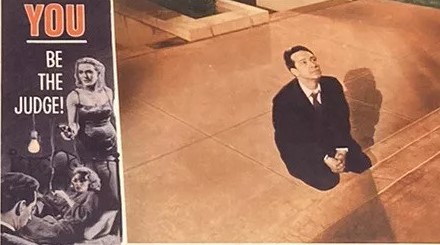
The Seventh Commandment (1961) ****

Wow! Here’s a find. High octane noir. Smorgasbord of illicit sex, alcohol, blackmail and murder. Noir without the traditional shadow and shading, reeking of sin, heading straight down the road to Exploitation City. Even redemption is tainted. Some quite stunning scenes, what it lacks in style makes up with juddering twists, out-doing Elmer Gantry (1960) as it barrels through fifty shades of hypocrisy. The title’s a bit of misnomer because there’s hardly a commandment that doesn’t get broken.

Following a car accident involving girlfriend Terry (Lyn Statten), business graduate Ted Mathews  (Jonathan Kidd) loses his memory, hooks up with preacher Noah (Frank Arvidsen) and re-emerges as fire-and-brimstone evangelist Tad Morgan, a huge success on the circuit, especially when he calls upon (presumably fake) healing powers.

Seven years later Terry is close to Skid Row, her vicious tongue no match for the vicious punch of lover Pete (John Harmon) who rolls bums to keep them in booze. When by coincidence she happens upon Ted/Tad, she wants revenge. Because he ran away from the accident, she took the rap and served a prison spell for drunken driving. So she indulges in a spot of blackmail.

Ted/Tad, on rediscovering his identity, is hit by a shed-load of guilt because he believes he killed another man in the accident. Noah, with a major in hypocrisy, and not wanting to kill the golden goose, tells him to suck it up rather than confess, and soon the preacher is on his knees begging God for forgiveness.

Having struck gold herself, Terry wants more and to protect her investment, should Ted/Tad ever discover that nobody was killed in the accident, decides to marry him and rook him of all his money. That involves seducing the preacher, much to the annoyance of her lover, and getting him so drunk he can hardly stand when she hauls in a two-bit no-questions-asked celebrant to carry out the wedding.

Ted/Tad wakes up from a drunken stupor on his wedding night to find the lovers making out in the next room. After he uncovers the con, he chucks her off a bridge into the river. But she’s not dead and returning to her room and mistaking the sleeping Pete for her new husband shoots him dead. For good measure, she pumps two bullets into Ted/Tad, but in one of those tropes that seem to afflict any picture involving a preacher or religion, he is saved by his Bible. So he strangles her and buries her.

The picture ends with Ted/Tad on his knees begging forgiveness from God on the usual terms i.e. that he spends the rest of his life making sinners repent.

While spending too much time on the amnesia malarkey and the Elmer Gantry rip-off scenes, it fair picks up once Terry re-enters the scene. I said this has little style, but that’s only when you compare it to traditional film noir, which is full of contradictions and clever use of light and compositional highpoints.

But that’s not to say it doesn’t have several distinctive stylistic features, not least being light, played like a searchlight along every inch of Terry’s flesh in the opening scene. The wedding scene is a corker, Terry literally holding an unconscious Ted/Tad erect while the wedding is conducted. As greedy as he is, Pete is none too keen on his lover using sex as the lure to snap up Ted/Tad.

The murders and attempted murders are exceptionally well done, especially when the dupe doesn’t turn out to be the easy pickings Terry imagined. Under the guise of giving her a foot rub, he sits her on a bridge over a river, then yanks up the legs and sends her tumbling over.

So the last thing we expect is a bedraggled soaking wet Terry to reappear. At this point, Pete has snaffled Ted/Tad’s striped dressing gown and in, ironically, another drunken stupor, is sleeping it off, lying on his front in the bed, when the enraged Terry turns up, and kills him with his own gun.

And when Ted/Tad doesn’t drop dead after being pumped full of two bullets, Bible taking the hit instead, all we see is his hands reaching for her whiter-than-white throat.

We end with Ted/Tad on his knees.

Hollywood wasn’t in the habit of looking to B-picture directors to fill out the ranks of A-list movies, so whatever Irvin Berwick (Strange Compulsion, 1964) achieved here in his sophomore outing went unnoticed and he was as likely to pop up as dialog coach (Rough Night in Jericho, 1967), for example, as anything else.

But he does evince good performances from his cast. Lyn Stratten – in her only movie – has the easier task, she’s the standard hard-bitten blonde, but there are a couple of scenes where the vulnerable takes over from the nasty and she turns in a many-sided performance. I should point out that you’ll flinch at the brutality of the domestic abuse.

This, too, was the only leading role for Jonathan Kidd, who spent most of his career in bit parts, but he’s especially powerful when he snaps out of the drunken dream and goes hitman and invokes the God of Hypocrisy. Second and last screenplay for Jack Kevan, who co-wrote with Berwick.

As tough on faith and redemption as the more highly-praised Elmer Gantry, this seems to have slipped through the cracks.

Worth redeeming.

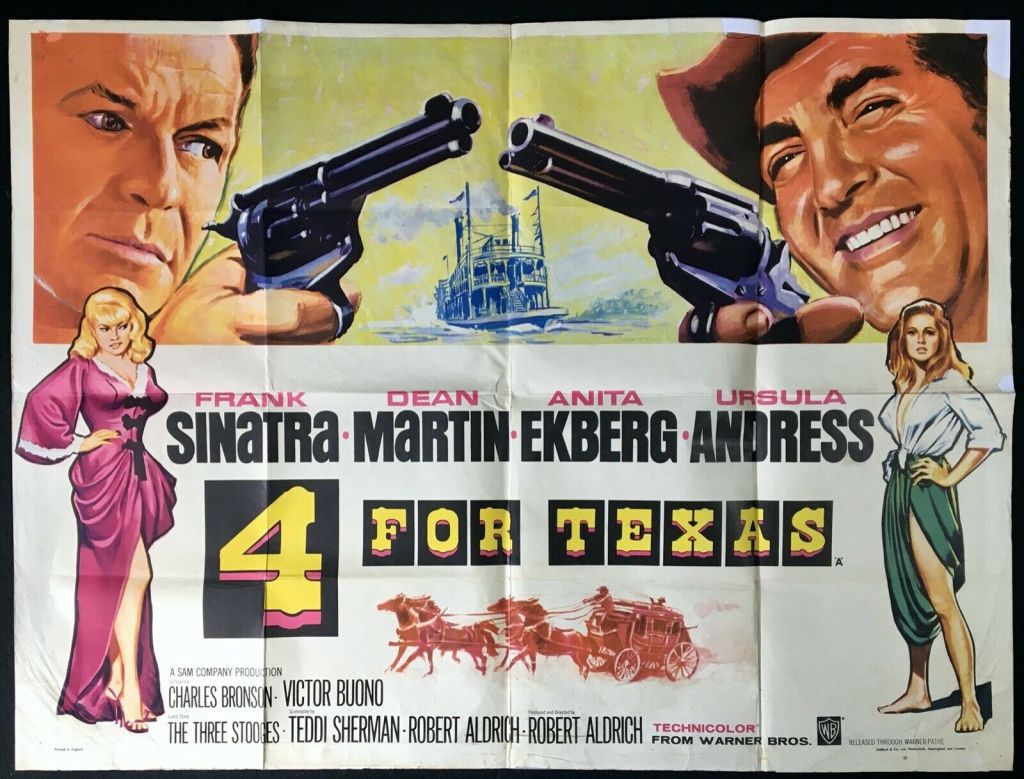
4 for Texas (1963) ****

To my mind the best of the Frank Sinatra-Dean Martin collaborations, outside of the more straightforwardly dramatic Some Came Running (1958), and for the simple reason that here the two stars are rivals rather than buddies. The banter of previous “Rat Pack” outings is given a harder edge and it is shorn of extraneous songs.

I came at this picture with some trepidation, since it did not receive kind reviews, “stinks to high heaven” being a sample. But I thought it worked tremendously well, the ongoing intrigue intercut with occasional outright dramatic moments and a few good laughs.

It’s unfair to term it a comedy western since for a contemporary audience that invariably means a spoof of some kind, rather than a movie that dips into a variety of genres. In some respects it defies pigeonholing. For example, it begins with a dramatic shoot-out, stagecoach passengers Zack Thomson (Frank Sinatra), a crack shot with a rifle, and pistolero Joe Jarrett (Dean Martin) out-shooting an outlaw gang headed by Matson (Charles Bronson). When director Robert Aldrich (Sodom and Gomorrah, 1962) has the cojones to kill off legendary villain Jack Elam in the opening section you know you are in for something different.

After out-foxing Matson, Jarrett attempts to steal the $100,000 the stagecoach has been carrying from its owner Thomas. Jarrett looks to be getting away with it until he realizes he is still in range of Thomas’s rifle. Then Thomas looks to have secured the money until Jarrett produces a pistol from his hat. And that sets the template for the movie, Thomas trying to outsmart Jarrett, the thief always one step ahead, and the pair of them locking horns with corrupt banker Harvey Burden (Victor Buono), in whose employ is Matson.

The movie is full of clever twists, cunning ruses, scams, double-crosses, reversals and sparkling dialog. Whenever Jarrett and Thomas are heading for a showdown, something or someone (such as Matson) gets in the way. While Thomas has the perfect domestic life, fawned over by buxom maids and girlfriend Elya (Anita Ekberg), Jarrett encounters much tougher widow Maxine (Ursula Andress) who greets his attempts to invest in her riverboat casino by shooting at him. 

Take away the comedic elements and you would have a plot worthy of Wall Street and ruthless financiers. The story is occasionally complicated without being complex and the characters, as illustrated by their devious intent, are all perfectly believable.

It’s a great mix of action and comedy – with some extra spice added by The Three Stooges in a laugh-out-loud sequence – and it’s a quintessential example of the Sinatra-Martin schtick, one of the great screen partnerships, illuminated by sharp exchanges neither lazily scripted nor delivered. Even the blatant sexism is played for laughs.

Sinatra and Martin, especially, are at the top of their game. Forget all you’ve read about Aldrich and Sinatra not getting on. Sinatra never got on with any director. But an actor and director not getting on does not spell a poor picture. Sinatra brings enough to the table to make it work, especially as he is playing against type, essentially a dodgy businessman who is taken to the cleaners by both Martin and Buono.

The only flaw is that Ursula Andress (Dr No, 1962) does not turn up sooner. She has a great role, mixing seductiveness and maternal instinct with a stiff shot of ruthlessness, not someone to be fooled with at all, qualities that would resonate more in the career-making She (1965).  Anita Ekberg (La Dolce Vita, 1960) on the other hand is all bosom and not much else. Charles Bronson (The Magnificent Seven, 1960) demonstrates a surprising grasp of the essentials of comedy for someone so often categorized as the tough guy’s tough guy.

The biggest bonus for the picture overall is the absence of the other clan members – Sammy Davis Jr, Peter Lawford and Joey Bishop – who appeared in previous Rat Pack endeavors Oceans 11 (1960) and Sergeants 3 (1963). Without having to laboriously fit all these other characters in, this film seems to fly along much better. As I mentioned, the fact that Sinatra and Martin play deadly enemies provides greater dramatic intensity.

Robert Aldrich was a versatile director, by this point having turned out westerns (Vera Cruz, 1954), thrillers (Kiss Me Deadly, 1955), war pictures (The Angry Hills, 1959), Biblical epic Sodom and Gomorrah (1962) and horror picture Whatever Happened to Baby Jane? (1962). But 4 for Texas called for even greater versatility, combining action with quickfire dialog, a bit of slapstick and romance and shepherding the whole thing with some visual flair.

If you are a fan of Oceans 11 and Sergeants 3 you will probably like this. If you are not, it’s worth giving this a go since it takes on such a different dynamic to those two pictures.

The Man Who Shot Liberty Valance (1962) *****

A mighty cast headed by John Wayne (True Grit, 1969), James Stewart (Shenandoah, 1965), Lee Marvin (The Dirty Dozen, 1967) and Vera Miles (Pyscho, 1960) with support from Edmond O’Brien (Seven Days in May, 1964) Woody Strode (The Professionals, 1966), Strother Martin (Cool Hand Luke, 1967) and Lee Van Cleef (The Good, the Bad and the Ugly, 1967) do justice to John Ford’s tightly-structured hymn to liberty and equality and reflection on the end of the Wild West. So tight is the picture that despite a love triangle there are no love scenes and no verbal protestations of love.

The thematic depth is astonishing: civilization’s erosion of lawlessness, big business vs. ordinary people and a democracy where “people are the boss.” Throw in a villain with a penchant for whipping and a lack of the standard brawls that often marred the director’s work and you have a western that snaps at the heels of Stagecoach (1939), Fort Apache (1948) and The Searchers (1956).

The story is told in flashback after Senator Ransom Stoddard (James Stewart) and wife Hallie (Vera Miles) turn up unexpectedly in the town of Shinbone for the funeral of a nobody, Tom Donovan (John Wayne), so poor the undertaker has filched his boots and gun belt to pay for  the barest of bare coffins. Intrigued by his arrival, newspapermen descend, and Stoddard explains why he has returned.

Now we are in flashback as, arriving on stagecoach, novice lawyer Ransom is attacked, beaten and whipped by outlaw Liberty Valance (Lee Marvin). He is found by horse-trader Donovan (John Wayne) and taken to a local boarding- house-cum-restaurant where Hallie (Vera Miles) tends his wounds. With a young man’s full quotient of principle, Stoddard is astonished to discover that local marshal Link Appleyard (Andy Devine) has ducked out of responsibility for apprehending Valance on the dubious grounds that it is outside his jurisdiction and that Valance has so mean a reputation he has the town scared witless. When Valance turns up, he humiliates Stoddard and only Donovan stands up to him, rescuing an ungrateful Ransom, who detests violence and any threat of it.

Stoddard soon turns principle into action, setting up his shingle in the local newspaper office run by Dutton Peabody (Edmond O’Brien) and on learning that Hallie is illiterate establishing a school for all ages. In the background is politics, but the push for statehood is inhibited by big ranchers who employ Valance to intimidate. Despite his aversion to violence and insistence that due legal process will eliminate the law of the gun, Stoddard practices shooting. When Donovan gives him a lesson and, to point out his unsuitability to confront such a mean character as Valance, covers him in paint, Stoddard floors him with a punch. 

That principle I mentioned has something in common with Rio Bravo (1959) – Howard Hawks’ riposte to High Noon (1952) – in that Stoddard, determined to fight his own battles, refuses to ask for help when targeted by Valance. The inevitable showdown is extraordinary, not least because it takes place at night and Ford, a la Rashomon (1951), tells it twice from different points of view.  

Precisely because it retains focus throughout with no extraneous scenes, as was occasionally John Ford’s wont, the direction is superb. As in The Searchers, to suggest emotional state-of-mind, the director uses imagery relating to doors. This time the humor is not so broad and limited primarily to one incident. Both main male characters suffer reversals, in the case of Stoddard it is physical but in the instance of Donovan it is emotional. Either way, action is character. In the romantic stakes, they are equals, dancing around their true feelings.

Upfront there is one storyline, the upholding of law and order whether against an individual such as Valance or against the attempts of big business to thwart democracy. But underneath is a subtly told romance. Donovan and Stoddard are allies but in terms of Hallie they are rivals. Neither has an ounce of sense when it comes to women. Neither actually protests their love for Hallie. Although Donovan brings her cactus roses and is, unknown to her, building an extension to his house to accommodate what he hopes is his future bride, his idea of romance is to mutter, in patronizing manner, the old saw of “you look pretty when you’re angry.”  He would have been wiser to have taken note of her spunk, because she can more than direct if need be.

Stoddard isn’t much better. Despite her growing feelings towards him being obvious to the audience, he assumes she prefers Donovan. Action drives the love element, the need to save or destroy.

All three principals are superb. This may seem like a typical Wayne performance, a dominant figure, comfortable with a gun and his abilities, but awkward in matters of the heart. But he shows as great depth as in The Searchers and the despair etched on his face at the possibility of losing Hallie eats into his soul. Stewart combines the man-of-the-people he essayed for Frank Capra with some of the toughness he showed in the Anthony Mann series of westerns. Vera Miles tempers genuine anger with tenderness and practicality. Unlike many Ford heroines she is not a trophy wife, but a worker, mostly seen running a kitchen. Lee Marvin cuts a sadistic figure, with an arrogance that sets him above the law, his tongue as sharp as his whip.

As well as Woody Strode, Strother Martin, Edmond O’Brien and Lee Van Cleef, you will spot various members of the John Ford stock company including Andy Devine (Two Rode Together, 1961) as the cowardly gluttonous marshal, John Carradine (Stagecoach), John Qualen (The Searchers) as the restaurant owner and Jeanette Nolan (Two Rode Together) as his wife.

Written by James Warner Bellah (X-15, 1961), Willis Goldbeck (Sergeant Rutledge, 1960) and Dorothy M. Johnson (A Man Called Horse, 1970).

SPOILER ALERT

Despite its five-star status, I am dubious about the famous “print the legend” conclusion and for two reasons. You could subtitle this picture The Good, the Bad and the Politician. In the first place, what Stoddart tells the newspapermen in the flashbacks is in fact a confession. He did not kill Liberty Valance. Donovan did. By this point in his life Stoddart has served two terms as a Senator, three terms as a governor and been the American Ambassador to Britain. And yet his career is based on bare-faced fraud. He took the glory for an action he did not commit. That is a huge scoop in anybody’s book. And I just can’t imagine a newspaperman turning a blind eye to it.

The second element is that Stoddart does not show the slightest sign of remorse. He built his entire career on this violent action, the antithesis of his supposed stance on the process of law.  He takes all the plaudits and fails to acknowledge Donovan, except when it’s too late, and Donovan has died a pauper, his rootless life perhaps engendered as a result of losing Hallie. Hallie’s character, too, is besmirched. She chose Stoddart precisely because he was a man of principle who risked his life to tackle – and kill – Donovan. Those two elements are indistinguishable. Had she known Stoddart had failed and was only saved by the action of Donovan it is questionable whether she would have chosen the lawyer.  

There are a couple of other quibbles, not so much about the picture itself, but about other quibblers, commonly known as critics.  Alfred Hitchcock famously came under fire for the use of back projection, not just in Marnie (1964) but other later films. That spotlight never appeared to be turned on the at-the-time more famous John Ford. The train sequence at the end of the film uses back projection and the ambush at the beginning is so obviously a set.

Don’t let these put you off, however, this is one very fine western indeed.

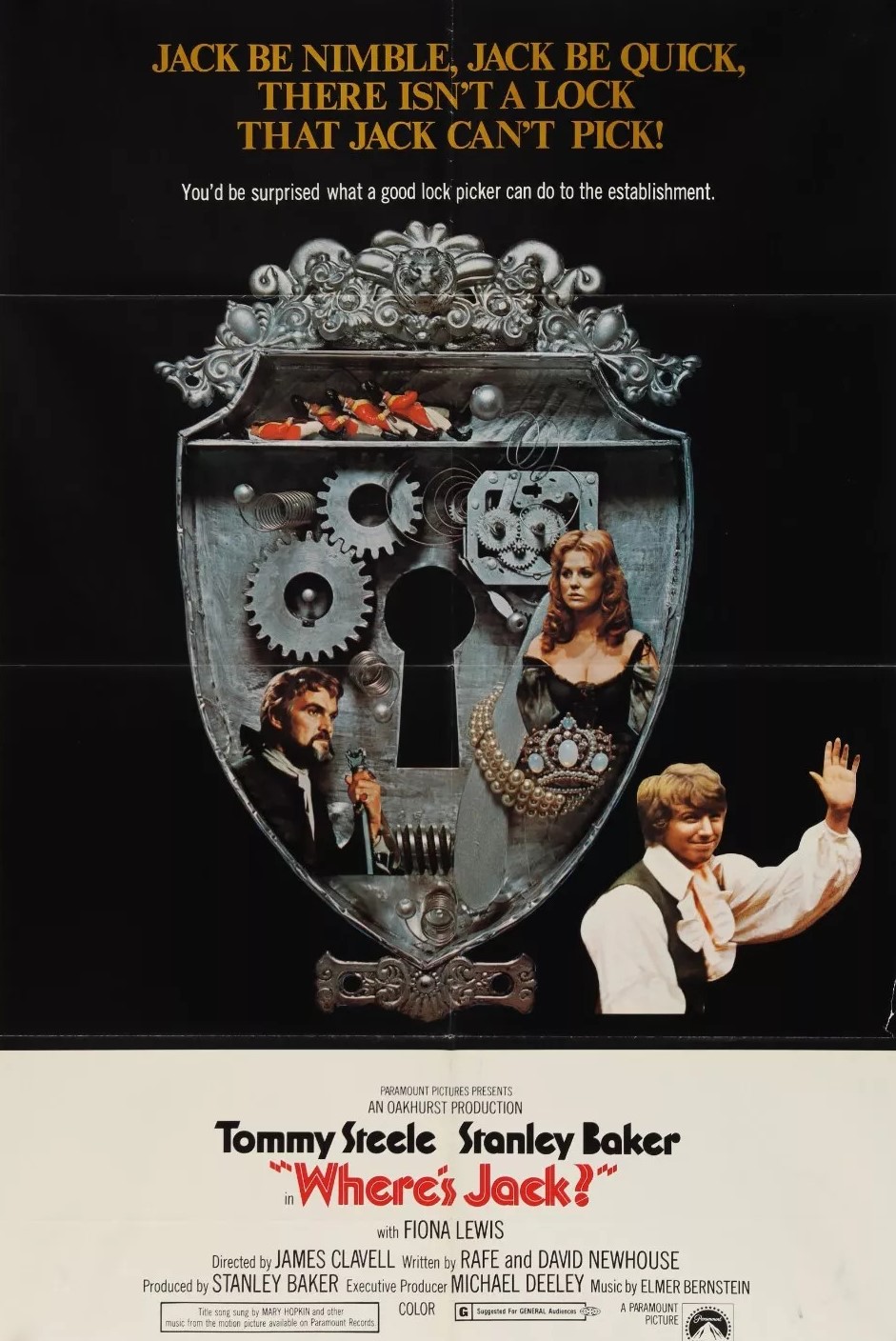
Where’s Jack (1969) ***

Prison escapees tend to conform to a certain type. Think Charles Bronson and Steve McQueen (The Great Escape, 1969), Paul Newman (Cool Hand Luke, 1967) and Clint Eastwood (Escape from Alcatraz, 1979). Admittedly, Tim Robbins (The Shawshank Redemption, 1994) doesn’t fit the bill, but he’s got brains instead of brawn. But he’s not twinkle-eyed or twinkle-toed or diminutive like British hoofer Tommy Steele (Half a Sixpence, 1967) who’s not helped here by being up against a distinctively tough screen character in the shape of Stanley Baker (Zulu, 1964).

Served up as an antidote to the tomfoolery and sexuality of Tom Jones (1963), more interested in the seamier side of Ye Olde England, it ignores the more interesting tale of criminal corruption and hypocrisy of Jonathan Wild (Stanley Baker), the Thief-Taker, in favor of young thief Jack Sheppard (Tommy Steele) who proves his nemesis.

Wild was the ultimate hypocrite, not just stewed in the corruption of the times but taking advantage of it, and not so much poacher-turned-gamekeeper but gamekeeper who had not entirely abandoned his previous profession. Wild, a notorious thief, managed to set himself up as London’s top lawman, keeping other thieves in line and handing over a certain number to the hangman. He had another sideline. He sold back stolen goods to burglarized owners. Most of this was condoned by the authorities who believed that it took a thief to catch a thief.

Wild enrages Sheppard, apprentice locksmith to trade, by reneging on a deal to free Sheppard’s criminal brother. Sheppard sets out to teach the antique godfather a lesson, breaking into his warehouse and stealing the contents.

Wild has him arrested on a variety of occasions, but each time Sheppard breaks out from prisons that had the reputation of the later Alcatraz, in one instance through a sewer, in another via a chimney, turning himself into a local hero in the process. Sheppard’s main trade is not so much burglary as highwayman and further annoying Wild by bringing such criminal solicitation to the streets of posh London, from which it had, by decree of Wild, been outlawed.

In so doing, Sheppard encounters Lady Darlington (Sue Lloyd), so taken with our scamp that had this been Tom Jones there would have been some rollicking in the hay (or the Mayfair equivalent). Instead, she bets her Scottish estate that he will escape from his latest incarceration.

Sheppard has the hots for barmaid Bess (Fiona Lewis) but this not being Tom Jones we don’t go much beyond cleavage. The sub-plot involving Lady Darlington, which I’m guessing forms part of the Jack Sheppard legend (since he was a real-life character), takes up valuable time which could have been spent either developing the romance or on the escapes, which don’t generate the necessary tension, or filling out the crook’s character.

Narrative-wise there’s more at stake for Wild, not just being led a merry dance by Sheppard and losing respect (the crime of crimes against a criminal mastermind) but also by potentially damaging his cosy relationship with the authorities, led by snippy Lord Chancellor (Alan Badel) who is on the other side of the Lady Darlington wager.

Fair amount of rubbish being tossed out of windows, unruly tavern occupants, poverty and homelessness abounding, and general but unspecified bawdiness, in fact a truer perspective of the times, doesn’t compensate for the lack of compelling narrative.

On paper, this should have amounted to a lot more. Mostly, it goes askew from miscasting. Tommy Steele is outshone without much difficulty by Stanley Baker and it’s asking a lot of an audience to accept that a cheeky chappie can outwit the exceptionally clever tough guy. It’s Baker who makes the most of his scenes, either lording it over his gangs, using cruelty to keep them in line, or fearing that he might be toppled from his lofty position and end up either back in the gutter or at the end of a noose.

There’s a bit of complicated jiggery-pokery relating to the effect your weight has on how long you can dangle on the end of a rope. Hangmen in those days did not follow scientific principles and provide some kind of weighting handicap as occurred later to prevent unnecessary suffering and make death as swift as possible.

Anyway, our Jack, being a skinny little runt (and this plot-point key to the climax ensuring the part required a skinny little runt rather than someone hewn from the normal tough guy runt) doesn’t die from the hanging, escaping the fury of Wild and (so legend has it) managing to escape to the colonies.

Put a Michael Caine (The Ipcress File, 1965) in the leading role or Richard Harris (Major Dundee, 1965) or even a Nicol Williamson (The Reckoning, 1970) and you would have quite a different movie, a more believable protagonist. Even Peter O’Toole (Night of the Generals, 1966), while devoid of muscle, would suggest the brains to outwit his opponent.

In the face of the mop-haired pop singers and raucous rock stars, Tommy Steele had reinvented himself from 1950s teen idol into Broadway musical star with Half a Sixpence and then viewed as a squeaky-clean alternative to the more louche movie star turned up in harmless offerings like Disney’s The Happiest Millionaire (1967) and Francis Ford Coppola’s non-grandiose Finian’s Rainbow (1968).

Oddly enough, it was to escape such typecasting that he took on what was perceived as a much tougher role only to discover he lacked the acting cojones to pull it off. Baker, Badel (Bitter Harvest, 1963) and Lloyd (Corruption, 1968) beat him hands down.

Director James Clavell was riding high after To Sir, with Love (1967) as was producer-star Stanley Baker after Robbery (1967) and screenwriters David and Rafe Newhouse following Point Blank (1967). This brought them down to earth.

More Artful Dodger than Get Carter.

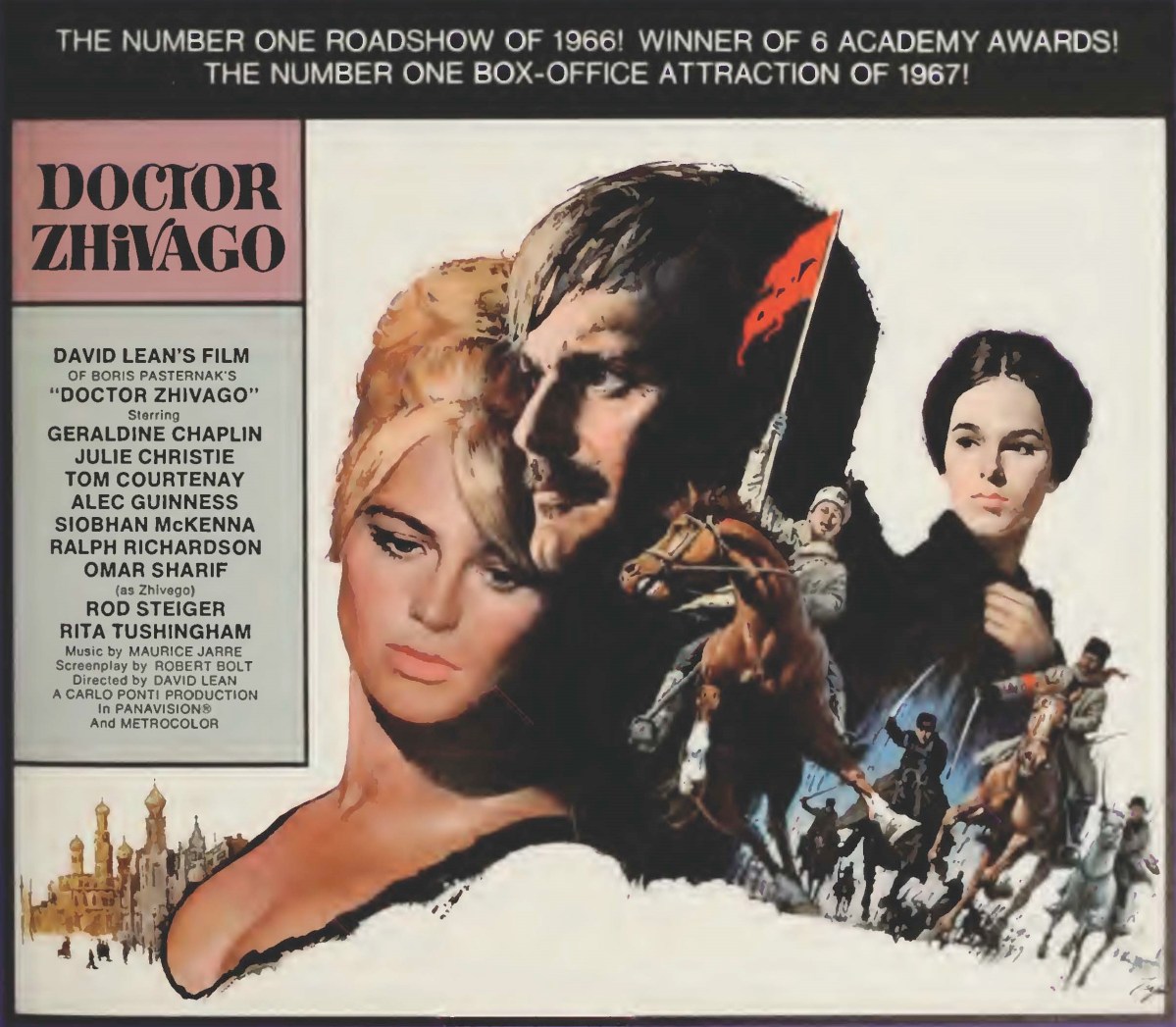
Behind the Scenes: “Doctor Zhivago” (1965)

That Italian producer Carlo Ponti owned the rights to Boris Pasternak’s worldwide bestseller – beating out a bid by Kirk Douglas and Stanley Kubrick – made it easier for David Lean to sever links with Sam Spiegel, producer of his two previous Oscar-winning blockbusters, Bridge on the River Kwai (1957) and Lawrence of Arabia (1962). Ponti lined up a deal with MGM who not only gave Lean carte blanche but the biggest ever salary handed to a director plus a generous profit share. Max von Sydow (The Quiller Memorandum, 1966) was Lean’s first suggestion for the leading role while MGM wanted Paul Newman (Cool Hand Luke, 1967) and Ponti was keen on Burt Lancaster (The Train, 1964).

Peter O’Toole (Lawrence of Arabia), fearing another exhaustive shoot, reportedly turned it down. Michael Caine (The Ipcress File, 1965) read for it. Omar Sharif (Lawrence of Arabia), all set to play the smaller role of Pasha, stepped in. Marlon Brando (The Chase, 1966) and James Mason (North by Northwest, 1959) were considered for Komatovsky – the former not replying to Lean’s offer, the laterr dropping out after accepting the role –  before that went to Rod Steiger (The Pawnbroker, 1964).

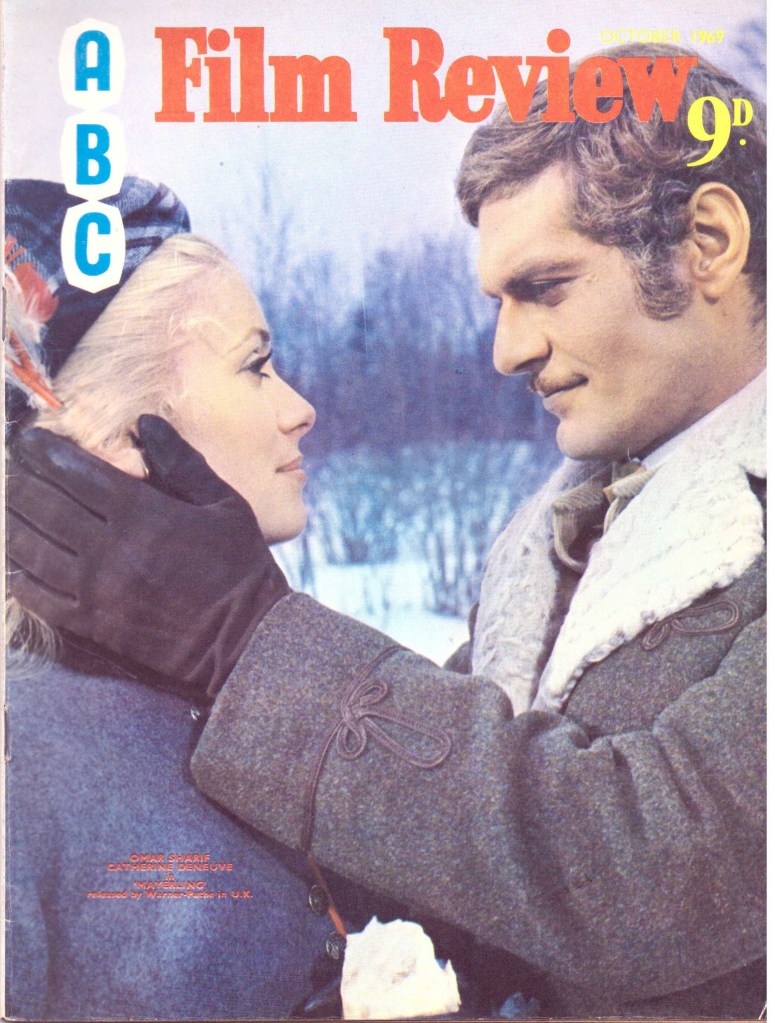
Front cover for the roadshow launch in the UK in 1966.

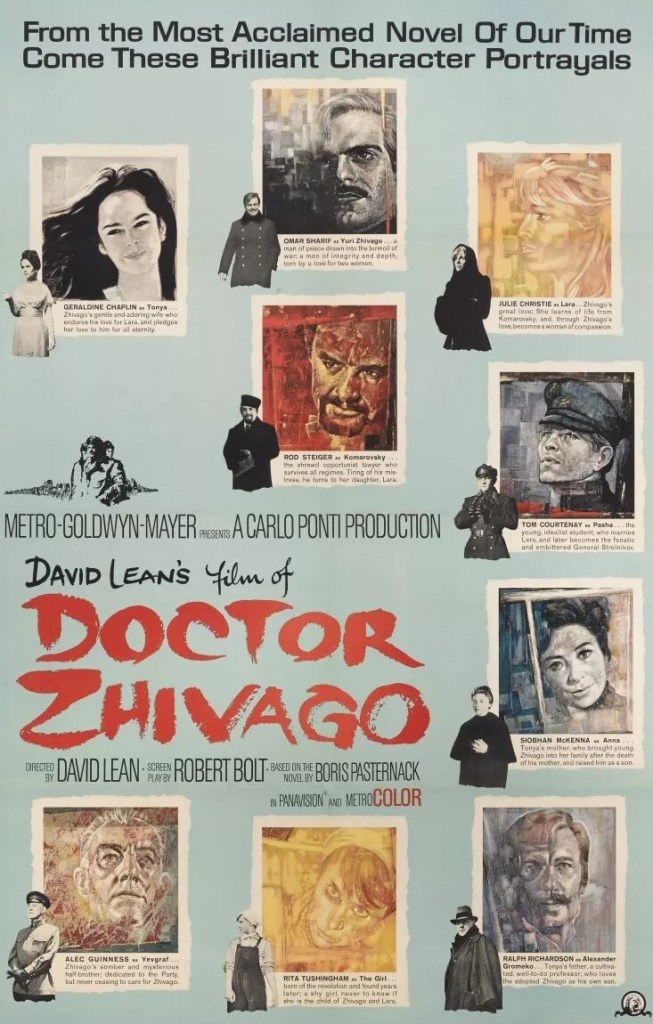
Jeanne Moreau (Viva Maria, 1965), Jane Fonda (Barbarella, 1968, who turned it down, then, recanted, by which time it was too late) Yvette Mimieux (Dark of the Sun, 1968), Sarah Miles (Lean’s Ryan’s Daughter, 1970), and, inevitably Ponti’s wife Sophia Loren (dismissed as “too tall” by Lean), were in the running for Lara until, on the recmmendation of John Ford who had directed Julie Christie in Young Cassidy (1965), the part went to the British actress. Audrey Hepburn (Charade, 1963) was Lean’s choice for Tonya until he was bowled over by the screen test by Geraldine Chaplin, the waif-like daughter of Charlie Chaplin, who, in the run-up to release, received the bulk of the advance publicity. Contrary to received wisdom, this was not her debut, she played opposite Jean-Paul Belmondo in Lovely Summer Morning (1965).

So, effectively, Lean was launching MGM’s biggest-ever productions with a cast headed by unknowns, Sharif’s marquee value not up to the mark, every film he had been in since Lawrence of Arabia had flopped and he had never received top billing – and would not here either.

Initially, Lean considered shooting in 70mm in black-and-white but 70mm equipment was deemed too cumbersome and monochrome too risky for such a big film so it was made in 35mm with the intention of blowing it up to the larger format for roadshow release. Ponti reckoned the movie could be made in the Soviet Union or Yugoslavia for $5 million. After switching to the eventual location, Spain, with some sequences filmed in Finland, it cost much more, over $11 million.

The shoot lasted 33 weeks but the production actually took two years and involved 800 craftsmen in three countries. . Original cinematographer Nicolas Roeg dropped out after “creative differences”, replaced by Freddie Young (Lawrence iof Arabia), adding two weeks to the schedule to reshoot Roeg’s scenes.

And for the general release three years later.

Much of what appeared on the screen was illusion. The Red Army charged across an apparently frozen lake at the height of summer, the lake itself non-existent, just a field covered in cement with sheet iron topped with thousands of tons of crushed white marble ironed out by steamrollers so when the horses slid it looked realistic. To complete the picture, a rowing boat was moored at the edge.

Other effects combined direcotrial genius with practicality. Prior to the scne featuring a huge field of daffodils, Lean had filmed three minutes of Zhivago and Lara against a freezing background, everything sprayed gray to remove any hint of color so that the sudden appearance of of the golden flowers cast a spell of spring.  To prevent the flowers  – 4,000 of them imported from the Netherlands – blooming too early, they had been dug up and put in pots to control their growth  and replanted when required. To make snow glisten in another scene, cellophane was spread over wintry bushes and trees.

The sleighs had little wheels fitted to the runners, icicles were made from polystyrene, the balalaika was created by the props team and the interior of the Ice Palace made from cellophane crushed into thousands of creases, paraffin wax and salicylic acid powder creating fantastic shapes. The floor was fashioned from a layer of soap flakes. The train journey went through Spain and in places where there were no railroad tracks, these were built.

Moscow, ten acres of it, rebuilt on a Spanish lot, took 18 months to construct and included 800 yards of cobbled street, the Kremlin, trolley cars and 60 houses and shops. Pasha’s armored train was an authentic replica. Even with the props trickery, Lean wanted to capture the different seasons so that was partly responsible for the long schedule. Sharif has his eyes taped back and his hairline shaved and straightened.

The aftermath of the dragoon charge down the steeets of Moscow was seen through the eyes of Zhivago – Lean’s advice to the actor was to imagine the moment before orgasm –  and it was just as well it worked because Lean had filmed no alternative.

The film intially struggled to attract public attention despite a $3 million publicity budget. Lean was not as marketable as Hitchcock or DeMille. The female leads were unknown, Darling (1965) not yet setting the box office buzzing except in arthouses. Sharif, as I mentioned, had not yet capitalized on Lawrence of Arabia.

“Lara’s Theme” was not yet in the shops – the soundtrack album sold 600,000 copies in a year becoming MGM’s biggest soundtrack seller –  and designer Phyllis Dalton’s furs were a long way from setting a fashion trend. Advance sales for the roadshow openings were poor, only $200,000 compared with $60,000 for Exodus (1961) and $500,000 for Cleopatra (1963). There was even speculation that the Capitol in New York where the film premiered had massaged the opening week’s figures. However, this kind of trickery would have been anathema in the industry, telling the truth about receipts to Variety every week considered the right thing to do, even if they fell short of expectation.

Historical epics had been long out of fashion. Lord Jim (1965) and The Agony and the Ecstasy, also roadshow numbers, were among the year’s box office casualties while a completely different type of movie, bouncy musical The Sound of Music (1965), was cleaning up. It didn’t help that Doctor Zhivago opened at the same time as Thunderball, the fourth Bond, which surpassed expectations with collosal initial box office. Nor did reviewers help. While Variety hailed its “soaring dramatic intensity” and the New York Daily News called it a “haunting emotion-charged drama,” the more influential New York Times slammed its “painfully slow-going and inevitable tedium” and it was condemned by the New York Herald Tribune as a “soap opera.”

In fact, if audiences had been slow to latch on, that was only during the first week, for soon it turned into a phenomenon, ending the decade as the $38.2 million in rentals. Lifetime rentals topped $60 million.  

SOURCES: Kevin Brownlow, David Lean (Faber and Faber, 1996); Eddie Fowlie, David Lean’s Dedicated Maniac (Austin & Macauley, 2010); Pressbook for Doctor Zhivago; “Metro Plots Two Features for Geraldine Chaplin,” Variety, February 24, 1965, p5; “Zhivago LP Soars Over 6000,000 Units,” Variety, August 17, 1966, 43; “All-Time Champs,” Variety, 1993.

Doctor Zhivago (1965) ***** – Seen at the Cinema in 70mm – Bradford Widescreen Weekend

“Showmanship” isn’t a word likely to crop up in critical appraisals of David Lean’s magnificent Russian romance. Few people in any audience would have an idea of its meaning. But when you see Doctor Zhivago given the full roadshow treatment with overture and entr’acte and in a theater where curtains come into play and a good chunk of the audience comprises industry professionals – projectionists, exhibitors and the like – it takes on a certain significance.

Generally speaking, “showmanship” related to the efforts of the exhibitor to sell a picture to a local audience in an enterprising manner. It’s not about posters or adverts. It’s about, in this instance, tying up a fashion show with a department store or having a sleigh sitting outside the cinema on opening night or running a competition where the prize is Russian fur.

But there was another element to showmanship and that was what was under consideration for the 70mm screening at the Bradford Widescreen Festival. You’re probably unaware that studios were incredibly dictatorial when it came to the presentation aspects of roadshows. Not only were musical cues expected to be rigidly adhered to, but projectionists were supposed to open the curtains at a specific point and progressively dim the lights at other pre-set moments.

The opening of the second half of this picture was considered a highlight – if not the highlight of all roadshows – of the movie. For when the movie recommences, we are in a tunnel and stay there until the train emerges at the other side. If such a thing exists it’s a roadshow coup de theatre, a director who’s not just taken immense pains over the most infinite of details but worked out to the last second where the first half of the movie should end and, more importantly here, how the second half should begin.

So the couple of hundred in the audience were watching to see if the projectionist would cock it up. Luckily, he didn’t. I was expecting the audience to burst into applause, but they didn’t do that either.

I hadn’t seen this picture in well over a quarter of century, once the director’s reputation, outside of Lawrence of Arabia (1962), had declined in the face of a critical onslaught that declared him the wrong kind of auteur, the one who wastes his power on frivolities. As far as the auteur theory went, it wasn’t a good idea for a director to drift outside set lines.

And this was one who’d moved from movies featuring a flawed hero struck down by circumstance as with Bridge on the River Kwai (1957) and Lawrence of Arabia, to one who’s major flaw was falling in love. What’s more, in Doctor Zhivago and its critically reviled successor Ryan’s Daughter (1970) he was focusing far more on women than ever before.

Lean was the type of director who visually went all-in. You want jungle, you’ll get masses of it in Bridge on the River Kwai, acres of sand dunes in Lawrence of Arabia, ice-covered panorama in Doctor Zhivago and the pounding Atlantic Ocean in Ryan’s Daughter.

And, boy, especially in 70mm, does it work here. The whiteness of the land is as implacable as the situation our hero finds himself in.

I was surprised how cleverly constructed the film was in terms of the romance. Zhivago (Omar Sharif) and Lara (Julie Christie) are kept apart for substantial periods of screen time. Even when they do fall in love, working side by side in medical tents during the First World War, you don’t see it, or at least not that moment so beloved of the romanticists.

In fact, it would have been better if he had disdained her, given she was the mistress of  loathsome businessman Komarovsky (Rod Steiger) and attempted murderess and wife of  vicious Bolshevik leader Pasha (Tom Courtenay) to boot. In any case, he’s in love with Tonya (Geraldine Chaplin).

That Zhivago is tossed here and there by the consequences of the Russian Revolution serves the movie’s purpose of keeping him even further apart from Lara. For good measure, his half-brother, the secret policeman Yevgraf (Alec Guiness) turns up from time to time to keep the narrative on track.

Zhivago moves from rich society to a somewhat rebellious proletariat and finally settles down as a poet in an icebound wilderness. But, except for a couple of sequences, David Lean avoids the sweeping action of Lawrence of Arabia, and in fact the most notable scene, the charge of the horsemen down the streets of Moscow, is dealt with discreetly, its impact most viewed through the eyes of the watching Zhivago.

Lean took an enormous risk in imposing two virtual unknowns on MGM for the leads. Theoretically, Sharif was a star but had done nothing to bolster his marquee credentials following Lawrence of Arabia, ending up in a series of duds that did not envisage him as the Egyptian equivalent of the Latin lover. It took Lean to see the power in those brown eyes. And to put his faith in Julie Christie, who had even less in her locker (she made Darling, 1965, after this).

There is very dependable work all round, Rod Steiger (The Pawnbroker, 1964) overplaying, Alec Guinness (Lawrence of Arabia) underplaying, Tom Courtenay (A Dandy in Aspic, 1968) doing both.

But the movie belongs to the principals and to Lean and on seeing again after all these years and with the benefit of 70mm, it now sits very close to the peak of the director’s achievements. Screenplay by Robert Bolt (Lawrence of Arabia) and memorable score from Maurice Jarre (Lawrence of Arabia).

Not just sumptuous, but tough, hard-edged, and doesn’t let the audience a moment to breath.

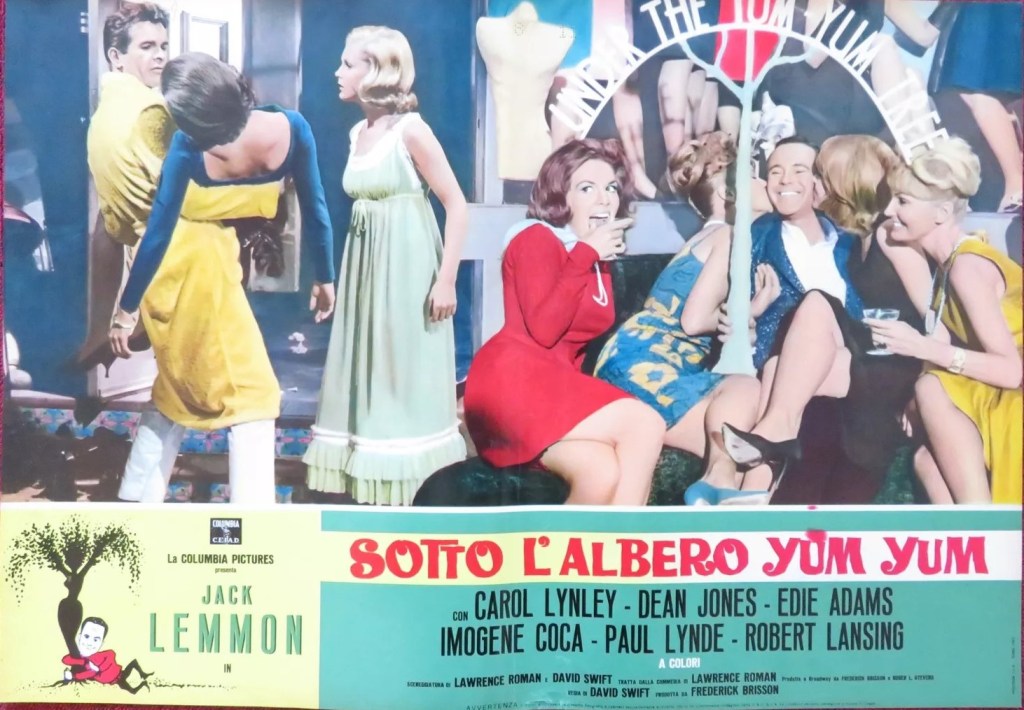
Under the Yum Yum Tree (1963) ***

Must have seemed a good idea at the time. A switcheroo from The Apartment (1960), where Jack Lemmon is the sap caught in middle of illicit affairs, to setting him up as the ace seducer with a string of girls at his beck and call. Except this won’t wash for contemporary audiences given that, effectively, he’s a sexual predator (seducer if you want to be nice about it), peeping tom (no way to dress that up) and eavesdropper (could have taught a class in  The Conversation, 1974). He lets out plush apartments to beautiful girls who either pay no rent or very low rents in return for favors granted.

He uses his own key to let himself into apartments and he’s got a telescope at the ready although that’s hardly required since all the ladies leave windows and doors open permitting him to gawk whenever he wishes.

Luckily, he’s not the mainstay of the tale. Nope, that’s breaking down another barrier, and very cleverly for the times. At this time, sex on the screen was usually the result of illegitimate affairs, involving at least one husband or wife, or it was a sex worker by any other name (Elizabeth Taylor in Butterfield 8, 1960, expects presents in lieu of cash). The idea of living in sin, as it used to be called, i.e. cohabiting without a marriage licence, was not generally on the cards.

So the deal here, to get round the snippy censor, was that Robin (Carol Lynley) and Dave (Dean Jones) set up home together to test out their compatibility but without sex entering the equation, him sleeping in a separate bed. Their apartment is let out by Hogan (Jack Lemmon), the predatory landlord. He has just been dumped by Robin’s aunt Irene (Edie Adams), hence the vacancy, and believes it’s two beautiful women moving in, not a couple. So his plan to offer two damsels a romantic meal with candles and violins (these play automatically) and a roaring fire (also electronic) falls apart.

That doesn’t prevent him from using his own key to enter the apartment at inappropriate moments and continuing his ardent wooing while trying to get rid of Dave or cause the kind of ruckus that’s going to cause the boyfriend to quit, leaving the coast clear.

Luckily, which gives the movie some acceptable life of its own, the dodgy landlord aspect takes second place to the lust vs logic argument that’s intrinsic to the idea of marriage. The couple spend most of the time arguing, and the movie is quite specific, much more than you might expect, on the ways in which a lusty young fellow can keep his ardor in check.

It’s based on a stage play, of the farce kind, so it relies on misunderstandings and misalignments and finds various ways of getting various combinations of the trio (and occasionally a quartet when Irene returns) in the room at the same time. There’s the usual problems when exchanges get heated.

Lurking in the background are married housekeeper Dorkus (Imogene Coca) and handyman Murphy (Paul Lynde), at opposite ends of the approval scale, the man even creepier than his employer.

Previously, I hadn’t found Jack Lemmon’s schtick so wearing, but his acting style is so frenetic you wonder how it ever found expression except in madcap comedy. It’s not just that his jaw constantly drops, but his eyebrows go up at the same time, and he might even be chucking in that trademark cackle. He toned it down for Days of Wine and Roses (1962) and jacked it up for The Great Race (1965) and somehow anything in between doesn’t quite work unless he’s got Billy Wilder on his tail.

But there are several pluses here. Carolyn Lynley (Bunny Lake Is Missing, 1965) proves an adept comedienne and Dean Jones was clearly in rehearsal for his later Disney pictures like The Love Bug (1967). Imogene Coca had been a legendary television staple, with her own show in the 1950s. There are fleeting glimpses of Bill Bixby (The Incredible Hulk, 1977-1982) and Variety columnist Army Archerd and James Darren (The Guns of Navarone, 1961), who died recently, sings the title song, and has a more robust voice than I had assumed for a pop singer.

David Swift (The Interns, 1962) directed and co-wrote the script with Lawrence Roman (The Swinger, 1966) from the latter’s Broadway hit.

A film of two halves. You can only cringe at the attitudes on display but enjoy the pre-marital ding-dongs between the couple.

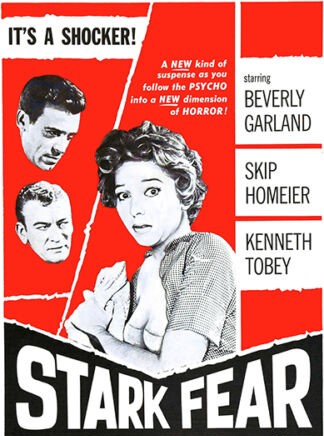
Stark Fear (1962) ***

Unless you were unfortunate enough to get mix up in an international conspiracy, or your wealth induced a husband towards your murder – or a la Gaslight towards your insanity – or had taken a shower in strange motel, a wife in American movies was unlikely to live in fear of a sadistic spouse. Wife-beating aka wife-battering had never been high on the Hollywood agenda as an appropriate subject matter, so this picture not only stands out for the period but also strikes a contemporary spark. While many marital dramas of the 1960s have quickly become outdated, this has not.

Opening with an audacious cut from a woman’s eyes seen in a car’s rear-view mirror to her face in a photograph being pelted, being smashed to pieces. Ellen (Beverly Garland) has committed the grievous sin not just of going out to work but of taking up the post of secretary to oil executive Cliff Kane (Kenneth Tobey), a previous rival of husband Gerry (Skip Homeier). But Gerry’s income had unexpectedly tumbled and the couple, married just three years, need her money. He pours a drink over the terrified woman’s head, demands a divorce and promptly disappears.

Her search for him takes her to Quehada, pop. 976, a rundown town she had never heard of and whose existence her husband made no mention despite the fact it was where he grew up. Her husband’s sleazy friend Harvey takes her to the grave of Gerry’s mother (also called Ellen) where he rapes and beats her while, unbeknownst to her, her husband watches.   

Back at the office, she begins to fall for Cliff, but Gerry, even though he no longer wants her, sets out to destroy the budding romance.

Following the classic pattern of course Ellen blames herself for making Gerry unhappy and for getting raped. Her guilt fuels her husband’s sadistic streak. She is unsure whether the threat of divorce is just the most cruel taunt her husband can imagine or for real, which would be just as bad, given her low-self-esteem.

Once she realizes Gerry had an unhappy childhood and is mother-fixated, it makes it even harder for her to abandon him, regardless of the mental and physical torment he inflicts and despite the entreaties of social worker friend Ruth (Hannah Stone). Ruth, too, however, represents an alternative equally fearful future, the now-single woman who regrets separating too quickly from her husband and has no man  in her life or none who come up to scratch.

This is not a picture where men come out well. Gerry is a fiend in a suit. On the way to Quehada she is groped by other men who clearly feel it is their right. Harvey has a history of just taking what he wants. Even the relatively gentle Cliff appears to have an underlying reason for taking an interest in her.

In a world and a time where marriage meant not just financial security, but a safe haven from all the other men who would like as not press themselves upon the opposite sex at any opportunity, and not necessarily with any delicacy, director Ned Hockman presents life as a succession of traps for women. And we know now that not much has changed, and that for women fear is a constant.

Hockman directs with some singularity. He uses black-and-white not quite in the film noir manner of shadows and shafts of light but sets the subject of any night scene in a pool of light with darkness all around, which makes for some striking images. A couple of unusual backdrops include Commanche tribal dancing and a chase in a jukebox museum help place this a couple of notches above the usual B-picture.

Beverly Garland was a 1950s B-picture sci-fi and horror scream queen in movies such as It Conquered the World (1956), Curucu, Beast of the Amazon (1956) and Not of This Earth (1957) so fear was something of a default. Here, she adds something else, desolation at the position she finds herself in, confusion that her marriage is in tatters, hunting for a solution that never emerges, and unable to summon up the anger that might free herself. Hannah Stone has an intriguing role, encouraging her friend to leave her husband, knowing that being single again is not all it is cracked up to be. Unusually for a minor character in this kind of picture, primarily there to shore up the star, she enjoys a spot of lifestyle reversal.  

Heart-breaking.

Discover WordPress

A daily selection of the best content published on WordPress, collected for you by humans who love to read.

The Atavist Magazine

by Brian Hannan

WordPress.com News

The latest news on WordPress.com and the WordPress community.