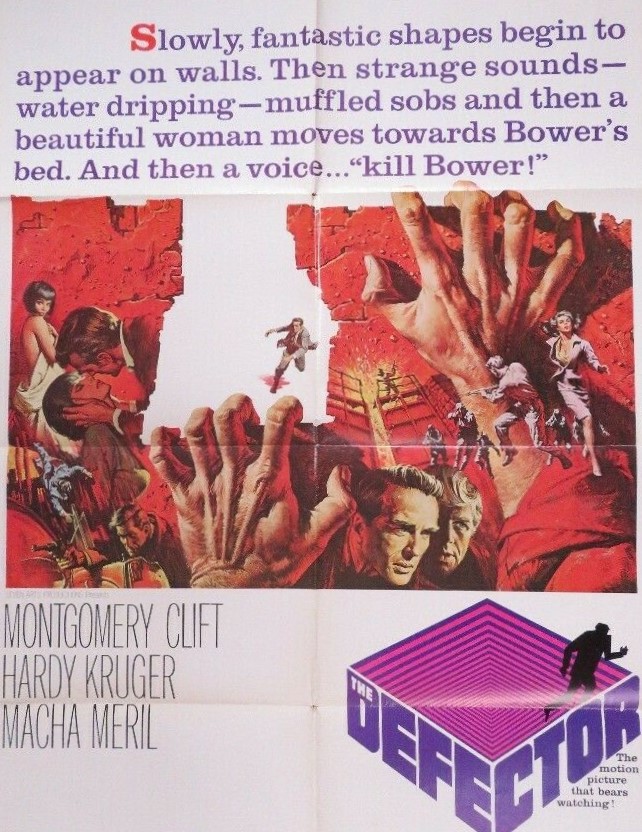
How often does a government hoodwink a morally upright citizen into deceitful action for the cause of the greater good? In this case physicist Professor James Bower (Montgomery Clift) doesn’t need a great deal of urging because what’s at stake are Russian space race secrets and the man selling them is a Russian scientist he knows from translating his books. It’s apparent from the outset that in setting out to make contact in East Germany, he is walking into a trap. It’s moody, and drab in the vein of The Quiller Memorandum (1966), shot in soulless German streets, and of course it is the final performance, after a four-year screen absence, of a frail-looking Clift, an iconic Hollywood star for nearly two decades.
But genres can be confusing. Although tagged as a spy picture it’s not really a spy film. It’s a character study. In fact, two character studies. And when you get to the end and realise the sacrifice made in order not to compromise principle, it turns into quite a different movie, one with considerably more depth than you might have imagined.

Bower is a rather adept amateur spy, neatly dodging being followed, and capable of nipping between two moving trams to evade pursuit. His instructions lead him to asking for a particular prescription and being sent in apparent haphazard fashion to an intended meeting with Dr Salter, his contact. Instead he is led to Counselor Peter Heinzmann (Hardy Kruger).
His hotel room is not merely bugged but fitted with electronic instruments to prevent sleep and distort his mind. Meanwhile Heinzmann is engaged in a hawk-vs.-dove battle with Orlovsky (David Opotashu) to determine whose methods, the latter preferring torture and brainwashing, would prove the more successful in forcing Bower to betray the whereabouts of the would-be defector. And there is also a doctor’s receptionist Frieda (Macha Meril), with whom romance so obviously beckons your natural moviegoer instinct is to regard her as lure rather than friend.
It’s a chess game, Bower a pawn, with the net growing tighter, imprisoned in more ways than one, being groomed for defection himself. Although there is double cross, triple cross, murder and an excellent chase, and a final unexpected, very human, twist, it’s far from your typical spy thriller, in general subtle in tone except for the nightmarish hotel scenes. Heinzmann is also a pawn, fighting a system that sees degradation as its most potent weapon and even while a danger to Bower displays humanity.

Quite what the set was like is anybody’s guess given than not only was Clift dead by the time of the film’s release but that Belgian director Raoul Levy (Hail,Mafia, 1965) – better known as the producer of many Brigitte Bardot films and now helming only his second film – had committed suicide.
If ever there was proof of star power, this is it. Even when the film is meandering and the plot at times impenetrable, Clift exerts an almost hypnotic hold on the viewer. Despite his clear infirmity, the intensity of expression that enraptured audiences from films as disparate as Red River (1948), From Here to Eternity (1953) and The Misfits (1961) has not vanished. Since many scenes are just meetings that scarcely progress the story, it is quite a feat to keep audiences interested. Far from his greatest performance, he still displays screen presence.
He is helped along by Hardy Kruger (Flight of the Phoenix, 1965) in one of his more measured performances, both sharing the knowledge that in doing good for their country they are betraying themselves. David Opatashu (Guns of Darkness, 1962) is excellent as his quietly ruthless superior and there should be mention of Karl Lieffen as the constantly complaining Major. Even as a dowdy East German, Macha Meril (Une Femme Mariee, 1964) still captivates. Serge Gainsbourg contributed the music.

 The Magnificent 60s
I don’t feel I hear enough about Hardy Kruger these days, big fan of his Wild Geese role. What was his big thing outside of Flight?
LikeLike
Hatari, Secret of Santa Voittoria, The Red Tent. Always excellent.
LikeLike
Suspecting it was some kind of thriller in the vein of Torn Curtain, I found it to be slow moving and quite dull. It made a one day screening then and attracted not more than 50 patrons at the time of viewing.
LikeLiked by 1 person
Agree it was slow moving but took a different route to most spy thrillers. Suspect it did poorly everywhere. Did cinemas announce how long a movie lasted in your neck of the woods?
LikeLike
No. Most without box office appeal last not more 2-3 days. The above, A Time To Sing etc were up for 1 day only screenings.
LikeLike
Tough crowd out your way though I suspect exhibitors had a good idea how long films would last.
LikeLike
Brian, thank you for leading me back to this rather good, as you write, character study set during the Cold War period. I first recall viewing THE DEFECTOR(1966) on television’s THE CBS THURSDAY NIGHT MOVIE in 1969 and I hadn’t viewed it since. I did remember some of it, but not that much. So, I looked the movie up online and I really enjoyed my revisit.
THE DEFECTOR isn’t the usual spy thriller and that’s why I enjoyed it. Also, Monty proving that he could still carry a movie as the lead actor, even doing his own stunts. This was his first movie in over four years. Sadly, it was to be his last, dying of a heart attack just a month after production ended.
I think Hardy Kruger is really good in this movie and I’ve always liked to see him appear in any movie. I think he is especially good as the lead in THE ONE THAT GOT AWAY(1957). Also, Macha Meril is a delight in an unexpected role.
LikeLiked by 1 person
Glad you enjoyed it, Walter. Always liked to see Kruger popping up in pictures. Not seen Macha Meril in much else.
LikeLike