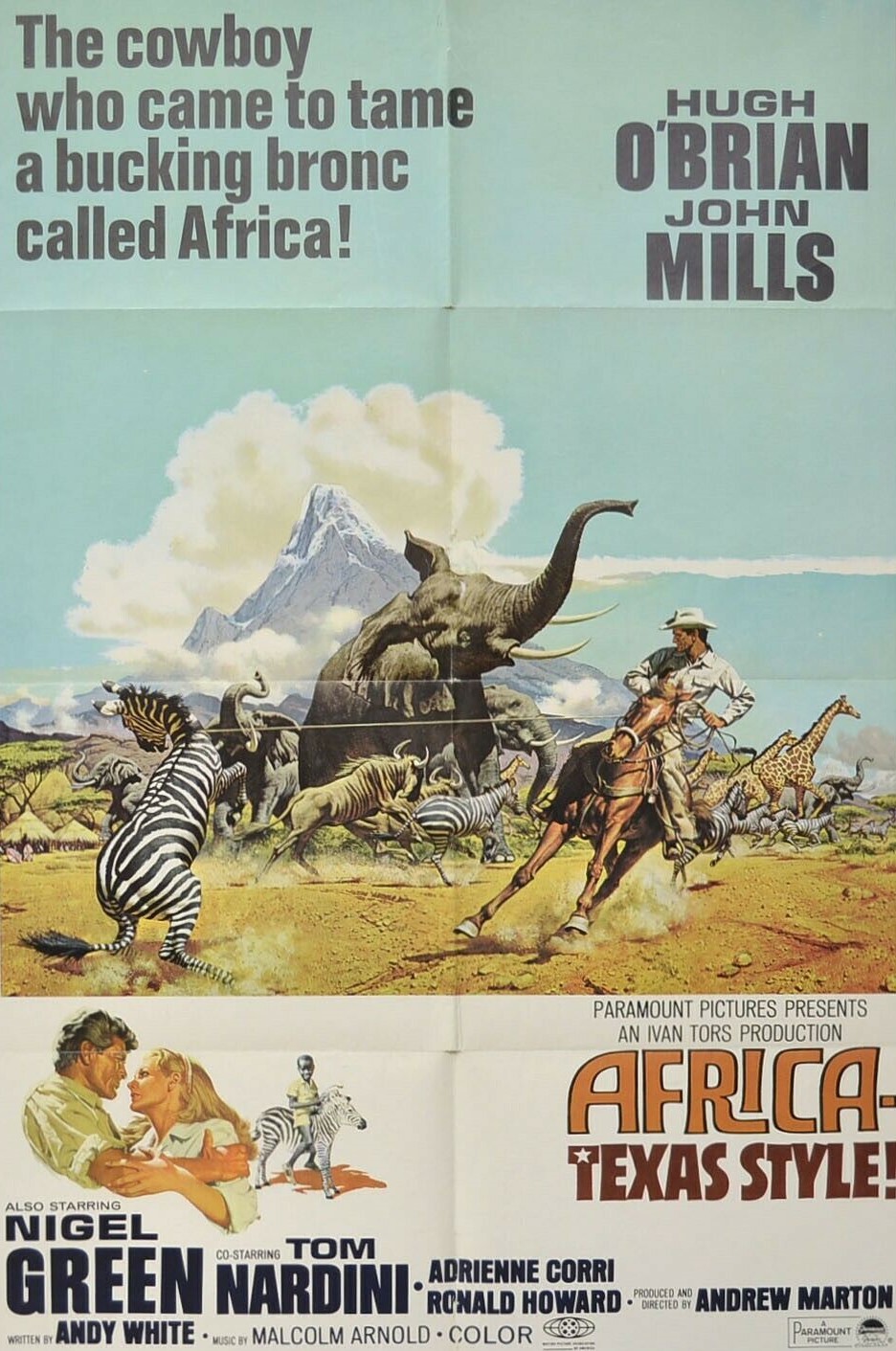
Falling into the unusual category of Saturday afternoon matinee with a message, American cowboy Jim Sinclair (Hugh O’Brian) and sidekick Jim Henry (Tom Nardini) hightail it across the Atlantic to help the wildlife conservation efforts of game rancher Wing Commander Hayes (John Mills) who faces sabotage at every turn by another rancher Karl Bekker (Nigel Green). It combines Hatari!-style action and interesting storylines with Disney-animal-cuteness (a domesticated zebra called Pyjama Tops).
To get the conservation element out of the way – Hayes is concerned that letting animals roam free will result in overgrazing, turning the countryside into a dustbowl and endangering a variety of species. That Hayes is already talking about animals becoming extinct is way ahead of the common perception of Africa at the time. His plan is to round up the wild animals and fence them in, this kind of ranching preventing foodstocks becoming depleted. Bekker’s objection is that wild animals could carry infections such as East Coast Fever that will endanger his herd.
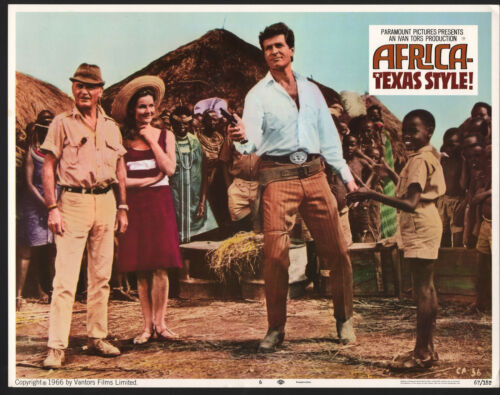
Romantic interest is supplied by the already-engaged nurse Fay Carter (Adrienne Corri) while orphan Sampson (Charles Malinda) tugs at the heart strings. There is a fair measure of authenticity, glorious aerial shots of elephants and buffalo and other species, tribal dances by the Masai while the Sinclair/Henry rodeo-style method of catching the wild animals, with lasso rather than giants nets as in Hatari!, ramps up the excitement quotient, not least when Sinclair goes one-on-one with an enraged rhino. As you might expect, there is also ample opportunity for Sinclair to encounter a deadly snake and crocodile and it wouldn’t be an African picture without a stampede.
Although villainous, Bekker is not without logical argument, not just the fear of infection which would decimate wildlife as much as soil erosion, but his own fears that taming wild animals would upset the balance of nature, and, on a personal level, the lack of respect for territorial rights. Of course, when push comes to shove, he resorts to rifle and fist to settle arguments.

Atmospheric, well-made, engaging and at times exciting, there is enough going on here to keep the picture ticking along – a hunt for a lost and bewildered Sinclair, questions about home, and the spectacular wildlife rodeo show. Unlike Born Free (1966) and any other animal picture for that matter although wildlife takes narrative center stage we are not subjected to countless cute four-legged specimens.
Hugh O’Brian (Ambush Bay, 1966) could be a latter-day Tarzan (or more correctly Jungle Jim since he is never in loincloth) but Scottish actress Adrienne Corri (The Viking Queen, 1967) is not a jungle adventuress but a principled counter to his easy manner. With every chance to rely on the stiff-upper-lip of an English war hero, John Mills (A Black Veil for Lisa, 1968) does anything but and turns in another engaging performance and if you are looking for a decent chap to deliver a conservation message he is definitely your man without being obsessively annoying. Nigel Green (The Skull, 1965) adds to his portfolio of interesting characters as a smooth-talking rough-edged bad guy while Tom Nardini (Cat Ballou, 1965) impresses. Look out for a fleeting glimpse of Hayley Mills at the start.
Director Andrew Marton, who had been involved in helming The Longest Day (1962) and second unit director of Ben-Hur (1959) and Cleopatra (1963), was something of a wild animal specialist with Clarence, the Cross-Eyed Lion (1965) in the kitty as well as a dozen episodes in total of television series Flipper (1965) and Daktari (1966). But he is at home as much with the human aspects of the story as with the animal. Producer Ivan Tors was a sometime rival to Walt Disney in the family film market with Flipper (1963) and Zebra in the Kitchen (1965) as well as small-screen Flipper and Daktari.
Mistakenly described on imdb as a TV pilot, this was a genuine feature film that happened to produce a television spin-off series Cowboy in Africa. It was screened for the trade on May 5, 1967, reviewed in the feature film section of Variety on May 17, and its box office figures can be tracked through Variety – opening in San Francisco and Kansas City in June, for example, Baltimore in July, Detroit in August and Boston and Louisville in September. In some situations it was double-billed with El Dorado (1967).
If only all message pictures were this much fun.

 The Magnificent 60s
I’m guessing you’re on a Corri tip, and if so, I’m here from it; her family owned a hotel in Callander if I remember correctly…
LikeLiked by 1 person
Wonder if it’s got a plaque at the door. She never quite got the breaks she deserved.
LikeLiked by 1 person
I recall seeing this at a drive-in theater in the summer of ’67 as well as the ensuing short-lived television series starring Chuck Connors (who starred in a lot of shows post “Rifleman”). It was definitely billed as “Cowboy in Africa” then and I’m pretty sure it was paired with “El Dorado” as well. I did however supplant O’Brien with Connors in my memories very early on. Not the first time I’ve scrambled childhood recollections like this but it’s always a bit jarring to have them corrected.
Africa-themed pop culture was definitely a trend at the time. Most of it was steeped in age-old stereotypes with natives wielding spears and White Man’s Burden attitudes prevailing but the racism was at least toned down considerably and I guess it did nudge the needle forward a bit. As you mentioned there was “Hatari” on the television as well as “Tarzan” (briefly) while many an American television series had an episode ostensibly set in Africa although clearly shot on the back lot. I remember faux African folk art on my grandparents living room walls as well as a safari playset and a game called “Swahili” for Christmas all probably within a year or so of this.
LikeLiked by 1 person
Apololgies for the tardy reponse. Have been on holiday and while I do my reviews in advance I switch off wordpress when away. Yes, it did go out with El Dorado in places. We had “Daktari” TV series and plenty faux African series in the 1960s.
LikeLike