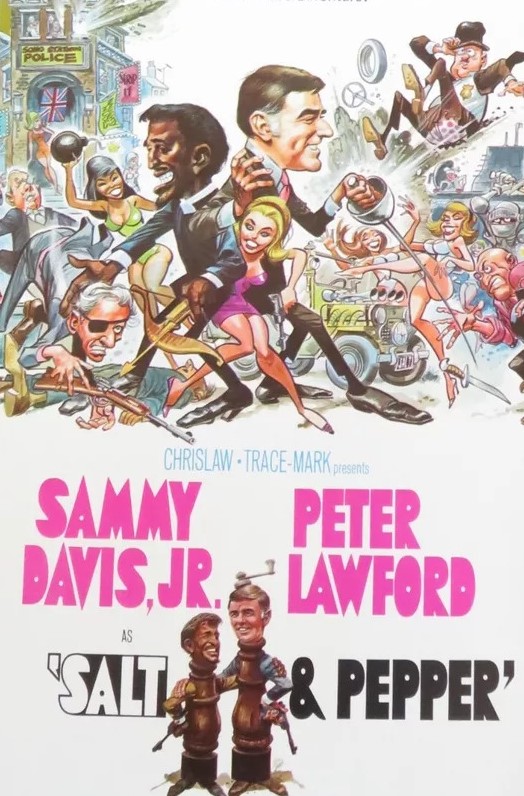
Salt and Pepper (1968) ***

Dry run for the director Richard Donner’s later Lethal Weapon? A cautionary tale about what might have happened to the revered Rat Pack series had it spluttered on into the vestiges of the  “groovy” Sixties? An attempt to emulate the Bob Hope-Bing Crosby joker-crooner concoction? Or Morecambe and Wise, two idiots on the loose? Spy movie spoof? Stuffy Brits in the firing line?

All of the above. If you are comfortable with the sexist agenda that was almost de rigeur for the times, don’t mind the movie’s lurching tone, or the scattergun gag approach, the glib approach to violent death, and don’t cringe at the running racist jokes (making fun of racism, you understand) you might well find enough to like.

Especially as this was something or an audition. A way to check whether, in Hollywood marquee terms, stars Sammy Davis Jr. and Peter Lawford could cut it. For such a renowned celebrity, this was one of only two films where Sammy Davis Jr. was top-billed. And for Peter Lawford, an eternal supporting actor, this was the highest billing he ever achieved outside of the Italian-made The Fourth Wall (1969).

Salt (Sammy Davis Jr.) and Pepper (Peter Lawford) – that’s your first joke, right there, the names, work it out – are under investigation by the London cops for their Soho night club, which doubles as a gambling joint where the croupiers are not only, unusually, female (strike one for feminism) but topless (strike out for feminism). Both consider themselves lotharios and have a running bet on who will be the more successful (so that’s all right then).

But they’re not that bright when it comes to women (so one in the eye for those James Bond types), as neither could spot a femme fatale is she had those words branded on her forehead (the forehead the last female feature they’re interested in), and the prospect of an inert female lying on the office floor is so inviting to them that it doesn’t occur to them they’re trying to chat up a corpse.

Anyways, the dead woman Mai Ling (Jeanne Roland) is a spy and soon our boys are caught up in an espionage tale that dithers between hard-nosed Soho thugs with requisite scars (and a twitch), posh villain with piratical eye-patch, Downing St and duff British officialdom, real and fake Prime Ministers and Home Secretaries, public schools (and a gag about “fags”) and car chases in a Mini-Moke stacked with standard 007 extras like machine guns and oil-spraying devices.  

So it’s one wildly imaginative situation after another, interrupted by stage turns by Sammy Davis Jr. (presumably to remind people this was a Rat Pack rip-off), with the cream of the British character acting fraternity being permitted to go way outside the stiff-upper-lip British box.

Fits neatly into the spy spoof, or the Eurospy spoof (which tended to be overloaded one way or another). Shame about the wayward direction and outlandish script because Sammy Davis Jr. and Peter Lawford do make a fine screen comedy pair, matching each other in ineptitude, and with Davis coming top of the Swinging Sixties Fashion Faux Pas Top Ten, with the kind of outfits that only attention-seeking nutjobs or villains would consider wearing.   

Plenty of fun watching the supporting cast play around with their screen personas. John Le Mesurier (Midas Run, 1969), Michael Bates (Hammerhead, 1968), Robertson Hare (All Gas and Gaiters series, 1966-1971), Graham Stark (The Plank, 1967) and Ernest Clark (Arabesque, 1966) are getting paid to have fun. Ilona Rodgers (Snow Treasure, 1968) makes her movie debut.

You kind of get the idea that Michael Pertwee’s screenplay fell into the wrong hands. That it was intended as a vehicle for Morecambe and Wise (Pertwee wrote The Magnificent Two, 1967) and somehow ended up with American stars.

If your familiarity with the 1960s espionage genre runs only to James Bond, Matt Helm, Harry Palmer and that big-budget ilk and your idea of a spy spoof is limited to Casino Royale (1967), this will fill you in on the breadth of inanity tolerated.

Successful enough to generate a sequel, One More Time (1970).
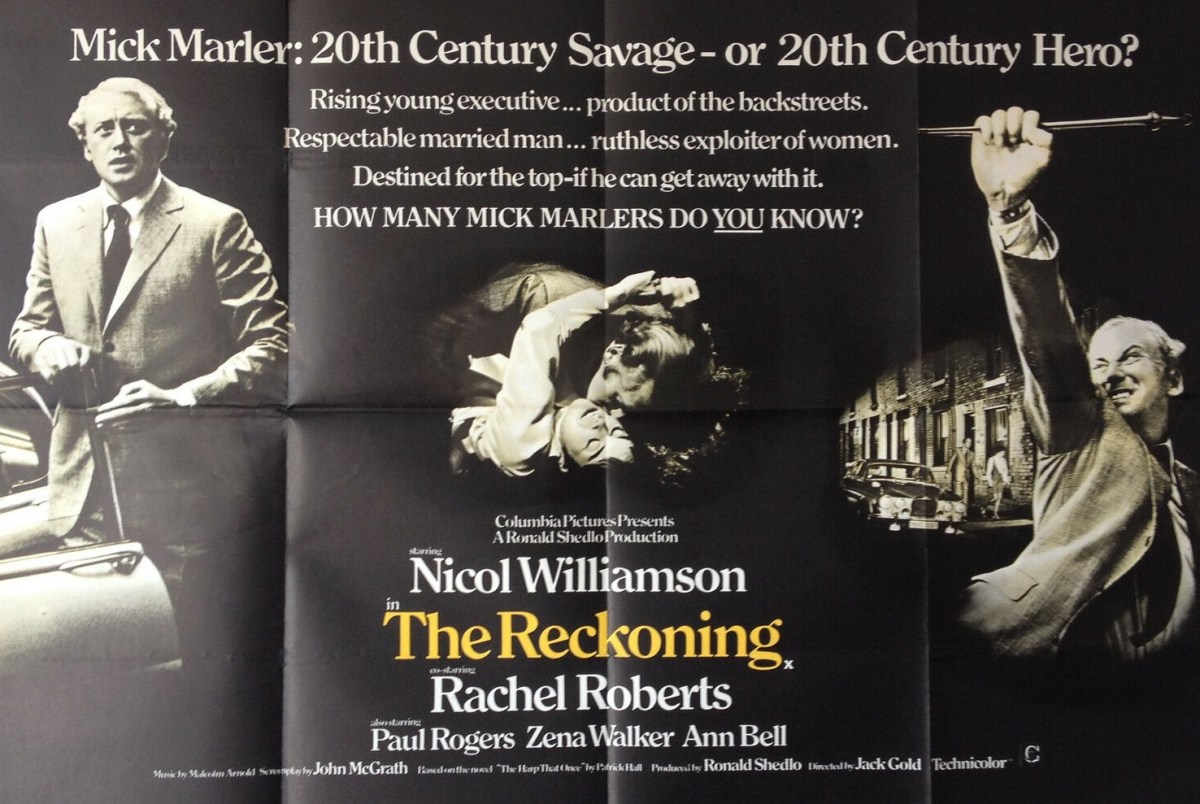
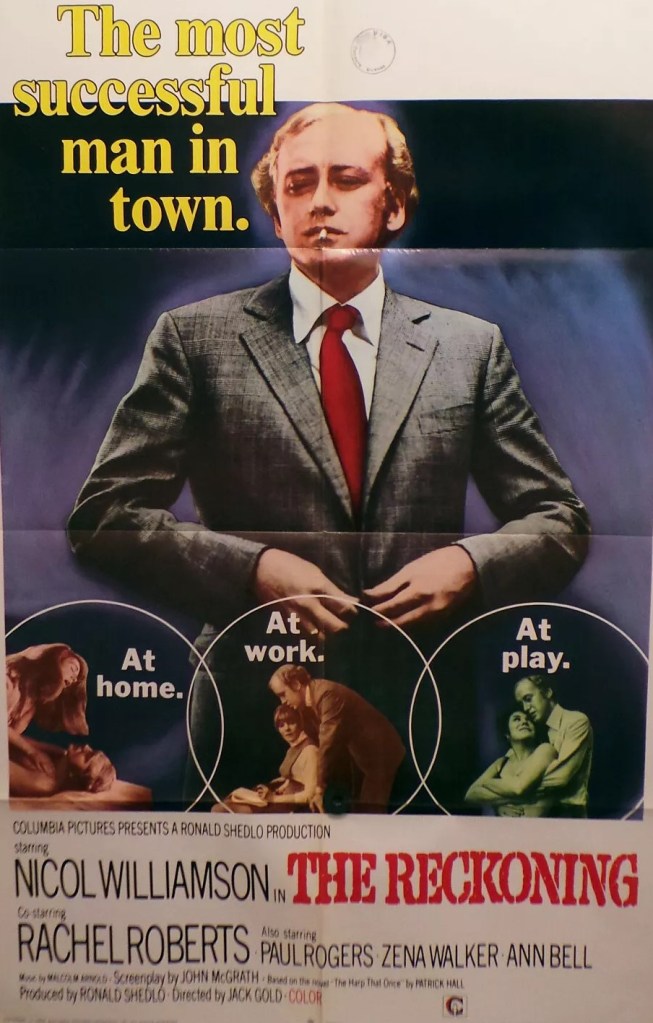
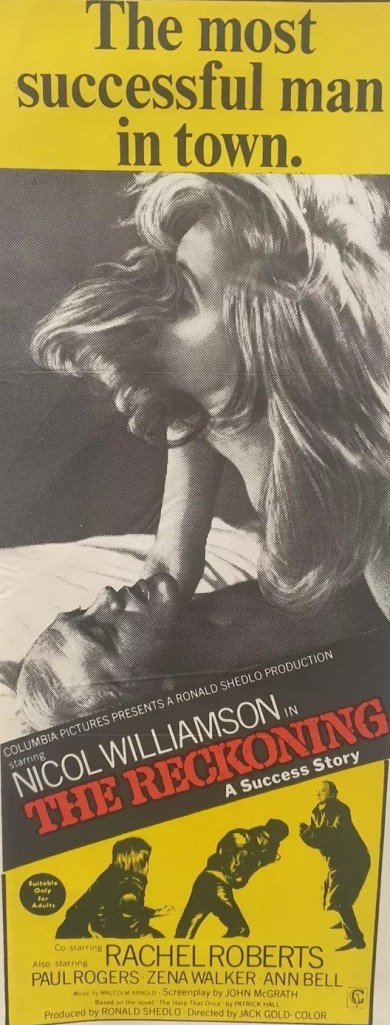
The Reckoning (1969) ****

Fans of Succession will love the boardroom battles and fans of Get Carter the gritty violence. Michael Marler (Nicol Williamson) is a thug whichever way you cut it. He’s a business hard-ass, at his nicest he’s obnoxious, at this worst brutal. He drives like a demon. Even in love, he’s fueled by hate, sex with wife Rosemary (Ann Bell) infernal. And all of this made acceptable, according to the left-wing tenets that underwrite the film, because he is a working-class man battling upper-class hypocrisy, never mind that his upper-class wife was hardly foisted upon him, nor that he was forced to live in luxury.

Unexpectedly, the film also explores other themes which have contemporary significance. Computers play a pivotal role and so does honor killing. The picture’s original title – A Matter of Honor – was ironic given that in the upper-class worlds in which he moved, courtesy of his job and marriage, he is considered to have little in the way of chivalry. But in the working-class world he has escaped he must avenge his father’s death in this manner.   

The sudden death of his father sends him back to Liverpool where he discovers the old man was killed in a pub brawl. But the local doctor and police, disinterested in complicating what must be a regular occurrence, view his death as accidental. So Marler takes it upon himself to uncover the culprits and wreak revenge, any kind of revenge on any kind of culprit, regardless of the fact that from the outset it is clear they will hardly be gangsters.  While contemplating violence, he strikes up a sexual relationship with the married Joyce (Rachel Roberts).

The story jumps between the back-stabbing corporate world to a scarcely less violent working class environment. The combination of charm and brute energy holds a certain appeal for Rosemary (Ann Bell) and helps keep him in the good books of his boss. He is otherwise a bully, targeting the weak spots of anyone who stands in his way on his climb to the top, and while heading up the sales division of a company in trouble blaming everyone else for his own failings. And while scorning his wife’s upper-class friends is quite happy to enjoy the benefits of her lifestyle, the flashy car might be the result of his endeavors but not the huge posh house. Marler stitches up another associate with the assistance of another lover, secretary Hilda (Zena Walker), and his long-suffering wife finally takes umbrage at his venomous manner.

Marler hides his hypocrisy behind the façade of a left-wing class-struggle. John McGrath’s screenplay clearly intends Marler’s working-class background to provide him with a get-out-of-jail-free card as well as to launch an attack on an upper classes seen as namby-pamby except when it comes to putting the poor in their place. The anti-class polemic has somewhat eroded over time but in its place can be found an accurate portrayal of social history.  For  ordinary people, alcohol, the drug du jour, plays a massive part.  The endless terraces, houses without a single car parked outside, the vast pub which hosts wrestling matches and is a tinder spark away from erupting in a brawl, a culture where the first graspings at sex are likely to take place up a close or in a car, are in stark contrast to the high-life Marler enjoys in London.

He has no desire to go back home, hasn’t visited in five years, escaping there deemed a sign of success, and mostly returns metaphorically to draw on memories with which to scourge the upper-class and excuse his own behaviour. 

Nicol Williamson (Inadmissable Evidence, 1968) delivers a tour de force, his screen presence never so vibrant, exhibiting the same raw appeal as Caine in Get Carter. At this point in is career, with a critically-acclaimed Hamlet on stage, he was perceived as the natural successor to Laurence Olivier and Columbia held up the release of The Reckoning to allow the Tony Richardson film of the stage production, in which he starred, to pick up critical momentum. Oddly enough Rachel Roberts had not capitalized on her Oscar-nominated role in This Sporting Life (1963) and this was only her second movie in seven years. Initially coming across as brassy, she soon softens into a surprisingly wistful character. Both Ann Bell and Zena Walker bring greater dimension to their characters rather than as adoring doormats. You can catch Paul Rogers (Three Into Two Won’t Go, 1969) and Tom Kempinski in supporting roles.

Director Jack Gold, who had worked with both Williamson and McGrath on his movie debut The Bofors Gun (based on the writer’s play), does a great job of capturing a particular period of British social history as well as Williamson stomping around in his pomp. Written by john McGrath (The Bofors Gun, 1967) and, in his debut, Patrick Hall.

Terrific performance stands up well.

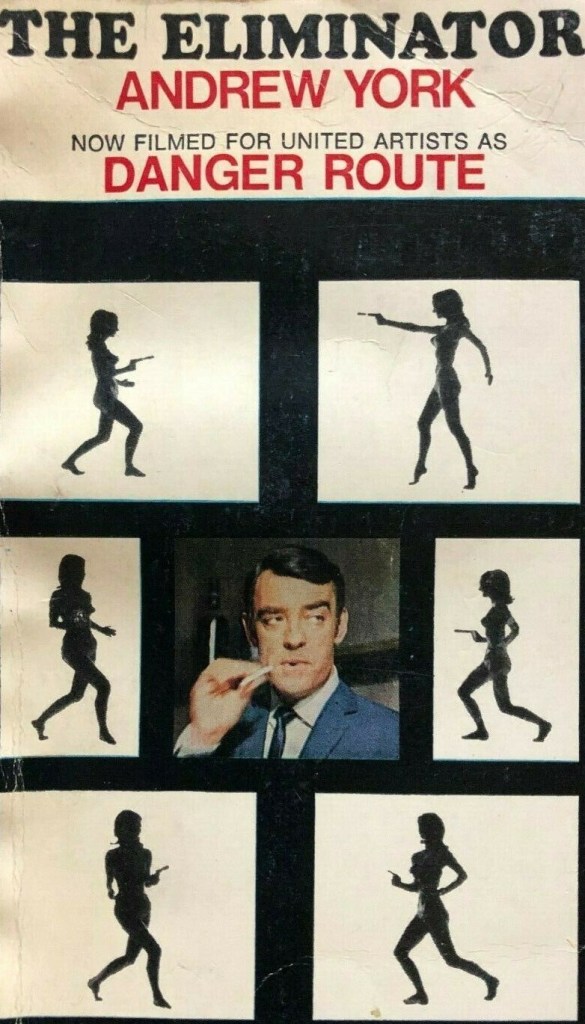
Danger Route (1967) ***

If the producers had not signalled Bond-style ambitions with a big credit sequence theme song by Anita Harris, moviegoers might have come at this with more fitting expectations in the Harry Palmer and John Le Carre vein. So although slipping into the late decade spy boom flourish don’t expect villains planning world domination, gadgets or a flotilla of bikinis.

Seth Holt’s bread-and-butter espionage thriller sets government agent Jonas Wild (Richard Johnson) – on his “last assignment” no less after eight licensed murders in five years – to kill off a defector in the far from exotic location of a Dorset country house not realizing that he is also being set up. That his liquidator will be a woman puts the mysterious Mari (Barbara Bouchet) in pole position.  

Wild gains access to the heavily-guarded mansion by seducing housekeeper Rhoda (Diana Dors) but after completing his mission is captured and tortured by Luciana – pronounced with a “k” – (Sam Wanamaker) who explains he is a patsy and that there is a mole in M.I.5. When his boss Tony Canning (Harry Andrews) disappears and another friend is murdered, Wild goes on the run with Mrs Canning (Sylvia Syms) and eventually makes his way back to his bolt-hole in Jersey to solve the mystery.

There is a decent amount of action, including a fight with a guard dog and a battle on a fog-bound yacht. Clever maneuvers abound – a bug is planted in a bandage. Treachery is always just round the corner and there is no shortage of suspects.

The film’s down-to-earth approach is somewhat refreshing after half a decade of spy thrillers and spoofs. Wild doesn’t employ anything more hi-tech than masquerading as a brush salesman to win over Rhoda. And although that relationship ends up in bed, there is no sex, Wild having drugged her to avoid that complication. Tony Canning is nagged by his wife. Wild’s girlfriend (Carol Lynley) is a sweet girl, sexy in a languid rather than overt fashion.  And Luciana takes enormous pride in telling Wild just how stupid he has been.

But that comes with a caveat. The plot doesn’t quite hang together and the movie sometimes fails to connect.

That said, Johnson (Deadlier than the Male, 1967) is excellent, quite an accomplished actor rather than a brand name. Both Barbara Bouchet (Casino Royale) and Carole Lynley (Harlow, 1965) play against type while Sylvia Sims (East of Sudan, 1964) and Harry Andrews (The Hill, 1965) present variations to their normal screen personas. Sam Wanamaker (The Warning Shot, 1967) has a peach of a role and Gordon Jackson (The Long Ships, 1964) and Maurice Denham (The Long Duel, 1967) are afforded small but critical parts. 

Seth Holt (Station Six Sahara, 1963) directs from a script by Meade Roberts (In the Cool of the Day, 1963) and Robert Banks Stewart (Never Mention Murder, 1965) based on the bestseller by Andrew York.

Competent with interesting touches.

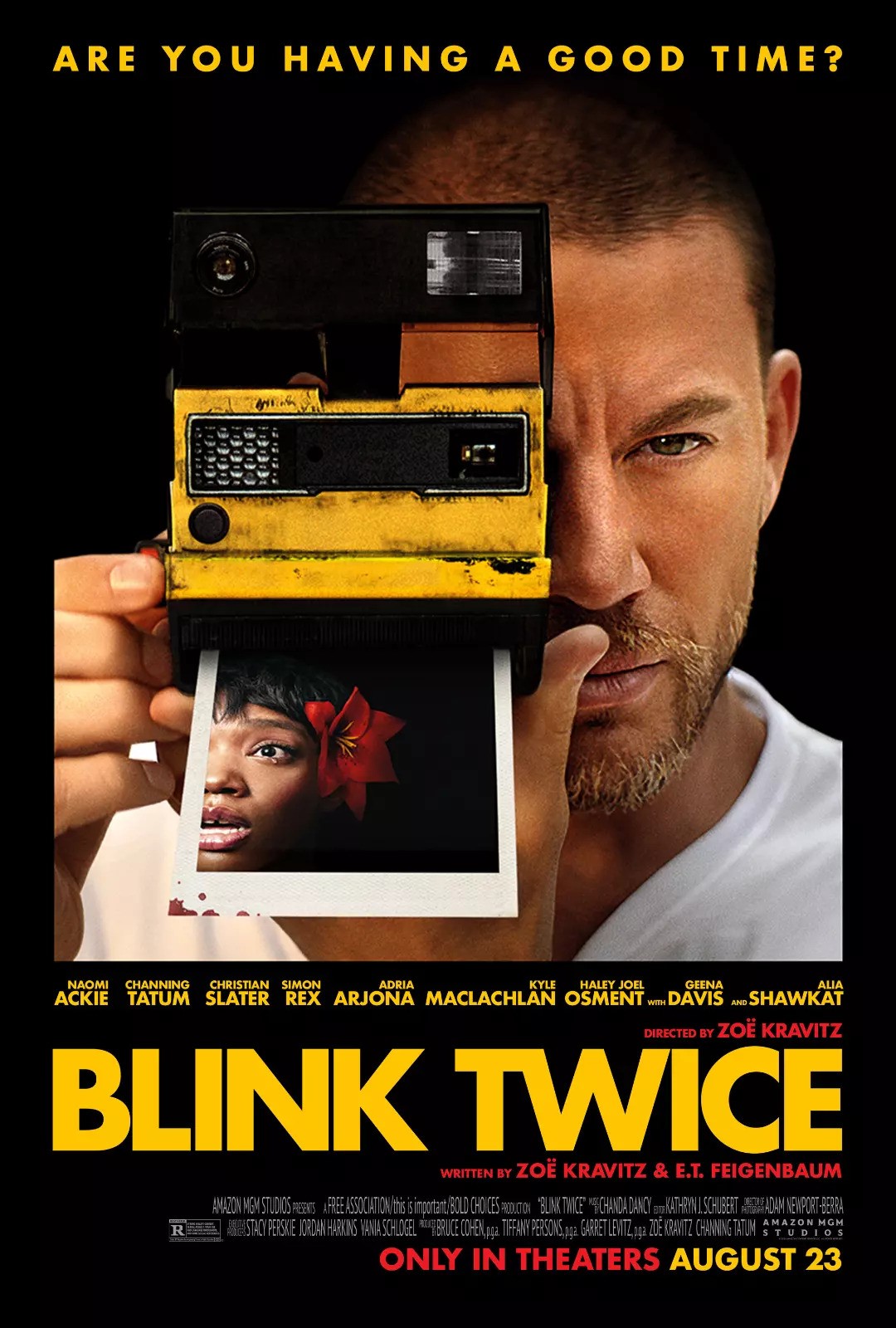
Blink Twice (2024) ** – Seen at the Cinema

Makes one good point about sexual abuse but takes forever to make it. Undone by two bizarre twists at the end and being more arthouse than horror, though that’s been a something of an annoying trend. And way too many cameos. Christian Slater (True Romance, 1993) is easy to spot. But, wait, is that Haley Joel Osment (The Sixth Sense, 1999) hiding behind that bushy beard? And Geena Davis (Thelma and Louise, 1991) as the klutzy personal assistant forever dropping bright red gift bags? And an immaculately spruced Kyle McLachlan (Dune, 1984)?

Buddies, for all I know, of star Channing Tatum, losing all the brownie points he accumulated for his cameo in Deadpool and Wolverine (2024) – although as with that picture he might just be showing an unwelcome predilection for the unintelligible. Or they could all be, out of the goodness of their hearts, just helping out novice director Zoe Kravitz. In general critics have been kind, possibly because it’s a movie debut, but more likely because the movie makes a point that sexually abused women and/or the victims of domestic abuse are likely to suppress or deliberately forget their experiences for the sake of keeping their relationship on an even keel or fear of not finding another.

It Ends With Us (2024) covered the same ground but at least took the trouble to fill it with properly-drawn characters. It’s not just that these people are ciphers and the set-up is fairy tale – poor woman meets billionaire who whisks her away to the holiday of a lifetime on a luxury  exotic island – but that ordinary logic doesn’t seem to apply. I don’t mean the kind of logic required to cover up holes in the plot. But really standard stuff. Like, as one of my readers pointed out of Trap (2024), would the cops really set out to ensnare a serial killer in a concert hall packed with teenage kids?

Here, the flaw is simpler. Would women decide not to communicate? Would, they, beyond a shallow surface skein, just not want to know everything about the lives of the women they meet on this island or, alternatively, can’t wait to bore them to death with every detail of their own lives. And if they are so sedated, what’s the drug that manages to switch off that chatterbox tendency because, forgive this sexist notion, you could make a fortune selling it.

So, rather than go to all the bother of writing real characters, we are not so much in blink twice territory as rinse-and-repeat. We are shown endless episodes of the same scene, women in billowing white Greek-style gowns running across the lawn, raspberries being popped into fizzing champagne glasses, some nutjob raving on about the exquisite meals.

At the end of course you try to unravel it to discover the visual clues you assumed the director has dropped. But still you’ve no idea. Are these women all sedated by something in the raspberries, or by the flashbulb of the instamatic cameras, or the food, or by the bottles of scent left in every room? Maybe’s there’s something in the swimming pool. Or could it be the supposed snake venom drained from local snakes by a housekeeper who takes the Channing Tatum approach to her lines so that her every word is unintelligible. The venom that has somehow been so cleverly diluted that although it looks like toilet cleaner that appears to be a selling point as does that it tastes so vile you need to mix it with tequila.

And is there really only one lighter in the place? That a magnificent house on a desert island replete with servants and everything you ever need has come up short on the one element essential to light up all the dope smokes in constant supply. But, wait, we need a sole lighter and some stuff about everyone stealing it from its owner so that said owner Jess (Alia Shawkat) has to write her name on it so when she goes missing that’s the only proof she was ever here.

So, when billionaire Slater (Channing Tatum) whisks off waitperson Frida (Naomi Ackie) to a desert island she discovers they’re not alone, they are accompanied by his assorted buddies  of varying ages and an equally assorted bunch of women all young and all gorgeous. You expect them to pair off and Frida is somewhat disappointed, even in this age of consent requiring to be expressly given not assumed, to find Slater making no moves beyond some old-fashioned hand-holding and neck nibbling.

So after you are bored rigid with the endless insight into how rich people live – drinking champagne, smoking joints, inhaling or swallowing whatever, eating food cooked to within an inch of its life – eventually, and that eventually is a hell of a long time coming, Frida smells a rat.

Spoiler alert – unknown to them because Slater has invented a forgetting drug – at night time  they are raped or tied up to a tree (presumably with silken cords that leave no mark) or beaten up (presumably with the bag of oranges from The Grifters, 1990, because beyond a rare bruise no physical traces are left) and the reason they race across the grass during the day is some memory blip because that’s what they do at night to escape their tormentors.

Anyway, spoiler alert, the women get to turn the tables on the men so it’s a slaughterhouse at the end, some clearly taking inspiration from The Equalizer (2014) and turning a bottle opener into a weapon, others making do with knife or gun or rock or whatever phallic object comes to hand.

Anyways, spoiler alert and big point, women treated badly always come back for more. In a bizarre twist, this is Frida’s second time on the island, and bereft on the miainland of whatever amnesiac drug they’re taking on the island, has managed to bury any memory of the experience although she must occasionally wonder how she got that scar on her temple. In an even stupider twist, instead of handing Slater over to the authorities, he’s somehow in her power and she controls his billions. Sweet revenge, apparently.

Clocks in at what felt like a bum-numbing epic length but turned out to be only just over 100 minutes. However, if you had trimmed the arthouse excess you’d scarcely have enough to cobble together a television episode.

Seems to me there was quite a good drama in there somewhere revolving around Frida and Jess about having some fun while making ends meet – their East-West routine scores points – but that didn’t fly with the studios so the two engaging stars were thrown into this heavy-handed horror.

Makes a point. But once would be enough, thanks.  

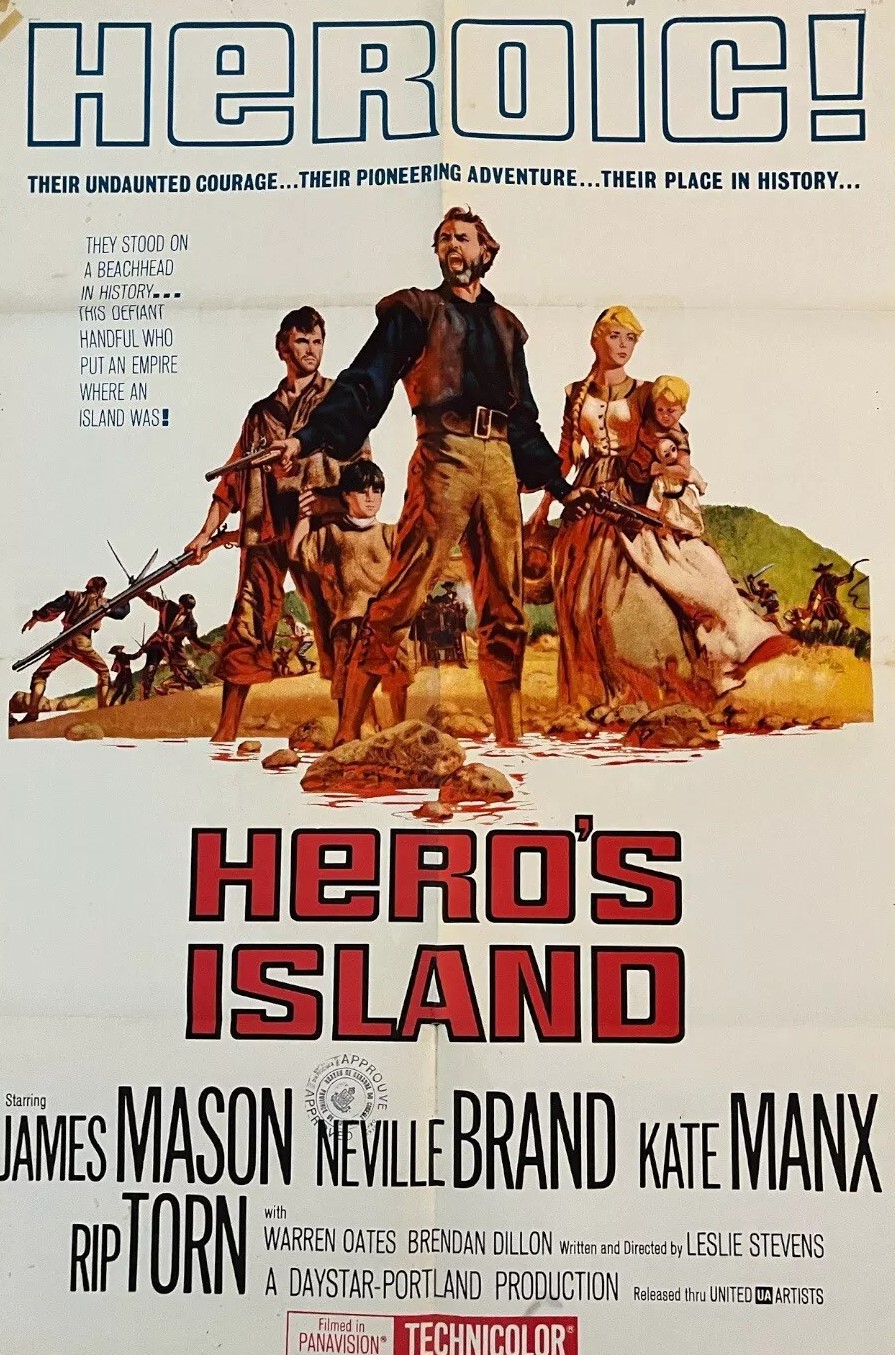
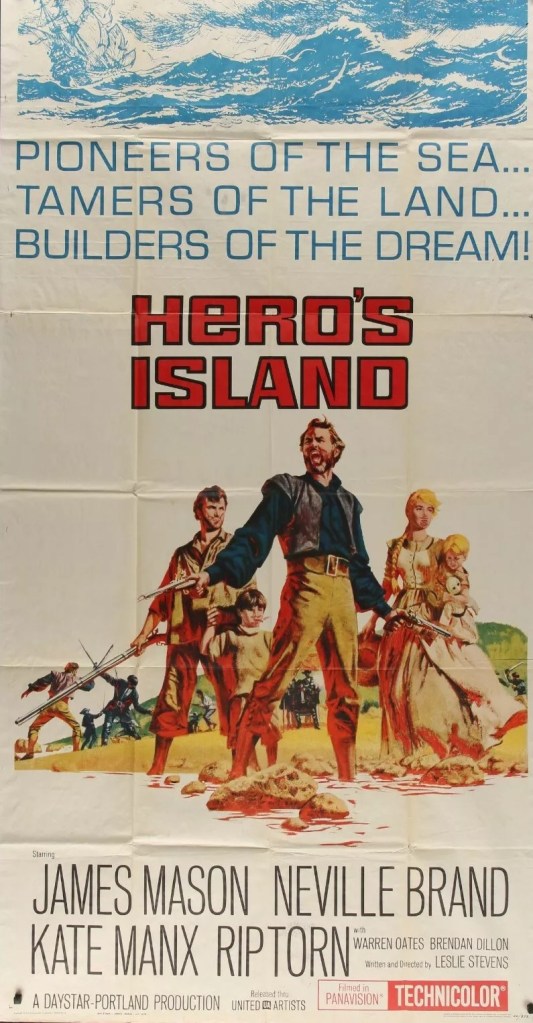
Hero’s Island (1962) ***

There’s a good reason you’ve never even heard of this famous lost film. A fabnulous cast – cult character actors (and occasionally stars) Warren Oates, Harry Dean Stanton, Rip Torn plus a top-billed James Mason – can’t prevent this relatively short film coming over as long drawn out. Proof, too, that cult television producers – in this case Leslie Stevens of The Outer Limits (1963-1965) and Stoney Burke (1962-1963) – shouldn’t always risk stepping into the director’s chair.  

But let’s stick for the time being to the good bits. It’s a historical Lord of the Flies, an almost primitive battle over territory, a small apparently uninhabited island off the coast of the Carolinas in the United States. There’s recognition of the British version of slavery, when, driven off their lands, or to escape dire poverty, people in the eighteenth century went willingly into indentured service in North America. After seven years, you could gain freedom – a contract torn up and rejoined at the indent the legal definition – and wives could equally be bought and if they were very lucky the husband might even agree to marry them in a church. You could buy children in similar fashion. There were other legal niceties, ownership could be challenged, since only a “full working family” could take command of land.

Freed from indenture, Thomas Mainwaring (Brendan Dillon), wife Devon (Kate Manx), two young sons and servant Wayte (Warren Oates) arrive on Bull Island, intending to live off the land, growing crops, fishing, building a house, and honoring God. But brothers – fishermen – Nicolas (Rip Torn), Dixey (Harry Dean Stanton) and Enoch (Robert Sampson) resent the intrusion, murder the husband and attempt to drive the others away, first invoking the law and then threatening violence.

The situation becomes more balanced when  Jacob (James Mason) washes up on the shore, tied hands and legs to a raft, though claiming to be the subject of a shipwreck. Gradually, he sides with the widow although he doesn’t take kindly to her giving orders, refusing to bear arms, and believing that faith in God will see them through. He’s so disenchanted that when pirates descend on the island, he stands back, refusing to help when the widow and then her children are kidnapped.

But eventually, thank goodness, he springs into action, revealing hmself handy with a cutlass, and a pirate, having sailed with Blackbeard, though his captaincy did not go so well, mutiny the true reason for ending up on a raft. Still, he wades into the pirates, retrieves the situation and the fisherman accept the widow’s rights to the island.

So, some interesting historical information, and a touch of swashbuckling. But that hardly makes up for the acres of time when nothing much occurs and the characters jaw about God, the law and life in general. A tinderbox of a set-up barely crawls along, scarcely catching fire.

And that’s despite the all-round good acting, Rip Torn (Sol Madrid, 1968), Harry Dean Stanton (Paris, Texas, 1984) and Warren Oates (The Wild Bunch, 1969) all at the beginning of their careers, their trademark acting styles not yet developed, so talent revealed as fresh, while James Mason (The Deadly Affair, 1967) acts very much against type. In her sophomore screen role, Kate Manx (Private Property, 1960), Leslie Stevens’ second wife (of five), only holds sway until Mason appears to blow her off the screen.

Writer-director Leslie Stevens (Private Property) has way too much to say but not the directorial skill to properly dramatize the material, which is crying out for greater tension, fiercer argument and more action.  

Now that I’ve brought this movie to your attention you may be wondering why, with this knock-out cast, you’ve never heard of it. And the reason is, as I’ve explained, it just doesn’t take off. More like a filmed play than a movie, the camera hardly ever moving. I’m not sure either why James Mason was tempted into becoming joint producer. He had just come off Tiara Tahiti (1962) and Stanley Kubrick’s Lolita (1962) so I would be guessing his career was in decent shape. Though sometimes it’s marquee power that pushes actors into the producing field. Whatever the plan, it backfired, the movie was a financial disaster and he wasn’t top-billed again for four years.

Worth a look for the cast but mostly just to see how even with the best cast a movie can miss the spot.

The Chapman Report (1962) ***

In the 1950s new talent was largely bloodied via small parts in big movies. In the 1960s, the easier route was to first build them up as television stars. This picture represents the nadir of that plan – female roles filled with established talent, males roles with actors who had made their names in television. And, boy, does it show, to the overall detriment of the picture.

Warner Bros even had the temerity to top-bill Efrem Zimbalist Jr (hauled in from 77 Sunset Strip, 1958-1964) over more famous actresses. Zimbalist Jr at least had some marquee value after starring in low-budget A Fever in the Blood (1961) and second male lead in the classier By Love Possessed (1961) and Ray Danton (The Alaskans, 1959-1960) had played the title role in B-picture The George Raft Story (1961), but Ty Hardin was unknown beyond Bronco (1958-1962) and Chad Everett drafted in from The Dakotas (1962-1963).

Little surprise, therefore, that director George Cukor (Justine, 1969) concentrated his efforts on the females in the cast. But it was curious to find Cukor taking on this sensationalist project based on the surveys of sexuality that had taken the country by storm. Had it been made by a less important studio than Warner Bros it would have been classed as exploitation.

The bestseller by Irving Wallace on which it was based was a take on the Kinsey Report a decade before and others of the species and, theoretically at least, opened up the dry material of the more scientific reports into how men and women behaved behind closed doors.

Amazing that this was passed by the Production Code since dialog and action are pretty ripe. Interviewed women are asked about “heavy petting” and how often they have sex and if they find the act gratifying. One interviewer crosses the line and has an affair; these days that would be viewed as taking advantage of a vulnerable woman. And there’s a gang rape.

Given the movie’s source Cukor takes the portmanteau approach, four women undergoing different experiences. The problem with this picture is that there’s little psychological exploration. Women are presented by their actions not by their thought patterns or by their treatment by their husband.

In what, in movie terms, is the standout section, Naomi (Claire Bloom), an alcoholic nymphomaniac, is so desperate for attention she throws herself at the delivery boy (Chad Everett), then at a married jazz musician (Corey Allen), with devastating effect, as he hands her over to his buddies, causing sufficient degradation that she commits suicide. Since we first come across her crying in bed, sure signs of depression, these days you would expect more exploration of her psychiatric state.

Similarly, the widowed Kathleen (Jane Fonda) has been tabbed frigid by her husband and nobody thinks to call into question his inadequacies as a sex partner rather than hers. Here it’s put down to daddy issues and growing up in a household heavy with morality.

Kathleen is taken aback by the researcher even asking her about sex, “physical love” the technical term, rather than a purer kind but her consternation at the questions being posed in very cold-hearted manner by an anonymous voice – researcher hidden behind a wall – does reveal how ill-equipped some people are to even talk about sex. Her story develops into some kind of happy ending, despite the fact that her interviewer Radford (Efrem Zimblist Jr) would be busted these days for taking advantage.

Teresa (Glynis Johns) is convinced by the interviewer’s tone that the simple normality of her own marriage must be abnormal and so, determined to fit in, embarks on a clumsy attempt to  seduce footballer Ed (Ty Hardin), coming to her senses when it comes to the clinch.

The interview also has a major impact on the adulteress Sarah (Shelley Winters). After confessing her affair to husband Frank (Harold J. Stone) she rushes off to lover, theater director Fred (Ray Danton), only to find, to her astonishment, that he’s a married man. Her husband accepts her back.

To keep you straight, the “good” women are dressed in white, the “bad” ones in black. The filming is distinctly odd. The man behind the wall is filmed with no ostentation, but the style completely changes when the director turns to the women who often end up in floods of tears.

Claire Bloom (Two into Three Won’t Go, 1969) and Jane Fonda (Barbarella, 1968) are the standouts because they have the most emotion to play around with. Oscar-nominated Glynis Johns (The Cabinet of Caligari, 1962) is the comic turn. Over-eager over-confident Oscar-winner Shelley Winters (A House Is Not a Home, 1964) gets her come-uppance. None of the men make any impact.

The book took some knocking into shape. Perhaps because, of the four names on the credits only one had signal screenwriting experience, Don Mankiewicz (I Want to Live, 1958). For the others, better known for different occupations in the business, this was their only screenwriting credit. Wyatt Cooper was an actor married to Gloria Vanderbilt, Gene Allen art director on many Cukor pictures and production designer on this, and Grant Stuart was a boom operator though not on this picture.

Best viewed through a time capsule.

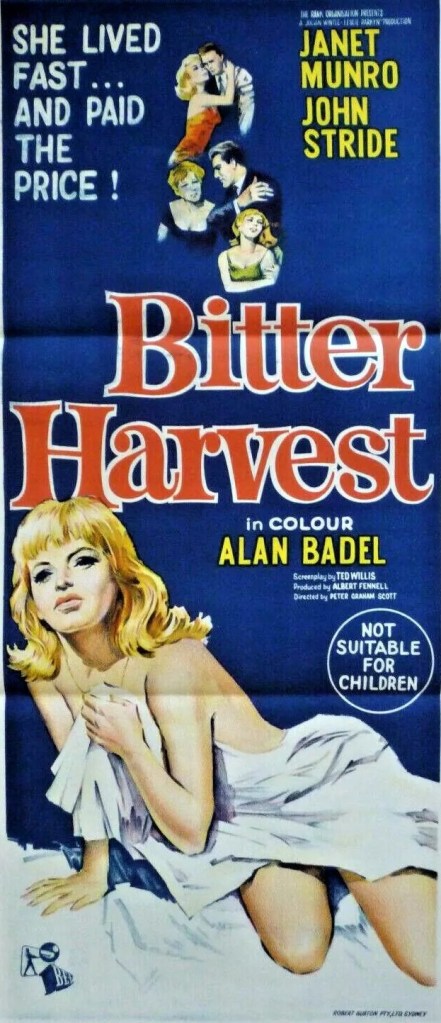
Bitter Harvest (1963) ****

Anyone claiming to be gaslighted will have unwittingly invoked the memory of an English writer who died over 60 years ago. Alfred Hitchcock paid tribute to him in adapting his fiendish play, Rope (1948). Hangover Square (1945) starring Linda Darnell was another of his novels to hit the screen. In all there have been over 50 film and television adaptations of his works.

One of his most famous publications was a trilogy focusing on a London barman and a barmaid in love with him whom he casts aside. I had read it, as I had all of Patrick Hamilton’s novels, with enormous pleasure. The trilogy was published in 1935 under the title Twenty Thousand Streets under the Sky. So it was with some trepidation that I realized Bitter Harvest was based on the middle novel of the trilogy. The DVD had sat, unwatched, in my collection for a couple of years because I was put off by the title, the no-name cast and journeyman director, assuming some routine tale with a sad ending.

Now I’m kicking myself I ignored it for so long. It’s a little gem that packs a punch, climaxing with a stylistic twist, and held together by a virtuoso performance by Janet Munro, one-time Disney ingenue in pictures like Swiss Family Robinson (1960), as she twists the audience and her lover round her little finger. And all the way through, despite the self-imposed travails, she manages to evoke sympathy.

Virgin Jennie (Janet Munro) escapes humdrum life in Wales, running a small shop in a run-down village, looking after her ungrateful father, and about to be dumped as a full-time carer onto a pair of aunts, when she meets smooth salesman Andy (Terence Alexander). He gets her drunk on champagne, whisks her back to his flat where he rapes her. Shame prevents her going home. Friendly barman Bob (John Stride) takes pity on her when she reveals she’s pregnant and lets her sleep, untouched by him, in his bed. Naturally, the relationship progresses, though she makes no move to find a job. But she wants her “share” of the good things in life and a barman isn’t going to provide them.  

Bob soon realizes she isn’t quite the docile waif delighted to be looked after. “When have I taken orders from you?” she snaps. He’s shocked when she reveals that her pregnancy was a ploy, and taken aback when she rejects his marriage proposal. Instead, she’s out on the town with actor neighbor Charles (Colin Gordon) who takes her to a showbiz bash where she wangles an introduction to impresario Karl (Alan Badel). “I’ve got something they want and they can have it and they’ll pay for it,” shows Bob which way the wind is blowing.

The movie begins with a drunken smartly dressed Jennie, long red hair cut in a more fashionable bob, returning to her upper mews apartment. She’s so sozzled she drops her handbag on the steps, only stopping to retrieve her keys before kicking the bag down the staircase. Opening the door, she tosses the key into the street. Inside, she sets about destroying the chintzy apartment, pours whisky over a photo of man later revealed as Karl, smashes bottles, upends furniture, tosses dresses out the window, scrawls something in lipstick on the mirror.

Then we’re into flashback telling the story I’ve just outlined. When she sets herself up to become Karl’s mistress, you think there’s a third act to come. But the movie cuts instead to the mews apartment and the by now dead Jennie.

What distinguishes it is the set-up. Jennie appears initially as the victim until she exerts control, using Bob, and presumably intending to work her way up. Quite how her life came to end in suicide is never revealed. But director Peter Graham Scott (Subterfuge, 1968) has the foresight to realize he doesn’t have to go into the degradation and shame, just show consequence.

And it’s framed with excellent performances. Bob, determined to improve himself, buys a book a month. Barmaid Ella (Anne Cunningham), in love with him, has to endure a scene where he tells her all about Jenny. Bob’s landlady isn’t going to get on a moral high horse about him having a woman in his room when she can rook him for increased rent. You can tell, even if Jenny ignores the obvious, what kind of life she will have as Karl’s mistress when in their first moment of intimacy he slaps her face and rips her expensive dress to make a bandage.

There’s another scene just as shocking and if it was not edited out by the censor at the time it still came as a surprise to see fleeting glimpse of a naked breast, a good year before the U.S. Production permitted similar in The Pawnbroker.  

As I said, the transition of Janet Munro (Hide and Seek, 1964) from victim to predator is exceptionally well-done, her iron fist cleverly concealed for most of the film. And it’s admirable, too, that John Stride, whose career was mostly in television, doesn’t come across as a hapless suitor, though obviously he is gullible. Alan Badel (Arabesque, 1966) only has a couple of scenes but makes a huge impact. Barbara Ferris (Interlude, 1968) has a small part.

Highlight of Peter Graham Scott’s directorial career, well-paced, measured, drawing out good performances all round, especially in the boldness of the closure. Ted Willis (Flame in the Streets, 1961) does an excellent job of updating the novel, though one flaw is that while the early section is set in Wales there’s no sign of a Welsh accent.

Recommended.

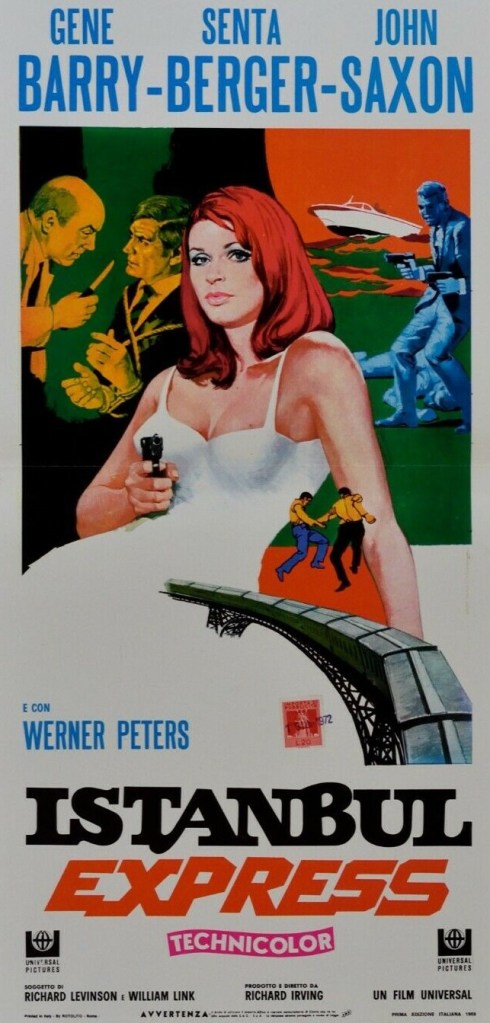
Istanbul Express (1968) ***

Calling this a by-the-numbers spy thriller does this movie no disservice since numbers are crucial to the complicated plot. On the one hand it’s quite a simple set up. Suave high-living art dealer-cum-spy Michael London (Gene Barry) travels from Paris to Istanbul on the Orient Express to bid for secret papers in a secret auction. The complication: he must pick up the auction money from a bank in Istanbul using a code given to him along the way, each number by a different unknown person. On his side are train security chief Cheval (John Saxon), investigative journalist Leland McCord (Tom Simcox) and colleague Peggy (Mary Ann Mobley). Out to get him are Mila Darvos (Senta Berger) and Dr Lenz (Werner Peters).

The numbers business is an interesting addition to the usual spy picture formula of scenic location – Venice and the Eastern bloc as well as the other famous cities – violence and beautiful, sometimes deadly, women. You spend a good time guessing just how the numbers will be passed on and let me warn you it is sometime by inanimate means while the numbers themselves come with a twist.

There’s also a truth serum, bomb threat, a traitor and every obstacle possible put in London’s way to prevent him completing his mission. London is about the world’s worst passenger, always missing the train as it sets off on the next leg of its journey, and requiring alternative modes of transport to catch up. But it’s as much about quick thinking as action and ends with a couple of unexpected twists. And it’s darned clever at times where the numbers are concerned.

Admittedly, the plot is a tad over-complicated but it’s fun to see London wriggle his way out of situations and for Cheval and McCord to turn up unexpectedly to provide assistance.

Gene Barry (Maroc 7, 1967) is little more than his television alter ego from Burke’s Law but he has an easy screen presence, never flustered, tough but charming and a winning way with the ladies. John Saxon (The Appaloosa, 1966) is the surprise turn, on the side of the angels rather than a villain, and equally commanding on screen, and certainly given one of his better roles. Senta Berger (Major Dundee, 1965) is not given as much screen time as you would like – a long way from being set up as the normal espionage femme fatale – but is certainly a convincing adversary.

This was only a movie if you saw it outside of the United States. There it was shown on television. But it had high production values for a television movie and director Richard Irving, who directed the television feature that introduced Columbo (Prescription Murder, 1968), keeps it moving at a healthy clip.  The numbers idea was probably a television device, allowing the opportunity for timed breaks in the action, Writers Richard Levinson and William Link were a class television act, creating Columbo, and prior to that the Jericho (1966-1967) and Mannix (1967-1975) television series. 

Interestingly, Senta Berger, John Saxon, Gene Barry, Levinson/Link and Richard Irving were all at various points involved in the groundbreaking U.S. television series The Name of the Game (1968-1971).

I had not realized Istanbul Express was a made-for-TV picture until I had finished watching it and in that case found it a superior piece of television and a decent-enough rift on the spy movie.

It Ends With Us (2024) **** – Seen at the Cinema

Doubt if I’m the target audience for this little number. In truth, I snuck it in between the excellent Alien sequel and the execrable Trap in my weekly cinema outing. They don’t make them like this any more in part because the straightforward romantic drama was overtaken by the quirky rom-com at which the likes of Tom Hanks, Meg Ryan, Julia Roberts, and Hugh Grant excelled. In the Hollywood Golden Age, Clark Gable would hardly have fashioned a career had he not been teamed with a host of top female stars and Spencer Tracy and Katharine Hepburn couldn’t keep their hands off each other.

But come the 1960s the superstar as loner did away with that popular genre. Apart from The Thomas Crown Affair, Steve McQueen scarcely had a screen romance worth noting, nor did Paul Newman, Lee Marvin or Clint Eastwood and although Charles Bronson ensured wife Jill Ireland had a role in virtually all his movies, romance was rarely on his mind. But cast your mind back to The Way We Were (1973), the incredibly popular pairing of Barbra Streisand (billed first you might notice) and Robert Redford and you can see what, for one reason or another, Hollywood tossed away.

Domestic violence wasn’t on the menu back then and while it plays a part here, that’s not to detract from a solid romance with an excellent meet-cute, two hunks, some terrific dialog, and a sparkling supporting cast. This could be dismissed as upmarket Mills & Boon, especially given the three principals are, respectively, a florist, chef and neuro-surgeon, outside of a fireman just about the sexiest professions abounding in the world of fiction.

Florist Lily (Blake Lively) has to choose between commitment-phobic top doc Ryle (Julian Baldoni) and childhood sweetheart Atlas (Brandon Sklenar), now a successful chef. Her shop assistant Allysa (Jenny Slate) warns Lily about her lothario brother Ryle, but eventually he wears her down and they embark on a relationship that ends in marriage. But when Atlas pops up again, the perfect marriage begins to wear thin.

The return of Atlas brings back memories of her father who abused her mother and beat up Atlas after discovering him in Lily’s bed. The movie skips over Lily’s failure to stand up to her father and, although Atlas was hospitalized as a result of the encounter with her father, she allows her first proper boyfriend to drop out of her life. Luckily, he bears no grudges and sits on the sidelines offering tacit support should her marriage go sour. Unfortunately, she’s tucked his telephone number away in her mobile phone cover and on finding it the already simmering Ryle kicks off.

We open with a great scene with Lily, called upon to give the eulogy at the funeral of wealthy father (Kevin McKidd), walking out without finding anything good to say. There’s a clever visual, the piece of paper where supposedly she was to write down the five things she loves about the deceased, but all she’s written are the five numerals, and it’s as cleverly reprised later on.

The domestic violence is artfully done, so that, at first, we are inclined to believe that he strikes her on the face or throws her down the stairs by accident, partly from seeing the incidents from her confused point-of-view and partly a mind-set that doesn’t want to accept that her chosen mate may be the  spitting image of her father. The bite on the tattoo on her neck accompanying attempted rape is a different story. While Ryle doesn’t per se have justification for his innate violence, his inhibition is partly explained by guilt over a devastating incident in his childhood.

The title comes from the final scene. Presenting baby to father, Lily asks Ryle what advice he would he would give his daughter should she ever confess she had been smacked around or thrown down the stairs. He’s shamefaced enough to give the correct answer and she’s smart enough to give him the boot. “It” meaning violence from men, “ends with us,” she whispers to the baby.

And although that’s the big supposed big takeaway from the movie, in reality it doesn’t pivot on that element, instead it’s a very satisfactory almost classical love triangle of the kind they used to make, with plenty good lines and packed with interesting scenes.

Blake Lively, as she proved in The Rhythm Section (2022), is very capable of carrying a picture but here she’s swamped by support. Justin Boldoni (Con Man, 2018) is in double-hyphenate form – he directed it (Clouds, 2020, his previous) – stepping up to the plate not just as a prospective candidate to become Hollywood’s next big male sex symbol but making an impressive movie, slow-burn to allow characters to find their feet and for the actors not to rush at scenes or bite off lines. Jenny Slate (I Want You Back, 2022) is superb.  Christy Hall (Daddio, 2023) adapted the Colleen Hoover bestseller. 

Thoroughly satisfying involving drama.

The Beckett Affair / L’Affare Beckett (1966) ***

More down’n’dirty Eurospy than the more pervasive high-gloss alternative and with some interesting directorial touches, especially in relation to POV, a narrative that leads you a merry dance but mostly down the road of grubby international politics, plus an eclectic score from Nora Orlandi. Even with actors I’d never heard of, and no idea how the DVD even ended up in my collection, it works well.

Opening Parisian sequence a standout. Gunman bursts through an office door, marches older occupant towards the exit. Outside, however, it’s the older man who emerges, climbs into a waiting car and again it’s he who comes out of that, leaving slit throats in his wake. The survivor, with a ramrod-stiff demeanor, turns out to be Col Segura (Gianni Solaro), wanted by the authorites for clandestine activites in Cuba in 1961 and for instigating too many apparent suicides.

Agent OS47 Cooper (Lang Jeffries), drafted in to track him down, does so by means of a letter supposedly written to his mistress Claire Beckett (hence the title) who is nowhere to be found. Next best thing is her secretary, blonde bombshell Helen (Nathalie Nort), who is already on Segura’s radar and is promptly kidnapped and then used to lure Cooper to a breaker’s yard where various tough guys want to beat him to death. Beckett, it transpires, ain’t going to be found unless you fancy digging graves.

The good guys are as villainous as the villains, torturing a suspect. As you might expect, there’s a heap of double-crossing, another agent as well as a cop in the pay of the opposition. Cooper’s sidekick Paulette (Krista Nell) is as tough as anyone, her beauty belying her fighting skills. The plot’s somewhat complicated and leads Cooper to being hired by Segura to assassinate a Nicaraguan leader, the notion of liberating Cuba just a front to mislead Segura’s pursuers.

Action sequences are more limited than the normal run of spy pictures, but when they come they pack a punch. The tussle in the breaker’s yard might appeal more than that in Mickey One (1965) for resisting the temptation to go down the existential or metaphorical route. Like the rest of the film it’s a down’n’dirty scrapyard. In the best action sequence, with an idea I’ve seen later stolen, the music playing that you assume to be the film’s score abruptly ends halfway through the fighters destroying an apartment, because they’ve trashed the object emitting the music. That takes a moment to digest so the sudden silence after the loud music strikes a stylistic note.

While Cooper isn’t as active sexually as James Bond, he does, like 007, get intimate with woman who might prove useful. Segura is good bit more normal than your usual espionage supervillain, with more flaws than you’d expect, especially after our introduction to him. There’s also unusual depth in subsidiary characters, Helen jealous of her boyfriend, secondary villains seeking social advancement and not always following orders, Paulette proving more than a second-potato character.

Theoretically set in France, Switzerland and South America, only the first locale appears authentic, with many outdoor shots, but not reliant on steeotypical tourist tapestry.

One of the alternative titles, The Spy Pit, better catches the tone of the picture, everyone caught in an espionage trap, and, ironically, given the constantly changing world of international politics, much of the background here has been superseded by real events. I’m putting the moodiness down as deliberate not just the state of the DVD.

Canadian Lang Jeffries (The Revolt of the Slaves, 1960) is a decent ersatz Sean Connery, Austrian Krista Nell (The Million Eyes of Sumuru, 1967) a capable sidekick, Gianni Solari (Seven Seas to Calais, 1962) comes across as efficient businessman rather than demented villain, Mali-born Nathalie Nort (Succubus, 1968) proves equal to an enlarged supporting role.

While you wouldn’t call it a directorial triumph, and it could do with some narrative clarification, Osvaldo Civirani (Return of Django) has more stylistic flourishes in his armory than you’d expect. Written by veteran Roberto Gianviti (Zorro and The Three Musketeers, 1963) who had over 100 movie credits.

Interesting take on the Eurospy subgenre.

Discover WordPress

A daily selection of the best content published on WordPress, collected for you by humans who love to read.

The Atavist Magazine

by Brian Hannan

WordPress.com News

The latest news on WordPress.com and the WordPress community.