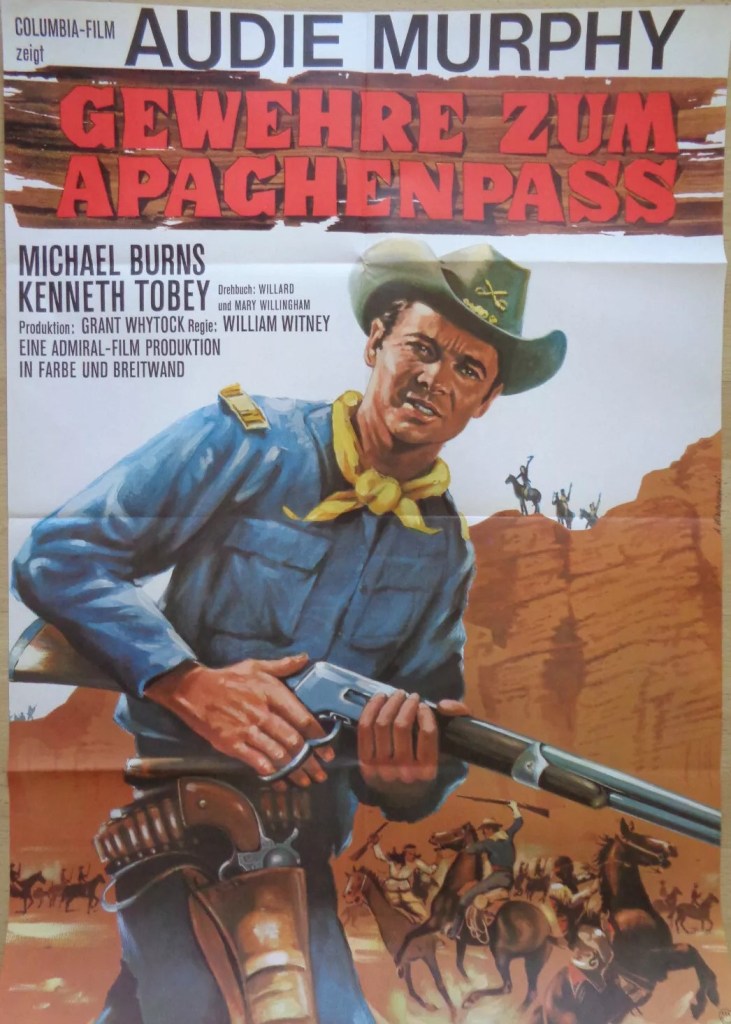
Spent most of the time watching this wondering what depths Glenn Ford and Inger Stevens would find in this interesting script in which relationships come asunder through situation. Instead, we’ve got war hero turned movie actor – I hesitate to say star because his marquee was virtually always of the B-movie brigade – Audie Murphy (Bullet for a Badman, 1964) in his last starring role looking as wooden as ever and in a superbly-written conflicted role the equally ineffective Laraine Stephens (Hellfighters, 1968).
That there was still a market for the kind of western that refused to embrace the revisionism expressed by Cheyenne Autumn (1964) or Hombre (1967) was odd in itself. In fact, by this stage most of the best westerns steered cleared of the Native American issue, preferring subjects like the Civil War (Shenandoah, 1965), errant gunslingers (Cat Ballou, 1965) or standard western tropes with standard villains (The Sons of Katie Elder, 1965, El Dorado, 1967, The War Wagon, 1967).
The title plays around with the more famous Battle of Apache Pass which took place in 1862, seven years before this movie was set. Despite the indifferent playing, the script by Willard W. Willingham and wife Mary (one of the exceptionally few female screenwriters plying their trade in Hollywood at the time) is lean and interesting. Apache chief Cochise is on the warpath and settlers have to abandon their homes and be brought to the safer environs of Apache Wells.
Ramrod stiff Captain Coburn (Audie Murphy) is in charge of the operation which includes bringing his romantic interest Ellen (Laraine Stephens) and her family to safety. There’s not much trouble doing that except rebellious Corporal Bodine (Kenneth Tobey), the kind of subordinate who’s always insubordinate, picks a fight with the officer. Against the ostensibly much tougher opponent, Coburn wins the tussle and beats the living hell out of his underling. But Ellen is of delicate stock and doesn’t take kindly to her potential husband’s violent streak.
At the makeshift fort Col Reed (Byron Morrow) is driven to desperation by the lack of weaponry, awaiting a long-promised supply of the newest model of repeating rifles. The scouts delivering the titular 40 weapons refuse to risk taking the supply wagons so close to the Apaches so Coburn is designated to undertake the “mission” to secrue them, taking a team of ten men including two of Ellen’s brothers Doug (Michael Burns) and Mike (Michael Blodgett) and Bodine. Doug falters under fire and is responsible for his brother’s death.
Bodine steals the guns, planning to sell them for $1,000 each in Mexico, an enterprise that gains the support of the remaining troopers bar the captain and his sergeant. With a piece of exceptional cunning, Bodine plans for those two to be blown up in a manner that will look like they have sacrificed their lives rather than surrender the weapons. And it’s an equally clever trick indeed that allows Coburn to escape.
This section brings unexpected depth, character revelation the key. Bodine turns out to be a Johnny Reb, joining the Army, wearing the dettestable blue, as an alternative post-war to imprisonment. And he’s not going to ride over 1,000 miles to Mexico when he’s got potential purchasers, the Apaches, hardly any distance away at all. Cochise doesn’t take too kindly to a traitor, though he’s willing ostensibly to do business.
Coburn, it turns out, is anything but the ramrod straight officer he effects to be. He came up the hard way, mostly been a loser all his life, and knowing that he’s blown this chance for future promotion. Back at the fort, not only does he face court martial, but Ellen blames him for the loss of her brothers, one dead, the other heading towards summary execution should he be captured as a deserter.
So, naturally, the only way out of this pickle is for Coburn to steal a couple of horses and attempt to recover the weapons. He’s again got a clever plan, holding off the bad guys by placing a bunch of repeating rifles at crucial points in his retreat so he doesn’t need to stop and reload.
In better hands this would have been a cracker. The duty-bound Coburn undone by duty, Ellen undone by placing her trust in the wrong man, Bodine undone by thinking he could outwit the clever Cochise.
Director William Witney (Arizona Raiders, 1965) had over 100 directoial credits, virtually all low-budget movies or television series, so he knew how to get the job done. A better director would have better use of the situation, characters and physical setting – those enscarpments go to waste for sure.
Calling out as much for a Budd Boetticher as a Glenn Ford and Inger Stevens.
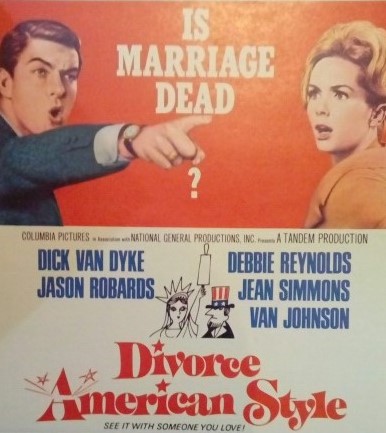
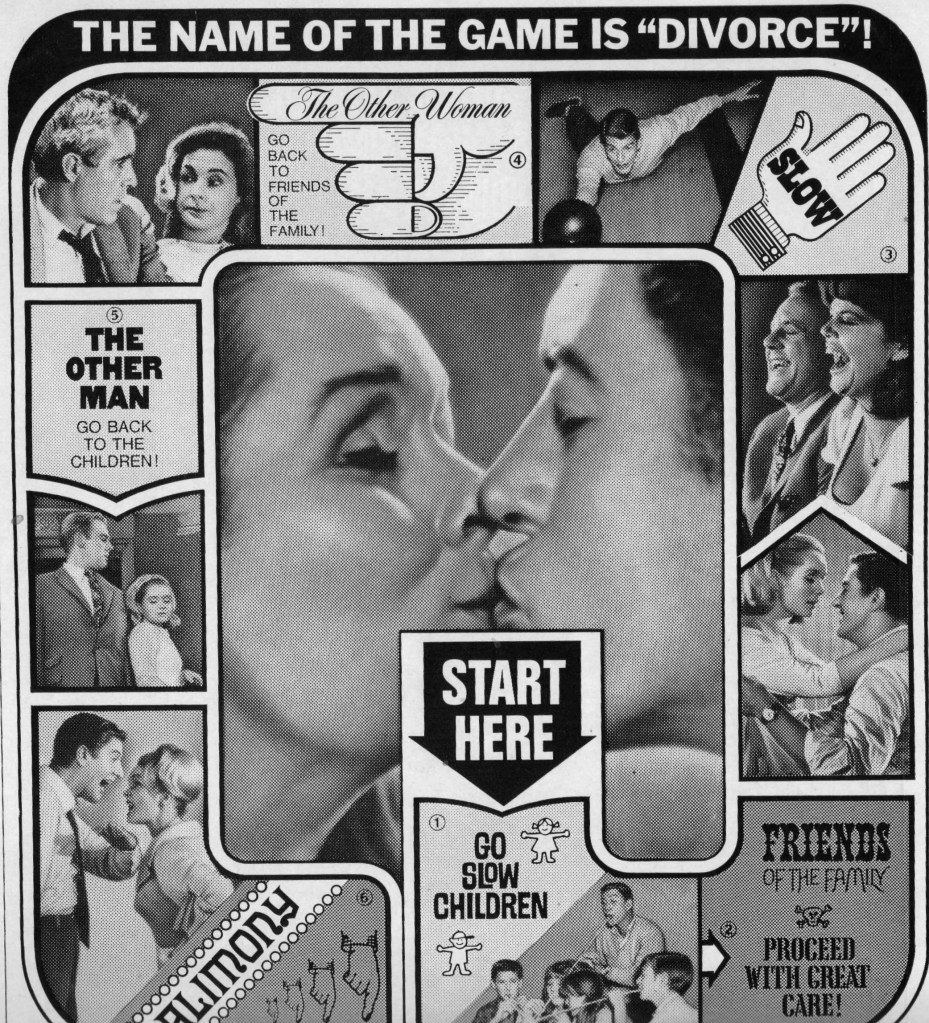
Not so much a comedy about a failing marriage as a guide to the American divorce laws, taking place in a world where the everyman is represented not by the likes of James Stewart or at a stretch Glenn Ford but Dick Van Dyke. It’s possibly only the fact that Van Dyke lacks dramatic chops without the innate vitriol of a Rod Steiger or Lee Marvin that keeps the movie from drifting into black comedy. That, or the filmmakers’ determination to find a happy ending.
When the ever-squabbling Harmons, Richard (Dick Van Dyke) and Barbara (Debbie Reynolds), break up after 17 years and two kids, the chips seem to fall heavily against the husband, the wife walking off with all assets, the husband landed with all the bills and little more than 80 bucks a week to get by on. Such is the supposed injustice of the American divorce laws at a time when most wives did not go out to work and so relied on their husband, married or otherwise, for support.
The only way out of this unhappy financial state for Richard is for his wife to get married again, so a second husband can pick up the tab for her upkeep. Another divorced couple, the Downes, Nelson (Jason Robards) and Nancy (Jean Simmons), is in the same pickle so Nelson spends his time acting as some kind of pimp for his ex-wife, serving up potential suitors, such as Richard, on a platter. But since Richard is impoverished, a helping hand is needed to even things up, so Nelson arranges for Barbara to fall into the arms of rich and single car dealer Al Yearling (Van Johnson).
There is a big male-female divide, for the most part the guys concentrating on material things like money and what money can buy, the gals leaning more towards emotion, conversation, genuine intimacy. Richard has given his wife everything she wants, so why can’t he have a few things his own way? Or as Barbara succinctly puts it, it’s a case of supply and demand, the women are in good supply while the men demand. Even after separation, while from the Richard and Nelson perspective the wives are living in the lap of luxury and the men understanding the meaning of penury, female thoughts turn to questions of loneliness, commitment and (not again!) emotion.
While there are moments of observational comedy – an excellent montage of Richard and Barbara opening and closing all sorts of doors while preparing for bed, cleaning out bank accounts before the other can get to them, the problems of accommodating the blended/hybrid family that divorce or multiple divorce can entail – there are not many laugh-out-loud moments.
And probably just as well because without the drama-lite presences of Van Dyke (who still can’t shake off those double takes and involuntary limb functions) and Reynolds, it would have been a much tougher watch. Reynolds is capable of expressing her feelings verbally because, as a female, she is used to expressing feelings verbally, so we know that Al Yearling does not quite hit the spot. But Van Dyke, without resort to the verbal, has his best scenes of emotional loss when he takes his kids to the ball game only to discover that his wife’s new suitor has more treats to offer.
Van Dyke (Lt. Robin Crusoe, U.S.N.) and Reynolds (The Singing Nun, 1966) do a decent job without plumbing any dramatic depths, but Robards (Any Wednesday, 1966) and Simmons (Spartacus, 1960) have more to offer as the conspiring couple, while one-time MGM golden boy Van Johnson (Battleground, 1949) proves that his four-year absence from pictures was premature Hollywood retirement.
More a cautionary tale than an outright laffer, this Norman Lear (Come Blow Your Horn, 1963) screenplay without missing many targets provides a more palatable dissection of modern marriage than something as full-blooded and expletive-ridden as the previous year’s Who’s Afraid of Virginia Woolf. Director Bud Yorkin (Come Blow Your Horn, also) shows a nice grasp of building up situations until they go out of control.
While, certainly, many of the attitudes, are out of date, you can be sure that male self-pity is not one of them.
You could come away from the Pressbook/Exhibitors Manual wondering if some of the actors were in the wrong profession, given the number of accomplished pilots on the roster. James Franciscus held a commercial license for multi-engine planes and had logged three thousand flying hours in three years. Gene Hackman not only had a private flying license but was in the process of building his own biplane.
Producer Mike Frankovich had flown with the US Air Force during World War Two, clocking up 7,000 hours flying time and ending up a colonel. Technical expert George Smith had ejected at 6,000 feet from a plane flying at 800 mph.
Another less well-known fact, Natalie Wood (who was appearing in producer Mike Frankovich’s Bob and Carol and Ted and Alice, 1969) was fluent in Russian and was brought in to translate for a showing of the movie to visiting Russian spacemen. Nancy Kovack, by the way, was equally talented, speaking Persian and other languages.
As much as the main function of the Pressbook was to provide exhibitors with a range of adverts in every conceivable size that they could cut out and take along to their local newspaper, its secondary function was to provide cinema owners with promotional ideas and to provide snippets and articles that could be passed on to a local friendly reporter. But pickings were slim for jouranlists. Not surprisingly, Gregory Peck didn’t have much say, since whatever he did have to say he’d said already as promotion work for the two other features preceding Marooned this year. And nobody’s spilling the beans on the special effects.
Due to the bulkiness of their space suits, the three actors playing astronauts couldn’t sit down between takes and instead the production employed “the slanted boards usually leaned against by elaborately-gowned female stars to protect their costumes.” (You learn something new about the business every day!). Never mind the bulkiness, the actors spent a chunk of their time in the air and the one day James Franciscus expected to meet acting hero Gregory Peck (they had no scenes together) it proved impossible as when the star visited the capsule set Franciscus was 60 ft in the air.
Richard Crenna got a better response from his young son, who had little concept of what an actor did. But after seeing his dad floating around in space high above him, he reckoned his father was actually a hero
For such a male-oriented picture, Columbia made a big play for the female audience. “The Ladies Love Marooned,” boasted one advert in the 16-page A2 Pressbook/Campaign Manual aimed at exhibitors. Pulling on quotes from critics nobody had really heard of, it managed to present the notion that the picture was as exciting, fascinating, “ingeniously-devised,” and suspenseful for women as much as men, at the same time as focusing on the feminine aspects of the movie – “Lee Grant is a knockout.”
The Pressbook itself allocated editorial space to the three female stars. For Lee Grant the slant was that her talent had been recognized by a host of awards – Emmy, Obie, Best Actress at Cannes plus an Oscar nomination (she would later win an Oscar for Shampoo, 1975). But you have to wonder how an actress would respond to be called, in print, “an egg-head with sex” as was the case with Nancy Kovack. In between turning out such pictures as Tarzan and the Valley of Gold (1966) and this, Kovack had been resident in Iran where she made Diamond 33 (1967) and Night of the Angels (1968). By comparison, Mariette Hartley got off lightly, thanks to her Shakespearian training.
A separate 4-page A2 insert promoted the three Oscar nominations for cinematography, sound and visual effects. “Nominated for 3 Academy Awards,” was the slug accompanying the ads. Never mind the reviews from female critics, much bigger space was devoted here to a rave review form Rex Reed, one of the most famous critics of the day (and star, if that’s the right word, of Myra Breckenridge, 1970), who claimed Marooned was “as exciting, spirited and suspenseful as any spy movie or any cops-and-robbers movie ever made.”
As you might expect, the bulk of the promotional ideas were science-based. Exhibitors were told to target the country’s 2,500 science clubs, the armed forces, the industries that supported the space program and, of course, schools and colleges. Tie-ins had been achieved with 4,500 A&P stores, Jane Parker Donuts, and Philco-Ford dealers.
From a contemporary marketing standpoint, the surprising tie-in was with Omega watches, tagged “the first watch on the moon,” the company’s Speedmaster brand not just worn by the astronauts who did land on the moon in July 1969 but seen in the picture on the wrists of Gregory Peck, Richard Crenna, David Janssen, Gene Hackman and James Franciscus. Over 4,000 dealers were backing the movie.
Model kit manufacturer Revell was offering space suits as prizes in a competition. It distributed more than 42,000 standees and posters and printed five million entry forms. Bantam books was promoting the original novel by Martin Caidin. That exhibitors would be eager to equip a staff member with an astronaut’s garb and have him/her parade through the streets went without saying. Using lift-off sound effects in a cinema lobby was another idea or turning the entire lobby into a space set.
Rather disconcertingly, the marketing bigwigs thought it would be a clever idea to propose a discussion program on radio or local television on the subject of what would happen if spacemen were marooned, a rather tetchy subject when that became reality.
Unusually, but not surprisingly, the posters stuck with the one tag line: “Three marooned astronauts. And only 55 minutes left to rescue them. While the whole world watches and waits…” and buttressed by some thumbs-up quotes from the likes of reviewers from the New York Times, Redbook, Los Angeles Times and Los Angeles Herald Examiner. In fact, the advertising department took such a shine to Charles Champlin of the LA Times that they cut up his review and stuck snippets of it in three separate ads.
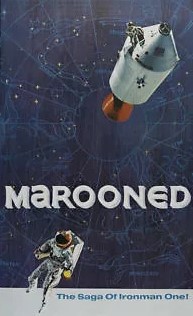
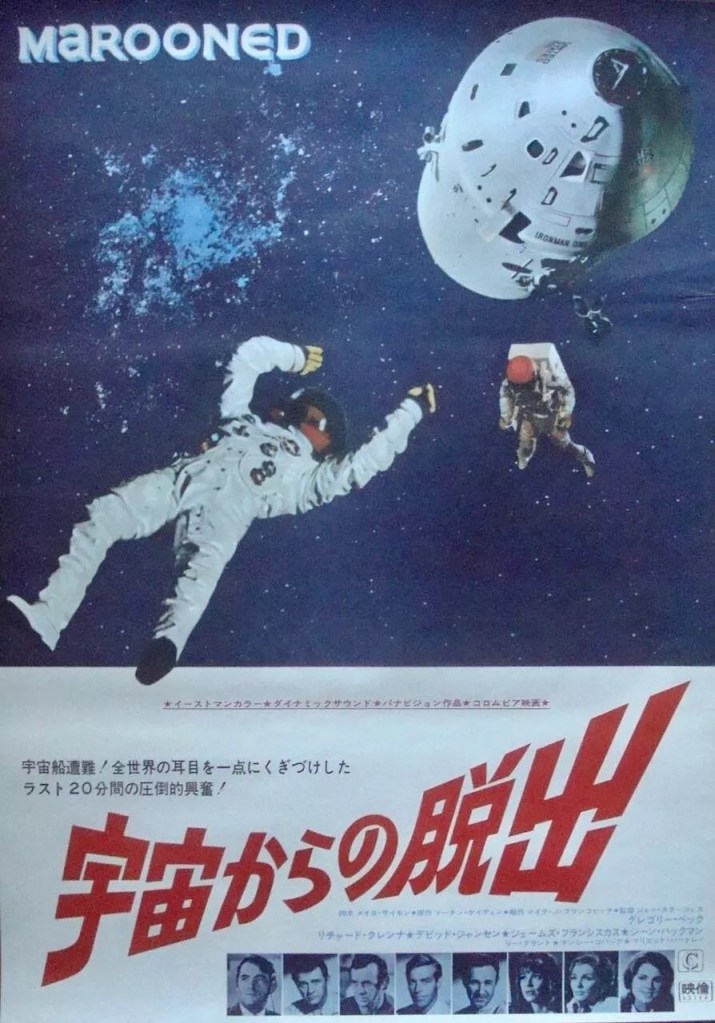
You’ll have seen from the variety of adverts I’ve used to support the review and the Behind the Scenes article earlier in the Blog, that there was a wider range, initially, of adverts, some showing the capsule stuck out in the middle of space. By the time it came to printing this Pressbook, the one for the picture’s general release, all of those were jettisoned in favor of the insipid “thumbs-up” poster with faces to the foreground and the launch in the background, attendant quotes and the “3 Academy award Nominations” slug.
Should have been a joyful reunion. Director Frank Capra linking up again with Columbia for whom he had won four Oscars in the 1930s and virtually single-handed lifted the studio out of the minor league. After coming unstuck with It’s A Wonderful Life (1946) – huge flop on initial release and not by this point having found its later more appreciative audience – he had backed off from Hollywood, only five more movies, none acclaimed, the last being the distinctly lightweight A Pocketful of Miracles (1961) with Glenn Ford.
Capra might have seemed a strange candidate for a sci fi picture given the bulk of his movies had been heartfelt comedies or dramas, but he’d become something of the go-to director for science fact programs, making, for Bell Laboratories, television documentaries on the sun, cosmic rays and the circulatory system. Dealing with the intricacies of space travel would have been catnip especially as he was in the process of making an industrial short Rendezvous in Space (1964) to show at the World’s Fair in New York that started in April 1964, and would, unexpectedly, proved to be his final production.
He’d bought the rights to the Matt Caidin bestseller on publication in March 1964 and and tied up a deal with Columbia’s first vice-president of worldwide production, namely Mike Frankovich who assigned the screenplay to Walter Newman (Cat Ballou, 1965). The novel was both simpler and more complicated. There was only one astronaut, Richard Pruett, and he faced the same problem of diminishing oxygen supply with old buddy Ted Dougherty planning to launch an untried Gemini as a rescue mission. But much of the narrative was given over to flashback, test pilot and trainee astronaut plus romance, with Russians planning to steal the rescue glory.
By June Capra was back on the studio lot prepping the picture and, still under the Frankovich aegis, it was announced as going into production in early 1966. So it took a good couple of years before Frankovich decided the Capra wasn’t, after all, the right man for the job.
By the time Capra was squeezed out, Frankovich was in the process of transforming himself into one of the new breed of producers, gamekeepers-turned-poachers, who had jumped from top level studio management into independent production. He prefaced his move by commenting, “Now that I’ve turned Columbia around and we’ve all these blockbusters,” it was time to head out to pastures new with the determined aim of “making a buck I can keep.”
But Frankovich was unusual in that prior to taking an executive role at Columbia he had made his bones as a producer (from serials and B-pictures to Footsteps in the Fog, 1955) in the 1940s-1950s. Frankovich set up an initial five-picture slate with Columbia comprising Marooned, The Looking Glass War (1970), Cactus Flower (1969), There’s a Girl in My Soup (1970) and Doctor’s Wives (1971), shortly after adding Bob and Carol and Ted and Alice (1969), half these titles scoring highly at the box office.
Columbia provided 100 per cent finance. Had he greenlit these pictures while at Columbia, he would have earned far less as a high-flying executive than as an independent enjoying a straightforward production fee plus a healthy share of the profits.
You get the impression from this ad in “Variety” on December 17, 1969, that “Marooned” was somewhat incidental to the opening of the first new theater on Broadway in three decades.
But having cut loose Capra, Frankovich waited until he had taken the project under his own personal wing in his new independent production company before hiring a replacement. He knew who he wanted and was willing to wait 18 months until his target, John Sturges, became free.
And in the way of neophytes wanting to make their mark quickly he did it in the usual manner – by making salary headlines. But rather than forking out for a marquee actor he made John Sturges the highest-paid director in Hollywood on a $750,000 fee, 50 per cent more than he had received for Ice Station Zebra (1968). He earned more than star Gregory Peck (on $600,000), still recovering from a box office trough. From six movies in the same number of years he mnaged only one hit. He should have worked with Sturges before now but had pulled out of Ice Station Zebra.
In fact, Peck was the only star in the Frankovich orbit. Apart from Walter Matthau in Cactus Flower and to a lesser extent Natalie Wood in Bob and Carol and Ted and Alice and Peter Sellers for There’s a Girl in My Soup, Frankovich banked on new, inexpensive, talent. None of the crew in the capsule for Marooned had any marquee status. He turned Goldie Hawn into a star with Cactus Flower and There’s a Girl in My Soup and gave a boost to the fledgling Hollywood careers of Christopher Jones (Wild in the Streets, 1968), Pia Degermark (Elvira Madigan, 1967) and Anthony Hopkins (The Lion in Winter, 1970) in The Looking Glass War. Both the careers of Wood and Sellers were on downward spirals before Frankovich intervened. Crenna and Hackman reunited for Doctors’ Wives along with Dyan Cannon from Bob and Carol and Ted and Alice.
John Sturges was a renowned gadget freak. He loved scientific detail, couldn’t get it out of his head that the Russians had beaten the U.S. into space. He dumped the Newman screenplay, dropping the romance, and despatched screenwriter Mayo Simon to Houston to research the NASA background, interviewing astronauts, wives, programmers, and to “spend a lot of time with the Apollo playbook.” The idea of sending three astronauts into space was already being considered by NASA.
But authenticity came at a price. The reality was that space travel proved every bit as dangerous as novelist Matt Caiden had imagined. In January 1967, three crew members preparing for space travel died on the ground testing equipment. Pressure mounted on Columbia to cancel the picture. The disaster severely dented the box office prospects of the distinctly lightweight The Reluctant Astronaut (1967). Frankovich changed tack and trimmed the tale so that it focused on the astronauts setting off for home only to discover their retro rockets won’t fire “and they don’t know why.”
Sturges decided not to opt for split screen, so effective in Grand Prix (1966) in telling a complicated story from multiple angles, and combined blue screen, hydraulics and models. A full-size Ironman One was mocked up and dangled on wires. Concerned the science might overwhelm the narrative, Frankovich, “afraid it wasn’t human enough,” instructed Simon to given the women “more to do” and humanize the Peck character (whose wife is not involved) by giving him a son of college age (though a scene between them was never used).
Frankovich didn’t stint on the budget now and splurged $8 million on the project and upgraded it to a 70mm roadshow. Nor was he so hung up on Columbia that he rejected an opportunity to film on MGM’s largest soundstage where production got underway in November 1968. Production ran through till April 1969, with Peck not required until February. Where the screenwriter depicted the astronauts as “dirty and unshaven and their capsule grungy and cramped like a phone booth,” Sturges opted for a cleaner, sleeker look, and in a bigger capsule.
The designers copied the Apollo 1 capsule and the orbiting laboratory was an early version of the Skylab. North American Aviation and Philco-Ford, suppliers to NASA, helped with designing elements of the hardware. Initially opposed to the project, NASA relented to sufficiently to permit use of its logo though stopping short of allowing access to its Houston HQ yet softening its attitude later on.
Some of the problems of filming space had already been solved – by Stanley Kubrick for 2001: A Space Odyssey (1968). But Kubrick wasn’t inclined to share his trade secrets, so Sturges went the low-tech route of wires, hydraulics and back projection. “The biggest problem was making everyone look weightless,” said Sturges, “We used every trick in the book.”
Sturges didn’t feel in competition with Kubrick. “Marooned was scientific,” explained Sturges. “It was about engineering. The Kubrick film was about evolution and the rebirth of humanity. One was nuts-and-bolts, the other poetry.”
By the time the film was released, Americans had landed on the moon and the first orbiting laboratory was about to launch into space. Nor did Sturges believe that astronauts could actually end up marooned, insisting that was “a possibility, not a probability” and that, in any case, methods of effecting a rescue were available.
The movie was marginal roadshow length, but it was felt the subject matter and style was more akin in release terms to 2001: A Space Odyssey than Planet of the Apes. Some of the “original rough language” was cut to achieve a G-rating. It was the debut movie at the Ziegfield in New York, the first purpose-built movie theater in the city in decades. Box office polarized: opening to a smash $50,000 at the 1392-seater Egyptian in Los Angeles compared to a tepid $20,000 at the 1200-seat Ziegfield.
When Apollo 13 (“Houston, we have a problem”) in April 1970 looked as if it would end in tragedy, it could have spelled curtains for the movie, now well into its general release. The averting of the danger provided a box office boost but not enough and it racked up a very modest $4.1 million at the domestic box office. It won the Oscar for best visual effects.
Excepting Frankovich who signed a deal to make a further dozen movies for Columbia, nobody came out of this well. Peck only made three films in the next five years, Sturges quit Le Mans (1971) after seven weeks and only made four more pictures. Mayo Simon was given a crack at Sturges’ next project, back to World War Two, for The Yards of Essendorf, to star Warren Beatty, Jean-Paul Belmondo, Ursula Andress and a 500-ton snowplow, but that stalled on the starting grid.
SOURCES: Glenn Lovell, Escape Artist, The Life and Times of John Sturges (University of Wisconsin Press, 2008) p263, 268-271; Gary Fishgall, Gregory Peck, A Biography (Scribner, 2002), p266-268; “Hollywood Report,” Box Office, March 11, 1964; “Hollywood Report,” Box Office, June 29, 1964; “Columbia 83-Film Production Slate Biggest in History, Frankovich Says,” Box Office, January 3, 1966; “See Frankovich Going Indie Next Winter or Spring,” Variety, May 24, 1967, p3; “Mike Frankovich’s 5 for Columbia,” Variety, January 17, 1968, p3; “Flight of Exec Brains to Production,” Variety, July 24, 1968, p3; “Metro’s Stage No 27 for Columbia Film,” Variety, November 6, 1968, p24; Wanda Hale, “Producer: Chicken or Egg,” Variety, November 13, 1968, p32; Wayne Warga, “Author, Director, All Out For Space-Age Authenticity,” Los Angeles Times, April 27, 1969; “Nowadays Anything A Box Office Plus or Minus,” Variety, September 3, 1969, p6; “G for Marooned After Dialog Cut,” Variety, November 12, 1969, p3; “Picture Grosses,” Variety, December 17, p9; “Picture Grosses,” Variety, December 24, p9.
The forgotten one. Left out in the cold by audiences and critics alike in the late 60s sci fi boom by the more audacious 2001: A Space Odyssey (1968), Barbarella (1968) and Planet of the Apes (1968). And that’s a shame because it’s by far the most realistic (to the nth degree) of the space movies. Audiences growing up with astronauts saving their own skins with ingenious maneuver – sling shot and whatnot – in Apollo 13 (1995) and The Martian (2015) might be shocked by the harsh reality of space travel as evidenced here. Astronauts are little more than helpless creatures in a tiny box with ground control in obsessive control. It’s salutary that escape was the audience mindset even after the Challenger Space Shuttle disaster of 1986.
Nobody thought to tell audiences to buckle up because they were in for a hell of a ruthless ride back in the day, but this one really should come with a warning.
Casting makes this work – when it shouldn’t. It’s full of those kind of actors who scarcely move their lips and rarely engage in extraneous facial movement. You can hear director John Sturges issuing instructions: to Gregory Peck, keep those brows knitted; to David Janssen, keep your head lowered and keep with the muttering; to Richard Crenna, don’t move a muscle; to Gene Hackman, limit that trademark chuckle to just once. Why this shouldn’t work is because the big star isn’t in the goldfish bowl of the shuttle cockpit, and since there’s none of the get-to-know-the-crew backstory of The Right Stuff (1983) or Apollo 13 there’s nobody to really root for, especially as the crew is just siting there, doing (by instruction) nothing and awaiting their fate. Which, by the way, which is constantly spelled out, is to suffocate from lack of oxygen.
But there’s a reason Gregory Peck’s on the ground and not in space. Because he’s the one making the life-and-death decisions.
This is by far Gregory Peck’s toughest role. He pulled out of Ice Station Zebra (1968) because he didn’t like the slant of the character, and since then he’d been in typical upstanding heroic mode in The Stalking Moon (1968), Mackenna’s Gold (1969) and The Chairman (1969). Here he’s the king of data management and crisis control, the most ruthless, heartless sonofa you’d ever encounter, not willing to take a risk on greenlighting a rescue mission because the computer says no. The weaselling PR-speak that’s all about saving the space program and making allowance for collateral damage is nothing compared to his terrible delivery of news to one of the wives that her husband is dead. She collapses with emotion, he puts the phone down.
If you’re geek-minded, you’ll give this five stars because there’s information overload. “Go” and “Mark” are the most commonly used words. And in case you can’t judge from the visuals what’s going on, there’s usually some television commentator voice-over to help you out.
So, the Ironman One mission hits trouble when its retro rockets refuse to ignite for return to Earth after several months in space. They’ve got 40 hours or so to effect a rescue before the oxygen runs out for crew members Jim Pruett (Richard Crenna), Buzz Lloyd (Gene Hackman) and Clayton Stone (James Franciscus). The crew are forbidden to try any stunts themselves because any exertion will use up valuable oxygen.
Plan by chief astronaut Ted Dougherty (David Janssen) to mount a rescue operation via an untried spaceship XRV (smaller than a helicopter, by the way) is vetoed as too risky by NASA boss Charles Keith (Gregory Peck) until the President, terrified of public reaction, overrules him. With time running out the impending launch is hindered by an approaching hurricane. But then, in the only nod to ingenuity, someone suggests taking off in the eye of the hurricane, when wind force will be zero.
Meanwhile, up in space, the three stalwarts are slowly coming apart. Buzz, the toughest-looking of the trio, is worst affected, screaming his head off as the prospect of dying looms. Then they are faced with a terrible decision. With the rescue delayed, there’s not enough oxygen to see them through, so one has to sacrifice himself.
I told you it was brutal stuff. About the last 30 minutes are not about whether they can be saved, but who will die and how, the impact of asphyxia on the brain spelled out by resident boffin Clayton. By this point anything they do will almost certain sabotage any rescue and they’re in cloud cuckoo land as Keith tries to keep them in line.
While there’s certainly information overload and a few questionable scientific decisions (can you really open a hatch straight into space?), the reality of the drama more than holds the enterprise together. The realpolitik, the callous use of the wives to go along with the company line as they watch their husbands suffer before their very eyes, the management of potentially bad news, was perhaps a shock for audiences back in the day but would be accepted more easily by contemporary moviegoers.
The acting is first class. Gregory Peck never attempts to lighten his load, to make his character less unattractive and appease his following. David Janssen (Warning Shot, 1966) is as solid as ever. Gene Hackman (The Gypsy Moths, 1969) is the pick of the crew but Richard Crenna’s (Midas Run, 1969) less showy disintegration packs a punch. Lee Grant (The Big Bounce, 1969) is the standout among the wives.
Much as Sturges lets the computerspeak run away with itself, he doesn’t flinch when it comes to the really tough scenes. Written by Mayo Simon (I Could Go On Singing, 1963) from the Matt Caidin source novel.
Interesting curiosity. Peak year for the genre, a dozen films from majors and indies alike, so by now full of alternative scenarios. But let’s start with Jon Hall. In the annals of actors turned director – Kevin Costner, Frank Sinatra, Clint Eastwood, John Wayne, Jon Favreau, Laurence Olivier – there’s nary a mention of one-time Hollywood superstar Hall. You’d never recognize the slim athletic actor in the Errol Flynn mold from the more rounded star of this picture.
Of Tahitian descent, he was a big noise in the 1930s/1940s, not just hot box office alongside Dorothy Lamour in The Hurricane (1937) and Aloma of the South Seas (1941) but a western star (Kit Carson, 1940), swashbuckler (The Prince of Thieves, 1948) and jungle hero after switching to television (Ramar of the Jungle, 1952-1954). But his movie career ground to a halt in the 1950s, and this was his debut as a director.
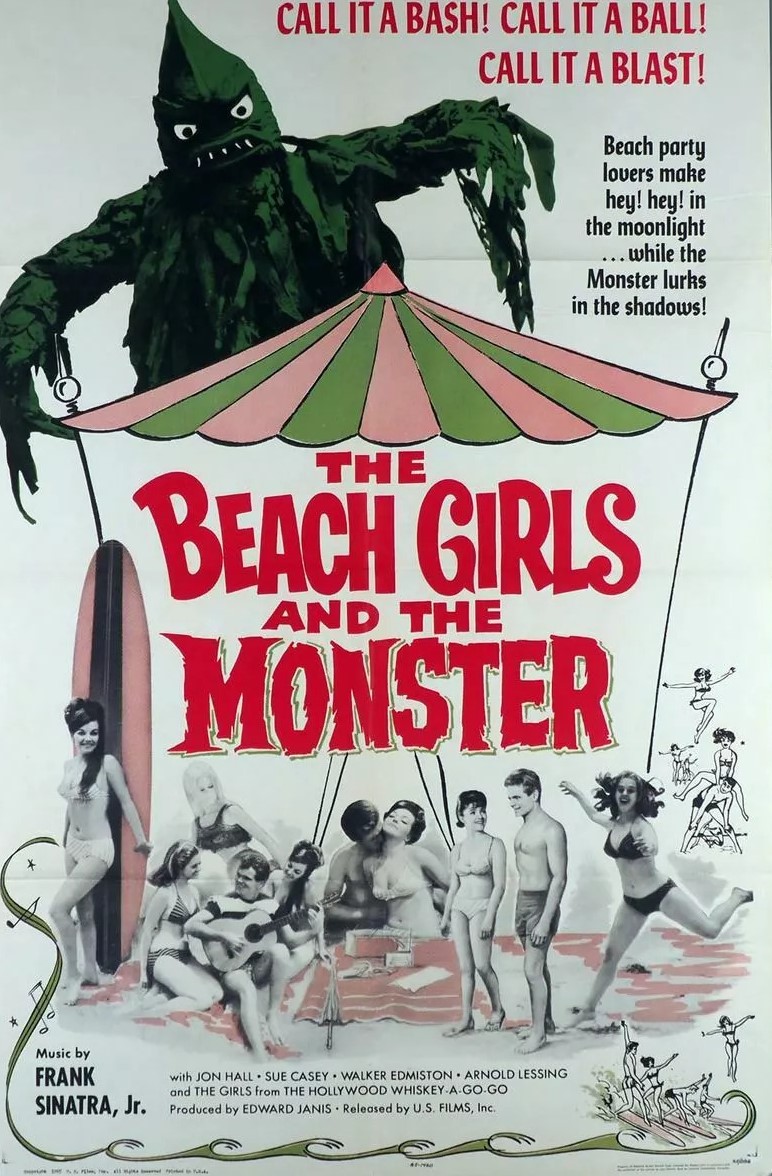
Tossing a few genres – beach party, noir femme fatale, and horror – into the blender, he comes out with quite an entertaining movie, in part because you don’t know which way it’s going to turn next. One minute the screen’s awash with jiggling and dancing, next minute there’s a monster on the loose, and before you know it we’re treated to some quite astonishing (for the period) surfing footage – a year before The Endless Summer – and a puppet (big hand for Kingley the Lion) plus a climactic car chase.
There’s a creepy stepmother Vicky (Sue Casey) making eyes at stepson Richard (Arnold Lessing) and heading out on adultery binges after telling scientist husband Otto (Jon Hall) that he got what he paid for. There’s a creepy limping sculptor Mark (Walker Edmiston), who hankers after Vicky, and whom you wouldn’t let any prospective model near, the limp a constant reminder to cocky Richard that he should have taken more care driving and not crashed his car.
And while the monster is laughable, actually there’s good reason for that, in a twist you may have seen coming. Pickled through this concoction is plenty family drama, the son who wants to get away from his science-obsessed father (and unspoken guilt for the accident he caused), the girlfriend Jane (Elaine DuPont) who fears he won’t, the sculptor whose relationship with the family is a shade too close, and the wife whose favorite pleasure is to see men wilt when she rejects them.
And this is an equal opportunities monster, victims male and female alike, and, despite the title, not concentrating on murdering innocent beach girls scarpering around in bikinis.
And this not being a haunted house movie, there’s even a cop involved, investigating the murders, who is detective enough to take a plaster cast of the strange footprints found around the corpse.
And it’s not full of simpering girlfriends either. Jane ain’t no walkover and the monster’s first victim Bunny (Gloria Neil) keeps her boyfriend in his place with her teasing. There’s the usual atomic-growth-spurt nonsense spouted by Dr Otto who contends the murderer is a monster fantigua fish. Monster is responsible one way or another for the deaths of surfer Tom, Vicky, Mark and Otto.
Worth noting: surf footage by Dale Davis (The Golden Breed, 1968); the surf-style score by Chuck Nagle; the dancers were recruited from Whisky-a-Go-Go; and Walker Edmiston did his own sculpting and created the puppet and the monster head. Actress-turned-screenwriter Joan Gardner (A Man for Hanging, 1972) dreamt it all up. Directorial debut for Jon Hall didn’t lead to much, just The Navy vs the Night Monsters (1966).
One of those films that, for sure, it would be far easier to laugh at if it wasn’t for the noir, femme fatale, surfing, and all the other elements that really should have no place in a beach picture.
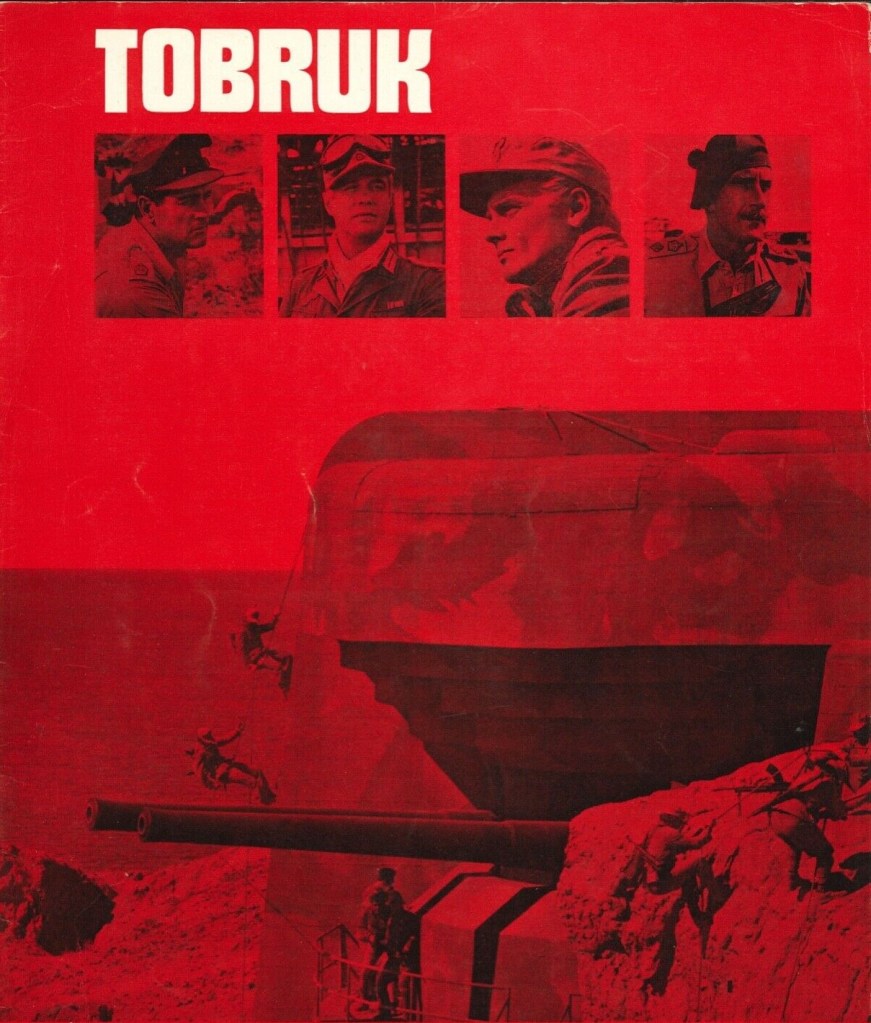
Occasionally ingenious action-packed men-on-a-mission picture that teams reluctant hero Major Craig (Rock Hudson) with Captain Bergman (George Peppard) who heads up a team of Jewish German commandos (i.e good guys). Arthur Hiller (Promise Her Anything, 1966) directs with some skill and to increase tension often utilizes silence in Hitchcockian fashion. He meshes innate antagonism between the two principals and stiff-upper-lip British Col Harker (Nigel Green), two subplots that have a bearing on the final outcome, and explosive battle scenes. In addition, in supporting roles is a Sgt Major (Jack Watson) unusually solicitous of his troops and a grunt (Norman Rossington) with a fund of one-liners.
Craig is liberated by frogmen from a prisoner ship and flown into the Sahara on the eve of the Battle of El Alamein to guide a strike force 800 miles across the desert to blow up Rommel’s underground fuel tanks in Tobruk, Bergman’s outfit providing the perfect cover as Germans escorting British prisoners. “It’s suicide,” protests Craig. “It’s orders,” retorts Harker.
Most action pictures get by on action and personality clashes against authority, but this is distinguished as well by clever ruses. First off, hemmed in by an Italian tank squadron on one side and the Germans on the other, they fire mortars into each, convincing the enemy units to open fire on one another. Craig, on whose topographical skills the unit depends, goes the desert version of off-piste, leading the group through a minefield, personally acting as sweeper with a bayonet as his rudimentary tool, his understanding of how the enemy lays its mines allowing him to virtually explode them all at one. But, ironically, their cover is so complete that they are strafed by a British plane, and equally ironically, have to shoot down one of their own.
Along the way they pick up a stranded father-and-daughter Henry (Liam Redmond) and Heidy Hunt (Cheryl Portman) who are on another mission entirely, to help create a Moslem uprising against the British in Egypt. Their arrival reveals the presence of a traitor in the camp. Naturally, this isn’t the only complication and problems mount as they approach Tobruk and, finding it vastly more populated with German troops than expected, they now, in addition to tackling the virtually impenetrable fuel dumps, have to knock out the city’s radio mast and neutralize the German big guns protecting the beaches.
So it’s basically one dicey situation after another, ingenuity solving problems where sheer force is not enough, and twists all the way to the end.
All the battles are particularly well done, pretty ferocious stuff, flamethrowers especially prominent, but they are also adept at hijacking tanks, and in another brilliant ruse capturing one without blowing it up. The screenplay by Leo Gordon (The Tower of London, 1962) supplies all the main characters with considerable depth. While Craig isn’t exactly a coward, he is not interested in laying down his life for a cause. Although Harker seems a typical officious British officer, he, too, has surprising depths. But it is Bergman who is given the weightiest part, not just a German seeking revenge against his own countrymen for the treatment of Jews but a man looking to a future when Jews will fight for their own homeland in Israel.
Hudson had begun his career in action films, mostly of the western variety, before being seduced by the likes of Doris Day and Gina Lollobrigida in romantic comedies and this is a welcome return to tough guy form. George Peppard made it two Germans in a row after The Blue Max (1966) but this is far more nuanced performance. There are star turns from Nigel Green, Guy Stockwell (Beau Geste, 1966) as Peppard’s sidekick and the aforementioned Jack Watson (The Hill, 1965) and Norman Rossington.
This was pretty much dismissed on initial release as a straightforward gung-ho actioner and one that tipped Rock Hudson’s career in a downward spiral, but I found it both thoughtful and inventive and had much more of an on-the-ground feeling to it, with nothing going according to plan and alternatives quickly need to be found.
Another rich kid with mental health issues though without Orson Welles to offer expiation. The cause of this character’s illness is undetermined but it’s easy enough to spot the trigger to violence. The lad’s father is dead and his mother’s new husband, a wealthy banker, wants him out of the way, or at least out of the house, or at least, given he’s twenty-one, out working rather than mooning about the house all day.
And this was certainly the year for the movies exploring split personality – if such shallow treatment could be deemed investigation – what with Tony Curtis and Rod Steiger in serial murderous form in, respectively, The Boston Strangler (1968) and No Way to Treat a Lady (1968). And for movie fans it was an unexpecteldy speedy reteaming for Hayley Mills and Hywel Bennett after the humungous success of The Family Way (1967) in which the actress shed her child-star persona in no uncertain manner and the British film industry was, apparently, suddenly blessed with a duo with marquee appeal.
A poster that gives the game away.And an apostrophe issue.
This takes the Rod Steiger route of charming killer rather than a Tony Curtis puzzled and horrified by the demands of his ulterior personality. Given the emphasis on mental illness these days, Twisted Nerve is the hardest of the trio to take, since it’s effectively a play on an old gimmmick, deviousness concealed inside appeal.
Martin (Hywel Bennett) faced with expulsion from his house by overbearing substitute father Henry (Frank Finlay) pretends to scoot off to France but instead inveigles himself into the boarding house run by Joan (Billie Whitelaw) after tricking her librarian daughter Susan (Hayley Mills) into extending a sympathetic hand to his alter ego, the childish Georgie, whose behavior falls only a little way short of sucking his thumb and clutching a teddy bear.
Joan’s initial cynicism gives way to maternal feelings when he clambers into her bed in the middle of the night after a supposed nightmare. (And not with sexual intent.)
Occasionally, Martin cannot control his true feelings, despite Susan rebuffing his romantic overtures. Father is the first victim, substitute mother Joan the second and it’s only a matter of time before Susan becomes a target either for his stifled sexuality or his inner venom.
This would probably work just as well minus the schizophrenic element. In fact, there’s too much of tipping the nod to the audience. Eventually, Susan’s suspicions are aroused but director Roy Boulting (The Family Way) is no Alfred Hitchcock able to manipulate an audience. So, mainly, what we are left with is Hywel Bennett’s ability to pull off a double role rather than his victims’ susceptibility to his charms.
Hayley Mills’ character could do with fattening up, otherwise she’s just the dupe, bright, bubbly, self-confident and attractive though she is, although her mother, in passing, is given more depth, a lonely attractive widow prone to sleeping with her attractive guest Gerry (Barry Foster) and, unnerved to some extent by her daughter’s growing independence, wanting a son to mother.
It’s only un-formulaic in the sense that the director is playing with an audience who were not expecting anything like this as a story fit for their two newest adult stars so hats off especially to Bennett for considering a role that could as easily have typecast him for the rest of his career. As I said, setting aside the mental illness elements, Bennett is good fun, as he toys with both aspects of his character, adeptly dealing with those who would patronise him, and like Leopold and Lowe convinced he can get away with the perfect crime, whose planning and attention to detail is noteworthy.
As with the Chicago killers it’s only accident that gives him away, although the policeman here (Timothy West) is less dominant than his American counterpart.
Clearly filmmakers of the 1960s were beginning to grapple with mental illness but either lurching too far towards romance as a way of instigating tragedy as with Lilith (1964) or to the most violent aspects of the condition as with virtually anything else beginning with Psycho (1960).
Worth a look for Hywel Bennett’s chilling performance – template for Edward Norton’s turn in Primal Fear (1996) – and Hayley Mills fans won’t want to miss it. Strong performances by Billie Whitelaw (The Comedy Man, 1964), Barry Foster (Robbery, 1967) and Frank Finlay (The Shoes of the Fisherman, 1968) help enormously. There was quite an input into the screenplay. Along with Boulting, Leo Marks (Sebastian, 1968) doing the heavy lifting adapting work by Roger Marshall (Theatre of Death, 1967) and, in his only movie credit, Jeremy Scott. Great score by Bernard Herrmann.
If you’re unfamiliar with the abortive Italian airship expedition to the North Pole led by General Umberto Nobilo (Peter Finch) in 1928, you’ll find this an absorbing tale. If you are familiar then you will probably appreciate the film-makers’ attempts, via an unusual framing device, to carry out a post-mortem and to apportion blame for the disaster. If you know your history, you’ll also be aware both poles had been conquered, American Robert Peary first to the North Pole in 1909, Norwegian Roald Amundsen (Sean Connery) claiming South Pole bragging rights two years later.
So you’re also probably wondering what was the point nearly two decades later of the Nobilo operation? But the sled-led efforts of Peary and Amundsen were feats of endurance i.e. man vs. nature. This was science vs. nature. The dirigible was the apex of aviation advancement and nations still battled for exploration glory. So to travel in some comfort and fly over the North Pole in a few days would be a demonstration of scientific supremacy. Conquest of one of the most inhospitable places on earth was almost a PR exercise. With no intention of landing it was also a glorified tourist trip.
However, the science was flawed. Nobody had counted on the build-up of ice. The airship crashed and since this was a joyride nobody was equipped to walk their way out. Just surviving would be difficult enough. Loss of radio transmission (science) indicated a problem so rescue airplanes were deployed. But without a location to pinpoint the survivors, searchers had about two million sq km to cover. Luckily, a brilliant scientific deduction by expedition member Finn Malmgreen (Eduard Martsevich) saves the day and a ham radio user (amateur science) picks up the location. Game on!
Except airplanes are too easily thwarted by blizzards, fog and the inhospitable. Home base, set up simply to welcome home a successful jaunt, is not capable of organizing a proper rescue. A Russian ice-breaker joins the rescue attempt. Taking greater risks is aviator Einar Lundborg (Hardy Kruger), fired up by the promise of sex with desperate nurse Valeria (Claudia Cardinale), who happens to be Malmgreen’s girlfriend, and a bounty from Nobilo’s insurers. The redoubtable Valeria does not have to sell her body to persuade the more highly-principled Amundsen to join the rescue effort.
So it’s gripping clock-ticking-down stuff, action shown in considerable detail, almost over-populated in one sense as director Mikhail Kalatozov (The Cranes Are Flying, 1957) covers multiple storylines, the various disjointed rescue efforts, the survivors weakening by the day, imperiled by marauding polar bears and the ice cracking up beneath their feet.
In the main it’s a true story, Valeria the only fictional element, inserted for genuine cinematic purpose, to give the audience someone to emotionally root for back on land and for her character to guide us in an almost contemporary touch through the ghoulish carnival onshore as thousands gather to witness first-hand news of disaster.
What’s obviously patently untrue is the framing device, given that it shows the still-living Nobilo summoning up the ghosts of others involved in the event for a post-mortem, in which his guilt drives him into the position of sacrificial lamb. Although on first encounter it appears a bizarre idea, that, too, soon achieves dramatic purpose. Clearly there was intense discussion at the time and in the immediate aftermath by those who survived the disaster and there must have been high-level talks behind closed doors that usually excluded the main characters of the kind that was played out in a host of historic pictures made during the decade. Lawrence of Arabia (1963) and Khartoum (1965) had many such set-pieces where reputations were shredded.
This approach permits opportunity for all the principals to come together for confrontational purposes in the one room. Not all of that discussion follows the expected path and there is an interesting argument between Nobilo and Amundsen about leadership. From an audience perspective, it is, of course, quite satisfying to see Sean Connery (The Hill, 1965) facing off against Peter Finch (The Sins of Rachel Cade, 1961) with Hardy Kruger and Claudia Cardinale (The Professionals, 1966) embroiled in the debate.
There is the bonus of fabulous cinematography of the majestic Arctic, the icy waste, and breaking up of ice floes and collapsing icebergs has never been captured in such widescreen glory. Further pluses are in the performances, especially Connery as an aged Amundsen, Finch as the glorious pioneer bewildered the sudden turn of events and Cardinale as a woman willing to go to any lengths to save her lover. Ennio Morricone provided the score.
However, you are best going into this aware that while Finch has a goodly amount of time onscreen, Connery and Cardinale (the ostensible stars judging by the credits) are not seen so frequently. That said, the movie works well as an account of the disaster. The version I saw was just a shade over two hours – cut by about 30 minutes from original release.
Streaming channel Sweet TV has the longer version but I couldn’t find a workable link.
Wonder if director Yorgos Lanthimos (Poor Things, 2023) was tempted to go full tilt batshit arthouse boogie on this one and run it all as one big picture rather than setting it into neat episodes, the opposite of what Kevin Costner has done – and been lambasted for – in Horizon (2024). What a riot it would have been if critics had been set the jigaw of trying to work out what part the several main actors were playing at any given time. Am sure that would had had critics out of their seats at both ends of the appraisal syndrome.
As it is, the Dogma-esque notion of the the main actors each essaying three different roles doesn’t work. We all know they’re pretty good actors – Emma Stone (Poor Things) a two-time Oscar-winner. Willem Dafoe (Poor Things) a four-time nominee, Jesse Plemons (Civil War, 2024) nominated once – so they’re hardly needing to prove anything, least of all that they’re versatile. Would have been much better as an all-star (in arthouse terms) cast of nine actors and none of the episodic separation since the stories all take place in a similar disturbed Lantimos-esque world. In fact, you could have tucked the whole lot into Poor Things (2023) and not missed an artistic beat.
Sure, when you think of the episodes individually, it comes across as Twilight Zone-lite or Stephen King on an off day, with (except once) none of the satisfying resolution or alternately deliberating confusing endings. But when you run all the episodes together without any real differential it packs a lot more punch and the world is more fully delineated.
So you get a shipwreck survivor chopping a finger off to satisfy the mania of her husband and him preferring instead a whole leg though he’ll settle for a kidney. Same fella wants to check out old videos of his wife and they turn out to be wife-swapping ventures captured on film. A female jumps headlong into an empty swimming pool in order to facilitate some kind of superpower in her twin.
A cult revolves around determining contamination by licking skin. Their devotees derive mystical loyalty from drinking water into which their cult chief has dropped his tears. Sexuality is fluid, not just the wife-swapping, but bisexuality abounds, and within what might appear to be sexual freedom is a lot of coercive control. But if anybody’s going to get slapped around, it’s the men.
Did I mention the dogs controlling the planet? And a vet who’s too dumb to notice that the cut on a dog’s paw is far too clean to have come from an animal? And, in a riff from Sommersby (1993), the ill-fitting shoes that suggest an imposter. And that a husband is feeding his wife abortion pills?
This is all pretty much standard territory for Lanthimos. But where Poor Things took place is an all too unreal world, here everything would be legit – business, cops – except for the behavior of the characters.
So you wonder if, presented with the script, the main actors couldn’t decide which part they wanted and so Lanthimos just said, heck, play them all. And it’s true you’d have a hard time deciding which part each is best at although as a rule each actor is dominant in only two sections and less important in one. Personally, I’d go for Emma Stone as the shipwreck survivor going along with her husband’s madness in order to save their marriage. For Jesse Plemons I’d choose the businessman under complete control of his boss, down to the clothes he wears each, what he eats and at what time he makes love to his wife. For Willem Dafoe, I’d go for his creepy cult personality.
Just like Horizon, the length (164 minutes here) didn’t bother me. There was generally enough going on, what with all the twists, to keep interest high.
This kind of has the feeling of one for Lanthimos rather than a more accessible one for a wider audience as instanced by The Favourite (2018) and Poor Things. The Academy might well respond to actors taking on more than one role though not quite in Alec Guinness/Peter Sellers fashion and if so the biggest nod should be in the direction of the under-rated Plemons.
Written by the director and regular collaborator Efthimis Fillipou (The Lobster, 2105).
Didn’t have me on the edge of mys eat, but I didn’t fall asleep either, and I certainly wasn’t fretting like some critics at the supposed waste of their valuable self-entitled time.















 The Magnificent 60s