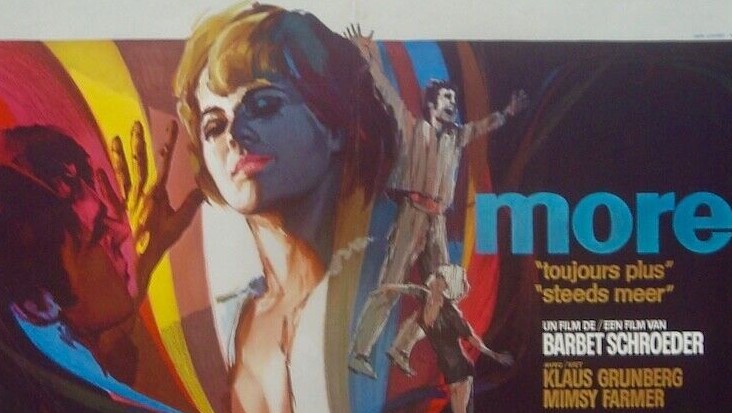
Hedonism gets a reality check but not before it’s done a pretty good job of marketing Ibiza as an idyllic setting and just the place to accommodate anyone wanting to get high on drugs. Despite being the directorial debut of French producer Barbet Schroeder (Reversal of Fortune, 1990), the movie’s better known for the soundtrack created by Pink Floyd.
Which is a shame because despite the focus on the beautiful people living in an exotic world, and plugging, it has to be said, the delights of marijuana as the drug du jour, and not wandering down any cinematic cul de sac like visually exploring in subjective fashion the effects of an LSD trip, it fairly captures the free love counter culture paradise of the time where you could chill out in the sun and you didn’t need to be a biker to do it.

Estelle (Mimsy Farmer) is the lissom siren who hooks the far from innocent Stefan (Klaus Grunberg) – an ex-student, he has indulged in a bit of burglary – and introduces him to pot, Ibiza and heroin in that order. He finds his own way to other indulgences like a menage a trois. There’s an older drug dealer (Heinz Engelmann) in the background and some pals, Charlie (Michael Chanderli) and Cathy (Louise Wink), fleetingly hover into vision, but mostly it’s a two-hander, and there’s none of the despair and nihilism of drug addiction nor the moralistic overtones of a Hollywood picture too frightened of even the more enlightened censor to dare suggest you can have your cake and eat it.
There’s not much story, just the pair falling in love and hanging out, and Stefan wanting to experience the “more” that has made Estelle so impervious to life’s downturns. When he discovers her secret is heroin he wants to turn on in similar fashion and loving lover that she is she obliges. He can’t handle it the way she can and he’s the one that goes over the edge and dies of an overdose. But the director doesn’t resort to any moralizing at the end, this is no wake up call for Estelle, and there’s no sense of guilt, he’s just another handsome ship passing in the night.
The film’s best at exhibiting the easy living, the relaxed lifestyle, of the drug community where ownership is forbidden and life is cheap. It’s filmed as a romance, glorious settings made more glorious by the cinematography of Nestor Almendros (Days of Heaven, 1978).

Mimsy Farmer (Spencer’s Mountain, 1963) is the standout, making the jump into adult roles with ease, presenting an amoral character whose main aim in life to find the deepest sensory experiences. Klaus Grunberg, on his debut, is really just swept along like some flotsam in her attractive wake. Even when Farmer is stoned and really out of it she captures the camera, and while her character is essentially unattractive, it takes some pretty good acting to keep the audience from coming to that conclusion.
The act of shooting up was innovative for the time – and censored in some countries – but it’s not presented as anything but an extension of freedom, liberation of self a la LSD, and even Stefan’s death, the grittiest scene, comes over as mere collateral damage.
That it works is mostly due to Farmer’s performance and Schroeder’s lack of prurience. While there’s abundant nudity, and Estelle makes out with a gal and then enjoys a threesome, there’s no sense of sexploitation, which creates quite a different atmosphere to the more sensational movies of the time. Best of all, in deliberately moving away from heightened drama and turgid instincts that might focus instead on such elements like jealousy or guilt, the director allows the audience to make up its collective mind.
And if you get bored, there’s always the soundtrack and scenery.
Interesting depiction of elusive nirvana.

 The Magnificent 60s
It’s Mimsy Farmer week! She could farm to the last Mimsy! Wrote about her Monday, and you wrote about her last week, and she’s still going! More is better known for the soundtrack that the film, but you make a good argument for a reappraisal. I know everyone hates Zabriskie Point, but that’s one counter-culture film I secretly enjoy…
LikeLiked by 1 person
I enjoyed Zabriskie more than I expected. Just watched Road to Salina so will post that in a week or so.
LikeLiked by 1 person
For a 50 Worst Movies film, it’s quite iconic. Funny how some of these counter cultural films that were seen as the collapse of Hollywood at the time now just appear reflective of a time of change.
LikeLiked by 1 person