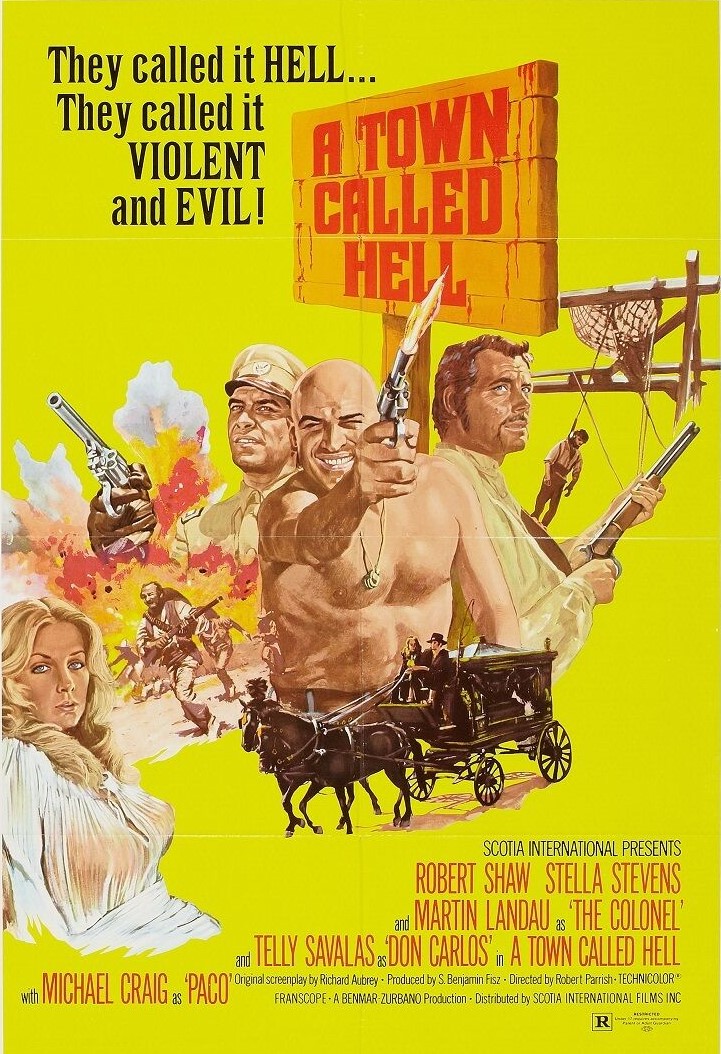
You think you’re in for something quite stylish when widow Alvira (Stell Stevens) rides into town asleep in a coffin in a hearse. Or when she turns up in a dream as an avenging angel. Or when a rebel, entrusted with funds to buy guns, squanders the cash on women and booze. Or when a Mexican general is so disgusted by informer Paco (Michael Craig) that he refuses to face him. But these are about the only highlights in a bloody, sadistic confusing affair.
And diversity rules. Not only do we have a deaf mute going by the apocalyptic name of The Spectre (Dudley Sutton), there’s also an unnamed blind man (Fernando Rey) who comes in handy because he can recognise people by fingering the contours of their faces.

We begin straightforwardly enough with the massacre in a church of the well-to-do by Mexican rebels led by two unnamed characters (Robert Shaw and Martin Landau). Turns out that’s only the prologue and we cut to a decade later to a town ruled by sadistic sun worshipper Don Carlos (Telly Savalas) who has a tendency to string people up at the drop of a hat. Keeping a low profile is another unnamed character known only as the Priest (Robert Shaw) who may always have been a cleric or who has turned to God after being involved in the massacre. Even so, religion doesn’t prevent him having a mistress.
Alvira is offering a $20,000 reward for the killers of her husband, Montes, a victim of the earlier massacre. To get the money, Don Carlos employs the typical wheeze of framing a couple of villagers, husband and wife, hanging them before their tongues run so loose they can confess it wasn’t them. In a bid to save his own skin, the husband blames his wife.
Don Carlos’s luck turns bad when his sidekick La Bomba (Al Lettieri) decides it might be fun to take over, beginning by shooting off his boss’s fingers before hanging him in the sun. But just when you might think you are getting the hang of what’s going on, the unnamed Colonel (Martin Landau) appears. He’s also looking for information, but not inclined to pay for it. He’s hunting for a rebel leader with, wait for it, an actual name, though this still sounds like a pseudonym, Aguila (Eagle, get it?). For no reason whatsoever, it takes the priest a little while to work out this is his former comrade from the church massacre.

on the poster than she does in the film.
It doesn’t take long for the Colonel to get a grip on the hanging malarkey and with as much relish as Don Carlos, determining to continue hanging the townspeople until they tell him where Aguila is. The two narratives don’t quite mesh, but then what do you expect, this is high on atmosphere, sweating bodies, raw emotions, blazing sun. The Colonel, equally obviously, has given up on being a rebel, presumably because as a government official, he can officially murder people any time he likes without having to round up a gang of rebels to do so.
Every now and then the movie dips into flashback or Paco appears to confuse matters further.
There’s an odd sensibility at work. Maybe this is intended to be one of those down’n’dirty westerns trying to show us how mean the actual West really was (although given it’s set in Mexico, we only need to go as far back as The Wild Bunch, in 1969, to get that point). It doesn’t fit so easily into the spaghetti western canon, either, despite the uniform malevolence.
The oblique tone reminds you more of something that could have been put together by Luis Bunuel, but that would be ranking it far higher than it deserves.
The cast are the biggest plus points, though you might be asking whether Robert Shaw (Battle of the Bulge, 1965) and Stella Stevens (The Mad Room, 1969) were sold a different film entirely. Stevens doesn’t have much to do, except look beautiful and soulful. But Shaw is about the only leading man you’ll come across who so puts his heart into a part that he doesn’t mind being seen actually drooling at the prospect of massacre. In fairness, Telly Savalas (The Assassination Bureau, 1969) and Martin Landau (Nevada Smith, 1966), while not exactly dripping spit, drool in different ways.
There’s enough brooding going on stylistically that you are almost willing it to turn into something not just better but more definable. Alas, no such luck.
Robert Parrish (In the French Style, 1963) does his best with a screenplay by Robert Aubrey (The One-Eyed Soldiers, 1967) and Benjamin Fisz, in his only writing gig, he was better known as a producer. My guess is they were more script doctors than anything else, the original damage having been done by the uncredited Philip Yordan (Battle of the Bulge).
Could a been something.

 The Magnificent 60s
I kind of like 70’s films like this and Duck You Sucker which push the spaghetti western in even darker and more baroque direction, although the spotlight seemed to have moved on by then.
LikeLiked by 1 person
This is not quite baroque enough, but headed in that direction.
LikeLike