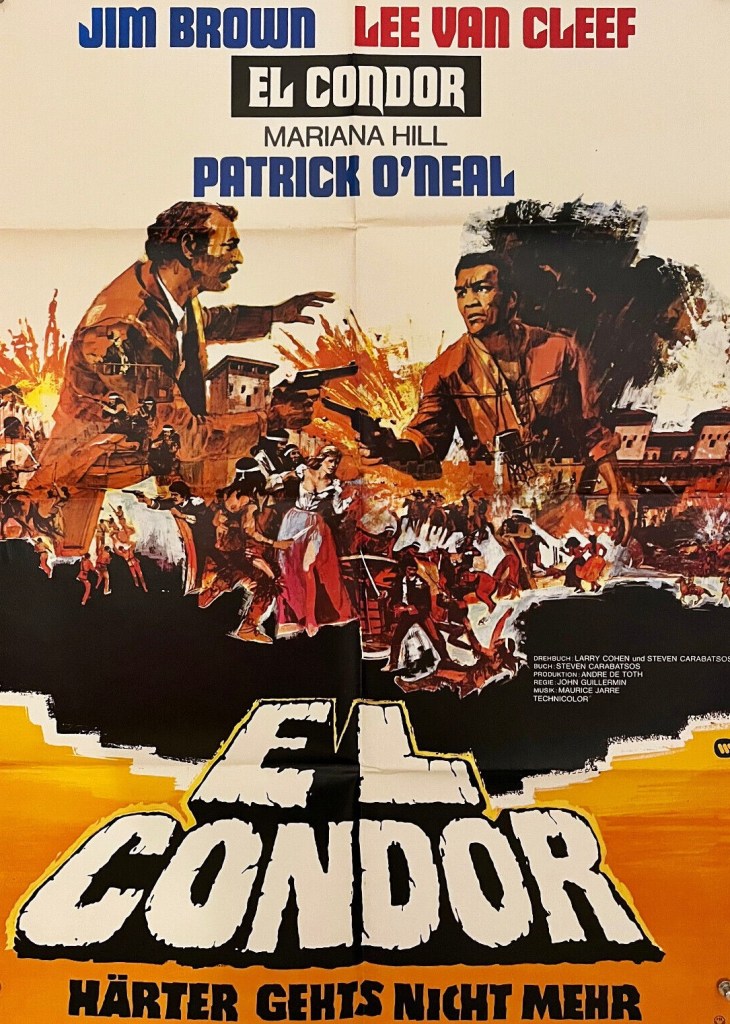
Highly under-rated western, directed with some style by a Britisher, bolsters Jim Brown’s marquee credentials and twists and turns every inch of the way. The basic story couldn’t be more cliché: outlaw Luke (Jim Brown), after escaping from a chain-gang, hooks up with gunslinger Jaroo (Lee Van Clef) and his gang of Apaches to steal the gold bullion hidden inside a Mexican fortress.
It just doesn’t work out that way. Any time a cliché rears its ugly head, director John Guillermin (The Blue Max, 1966) treats it as narrative obstacle and finds a neat way round it. Luke’s attitude doesn’t help either. Looking at a woman the wrong way, not showing Apaches sufficient respect, failing to rein in his larcenous partner, all lead to trouble. But at the right time and the right place, the pair show – almost show off – their respective skills, permitting escape when necessary and finding a way into the citadel.
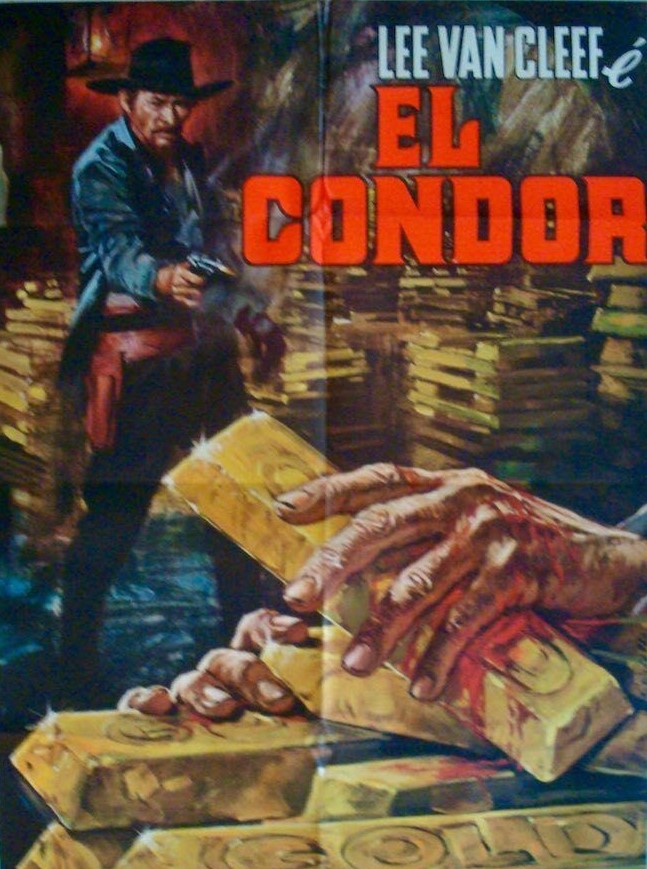
Lee Van Cleef takes top billing in the Italian poster which adopts a more thematic approach than the normal action-oriented marketing.
Did I mention there was a bullfight with fort commander Chavez (Patrick O’Neal), wielding a saber, dancing around the animal on horseback, or that at one point Luke becomes the bull substitute. Or that, in the picture’s most notorious scene, shades of Raquel Welch taking an impromptu shower in 100 Rifles (1969), the invaders are helped by Chavez’s disgruntled mistress Claudine (Marianna Hill) distracting the defending soldiers by disrobing.
And, though minus such distractions, this is probably where the white walkers in Game of Thrones learned to scale a mighty wall. Even so, it’d be a pretty big ask to infiltrate a fortress almost medieval in its construct with an outer and an inner wall, so Luke evens the odds by subjecting the inmates to involuntary thirst, having destroyed their water tower and poisoned all nearby wells.
Given the heist involves gold, it’s no surprise that the weaselly Jaroo is overcome by greed, taking any opportunity to help himself to more than his fair share, encouraged of course by the even wilier Chavez who has the measure of the potential thief. Luke might have been cautioned about entering into a partnership with such a character after witnessing a couple of Jaroo’s schemes backfire. In one of them, in just about the cleverest and most audacious cut you will ever see, we go from Jaroo in a store stuffing illicit goods under his coat to the pair emerging tarred and feathered from a pond.
And this ain’t The Dirty Dozen, nobody appears to understand a command structure, or even stick to orders, Apache chief Santana (Iron Eyes Cody), left to his own devices, liable to attack a wagon train despite that giving due warning of their presence in the vicinity. But then Luke doesn’t show due respect either, resulting in the pair being staked to the ground in the boiling sun, and finding it impossible to dislodge an Apache clinging to his back.
As you might expect, it’s a bloody affair, but without dwelling on gore, none of the visceral exploding body parts of The Wild Bunch (1969). And there is a surprisingly touching moment when, shades of Charles Bronson in The Magnificent Seven (1960), the hard-nosed Jaroo bonds with a young boy on the grounds that they are both illegitimate and parts with one of his two precious gold nuggets to give the child a start in life.
Harsh reality intrudes. Unspoken racism on the part of Chavez sets him against Luke. And that women are prizes of war provides an uneasy undercurrent. Claudine is Chavez’s lover because he offers safe haven, a security not afforded other Mexican woman, forcibly parted from husbands to provide soldiers with sexual playthings.
Jim Brown (100 Rifles) and Lee Van Cleef (The Good, the Bad and the Ugly, 1967) are an inspired teaming, both playing against type, incurring more laughs than you might expect, and less inclined to play their previous stock characters, the former just a tough guy, the latter a ruthless professional. Patrick O’Neal (Stiletto, 1969) is a formidable opponent, perfectly capable of outwitting the more easily-duped Jaroo.
Despite, perhaps unfairly being remembered more for her nudity than her acting, Marianna Hill (Medium Cool, 1969) exhibits vulnerability as well as a tough core. Iron Eyes Cody (Nevada Smith, 1966) has a very refreshing take on an Apache war chief. And you might spot British starlet Imogen Hassall (The Long Duel, 1967) and veteran Elisha Cook Jr (Welcome to Hard Times, 1967).
But this movie really belongs to director John Guillermin who takes a fairly routine western and turns it on its head, extracting reversals at every opportunity, and clearly delighting in the several twists in the tail. Larry Cohen (Daddy’s Gone A-Hunting, 1969) and in his movie debut Steven Carabatsos (The Revengers, 1972) wrote the screenplay and the presence in the producer’s chair of Andre de Toth (Play Dirty, 1968) might account for some of the movie’s subversiveness.
There’s a historical footnote to El Condor. In a revision of the certificates issued by the censor, the British Broad of Film Classification in 1970 introduced the “AA” certificate, permitting people aged over 14 to view material that would previously have been restricted to the X-certificate. Admission to that category was raised to 18. So for a whole generation of teenage boys, hormones going wild, the first glimpse they had of a naked woman was in El Condor. (In the US it was an “R”.)
Not only well worth seeing but free to view on YouTube.
And when that source dries up you can find it on the Warner Archive.
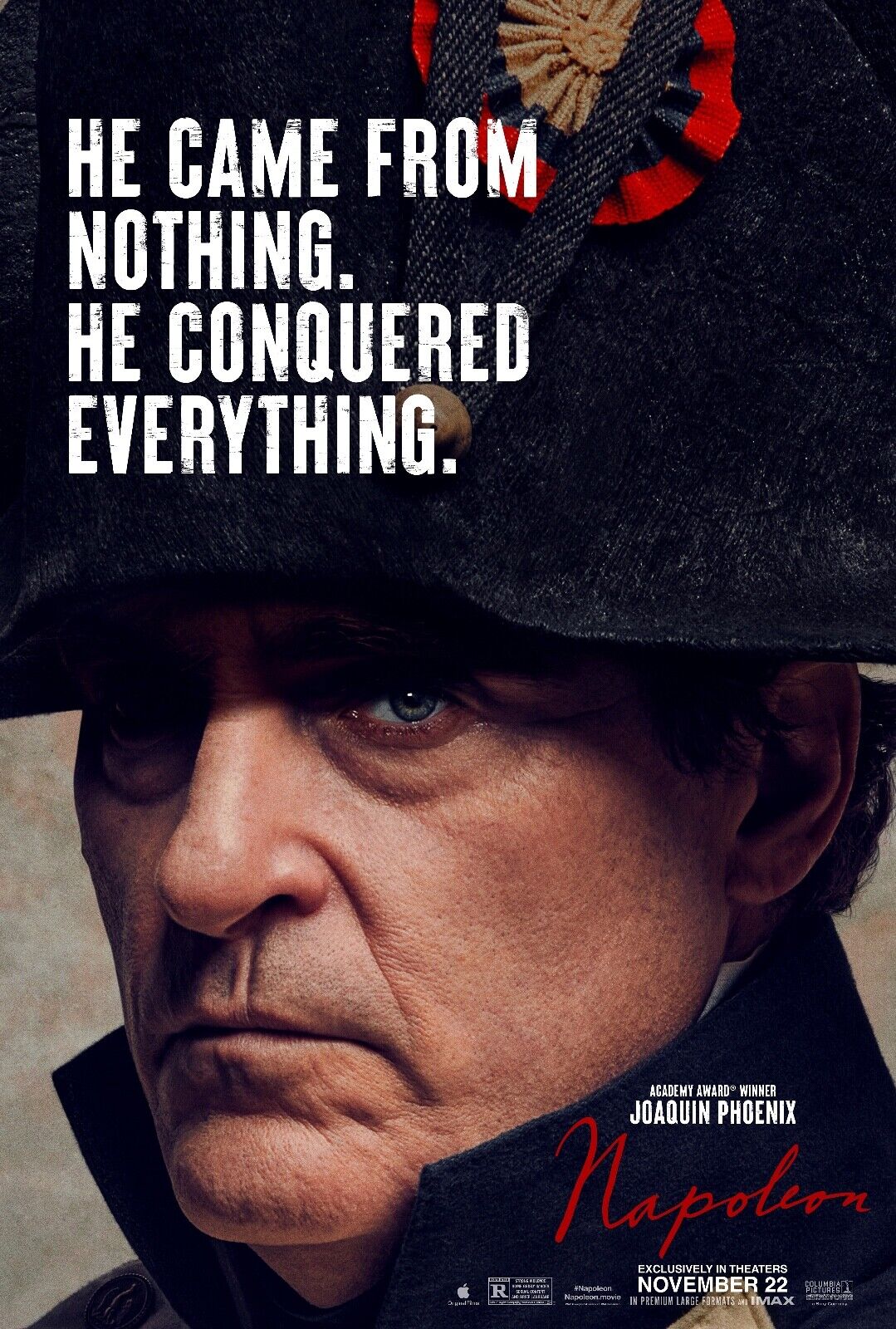
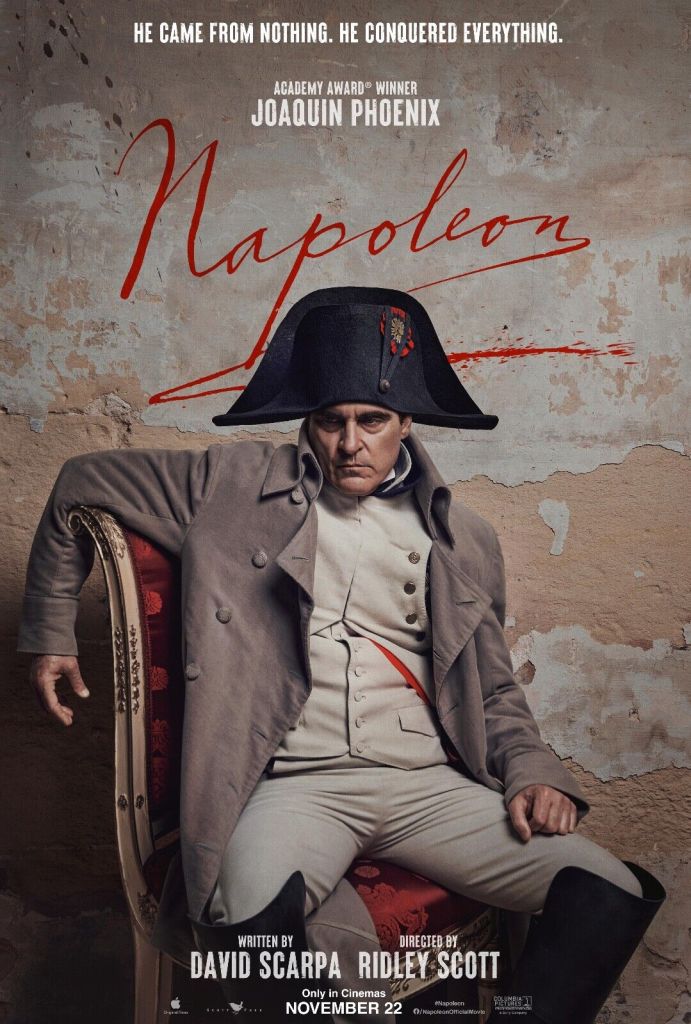
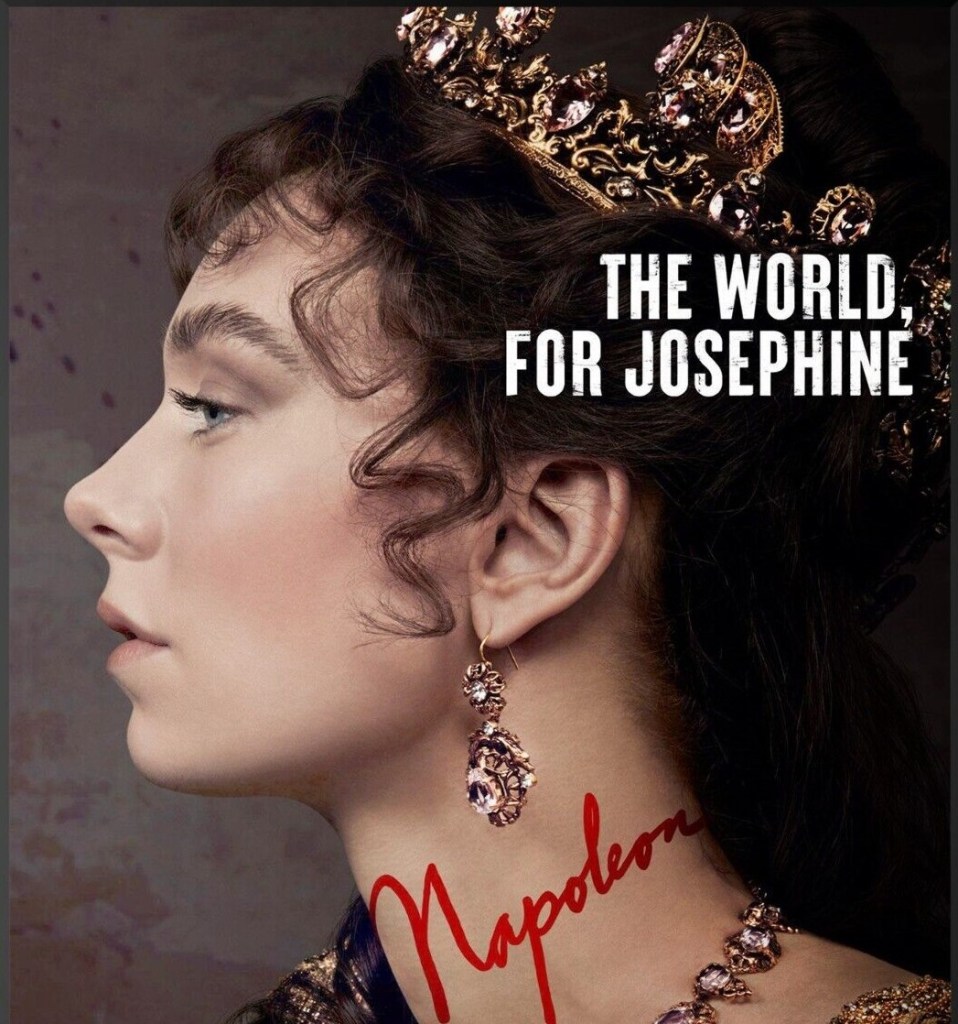
I come at this with a disadvantage since I’m all Napoleoned-out what the various Abel Gance projects and that of Stanley Kubrick. So I suffer from over-familiary with the subject matter. Most of the audience won;t have viewed a Napoleon movie in their lifetime, but I’ve already sat through six-seven hours of this material.
In the end length defeats them all, the magnitude of the task of encapsulating an extraordinary career ends up as a mad dash through history. Setting any deliberate distortions aside, those scenes fictionalized for dramatic effect providing directors with a free pass, it’s just too much to find a central thread on which to encompass the man. Here, Ridley Scott makes a good stab at using romance as that glue, but it’s hampered by the great emperor (Joaquin Phoenix) being such an oaf in terms of seduction. Although he is as ruthless as any dictator whose risen from poverty to the absolute heights.
On the other hand, Josephine (Vanessa Kirby) is shown as a more complex character in more complex times, effectively taking up with this oaf for mercenary reasons, her clever plan only coming adrift because she cannot provide him with an heir. I doubt if that many among the audience are looking for an actual history lesson, which is just as well, because it feels, in part because of length restrictions, that this is inevitably going to come up short.
Little is made of the political situation in a world terrified of the revolution that changed France seeping into the countries of Europe. Theoretically, Britain was a democracy, but in reality it was ruled by an elite land-owning cabal, with poverty as rife as in France. Every other country in Europe had an unelected monarch. So Napoleon didn’t so much intend to conquer Europe from power lust but prevent his country being attacked by those who feared an end to the status quo.
Of course, if you had included more history you would have to accommodate an endless stream on one-line characters trying to explain the situation. Scott makes more use of subtitles to provide the audience with its historical bearings but still isn’t afraid to simply fall back on the Austerlitz trick of using protocol to announce a new one-line character.
In terms of actors, this has more the feel of a mini-series than a movie. Hardly anyone of box office significance and being weighed down with British character actors, virtually nobody is on screen long enough to make a mark. Certainly, none command the screen the way the veterans of the old-style all-star cast like Ralph Richardson (Khartoum 1966) or John Gielgud (Becket, 1964), and I’m sorry but Rupert Everett as the Duke of Wellington is sorely miscast.
Anyway, you could go through this entire picture pulling it to pieces, instead of concentrating of what does work. Napoleon’s insecurities contrast nicely with his rampant ambition and arrogance and every now and then someone delivers a historical bon mot. As annoying as it is, I doubt if many males of the period gave any thought to female pleasure during sex, so Napoleon’s amateur love-making can be ignored.
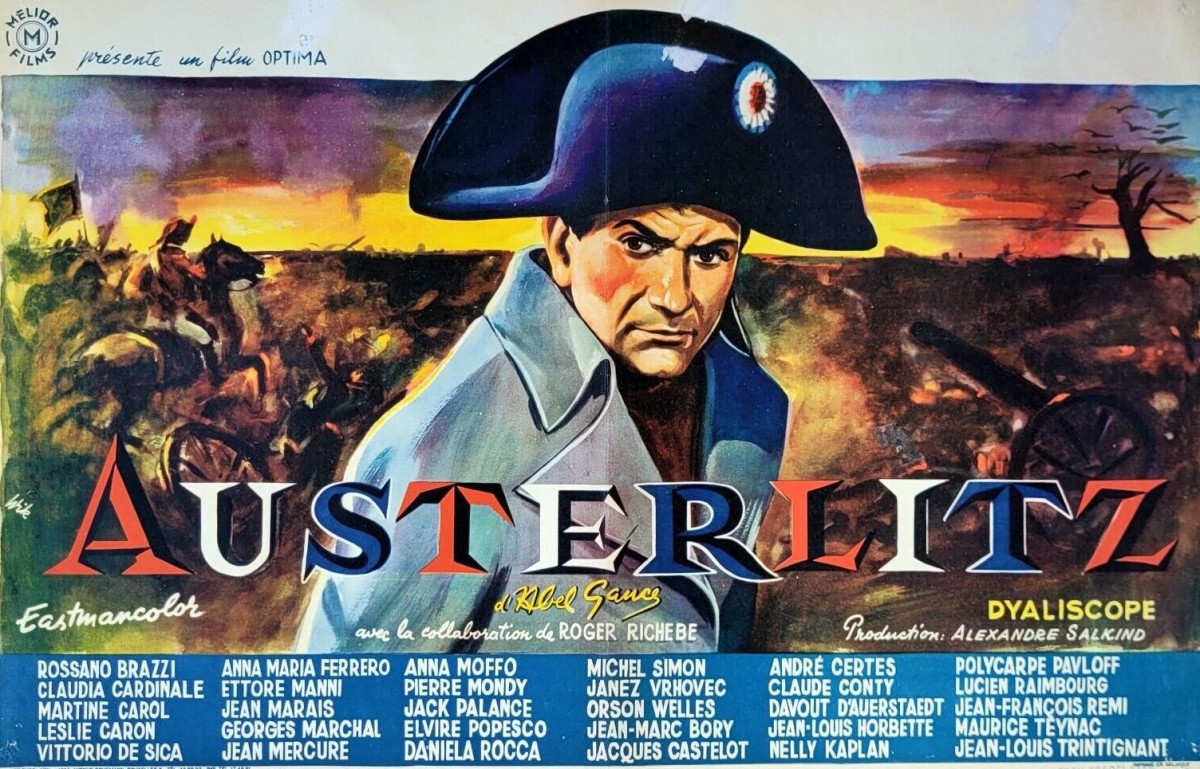
Except for the verbal sparring with Josephine, it’s the military duels that bring this up to scratch at least within the Ridley Scott canon. The taking of Toulon, the bloody putting down of the royalist revolt and Austerlitz are the outstanding scenes, though anybody who has dared to sit through Abel Gance’s Austerlitz might not come out thinking the frozen ice splintering is quite as novel as it might appear.
I’m guessing that the four-hour version planned for streaming might fill in some of the holes, but I’m worried that, like Austerlitz, it will be more of the boring stuff, a potted history filled out with more balls and costume-heavy scenes. If this is all the insight into the life of Napoleon that $200 million buys, then it will take another streamer with even deeper pockets to make a serious dent at tackling the full story of Napoleon.
I usually go back to see a Ridley Scott film at least once – I saw The Martian (2015), Gladiator (2000) and American Gangster (2007) four times each in the cinema – but I’m not sure this holds the same attraction. The director’s cut of Kingdom of Heaven (2005) even with a miscast Orlando Bloom totally transformed that movie so I’m hoping the longer version here might achieve the same. But the latter had a marvellous score, which I had bought as a CD and was a virtual earworm for me, whereas the music here is an uneven as the picture.
I’d love to give this a better score, especially as it may be the director’s last cinematic outing, but it’s too disappointing.
At the height of his power after the tremendous critical and commercial success of 2001: A Space Odyssey (1968) you wouldn’t have wagered on Stanley Kubrick being outfoxed by Italian uber-producer Dino De Laurentiis. But the latter’s Waterloo (1970) was the prime reason why MGM shuttered Kubrick’s ambitious project. It’s not the reason it was never eventually made – money was.
At one point, it looked as if the movie would shift over to Columbia, which had funded the director’s previous hit, Dr Strangelove (1964), and thence to United Artists – production scheduled to start in September 1970 – before ending up in the lap of Warner Brothers, which would prove Kubrick’s home for the next few decades.
One of the reasons WB was so keen was that it had greenlit a movie by British director Bryan Forbes called Napoleon and Josephine. This was to follow The Madwoman of Chaillot (1970), a project he had taken over at the last minute after John Huston bailed. But it never went ahead because Forbes instead took over as head of production at British studio EMI. To have considered the project in the first place, despite facing competition from Waterloo, would have meant WB viewed the idea as a financailly sound.
The bigger problem, commercially, was that two events coalesced. By the end of the 1960s, the 70mm roadshow was on its last legs. It still continued in haphazard fashion into the early 1970s, but scarcely with the vigor and elan that had produced such different movies as Lawrence of Arabia (1962), It’s A Mad, Mad, Mad, Mad World (1963), Doctor Zhivago (1965) and The Sound of Music (1965) that set fire to the global box office.
As important, studios hit a financial wall at the end of the 1960s as over-investment in all sorts of unlikely roadshow vehicles, often musicals, came back to bite Hollywood. And with Easy Rider (1969) cleaning up, the message to Hollywood was mean and lean.
So a project that could top out at $30 million – even with Jack Nicholson, Audrey Hepburn and David Hemmings involved – and inevitably run over budget, take well over a year to complete and appear when who knew how the movie landscape would have changed, and working with the only director from whom no studio executive in their right mind would dare seize control, this version of Napoleon was put on the back burner, resurrected every time Kubrick had a hit.
As well as the massive book, there were coveted extras, accessed via this card fixed to the inside front cover of the Taschen publication.
When MGM pulled out it was deemed “one too many…ultra-high budget commitments for the studio,” one of the hardest hit by financial turmoil. Columbia, it transpired, had only toyed with the idea. Warner Brothers built up the notion of coming to Kubrick’s rescue with Variety headlines such as “Costume Epic Due Anew? WB Hunch,” that appeared in Variety in 1972. It was the kind of movie that you almost expected an operation looking to grab Hollywood attention, say new ventures like Cannon or Orion, to pick up.
While Waterloo (1970) was seen as the main obstacle, coupled with the fact that one of the reasons Abel Gance’s Napoleon had stiffed way back in the silent era was American audience indifference to the French Emperor, it has to be said Hollywood would have noticed that Kubrick faced more competition than just De Laurentiis. Wider awareness of subject matter might have come from an unusual source, since Barbra Streisand was contemplating starring in a new Broadway musical about Napoleon and Josephine,
That there was continued interest in Napoleon was proved with the release of Fielder Cook’s Eagle in a Cage (1972), starring Kenneth Haigh (The Deadly Affair, 1965) and Billie Whitelaw (Leo the Last, 1970) and British acting royalty like John Gielgud (Khartoum, 1966) and Ralph Richardson (The 300 Spartans, 1962). This was limited to Napoleon’s exile, and was funded by a newcomer, Group W, its biggest-ever production gamble, albeit with a budget of only $1.25 million. The Brits proved pretty keen on the subject matter, a television mini-series Napoleon and Love (1974) up next starring Ian Holm (Chariots of Fire, 1981).
Interest never dwindled. There was a French musical in 1985 and a French mini-series at the turn of this century with an all-star cast including Christian Clavier (Asterix and Obelisk: Mission Cleopatra, 2002), Gerard Depardieu (Green Card, 1990) Anouk Aimee (A Man and a Woman, 1966) and Isabella Rossellini (Blue Velvet, 1986).
The larger obstacle had always been the budget which the new Ridley Scott picture has overcome thanks to the deep pockets of Apple.
Just how far the ever-obsessive Kubrick got with his project can be seen from the gigantic tome – Stanley Kubrick’s Napoleon: The Greatest Movie Never Made – running to 1100 pages, published by Taschen and now a collector’s item, copies changing hands for up to $2,000, containing not just the entire script, but all the details he had already filled in of costumes, locations, budget, and even his own thinking, as revealed in a series of interviews with collaborators. The book is crammed full of photographs and it’s a good a testament to a film that never was as you’re likely to find. I have a copy and can attest to that.
Surprisingly, there’s a happy ending. Apparently, Steven Spielberg is taking up the Kubrick mantle. HBO, not shy of spending gazillions as proven by Game of Thrones, has enlisted the director to make an eight-part mini-series based on the Kubrick screenplay. And although officially in retirement, Jack Nicholson is the first big name signed up.
Old legends never die.
SOURCES: Alison Castle, Stanley Kubrick’s Napoleon (Taschen, 2009) ; “Kubrick To Make Napoleon for MGM Next Year, Box Office, July 22, 1968, pE7; “Kubrick’s Napoleon not for MGM May Go Via Columbia,” Variety, January 1, 1969, p5; “Forbes Has Full Reign on Napoleon and Josephine,” Box Office, January 6, 1969, pW3; “Kubrick’s Napoleon to UA,” Variety, January 15, 1969, p21; “Newley-Steisand for Broadway Tuner on Nappy-Josie,” Variety, July 2, 1969, p1; “Group W Biggest Theatrical Feature,” Variety, September 10, 1969, p7; “Gaffney as Kubrick Assisant on Napoleon,” Variety, October 19, 1969, p25; “Costume Epics Due Anew? WB Hunch,” Variety, January 12, 1972, p6; Advert, Napoleon musical,” Variety March 13, 1985, p120; Peter White, “Steven Spielberg Says Stanley Kubrick’s Napoleon 7-Part,” Deadline, Feb 21, 2023.
If I’d seen this first, I might well have resisted the publicity tsunami that welcomed in 1981 the restoration reissue of Abel Gance’s silent epic Napoleon (1927). It’s the equivalent of John Ford following up The Searchers (1956) with something as clunky as Cannon for Cordoba (1970).
Oddly enough, the first few minutes are outstanding in telegraphing the French leader’s myriad insecurities. He forces a flunkey not only to break in his stiff new shoes – for fear the master of all he surveys be seen limping along – but also his new hat and then cheats when he undergoes the self-imposed ritual of being measured, pushing up on his toes to elevate his height by two inches from its genuine five foot two inches.
After that splurge of exquisite exposition, it goes not so much downhill as up and down ever narrative pathway possible. No wonder Ridley Scott felt that encompassing this particular life required at least four hours (the length of the planned streaming version) and that Steven Spielberg aims to devote seven hours to the subject when he revisits Stanley Kubrick’s script for HBO.
Mercifully, this part of the Napoleon legend is truncated to just three years, from the Treaty of Amiens in 1802, which purportedly brought peace to Europe, to the Battle of Austerlitz in 1805 when the French commander-in-chief demonstrated his military genius and shredded his opponents. But that battle is an almighty time coming.
In between, we have to put up with endless balls and endless characters shuttling through doors, although following the protocol of the time at least we have a clue who they are since they are announced by another flunkey in advance of their appearance. You would need Google open to check out who exactly they all are and what part they play.
Roughly, the story goes: Napoleon (Pierre Mondy) is attempting to achieve the “unification of Europe” (as would occur by more peaceful means over a century and a half later). The rest of Europe, naturally, isn’t in agreement so when foreign countries are not despatching assassins or reneging on treaties they’re lining up armies against him. Things are just as tough domestically. Even though, by overwhelming public vote, he has been named Consul for Life, he hankers after reviving the old title of Emperor, despite the last owner having his head chopped off.
Plus, there are problems on the romantic front, wife Josephine (Martine Carole) has taken a lover and is jealous of the imminent arrival of his former Italian lover. All in all, it’s a pretty busy affair with countless sub plots, including an attempt to dupe the English into thinking he plans to invade their country via Ireland, and American inventor Robert Fulton (Orson Welles) trying to sell him on the notion of an ironclad steamship and submarine. Even when he gets to war, it’s nothing but chatter and subterfuge, various underlings almost rebelling at his, according to them, lack of military skill and troops disobeying orders.
The battle also lacks that essential ingredient, of the audience being told exactly what’s going on and understanding just how clever a maneuver might be, and although there are thundering horses aplenty it comes nowhere near the scale and grandeur he achieved with Napoleon, nor, it has to be said, the later Waterloo (1970), except for the horses and men disappearing under the frozen lake.
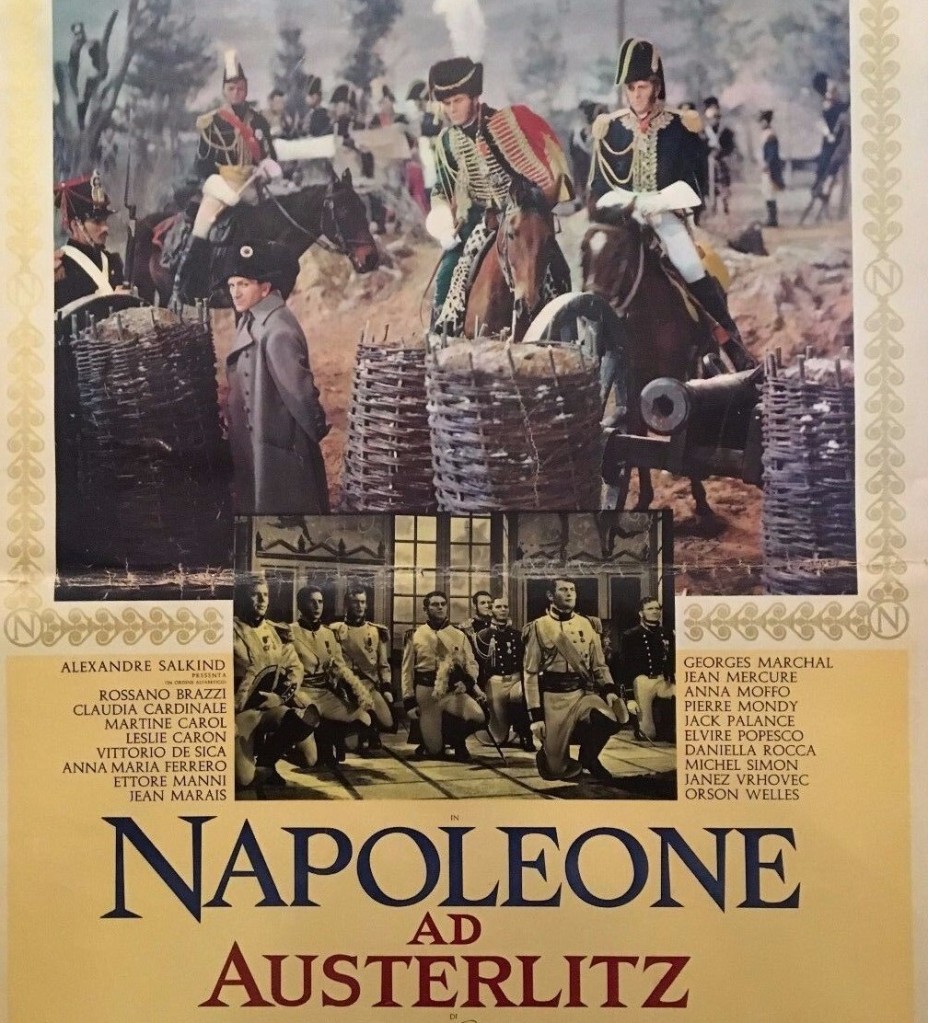
It was the fate of Abel Gance to be ruthless edited, his monster Napoleon chopped by two-thirds for original U.S. release, this one losing one-third of its running time, though I suspect what was cut out was no great loss, assuming it was just more rigmarole and costume drama set around his court, although it might have helped in working out what part his sister Pauline (Claudia Cardinale) and Mlle de Vaudey (Leslie Caron) play in the proceedings. Though we could have done with less of the Austrian General Weirother (Jack Palance with an execrable accent). Pauline has the best line in the whole endeavour, refusing to sit on a couch because its color clashes with her outfit.
Nestling among the all-star cast you’ll find – or not, depending on which version you view – names like Vittorio De Sica (The Shoes of the Fisherman, 1968), Rossano Brazzi (The Battle of the Villa Fiorita, 1965) and Jean-Louis Trintignant (Les Biches, 1968).
Nobody does much to earn their crust and Pierre Mondy (The Night of the Generals, 1967) just looks irritated beyond belief that he got mixed up in this.
Far from director Abel Gance’s finest moment. Little more than an elongated information dump.
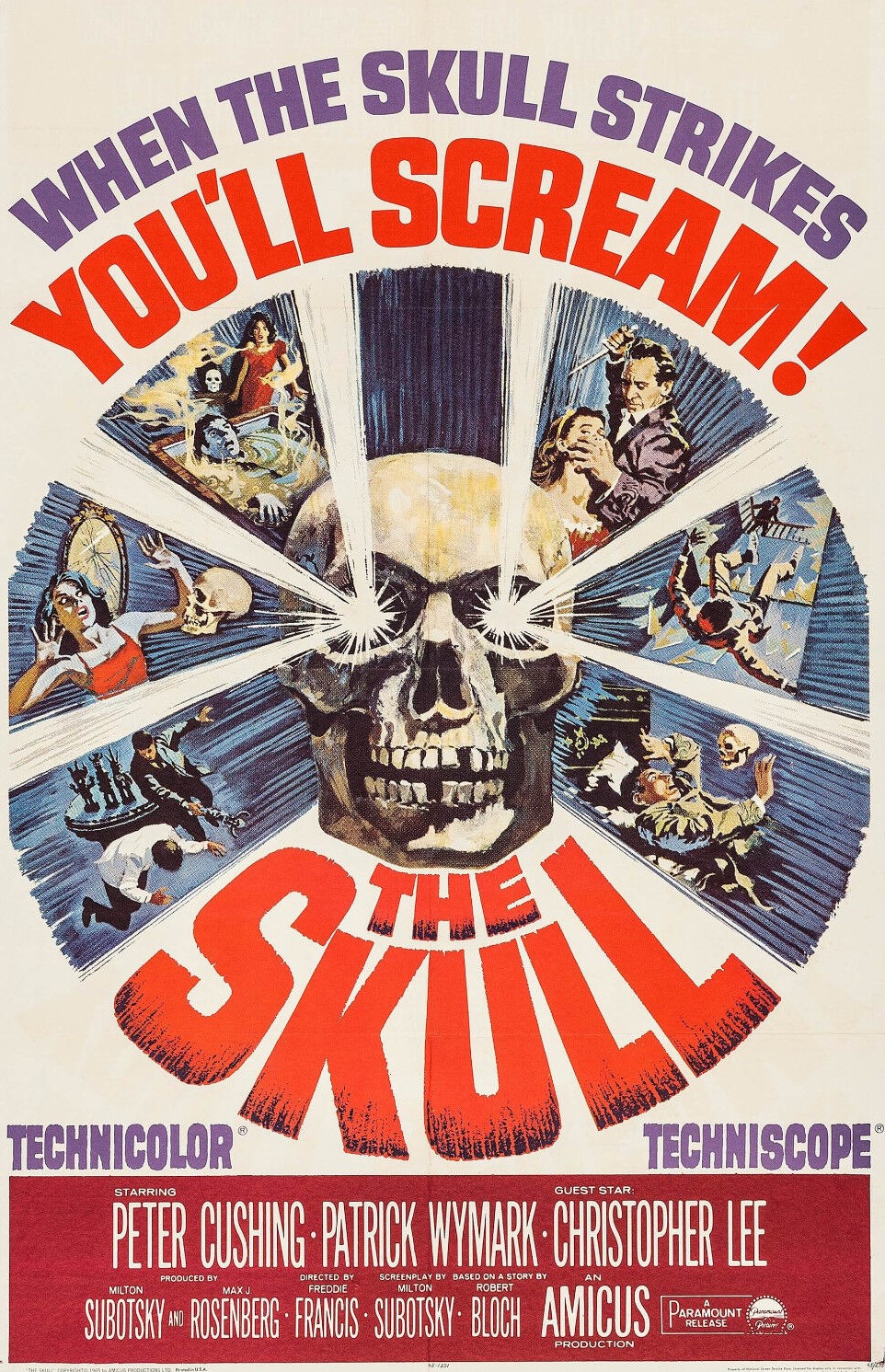
I have no idea why this masterpiece has not been acclaimed. For virtually half the picture, there is no dialogue, the entire focus on camerawork and reaction. Even Stanley Kubrick in The Shining (1980) gave in to grand guignol and The Exorcist (1973) was filled with over-the-top scenes but here the psychological impact of possession remains confined.
Initially, it appears we are in familiar Hammer territory, a grave-robber detaching a skull from a corpse only to meet an untimely end. There is another flashback to the gothic where the presence of the skull drives an order man to murder. But this is an Amicus production and set in contemporary times where Christopher Lee and Peter Cushing are once again in opposition, but this time only in an auction house bidding for demonic artefacts.
Exposition is straightforward. Dealer Marco (Patrick Wymark) sells Maitland (Peter Cushing) a book about De Sade bound in human skin. Marco may be a con man. He claims to possess the skull of the Marquis de Sade but his attitude towards it, kissing its head, plucking its nose socket, and the fact that he willing to halve his asking price, suggest otherwise. Sir Matthew (Christopher Lee), who once owned the skull, warns Cushing against it.
The rest of the film covers Maitland’s possession of the skull and the skull’s possession of him. There is a notable Kafkaesque sequence where Maitland is arrested, taken before a judge and forced three times to play Russian roulette before ending up in the house of the dealer where he steals the skull. What is less often commented upon is that this nigh-on 15-minute sequence including a 90-second taxi ride is conducted in virtual silence, the camera mostly on Maitland’s face, that silence only broken by the feeding of bullets not the barrel of the gun and the barrel being rolled round. It is not long before Maitland commits his first murder.
There is a famous scene in the Last Tycoon (1976) in which Robert De Niro explains to a truculent word-obsessed British writer why dialogue is redundant in the movies. All you need is camera and reaction. That sets up The Skull’s greatest scene, a 17-minute dialogue-free climax, where Maitland is effectively preyed upon and consumed.
The skull itself appears to have a point-of-view, various shots of Maitland through the skull’s eyes. The actual special effects are limited to what is imminently achievable, the skulls glows, it moves through the air. The impact of its presence is shown on Maitland’s face and by his action. It is just hypnotic.
Various directors have been anointed for the way they move their camera – Antonioni’s 360-degree turn in The Passenger (1975) comes to mind, large chunks of 2001: A Space Odyssey (1968), the long wait for sunrise in Lawrence of Arabia (1962), the lengthy shots of James Stewart driving a car in Vertigo (1958). But I have never seen anything as innovative as the silent sequences in The Skull which would be a waste of innovation were the sequences not so effective, especially on the small screen. Freddie Francis (Nightmare, 1964) directed from a story by Robert Bloch (Psycho, 1960). Equally innovative is the jarring music by avant-garde composer Elizabeth Lutyens.
In the role of his career, Peter Cushing (Dr Who and the Daleks, 1965) turns on the style, his character virtually turning 360-degrees as he becomes enmeshed in diabolic terror.
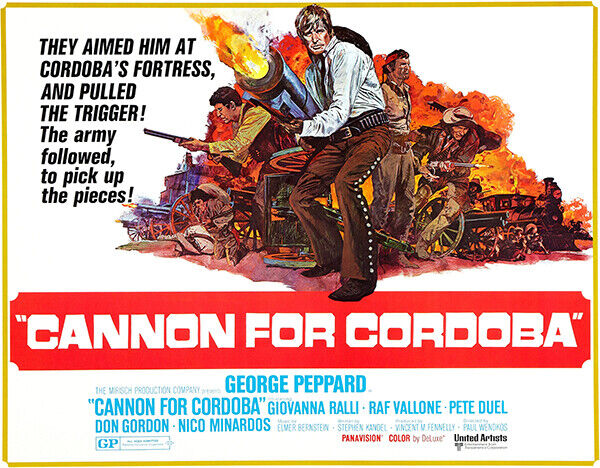
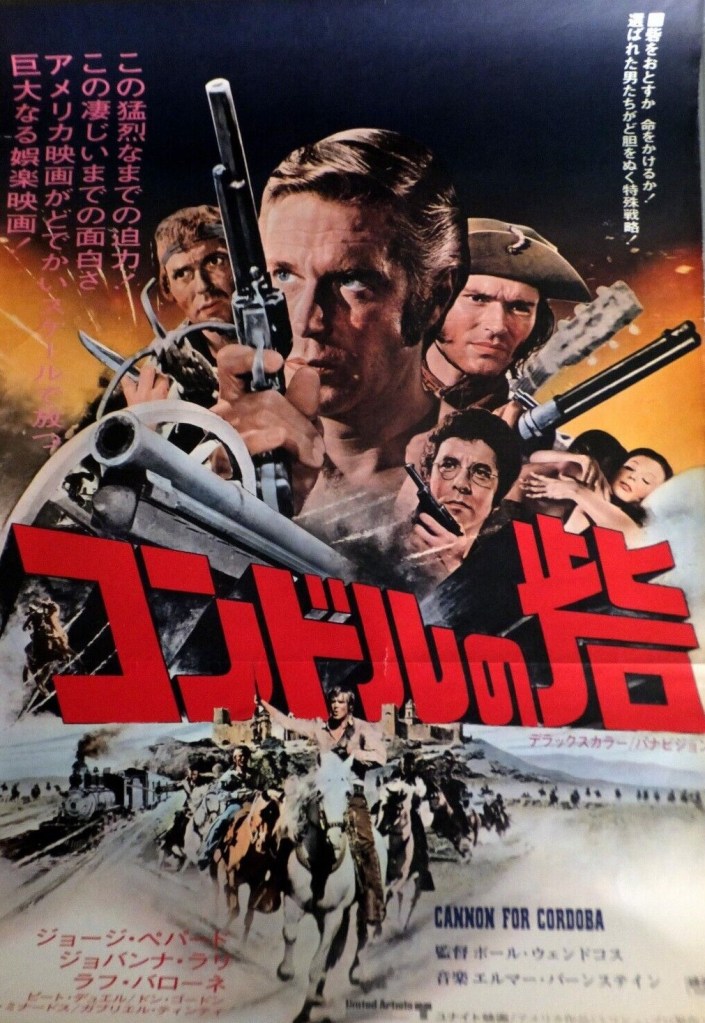
Why settle for a measly Gatling Gun, as Mapache does in Sam Peckinpah’s gloriously violent The Wild Bunch (1969), when you can just as easily relieve government troops of serious artillery. It’s 1912 and the U.S. has sent General Pershing (John Russell) into Mexico with the titular weaponry in a bid to subdue Mexican rebels led by the titular Cordoba (Raf Vallone) raiding across the border and annoying powerful ranchers like Warner (John Larch).
Over-plotted to within an inch of its life and atmospherically indulgent – the natives are constantly whooping it up – and with star George Peppard trying out cigars for size for future enterprises like The A-Team (American television 1983-1987), this comes up short when compared to similar hard-nosed incursions into enemy territory like The Professionals (1966) and The Dirty Dozen (1967).
It’s a movie of many – too many – parts. First of all, we have rebellious U.S. soldier Capt Douglas (George Peppard), who gives superiors the finger, packed off with a small team to infiltrate the rebel army and find out what they’re up to. Not that that would require any infiltration. It’s pretty obvious with a prize plum like artillery suddenly arrived, the rebels are going to chance their arm and steal it.
Lo and behold that’s exactly what Douglas’s gang – which includes Jackson Harness (Don Gordon) quickly embittered because the good captain, in order to maintain his disguise, refuses to save one of his captured team being slowly roasted over a pit – does discover. But they don’t quite manage to get this information back to Pershing before those dashed clever Mexicans are blowing everything to hell and stealing the train containing the guns.
So now Douglas has to put together another team, the aforementioned Harkness augmented by Rice (Pete Duel) and Antonio (Gabriele Tinti), a Mexican who wants Cordoba brought to justice, and a few others, and infiltrate the Mexican stronghold. Along the way, they acquire the assistance of the beautiful Leonora (Giovanni Ralli) who is willing to use her body any which way (not going quite as far as Marianna Hill in El Condor out the same year) to gain revenge for Cordoba slaughtering her family and raping her. That last aspect seems a psychological stretch, but what the hell, how otherwise will the gang get close enough to the rebel leader.
Of course, just to sauce up the story, as if anything more is required, they are captured and need to bust out of jail and what with one thing and another it takes a goodly time before they can get close to achieving their objective. And that’s not to mention the betrayal that simmers in the background, Leonara having her own way of getting close to Cordoba, Warner not quite as right-minded as he appears, and the aforementioned Harkness waiting for the right moment to blow away his leader.
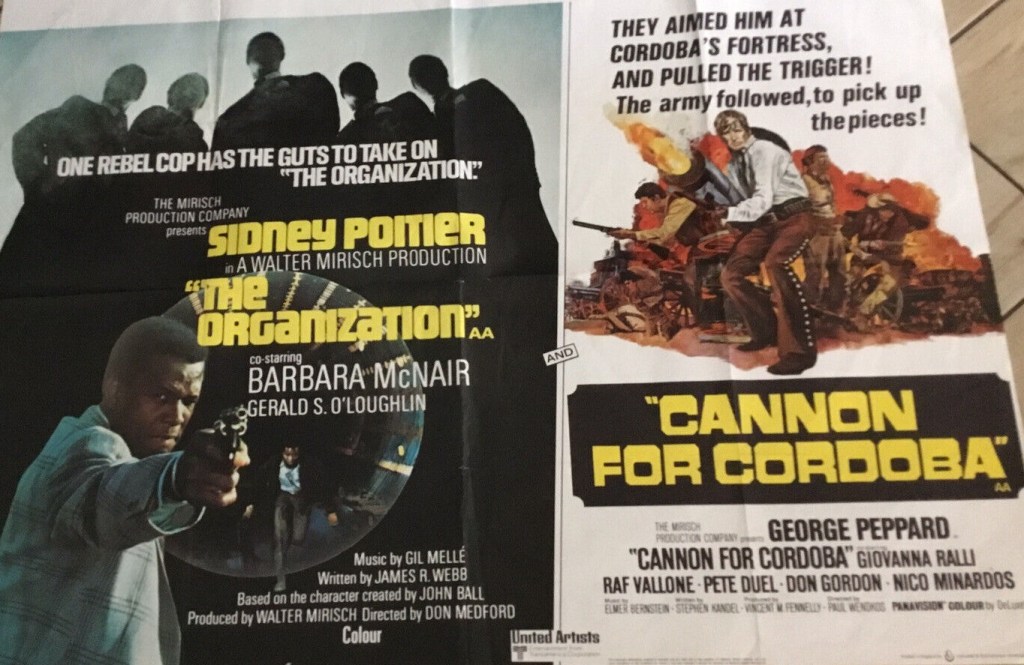
Not too well received, the movie went out in the supporting role in a double bill.
Plenty explosions, plenty action, and plenty living it up, scantily-glad women appearing at every turn, firecrackers going off, dancing in the streets, but somehow too much of this scrambles the focus while subsidiary characters take center stage too briefly too often, as with rebel women in the 100 Rifles (1969)-Raquel Welch mold. It gets there in the end of course but you just wish it would hurry up or expend more of its running time on developing the main personnel.
George Peppard (The Groundstar Conspiracy, 1972) is having a ball, but that’s only because every other character is so reined-in and there’s little else character-wise for him to hold onto. It wouldn’t have taken that much for him to command center stage, for competition in the acting stakes he’s only got Raf Vallone (The Cardinal, 1963), in worldly-wise form, and Don Gordon (Bullitt, 1968), stewing away. Giovanni Ralli (Deadfall, 1968) arrives too late in the proceedings to make much impact. Pete Duel (Alias Smith and Jones, 1971-1973) looks cute but has little to do.
Diligently put together by Paul Wendkos (Guns of The Magnificent Seven, 1969) but coming across as trying too hard, from a screenplay by Stephen Kandel (Chamber of Horrors, 1970).
Enjoyable if you enjoy shoot-em-ups, and even more if you’ve been charting the career of George Peppard who here makes the switch from all those uptight characters of the previous few years to letting a whole lot more hang out.
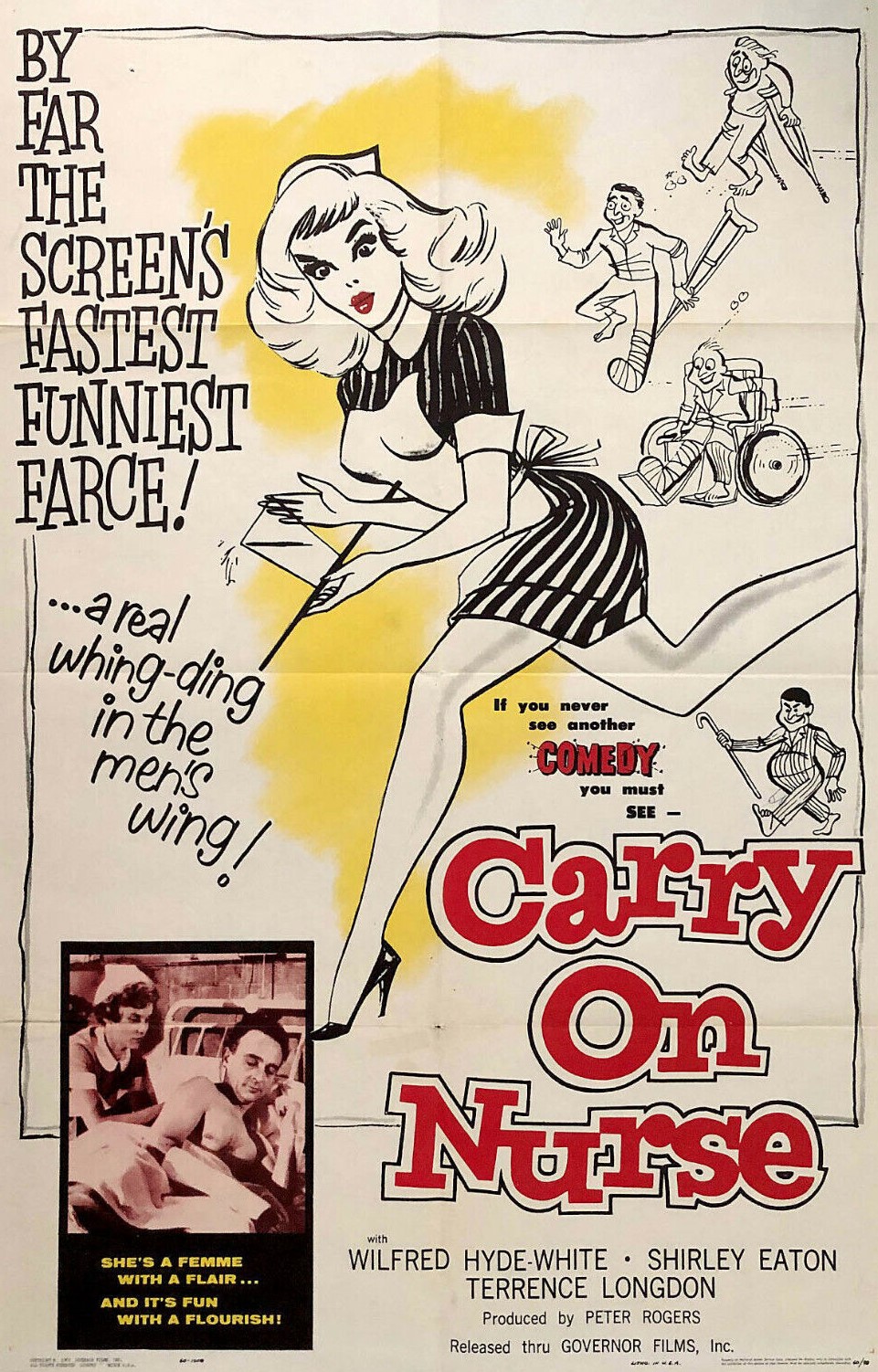
There was no greater divide between audiences and critics in Britain than the long-running comedy “Carry On” series (outside of an occasional satirical bulls-eye like Carry On Up the Khyber, 1968). And a similar gulf existed between the type of audiences the movies attracted in Britain and those in America. In Britain they were vastly popular general releases while in America their usual habitat was the arthouse as if they were seen as the natural successors to the Ealing comedies. And there was a third chasm – between the endearing risqué early comedies and the more lascivious later versions.
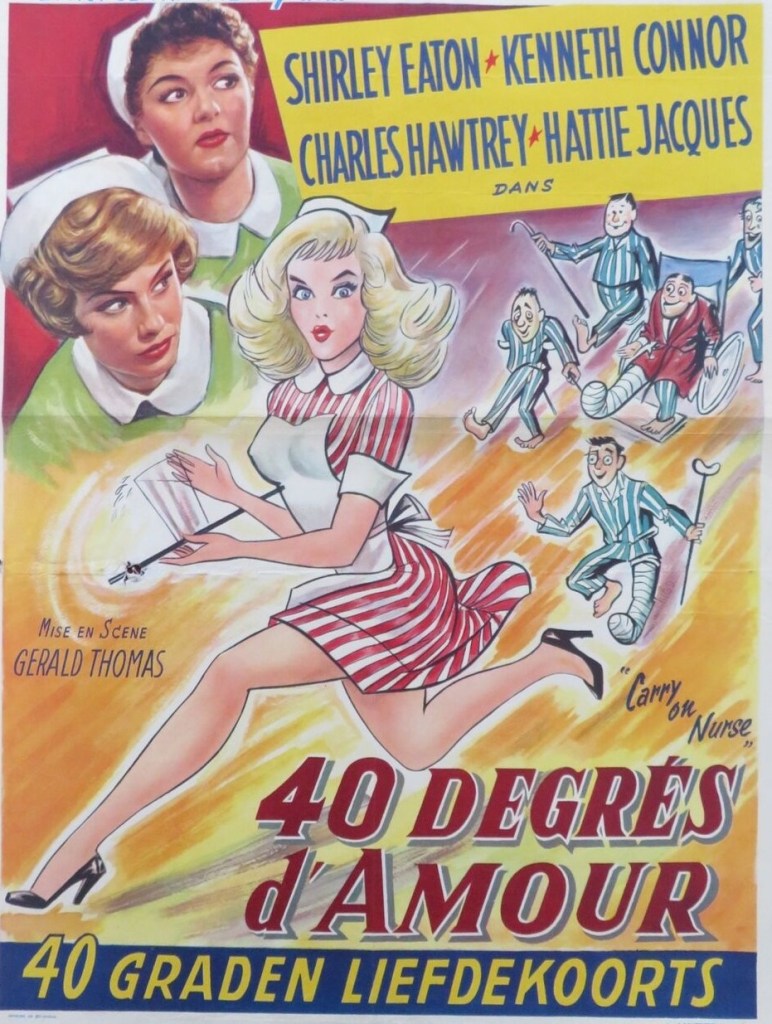
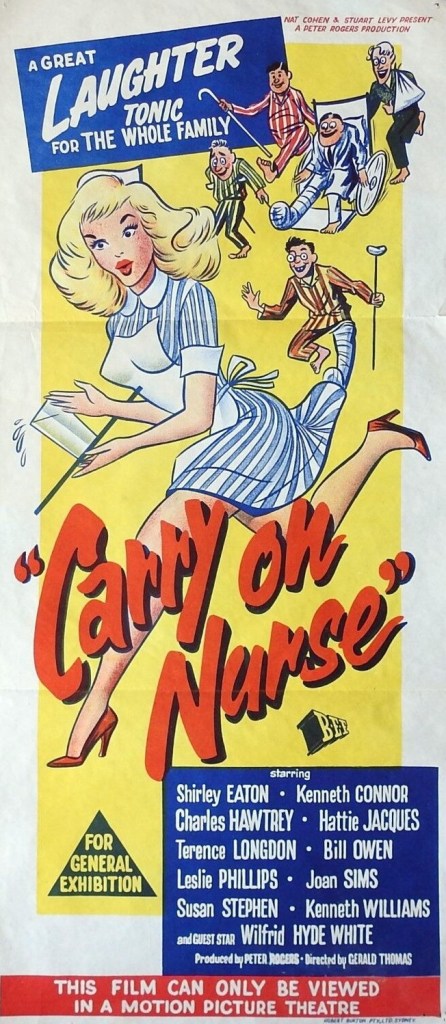
Carry On Nurse fell into the endearing camp. The humor was gentle rather than forced, the emphasis on misunderstanding and innuendo and smooth seducers like Leslie Phillips rather than exposed female flesh and the grasping likes of the ever-chortling Sid James. Perhaps you could define this earlier film as pre-nasal Kenneth Williams, his peculiar type of delivery not yet at full throttle. Here there is innocence rather than lust and the males quake in fear not just of the indomitable Hattie Jacques in brusque matron mode but of the other efficient nurses led by Shirley Eaton who have the measure of their rather hapless patients, although student nurse Joan Sims – making her series debut – is an accident-prone soul.
And they say comedy doesn’t travel.
The action is mostly confined to a male ward. There are plenty of gags – alarms rung by mistake, boiling catheters burned to a turn, medication making a patient go wild, patients intoxicated by laughing gas and the famous replacement of a rectal thermometer by a daffodil. Wilfred Hyde-White as a constant complainer and obsessive radio listener Charles Hawtrey provide further ongoing amusement.
But the thrust of the story is romance. Journalist Terence Longdon fancies Shirley Eaton but his initial advances are spurned as she is in love with a doctor. In a role far removed from his later brazen characters, Williams plays a shy intellectual who finally comes round to the charms of Jill Ireland (later wife of Charles Bronson). Although Leslie Phillips is his usual suave self, he makes no designs on the female staff since he has a girlfriend elsewhere and his ailment – a bunion on the bum – makes him an unlikely candidate for a hospital liaison.
Hattie Jacques is in imperious form, Shirley Eaton shows what she is capable of, Kenneth Williams playing against type is a revelation.
British critics hated the “Carry On” films until late in the decade when Carry On Up the Khyber (1968) hit a satirical note. Critics felt the movies pandered to the lowest common denominator and were a poor substitute for the Ealing comedies which had given Britain an unexpected appreciation among American comedy fans.
It was a well-known fact the comedies did not always travel. Apart from Jacques Tati, the more vulgar French comedies featuring the likes of Fernandel were seen as arthouse fare. Unless they featured a sex angle or the promise of nudity, coarse Italians comedies struggled to find an international audience. The “Carry On” films were bawdy by inclination without being visually offensive
Carry On Sergeant (1958), the first in the series, had been a massive success in Britain. Distributor Anglo-Amalgamated was so convinced it would find a similar response in the U.S. that it was opened in New York at a first run arthouse. Although comedies were hardly standard arthouse fare, this was generally the route for low-budget British films. The picture lasted only three weeks and taking that as proof of its dismal prospects other exhibitors ignored it.
The follow-up Carry On Nurse (1959) took an entirely different route when launched in America in 1960. This time New York would be virtually the last leg of its exhibition tour. Instead it opened on March 10 at the 750-seat Crest in Los Angeles. Away from the New York spotlight, the little movie attracted not just good notices but decent audiences.
Instead of being whipped off screens after a few weeks, it developed legs. In Chicago it ran for 16 weeks in first run before transferring to a further 50 theaters. Within a few months of opening it had been released in 48 cities. In Minneapolis it was booked as a “filler” at the World arthouse, expected to run a week and no more. Instead, it remained for six weeks and when it shifted out to the nabes out-grossed Billy Wilder’s big-budget comedy The Apartment (1960) with a stellar cast of Jack Lemmon and Shirley Maclaine.
In its fourth month at the 600-seat Fox Esquire in Denver where it opened in May, it set a new long-run record for a non-roadshow picture. It had been taking in a steady $4,000 a week since opening.
SOURCES: “How To Nurse a Foreign Pic That’s Neither Art nor Nudie: Skip N.Y.,” Variety, Aug 24, 1960, 3; “British Carry On Nurse A Sleeper in Mpls With Long Lopp Run, Nabe Biz,” Variety, Aug 24, 1960, 18;
Note: by and large this blog follows American release dates so although Carry On Nurse was shown in Britain in 1959 it did not reach America until 1960.
A post-WW2 operation to save a handful of Japanese adrift at sea in a storm is endangered when three members of the U.S. Air Force Air Rescue Service confront conflicts from their past. Despite tense rescue action, this is basically a three-hander about guilt and how men deal – or fail to deal – with emotions. Extended flashbacks illuminate the tangled relationships between Sgt Takashima (Yul Brynner), Lt Col Stevenson (Richard Widmark) and Second Lieut Gregg (George Chakiris). Unusually, for the period, tough guys actually emote.
So really it’s like one of those portmanteau films that are occasionally popular – like Trio (1950) made up of Somerset Maugham short stories or similar to something like the Oscar-winning Crash (2004) where characters interconnect after an accident. While each of the episodes stands up in its own right, the thrust of the narrative revolves around actions taken in the past having a direct bearing on the present situation.
Gregg is haunted by causing an avalanche after flying his helicopter too close to a mountain and, as a result, by having to leave behind many of the victims, due to restricted capacity on board, and now he is terrified of flying solo. As a consequence Stevenson has no faith in abilities as a pilot.
Stevenson also has an abiding hatred of Japanese – colleague Takashima of Japanese ancestry also bears his wrath – because his ill wife Caroline (Shirley Knight) and child died in a Japanese prisoner-of-war camp because medical supplies were reserved only for the Japanese. Faced with rescuing Japanese, he is enraged.
For his part, Takashima, a paratrooper during the war, inadvertently caused the death of his Algerian girlfriend Leila (Daniele Gaubert). It’s not so much an examination of tough guys under pressure as about their inability to deal with the consequences of action. There’s certainly a sense that the only way men like these have of dealing with trauma is to throw themselves into dangerous action.
Yul Brynner (The Double Man, 1967) gives a more thoughtful performance than you might expect while Richard Widmark (The Secret Ways, 1961), himself dabbling in production elsewhere, was good value. Goerge Chakiris (The Young Girls of Rochefort, 1967) was a weaker link. The presence of Suzy Parker (Circle of Deception, 1960) and especially Daniele Gaubert (The Golden Claws of the Cat Girl, 1968) strengthen the film.
Unusually, at a time when product was in short supply and for a film boasting a strong cast, the picture was shelved for two years after completion. Presumably explained by the demise of Harold Hecht’s production company after he split with Burt Lancaster. Michael Anderson (The Shoes of the Fisherman, 1968) directed from a screenplay by Waldo Salt (Midnight Cowboy, 1969) based on the novel by Elliot Arnold (Kings of the Sun, 1963).
The title’s a bit of a misnomer, suggesting someone is trying to escape from Ashiya when, in fact, that is just the name of the air base where the rescue team are located.
Critics complained it was neither one thing nor the other, but in fact I found it a perfectly satisfactory combination of action and drama, especially as it dealt with rarely-recognized male emotions.
The selection process for my weekly Monday visit to the cinema has sorely let me down. I never refer to reviews in advance, not wishing to learn anything, however inadvertently, about the story. So, I went into this arthouse trio – all showing I hasten to add at my local multiplex – with high hopes.
May December
I find it impossible work out how anyone, least of all a brace of Oscar-winners like Natalie Portman (here listed as producer) and Julianne Moore, could seriously consider making a movie about someone convicted of child sex abuse. In this case, I guess, the excuse is that because it’s a woman it’s either a) understandable or b) excusable. But if the subject was a male sex abuser I doubt if he would be given the same latitude.
This is one of those films that would have been far better dealt with as a documentary where the facts can be treated more straightforwardly rather than deliberately clouded by fictional elements and sympathetic treatment. Supposedly, the audience is provided with perspective since the movie revolves around an actress Elizabeth (Natalie Portman) doing preparatory work 20 years after the event as a prelude to playing the character in a television movie.
The fact that Gracie (Julianne Moore), the married woman convicted of having sex with a 13-year-old boy, denies that she committed any crime, maintaining a) that it was true love and b) that she was the victim, that the boy was “in charge” and the seducer, seems a very deliberate attempt to muddy the waters. Especially, when it becomes clear that the boy, Joe (Charles Melton), now of course a man, has been forced to bury his true feelings about the subject.
With the usual showbiz entitlement, Elizabeth sees nothing wrong with disrupting what is, on the surface at least, a reasonably happy family, forcing the children of this relationship to come to terms with the fact that at least one of them was born from an illegal coupling.
Not to mention the damage this will do to the innocent children of the couple on whom the story was based, Mary Kay Letourneau (since dead) and Vili Fualaau. That Elizabeth turns out to be pretty creepy herself – explaining to a shocked teenage audience that she gets aroused during sex scenes and seducing Joe – seems to be an attempt at mitigation (oh, look, we all do crazy things once in a while!).
Saltburn
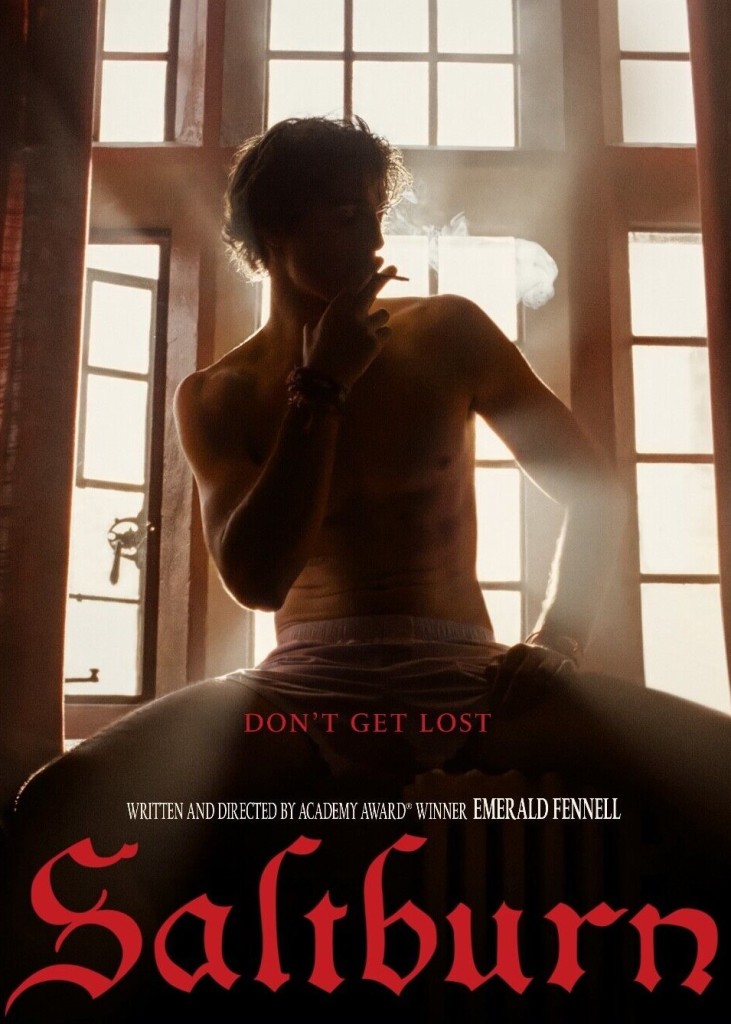
Brideshead Revisited Meets Carry On Downton Abbey. Wouldn’t surprise me if that’s the way it was actually pitched, it’s just so uneven, veering through several different styles without ever finding a target. The shock elements are, unfortunately, just risible. Via the trailer this appeared to be a moody, atmospheric picture about entitlement, the downside, if you like, of Downton.
Instead, it’s just plain barmy, which might well have worked if its take on the bizarre had been consistent, but, really it’s a contender for the coveted So-Bad-It’s-Good Award with Rosamund Pike odds-on to nab a gong for Best Maggie Smith Impression. .
Oliver (Barry Keoghan) is supposedly a scholarship student at Oxford, coming from a sinkhole estate in Liverpool, parents drug dealers etc etc. Out of his depth, by chance he latches on to sex god Felix (Jacob Elordi) and is invited to spend the summer at the latter’s stately home complete with sneering butlers and demonic family all graduates of the Over-Acting Academy.
Turns out we’ve not been watching Downton Abbey at all, but The Usual Suspects, Oliver not an innocent little bookworm but an extremely malevolent character who manages – in the absence (luckily) of post-mortems – to bump off the entire family in order to inherit (don’t ask!) Saltburn in order to, in a bizarre nod to Risky Business, dance naked through it.
The only reason it gets any points at all is Jacob Elordi, who exhibits tremendous screen charisma, and because the barmy extremely self-centred and out-of-it Rosamund Pike does elicit a few laughs and maybe, courtesy of Richard E. Grant, has a haircut to enter some kind of Hall of Fame.
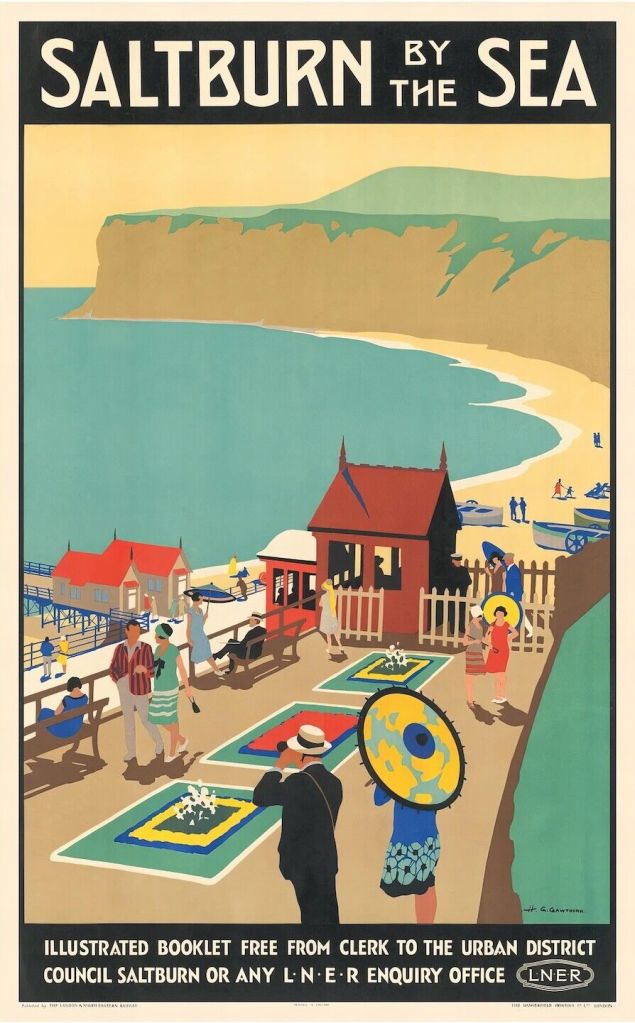
Couldn’t find a poster for “A Forgotten Man” so thought I would temper proceedings with this old British poster for a seaside resort.
A Forgotten Man
This wants to say something important about the neutrality stance of Switzerland during the Second World War. But unless you live in Switzerland, you won’t have a clue what it’s trying to say. And if you thought The Crown was off-the-wall in summoning up the ghost of Princess Diana, wait till you start counting the number of ghostly apparitions here of young Swiss chap Maurice (Viktor Poltier), whom the protagonist Henrich (Michael Neuenschwander), while Swiss Ambassador to Berlin during the war, failed to prevent being executed.
I’ve no idea if this aspect is based on a true story. Either way, fictional or not, it’s a preposterous central conceit. Supposedly, Maurice had been arrested for trying to assassinate Adolf Hitler. Theoretically, we should all be applauding his actions. He should get a free pass for trying to rid the world of a monster. But, in reality, how would you expect an Ambassador to go about pleading clemency for one of his citizens who tried to murder the ruler of Germany?
There’s clearly some angst about the fact that Switzerland managed to emerge unscathed after a war which left the rest of Europe in turmoil. But it’s pretty hard to summon any sympathy for anybody, least of all the director because whatever point he’s trying to make is made so obliquely it fails to register. That it gets any points at all is due to its brevity and that, as the first movie in my self-selected triple bill, I came out of it in a far better mood than the other two.
If you ever wondered what kicked off the fad for having live orchestras playing at screenings of older films, you might be even more surprised to discover that Napoleon (1927) was the cause. And, for that matter, created the “event” movie, another contemporary buzzword that appears to indicate a limited-time-only showing. Abel Gance’s picture also set up another template, one that every director and critic ascribed to in their thousands, the restoration. For, in one fell swoop, the revival of this picture in 1981 after over half a century of neglect, turned restoration into an event, worthy of acres of newspaper articles, hi-hat premieres, and subsequent profitable release in both the theatrical and ancillary pipeline.
Equally, as luck would have it, Abel Gance’s Napoleon (1927), truly was an event, a silent epic, the last section projected across three screens (the famed triptych, precursor of Cinerama and 70mm), road-shown with a full orchestra and ticket prices as high as $20. It became the “must-see” cultural happening of the year. American journalists gave director Francis Coppola virtually all the credit and he was certainly due everything that went with the bold showmanship and the financial risk, underwritten by his Zoetrope company, of launching the film in America’s largest cinema, the Radio City Music Hall in New York, with a complete score (incorporating classical music) by his father Carmine and the aforementioned full orchestra.
But in fact, the actual restoration had been carried out in Britain by silent film expert Kevin Brownlow – author of The Parade’s Gone By and director of It Happened Here (1965), the documentary Abel Gance, The Charm of Dynamite (1969) and Winstanley (1976) – who had compiled his version from eleven different sources including the Cinematheque in Paris, an MGM print and a seventeen-reel version from a private collector.
Thanks to Brownlow, Napoleon became “The Greatest Reissue Story Ever Told.”
Why? Because it was the result of obsession and passion, emotions every artist shares with every cinephile. Brownlow first came across Napoleon as a fifteen-year-old, and although he only glimpsed a few fragments, it was enough to trigger a quest that was to last nearly thirty years. Ironically, it was thanks to a quirky French invention that Brownlow encountered the Gance masterpiece. Where other countries adapted the 8mm format for showing abridged features at home, the French projected these films on a 9.5mm gauge.
After being gifted such a projector for his eleventh birthday, Brownlow started hunting down and purchasing silent films. In 1954, at the age of fifteen, disappointed by Jean Epstein’s Lion des Mongols (1924) he asked for a replacement and was offered two reels of a movie of which he had never heard – Napoleon vu par Abel Gance. It proved a revelation. He was “converted as surely as Paul on the road to Damascus.” He found exhilarating the “rapid cutting and swirling camera movement…and the magic of the visuals were exceptional.” From scouring junk shops and advertising in magazines, he assembled other reels and began showing a 90-minute version to family, friends and other film lovers. Even when the British National Film Archive turned down the opportunity to view the picture Brownlow, undeterred, wrote to Gance and, by happy coincidence in 1955, was invited to meet the director at the British Film Institute.
The accepted version of the Gance story was that Napoleon was a neglected masterpiece, but that was not strictly true. If the parade had passed him by, it was not for want of trying. Napoleon was revived (although primarily in France) as Napoleon Bonaparte in 1935 and in 1953-1955 on the back of his original technological innovations and other films about the French Emperor. In directing the silent picture, Gance had anticipated the arrival of sound and made his actors speak actual dialogue which later facilitated dubbing. The 1935 sound reissue (140 minutes including new footage), partly piggybacked on a new film about Napoleon written by Mussolini.
The next revival owed everything to recognition of his part in creating the first wide screen. Another French inventor Henri Chretien, inspired by Gance’s triptych, had invented what Twentieth Century Fox marketed as CinemaScope. While delighting in Chretien’s process, French journalists recognized Gance’s contribution. In 1953, when Twentieth Century Fox toured Cinemascope throughout Europe one port of call was the Venice Film Festival where the organizers “planned to surprise those who think widescreen is a new thing” by showing Napoleon on the CinemaScope screen.
Gance timed public demonstrations of his process (called Polyvision) to coincide with the launch of The Robe. The arrival of Cinerama also sent journalists delving into the past. However, Gance’s film had to wait until 1955 for another commercial outing, when it rode in on the heels of Sacha Guitry’s phenomenally successful Napoleon (the most expensive French film ever made and a box office smash) and enjoyed a two-year run at the Studio 28 arthouse in Montmartre aided by the releases of Desiree (1954) starring Marlon Brando and King Vidor’s War and Peace (1956). Independent distributor Tomas J. Brand acquired the U.S. rights in 1954, hoping to interest Cinerama in showing the movie as a “spectacle.” Gance toured his process, renamed Magirama, through France in 1956 but his comeback venture Austerlitz (1960) with an all-star cast of Orson Welles, Claudia Cardinale, Maurice Chevalier, Leslie Caron and Vittorio de Sica flopped in the U.S.
And there, pretty much, the matter lay, the parade now racing past Gance, until 1969 when, separately, Brownlow, using the facilities of the British Film Institute, began work on restoring the silent picture, while French film director Claude Lelouch (A Man and a Woman), who owned a cinema devoted to classics, purchased the rights and with funding from the French government released in 1971 (the 150th anniversary of Napoleon’s death) the 235-minute sound version Bonaparteand the Revolution, with some new scenes shot by Gance, who had reworked other scenes and added a color preface. Outside of France, it was destined for the rarified atmosphere of the film festival circuit, turning up in Rotterdam in 1972, Boulogne in 1972, the University of California in 1973, Paris again in 1973, not reaching New York till 1976.
Brownlow was aghast at this version, which had, in effect, been butchered by its maker, but after running out of money to complete his version turned in 1975 to the British National Film Archive which made a master print. The U.S. rights were purchased by Image Film Archive in 1975, which, with the New York Museum of Modern Art, purchased the rights to the MGM negative which contained several sections never seen before and working with Brownlow produced the five-and-a-half hour silent shown at the Telluride Film Festival in late summer 1979 in the presence of the director on a giant exterior screen erected by mountaineers for a screening beginning at nine o’clock at night. This edition, with music by Carl Davis, was the highlight of the London Film Festival in November 1980.
Interesting though all this was to the film buff, it was not going to make headlines across America. That was where Coppola’s marketing genius came in. He saw the necessity of creating an event that would match Gance’s ambitious scope and in one fell swoop remove restoration from the discreet chambers of museums and arthouses and push it out in the full public spotlight. For commercial reasons, Image Film Archive trimmed an hour, achieved by projecting the film at a faster speed and, at Brownlow’s suggestion, cutting scenes from the Toulon battle and a subplot concerning the secret passion of an innkeeper’s daughter for Napoleon.
Hiring Radio City Music Hall was an act of unsurpassed faith. The premiere on January 23, 1981, and two other performances cost $150,000, break-even set at ten thousand admissions (at $10-$15 a ticket) and the days when the Music Hall commonly did that were long gone. Bookings were sluggish until an article in the New York Times stimulated interest.
Napoleon at the Radio City Music Hall counted as three days that shook the reissue world. A gross of $297,000 spurred further showings. Image Film archive envisaged a 70mm version to avoid the necessity of projecting across three screens. If New York was a marketing coup, it was just the start. Coppola and Image Film Archive conceived an even bolder strategy. The movie would embark on an old-fashioned roadshow, harking back to the days of Griffith’s Birth of a Nation, when print and orchestra traveled from city to city. The touring schedule took in Columbus, Chicago and Los Angeles (in time for Bastille Day). Tickets would cost $10-$20. The 3,890-seat Chicago theater racked up $195,000 for the first four performances, $199,000 for the second four and $173,000 for the third. The 2,750-seat Midland in Kansas City pulled in $150,000, in New Orleans at the 2,800-seat Saenger Performing Arts Center it was $232,000, in Syracuse $93,000 at the Area Landmark.
By July the gross from just forty-five performances was over $2.5 million and for cinemas that could not afford the expense of a live orchestra the score was married to the print. Two more weekends at the Radio City Music Hall in October added $834,000. By year end that had more than doubled, an unbelievable sum for a silent movie revival. The way the film was presented was seen as the reissue catalyst to fight the twin onslaught of video cassettes and cable, since it could not be mounted anywhere but a cinema.
In a move that would have far-reaching implications for the reissue business, Universal’s new classics division was emboldened to buy the worldwide rights from Image. “This will be the kind of event that will be the mainstay for exhibitors over the next five to ten years as we come to grips with home entertainment,” prophesied Ben Commack Jr., the unit’s boss. “If all we get are film buffs, we’ve failed,” he added, “There’s no reason why this film can’t be accessible to mainstream audiences.” A second release wave in 1982-1983, minus the orchestra, targeted smaller first run emporiums in eleven key cities, following a more traditional roadshow pattern of two performances a day and three on Saturdays, an intermission and sales of posters and records in the lobby.
The 70mm six-track stereo version, utilizing the Carmine Coppola score, was tested at the 915-seat Cinerama Dome ($7.50) in Los Angeles. Brochures were distributed to high schools, colleges, hospitals, corporations and museums. The concept almost fell at the first hurdle, first week only $18,400. The second week rose by $100, and fell, but not by much, over the next three weeks. When a final week was announced, takings soared to $19,900. Universal need not have worried. Seattle opened “big” on two small theaters, Philadelphia figures were excellent, Pittsburgh was “wow,” San Francisco “dandy,” Denver “impressive” and Cleveland took in a “sensational” $40,000 opener. Returning to New York, it scored $9,000 at the 549-seat Sutton (at $5 a ticket) arthouse. Although the French premiere of the revival had taken place in Le Havre in 1982, the film did not open commercially until July 1983. Running at five-and-a-quarter hours and with top tickets priced at $20, the three shows at the 3,700-seat Palais de Congress saw twelve thousand admissions.
All in all Napoleon was a triumph, grossing $7.5 million worldwide, certainly the most unexpected reissue of all time, and one that changed attitudes to revivals for the next three decades.
SOURCES: Brian Hannan, Coming Back to a Theater Near You, A History of Hollywood Reissues, 1914-2014 (McFarland, 2016) p275-279; Kevin Brownlow, Napoleon, Abel Gance’s Classic Film, (London: Jonathan Cape, 1983); “Il Duce’s World Try on Napoleon Pic,” Variety, April 3, 1935, 19; “20th Fox Adaptation of Chretien System Stirs Paris Interest in 3D,” Variety, August 19, 1953, 13; “27 Pix from 16 Lands Incl Russia in Venice Festival Race This Week,” Variety, August 19, 1953, 3; “More 3D Systems Flooding Paris,” Variety, September 2, 1953, 10; “The New Always Has a Past,” Variety, November 3, 1954, 20; “Gance Preps Polyvision Prod. like Cinerama,” Variety, August 17, 1955, 14; “Gance Takes His Screen Process on Road Tour,” Variety, November 21, 1956, 14; “Abel Gance, at Age 90, Hit of Telluride; Napoleon on 3 Screens Runs Till 3am,” Variety, September 12, 1979, 28; “Gance’s Napoleon to be Shown at Nuart,” October 23, 1979, 17; “Zoetrope Mulls Symphonic Music for Gance’s Napoleon at Radio City,” Variety, March 19, 1980, 6; “British Slighted on Napoleon,” Variety, November 4, 1980, 1; “1926 Napoleon to Play Music Hall,” Variety, November 5, 1980, 1; Vincent Canby, “Gance’s Silent Napoleon is Reconstituted,” New York Times, January 24, 1981; “1927 Napoleon Makes Strong Showing,” Variety, January 27, 1981, 3; “Napoleon Sellout Prompts Added Screenings,” Variety, January 28, 1981, 2; “Picture Grosses,” Variety, 1981 – Chicago (April 29), Kansas City (May 27); “Napoleon Wow B.O. with 232G, 4 Shows; Syracuse is also Happy,” Variety, July 8, 1981, 5; “Napoleon Grosses $2.6-Mil to Date,” Variety, July 21, 1981, 4; Kevin Brownlow, “Napoleon a Triumph,” New York Times, October 11, 1981; “U’s new deal for Napoleon,” Variety, December 4, 1981, 2; “Big Rental Films of 1981,” Variety, January 13, 1982, 42; “Napoleon Retakes Paris,” Variety, July 27, 1983, 7.










 The Magnificent 60s