
Take twelve condemned men, drop them in the desert hundreds of miles from safety with only enough water to last two weeks, and nothing to eat but dates, and make them work together to effect salvation from their predicament. Not exactly the premise for The Dirty Dozen (1967) but not far off. The Flight of the Phoenix appears a dummy run for director Robert Aldrich’s more ambitious war picture, not least because in terms of structure it is only eight minutes shorter. There are no women in the picture (except those appearing in a mirage) and the men, of all different types, must come together or die in the savage heat.
You might argue that the audience for this kind of picture no longer exists. In the 1960s there was a big market for the Nevil Shute/Hammond Innes/Elleston Trevor type of novel which contained a lot of practical detail at a time when heavy industry – mining, shipbuilding, oil, car manufacture – was a massive employer and the ordinary man had an easy understanding of – and was often fascinated by – the principles of engineering. Bear in mind that this was the era of space rockets and there was excitement about man’s planned flight to the moon.
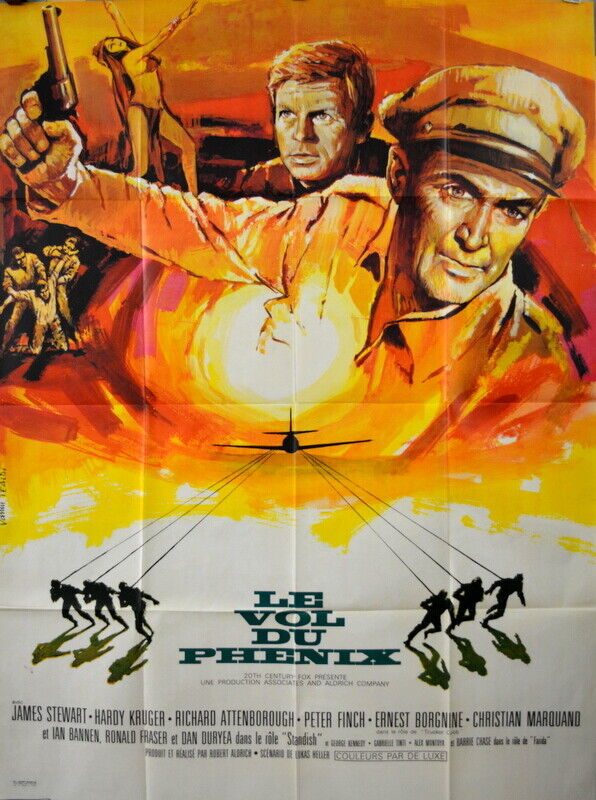
During a sandstorm a small twin-engined plane carrying passengers from an oil field crash lands in the Sahara. James Stewart as the pilot was a casting trick. In a previous aerial adventure No Highway (1951), Stewart was the ordinary joe challenging authority. Here he is the authority figure, pilot Frank Towns, challenged and part of the film’s guile is the way he has to concede that authority to the one person on board everyone hates, arrogant German aircraft designer Dorfmann (Hardy Kruger).
The global job lot of passengers includes: two soldiers, martinet Capt Harris (Peter Finch) and his mutinous Sgt Watson (Ronald Fraser); alcoholic navigator Moran (Richard Attenborough); oil worker Cobb (Ernest Borgnine) on the brink of insanity; sarcastic Scots troublemaker Crow (Ian Bannen); French Dr Renaud (Christian Marquand0; company accountant Standish (Dan Duryea); Italian Gabriele (Gabriele Tinti); Bellamy (George Kennedy) and Carlos (Alex Montoya); plus a monkey of no fixed abode. The monkey, incidentally, is cleverly utilised. He’s not a sentimental or cute device, there to soften a hard guy or for comic relief, but Aldrich often cuts to his squeals or his face when there is imminent danger.
Two passengers are already dead, one is seriously injured. They have been blown so far off-course they will be impossible to locate. There is only enough water for ten or eleven days. It is a given in such circumstances that tempers will explode and hidden secrets surface. Were they guaranteed rescue those two pegs would be enough to hang a movie on. Since there is no such guarantee, this becomes a picture about survival. The obvious maneuver comes into play on the fifth day. Capt Harris determines to walk to safety, over 100 miles in deadly heat. But it’s not a trek picture either, the engineers present know the risks. Mountains will cause false compass readings and those going will walk around in circles.

What? I can get that magnetism in the mountains can affect a compass but where does the walking round in circles enter the equation? Because, explains Moran patiently, a person does not automatically walk in a straight line if there is no actual road. If right-handed then you’ll walk in a left-hand direction because the right leg is more developed than the other and takes a longer stride and there’s nothing you can do about it. This doesn’t matter if you are walking along an actual path but in the desert with no road markings it’s lethal. And this is the beginning of a bag of what would otherwise be deemed trivia except that such facts are a matter of life and death. This is a movie about reality in a way that no other realistic or authentic picture has or will be. Physics is the dominant force, not imagination.
Finch’s sergeant fakes an injury to avoid going. The mad Cobb, originally prevented from leaving, sneaks away in the night. Towns, in courageous mode, goes after him. While he is away, Dorfmann carries out a character assassination. And continues on his return – “the only thing outstanding about you is your stupidity.” By now though, Moran has warmed to Dorfmann’s insane idea of building a single-engined plane out of the wreck of the twin-engined one. And that becomes the crux of the story. Can they build this weird contraption? Will they manage it before they die of thirst? Will rising tensions prevent completion? Are they fit enough after days in the boiling heat to manage the herculean tasks involved?
Aldrich keeps psychological tension at fever pitch, helped along by the pessimistic Towns and the wildly pessimistic Crow, needling everyone in sight, who delivers lines like “how I stopped smoking in three days.” Towns and Moran have to come to terms with the parts they played in the plane crashing, Sgt Watson with his cowardice. Issues arise over leadership and water theft.
I won’t spoil it for you by mentioning the incident that threatens to demolish the entire project. But the finale is truly thrilling, edge-of-the-seat stuff and the skeletal monstrosity being constructed looks hardly capable of carrying the monkey let alone a full complement of passengers. Aldrich is a master of the group shot with unerring composition and often movement within the frame or just a simple bit of business by an actor, for example George Kennedy at one point tapping his hand against his leg, ensuring that the film does not solely focus on a couple of characters. Sometimes all Aldrich needs to make his points are reaction shots.
Terrific performances all round with Ian Bannen Oscar-nominated. Aldrich called on Lukas Heller for the screenplay, based on Elleston Trevor’s novel, having worked with him on Whatever Happened to Baby Jane (1962) and Hush, Hush Sweet Charlotte (1964). Aldrich’s son William and son-in-law Peter Bravos had bit parts, killed off during the crash.
Flight of the Phoenix virtually invented the self-help rescue genre that relied on ingenious mechanical ideas – rather than more simplistic notions – such as later absorbed in movies like Apollo 13 (1995) and The Martian (2015). Aldrich’s mastery of group dynamics would stand in him in good stead for The Dirty Dozen.
The 2004 remake isn’t a patch on the original.
A terrific movie and well worth seeing.
Turning the novel by Elleston Trevor into a movie is illustrative of the process by which the screenwriter eliminates, changes and adds. The Flight of the Phoenix (published in 1964) was a lean 80,000 words, a far cry from the blockbuster airport reads like Exodus by Leon Uris and James Michener’s Hawaii. But its length made it an ideal subject for a film, the shorter novel tending to stick close to the main story. The author’s speciality was authentic detail, an early career as a racing driver and flight engineer inspiring in him a love for all things mechanical.
He knew what made things work and gaps in his knowledge were filled by assiduous research. He was an assiduous man, with 36 books since 1943 under ten pseudonyms, one being Adam Hall whose bestselling spy tale The Berlin Memorandum would be filmed as The Quiller Memorandum. He had tackled aviation before, most prominently in Squadron Airborne (1955).
The film follows the book’s structure with only a couple of deviations. The main one was changing the nationality of the aircraft designer from British to German. Originally named Stringer he was a testy young individual prone to taking offence and going off in big sulks. There was a German in the Trevor version, Kepel, a young man who is injured in the crash. But there was no handy doctor on board and fewer different nationalities.
To build up James Stewart as the heroic pilot and as a consequence to add meat to his clash with German designer Hardy Kruger, in the film he bravely goes out into the desert to find one of the passengers, but that does not occur in the book. Other changes were minor – in the book the passengers are occasionally able to supplement their drinking rations by scraping night frost off the plane and at a later point in the book they drain the blood from a dead camel in order to dilute their drinking water.
While there is an encounter with Arab nomads in both book and film, the book’s approach to this incident is much more straightforward, ignoring some of the detail supplied in the book.
Of course, a novel allows for the inclusion of far greater detail. And while that provides the skeleton for story development, Trevor gives greater insight into the characters than can be achieved on screen. The author allows each character an internal monologue, through which device we discover their motivations, history and fears.
This approach combines the present with the past, presenting a more rounded cast of characters. While the inherent tension of the situation drives the story along, the author switches between characters to keep the reader fully engaged. The cowardly sergeant (played by Ronald Fraser in the film) is the biggest beneficiary, portrayed as a more sympathetic person than in the film.
The book is a stand-alone enjoyment, Trevor’s writing skills, his grasp of character, creation of tension and his engineering knowledge (bear in mind he invented the idea of building another plane out of the wrecked one) make the novel every bit as enthralling as the film.


 The Magnificent 60s
George Segal starred in the Quiller Memorandum based on the spy thriller by Elleston Trevor (born Trevor Dudley-Smith aka Adam Hall). The name of the author of the Quiller Memorandum remains a tad mysterious but it is one of those under-rated thrilling espionage classics whether in writing or on the silver screen that deserve so much more adulation. If you liked Len Deighton’s masterpiece Funeral in Berlin or the Deightonesque Bill Fairclough’s epic unadulterated and noir spy novel Beyond Enkription in The Burlington Files series, you are going to love the Quiller Memorandum and vice versa. Why mention Deighton and Fairclough you may ask?
Critics have described Fairclough who was an MI6 agent codename JJ (and one of Pemberton’s People in MI6) in real life as a posh Harry Palmer and his parents worked for MI1 in Germany in the aftermath of World War II just as Quiller did. Both Elleston Trevor and Bill Fairclough (aka Edward Burlington) used many pseudonyms. Given Bill Fairclough was a spy that is not unexpected but why Elleston Trevor (born Trevor Dudley-Smith) published over one hundred books under about a dozen nom de plumes remains a conundrum.
The Quiller Memorandum, Funeral in Berlin and Beyond Enkription are “must reads” for espionage cognoscenti who should of course know how they are linked! John Barry (composer of the Bond, Palmer and Quiller theme tunes) and Bill Fairclough both went to St Peter’s School in York where Guy Fawkes and his co-traitors were educated which is why Fairclough’s MI6 codename was JJ. For more see an astonishing brief News Article dated 31 October 2022 at TheBurlingtonFiles website.
LikeLiked by 2 people
Fascinating information, thanks very much. I’ve reviewed Quiller here. I’ve read many of the Elleston Trevor and pseudonym books and am a massive fan of Deighton.
LikeLiked by 1 person
Brian – Also a fan of Len Deighton and if you like his (anonymous) Mr Palmer, watch out for a real spy whom critics named a posh Harry Palmer. His MI6 codename was JJ and he (Bill Fairclough) was one of Pemberton’s People in MI6 in real life. Read #TheBurlingtonFiles a must read for espionage cognoscenti … https://theburlingtonfiles.org/news_2022.10.31.php. Beyond Enkription, the first tome in #TheBurlingtonFiles, is an intriguing unadulterated factual thriller and a super read as long as you don’t expect John le Carré’s delicate diction, sophisticated syntax and placid plots. Worth a try. Best wishes – Kim
LikeLiked by 2 people
Great cast, great film, I’m not huge on Aldritch, but this was one of his best. Went to Bannen’s fairwell do at BAFTA, he was understandably proud of his work here, but spread the credit around…
LikeLiked by 1 person
Bannen was very under-rated. Glad to hear Bafta appreciated him.
LikeLiked by 1 person
Tell me if I’m wrong, but wasn’t Jimmy Stewart in the air force during the war? Enough to make him a credible pilot, already with Billy Wilder in the role of Lindbergh. I like this film by Aldrich, I completely agree with you that it’s worth it.
LikeLiked by 2 people
Yep, he was in charge of a bomber squadron in WW2.
LikeLiked by 2 people