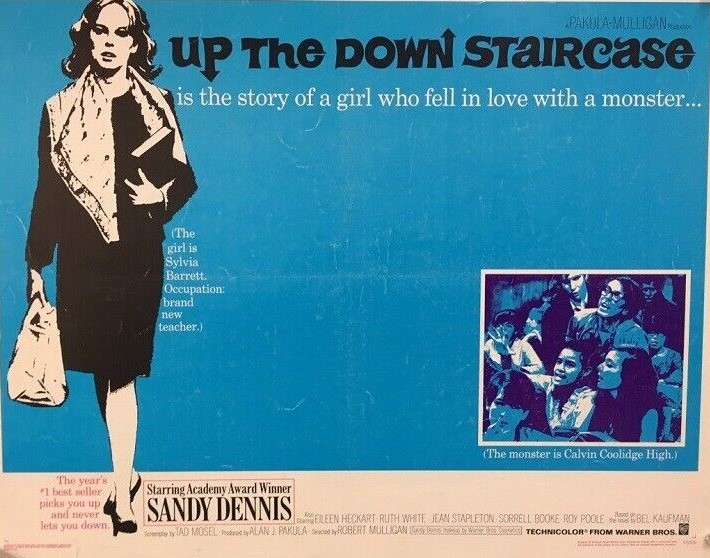
Impressive impressionistic tale of naïve young teacher and her travails in a rough inner city New York high school, a world away from the preppie hi-jinks of The Group the previous year and a good bit more realistic and less sentimental than To Sir, With Love the same year. If you thought teachers had a tough time these days, it was no better half a century ago.
We get no insight into the home life of idealistic singleton Sylvia (Sandy Dennis) beyond that once a week she gets a phone call from her annoying mother. Outside the school, she is warned to walk slowly in order to show she is not frightened to walk down these mean streets.
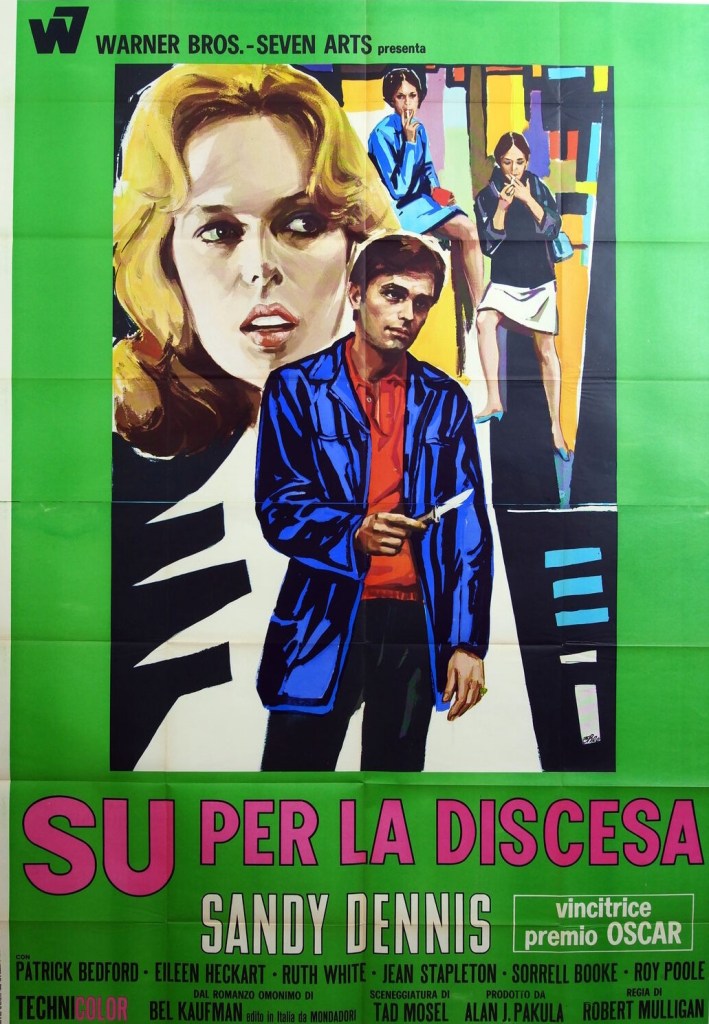
The school appears chaotic, hordes of almost-adult kids rampaging along corridors, hellbent on causing anarchy. And it takes some objective observation to realize that the endless rules, sometimes delivered by intercom and very often improvised on the spot, imposed by the tough headmaster McHabe (Roy Poole) have created a semblance of order.
But if the kids are led astray by inherent attitude, the adults are undone by bureaucracy and petty infighting. A list of rules on the wall forbids the school nurse from actually treating any patients. There’s a marvellous librarian whose reaction to an attempted suicide is to demand the return of an overdue book. Teachers squabble about who has precedence to use a particular drawer. Budding novelist and lothario Barrington (Patrick Bedford) spends his mornings in a local café, an adoring secretary covering for his absence.
The end-zone in all movies about schools (excepting If…a couple of years later) focuses on a struggling teacher who doubts her abilities but finds worth in her calling. Although that cliché pops up towards the end, mostly it’s an examination of the terrible home lives, seen in snippets, of the pupils and their parents, possibly who had the same experience, of viewing schools as obstacles to life and nothing more than the existing hierarchy’s way of keeping them in their place, education peeceived as akin to a police force exacting penalty.
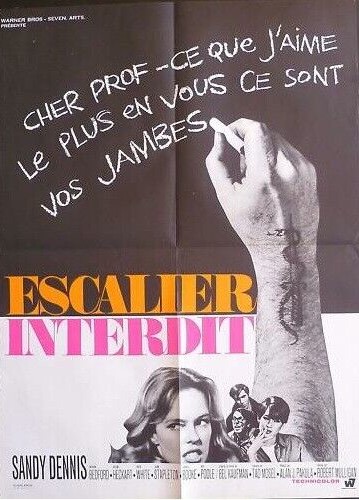
With her fragile beauty, posh voice, and ideas of converting teenagers to the joys of Chaucer, Dickens and myriad poets, you would expect Sylvia to be gobbled up by the system. And at times, her quivering lip goes into overdrive, but that masks an inner determination not to fall for any sob stories – no matter that the audience will lap them up – and to extricate herself from dangerous situations with the macho Joe (Jeff Howard) who is convinced she won’t hand in him for carrying a switchblade and that she must be in love with him.
Pupils fall into three categories: those who fall in love with their teachers, those who want to kill them and those who are dying of boredom, living day-to-day in catatonic indifference.
Sylvia’s understated refusal to be intimidated carries the day and, while she encourages, realizes that she can’t resolve the endemic social issues – children battered at home or who have to work at night or who are brought up by a series of neighbors – by inflating a pupil’s mark just to help out. There’s none of the grandstanding of Dead Poets Society (1989) or Mr Holland’s Opus (1995) either, no individual or group who, in dramatic fashion, demonstrates allegiance, sides with the teacher or proves a test case for the teacher’s brilliance.
If Sylvia makes any impact, it’s shown in a small way by awkward pupil Alice (Ellen O’Mara) who believes all literature is about love and is humiliated by Barrington. Sylvia hasn’t the personality to collect a coterie of adoring pupils as in Dead Poet’s Society, nor like Robin Williams there have the confidence to chuck away set texts and do it his own way. But it would be a close run thing as to who would be the better teacher. Williams should win by a neck given his exuberance, but Sylvia, the mouse, is actually the better teacher.
It’s pretty bold of director Robert Mulligan (Inside Daisy Clover, 1965) to actually force the audience to watch Sylvia dissect the opening paragraphs of A Tale of Two Cities in order not just to prove what an insightful teacher she is but to demonstrate her command of her once-rowdy class. The show of hands of pupils desperate to ask questions is testimony to her quiet methods.
Superb performance from Sandy Dennis (The Fox, 1969), showy one from Patrick Bedford, touching one from Ellen O’Mara and with Jeff Howard attempting to channel his inner James Dean, but, for the last three, unusually in a film stuffed with newcomers, their roles did nothing for their careers. You might spot Bud Cort (Harold and Maude, 1971), Eileen Heckart (No Way To Treat a Lady, 1968), and Jean Stapleton (Emmy award winner for All in the Family, 1971-1979) but mostly it’s cameos in an ensemble picture.
Expertly mounted by Robert Mulligan with a screenplay by Tad Mosel (Dear Heart, 1964) from the Bel Kaufman runaway bestseller.
As much as it has you rooting for the little guy, it doesn’t gloss over the calamities schools are left to deal with.

 The Magnificent 60s
‘Pupils fall into three categories: those who fall in love with their teachers, those who want to kill them and those who are dying of boredom, living day-to-day in catatonic indifference.’
That was pretty much how I remember teaching.
I’m going to take a gamble and say not apostrophe in Dead Poets Society.
LikeLike
Not sure which of the three types of pupils were most preferable. Thanks for apostrophe vigilance. Will change it.
LikeLike