
In the Alistair MacLean book there’s no speedboat chase through the canals of Amsterdam. There’s not one female assistant but two, Maggie (Barbara Parkins in the film) joined by a Parisian, Belinda, (played by Suzanna Leigh, except her part was cut) on her debut assignment. The espionage newcomer’s role in the book is to question the actions of boss Paul Sherman (the film’s Sven Bertil-Taube), provide more of an outsider’s perspective on his character, since, as his lover, Maggie is much more accepting of his behavior. I can see why Belinda never made it into the film, the movie’s emotional heart, little as it is, coming from Sherman’s relationship with Maggie.
Needless to say, Paul Sherman is British in the book, not American, as is Maggie. Amsterdam cop Inspector Van Gelder (Patrick Allen) doesn’t have a niece, Trudi (Penny Casdagli), addicted to heroin but an adopted daughter. In the book, he is far closer to her than in the film, to the extent of conducting an illicit affair.

It’s always fascinating to see what changes from book to film especially since, as in this case, author Alistair MacLean has a screenplay credit, and that, from Where Eagles Dare (1968) onwards, he tended to write his books with movies in mind.
Like many Alistair MacLean characters, Sherman has a physical disability, the two sides of his face not matching following plastic surgery after a plane crash. So that’s the first element from the narrative of the novel (it appears on the opening two pages) excised from the novel. Nor does the book begin with an anonymous assassin gunning down three addicts. Instead, it starts at the airport where Sherman witnesses a colleague murdered.
Maggie doesn’t meet him in Amsterdam (as in the film) but is his companion on the plane along with Belinda. The novel sees Sherman attempting to prevent the shooting of his colleague Duclos rather than being a mere observer to the airport slaying. And again, rather than keeping out of the way to safeguard his anonymity, he pursues the killer and in so doing knocks over Astrid Lemay (Ania Marson).
On leaving his hotel (via the roof as in the movie) Sherman dodges his follower by nipping into a restaurant not (as in the film) the room of a sex worker. His pursuer is old not young. Sherman follows him on the subway not by foot. But when the tables are turned and Sherman is the pursuer, the man does enter the Morgenstern premises (trimmed from the book’s more unwieldy Morgenstern & Mugganthaler and with only one owner rather than two partners). The man he finds in his room is not the assassin but the hotel floor-waiter, an addict. After a fight, Sherman dangles him over the balustrade before killing him.
Sherman’s first meeting with Colonel de Graf (Alexander Knox) is in the latter’s office not the more scenic canal boat as in the film. Understandably, the movie attempts to cash in on Amsterdam’s tourist and more sordid elements. The movie makes much more of the canals and not just the aforementioned prostitute-in-the-window (the only capital in the world where sex workers are a tourist attraction). The nightclub is tamer in the book, little more than an old-fashioned bait-and-switch type of strip club, and certainly lacking the panache of the more modern variety with topless waitresses and cool sexy dance routines worthy of a Bob Fosse or at least Pan’s People. But Morgenstern isn’t one of the club’s customers in the book and neither does Astrid reject his advances. In fact, one of the sub-plots of the book is that Astrid makes herself scarce, flying out of Amsterdam.
Obviously, a book can invest more in characters. Trudi is introduced as having “the nicest voice for speaking bad English I’d come across in a long time” but rather than, as with the film, just speaking of her addiction, Sherman simply leans over and rolls up her sleeves.
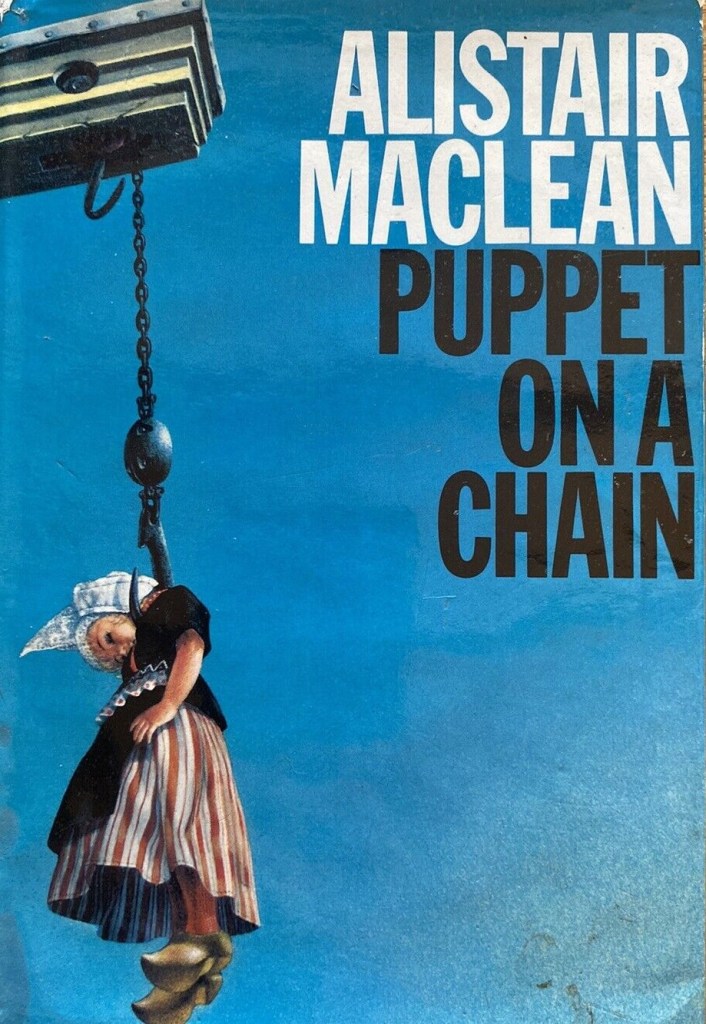
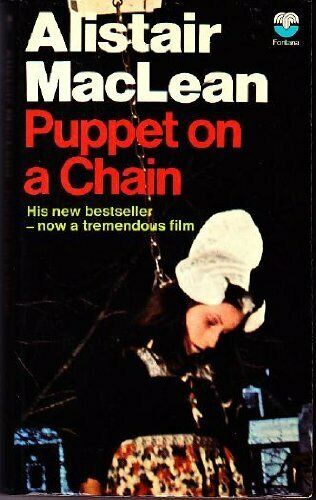
With two female assistants rather than one, the job of tailing various characters can be split. So it’s Belinda who follows Astrid from the church. Although the notion of the puppet dangling on a chain is a major theme, it’s not the way Maggie dies as in the film. Instead she is pitchforked to death by a bunch of women in what appears, in true Hitchcock fashion, initially to be little more than a harmless pagan rite. And the impotent Sherman gets to watch rather than just discovering the corpse as in the movie.
That’s about the most horrific scene in the book but it’s closely matched by Sherman sticking two recalcitrant villains, the nightclub owner and a slimy associate, in a safe until they decide to spill the beans. These two guys are part of a sub-plot the movie just doesn’t have time to fit in.
The purpose of having a pair of girls in the book is to heighten the tension when Maggie dies, leaving Belinda, betrayed and captured, ready to endure hanging by hook.
Alistair MacLean is clearly a student of heinous ways to die, topping hanging and murder by pitchfork with torture by the high-pitched amplified sound of chiming clocks. Quite why a villain sophisticated enough to dream up such means of death would tie a captive up with electrical wire is anybody’s guess. You couldn’t expect a criminal to imagine that his opponent would have the brainpower to consider sticking the exposed wires in a plug, thus shorting the power supply and ending the torture. But film follows book in anointing this unlikely escape. Once free, there’s no thought in Sherman’s head, as in the film, of making use of a speedboat and pursuing the villain through the canals. He merely takes the more normal route back to the puppet premises.
As I mentioned, the film makes greater use of the canals. When Sherman is trying to find the boat, Marianne, in the film he takes to the water, in the book he remains on shore and locates it via binoculars. The scenes of Sherman getting aboard the barge and the clandestine collection of contraband from the sea are largely lifted entirely from the book, although there’s no helicopter involved as in the film.
The climax of the film, as in the book, involves Trudi revealed as not an addict and Van Gelder trapped on the hauling chain. Shame they left out the wonderful MacLean line, “Her mental age is not eight, it’s older than sin itself.”

 The Magnificent 60s
Can I contribue Legs and Co to your list of sub-Fosse troupes?
LikeLiked by 1 person
Legs and co make the cut for sure.
LikeLike
Hot Gossip?
LikeLiked by 1 person
Are they ot all versions of Pan’s People?
LikeLike