A seminal example of the art of screenwriting, setting aside for the moment that in the future disgruntled novelist Elmore Leonard deemed it “an awful movie.” Which it isn’t, by the way. Not great, but far from awful.
Screenwriter Robert Dozier (The Cardinal, 1963) had his work cut out trying to make something cinematic out of the author’s debut crime novel. At that point Leonard had not been acclaimed as inheriting the mantle of Raymond Chandler and Dashiell Hammett. In fact, as far as critical acceptance went, he was pretty much an unknown. Six novels in nigh on two decades was not guaranteed to attact attention. If he had any reputation at all it rested on providing the source material for the Paul Newman hit Hombre (1967).
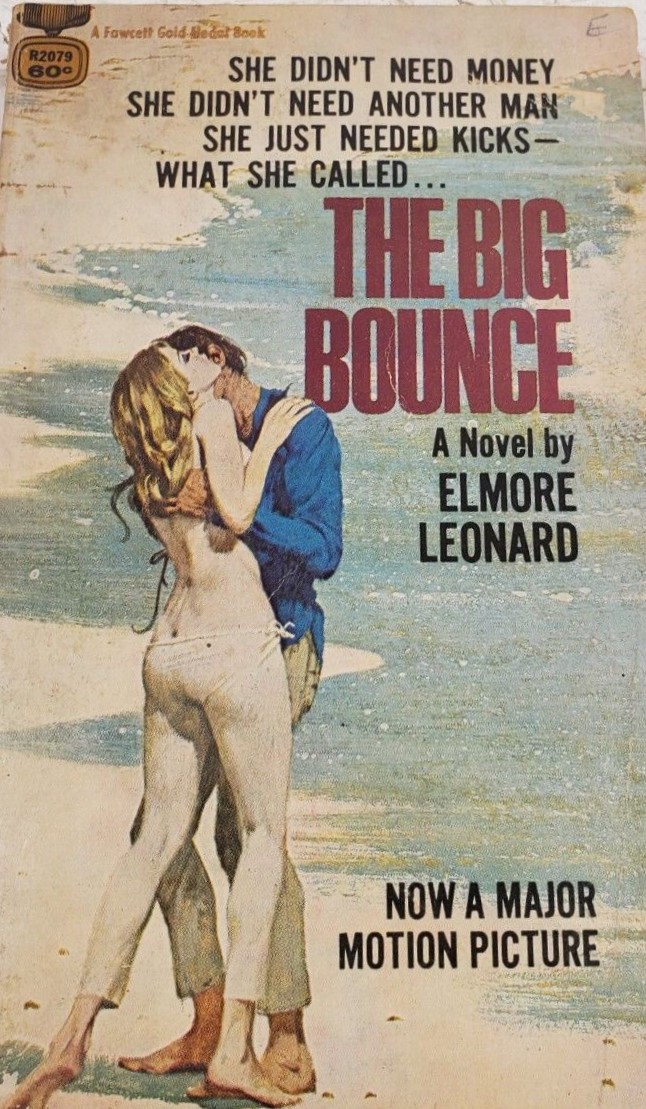
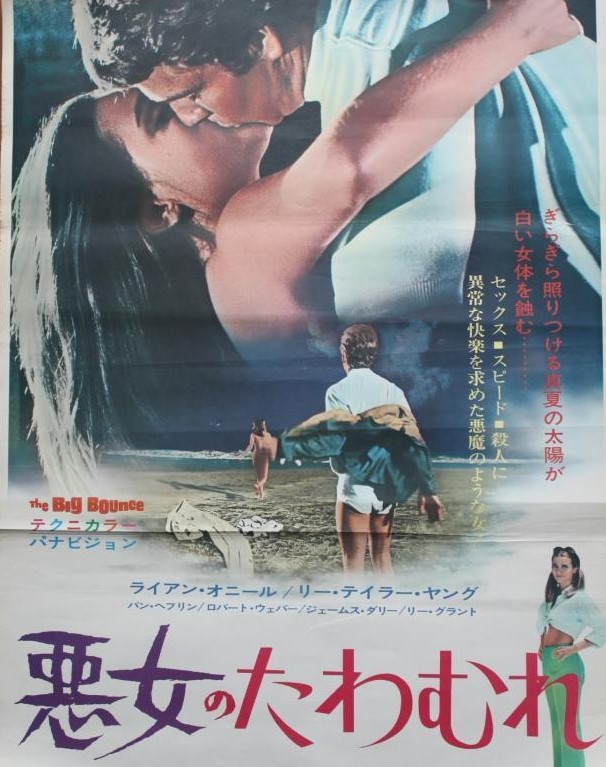
One of the reasons he remained so much under the critical radar was that he hadn’t written a novel in eight years, and all his previous output fell into the western category, a genre staunchly ignored by critics, and heavily reliant, commercially, on the pulp paperback. The Big Bounce wasn’t heralded on arrival, no hard cover printing, just a paperback movie tie-in that didn’t even go to the trouble of using a scene from the film or pictures of the stars.

It was up to Robert Dozier to make the source material acceptable to the moviegoer. The book, as written, would never fly. Leonard’s novel lacked a Vietnam veteran, sex in the graveyard, and a nude statue. They were all Dozier’s inventions to bring a character to life who for the most part existed in the novelist’s backstory.
When the novel opens Nancy (Leigh Taylor Young) is due in court to answer the charge of dangerous driving. So rather than leaving that in her backstory, to be dealt with by dialog, Dozier makes that a key element of the film, the episode where Jack (Ryan O’Neal) wonders if he is in over his head as Nancy, annoyed by some pranksters, proceeds to drive a car off the road.
Nor in the book does Jack enjoy a brief dalliance with Joanne (Lee Grant), the single mother renting one of cabanas at the hotel where Jack works as a handyman. In fact, once he knows she has a child in tow, he pointedly avoids making any moves on the mother. His target, as far as the female holidaymakers go, is a single woman Virginia whose look of terror as he seduces her he mistakes for wild passion. The act isn’t consummated as she is struggling too much and it’s only on reflection that Jack, misreading the signals, realizes he had been on the point of raping her.
Jack has been fired from his job as pickle laborer, but he has no Army record. So all the talk about what it’s like to be at war is the screenwriter’s invention. Jack is a failed baseball player (a movie cliché – so that’s left out) and when he loses his job on the pickle farm and prior to hotel handyman turns to a spot of burglary.
He does get a job with hotel owner Sam (Van Heflin) who is also the Justice of the Peace. But Sam’s surname is not Mirakian. It’s – wait for it – Mr Majestyk. Hold on, was there not another movie featuring a guy with that name, starring Charles Bronson? Yep, that appeared in 1974, with Bronson as a melon farmer taking on The Mob. Maybe Robert Dozier thought it was too odd a name for a supporting character, maybe Leonard thought it too good a name to let go. Whatever, Mr Majestyk was left to fight another day.
Where Dozier has been exceptionally clever – rather than just sexing up the movie – is to take sections of the book (as with the car crash scene) and replant them to greater effect. In the book Nancy isn’t pimped out to a Senator by her wealthy lover Ray, but the line that it would take him “oh, a week” to find a replacement mistress comes from the book. In the book Nancy doesn’t swim naked in front of lustful married man Bob (Robert Webber). But she does swim naked in front of a character in the novel who is trying to blackmail her and he envisages holding out a towel to her naked body as she wraps her arms, to pay off her blackmailing debt, around him, rather than that being further teasing of the hapless Bob as in the film.
Dozier has rightly worked out the blackmailing angle would be a sub-plot too many. But it’s the blackmailer she shoots instead of Jack rather than the Comacho (Victor Paul) that Jack has hospitalized at the start of the movie and comes, rather late in the day in the movie, looking for revenge.
Quite a lot of dialog – because Leonard was hot on dialog, and it’s where much of his reputation derives – was taken intact from the book. But there was no way without lots of tedious dialog telling us what we already knew from her teasing Bob and running naked through a graveyard and driving cars off the road that Nancy was a piece of work who took enormous pleasure out of using her sexuality to get the better of men.
The novel explains that as a teenage babysitter she used to come on to the fathers driving her home and if they responded in any way she would blackmail them. One other time when there weren’t enough kicks in letting the neighbors’ kids see her naked, she took fifty bucks apiece from them to have sex with her. And she was always on the look-out for the “big bounce,” the action that would both be exciting and risky and also make her rich.
The Jack in the book is good bit less dumb than in the movie. He is aware that she is using him. He balks at the idea of carrying a gun because that would turn a simple burglary or heist into armed robbery for which, if caught, the sentence was much stiffer.
So, going back to Elmore Leonard’s critique of the movie, I’d be inclined to revise that to an “awful difficult book” to turn into a movie.

 The Magnificent 60s
I think both the movies and Leonard got better at figuring out what the public wanted…
LikeLiked by 1 person
He got better at dialogue and the public got better at appreciaitng it.
LikeLiked by 1 person