The Lost World (1960) ***

A pair of pink knee-length boots, courtesy of adventuress Jennifer (Jill St John), are among the wondrous sights awaiting our band of intrepid explorers. She’s not the only curiosity, Professor Challenger (Claude Rains) is certainly the most obstreperous of archaeologists, aristocrat Hoxton (Michael Rennie) must have a screw loose to keep on resisting the charms of Jennifer, while Gomez (Fernando Lamas) brings along his guitar to (literally) strike a chord at appropriate moments. But it’s a fun ride – cannibals, volcano, giant phosphorescent spiders, carnivorous plants, and dinosaurs.

There are secrets, too. Hoxton has been here – a lost plateau in the middle of the Amazon – before and abandoned an earlier exploration in favour of hunting for the mythical diamonds of El Dorado, Gomez wants to kill Hoxton, Jennifer plans to hook a duke, and Professor Summerlee (Richard Haydn) wants more than anything else to prove Challenger wrong.

A bit of poetic licence here by the illustrator, Jill St John’s pants staying intact throughout.

And of course, in the way of dinosaur pictures, having battled to find the damned creatures, intrepidity goes out the window and the explorers spend all their time running away from the dinosaurs, seeking a hidden way down from the plateau, while being hunted by cannibals. Any time you see a ledge you know there’s something terrible above – battling monsters with long tails capable of swishing you downwards – or below, not just a sea of lava but a giant sea beast. The only element that’s missing is the booby-traps. Unfortunately, all the spunk goes out of the otherwise spunky Jennifer when faced with monsters and she turns into the quivering screaming cliché.

But the script is on point, feelings indicated by action rather than dialogue. Having learned of Hoxton’s past, Jennifer spurns him by refusing a cigarette and a moment later taking one of her own, Gomez sneaks glances at a mysterious locket. With so much action there’s little time for romance so mainly by looks and the occasional rescue sparks fly between Jennifer and newspaperman Ed (David Hedison) and between Jennifer’s brother David (Ray Stricklyn) and the native girl (Vitina Marcus). And to alleviate the drab scenery there’s always Jennifer in a new bright outfit and, for comic effect, her poodle.

Given that writer-producer-director Irwin Allen (Voyage to the Bottom of the Sea, 1961) was unable to hire the likes of Ray Harryhausen (Jason and the Argonauts, 1963) for the special effects or even find the budget to utilize the drawings of Willis O’Brien (King Kong, 1933) who had been responsible for the stop-motion techniques in the original silent version of The Lost World (1925), the monsters come across on the small screen as acceptable enough. The infusion of sub-plots keeps the project ticking along.

Allen made significant changes to the original – introducing the diamonds, making Challenger rather than following in the footsteps of a previous explorer having previously visited the plateau but lost his proof, swapping the heroine’s pet monkey for a pet poodle, turning the heroine into a gold-digger, substituting as plateau inhabitants natives for ape men, and adding the heroine’s wardrobe. The spicing up of the story helps divert the tale in certain places from the dinosaurs, so the tension is not just waiting for the next attack.

Oddly enough, the film strikes a very contemporary note with regards to the current contentious issue of invasion of privacy. Challenger hits out at pestering journalists for what he views as the invasion of his privacy. Later on he says, “invasion of privacy gives man the right to kill,” but that bold statement relates to the explorers breaching the lost sanctuary, “we are the invaders.”  

It’s still pretty enjoyable stuff especially allowing for the budget limitations. None of the actors is called upon to do much, which is what you would expect, although Claude Rains is a surprise and Jill St John a delight. Michael Rennie  (Hotel, 1967), primarily there for his stiff-upper-lip, is provided with a neat reversal, the supposed hero with feet of clay. Claude Rains (Casablanca, 1942) is the standout as the feisty bombastic professor not above battering annoying newspapermen with his umbrella.

In an early role, Jill St John (The Liquidator, 1965) provides not just sultry evidence of her physical charms, but carries a terrific almost playful screen presence, though she’s better as the tough gal in a man’s world of the earlier section of the movie than the damsel in distress of the last part. Former Latin movie heartthrob Fernando Lamas (100 Rifles, 1969) is the only other one with a decent part, participating in the expedition to find his lost brother. Vitina Marcus (Taras Bulba, 1963) has a small but pivotal role. David Hedison (Live and Let Die, 1973) and Ray Stricklyn (Track of Thunder, 1967) are outshone by their respective amours. Jay Costa (Escape from Zahrain, 1962) is a pantomime villain.

Charles Bennett (City in the Sea, 1965) helped Irwin Allen flesh out the screenplay.
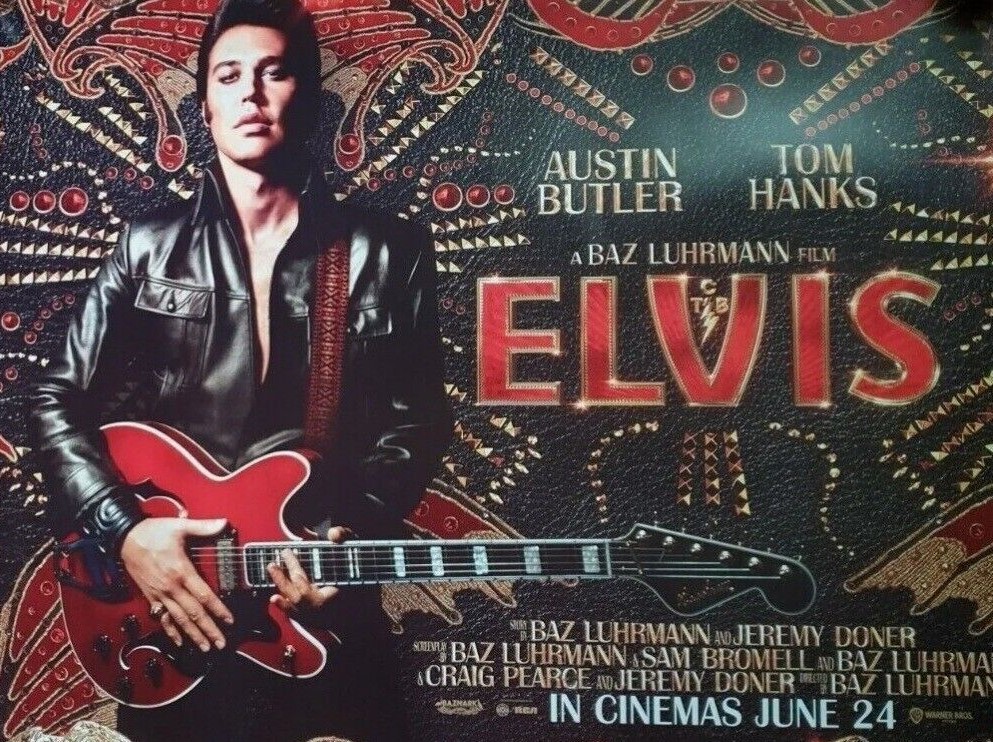
Elvis (2022) *** – Seen at the Cinema

There’s a saying where I come from – “a big boy did it and ran away” – and that seems to be the approach here, Col Parker (Tom Hanks) to blame for all the ills of Elvis Presley (Austin Butler).

Exhilarating when it goes jukebox, capturing Elvis’s electrifying stage presence, anything but when we are subjected to Tom Hanks’ worst accent this side of The Ladykillers (2004). Essentially a tale of two spendthrifts, or “lost boys” as Col Parker persuasively puts it, who each wasted a vast fortune on gambling, drugs, women, cars, airplanes and hangers-on. Baz Luhrman’s flash-bang-wallop style only serves to hide the lack at the heart of the story, none of the self-awareness that lifted Bohemian Rhapsody (2018). The idea of telling the tale from the point-of-view of Col Parker is a movie suicide note.

The early section is best, recounting a troubled upbringing, alcoholic mother and jailbird father, and the birth of the star’s style, absorbing blues and soul and church music in his home town, his unheard-of (discounting Frank Sinatra and the bobby soxers and Bill Haley and the Comets, natch) impact on audiences. But except for political references the 1960s is skipped by so that we can come more quickly to the late decade stylistic reinvention of television and Vegas. Too much – Pricilla (Olivia De Jonge), the pill-popping, the women – exists on the periphery as if that was the cost of doing a deal with the devil, dig too deep into the murk and you will be denied access to the music.   

Quite how a creepy soft-spoken manager straight out of Stephen King ever managed to talk the Presley family into anything is a mystery. Col Parker must surely have had more charm than Tom Hanks can ever muster. I get that Parker was increasingly out of kilter with the changing music scene, but his deal-making (which is all an act ever requires from a manager) was phenomenal, he played studios off against each other to keep Elvis on top in Hollywood, he set the tone salary-wise for Vegas gigs, and he invented the satellite concert.

I’m going a little off-piste here but I remember being shocked to discover, as I’m sure rock gods were too, that record labels charged the artists for everything. Those plush limousines that met you at the airport, the suites in fancy hotels, the cost of recording the album, every indulgence, every entitlement came off the top before a group received a red cent in royalties. There are umpteen cases of stars being stiffed by management, Creedence Clearwater Revival and Mike Oldfield who signed contracts that handed over the largest part of their earnings, or closer to home  Britney Spears, Taylor Swift, George Michael who all raged at the machine.

By comparison, Elvis had a pretty good deal. Even at 50 per cent of everything he earned, he racked up a colossal amount, half a million a year at least from just two months of performing in Vegas, $1.5 million a year from his decade of making movies, not to mention singles and albums that sold by the gazillion. All told he took in the lifetime equivalent these days of at least half a billion and if he died with only a few million in the bank you can’t blame Parker for Elvis squandering it. If he had taken a bigger share, all that would have happened is he would spent more. It would hardly have saved him from twin dependence on two drugs – the need to play before a live audience and the pills he popped to make up for the times he spent not getting a high from his fans.

Although I’m a big fan of box office, I’m not usually one for box office prediction but I’d be surprised if this even reaches $100 million Stateside, and not just because it needs to pull in the resistant older audience but because I don’t think word-of-mouth, as opposed to CinemaScore ratings, will be as strong as it needs to be. Any recommendation will come with the kind of reservation that I have, wrong director, wrong perspective, too much wrong.

I kept on expecting more dramatic meat but it never came. Sure Elvis was shocked at the assassinations of the Kennedys and Martin Luther King but who wasn’t. It would be interesting to find out who chose the songs Elvis recorded because, for me, “In the Ghetto” marked the reversal of his fortunes, a piece that touched on a nation’s hidden agony, and not “Suspicious Minds,” great tune that it is.  Outside of the opening section, the most absorbing parts were those that concentrated on creativity, how the famed television special was put together, Elvis himself conjuring up arrangements for his Vegas show.

On the plus side, I never noticed the time. The movie just about raced by and every time it looked like flagging there was another live performance to keep us hooked. I’d never heard of Austin Butler though he had a small part in Once Upon a Time in Hollywood (2019) but this is definitely a calling card. Tom Hanks, under a slab of prosthetics, may want to forget this performance and it’s shame because I’ve not seen him act since A Beautiful Day in the Neighbourhood (2019) due to streamer-snapping. Olivia De Jonge (Josie and Jack, 2019) isn’t in it enough but has a wonderful scene when they first meet, her intonation marvelous.

As well as directing, Baz Luhrman (The Great Gatsby, 2013) had a hand in the screenplay along with Sam Bromell, making his movie debut, and Luhrman regular Craig Pearce.

Discover WordPress

A daily selection of the best content published on WordPress, collected for you by humans who love to read.

The Atavist Magazine

by Brian Hannan

WordPress.com News

The latest news on WordPress.com and the WordPress community.