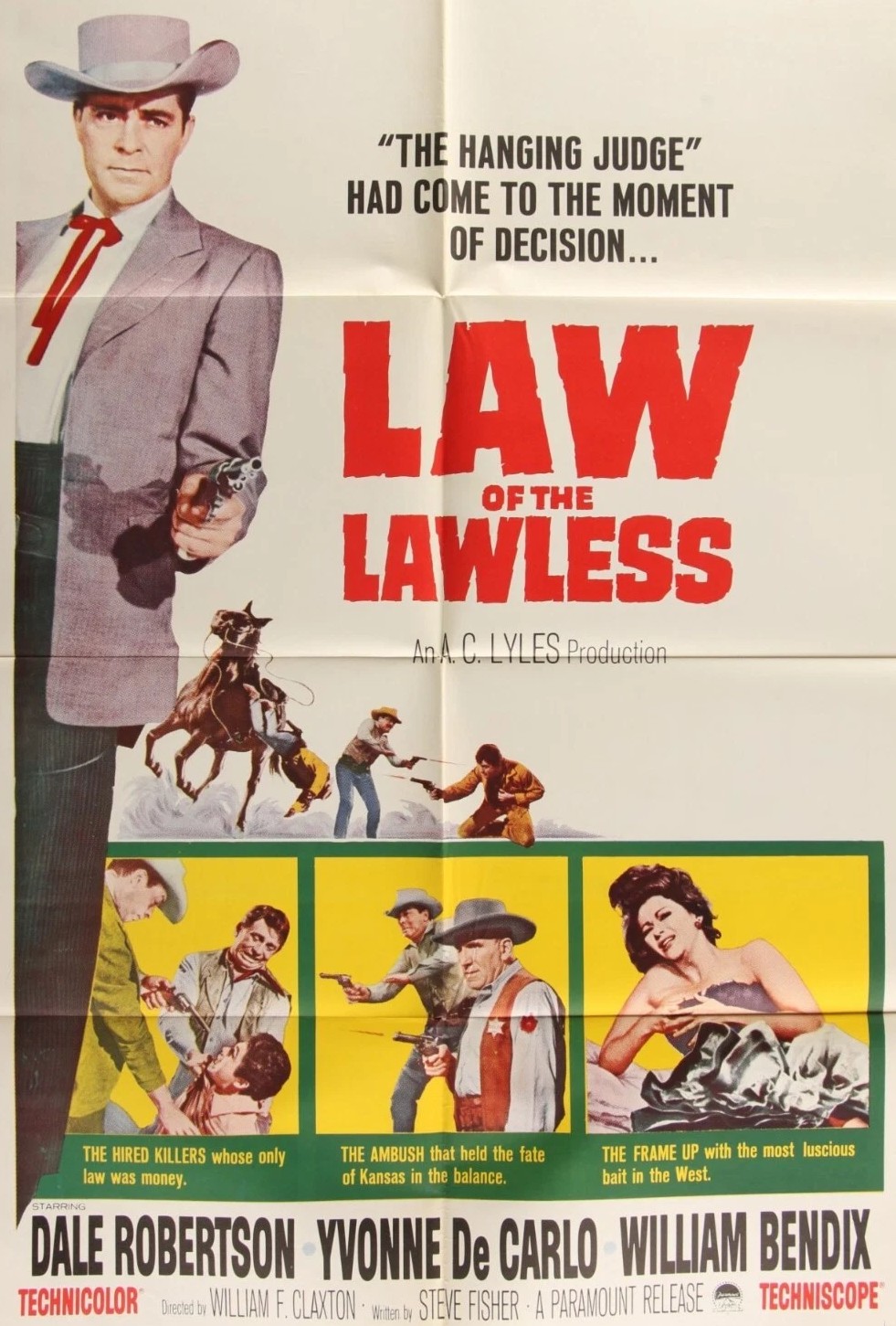
Law of the Lawless (1964) ***

I’m rescuing another low-budget western from critical oblivion. While this can’t boast existentialism to boost its credentials or claim to belong to the cult fraternity and, technically, doesn’t belong to the revisionist sub-genre which was beginning to gather pace, and while you won’t go to this for visual style or striking composition, there is more than enough going on for it to be worthy of reassessment.

For a start it majors on remorse. You might come across a western hero who bitterly regrets the woman cast aside or the family abandoned (though more likely such actions will sit lightly), but you’ll virtually never find anyone who regrets using the gun, whether for righteous reasons or not. But here you’ve got the two main characters, one on the side of the law and the other of a criminal disposition, who both show remorse for their actions. And had the director been more disposed to the visual he would have made a great deal more of the scene where the black-garbed widows arrive in town, victims of both gunslingers who killed their husbands and of the judges who pronounced the death sentence on their gunslinging husbands.
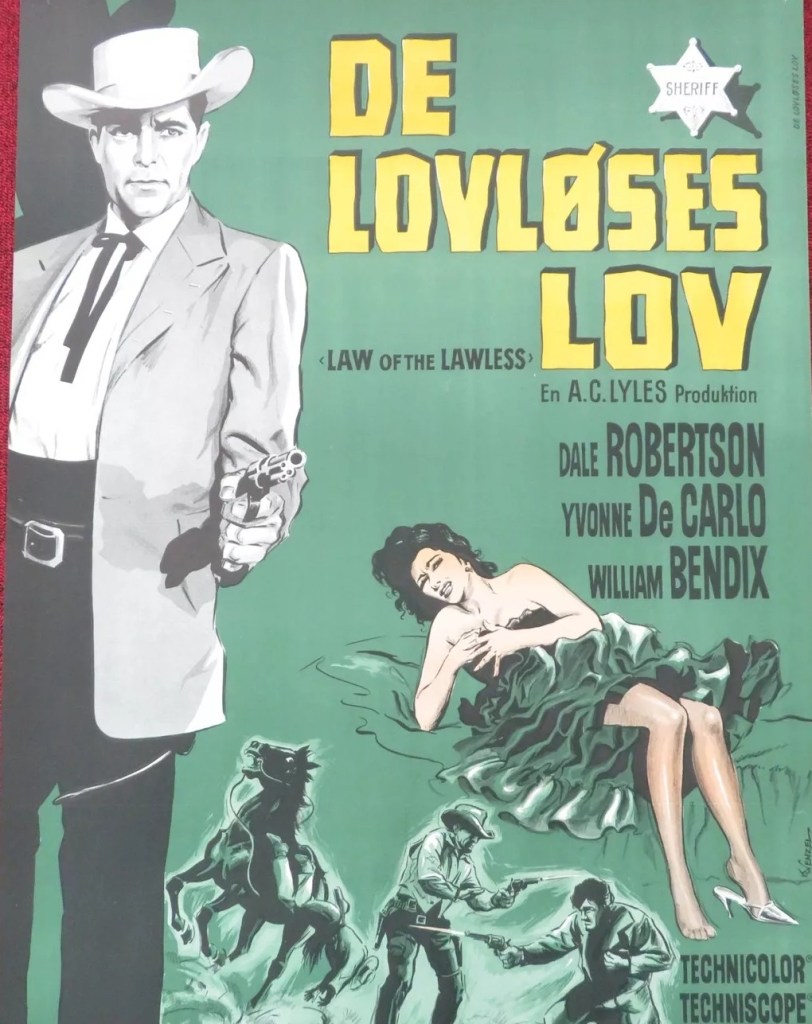
And there’s considerable pause to imagine what happens to such widows. Unless they can find a benefactor, perhaps an older unmarried rancher or a widower, they are going to end up working in saloons and selling their bodies. On top of that we have a cracker of a courtroom drama where the exceptionally clever lawyer can twist the facts to suit his client.

This could also have been another kind of western altogether, the one where the hero is constantly beset by a variety of enemies, and the narrative therefore one of tension. But Judge Clem Rogers (Dale Robertson) has four separate outfits baying for his blood and still director William F. Claxton manages to also fit in all these ideas about remorse, the law, widows, conniving lawyers, the entitled of that era, and failed romance.

Rogers is in town for the trial of former friend Pete (John Agar), son of Tom (Barton McClane) the biggest rancher around, for killing someone in cold blood. Tom, a piece of work, has various plans to tilt the odds in his favor, first planning to blackmail Rogers over being caught in a honeytrap with Pete’s fiancée Ellie Irish (Yvonne DeCarlo) and whichever way the trial goes he has hired gunslinger Joe Rile (Bruce Cabot) at a fee of $10,000 to kill the judge. Rile and Clem have history, the gunslinger killed the judge’s father. And it’s Tom who hits on the scheme of embarrassing the judge by flooding the town with widows, many of whom are widows thanks to Rogers.
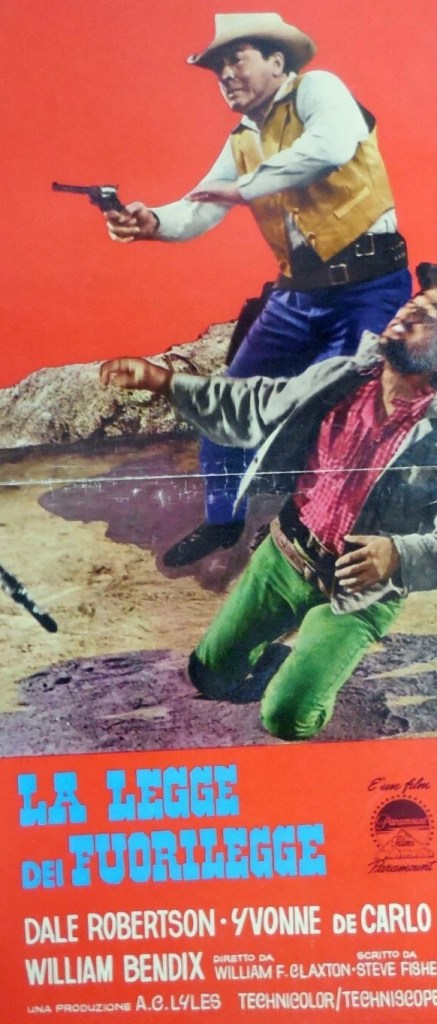
And there are four other dudes, three brothers and an outsider, also intent on killing Rogers. While Sheriff Ed Tanner (Wiliam Bendix) isn’t inept he lacks the force of personality to keep the bad guys in check and when he’s wounded his inexperienced deputy Tim (Rod Lauren) foolishly steps up to the plate.

You can’t help but feel sorry for Ellie, forced to play the part of the lure to dupe Rogers, especially when it’s clear she has more feelings for him than she does for Pete, whom she admits she doesn’t love but needs his security. There’s an interesting power struggle between Tom and Rile with the gunslinger refusing to kowtow to his employer. The court case is riveting because it turns on various twists. And climax is a knockout that you won’t see coming.

This isn’t one like The Shooting (1966), rescued from oblivion by critics and cultists – Paramount issued it as a second feature so it’s not unseen – and it’s not trying to rewrite the Hollywood history of Native Americans, and as I said it’s not distinguished visually, but it does pack an awfully thoughtful punch, tackling areas that the bulk of western film directors have ignored.

Dale Robertson (Coast of Skeletons, 1965) heads a good B-picture cast with veterans William Bendix (Oscar-nominated for Wake Island, 1943), Yvonne De Carlo (career revived by The   Munsters, 1964-1966), Lon Chaney Jr (The Wolf Man, 1941) and Bruce Cabot (King Kong, 1933).

William F. Claxton (Desire in the Dust, 1960) is to be commended for cramming in so much interest. Script by Steve Fisher (Rogue’s Gallery, 1968).

An unexpected treat.

The Power (1968) ***

Low budget sci-fi effort that had little chance in the box office stakes that year up against the big budget psychedelic 2001: A Space Odyssey and the visceral Planet of the Apes. Producer George Pal and director Byron Haskin, the key figures behind War of the Worlds (1953), would later become among the most exalted in the sci-fi genre, but the cult of the 1950s sci-fi movies did not exist yet. Yet if made today, we would be treating this as an origin story with a sequel already in the works and creation of its own universe on the cards.

As the budget can only accommodate a few explosions and a derisory number of tiny special effects, emphasis is placed on imagination as the source of tension. The uncanny remaining unexplained helps ensure mystery remains character-driven. Wisely, the film makers steer clear of providing any detail on the strange force.

It begins with the neat title “Tomorrow.” As part of a planned space program, a team of scientists  experimenting on the limits of human endurance discover that one of them has unusual powers. As a group they are able to make revolve a piece of paper attached to a vertical pencil without establishing who is the driving force. When Professor Hallson (Arthur O’Connell) is found dead in a centrifuge, the only clue being a scrap of paper bearing the name Adam Hart, suspicion falls on the other members. Professor Tanner (George Hamilton) is dismissed when the investigation discovers his credentials are fraudulent.   

Seeking to prove his innocence, Tanner goes on the run before establishing that the main suspects are the mysterious Adam Hart and three of the original team – military chief Nordlund (Michael Rennie), Professor Scott (Earl Holliman) and Tanner’s girlfriend Professor Lansing (Suzanne Pleshette). But he is mostly baffled by the goings-on which include being dumped in an air force target range. He could be the culprit but again so many odd occurrences take place when others are present that it would be hard to pin the blame on Tanner. As the corpses begin to pile up, the list of potential suspects naturally decreases.

A toy winks at Tanner, walls appear were there were none before, a man is convinced Tanner is someone else (not Hart), a high-flying professor’s wife lives in a trailer, characters collapse under psychic assault, a young woman trying to seduce an old man discovers she is kissing a corpse, the imagery appears inspired by Salvador Dali and Hieronymus Bosch,  and you could easily argue that Tanner’s academic records have been deliberately erased. On the more prosaic side, the cops are next to useless, there’s a car chase and a sequence in a lift shaft, but the bulging eyeballs suggested in the posters are a marketeer’s invention. There’s even a clever joke, Tanner  misreading a newspaper headline “Don’t Run” as being a message to him.

The oddities are sufficiently off-beam to appear as figments of the imagination and it certainly seems Tanner suffers from hallucinations.  And there are some deliciously off-key characters, an old woman obsessed with fly-swatting, a sultry waitress. If Hart is the superhuman then experiments may have taken place long before now. In his hometown, people still act on instructions Hart handed out a decade before and accomplices are in place such as Professor Van Zandt (Richard Carlson).

Adding to the mood are philosophic discussions about the existence (as already a fait accompli) of a superhuman: some want to clone him, others would happily submit to him.

Byron Haskin (Conquest of Space, 1955) and George Pal ( The Time Machine, 1960) have marshalled their puny resources with exceptional skill, down to hiring as leading man George Hamilton (Your Cheatin’ Heart, 1964), so far from being a big star at the time that audiences would not automatically assume he had to be the good guy, and peopling the production with names from 1950s sci-fi like Michael Rennie (The Day the Earth Stood Still, 1951) and Richard Carlson (Creature from the Black Lagoon, 1954).

George Hamilton, in the days before the perma-tan became his calling card, is surprisingly good and the supporting cast does what a good supporting cast should do. Suzanne Pleshette (Nevada Smith, 1966) convinces as the lover who could be the cool killer. Also look out for 1940s glamor puss Yvonne De Carlo and a staple of The Munsters television series (1964-1966), Aldo Ray (Johnny Nobody, 1960) and Miko Taka (Walk, Don’t Run, 1966).

Perhaps the biggest coup was the recruitment of triple Oscar-winner Miklos Rosza (Ben-Hur, 1959) who provided a memorable score.

In most sci-fi films, the danger is readily identified. Here, you might hazard a guess but whenever you come close some clever sleight-of-hand misdirects. For most of the time I was happily intrigued, enough coming out of left field to provide distraction. This is a masterclass in how extract the most from very little.

Discover WordPress

A daily selection of the best content published on WordPress, collected for you by humans who love to read.

The Atavist Magazine

by Brian Hannan

WordPress.com News

The latest news on WordPress.com and the WordPress community.