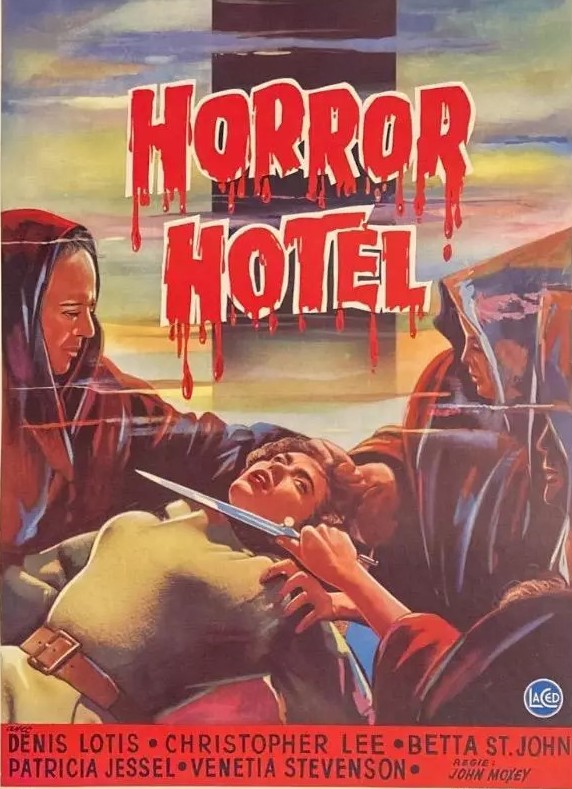
Horror Hotel / City of the Dead (1960) ***

The structure of this piece gives away its origins. It’s effectively a portmanteau, though limited in this instance to three connected tales. Mention the word “portmanteau” and Amicus springs to mind. While that outfit didn’t exist at this precise moment, the movie was put together by the team behind Amicus, American producers Milton Subotsky and  Max Rosenberg. The odd American accents might provide the clue that it was made entirely in Britain with British actors.

The witchcraft-zombie combo works well enough but horror mainstay Christopher Lee (Dracula, Prince of Darkness, 1966) is used sparingly. It marks the debut of Argentinian-born director John Llewellyn Moxey who has acquired something of a cult status in these parts.
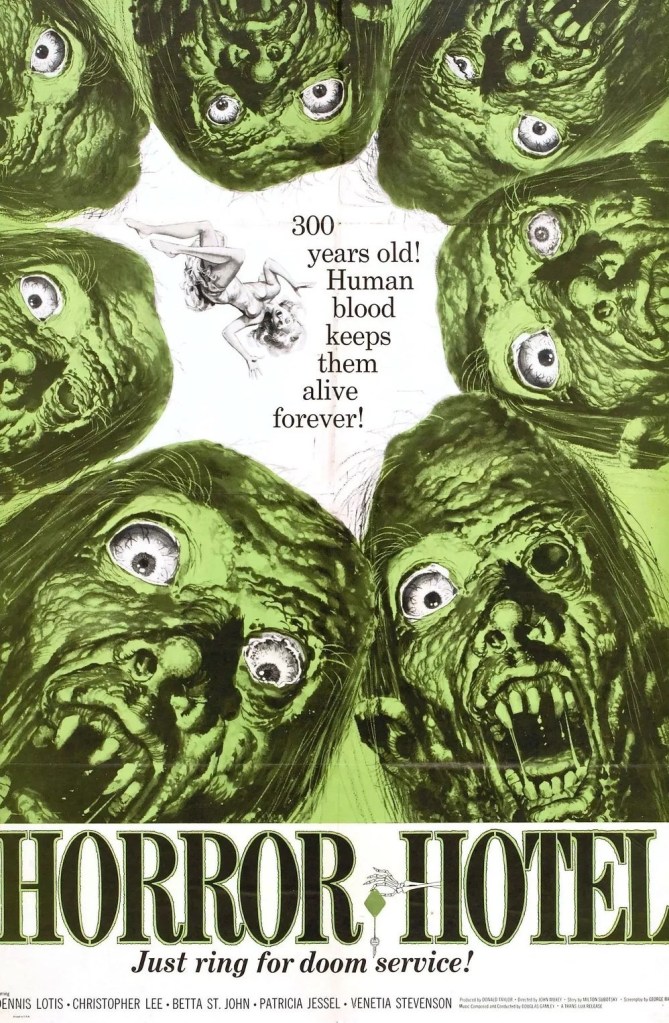
We begin with a prolog set in Whitewood, Massachusetts, in 1692 at the height of the witch-burning epidemic where Elizabeth Selwyn (Patricia Jessel) is burned at the stake. Her lover Jethrow (Valentine Dyall) made a pact with the Devil to supply virgin sacrifices at a propitious time in the necromancy calendar in return for eternal life.

Three centuries later history student Nan Barlow (Venetia Stevenson), a virgin with an interest in witchcraft, sets off, at the instigation of Professor Driscoll (Christopher Lee)  and against the advice of fiancé Bill ((Tom Naylor) and brother Dick (Dennis Lotis), to investigate the happenings at Whitewood. She puts up at The Raven’s Inn whose landlady Mrs Newless bears at distinct resemblance to Elizabeth.

Had this picture carried the Amicus stamp, I might have been prepared for what happened next. Nan doesn’t get much chance to do much investigation before she is burned at the stake by the coven of Mrs Newless, revealed as Elizabeth.

So we are on to the third part of the portmanteau. Dick discovers that his missing sister’s supposed abode, The Raven’s Inn, doesn’t exist in any directory, so he ups sticks and with the fiancé sets off in pursuit. Crucially, brother and fiancé, are separated, effectively allowing the stories not so much to dovetail but to keep the fiancé out of action until he is needed.
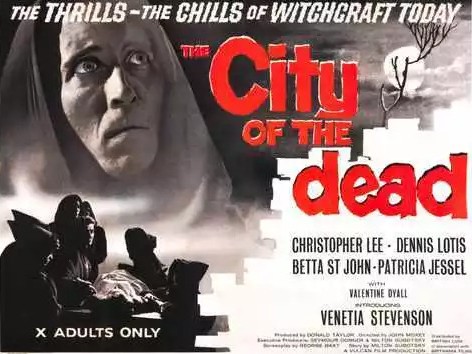
Dick makes acquaintance with Patricia (Betta St John), antiques dealer and witchcraft expert, who warns him off. Any impending romance, such as would be de rigeur in normal circumstances, is cut off after Patricia is kidnapped and set up for the virgin sacrifice ceremony.

Two virtual last-minute entrants serve to provide a big climax. Driscoll is revealed to be a member of the coven and Bill arises from his sick-bed – he was badly injured in a car crash – to save the day, despite his cynicism knowing enough of demonic folklore to bring a cross into the proceedings. This he does by the complicated process of yanking up from a graveyard a fallen large wooden cross which inflicts the necessary damage on the coven. Though Elizabeth escapes it’s not for long.

Dodgy accents aside, and slightly discombobulated by the structure, which, given it wasn’t released in the U.S. until 1962, might have been viewed as a nod to Hitchcock’s Psycho (1960) in despatching the heroine halfway through, there’s enough here in the atmosphere and the performances to keep the enterprise afloat, if only just.

A good dose of fog always helps and the occasional appearance of the undead and the olde worlde atmosphere makes this work more than the acting which, excepting Lee, is on the basic side. Venetia Stevenson (The Sergeant Was a Lady, 1961) otherwise the pick.

This didn’t set Moxey on the way to fame and fortune but somehow in the world of cult less is more. He made only a handful of movies including Circus of Fear (1966). Written by Subotsky and George Baxt (Night of the Eagle, 1962).

A good first attempt at horror from the Amicus crowd.

Burn, Witch, Burn / Night of the Eagle (1962) ****

That rare event, a piece of cinematic alchemy. None of the principals had any particular form yet it all comes together quite splendidly.

Director Sidney Hayers was a journeyman, for every Circus of Horrors (1960) or Southern Star (1969) there was Cliff Richard vehicle  Finders Keepers (1966) or Three Hats for Lisa (1965) starring pop star Joe Brown. Apart from The Innocents (1961), Peter Wyngarde did not make another movie for nearly two decades and fame eluded him until he grew one of television’s most iconic moustaches for Department S (1969).

Janet Blair was attempting to revive a moribund career that had stopped dead with The Fuller Brush Man (1948). Ditto Margaret Johnston, nothing since Touch and Go (1955).

More prominent names were attached to the script: Richard Matheson had made B-movie waves with The Fall of the House of Usher (1960) and The Pit and the Pendulum (1961) and Charles Beaumont for The Premature Burial (1962). But the script itself, an adaptation of Fritz Lieber Jr.’s novel Conjure, Wife, was not in itself extraordinary.

Instead, it’s a prime example of what a director can bring to material. It begins with credits on one side of the screen and a wide-open eye on the other. Scenes brim with suspense yet often we have no idea what’s going on and with only music to guide us are sucked into a devilish plot. Most of the time Hayers concentrates on eyes, reaction, rather than lengthy scenes of dialog.

The fact that Hollywood ignored the depth of Wyngarde’s performance seems beyond belief. And you might be interested to know it was one of the earliest feminist pictures, the wife in control, acting as protector for the husband.

Norman Taylor (Peter Wyngarde) is a handsome successful college professor in the running for promotion. While he locks horns with lazy pupil Fred (Bill Mitchell), he charms others to the point of infatuation, witness Margaret (Judith Stott). But after a bridge party at their home his wife Tansy (Janet Blair) becomes obsessed with finding something. Upstairs, by accident Norman comes across a dead spider that she claims is a good luck charm from a holiday in Jamaica.

Eventually, while he’s asleep, she finds what she’s looking for, hidden in a lampshade and burns it. Later, a suspicious Norman uncovers all sorts of strange objects. All three scenes of the characters looking are filled with suspense and masterpieces if you like of how to use a camera and hook an audience, no explanation given, just a background of increasingly ominous music.

Confronted, Tansy admits she is a witch, that decision triggered by an incident in which her husband nearly died. Her spells, she claims, have brought him not just good luck, but protected him from bad sorcery, his success not just down to his charm. He insists on burning all her material, including, to her horror, a locket with his picture. And no time is spent, a la The Devil Rides Out (1968), in explaining the intricacies of the occult.

From then on his life turns sour. He is nearly run over by a van. Fred makes a complaint against him and then comes after him with a gun, Margaret claims he raped her. Gradually, Norman, an atheist where the Devil is concerned, believing that neurosis causes the wrong kind of faith, comes to realise he is a victim.

They are both up against someone more powerful. Some of the events have a supernatural tinge – doors that swing open in a storm, Tansy praying to “let me die in his place” – but others appear severe accentuations of the normal, a loudspeaker blaring out his voice from a tape recording over the college grounds, an eagle that hunts him down, big enough (in one astonishing scene) to break through a door, and with a 9ft wing span appearing enormous in a corridor.

The curse plays out to a fabulous end, a tremendous finale, full of human drama, emotions ripped apart, confrontation, Norman’s failed schemes to save his wife.

To say I was mesmerised was an under-statement. Just a brilliantly-done little picture with cracking direction and excellent acting all round.

Not only is the picture ripe for reassessment you would have thought it was well worth a remake.

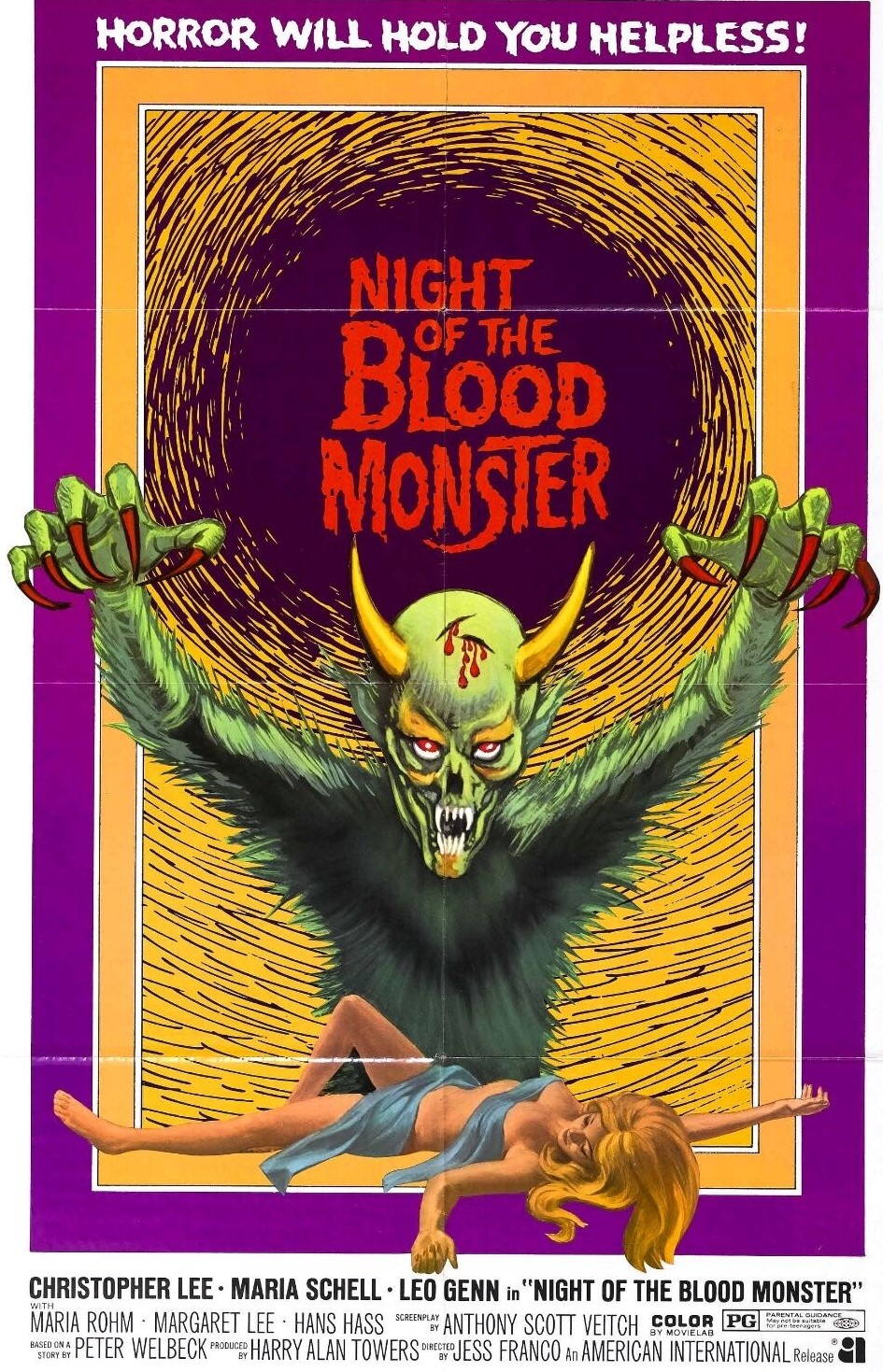
Night of the Blood Monster / The Bloody Judge (1969) ***

Handsomely mounted historical drama set in 17th century England on the brink of revolution  meets Son of Witchfinder General. An uprising headed by the Duke of Monmouth in the south-west threatens to overthrow King James II. Involved in the plot are Harry Selton (Hans Hass), son of suspected agitator Lord Wessex (Leo Genn), whose beloved Mary Gray (Maria Rohm) is in the sights of Judge Jeffreys (Christopher Lee) after he has condemned her sister Alicia (Margaret Lee) to be burned as a witch.

The minute witchcraft enters the equation the narrative thrust is constantly interrupted by scenes of nudity, blood and torture, mostly involving women, but actually the film does attempt to cover the rebellion and its notorious aftermath when hundreds of rebels were executed, the “Bloody Assizes” with “Bloody Judge” Jeffreys to the fore. Conflating witchcraft with a genuine historical episode does not work very well and unlike Witchfinder General (1968), the murder of innocent women is more of a sideshow, despite the brutality involved, and you get the impression the story has been hijacked to accommodate supposed witch Mary in the interests of adding titillation.

Even as the story of the rebellion unfolds, the threat to the crown spelled out, the origins of the revolt mostly made clear (Monmouth being the illegitimate son of Charles II, and nephew to James II) although the sectarianism behind the rebellion is ignored, the narrative keeps jumping back to the witch element. Jeffreys connects the parallel narratives, hunting down rebels and witches, while handling most of the exposition. Given the budget, there’s a surprisingly good battle sequence, cavalry charging cannon. Given his later reputation, Jeffreys also reflects on the meaning of justice.

And while there are some camp moments – Jeffreys playing the organ while attired in grand robes, dancing girls sticking pins in his effigy – the twists and turns (Mary captured and rescued, captured again)  are effective enough. Despite the copious nudity, there a couple of low-key love scenes and, oddly enough, a touching moment when Mary licks the blood from a dead prisoner. And for all the blood, that is effect rather than cause, nothing too gory.

But with the powerful all-mighty, and investigators able to plant evidence, and the innocent forced into immoral acts to save their loved ones, lawlessness is apparently next to godliness. But in reality the wicked did not get away with their crimes so various villains get their come-uppance.

Most peculiar sight is Christopher Lee in a love scene where he is not about to sink his incisors into a neck. Occasionally, the film bursts into German with English subtitles – as if various versions were pillaged to produce this copy – or has lines like “you turn me on.”

However, fans of Spanish cult director Jess Franco (The Girl from Rio) who expected something more along the lines of 99 Women (1969) and Venus in Furs (1969) may be disappointed that he spends so much time on the historical elements and less on the random T&A. You might not be surprised to learn of the involvement of ubiquitous producer Harry Alan Towers (Five Golden Dragons, 1967).

Discover WordPress

A daily selection of the best content published on WordPress, collected for you by humans who love to read.

The Atavist Magazine

by Brian Hannan

WordPress.com News

The latest news on WordPress.com and the WordPress community.