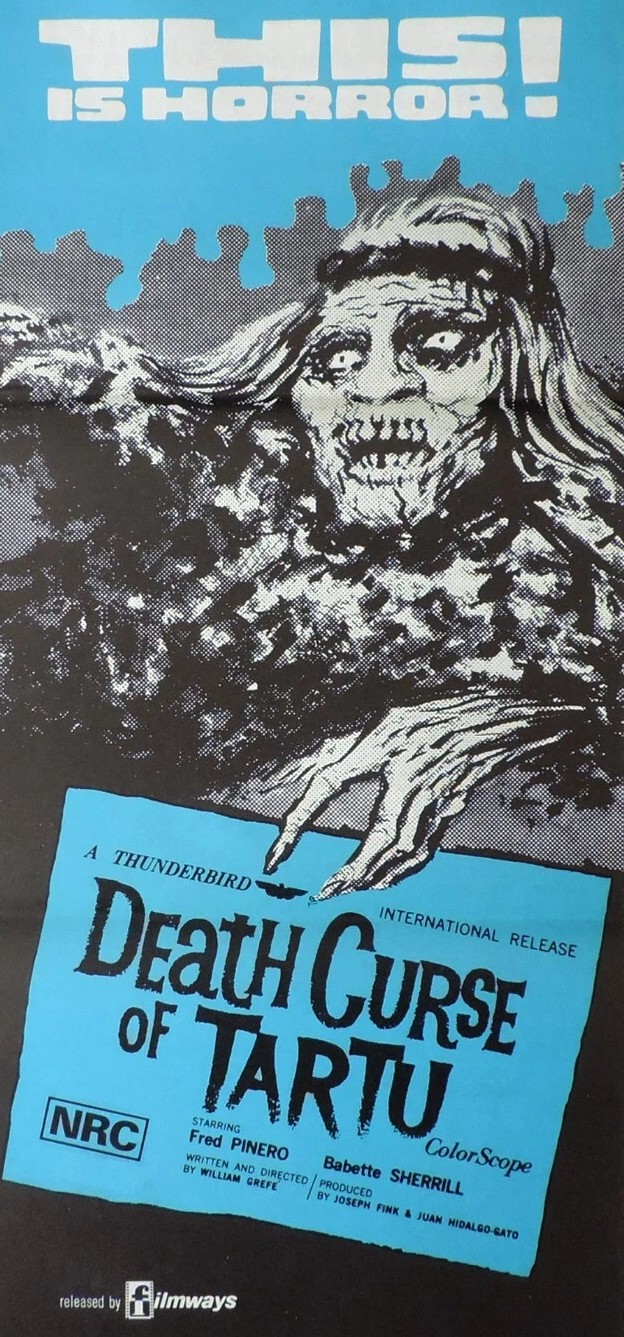
Absolute hoot. I often think it’s a shame we can’t admit to enjoying a really good bad picture and here we have a gem in the So Bad It’s Good category.
If you have a notion for the kind of movie where actors have to wrap rubber snakes around their necks and pretend to strangle themselves, or do a passable imitation of being eaten alive by a non-existent shark, manage to position themselves in a tree so they can fall into the open mouth of a stationary model alligator, or foolishly go where even devils fear to tread, this one is for you.
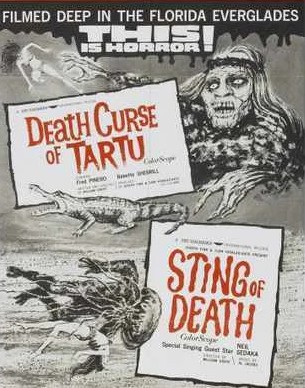
This wasn’t even the kind of schlocky picture that scraped out onto the release circuit in flea-ridden cinemas – it had a one-week engagement at the ABC Regal in Glasgow city centre, Scotland, one of the city’s two main first run venues.
It’s the Florida Everglades version of the Old Dark House and comes replete with umpteen warnings. Already people have gone missing in this particular area of interest, reputedly an ancient Native American burial ground. But that doesn’t stop explorer Sam Gunter (Frank Weed) continuing his solo expedition against the advice of local guide (Bill Marcus) who warns of ghostly chants and drums and of finding the imprint of tiger feet.
Sam’s pretty chuffed with himself to uncover an archaeological find, a stone whose significance is unclear. Anyways, poor Sam has not taken into account the presence of deadly snakes that can slither through the undergrowth and (holy moly!) overturn a kettle and then climb a tree and ambush him and suffocate him to death – though who wouldn’t be suffocated if instead of trying to remove said creature from around your neck your task as an actor was to pull the damn reptile as tight as possible so it looks like it’s impossible to escape. This is a mighty predatory creature and must just be protecting its territory because it makes no effort to eat its prey.
Sam’s disappearance doesn’t put off archaeology lecturer Ed Tison (Fred Pinero) and wife Julie (Babette Sherrill) who are escorting four students on their first dig. Luckily, the youngsters – Johnny (Sherman Hayes), Tommy (Gary Holtz), Cindy (Mayra Gomez) and Joan (played by Maurice Stewart!! according to imdb) – are already paired off, so there’s time for a bit of necking and dancing.
But it’s not long before the larking about turns into peril. Frolicking in the water ain’t such a good idea when there’s a stray shark about (presumably culled from stock footage) and the actors, who have presumably taken thrashing-about lessons, manage to churn up the water sufficiently to suggest they have been attacked.
Meanwhile, every now and then, we have been favored with shots of some gruesome creature coming to life. Given that, according to legend, he was capable to turning himself into a tiger, it’s a fair enough conclusion that he was the marauding shark, whose appearance in the Everglades would otherwise be too mysterious this side of chemical pollution or atomic accident.
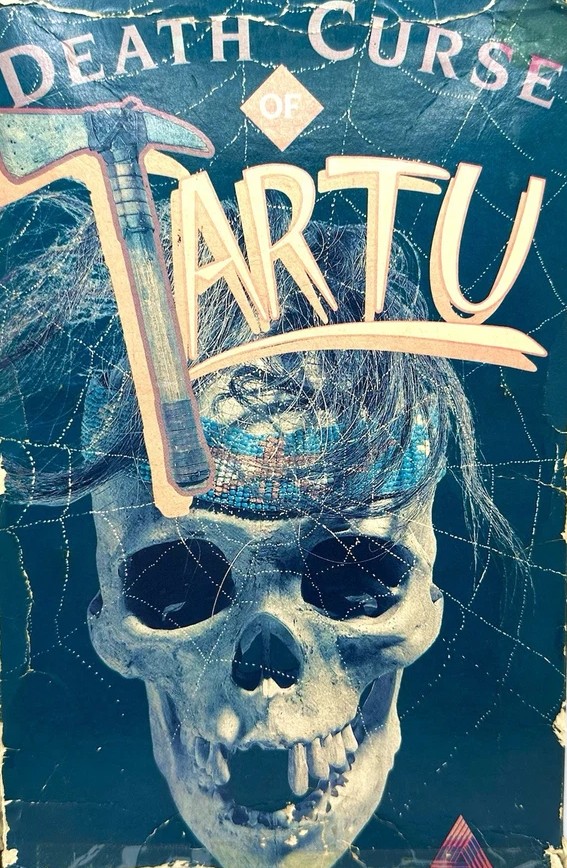
The monster takes human form and begins pursuing the remaining intruders. Although Ed has a bolt-action rifle he’s not much of a marksman so their pursuer is able to happily maraud and his target hasn’t enough wits about her to snatch the knife he has embedded in a tree – and thus defend herself – so naturally enough she ends up in quicksand (or gradually going down on her knees in a patch of sandy water so it looks like she’s sinking). It’s lucky there is quicksand because that provides the narrative solution as to how Ed is going to escape the monster. The girl can be given a helping hand to get out of the quicksand, but the monster, after being thrown in, is denied assistance. But before he can be sucked under, he turns into a skeleton.
This has some historical significance in the horror genre, being at the forefront of what was known as the “regional” subgenre where movies were made in remote spots on miniscule budgets often with amateur actors. Writer-director William Grefe (Sting of Death, 1966) conjured up enough of these pictures to enter the esteemed halls of cult, but he was significant for another reason. At a time when movies were in short supply, the exhibitors had decided to enter the production game and funded The Checkered Flag (1963), directed by Grefe, under the auspices of Motion Picture Investors.
Nothing more was expected of the actors than that they could put on a good show of dying. Fred Pinero, Gary Holtz and Babette Sherrill had appeared in Sting of Death, but that was the extent of their acting careers. Frank Weed made one other movie. It was another decade before Mayra Gomez made another picture but by then she was on her way to a career as a television presenter, for which she received a Spanish lifetime achievement award.
If there was a separate ranking system for So Bad It’s Good films this would be hitting at least the four-star mark. As it is under my current system, it has to be marked down, which is a shame because there’s a heck of a lot of fun to be had here.
 The Magnificent 60s