Law of the Lawless (1964) ***

I’m rescuing another low-budget western from critical oblivion. While this can’t boast existentialism to boost its credentials or claim to belong to the cult fraternity and, technically, doesn’t belong to the revisionist sub-genre which was beginning to gather pace, and while you won’t go to this for visual style or striking composition, there is more than enough going on for it to be worthy of reassessment.

For a start it majors on remorse. You might come across a western hero who bitterly regrets the woman cast aside or the family abandoned (though more likely such actions will sit lightly), but you’ll virtually never find anyone who regrets using the gun, whether for righteous reasons or not. But here you’ve got the two main characters, one on the side of the law and the other of a criminal disposition, who both show remorse for their actions. And had the director been more disposed to the visual he would have made a great deal more of the scene where the black-garbed widows arrive in town, victims of both gunslingers who killed their husbands and of the judges who pronounced the death sentence on their gunslinging husbands.
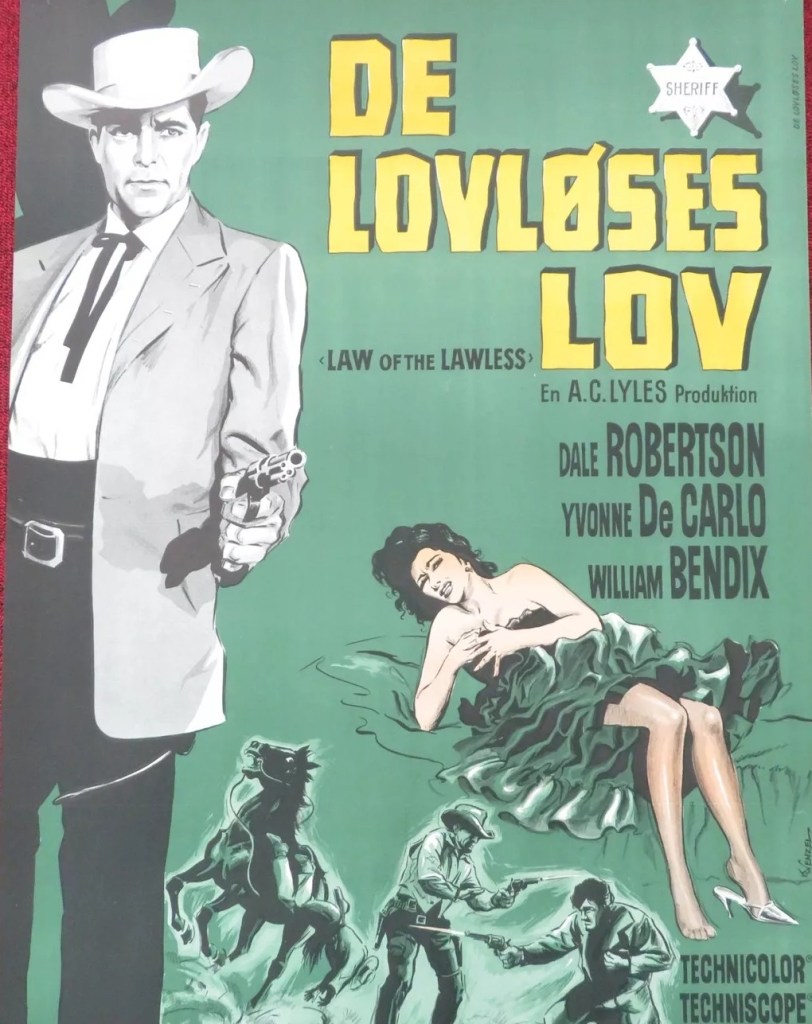
And there’s considerable pause to imagine what happens to such widows. Unless they can find a benefactor, perhaps an older unmarried rancher or a widower, they are going to end up working in saloons and selling their bodies. On top of that we have a cracker of a courtroom drama where the exceptionally clever lawyer can twist the facts to suit his client.

This could also have been another kind of western altogether, the one where the hero is constantly beset by a variety of enemies, and the narrative therefore one of tension. But Judge Clem Rogers (Dale Robertson) has four separate outfits baying for his blood and still director William F. Claxton manages to also fit in all these ideas about remorse, the law, widows, conniving lawyers, the entitled of that era, and failed romance.

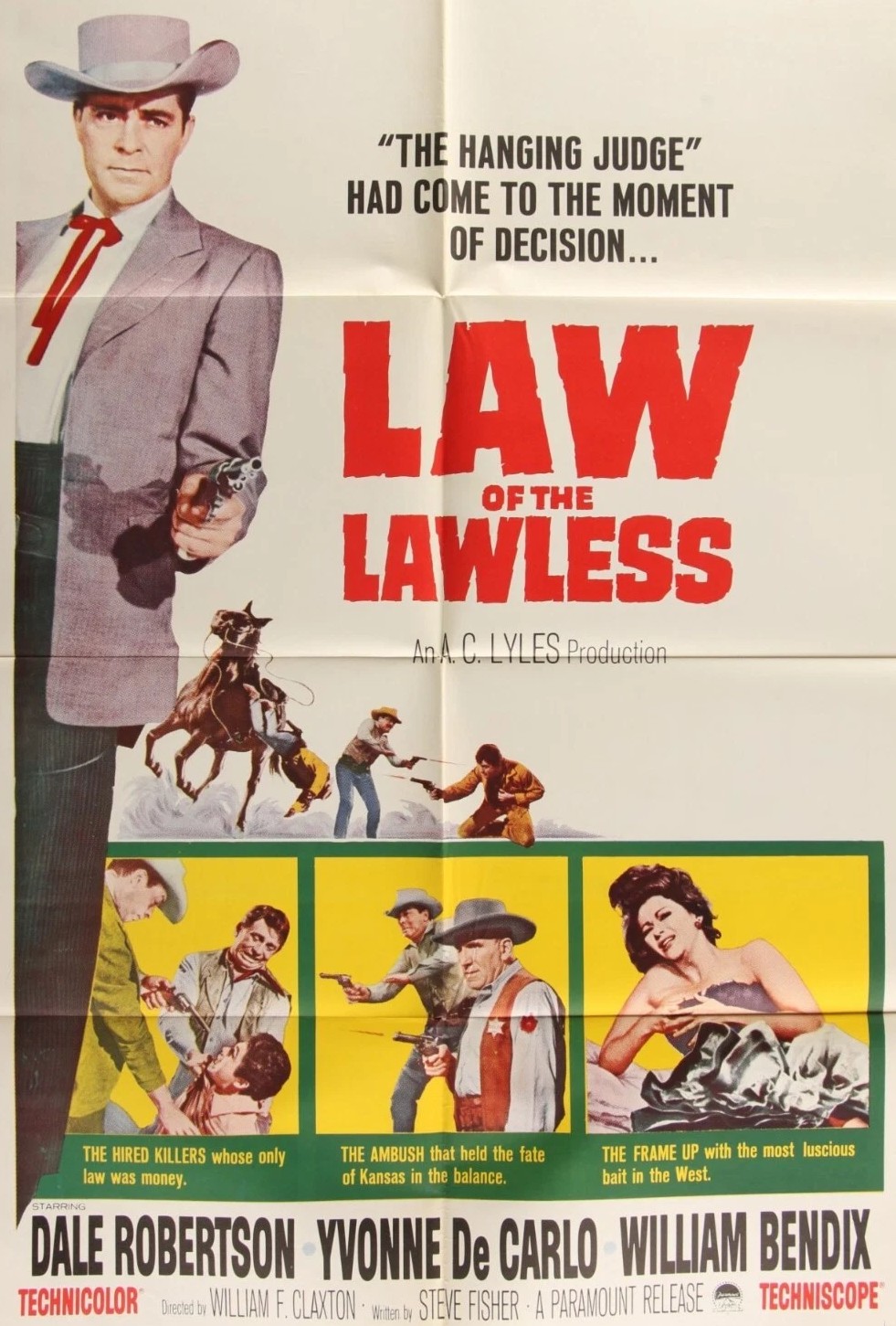
Rogers is in town for the trial of former friend Pete (John Agar), son of Tom (Barton McClane) the biggest rancher around, for killing someone in cold blood. Tom, a piece of work, has various plans to tilt the odds in his favor, first planning to blackmail Rogers over being caught in a honeytrap with Pete’s fiancée Ellie Irish (Yvonne DeCarlo) and whichever way the trial goes he has hired gunslinger Joe Rile (Bruce Cabot) at a fee of $10,000 to kill the judge. Rile and Clem have history, the gunslinger killed the judge’s father. And it’s Tom who hits on the scheme of embarrassing the judge by flooding the town with widows, many of whom are widows thanks to Rogers.
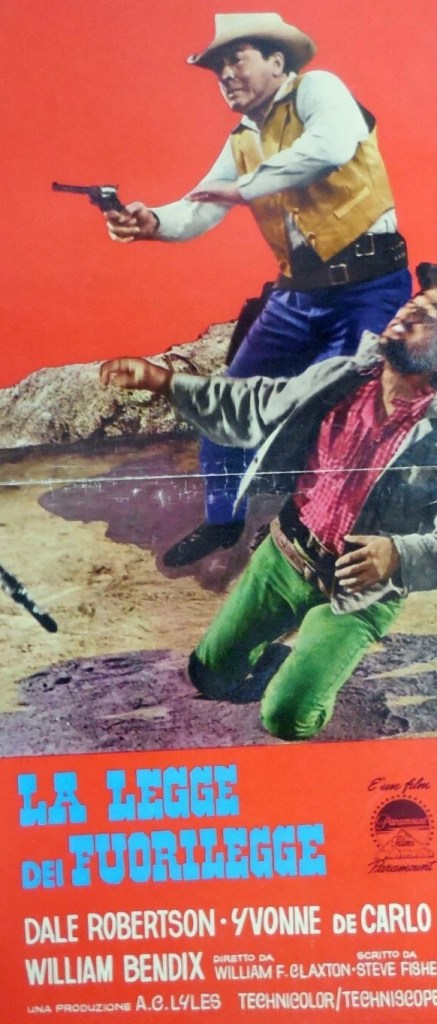
And there are four other dudes, three brothers and an outsider, also intent on killing Rogers. While Sheriff Ed Tanner (Wiliam Bendix) isn’t inept he lacks the force of personality to keep the bad guys in check and when he’s wounded his inexperienced deputy Tim (Rod Lauren) foolishly steps up to the plate.

You can’t help but feel sorry for Ellie, forced to play the part of the lure to dupe Rogers, especially when it’s clear she has more feelings for him than she does for Pete, whom she admits she doesn’t love but needs his security. There’s an interesting power struggle between Tom and Rile with the gunslinger refusing to kowtow to his employer. The court case is riveting because it turns on various twists. And climax is a knockout that you won’t see coming.

This isn’t one like The Shooting (1966), rescued from oblivion by critics and cultists – Paramount issued it as a second feature so it’s not unseen – and it’s not trying to rewrite the Hollywood history of Native Americans, and as I said it’s not distinguished visually, but it does pack an awfully thoughtful punch, tackling areas that the bulk of western film directors have ignored.

Dale Robertson (Coast of Skeletons, 1965) heads a good B-picture cast with veterans William Bendix (Oscar-nominated for Wake Island, 1943), Yvonne De Carlo (career revived by The   Munsters, 1964-1966), Lon Chaney Jr (The Wolf Man, 1941) and Bruce Cabot (King Kong, 1933).

William F. Claxton (Desire in the Dust, 1960) is to be commended for cramming in so much interest. Script by Steve Fisher (Rogue’s Gallery, 1968).

An unexpected treat.

The Unfinished Task / I’ll Give My Life (1960) ***

Complete your Angie Dickinson collection with his long-lost number. Almost unrecognizable as a brunette, she carries much of the emotional weight of this tale about an outsider rejecting a chosen career. Hollywood pictures about creative outsiders such as artists and writers relied on charismatic actors – Kirk Douglas in Lust for Life (1956), Charlton Heston in The Agony and the Ecstasy (1965) – to bring the project to life. Similarly, you might think, in movies about another type of outsider, of the religious variety, having the likes of Gregory Peck (The Keys of the Kingdom, 1944) or Bing Crosby in Going My Way (1944) goes a long way to giving such ventures audience-appeal.

Here, Jim (John Bryant), the son of a successful construction tycoon, having completed a degree goes against the wishes of father John (Ray Collins) by becoming a minister instead. In due course he is sent overseas to a mission in New Guinea, and like Father Stu (2022) contracts a deadly disease. Jim is far from charismatic, just a plodding ordinary guy who has found “something more important than building skyscrapers.”

The story is instead told through the eyes of John, resentful of his son’s decision, and his girlfriend/fiancée/wife Alice (Angie Dickinson) who, expecting marriage to a wealthy engineer, instead has to set aside her own ambitions and go along with her husband’s wishes, this being post-WWII America, and independence hardly a prerequisite in a wife, never mind a woman.

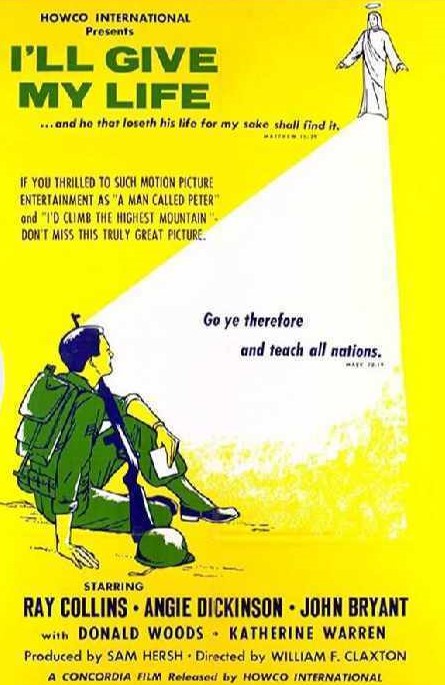
This poster does not do the film justice. It’s nothing like as “heavenly” as that. Howco was an exhibition company that entered distribution in order to provide enough product for its cinemas.

But if this is a story of a conversion – as was the case in Father Stu – it’s about the conversion of the father and Alice and the bulk of the story hinges upon their reactions to the path taken by Jim rather than him taking center stage. So it’s cleverly done, and whether this is due to budgetary pressure, or creative decision, it proves the right choice. John is the kind of self-made man who would dominate any stage, forever making plans, spinning the world as he would like it to be. In Alice’s eyes we see nothing but her weighing up Jim’s choices, sometimes accompanied by shock, occasionally elation, but mostly resignation and infrequent resentment as she, too, is parted from family to follow her husband into an unknown in which she had considerably less faith.

Unlike Father Stu, conversion does not come easily. Jim is long dead, two-thirds of the way through the picture as it happens, before John comes to realize that his son’s demise should not be in vain and that he left behind “an unfinished task” for his father to complete, namely raising awareness of the power of missionaries to improve the lot of the miserable and poor in foreign parts. Bear in mind the era in which this was made, so there are some attitudes that will make you wince, but generally it is well done, not weighted down with platitudes and, in concentrating on the doubter, brings alive a difficult subject.

And although this was before questions were asked about the sexual corruption of priests and ministers, men who followed religion were still not as easily accommodated in the general community, seen as overly pious and, to the businessman, existing in a vacuum. The idea that the Church, of various kinds, had not done enough to ease global suffering, is continually raised and nobody here is giving themselves a pat on the back.

Alice is actually given more screen time than Jim, his father using her as a sounding board, and, while Jim is off in New Guinea, enjoying herself with the firm’s resident beau, Bob (Jon Sheppod), and finally taking on motherhood and coping with the premature death of her husband and still fighting to open the father’s eyes to the good being done.

Angie Dickinson (Jessica, 1962) gives a very good account of herself, especially as the narrative restricts her to the kind of wifely 1950s role rather than the frisky sexuality she exhibited in the 1960s. Her acting skill saved her from being lumbered with portentous dialogue since she could portray her feelings more easily with her eyes.

Ray Collins (famed for a running role in the Perry Mason series) is excellent as the father confused by his son’s decision, fighting him every inch of the way. John Bryant (The Bat, 1959), it has to be said, does not light up the screen, lacking the magnetism of a Peck or a Crosby but in some regard this kind of straight playing suits the film, since the character is not meant to be out of the ordinary.

William F. Claxton (Desire in the Dust, 1960) directed from a script by Herbert Moulton, better known as a producer of shorts. Although this film was released in 1960, it appears to have been made before that, some suggest as early as 1955. Given it was funded by the Lutheran Church, the script does not make heavy weather of the religious elements and John’s resistance to his son’s vocation reflected that of any father to a son embarking on as shaky a career as painting or writing.

You can catch this on YouTube, though it’s not a great print. And, yes, that is Angie Dickinson sitting demurely at a desk.

Discover WordPress

A daily selection of the best content published on WordPress, collected for you by humans who love to read.

The Atavist Magazine

by Brian Hannan

WordPress.com News

The latest news on WordPress.com and the WordPress community.