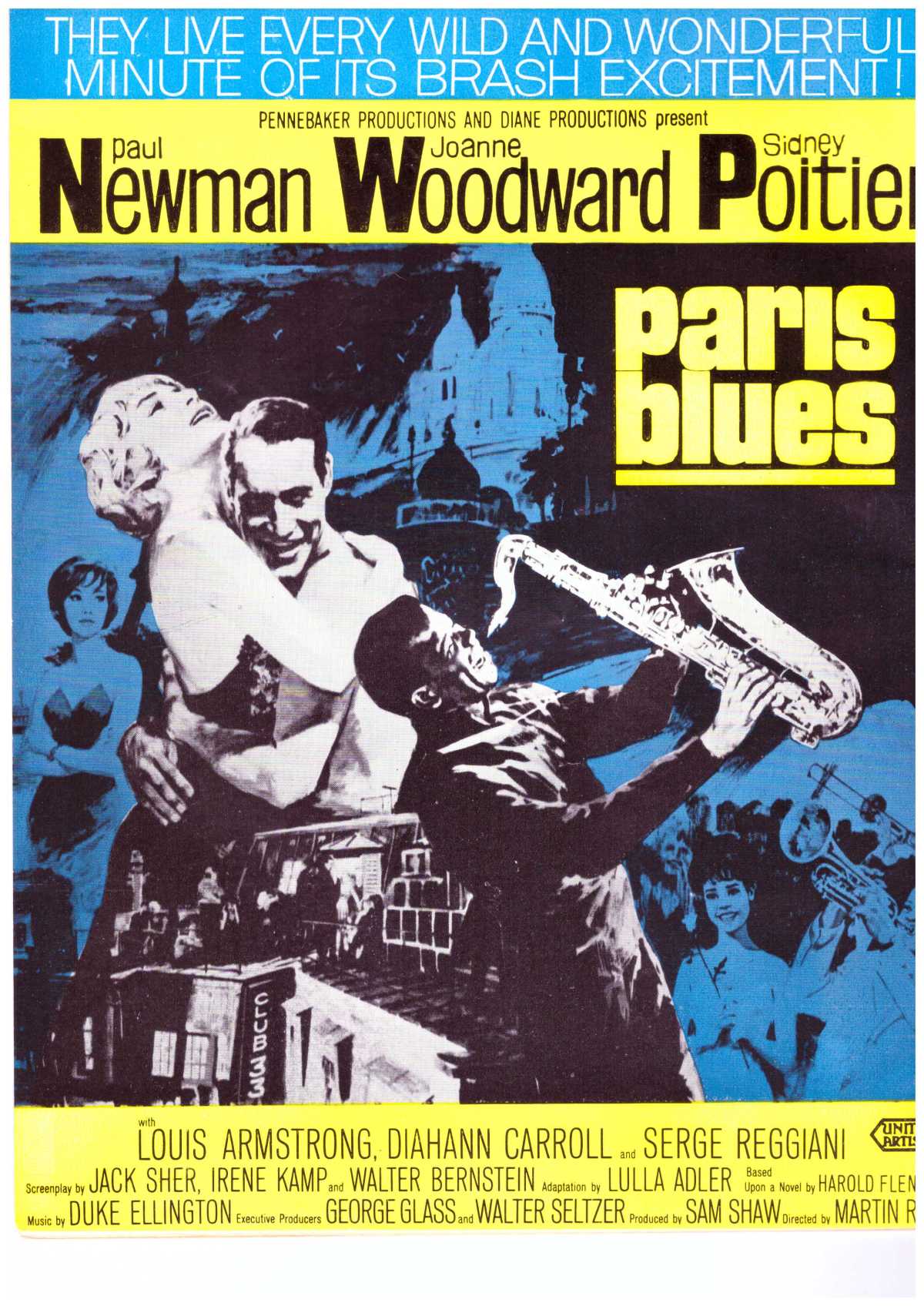
Paris Blues (1961) ****

Sometimes the stars just do align. Issue-driven drama played out against scenic Paris and host of jazz greats in support. The Walter Newman script gets quickly to the nub of a drama that focuses squarely on racism and creativity.

Jazz trombonist Ram (Paul Newman) lives for his music and fancies himself a composer as well as a player and expects women to fall in with his creative lifestyle until he comes across single mother tourist Lillian (Joanne Woodward) who ups the romantic ante by hopping into bed right away. Ram’s buddy, saxophonist Eddie (Sidney Poitier), falls for Lillian’s pal Connie (Diahann Carroll) but not only is she less promiscuous but a civil rights activist who rails against him for abandoning the cause and hiving off to Paris.
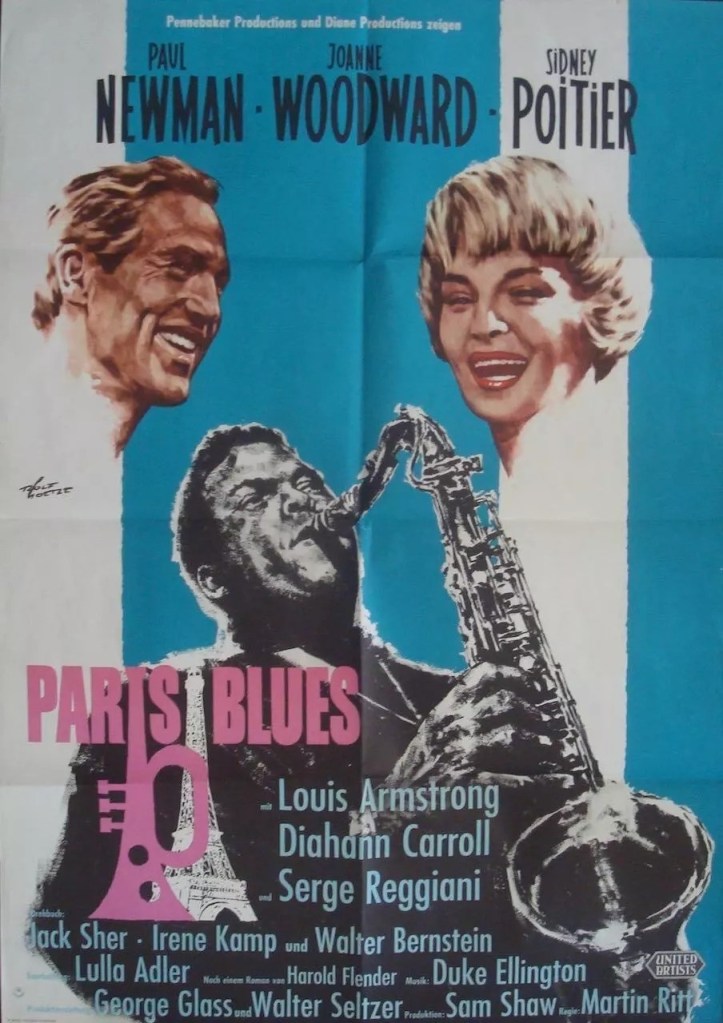
There’s a good twist on the will-she-won’t-she trope as this time around it’s the men (no surprises there) who have trouble committing. While the guys are both smitten, and at various times ready to throw up their Parisian lives and head for home, it doesn’t work out that way, so mostly what we get is argument, making up, repeat. But that’s not to suggest this falls into any kind of trap.

While Lillian uses seduction to try and winkle Ram out of his refuge, Connie, on the other hand, depends on guilt. Although Eddie’s able to verbalize the benefits for a black musician playing in Paris, he hardly needs to point it out, it’s plain to see that the innate racism he suffers at home is entirely absent in his adopted city.

If you’re a jazz enthusiast you’ll probably be more aware of the central musical conflict, the older-fashioned New Orleans style versus the modern be-pop. There’s no shortage of jazz. Duke Ellington was Oscar-nominated for the score, Louis Armstrong turns up, mobbed at the train station by fans, and every time the movie’s not cutting away to a Parisian backdrop it’s indulging in some great jazz tunes in the traditional smoky night club.

What’s really attractive here is the assured acting. Paul Newman was in the middle of a hot spurt, both at the box office and from the critics, successive Oscar noms on the way for The Hustler (1961) and Hud (1962) and endorsing his marquee credentials with From the Terrace (1960) and Exodus (1960). This is a lively performance, one in which he doesn’t have to carry the weight of the world on his shoulders or the deadweight of expectation. He’s not a snarling rebel, he doesn’t need to be, not with nightly improvisation, recognition from his peers, and a toehold on the next stage of creativity, composition. If he’s tussling with anybody it’s himself and his spats with Lillian are little more than arguments with himself about the road to take and the sacrifices that might be essential along the way.
Sidney Poitier (The Long Ships, 1964) snags a great career break, like Newman deprived of heavy duty, able to display his great charisma and charm with such a light touch. Joanne Woodward (Big Hand for a Little Lady, 1966) as ever brings a wide range to her role, sassy at times, pragmatic, not inclined to the lovelorn. Diahann Carroll has the hardest part, since she’s the evangelist for modern America, one where equality is going to be a given, so her scenes with Poitier end up mostly being argument rather than pure romance.

This would have been a lot edgier had it gone down the originally planned route of Ram falling for Connie, and that’s hinted at when they first meet, but I guess Hollywood wasn’t ready for that.

This was the second (of five) of director Martin Ritt’s collaborations with Paul Newman – they had formed a production company – and shows the pair’s preference for movies bearing social comment. Ritt (The Spy Who Came in from the Cold, 1965) marries all the various elements to produce an entertaining picture on a serious subject.

Walter Bernstein (The Money Trap, 1965), Jack Sher (Move Over, Darling, 1963) and Irene Kemp (The Lion, 1962) collaborated on the screenplay from the novel by Harold Flender.

Thought-provoking.
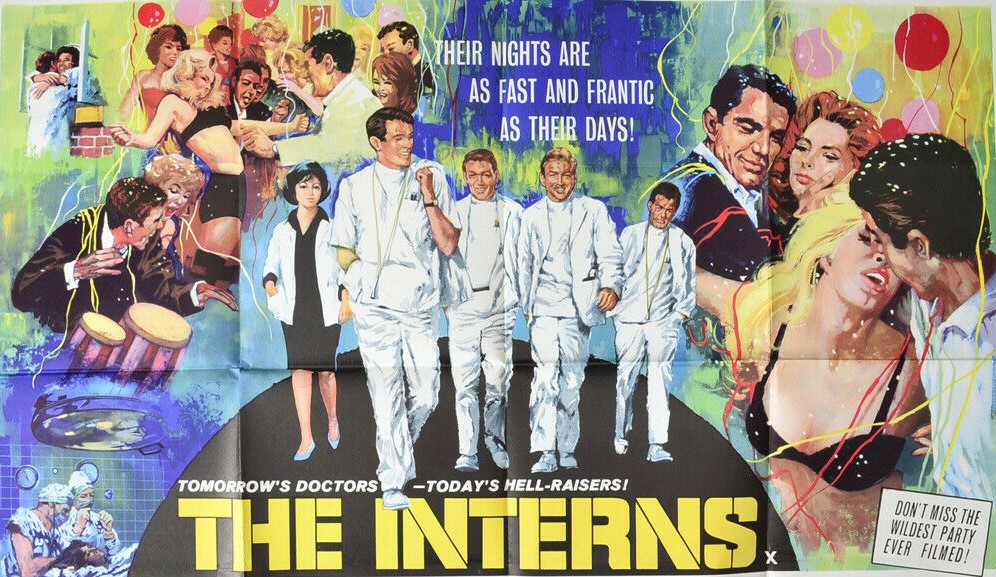
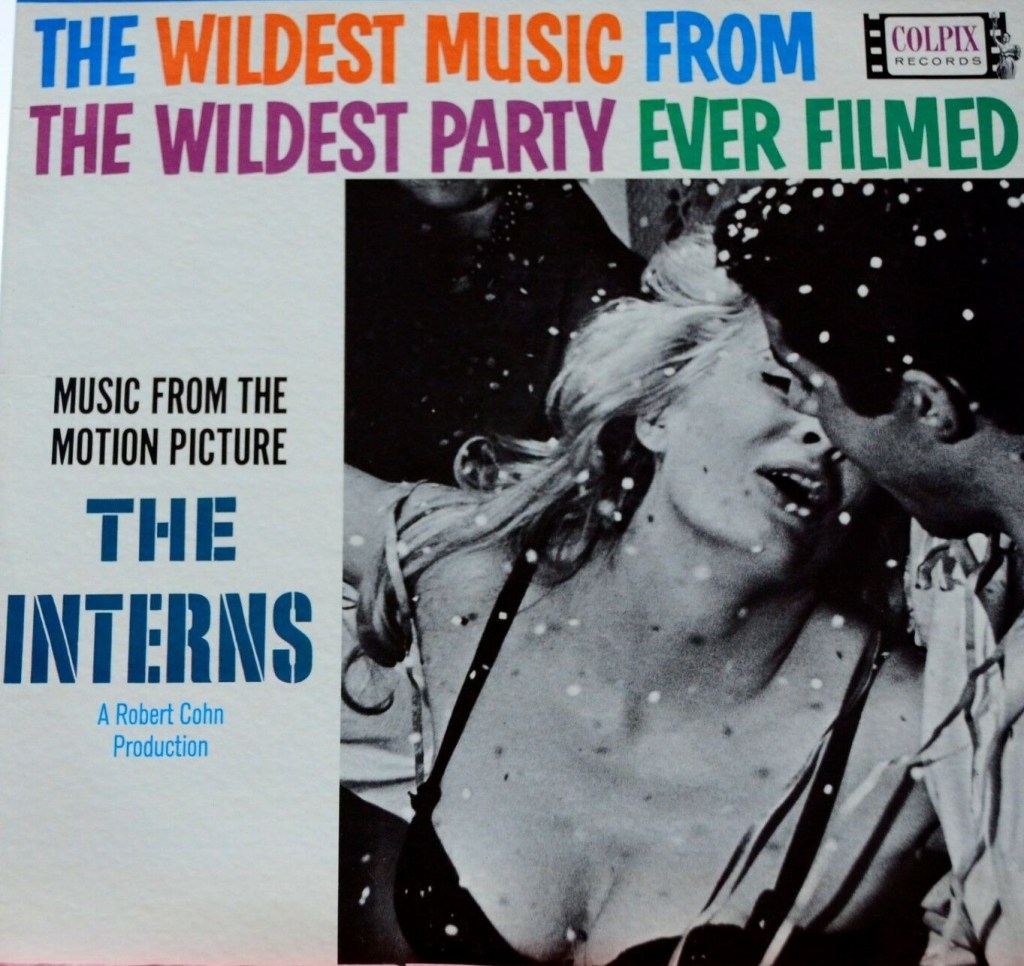
The Interns (1962) ***

Patients are a nuisance to be tolerated on the route to wealth in this superior soap opera that sees young doctors wrestling with ambition and ethics. Although also concluding that impending lofty status will snare them an attractive bride, they find women less biddable than expected, romance proving the trickiest of all procedures.

The main cast of four men and one woman are played by a roster of hotly-tipped newcomers, including future Oscars winners and nominees and the elusive Haya Harareet (The Secret Partner, 1961). Director David Swift, accustomed to handling multiple characters in the likes of Pollyanna (1961), keeps the pot boiling and although some storylines lead to obvious conclusions the screenwriters bring sufficient imagination to the various strands.

The story unfolds over the one year the doctors spend in a general hospital, where the patients are liable to be drunk and obstreperous, before taking up residencies elsewhere. As you might expect, the main characters divide into the good and the arrogant. Heading the latter are Alec Considine (Michael Callan) who cheats on girlfriend Mildred (Anne Helm) with older nurse Vicky (Katharine Baird) in order to gain through her connections a residency at a highly prestigious hospital.

Matching him in the cocky stakes is John Paul Otis (Cliff Robertson), charming to old ladies but willing to risk his career to bed movie actress Lisa (Suzy Parker). The good guys are Lew Worship (James MacArthur) who is seduced into the supposed backwaters of obstetrics and Sid Lackland (Nick Adams), an all-round good egg who falls for a patient Loara (Ellen Davalos).

The most interesting of the young doctors, however, is single mother Madolyn Bruckner  (Haya Harareet) who takes on surgeon Dominic Riccio (Telly Savalas) at every turn. Riccio spends his time berating his charges and, in particular, has a downer on female doctors. At every encounter, despite his vicious tongue, she refuses to back down.

But it is the patients, in particular Arnold Auer (Peter Brocco) and Loara, who blow a hole in the myth of hospitals. In the best scene in the film, Auer, suffering from a degenerative illness that will turn him into a vegetable, takes over from the doctor in giving his own awful diagnosis. His pleas for clemency from his ordeal, in essence assisted suicide, create an ethical dilemma for the young doctors who did not realize that modern medicine could prolong rather than curtail patient suffering.

Auer’s anguished wife Emma (Angela Clarke) flits in and out of the picture as she buttonholes any doctor willing to listen to a new cure she has discovered. While the more hard-hearted doctors can inure themselves to his agony, a savage turn of events finds them all caught up in a situation that could jeopardize their future careers.

Although Loara has an incurable disease and has more or less given up, Lackland’s effervescent good humor and determination that surgery can resolve all health issues brings her hope and if you were in her condition possibly the last thing you would want would be a cheerleading doctor on your side, but in this instance it brings succor and in the doctor’s case forces him to rethink his priorities.

Probably the last thing the doctors – and the audience – expected was to come up against such stubborn, free-thinking women. While Bruckner appears to fly the flag for female independence, she has solid support from Lisa who spends most of the picture rejecting Otis’s advances on the grounds that even when he becomes rich he will be too poor for her liking. Eventually, Vicky forces Considine to choose. Shy nurse Gloria (Stefanie Powers) shocks Worship by putting global travel ahead of marriage. But she’s not as shocking as the bespectacled inhibited Olga (Carroll Harrison) who loses her inhibitions in style at a wild party.

Theoretically, a film about young doctors having a romp, in reality a thoughtful and thought-provoking picture, tackling issues that would have been taboo at the time and removing the submissive tag that daunted most movie female characters in the movies.

Those who succeeded in later winning Oscar favor were Cliff Robertson, Best Actor for Charly (1968), and Nick Adams and Telly Savalas, both nominated for Best Supporting Actor, the former in Twilight of Honor (1963) and the latter in The Birdman of Alcatraz (1962).

Robertson was the pick of the bunch, a star in his own right graduating from 633 Squadron (1964) and Masquerade (1965) to J.W. Coop (1971) which he also directed. But largely, the stars did not fulfil initial promise. The peak of Michael Callan’s movie career was reprising his role in The New Interns (1964), star in British director Michael Winner’s You Must Be Joking! (1965) and second male lead in Cat Ballou (1965). James MacArthur had a steady movie career before an epic run in television series Hawaii Five-O (1968-1979). Nick Adams switched between film and television before his premature death in 1968.  Haya Harareet made only one more film, The Last Charge (1962). In a bit part here, this is the same Brian G. Hutton who went on to greater things as a director, most notably Where Eagles Dare. (1968).

Although primarily in television, the less-heralded stars enjoyed greater ongoing success. Mainly a strong supporting actor, Telly Savalas had only one stab at a starring role (Land Raiders, 1970) before achieving worldwide fame as Kojak (1973-1978).  Stefanie Powers was television’s The Girl from U.N.C.L.E. (1966-1967) and later Hart to Hart (1979-1984). Buddy Ebsen (who plays the older Dr Sidney Wohl) went straight into a nine-year run of The Beverley Hillbillies

Directed with considerable care and awareness of relevant issues by David Swift (Pollyanna, 1961) who co-wrote the screenplay with Water Newman (The Magnificent Seven, 1960) from the novel by Richard Frede. It spawned sequel The New Interns and a TV series. Some reports have The Interns as the biggest of the year for Columbia, but that would only be correct if you were only able to exclude the massive box office for Lawrence of Arabia.

Still a soap, but an interesting one.

Discover WordPress

A daily selection of the best content published on WordPress, collected for you by humans who love to read.

The Atavist Magazine

by Brian Hannan

WordPress.com News

The latest news on WordPress.com and the WordPress community.