Behind the Scenes: United Artists Goes to War on a Low Budget – “Submarine X-1” (1968) and Five Others

With the contraction of Hollywood production in the 1960s, cinemas worldwide were always crying for pictures – any pictures – that could take up a weekly slot or pad out a double bill. (The single-bill programming that is standard these days was not welcome in most cinemas, except a prestigious few, and audiences expected to see two movies for the price of their ticket). Indie unit Mirisch had scored such a big hit with aerial war number 633 Squadron (1964) – it recouped its entire cost from British distribution so was in profit for the rest of its global run – that Walter Mirisch persuaded distribution partner United Artists to attempt to capitalize on the idea and thus set in progress a series of war pictures to be made in Britain.

There would be cost savings through the Eady Plan. Each film would have a “recognizable American personality in the lead” and have American directors. Budgets would be held under $1 million. Half a dozen movies were planned, the first appearing in 1967, the last in 1970.
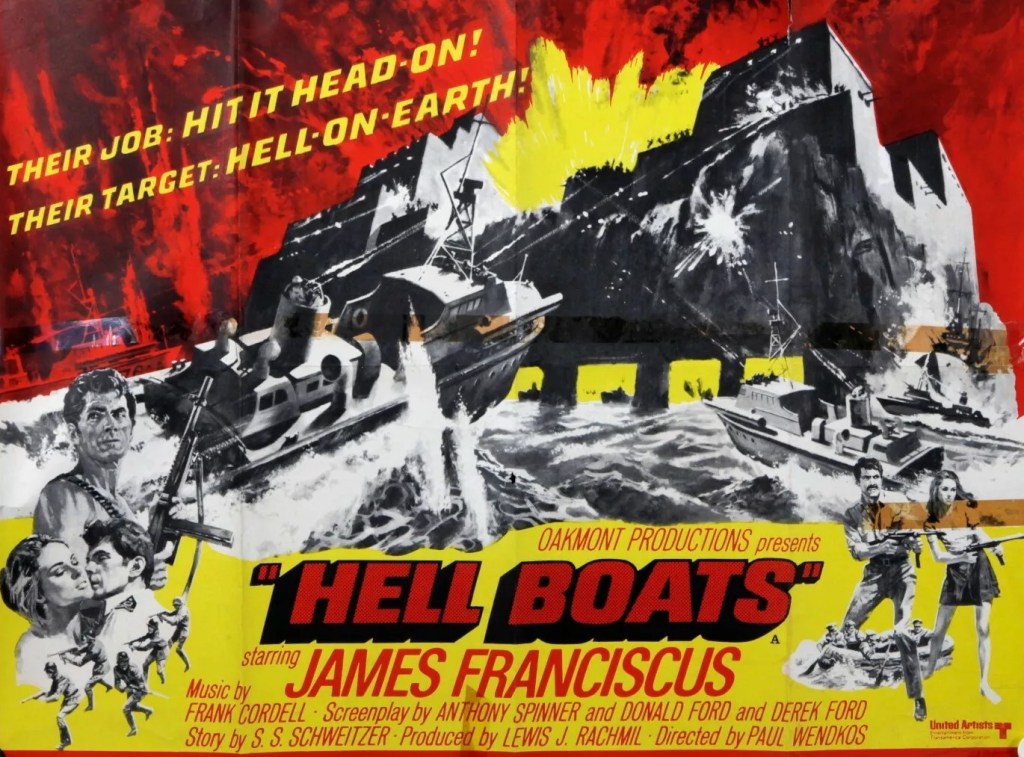
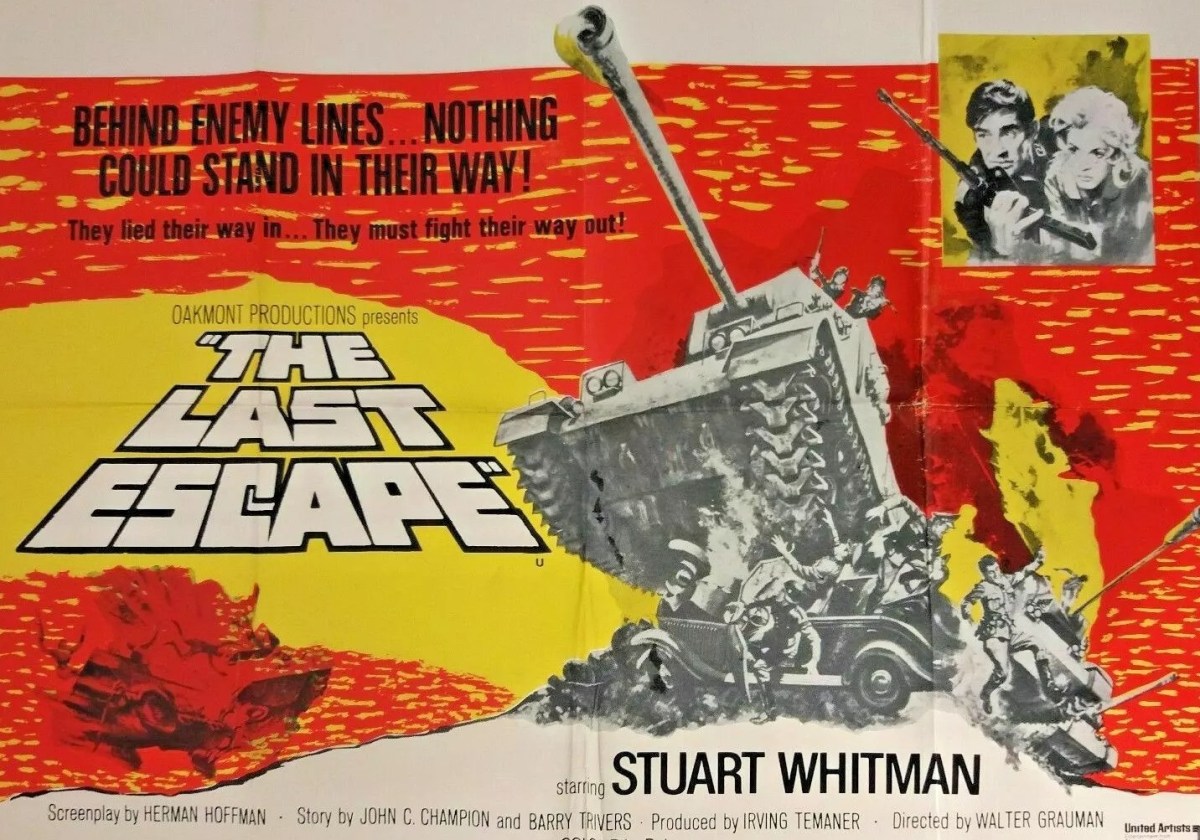
Quite whether James Caan (Red Line 7000, 1965) passed muster as a well-known enough star to qualify as a “personality” at the time he headlined Submarine X-1 (1968) is debatable, as was the presence of James Franciscus (The Valley of Gwangi, 1969) in Hell Boats (1970) and Christopher George (Massacre Harbor, 1968)  in The Thousand Plane Raid (1969) though Stuart Whitman (Rio Conchos, 1964)  exerted a higher marquee appeal for The Last Escape (1970). Veteran Lloyd Bridges (Around the World under the Sea, 1966) who headlined Attack on the Iron Coast (1968) was probably the best known, but these days that was mostly through television. And David McCallum owed whatever fame he had to television as part of The Man from U.N.C.L.E. double act and the idea that would still be enough to attract an audience for Mosquito Squadron (1969) seemed dubious.

Beyond setting up the project, Walter Mirisch had little to do with the actual production, putting that in the hands of Oakmont Production, which beefed up the action with judicious use of footage from other pictures. Invariably, reasons had to be given to explain why actors with American accents were members of the British fighting forces – most commonly they were represented as Canadian volunteers or might have British nationality by dint of having a British mother.

Storylines followed a similar template. At its heart was a dangerous mission. Leaders were invariably hated for some previous misdemeanor or because they were ruthless and drove the men too hard. If there was romance – not a given – it would border on the illicit. And someone required redemption.

And while none of the stars chose – or were chosen to – repeat the experience, Oakmont established something of a repertory company behind the scenes, writers, directors and producers involved in more than one movie.
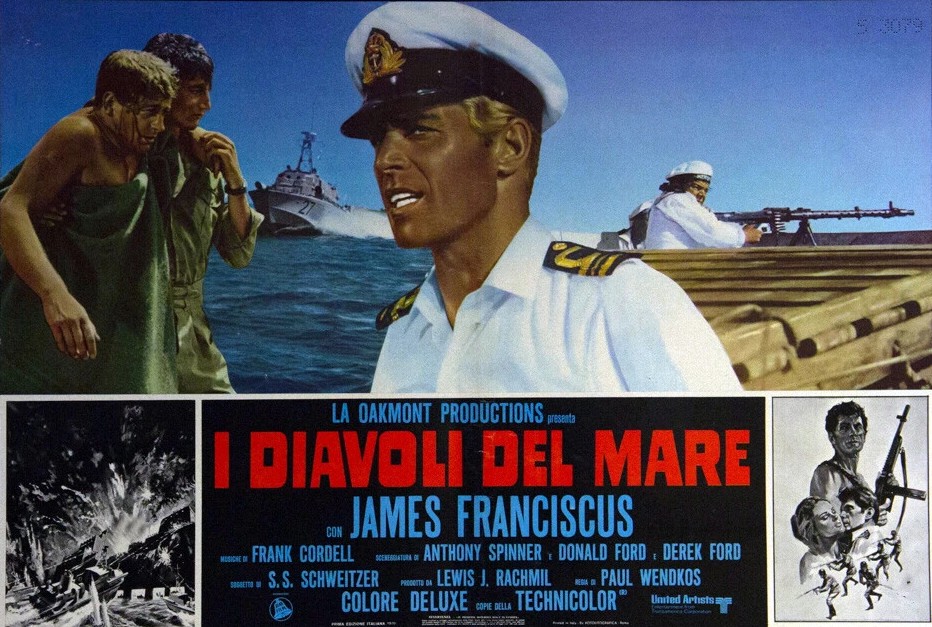
Italian poster (photobusta) for “Hell Boats”. I found Japanese and Australian posters
for most of the films in the series.

Boris Sagal (Made in Paris, 1966) directed both The Thousand Plane Raid and Mosquito Squadron and then made his name with The Omega Man (1971). Paul Wendkos (Angel Baby, 1961) helmed Attack on the Iron Coast and Hell Boats. Walter Grauman who had kicked off the whole shebang with 633 Squadron returned for The Last Escape. William Graham (Waterhole #3, 1967) as the only outlier with just Submarine X-1 to his name.

Veteran producer Lewis Rachmil (A Rage to Live, 1965) oversaw three in the series – Hell Boats, Mosquito Squadron and The Thousand Plane Raid. Another veteran John C. Champion, younger brother of celebrated Broadway choreographer Gower Champion, was involved in a variety of categories. Champion is almost an asterisk these days, best known these days for producing the film Zero Hour! (1957) that inspired disaster parody Airplane! (1980). He was only 25 when he produced his first picture, low-budget western Panhandle (1948). He was behind another four low-budget westerns pictures before Zero Hour!, which had a decent cast in Dana Andrews and Linda Darnell. But that was his last movie for nine years as he switched to television and Laramie (1959-1963), barely reviving his movie career with The Texican (1966) starring Audie Murphy.

He produced Attack on the Iron Coast and Submarine X-1 and was credited with the story for both plus The Last Escape. Irving Temaner produced The Last Escape and received an executive producer credit on Attack on the Iron Coast and Submarine X-1.  Donald Sanford (Battle of Midway, 1976) was the most prolific of the writers, gaining screenplay credits for Submarine X-1, The Thousand Plane Raid and Mosquito Squadron. Herman Hoffman (Guns of the Magnificent Seven) wrote Attack on the Iron Coast and The Last Escape.

Cinema managers were not, it transpired, queuing up for the product. Most commonly, when reviewed in the British trade press, their release date was stated as “not fixed” which generally meant that United Artists was hoping the review would do the trick and alert cinema owners.

In the United States, they rarely featured in the weekly box office reports, though Portland in Oregon appeared partial to the product, Attack on the Iron Coast appearing there as support to Hang ‘Em High (1968), Mosquito Squadron supported The Christine Jorgensen Story (1970), Hell Boats supported Lee Van Cleef western Barquero (1970) while The Last Escape supported Mick Jagger as Ned Kelly (1970). To everyone’s astonishment a double bill of Hell Boats / The Last Escape reported a “big” $10,000 in San Francisco, but that proved an anomaly.

In Britain, the movies fulfilled their purpose as programmers, not good enough to qualify as a proper double bill, but accepted as supporting feature for a circuit release on the Odeon chain. Since UA supplied Odeon with its main features, it proved relatively easy to persuade the circuit to take the war films to fill out a program. This kind of second feature would be sold for a fixed price not sharing in the box office gross. However, they were given the kind of all-action poster they hardly deserved.

So in 1968 Attack on the Iron Coast went out with The Beatles Yellow Submarine. In 1969, Submarine X-1 supported slick heist picture The Thomas Crown Affair, which with Steve McQueen and Faye Dunaway in top form scarcely needed any help securing an audience. Hell Boats was supporting feature in 1970 to Master of the Islands (as The Hawaiians starring Charlton Heston was known). As well as accompanying it on the circuit Mosquito Squadron in 1970 made a very brief foray into London’s West End with thriller I Start Counting and then reappeared a few months later as an alternative choice of support for Billy Wilder flop The Private Life of Sherlock Holmes. If you went to see Burt Lancaster western Lawman in 1971 you might have caught The Last Escape – equally it could have been If It’s Tuesday, It Must Be Belgium (cinema managers could choose either).

United Artists, under the financial cost in the early 1970s, pulled the plug on “programmers” such as these. Walter Mirisch in his biography, disingenuously suggested that the six movies had done relatively well. But that wasn’t supported by the studio’s own figures.

Collectively, they made a loss of $1.7 million. Only Attack on the Iron Coast made it into the black and then by only $59,000. Hell Boats lost $700,000. None of the movies earned more than $200,000 in rentals in the United States.

Although Mirisch managed to keep budgets down to around the million-dollar mark, they would have had to be much smaller to see a profit. Ironically, it was the cheapest, Attack on the Iron Coast costing $901,000,  that made the most. Submarine X-1 lost $150,000 on a $1 million budget, Mosquito Squadron lost $253,000 on a $1.1 million budget while The Thousand Plane Raid lost $50,000 more on the same budget. The longer the series went on, the worse the losses – The Last Escape lost $449,000 on a $995,000 budget while for Hell Boats the budget was $1.36 million.

SOURCES: United Artists Archives, University of Wisconsin; Walter Mirisch, I Thought We Were Making Movies, Not History (University of Wisconsin Press, 2008) p204; Reviews, Kine Weekly – Feb 9 1968, Aug 31 1969, January 1970, April 18 1970; “Flops Loss-Cutting,” Variety, August 26, 1970, p6; “Picture Grosses,” Variety – March 13 1968, May 8 1968, April 24 1968, October 2 1968, June 10 1970, July 1 1970, July 8, 1970, August 12 1970, August 26 1970.

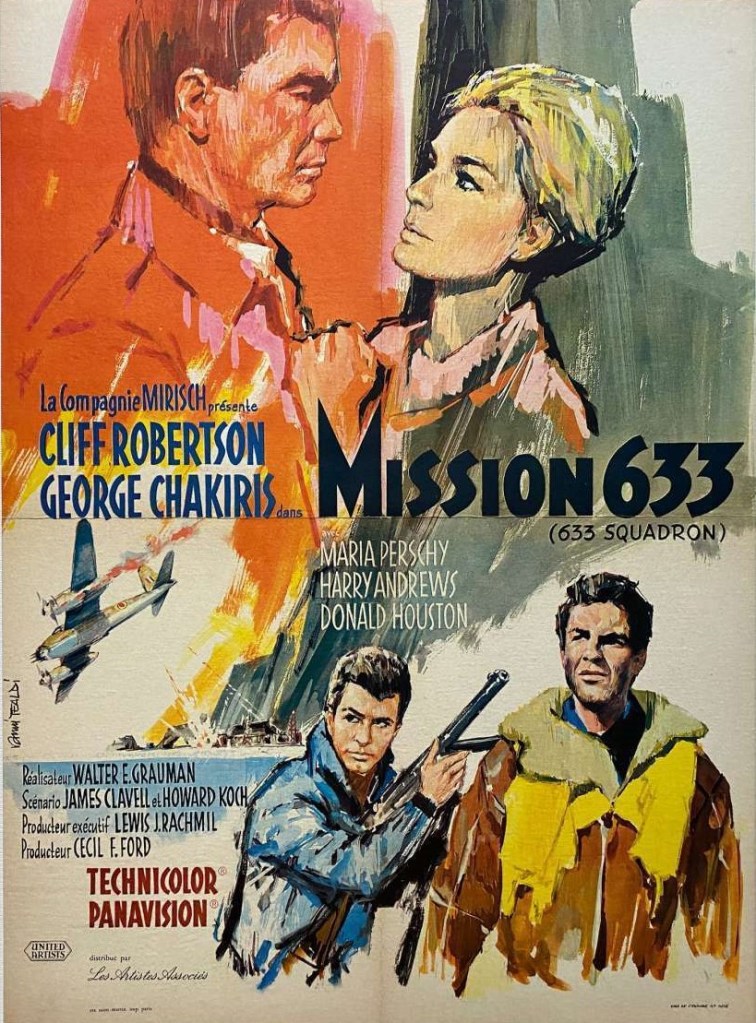
633 Squadron (1964) ***

You can keep your current and future Oscar winners, George Chakiris (for West Side Story, 1961) and Cliff Robertson (for Charly, 1968). The stars here are the mechanical birds, the Mosquito bombers, and the Ron Goodwin score, a thundering rehearsal for Where Eagles Dare (1968).

The aerial photography was pretty amazing for the day, though there were no Top Gun: Maverick shenanigans with actors supposedly actually flying the planes, just sitting there with an occasional turn or yank of the controls.  Even so, watching the planes take off, land, propellers describing perfect arcs, being attacked on ground or in the air, firing back, and the (apologies) bird’s eye view of dashes along precipitous cliffs takes up a huge amount of the running time.

You’ll know by now there was no actual 633 Squadron – but there was an international squadron (see the current Masters of the Air) to accommodate the various accents on show – and that the mission is also fictional, though the idea that the Germans had chosen the Norwegian fjords to hide a factory making rocket fuel for the V1s currently in production elsewhere wasn’t too far off the mark given (see The Heroes of Telemark, 1965) they were using that country for atomic bomb experiments.

The British know the rockets are inevitable, impossible to completely destroy them, but as long as they don’t interfere with D-Day that will be good enough. Wing Commander Grant (Cliff Robertson), although his squadron is exhausted from flying too many daily missions, has his leave curtailed, and told he’s on a strict deadline to destroy the factory.

Like the factory in The Heroes of Telemark, it’s virtually impossible to hit, buried beneath too much rock, but the Germans ain’t that clever, and it’s the rock that is the weakness. The theory is hit the overhang with sufficient bombs and the mountain will come tumbling down and destroy the factory.

Norwegian Resistance fighter Lt Bergman (George Chakiris) is on hand to explain just how difficult the task is, flying at extremely low altitude along fjords guarded by anti-aricraft guns. To add more tension, or just for the hell of it, Air Vice Marshal Davis (Harry Andrews) keeps on truncating the already tight deadline. The pilots have barely got time for a few practice runs along Scottish glens before it’s M-Day (no idea where that daft moniker came from, presumably a D-Day discard).

But there is just enough time for Grant to make pretty with Bergman’s refugee sister Hilde (Maria Perschy). Although after Bergman returns to help out his mates and is unhelpfully captured by the Nazis, Grant has to bomb the Gestapo building to kill him before he can be tortured and give out vital information.

In another film, Hilde would have been a spy or cut off the burgeoning romance after discovering Grant’s mission, but instead she’s not in the espionage line and she thanks the wing commander for sparing her brother torture. In the only major twist in the picture, it turns out Grant was too late, for there’s a nasty welcome committee awaiting the bombers.

Not quite the Boy’s Own derring-do adventure tale I remember, what with the torture and the climax, but it was still in my day one of the few films that appealed heart-and-soul to the pre-teen and teenage boy, along with The Magnificent Seven and The Great Escape, in part, I guess, because it was so thrifty in terms of character development.

No time is wasted giving everyone a character arc, beyond the usual daredevil and someone getting married, the characters are sketchy beyond belief, but who the hell cares, let’s get on with the action. So, it certainly delivers on that score. But watching as an adult, and I’ve probably not seen this in four decades, it’s a good bit tougher than the surface might suggest, eating away at the idealism of war, of the noble sacrifice, and tuning in better than most World War Two pictures to raw finality.

Perhaps it’s emblematic that the best cinematic introduction is given to the arrival of the new-style bombs, although Hilde turning up to a torrent of wolf whistles in the bar runs it close, and she does have a habit of leaning out a window to give the audience a glimpse of cleavage every now and then.

No wonder we all came out humming the Goodwin theme. You can’t escape it. It’s in virtually every scene. Memorable final line uttering by the air vice marshal, “You can’t kill a squadron.”

It would have set the bar high for aerial photography, except that by showing how it could be done, triggered a small flurry of similar pictures, most notably The Blue Max (1966) and The Battle of Britain (1969).

Walter Grauman (A Rage to Live, 1965) clearly adores the machines more than the humans, but the script by James Clavell (The Great Escape, 1963) and Howard Koch (The Fox, 1967) based on the novel by Frederick E. Smith doesn’t give him much option.

Still worth a watch.

A Rage To Live (1965) ***

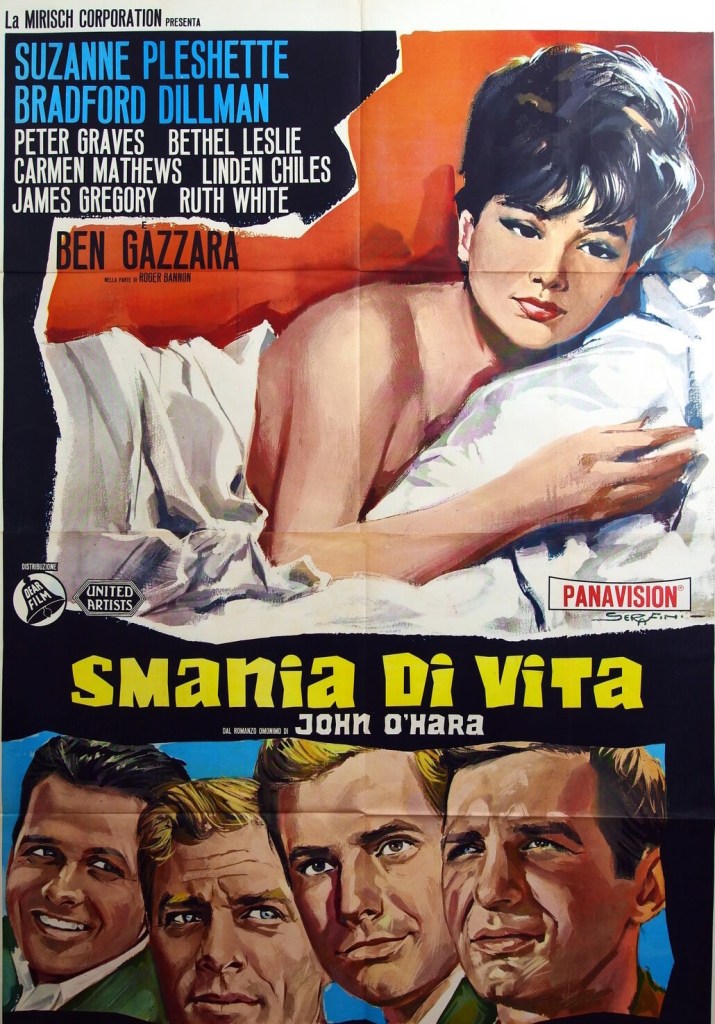
There was one in every town: a woman, rich (Sanctuary, 1961) or poor (Claudelle Inglish, 1961) or in between (Butterfield 8, 1960), with a predilection for sex. There were several men in every town, queuing up to take advantage. The woman was inevitably a shameful creature, the men the envy of their peers. You don’t have to look further than Frank Sinatra’s tom-catting in Come Blow Your Horn (1963) or Omar Sharif as the romantic star of the decade with two women in tow in Doctor Zhivago (1965) for an idea of the double standards in play. Welcome to hypocritical Hollywood.

Grace (Suzanne Pleshette), father dead and stuck with a domineering mother, finds escape and fulfilment in sex, and just to give hypocrisy a final tug discovers that while boyfriends are keen to help her explore such physical needs, they take the hump when they discover they might not be the first – or the only. Parents, naturally, are appalled, and discovery of Grace’s antics – and she’s not particularly particular, a passing waiter will do – leads her mother to collapse.

Having confessed to potential husband Sidney (Bradford Dillman) that he will not be marrying a virgin and almost bursting with gratitude that he is willing to overlook her behavior, Grace becomes a farmer’s wife and then a happy mother, until construction owner Roger (Ben Gazzara) comes on strong. She might well have been able to have her cake and eat it but Roger, having fallen in love,  reacts badly to being dumped and it’s only a matter of time before her world implodes.

Made a couple of years later, when the independent woman was being exalted, this would have been a different kettle of fish. Here, the boot on the other foot, the woman who picks and chooses her lovers seemed a step too far for that generation.

Before the big trouble begins, the movie does explore, though somewhat discreetly, the almost taboo notion that a woman might just enjoy sex for the sake of it. Sure, Grace likes being wanted and likes being held, but if she was around today, nobody would bat an eyelid if she just came out and expressed her preference.

Less discreetly, the subject of consensual sex comes up, but not as a question of debate, more as a matter of fact, that when Grace says no she actually means yes. There’s a very uncomfortable moment at the beginning when in a Straw Dogs-scene, though nothing like as violent, Grace appears to welcome a rape. Whether this is as bad as it sounds, or is just Hollywood hiding the blush that a woman would not seek out sex but could only discover its pleasures when forced upon her, is hard to say.

Nor is Grace a walking sex machine. She knows enough about men that she only has to put out feelers and any susceptible male will take the bait. And given the restrained times, she’s got no female pal with whom she can discuss her unseemly desires.

Of course, if this was a man, nobody would be batting an eyelid. Sure, once caught, he’d come up with all sorts of excuses, denials, begging for forgiveness, but an audience would give him a free pass. It’s only because this is a woman that it causes ructions. The movie just about gets close to what does make Grace happy and why she needs the thrill of extra marital sex but by that point the melodrama has taken over and there’s little time left for discussion, what with Roger intent on revenge and another lovelorn wife, mistakenly imagining her husband has fallen victim to Grace’s charms, also on the warpath.

Small town constraints play their part, too. Washing your dirty linen in public the worst of all offences. Author John O’Hara, on whose bestseller this is based – and whose other works Butterfield 8, Ten North Frederick (1958) and From the Terrace (1960) explored similar worlds  – knows only too well that while wealth brings freedom and privilege it comes with chains attached.

And there’s some interesting role reversal, an illicit lover falling in love with a married person normally a starting point for a movie to explore happiness and its opposite rather than being the one act Grace will not tolerate in a lover, she wants strings-free sex, not anything with encumbrance. While Grace would like to act like a man, and has the wealth to shield herself from the worst of the fall-out, as a mother she is extremely vulnerable, and in this particular era could risk losing her child if seen as maternally unfit.

While lacking the sexual combustibility of Elizabeth Taylor or Lana Turner or other Hollywood heartbreakers, Suzanne Pleshette (Nevada Smith, 1966) gives a decent enough performance especially when it comes to her straightforward attitude to sex, aware she might be causing upheaval, but finding it impossible to ignore desire, or imagine a life in which that does not play an impulsive part.

Bradford Dillman (Sanctuary) has less room for character maneuver and is mostly called upon to suck it up. He comes into his own in the movie’s latter stages when bewilderment at betrayal and public humiliation clashes with continued love for his wife. Ben Gazzara (The Bridge at Remagen, 1969), trademark leer and smug face kept in check, has a showier role especially when the violent aspects of his character explode.

Director Walter Grauman, while better known for war picture 633 Squadron (1963), had just come off another picture dealing with female trauma (Lady in a Cage, 1964) and does quite a decent job here, the camera intensely focusing on the leading actress and then as the tragic outcome unfolds drawing away from her. There’s one great piece of composition. He had used tree branches and the countryside to frame Grace and Sidney at the height of their love. And he does the same again when Grace is abandoned.

Asks some difficult questions without quite getting to grip with the real subject of female sexuality. There was a sense that Hollywood was just on the cusp of accepting the independence of women, but didn’t want to go the whole hog just yet, because, apart from anything else, where would it leave the guys?

Discover WordPress

A daily selection of the best content published on WordPress, collected for you by humans who love to read.

The Atavist Magazine

by Brian Hannan

WordPress.com News

The latest news on WordPress.com and the WordPress community.