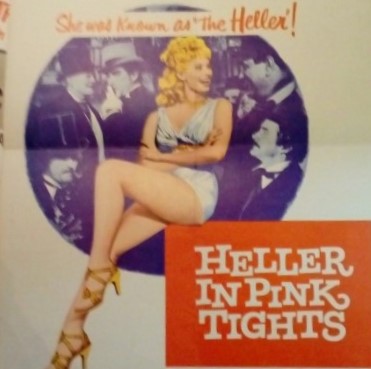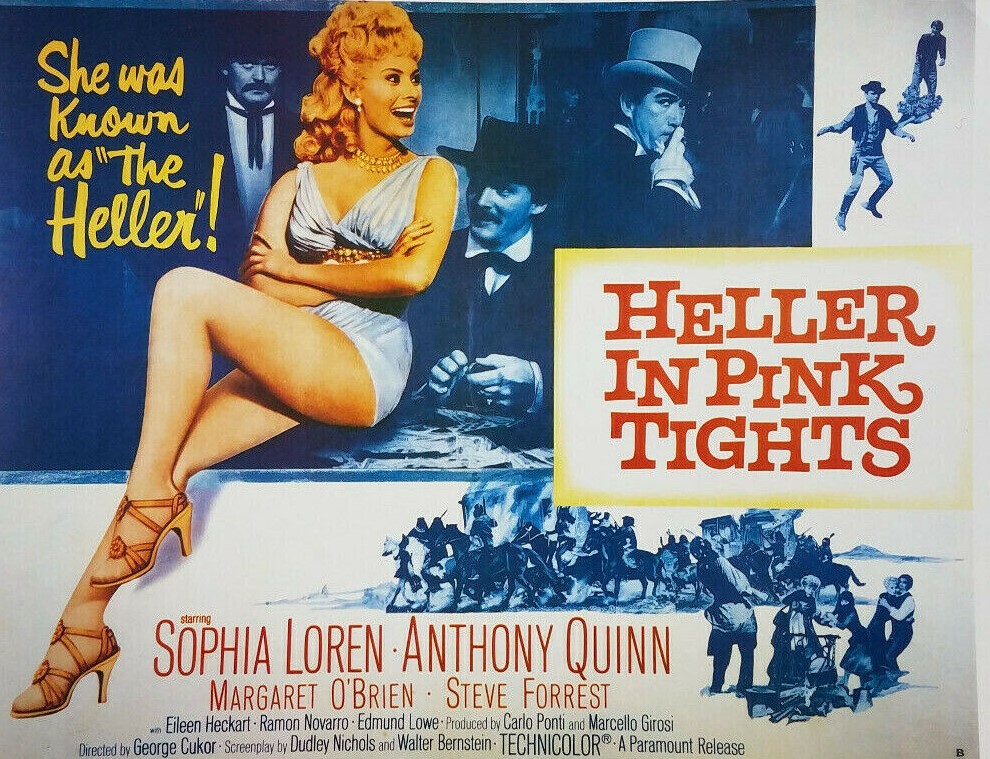
Heller in Pink Tights (1960) ****

Taken on its own merits, George Cukor’s western is a highly enjoyable romp. Hardly your first choice for the genre, Cukor ignores the tenets laid down by John Ford and Howard Hawks and the film is all the better for it. Although there are stagecoach chases, gunfighters and Native Americans, don’t expect upstanding citizens rescuing good folk. Instead of stunning vistas Cukor chooses to spend his budget on lavish costumes and sets.

You can see he knows how to use a colour palette, and there is red or a tinge of it in every scene (to the extent of rather a lot of red-haired folk), and although this might not be your bag – and you may not even notice it – it is what makes a Cukor production so lush. The film might start with comedic overtones but by the end you realise it is serious after all.
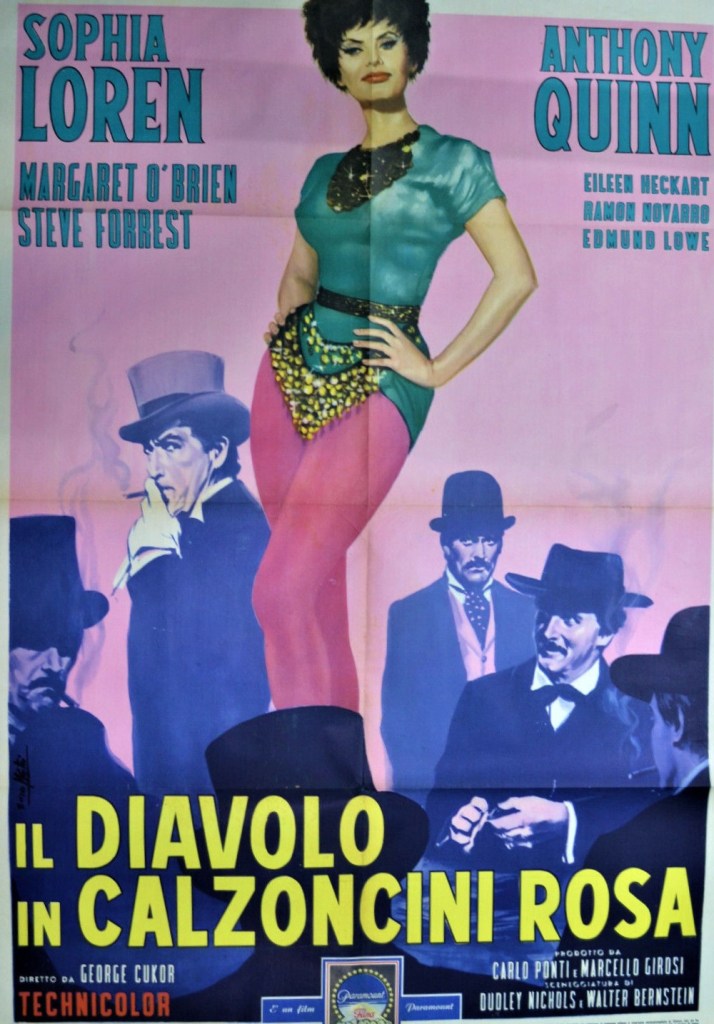
Angela (Sophia Loren) is the coquettish leading lady and Tom (Anthony Quinn) the actor-manager of a theatrical company managing to stay one step ahead of its creditors, in the main thanks her propensity for spending money she doesn’t have. Of course, once gunfighter Clint (Steve Forrest) wins Loren in a poker game, things go askew. 

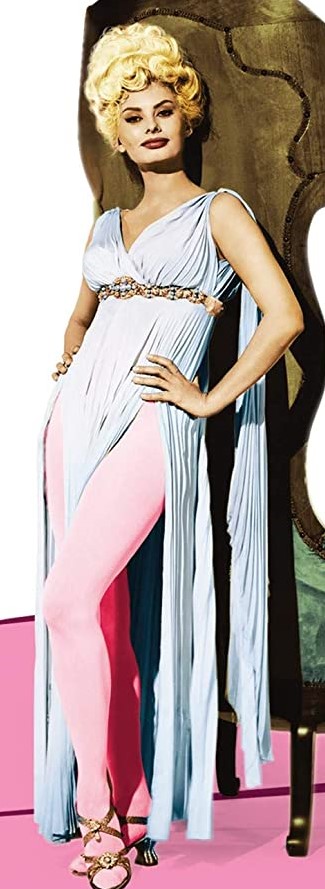
Anthony Quinn (Guns for San Sebastian, 1968) had never convinced me as a romantic lead, but here there is genuine charisma between the two stars. Sophia Loren (Five Miles to Midnight, 1962) is at her most alluring, in dazzling outfits and occasionally in costumes as skin-tight as censors would allow in those days, but with a tendency to use beauty as a means to an end, with the conviction that a smile (or occasionally more) will see her out of any scrape. There is no doubt she is totally beguiling. But that is not enough for Quinn, as she is inclined to include him in her list of dupes.

While primarily a love story and a tale of theatrical woes set against the backdrop of a western, when it comes to dealing with the tropes of the genre Cukor blows it out of the water.  We open with a stagecoach chase but our heroes are only racing away from debt until they reach the safety of a state line. We have a gunfighter, but instead of a shoot-out being built up, minutes ticking by as tension rises, Cukor’s gunman just shoots people in sudden matter-of-fact fashion.

Best of all, George Cukor (Justine, 1969) extracts tremendous comedy from the overbearing actors, each convinced of their own genius, and the petty jealousies and intrigue that are endemic in such a troupe. An everyday story of show-folk contains as much incipient drama as the more angst-ridden A Star Is Born (1954), his previous venture into this arena.

From the guy who gave us The Philadelphia Story (1940) with all its sophisticated comedy, it’s quite astonishing that Cukor extracts so much from a picture where the laughs, mostly from throwaway lines, are derived from less substantial material. Quinn (his third film in a row with Cukor) has never been better, no Oscar-bait this time round, just a genuine guy, pride always to the forefront, king of his domain inside his tiny theatrical kingdom, out of his depth in the big wide world, and unable to contain the “heller.”

I won’t spoil it for you but there are two wonderful character-driven twists that set the world to rights.

There is a tremendous supporting cast with former silent film star Ramon Novarro (Ben-Hur: A Tale of the Christ, 1925) as a duplicitous businessman, former child star Margaret O’Brien, another star from a previous era in Edmund Lowe (Cukor’s Dinner at Eight, 1933), and Eileen Eckhart. Dudley Nichols (Stagecoach, 1939) and Walter Bernstein, who wrote a previous Loren romance That Kind of Women (1959) and had a hand in The Magnificent Seven (1960), do an excellent job of adapting the Louis L’Amour source novel Heller with a Gun, especially considering that contained an entirely different story.

Without a doubt it’s Cukor’s picture but Loren and Quinn combine to make it such a believable delight.
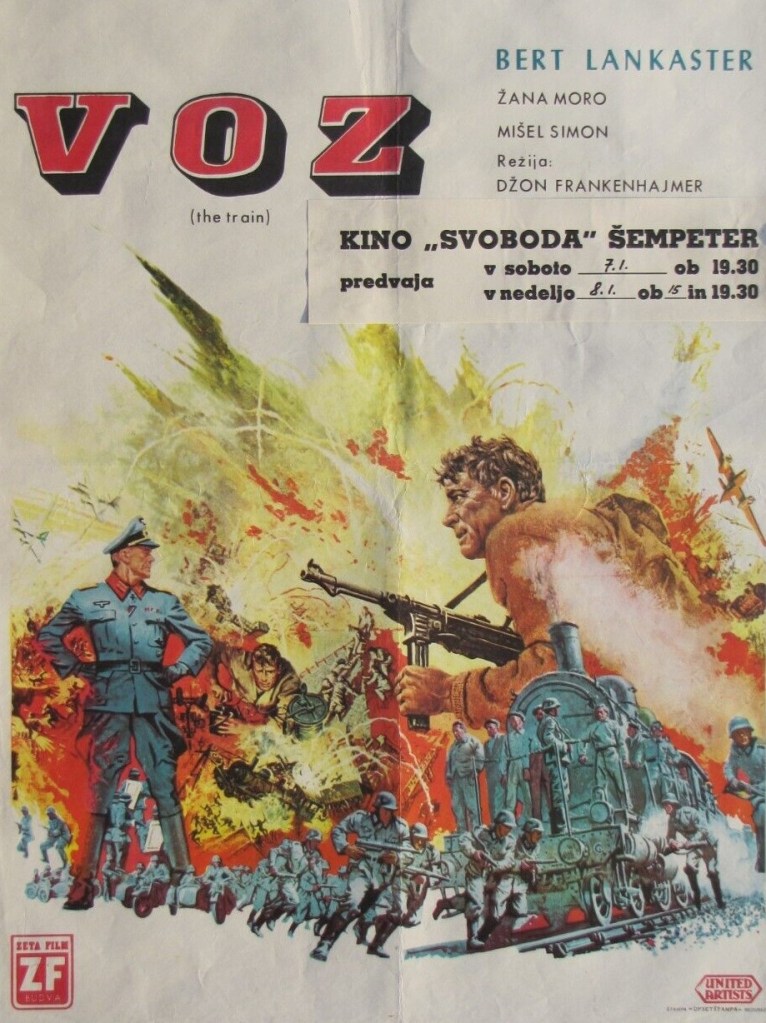
Behind the Scenes: “The Train” (1964)

A juggernaut of problems was coming down the track – director sacked, over a year in production, script changing by the minute, way over budget, star Burt Lancaster, his public halo slipping after being caught escorting women who weren’t his wife,  earning only 20 per cent of his normal $750,000 fee in order to pay off his massive debt to United Artists. And yet it set the template for “hi-tech shoot-em-ups” such as First Blood (1982) and Die Hard (1988), action pictures where a lone hero saved the day against overwhelming odds.

Lancaster’s hot critical run, Oscar winner for Elmer Gantry (1960), nominated for The Birdman of Alcatraz (1962), had turned sour with Luchino Visconti’s The Leopard (1963). Financially his career had hit an iceberg.

As part of the producing triumvirate of Hecht, Hill and Lancaster, responsible for pictures like Marty (1955), Trapeze (1956) and The Sweet Smell of Success  (1957), he found himself in a financial hole, only bailed out when United Artists picked up the tab for the company’s accumulated debt, the actor paying it back with a four-movie deal for which he was remunerated to the measly tune of $150,000 each, a contract he described as “slavery.”

The Train was third on that agenda. It was a risk for United Artists, its first venture into the complex world of the European co-production, this time teaming with French outfit Les Films Ariane. At that point, Lancaster was still considered a creative powerhouse, if not the actual producer, then carrying out a great deal of that function.

Walter Bernstein (Fail Safe, 1964), who had worked with Lancaster on Kiss The Blood off My Hands (1948) and  described the actor as “the gorilla on the bus,” was the only one of the original trio of screenwriters – the others being Franklin Coen and Frank Davis – not to receive a screen credit. It was based on a true story, a book Le front de l’art (1961) by Rose Valland. According to that narrative, Germans did try to transport by train a haul of Impressionist paintings. But it was bureaucracy and not the lone hero which prevented it reaching Germany.

But initially, the script had little traction, shelved  by the studio until Arthur Penn (Mickey One, 1965) happened upon it. The director’s curiosity was piqued by what he perceived as the peculiar French trait of being willing to risk their lives for art. Penn targeted Lancaster as capable of generating “a certain kind of French sensitivity to the idea of art needing to be protected.” When Lancaster signed on, it was with the proviso Penn direct.

The movie went into production in August 1963, a 15-week schedule, and cooperation from the Louvre, French National Railways, French Army and with a contingent of 40 rail cars. Shots of Nazis in Paris were shot very early in the morning so as not to upset Parisians. The production was based in a small village close to Paris.

Turned out Lancaster and Penn were at odds from day one. Pestered to show “vulnerability” Lancaster decided to show the director “the grin.” Penn only lasted a day, technically two if you include that the following day was a holiday. By 11pm that night Penn was gone. John Frankenheimer who had directed Lancaster in three previous movies, The Young Savages (1961), The Birdman of Alcatraz and Seven Days in May (1964), was his replacement.

Bernstein quit. Lancaster told the writer, “Frankenheimer is a bit of a whore, but he’ll do what I want.”

Why Lancaster didn’t want to make Penn’s version – a quieter film about art (the train didn’t leave the station till about 90 minutes in) – was down to the commercial and critical failure of The Leopard. He needed a hit. And having gone down the arthouse Visconti route, the actor wanted to return to his action roots.

Lancaster showed where the power truly lay. As part of Frankenheimer’s deal, he received a Ferrari; Lancaster told him to keep UA at bay by complaining about the color. Frankenheimer did better than that. He negotiated a credit that read “John Frankenheimer’s The Train.” He evaded French laws that demanded a co-director on set and he received final cut, not to mention a bigger budget.

Production shut down while Lancaster and Frankenheimer hammered out a new script, one that called for, among other things, a 70-ton locomotive, a complete station, more boxcars, signal tower and switch tower as well as a ton of TNT and 2,000 gallons of gas to create the 140 separate explosions for a one-minute sequence that took four months to plan. One of the most striking shots, where the locomotive smashes free and provides a terrific close-up of the upended train wheels spinning, was achieved by accident. Once all the plans were agreed, production was delayed again because winter conditions meant the ground was too hard to safely detonate explosives. The budget doubled to $6.7 million.

Some goodwill was involved. The French welcomed the idea of UA destroying a marshalling yard because it saved them the cost of doing it.

Shooting restarted in Spring 1964. But the schedule was cut to seven weeks, though that include the strafing sequence. You may remember Lancaster had to lug around a wounded leg. That was a clever accommodation. The actor had incurred a knee injury so wouldn’t it be a good idea to find a reason for him to limp such as being wounded. Circumstances – other movies taking precedence after the long lay-off – resulted in the death of Michel Simon’s character.

Injury didn’t tend to hamper Lancaster’s physicality. He runs, jumps, climbs, falls downhill. Said Frankenheimer, “Burt Lancaster (aged 50 mind you) was the strongest man physically I’ve ever seen. He was one of the best stuntmen who ever lived.”

The ending was conceived late in the day. Originally, it was going to be a proper shoot-out. But the idea of Paul Schofield with a gun going up against Lancaster was deemed “ridiculous” so, in effect, the snob German “talked himself to death.”

Reviews were mixed and many found the film too long, one critic complaining, the train “pretends it’s going somewhere and…isn’t.” But somewhere along the way, Lancaster invented the modern action hero.

It didn’t do him much good. The film failed at the U.S. box office but (as Roy Stafford has reminded me) it was in Top 13 in the UK and top 5 in France so there’s a fair chance it at least broke even and may well have gone into profit. Lancaster, forced by UA into making The Hallelujah Trail (1965), another box office calamity, lost out on The Spy Who Came In from the Cold (1965) and Khartoum (1967)

SOURCES: Kate Buford, Burt Lancaster, An American Life, (Aurum paperback, 2008) p230, 234-240; John Frankenheimer, A Conversation with Charles Champlin (Riverwood Press, 1995); Charlton Heston, In the Arena (Simon and Schuster, 1995), p315; Tino Balio, United Artists, The Company That Changed the Film Industry, (University of Wisconsin Press, 1979)  p279; Arthur Penn Interviews (University Press of Mississippi, 2008) p15, p45; Matt Zoller Seitz, “Those Hi-Tech Shoot-‘Em-Ups Got the Template from The Train,” New York Times, Apr 30, 1995;  Lancaster interview, New York Post, Mar 22, 1965; Jean-Pierre Lenoir, “Stalling a Great Train Robbery,” New York Times, November 3, 1963.

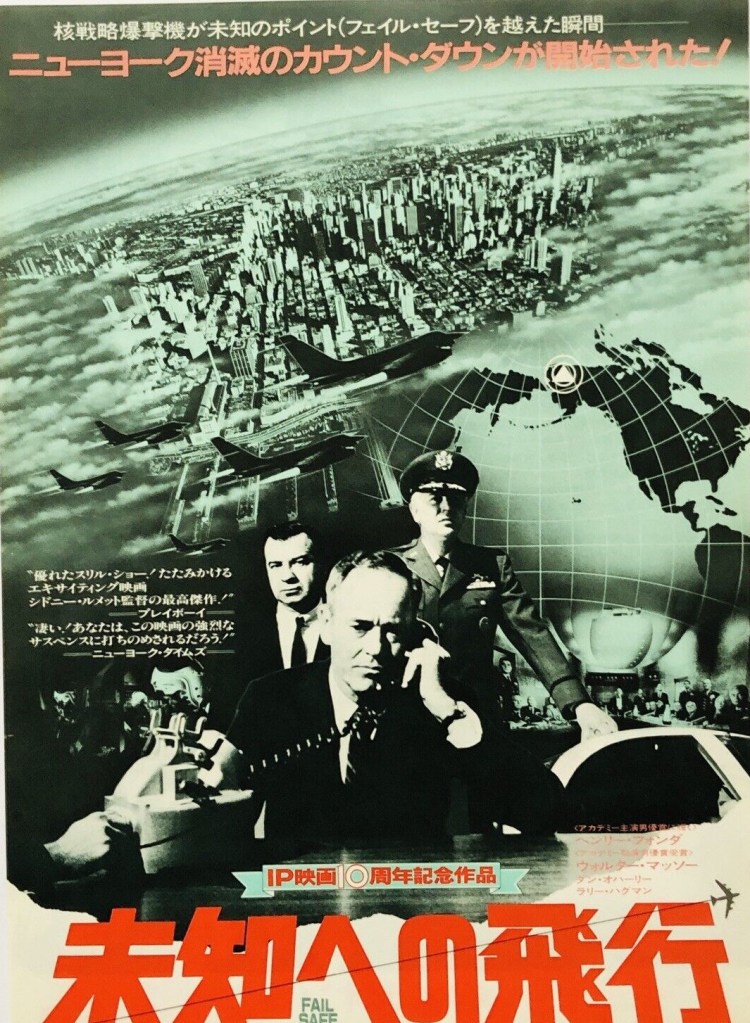
Fail-Safe (1964) *****

Given unexpected heft by current concerns over AI. Human error, it appears, is more simple to correct than computer malfunction. Once a course of action commences, machines have no way of checking it. And paranoia is the first casualty of truth. Bear in mind this was shockingly contemporary at the time it was made, the world in constant fear of nuclear war, the Cold War, that seemingly endless stalemate doing little to pacify terror.

Those whose job it ease the best outcome in the event of nuclear war were always inclined to rationalize staggering death tolls. So we begin with a late night discussion in which political analyst Dr Groeteschele (Walter Matthau) makes the argument that in the event of war, the country with the fewest casualties is the winner and in a nod to the ironic suggests the most likely survivors would be the worst type of convict, imprisoned underground, and office workers protected from the blast by being surrounded by filing cabinets crammed full of paper.

Just before the real drama begins there’s a neat scene where a women, turned on by a powerful man, makes a move on the doctor only to be slapped into place, sternly told by the prim analyst that he’s not of “her kind.” That’s not the only human element in the tale. the highest levels of secrecy may force top-level Army and Government executives to sacrifice families.

For no accountable reason, jets with nuclear warheads shift into an attacking position on the Russian border, the target if not stopped Moscow. The planes are unstoppable once they commence attack, unable to turn away from a strict sequence of pre-determined action. Not even the personal intervention by the President (Henry Fonda) of the United States can affect the outcome, the pilots already trained to ignore such an action on the grounds that the  enemy could be imitating the President’s voice.

When the planes fail to turn back, the only option is for the Americans to blow their own planes out of the sky, an action that appears not just inconceivable to the Army personnel but treasonable. High-rankings officers ruthless trained for battle and to observe the protocol of obeying orders find this unconscionable.

Three dramas take place at once. On the ground the Army chiefs try to explore every option to avoid the unthinkable while battling with their own consciences at what appears to be the only way out. The President on the hotline to the Russian premier has to circumvent natural suspicion that this is a cunning ploy by the Yanks and then come to some agreement with the Russians on the assumption that Moscow may yet come under attack. We, the audience, are playing out the third element in our minds, a series of terrifying what if scenarios with indescribable consequence.

I’m not going to reveal the shock ending because it came as a hell of a shock to me, given I’d not seen the picture in decades.

It’s brilliantly-made with almost futuristic sets and noir lighting and the President effectively physically imprisoned, and not just by his conscience, stuck in a featureless cell presumably in the pits of the White House arguing the toss with the Russian chief, his only companion the translator (Larry Hagman) whose face seems to get greyer and greyer as he transmits worse and worse news.

Dr Groeteschele makes matters worse, at least to a pacifist left-wing viewer (though an opposite view would be taken by the hawks), by urging the President to take advantage of computer error and “first strike” and blow Russia to pieces, assuming that indulging in the attack option will result in fewer casualties in America, and thus, following his earlier projections, not just win the war but rid the word of the fear of nuclear war.

While the style is documentary, it’s a riveting watch. The tension is unbearable. Some like Col Cascio (Fritz Weaver) succumb to the pressure while the commanding General Black (Dan O’Herlihy) retains a stolid soldierly presence.  

Sidney Lumet (The Pawnbroker, 1964) doesn’t put a foot wrong. Taking the line – rather than in The Bedford Incident (1965) of the wrong man with his finger on the button – of the right man trying to make the best of a botched job, he delivers a just superb picture. Walter Bernstein (The Magnificent Seven, 1960) does a terrific job in delivering a taut screenplay from a more meandering novel by Eugene Burdick and Harvey Wheeler.        

There probably couldn’t be a more prescient movie for today.

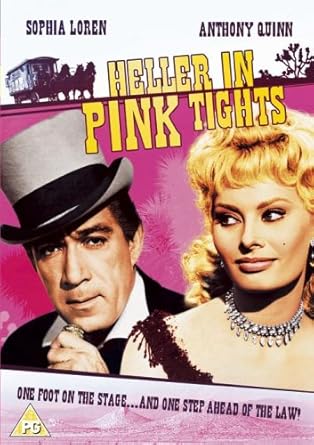
Heller in Pink Tights (1960) ****

Sophia Loren is enjoying a swansong with the Netflix feature The Life Ahead (2020), which may well net here another Oscar nomination to add to two wins for Two Women (1960) and an Honorary Award in 1991 and a previous nomination for Marriage Italian-Style (1964). She has dined at the Hollywood high table for over 60 years since taking America by storm in 1957 in a three-film blast comprising Boy on a Dolphin with Alan Ladd, The Pride and the Passion with Cary Grant and Frank Sinatra and Legend of the Lost with John Wayne. She was one of the greatest leading ladies of the second half of the twentieth century, combining style with ability. If you want an idea of how mesmerising she was in her pomp, check out this little number – Heller in Pink Tights.

Taken on its own merits, George Cukor’s western is a highly enjoyable romp. Hardly your first choice for the genre, Cukor ignores the tenets laid down by John Ford and Howard Hawks and the film is all the better for it. Although there are stagecoach chases, gunfighters and Native Americans, don’t expect upstanding citizens rescuing good folk.

Instead of stunning vistas Cukor chooses to spend his budget on lavish costumes and sets. You can see he knows how to use a colour palette, and there is red or a tinge of it in every scene (to the extent of rather a lot of red-haired folk), and although this might not be your bag – and you may not even notice it – it is what makes a Cukor production so lush. The film might start with comedic overtones but by the end you realise it is serious after all.

Sophia Loren is the coquettish leading lady and Anthony Quinn the actor-manager of a theatrical company managing to stay one step ahead of its creditors, in the main thanks to Loren’s capacity for spending money she doesn’t have. Of course, once a gunfighter (Steve Forrest) wins Loren in a poker game, things go askew.  Quinn had never convinced me as a romantic lead, but here there is genuine charisma between the two stars.

Loren is at her most alluring, in dazzling outfits and occasionally in costumes as skin-tight as censors would allow in those days, but with a tendency to use beauty as a means to an end, with the conviction that a smile (or occasionally more) will see her out of any scrape. There is no doubt she is totally beguiling. But that is not enough for Quinn, as she is inclined to include him in her list of dupes.

While primarily a love story crossed with a tale of theatrical woes set against the backdrop of a western, when it comes to dealing with the tropes of the genre Cukor blows it out of the water.  We open with a stagecoach chase but our heroes are only racing away from debt until they reach the safety of a state line. We have a gunfighter, but instead of a shoot-out being built up, minutes ticking by as tension rises, Cukor’s gunman just shoots people in sudden matter-of-fact fashion.

Best of all, Cukor extracts tremendous comedy from the overbearing actors, each convinced of their own genius, and the petty jealousies and intrigue that are endemic in such a troupe. An everyday story of show-folk contains as much incipient drama as the more angst-ridden A Star Is Born (1954), his previous venture into this arena. From the guy who gave us The Philadelphia Story (1940) with all its sophisticated comedy, it’s quite astonishing that Cukor extracts so much from a picture where the laughs, mostly from throwaway lines, are derived from less substantial material.

Quinn (his third film in a row with Cukor) has never been better, no Oscar-bait this time round, just a genuine guy, pride always to the forefront, king of his domain inside his tiny theatrical kingdom, out of his depth in the big wide world, and unable to contain the “heller.” I won’t spoil it for you but there are two wonderful character-driven twists that set the world to rights.

There is a tremendous supporting cast with former silent film star Ramon Novarro (Ben-Hur: A Tale of the Christ, 1925) as a duplicitous businessman, former child star Margaret O’Brien, another star from a previous era in Edmund Lowe (Cukor’s Dinner at Eight, 1933), and Eileen Eckhart. Dudley Nichols (Stagecoach, 1939) and Walter Bernstein, who wrote a previous Loren romance That Kind of Women (1959) and had a hand in The Magnificent Seven (1960), do an excellent job of adapting the Louis L’Amour source novel Heller with a Gun, especially considering that contained an entirely different story.

Discover WordPress

A daily selection of the best content published on WordPress, collected for you by humans who love to read.

The Atavist Magazine

by Brian Hannan

WordPress.com News

The latest news on WordPress.com and the WordPress community.