
Ursula Andress certainly knows how to make an entrance. Emerging out of the sea in a bikini in Dr No (1962) proved a Hollywood calling-card but failed to put her center stage. She fixed that with She and dominates this superior adventure hokum. Studio Hammer lucked into a solid piece of storytelling, a classic, and all it had to do – with the help of a bit more finance than was usual for their productions courtesy of MGM – was not muck it up.
Three soldiers are celebrating the end of the First World War in a Palestinian night club and while archaeologist Holly (Peter Cushing) and his bowler-hatted valet Job (Bernard Cribbins) are tripping the light fantastic with belly-dancers, blond-haired Leo (John Richardson) is seduced away by Ustane (Rosenda Monteros) because he bears a stunning resemblance to an ancient medallion. Encountering a vision of Ayesha (Andress) he is urged to embark on a dangerous journey to the lost city of Kuma where she awaits.
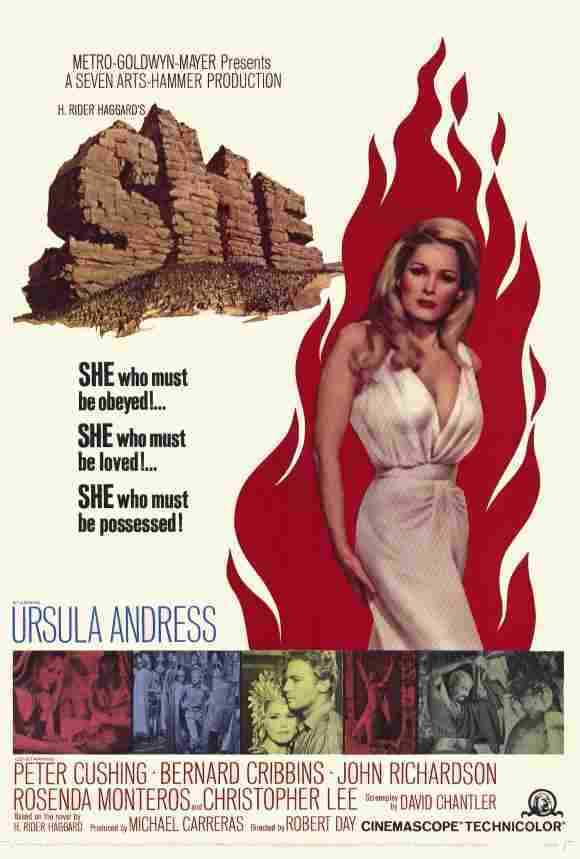
Despite the theft of their camels and loss of water, the trio trek exhausted across desert and mountains, Leo sustained by his vision, by the fact that he seems to know the way and with the assistance of Ustane. But a savage tribe reckon Leo would make an ideal sacrifice to the gods. Just as the tribe are driving themselves into ritualistic frenzy, high priest Billali (Christopher Lee) comes to the rescue, escorting the explorers into Kuma.
The regal Ayesha is as beautiful in the flesh as in the vision, but more ruthless, condemning slaves to a terrible death for disobedience and, noting the attraction between Leo and Ustune, planning also to rid herself of her rival. Leo’s arrival will fulfil an ancient prophecy with the Englishman attaining immortality, and he seems to be able to “float through the sea of time” and remember events from two thousand years ago. However, Ayesha has a dubious past, providing one of several unexpected twists.
Most films of this sub-genre rely on improbable mumbo-jumbo and are loaded down with wearying amounts of exposition. But here is nothing but clarity, the ancient backstory tale told with minimum visuals and verbals and the intellectual sparring between Holly and Ayesha on the one hand and the archaeologist and the high priest on the other are intelligently-put, presenting opposing options for the development of civilisation, absolute monarchy vs. democracy and immutability vs. change.
But that takes place within a highly-charged drama, the enfolding romance between Ayesha and her chosen man both touching and perilous, while the battle for the life of Ustane is brilliantly presented. Lack of reliance on special effects and art direction utilizing the MGM millions – the mountain-sized statue outside Kuma (prefiguring perhaps Game of Thrones) and the set for Ayesha’s room especially magnificent, as is her golden crown – prevents the picture falling into the camp camp. Instead, it emerges as an adventure classic.

Ursula Andress (4 for Texas, 1963) is stunning, every inch a goddess and yet believably mortal. Her looks tended to mask her abilities and while she rarely received credit for her acting she holds her own in some redoubtable company. John Richardson (Black Sunday, 1960) doesn’t quite step up and remains more a creature of adoration. But the supporting cast more than compensates. Peter Cushing (The Skull, 1965) has had a persona transplant, replacing his normal grim demeanor with fun and enthusiasm, not lacking courage where required, and delivering a very fine performance. Bernard Cribbins (Crooks in Cloisters, 1964) provides the humor. And we still have Christopher Lee (The Gorgon, 1964), filled to bursting with self-entitlement, in malevolent form, Andre Morell (The Vengeance of She, 1968) and Rosenda Monteros, scandalously under-used in films since The Magnificent Seven (1960). It’s interesting to see Cushing and Lee, who dealt with immortality in the Dracula series, engage in conflict without coming to blows.
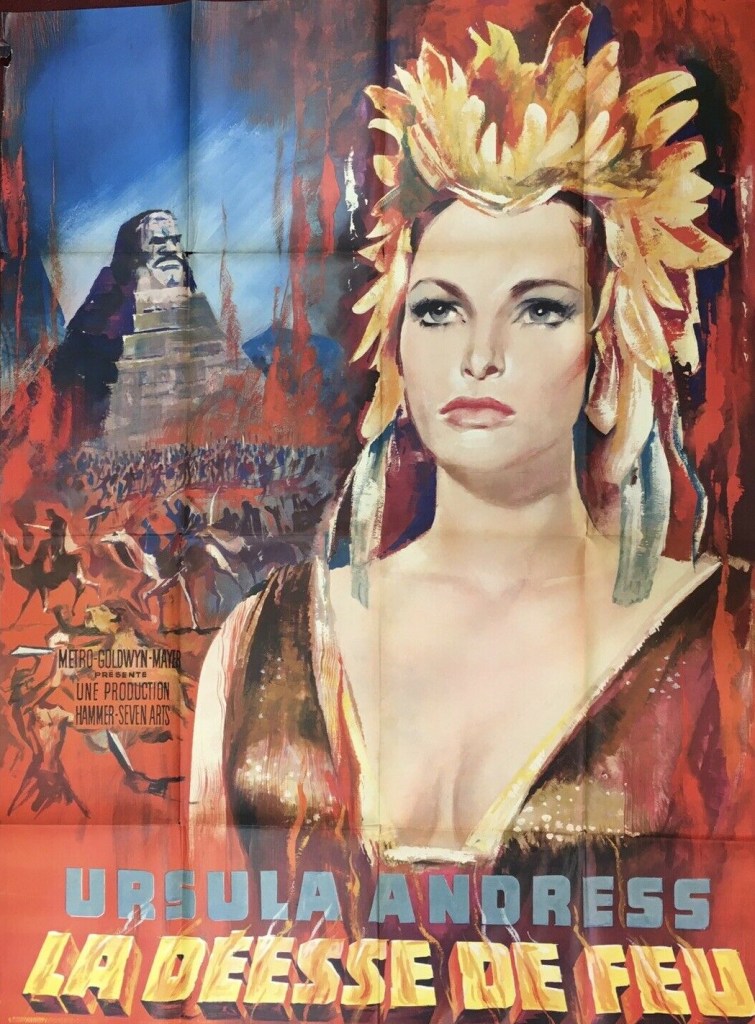
Director Robert Day (Tarzan’s Three Challenges, 1963) keeps up a brisk pace at the same time as focusing on character and provides Hammer with a marvelous adventure template for the future. Five features and two shorts had already been adapted from the H. Rider Haggard classic, but the last was in 1935, starring future U.S. House of Representatives member Helen Gahagan. This version presents the best shot at visual interpretation of the classic.
Catch-Up: Ursula Andress was reviewed in the Blog for 4 for Texas (1963), The Blue Max (1966) and The Southern Star (1969). Christopher Lee pictures already reviewed are: The Devil-Ship Pirates (1964), The Gorgon (1964), The Skull (1965), The Brides of Fu Manchu (1966), Five Golden Dragons (1967) and The Curse of the Crimson Altar/The Crimson Cult (1968).


 The Magnificent 60s