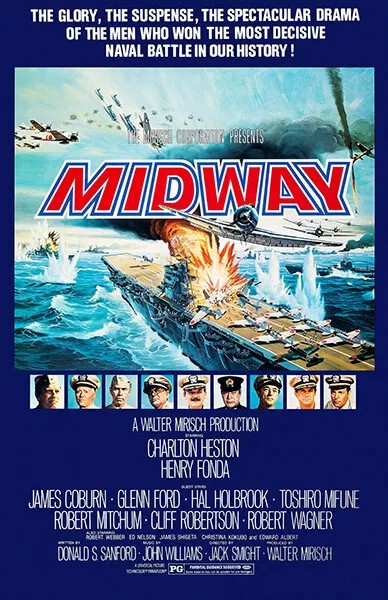
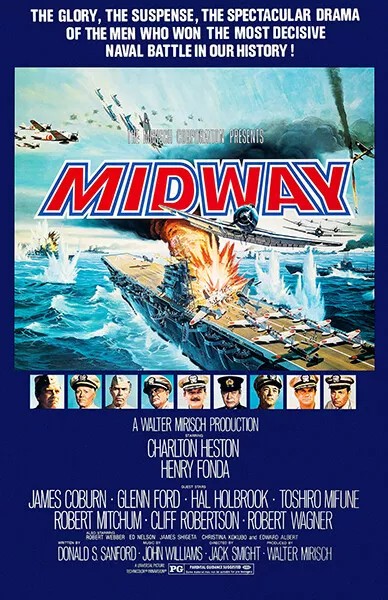
Behind the Scenes: “Battle of Midway” (1976)

Mirisch could easily lay claim to be the top independent production outfit of the 1960s generating hits like The Magnificent Seven (1960),  West Side Story (1961), The Great Escape (1963), The Pink Panther (1964) and its sequel A Shot in the Dark (1964), The Russians Are Coming, Russians Are Coming (1966), In the Heat of the Night (1967) and The Thomas Crown Affair (1968) plus a shelf load of Oscars and Oscar nominations. But dependence on a partnership with Billy Wilder in the 1970s and a more lackluster performance at the box office – with the noted exception of Fiddler on the Roof (1971) – spelled the end of its 17-year relationship with United Artists, which was reeling from financial losses and under new management.

The company found a new partner in Universal which had a series of deals with other major producers like Alfred Hitchcock, Zanuck and Brown (Jaws, 1975) and George Seaton (Airport, 1970). Mirisch was not in any financial trouble, having severed ties with UA after Mr Majestyk (1974), a major success abroad, and recovered its development costs for Wheels, based on the Arthur Hailey novel but the script rejected by UA, from Universal which turned it into a mini-series.
The Universal deal was initially not as good as that enjoyed at UA. Universal charged a twenty-five per cent overhead whereas UA had charged nothing and Universal was now doing direct deals with directors rather than relying on the likes of Mirisch to tie up the talent.

Many years before, Mirisch had commissioned a script on the Battle of Midway from Donald S. Sanford who specialized in war pictures but of the distinctly low-budget variety – Submarine X-1 (1968), The Thousand Plane Raid (1969) and Mosquito Squadron (1969), none of which had enjoyed any success. 

Though all of the Mirisch war pictures had concentrated on Europe, Walter Mirisch, generally the creative driving force for the production company, in his previous incarnation with Allied Artists had some experience of the Pacific War, having produced Flat Top / Eagles of the Fleet (1952), set around an aircraft carrier during the Battle of Leyte Gulf, and was an avid reader of books about the Second World War.

John Ford and Louis de Rochmont had made documentaries about the Pacific naval battles. UA rejected the script twice, a shrewd move in the end because Tora! Tora! Tora! (1970) lost a packet for Twentieth Century Fox. The Sanford screenplay had initially taken more of a documentary approach but after gaining the interest of Charlton Heston, who had starred in Mirisch’s The Hawaiians (1970), the script was tweaked.

Programming a war picture was a risk for the studio. There hadn’t been a big-budget war picture in five years. And while Patton (1970) and Kelly’s Heroes (1970) ended up on the right sight of the ledger book, Tora!, Tora! Tora! and Too Late the Hero (1970) were stiffs.

Mirisch signed a two-picture deal with Universal, for Midway and Wild Card with a screenplay by Elmore Leonard (Mr Majestyk). Mirisch proposed to reduce costs by using footage from naval archives, converting the original 16mm film to 35mm. The producer also  took footage from Japanese film Storm over the Pacific / I Bombed Pearl Harbor (1960) – the rights cost him $96,000. Footage of the Pearl Harbor attack in Tora! Tora! Tora! doubled for shots of the attack on Midway Island.   A clip of the Dolittle raid on Tokyo from Thirty Seconds over Tokyo (1944) was used in the credit sequence after “subjecting it to a sepia bath.”

After the success of Earthquake (1975), Heston was back in the top ranks of box office stars and his involvement guaranteed the green light. The U.S. Navy offered its support, not surprising since Midway was considered its greatest success.

John Guillermin (The Towering Inferno, 1974) was hired to direct and Stirling Silliphant (In the Heat of the Night) signed up for a screenplay rewrite. Mirisch had determined to employ the all-star-cast device that had been an essential ingredient of many of the 1960s roadshow pictures, kicking off with Henry Fonda (The Boston Strangler, 1968), by now pretty much a spent force at the box office – he hadn’t made a picture in three years – but still a well-known name. 

The amount of work involved for the other stars was minimal – mostly just one day – and, astutely, Mirisch called on stars who had worked for him in the past and who, like James Coburn (The Great Escape), Cliff Robertson (633 Squadron, 1964) and Christopher George (The Thousand Plane Raid) owed him something in terms of a career leg-up. Others included Robert Mitchum (The Sundowners, 1960), Robert Wagner (The Biggest Bundle of Them All, 1968) and Tom Selleck in an early role. Mitchum was the first of these stars to sign up, in March 1975, six weeks before the scheduled start date of April 27, followed two days later by Coburn.

Toshiro Mifune (Red Sun, 1971) headed up the Japanese cast and proved so meticulous in his preparations that he had his uniform made by Japanese tailors. The white gloves he wore had a finger shortened on the left hand because his character Admiral Yamamoto was missing a pinky. However, despite coaching in English by actress Miko Taka (Walk, Don’t Run, 1966), his dialog was revoiced by Paul Frees. 

Guillermin demanded a bigger budget to accommodate more airplanes and equipment and a longer shooting period. Two months before filming was due to start, Mirisch put his foot down and told the director he couldn’t accommodate his requests as Universal had only provided funding on the basis of Mirisch’s original idea. Guillermin walked. As far as the public was concerned, the parting of the ways was due to a “conflict of schedules.” Jack Smight, who had directed Airport ’75 (1974), a box office success and also starring Heston, was his replacement.

The Navy lent aircraft carrier U.S.S. Lexington – the last remaining World War Two carrier – while it was at sea training pilots as long as the shoot didn’t interfere with those exercises. A limited number of World War Two vintage planes – in great condition having been cared for by their owners – were permitted on board. The Navy charged the crew for accommodation – Mirisch was housed in Admiral Strean’s quarters – and meals. “We had a detailed contract with the Navy,” recalled Mirisch, “in which we agreed to stay out of their way when asked.”

On board, the crew filmed scenes, some silent and others with dialog, and “made plates for rearview projection and aerial shots of our vintage planes so positioned that we could print them into flights of six or nine.” Charlton Heston, Glenn Ford (Rage, 1966) and Hal Holbrook (The Group, 1966) were aboard and the shoot went well.  A scene involving Henry Fonda was shot at Pensacola. The Florida coast stood in for the Pacific. Additional exteriors were filmed in Los Angeles at Long Beach and Point Dune with interiors at Universal.

The construction of the interiors for the Japanese aircraft carriers was so authentic Mirisch was later asked to reassemble the set for the Smithsonian Institute for a presentation there. The interpolation of the old footage was crucial and it was planned in advance where such shots would appear. The old footage was precut and scenes were shot with actors with “scene missing” in those sequences into which the old footage could be dropped. Other devices were used to ensure the background in the old footage was more lively.

The final element was in cinematic presentation. Sensurround, a precursor of Imax, had been introduced with great success by Universal to Earthquake and this added greater realism to the battle scenes. While limited to those theaters which had installed the expensive equipment, and although the roadshow was long gone, it created an “event” aspect to those viewing it in that system. In his autobiography Mirisch suggested the addition of Sensurround was last minute and sparked  by the success of Earthquake. But, in fact, Universal had announced a year in advance of opening that Battle of Midway would utilize Sensurround.

Some cinema owners were outraged at the stock footage, whose proposed inclusion had been kept from them when they went into the blind-bidding process at the start of the year. Mirisch countered that there was no alternative. “A great many aircraft,” he argued, “used in the battle no longer exist.” Universal’s terms were stiff – a minimum nine-week run starting at a 70/30 split for the first three weeks in the studio’s favor, a $75,000 advance guarantee from cinemas and 5% of the gross for use of Sensurround.

With the budget kept as low as a reported $4 million it was a massive hit, picking up $20.3 million in rentals (what the studio retains of the box office gross) – sixth in the annual box office league beaten only by Oscar-winner One Flew over the Cuckoo’s Nest, All the President’s Men with Robert Redford and Dustin Hoffman, demonic The Omen, Walter Matthau baseball comedy The Bad News Bears and Mel Brooks’ Silent Movie and just ahead of such offerings as Sidney Lumet’s Dog Day Afternoon with Al Pacino, and comedy Murder by Death but nearly doubling the take of the more critically-acclaimed Taxi Driver, Clint Eastwood western The Outlaw Josey Wales and thriller Marathon Man also starring Hoffman. The final domestic figure amounted to $21.8 million.

Foreign figures were astonishing, especially in Japan, where its gross exceeded $4 million. The benefits of the promotional tour undertaken by Heston in the Far East were soon obvious – in Manila it beat both Jaws and Earthquake. In the annual box office league there and Hong Kong, it ranked third. In Italy it proved a “big surprise”, coming in fourth behind King Kong, Taxi Driver and a local offering.

While a successful movie could expect to benefit from television viewings – this was before the video revolution – the movie had an unusual afterlife. NBC, which had bought the rights, wanted the film to be longer, so it could be shown over two nights, thus increasing advertising and setting it up as a more prestigious event. Largely by adding plotlines to the Heston character, the running time increased by nearly an hour, which proved a bonus for the future home screening revolution. 

“Of all the films that I have made,” noted Mirisch, “it produced the greatest amount of profit.”

SOURCES: Walter Mirisch, I Thought We Were Making Movies Not History (University of Wisconsin Press, 2008) pp324-339; “Readying Midway,” Variety, February 5, 1975, p6;  “Universal in New Shake,” Variety, July 23, 1975, p3; “Admiral Mitchum,” Variety, March 12, 1975, p18; ”Jap Feature Footage Inserted into Midway,” Variety, June 6, 1976, p7;  “Midway Big in Manila,” Variety, August 11, 1976, p24; “Big Rental Films of 1976,” Variety, January 5, 1977, p14; “Jaws Led Bangkok,” Variety, February 9, 1977, p39;  “International,” Variety, June 29, 1977, p35.

Behind the Scenes: “Bus Riley’s Back in Town” (1965)

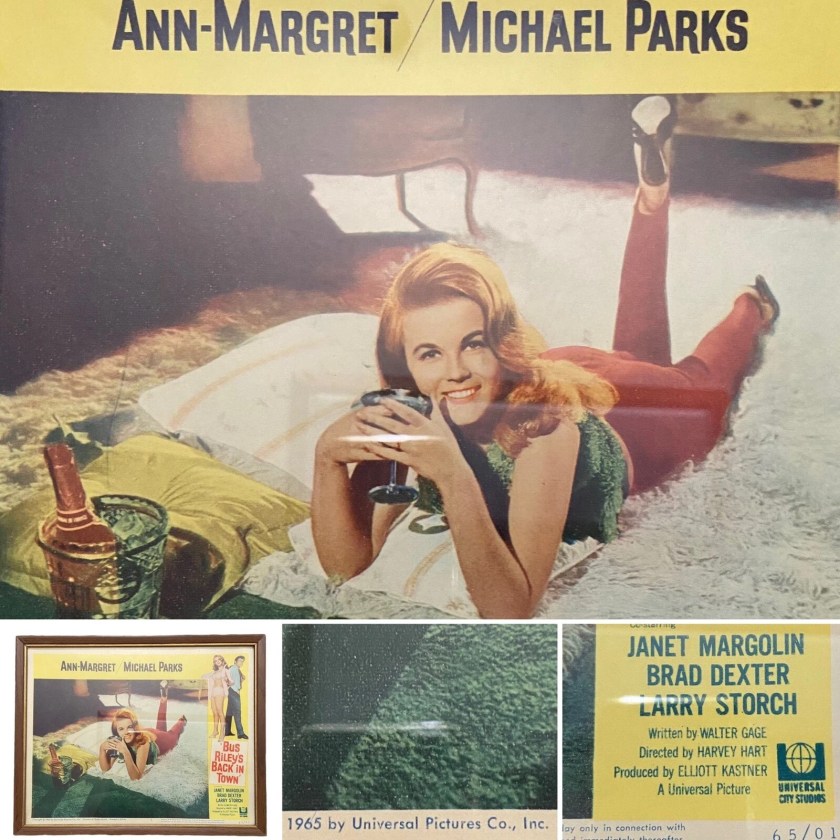
Small wonder that Bus Riley’s Back in Town found scant appreciation on producer’s Elliott Kastner’s dance card. He preferred to have people believe that his career began with box office smash Harper / The Moving Target (1966) rather than the two flops – Kaleidoscope (1966) and Bus Riley’s Back in Town (1965) – that preceded it. As his son Dillon Kastner pointed out: “He always preferred to forget his first film. He liked to think his first film was Harper so he never put that title (Bus Riley) on his list of credits for investors.”

After jockeying in the Hollywood trenches for three years, Kastner should have been delighted to finally get his name on a picture after so many potential movies had slipped through his grasp. But he had good reason to want to forget the experience of working on Bus Riley. It sat on the shelf for a year and, minus the involvement of the producer, was “butchered” by the studio.

By the time the movie appeared it was the latest in a long line of failed attempts by former agent Elliott Kastner to get onto the Hollywood starting grid. He had previously been involved in a pair to star Warren Beatty – Honeybear, I Love You with a screenplay by Charles Eastman and Boys and Girls Together adapted from the William Goldman bestseller with Joseph Losey (Accident, 1966) lined up as director. Also on his scorecard were 1963 William Inge play Natural Affection, Tropic of Cancer from the controversial Henry Miller novel and The Crows of Edwina Hill. At the time of the Bus Riley opening, he had acquired a further seven properties.

Bus Riley was never intended as a major picture, the budget limited to $550,000 – at a time when a decent-sized budget was well over $1 million. Shot in Spring 1964, and in post-production in July, release was delayed until Universal re-edited it and added new scenes because Ann-Margret had  achieved surprising movie stardom between her recruitment and the film’s completion. Along with Raquel Welch, she became one of the most glamorous stars of the decade and in building up her own career Welch clearly followed the Ann-Margret template of taking on a bucket of roles and signing deals with competing studios.

After making just three movies – A Pocketful of Miracles (1962), State Fair (1962) and Bye, Bye Birdie (1963) – Ann-Margret shot into the fast lane, contracted for three movies with MGM at an average $200,000 per plus an average 12% of the profit, substantial sums for a neophyte. On top of that she had four far less remunerative pictures for Twentieth Century Fox, three for Columbia, Marriage on the Rocks with Frank Sinatra and a couple of others. By the time Bus Riley finally appeared, she had expanded her appeal through Viva Las Vegas (1964) opposite Elvis and top-billed roles in Kitten with a Whip (1964) and The Pleasure Seekers (1964).

Universal also had another property to protect. Michael Parks was one of small contingent of novice actors in whom the studio had invested considerable sums, using them in television roles before placing them in major movies. Others in this group – at a time when most studios had abandoned the idea of developing new talent – included Katharine Ross and Tom Simcox who both appeared in Shenandoah (1965), James Farentino (The War Lord, 1965), Don Galloway (The Rare Breed, 1965), Doug McClure (The Lively Set, 1964) and Robert Fuller and Jocelyn Lane in Incident at Phantom Hill (1965).

However, the introduction of Parks had not gone to plan. He was set to make his debut in The Wild Seed (1965) – originally titled Daffy and going through several other titles besides – but that was also delayed until after Bus Riley, riding on Ann-Margret’s coat-tails, offered greater potential. Kastner had been instrumental in the casting of Parks – whom he tabbed as “a wonderful up-and-coming actor” – in The Wild Seed.

Also making their movie debuts in Bus Riley were Kim Darby (True Grit, 1969) and Canadian director  Harvey Hart (Dark Intruder, 1965), an established television name. Hart joined David Lowell Rich and Jack Smight as the next generation of television directors making the transition. Universal was on a roll, in 1964 greenlighting 25 pictures, double the number of productions in any year since 1957.

Falling just behind Tennessee Williams league in terms of marquee clout, playwright William Inge had won an Oscar for Splendor in the Grass (1961) and been responsible for a string of hits including Come Back Little Sheba (1952) – Oscar for Shirley Booth – the Oscar-nominated Picnic (1955) starring William Holden and Kim Novak and Bus Stop (1956) with Marilyn Monroe.

Kastner had persuaded him to turn his little-known 1958 one-act play All Kinds of People into a movie-length screenplay. Inge was initially keen to work on a low-budget picture, anticipating “more freedom with an abbreviated budget.” He asserted, “You don’t have the front office calling you up all the time.” Since the movie was not initially envisaged as a star vehicle for Ann-Margret (and, in fact, she plays the supporting role) he saw it as a “way of breaking up that old Hollywood method of selling pictures before they were made” on the back of a big star and hefty promotional budget.

Unfortunately for him, once Universal realized they had, after all, a star vehicle, the studio concluded that her image was more important than the “dramatic impact” of the film. “When we signed Ann-Margret she wasn’t a big star but in six months she was and Universal became very frightened of her public image. They wanted a more refined image.”

Kastner and Inge were elbowed aside as Universal ordered a rewrite and reshoots. Inge took his name off the picture. The credited screenwriter Walter Gage did not exist, he was created to get round a Writer’s Guild dictat that no movie could be shown without a writer’s name on the credits.

Despite her supposed growing power, Ann-Margret had little say in preventing the changes either. She expressed her disappointment to Gordon Gow of Films and Filming: “You should have seen the film we shot originally. William Inge’s screenplay…had been so wonderful. So brutally honest, And the woman, Laurel, as he wrote her, was mean and he made that very sad. But the studio at the time didn’t want me to have that image for the young people of America. They thought it was too brutal a portrayal. They wanted me to re-do five key scenes. And those scenes completely changed the story. There were two of these scenes that I just refused to do. The other three I did, but I was upset and angry.”

Film historian James Robert Parish refuted Ann-Margret’s recollection of events. He claimed the changes were made at her insistence because she wanted to be the focal point of the narrative rather than Bus Riley (Michael Parks).

Harvey Hart reckoned Universal got cold feet after the audience attending a sneak preview made “idiotic” comments on the questionnaire. Recalled Kastner, “I had nothing but heavy fiddling and interference from Universal.” Even so, given it was his debut production, he wasn’t likely to disown then and didn’t follow Inge in removing his name.

Despite the changes, the movie received a cool reception at the box office. It turned in opening weeks of a “modest” $7,000 in Columbus, “slow” $9,000 in Boston, “modest” $9,000 in Washington, “lightweight” $10,000 at the 1642-seat Palace in New York, “mild” $4,000 in Provident, “so-so” $4,000 in Portland, “not so good” $7,000 in Pittsburgh, “okay” $7,000 in Philadelphia, and $98,000 from 22 houses in Los Angeles with the only upticks being a “good” $7,000 in Cincinnati and a “fast” $7,000 in Minneapolis. The movie didn’t register in Variety’s Annual Box Office Chart which meant it earned less than $1 million in U.S. rentals and was listed as a flop.

SOURCES: Elliott Kastner Memoir, courtesy of Dillon Kastner; “Elliott Kastner’s Partner on Honeybear Is Warren Beatty,” Variety, January 23, 1963, p4; “Elliott Kastner Will Helm Crows for U,” Variety, May 1, 1963, p21; “Escalating Actress,” Variety, May 22, 1963, page 4; “Raid Canadian Director,” Variety, March 4, 1964, p24; “Inge Thinks Writer Contentment May Lie in Creative Scope of Cheaper Pix,” Variety, May 6, 1964, p2; “Ann-Margret Into the Cash Splash,” Variety, July 22, 1964, p5; “Universal Puts 9 Novices Into Pix,” Variety, March 3, 1965, p25; “ A Collective Byline,” Variety, March 17, 1965, p2; “U Stable of Promising Thespians,” Variety, March 17, 9965, p2; “Fear Ann-Margret Going Wrongo in Her Screen Image,” Variety, March 24, 1965, p5; “Radical Kastner-Gershwin Policy: Get Scripts in Shape Way Ahead,” Variety, May 19, 1965, p19; “Warren Beatty Partner and Star of Goldman Tale Via Elliott Kastner,” March 31, 1965, p7; “Picture Grosses,” Variety – March-May 1965.

Behind the Scenes: Exploding the Myth of “Jaws” (1975)

Just to follow on yesterday’s reissue of an article of mine regarding the box office of Jaws, I thought it might be timely to ressurect an older article which sets the record straight on some aspects of the movie’s release.

This was in response to the publication of movie critic Richard Schickel’ s Spielberg: A Retrospective which continues to perpetuate the Jaws release myth. I can hardly expect Mr Schickel’s due diligence to cover my own modest tome, In Theaters Everywhere, A History of the Hollywood Wide Release, 1913-2017 (McFarland, 2019), which is now (apparently) the standard text (in case you didn’t know) for all questions relating to wide release, saturation, call it what you will.

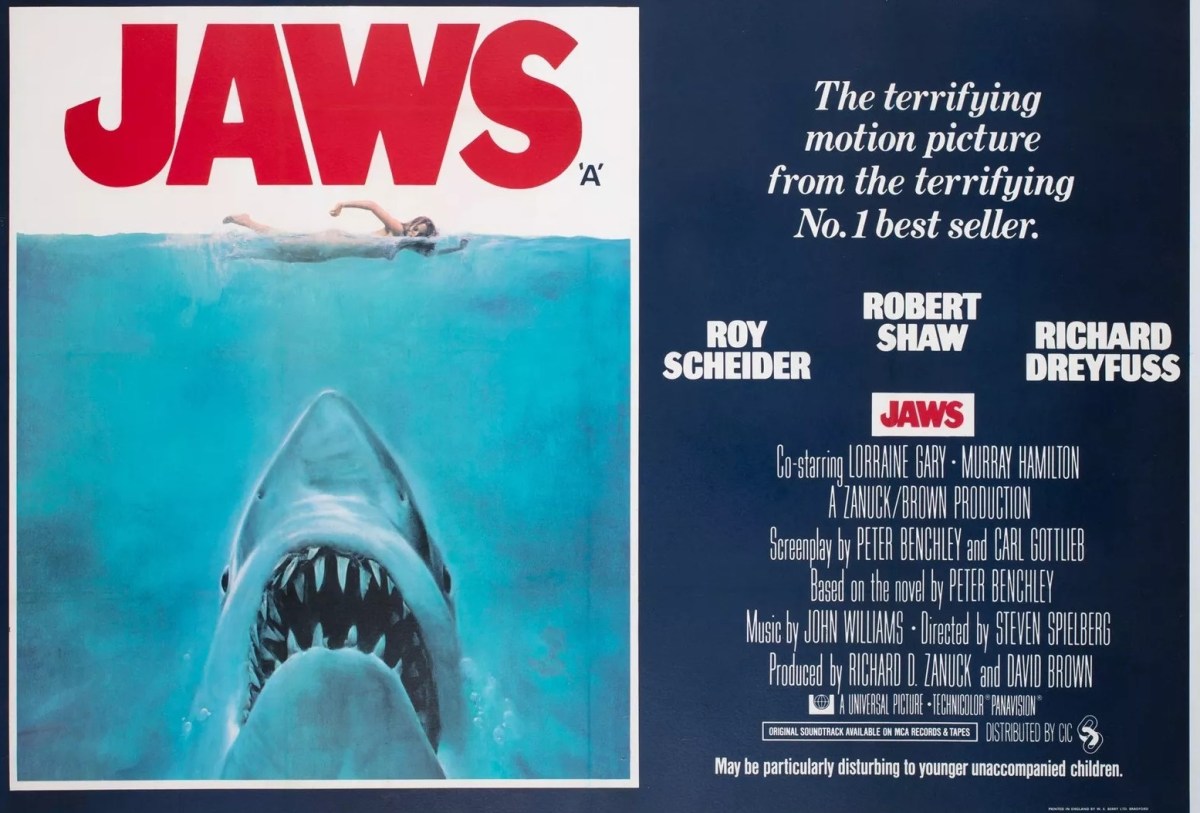
Jaws was not a phenomenon in the normal sense. It did not belong to the realm of the unexplained. In fact, mystery was the least part. It was eminently explainable, despite realms of academics and observers regarding its explosion at the box office in tones of wonder. Hollywood loves a legend, especially one of its own making, and the movie did conform to two attractive narratives, that of the tyro director Steven Spielberg coming good and of  the movie overcoming a massive budget over-run (from $3.5 million to $8 million) that could have sunk the enterprise at the outset.

Jaws did not not invent the wide release, summer release or the event movie.

To start with the biggest myth – the wide release – that had been around since the 1930s. The Wizard of Oz (1939) debuted on 400-plus. Warner Brothers signed up 400 for This is the Army in 1943. David O. Selznick created a new phrase for wide release, “blitz exhibitionism,” for Duel in the Sun (1946). In 1948 Twentieth Century Fox opened Iron Curtain, Republic Bill and Coo and Allied Artists The Babe Ruth Story at over 500 cinemas. Fast forward to 1960 and The Magnificent Seven’s initial theater haul was 750. Earlier in 1975, studios had gone for saturation broke with The Master Gunfighter opening on 1,000-plus with Breakout starring Charles Bronson claiming the record of 1,400 houses for the opening week.

In fact, far from inventing saturation or the summer blockbuster or even the event movie, the Steven Spielberg picture, was merely an extension, albeit a wildly successful one, of what had gone before. The problem with the scenario of “Jaws the Legend” is that too few people, academics and journalists alike, placed it against the backdrop of not just the previous few years but the prior decades during which  saturation/wide release had flourished.

Long before Jaws came onto the scene, the 1970s had changed and the two conditions that had marked out the previous decade, the reduction in studio output and the increase in saturation, were the prime movers. Jaws was not the beginning of a new era, but very much the opposite, the triumphant culmination of an old one.

It owed a great deal to the other 1970s box office phenomena – Airport, Love Story, The Godfather, Towering Inferno, The Poseidon Adventure and The Exorcist.  Their most obvious common thread was that they were based on bestsellers and successful books enjoyed a publicity life and after-life all of their own, as well as providing marketing tie-up benefits and journalistic opportunity.

But turning bestsellers into films was not unusual, Gone with the Wind in 1939 the most obvious example. The top three movies of 1953 – The Robe, From Here to Eternity and Shane – were based on bestsellers as were 1958’s leading trio, Bridge on the River Kwai, Peyton Place and Sayonara. The Guns of Navarone (first in 1961), Spartacus (first in 1962), The Carpetbaggers (first in 1964), Thunderball (first in 1966), The Dirty Dozen (first in 1967), and The Graduate (first in 1968) were all taken from bestsellers. Airport, Love Story, The Godfather and The Poseidon Adventure were the number one films of their respective years, The Exorcist second in its. 

The subject matter of The Godfather and The Exorcist attracted a mass of newspaper headlines, Love Story because it was such an unexpected hit, while Jaws afforded endless journalistic opportunity. The Godfather, The Exorcist and Jaws all had in common budget and shooting problems. Like Jaws, the theme tunes to Love Story, The Godfather and The Exorcist were million-sellers. Airport apart, none of the biggies boasted established stars, Marlon Brando, although a giant of the 1950s, no longer a box office attraction while Gene Hackman was a potential one-hit wonder prior to The Poseidon Adventure. Ryan O’Neal and Ali McGraw (Love Story), James Caan and Al Pacino (The Godfather), Ellen Burstyn (The Exorcist) and Roy Scheider and Richard Dreyfuss (Jaws) were virtually unknowns.

The idea that summer was a release desert had not been true for more than a decade, Paramount launching ‘a powerhouse of important product’ – a total of eight pictures – in 1970 – Norwood had 1,400 bookings between May 27 and July 8 in four waves of 450 theaters – more, incidentally, than the number of theaters showing Jaws in its opening week – each running the picture for two weeks. In 1973 Twentieth Century Fox, MGM and Columbia opened a total of 19 movies during the season. 

The Twentieth Century Fox schedule comprised the long-awaited reissue of The Sound of Music, Robert Aldrich’s The Emperor of the North, Battle for the Planet of the Apes (the fifth in the series), Jeff Bridges as The Last American Hero (with a tie-up with over 16,000 gas stations) based on articles by Tom Wolfe, and The Legend of Hell House, the whole shebang kicked off in late June by a featurettes on ABC and an eight-day television campaign.

Columbia reckoned it would need a company record 3,150 prints to meet demand for George C. Scott and Faye Dunaway in Oklahoma Crude, Burt Reynolds as Shamus, Charles Bronson in The Valachi Papers, romantic comedy Forty Carats, remake Lost Horizon, and concert documentaries Let the Good Times Roll and Wattstax.

The MGM septet included Yul Brynner in Westworld, Burt Reynolds in The Man Who Loved Cat Dancing and Shaft in Africa. In 1974, Twentieth Century Fox  targeted summer with ten movies including Richard Lester period romp The Three Musketeers, heist drama 11 Harrowhouse, chase picture Dirty Mary Crazy Larry, Spys, and the ‘Ape-athon’, a quintuple bill of all the Planet of the Apes pictures, plus another outing for The Sound of Music. Substantial radio advertising was added to usual television/newspaper marketing mix, with stations in 30 key cities running an eight-week campaign.

The studio cleared $35 million over 13 weeks, up $5 million on its previous best summer in 1970. Paramount’s high voltage program included The Longest Yard and Chinatown. But it was not just the majors who recognized the importance of summer, Crown International and American International both reported record business for summer 1974.

The $1.8 million Universal spent marketing Jaws was both a large and modest amount. In proportion to production costs, it was less than Joe Levine devoted to Hercules or to the promotional budgets for four-wallers, and a lot less, than was allocated The Culpepper Cattle Company or Breakout. That television accounted for 38percent was not astonishing either since research proved that newspaper advertising was more effective.

Although claiming to be the largest amount spent in television spot advertising, compressed into the three days prior to opening and opening day (June 20) itself, it was rather last-minute compared to the selling of The Man with the Golden Gun for which United Artists ran 700 prints of a teaser trailer in theaters six months prior to launch and 30-second advertisements on the ten top-rated television shows well in advance of opening.

The tactic of specifying which television slots of movie would advertise on, as Jaws did, was far from rare, four-wallers specializing in this, and Breakout had done the same. In fact, the record that Universal claimed for Jaws, too, was questionable since Breakout had 42 30-second spots compared to 23 for Jaws. Disney, overall, spent a lot more. Nor did Universal knowingly aim for a summer launch – only shooting delays prevented it opening at Xmas 1974.  Nor did publisher and studio jointly adopt the same visual for Jaws from the start – a March 1974 trade advertisement in Box Office differed substantially from the iconic poster.

The marketing device of reporting grosses week-by-week was not novel either. Most the big hitters of the 1960s did not pull in money at top speed. Love Story changed all that. Paramount kept the industry and the wider newspaper planet up-to-date on a weekly basis of the movie’s unprecedented progress. Its $2.46million (actually $2.36million) in three days from 165 was the biggest in history and it set the seal on the industry reporting the weekend rather than weekly gross. The second weekend was $2.49million, the third $2.4million, the fourth $2million and the fifth $2.3million. That the second and third weekends both out-grossed the first, and the fifth weekend out-grossed the fourth, were publicity bonuses. The first five weeks topped $17.5million. Four weeks later, theater count risen to 231, it totaled $28.4million and two weeks further on, on 282 theaters, the gross stood at $35.4million.

When in 1972 The Godfather so quickly gunned down Love Story, it set in motion an ongoing marketing story, and the question facing each new hit, from The Poseidon Adventure to The Exorcist and The Sting, was box office speed and whether it could topple the reigning champion.

By 1975 accelerated grossing had become common: The Trial of Billy Jack hoisted $9 million in five days, The Man with the Golden Gun $5.1 million in a week, The Sting $7 million in two weeks, Papillon $11.25 million in three weeks, Airport ’75 $10 million in a month, Earthquake $7.3 million in a month, The Godfather Part II $22.1 million in under five weeks, Magnum Force $18 million in five weeks.

So when Jaws showed the potential to reach the very top, Paramount raced out of the traps with a series of advertisements showing the gap closing between the new movie and the title holder. This tack in itself was nothing new – The Robe, hoping to catch up on Gone with the Wind, had made a big hullabaloo of reporting opening week’s grosses day-by-day in the trade press and Twentieth Century Fox had capitalized on The Sound of Music’s overhauling of Gone with the Wind.

Jaws simply took advantage of a media ready-and-waiting for an accelerated box office story. Since money was made faster than ever before, box office records fell faster than ever before. It made news precisely because it was sustainable – week after week – an ‘immediate stampede’ at the box office – $14.3 million ($34,900 per theater average) in the first week, $33.8 million in two weeks and three days, $69.7 million in five weeks and three days, $100 million in eight weeks and three days, $150 million in twenty-three weeks. (It did not venture overseas until November, first stop Australia, and then it was a major Xmas release in seven hundred theaters in forty-four countries.)

Substantial questions remain about the Jaws saturation. Although history proved the Universal strategy to be a success, I am not convinced it was as deliberate as suggested nor that Universal had any idea of the winner it had on its hands.

There had been much larger saturations going back two decades and both Trial of Billy Jack in 1974 and Breakout in 1975 had debuted in over 1,000. The number of theaters involved in the Jaws launch was, I shall argue, proof of the studio’s lack of confidence not the opposite.

Studios with what they believed were guaranteed winners had consistently used a different scenario. The Exorcist opened in 24 theaters, Earthquake in 62, Papillon in 109 and The Godfather Part II in 157. Movies that opened in the Jaws range and above – Magnum Force in 418, The Man with the Golden Gun in 635, The Trial of Billy Jack, Breakout and The Master Gunfighter in 1,000-plus – were not expected to last as long. Statistics proved that for features with high box office expectation the slower limited roll-out was the more effective approach. The question really to be asked is whether Universal realistically expected Jaws to bring in rentals in the region of The Exorcist ($66million), The Sting ($68million) and The Godfather Part II ($128.9million) or whether its expectations were more in the Magnum Force ($18.3million) ballpark. I would argue that circumstantial evidence pointed to the latter. No other studio would throw away a prospective gold-plated opportunity on a saturation of the Magnum Force variety unless it reckoned grosses around the Dirty Harry sequel mark would count as a good return on its investment.

I would also challenge whether Universal actually deliberately limited the number of original theater participants. I would suggest it is much more likely that the studio encountered considerable resistance from exhibitors to being asked to hand over 90percent of the gross, agree a 12-week run and contribute to the national television campaign for a movie with an unknown director and no stars. Also, the movie did not, like The Exorcist or The Godfather, open in engagements exclusive to one city, but went multiple from the start, 46 in New York, 25 in Los Angeles; even Airport 1975 only opened in five theaters in New York.

More likely, I would venture, is that the original theater count declined over the blind-bidding controversy and/or when Universal and exhibitors reached a negotiating impasse. Negativity could also have been sparked by the recent experience of Breakout which fell short of box office targets. It certainly strikes of wisdom-after-the-event for Universal to claim this was a deliberate strategy. Nobody spends $1.8million on launch advertising in the hope that it would carry the picture all through summer since that would suggest a paltry $225,000 per week over an eight-week season.

Universal spent nearly two-fifths of the film’s production budget on that kind of launch because they wanted big opening grosses. For the first month, Jaws was restricted to 409 theaters in the U.S., the number increasing to 700 after five weeks and then to 900 after another three weeks, suggesting that exclusivity was part of the deal for initial exhibitors.

A tougher business take on the limited opening was that Universal shot itself in the foot.

With an 800-theater launch, grosses would have been stratospheric, even higher than the movie actually achieved. Ironically, it was roadshow precedent and practice that created the opportunity for Jaws to break all box office records. Without the guaranteed run that roadshows traditionally enjoyed, theaters would have dumped the movie, regardless of grosses, because they were already committed to another feature. Longevity, not opening week grosses, was the key to the Jaws record-breaking.

So if it was not a unique development in saturation that precipitated the Jaws success, or a new way of latching onto summer as an unrealized opportunity, or a breakthrough in publishing or record sales, or a novel approach to television advertising, to what else can you ascribe the movie’s unprecedented success?

Well, the answer is the simplest, the oldest, of all. The public just liked it. It hit a chord the way a raft of movies as different as Gone with the Wind, The Sound of Music and The Godfather before it. And it also benefitted from the public reappraisal of reissues, the idea that you could go back to see a movie you enjoyed again and again. Jaws broke no saturation rules and did not set new saturation boundaries. All the hard work on that had already been done. But it certainly reaped the reward. 

SOURCE: Brian Hannan, In Theaters Everywhere, A History of the Hollywood Wide Release, 1913-2017 (McFarland, 2019) p192-195.


Behind the Scenes: “The Nightcomers” (1972)

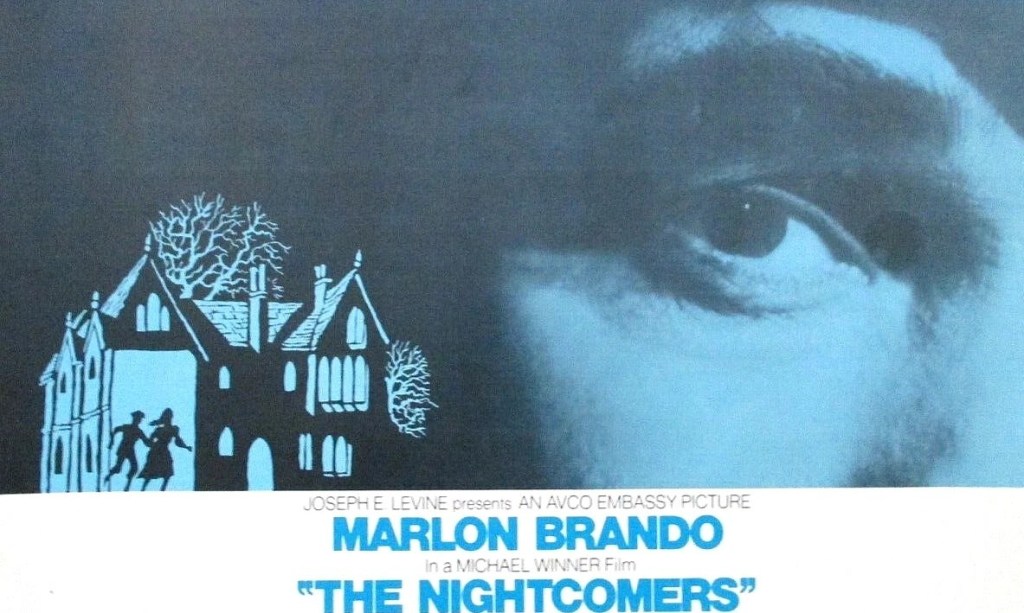
Marlon Brando’s box office cachet had crashed. He hadn’t made a picture in two years following the flop of Queimada/Burn (1969) which had followed his debilitating box office trend of most of the decade. While his stock remained high enough to headline such big budget numbers as The Chase (1966) and Reflections in a Golden Eye (1967), thereafter confidence in his marquee value tumbled. Apart from Queimada, he had only been signed up for Night of the Following Day (1968), another loser.

But that last picture had brought him into the orbit of independent producer Elliott Kastner (Where Eagles Dare, 1968) who had been a friend of director Hubert Cornfield (Pressure Point, 1962) when they had both worked as agents at MCA. “Although he was crazy,” recalled Kastner, “I loved his writing and his drive.” Kastner was a fan of Cornfield’s earlier movies especially as they had been delivered on short time schedules. “I wanted to do something with Marlon Brando and he wrote Night of the Following Day.” 

Brando still had clout in Hollywood. His three-picture deal with Universal obliged the studio to pony up for any (financially viable) projects he put to them. Kastner was delighted to hop over from his base in London to the French location and although the movie continued the actor’s poor reception at the box office, the producer enjoyed the experience.

Brando wasn’t averse to the “resting” that most actors endure, stints of unemployment between gigs. So when the actor approached Kastner to work with him again, it took the producer by surprise. “Marlon wanted to do a film,” said Kastner, “which was unusual for Marlon because he hides from work. He wanted to do a film in Europe and he loved staying at my house in the country. I talked to (Brando’s agent) Jay Kanter (who later became Kastner’s business partner) about it and we gave him a screenplay called The Nightcomers…that Michael Winner wanted to direct.”

Kastner had liked Winner’s output and was equally attracted to the fact that he also worked fast. Winner was contemptuous of directors who shot too much footage, especially “coverage”, filming a scene from too many different angles. But he was also a very fast editor. He took an editing caravan with him on location, and after the day’s filming ended at 6pm he spent the next two hours watching rushes and another two hours after that editing. His editor Freddie Wilson said,” His speed of decision in the cutting room saves a great deal of time and money.”

Winner had been sitting on the screenplay by Michael Hastings for some time. “No one was rushing to finance it,” remembered Winner, until Brando showed an interest. Winner arranged to meet the actor at his “modest Japanese-style house” in Los Angeles. However, insurance proved a sticking point following payouts for Quiemada.

“On a personal level,” recollected Kastner, “I thought he (Winner) was a bully with waiters. He was really nasty to people beneath him. I didn’t have much (personal) respect for him but he was very amusing.”

Due to scheduling conflict Vanessa Redgrave (Blow-Up, 1966) turned down the role of Miss Jessel. Winner also offered the part to Britt Ekland (The Double Man, 1967) provided she could bring some financing to the project. In the end, remembered Kastner, “Michael wanted to cast this girl with this big bust who was a halfway decent actor.” Neither Redgrave nor Ekland could compare in the bust measurement department to Stephanie Beacham, so clearly chest size was not a priority.

Kastner reckoned Brando “would bring plenty of poetry” to the project. It was remarkably cheap even for a star of Brando’s fading attraction. The budget was $686,000, of which Kastner received $50,000 as a producer’s fee plus 30% of the profits. Winner deferred his fee, only paid if the movie made money. At that point, Kastner was leading the way in finding funding outside the studio system. Funding for When Eight Bells Toll (1970), for example, was entirely sourced from an American businessman. For The Nightcomers, Kastner located investment of $100,000 from a company called Film & General Investments. Universal was involved through its contract with Brando – paying him his $300,000 salary for this picture to count as the final one on his contract, but declined to distribute the picture. For another producer, this might have been enough to kill off the project, but not for Kastner, who, following his current practice, intending to sell the completed film to a distributor.

As far as Kastner was concerned the movie went into immediate profit. Joe Levine of mini major Avco Embassy, still riding high after the success of The Graduate (1967) and The Lion in Winter (1968), ponied up $1 million for the worldwide rights plus a share of the profits. But Avco also limited its exposure, selling a 40% share to businessman Sigmond Summer for $1 million. (Judging from later legal documents, Universal retained some financial interest in the picture).

Brando had decided Quint was Irish. To learn the dialect, Brando and Winner got together with a group of Irishmen in the back room of a pub, one whom became the actor’s dialog coach on location.

The six-week shoot, on locations in Cambridgeshire, Britain, with Sawston Hall doubling as the mansion, began in January 1971. There was another reason for the speed of the shoot. Winner had contracted with United Artists to make Chato’s Land (1972) and there was no time to spare between the movies. Over 100 actresses auditioned for the role of the female orphan. Winner, seeking “someone over 18 who looked 11,” selected Verna Harvey (she also won a role in Chato’s Land).

Although Winner had gone to some expense to set up a private dining room for the star at Sawston Hall, Brando preferred to eat with the crew. According to Winner, despite Brando’s fearsome reputation, he knew all his lines, immensely patient with his young inexperienced co-stars, concerned about the crew, and, as importantly, arrived on time and even watched rushes, a rarity among the profession. Brando used earplugs to prevent distraction from extraneous noise. During the shoot Francis Ford Coppola flew over to spend time discussing the script of The Godfather with Brando.

Brando initially refused to have stills taken of him during the sex scene and only gave in after considerable persuasion, though he kept his wellington boots on. He wanted to leave the drunk soliloquy to the end of shooting. Though he was actually drunk after consuming a lot of Scotch, “he remembered his lines immaculately…(and) also matched his hand movements and body movements, which is very important in movies,” explained Winner, “because if you have to cut different bits of film together if the body or hands or arms are in a different position you’re in trouble.” 

Jerry Fielding didn’t record his score until July during a three-day session with an orchestra of 80 at Cine Tele Sounds Studio. Despite his editing prowess, Winner realized his final version didn’t work. “The first cut was too fast. For a moody period film I’d just messed up. I put back seven minutes (of footage) and spent another three weeks getting it right.”

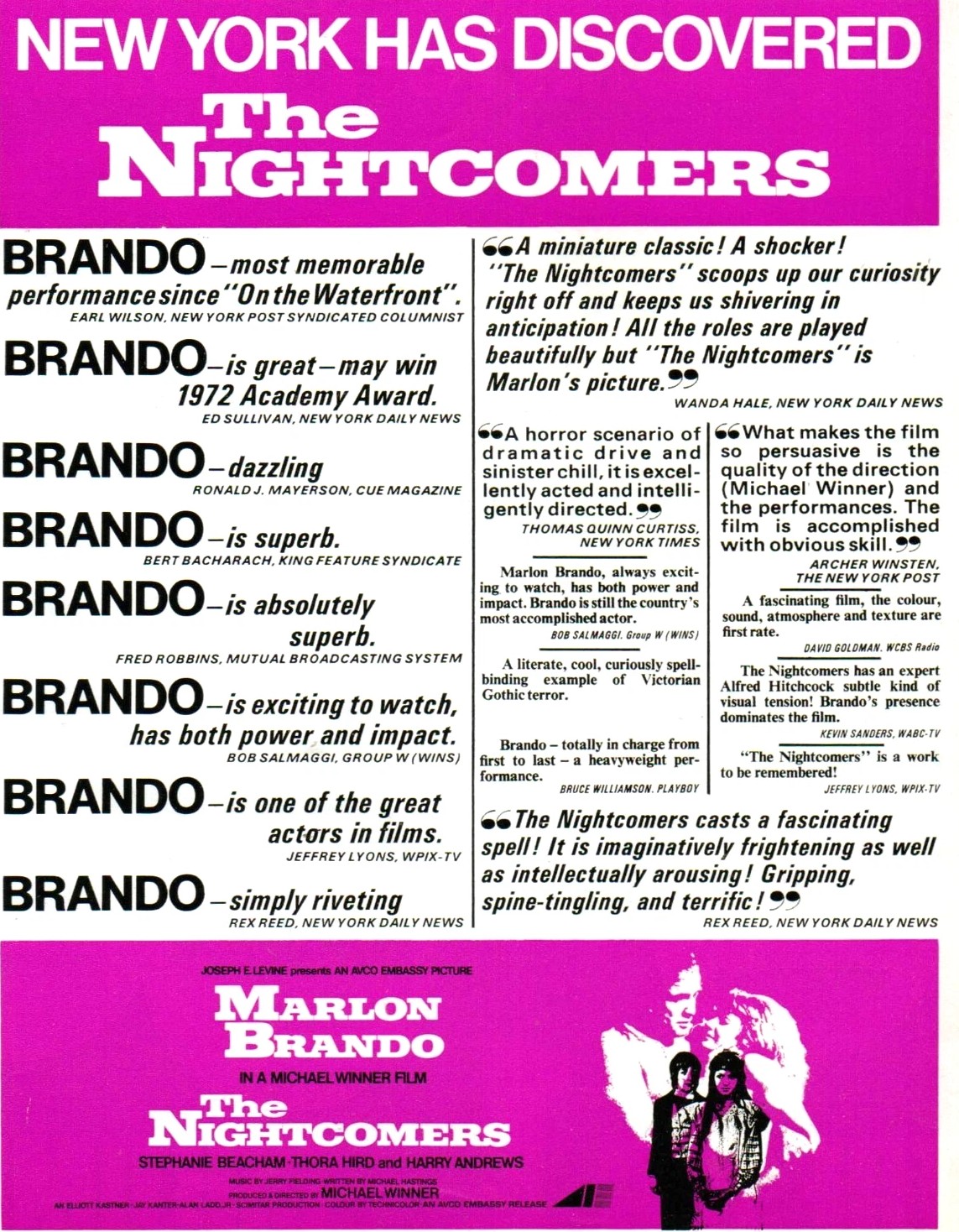
Thanks to its world premiere at the Venice Film Festival alongside the likes of Sunday, Bloody, Sunday (1971), it was touted, perhaps unwisely, as an arthouse picture, rather than majoring on the sex and violence. While Variety tabbed it a “grippingly atmospheric thriller,” only two out of the five most influential New York critics gave it the thumbs-up.

A distribution deal was not struck till the end of 1971. Rather than potentially riding along in the slipstream of The Godfather (1972), which was already attracting huge hype, Avco decided that it was better to come out before the Mafia picture than risk being swamped in its wake. But there was confidence in the project. “Joe Levine thought the film was so brilliant we didn’t have to wait for The Godfather,” related Winner.

It launched first in America, opening in February 1972 – beating The Godfather to the punch by a month – at the 430-seat Baronet arthouse in New York. The opening week of $20,700 was rated “nice” and held well for the second week before plummeting to $11,000 in the third week. It was yanked after six weeks.

By the time it spread out into the rest of the country, The Godfather rollercoaster was well into it stride, but the early release had not particularly gathered any pace and in the aftermath of the Coppola movie it was certainly buried. It opened to $6,500 in Boston compared to The Godfather’s second week of $140,000. There was a “scant” $39,000 from 13 houses in Los Angeles, a “modest” $4,000 in Louisville though $5,000 in San Francisco was rated “brisk” and the same amount in Washington “snappy.

Initially, at least, Britain appeared more propitious. It opened in key West End venue the 1,400-seat Leicester Square Theatre to a “loud” $24,700 and though it dropped $10,100 in the second week, the third and fourth weeks improved on the second. Eight weeks into its West End run, when it was still pulling down $13,300, The Godfather put it to the sword with a record-breaking $191,000 from five West End houses. After that pummelling, The Nightcomers managed only three further weeks.

In fact, the movie did surprisingly well, especially overseas. Total rentals came to $1.69 million, a clear million-dollar profit on the negative cost. While less than half a million came from the U.S., and only $160,000 from Britain, the overseas market kicked in the bulk of revenue – $986,000 – possibly because it was released after The Godfather (1972) rather than, as in the UK and the US, before. In the run-up to and in the wake of The Missouri Breaks (1976), it was included in Brando perspectives at the Museum of Fine Arts, where it was presented as a “novel film…lost in the shadow of The Godfather,”  and Carnegie Hall. But an attempt at commercial  reissue proved disastrous – a “weak” $1200 in Pittsburgh.

Except from a financial perspective, Kastner wasn’t especially impressed, calling it “grim, boring, contemptuous of story, oblique.” Viewers, including me, beg to disagree.

SOURCES: Elliott Kastner’s Unpublished Memoirs, courtesy of Dillon Kastner; Elliott Kastner Archive, courtesy of Dillon Kastner; Michael Winner, Winner Takes All, (Robson Books, 2004); “Production Review,” Kine Weekly, January 23, 1971, p10; “Not So Young,” Kine Weekly, May 22, 1971, p16;“Jerry Fielding,” Kine Weekly, July 17, 1971, p10; “Michael Winner,” Kine Weekly, August 13, 1971, p10; “Nightcomers to Avemb,” Variety, January, 19,1972, p5;  “New York Critics,” Variety, February 23, 1972, p35; “Picture Grosses”, Variety, 1972: February 23-April 26, June 7-14; July 19- Sep 27; “Broadway,” Box Office, February 9, 1976, pE2; “Museum of Fine Arts,” Box Office, October 18.

Discover WordPress

A daily selection of the best content published on WordPress, collected for you by humans who love to read.

The Atavist Magazine

by Brian Hannan

WordPress.com News

The latest news on WordPress.com and the WordPress community.