Can Heironymus Merkin Ever Forget Mercy Humppe and Find True Happiness (1969) **

One of the biggest-ever movie follies, an overblown vanity project with Fellini-esque overtones – written, directed, produced and starring British crooner Anthony Newley (Doctor Dolittle, 1967) – that turned into the first X-rated musical. Bob Fosse mined a similar, almost as seedy, sex-obsessed autobiographical vein in All That Jazz (1979) to critical acclaim whereas the Newley effort met with critical coruscation.

Although primary known as a Broadway star (Stop the World, I Want to Get Off), he had a small but reasonable movie portfolio, star of The Small World of Sammy Lee (1963) and male lead to Sandy Dennis in Sweet November (1968), so in a sense he was ready for the leap into movie stardom, though perhaps not in such grandiose fashion. Had the movie shown the slightest touch of irony, that might have been its saving grace, but the main theme is that women queue up to bed a star who is fed up with bedding women yet appears to revel in his own moral decadence.

The story is so slim it defies belief or arrogance. Hieronymous Merkin (Newley) is preparing to make a film about his own life though he feels he has been controlled from the outset, his child view is that of a marionette with someone else pulling the strings. Once Goodtime Eddie Filth (Milton Berle) sets him on a stage career beauties flock to his side. Although married to Polly Poontang (Joan Collins) he longs to be reunited with earlier lover Mercy Humpe (Connie Kreski). Basically, he keeps asking the universal question besetting all men – if I can have all the sex in the world, why am I not happy?

On the plus side it is certainly audacious, surreal, pretentious, unconventional and gives a good idea of what would happen if a director turned up on a beach in Malta with $1.25 million to spend on whoever happened to be available plus assorted nudes and rolled the camera to see what would happen and then argued with his crew or critics about what was taking place. One big minus is the songs. Newley was a talented lyricist (Goldfinger) and composer as well as performer. But the material here is poor and Newley, despite his Broadway experience, has no idea how to stage a musical.

Cameos abound. You can spot famed comedian George Jessel, singer Stubby Kaye, British entertainer Bruce Forsyth, Tom Stern (The Devil’s Brigade, 1968), and British character actors Patricia Hayes, Victor Spinetti and Judy Cornwell. You may be surprised to learn that the script written in tandem with Herman Raucher (Sweet November) was named Best British Original Screenplay by the Writers Guild of Great Britain.

Theoretically, this is now regarded as a cult classic but I’ve yet to come across a review that treats it as anything other than a self-indulgent curiosity rather than a must-see.

Studio Universal was so embarrassed by the final outcome that it released it in the U.S. under its Regional Film unit “which handles product Universal doesn’t care to go out under its own banner.” The picture was not quite the box office disaster many anticipated after poor runs in New York and Los Angeles. Helped along by a 10-page spread in Playboy it scored substantial business in cities as diverse as Detroit, Louisville and Minneapolis, though not enough, ultimately, to break even.

Given Newley did not make another picture for six years, you might have imagined Hieronymous Merkin spelled the death-knell for his career. But that was not so. After the film opened, he signed a $1 million four-year deal at Caesar’s Palace in Las Vegas, was lining up a Broadway musical about Napoleon and Josephine with Barbra Streisand and was in talks to star in a movie adaptation of his hit musical The Roar of the Crowd.

Afraid you’ll have to dig around on Ebay to find this.

SOURCES: “Newley Making Vegas Bow Aug 7 at Caesar’s Palace,” Variety, June 11, 1969, p76; “Newley-Streisand for B’way Tuner on Nappy-Josie,” Variety, July 2, 1969, p1; “Merkin Dates Overcome Jinx,” Variety, July 9, 1969, p3; “Jack Haley Jr. Setup To Produce, Direct,” Variety, December 24, 1969, p6.
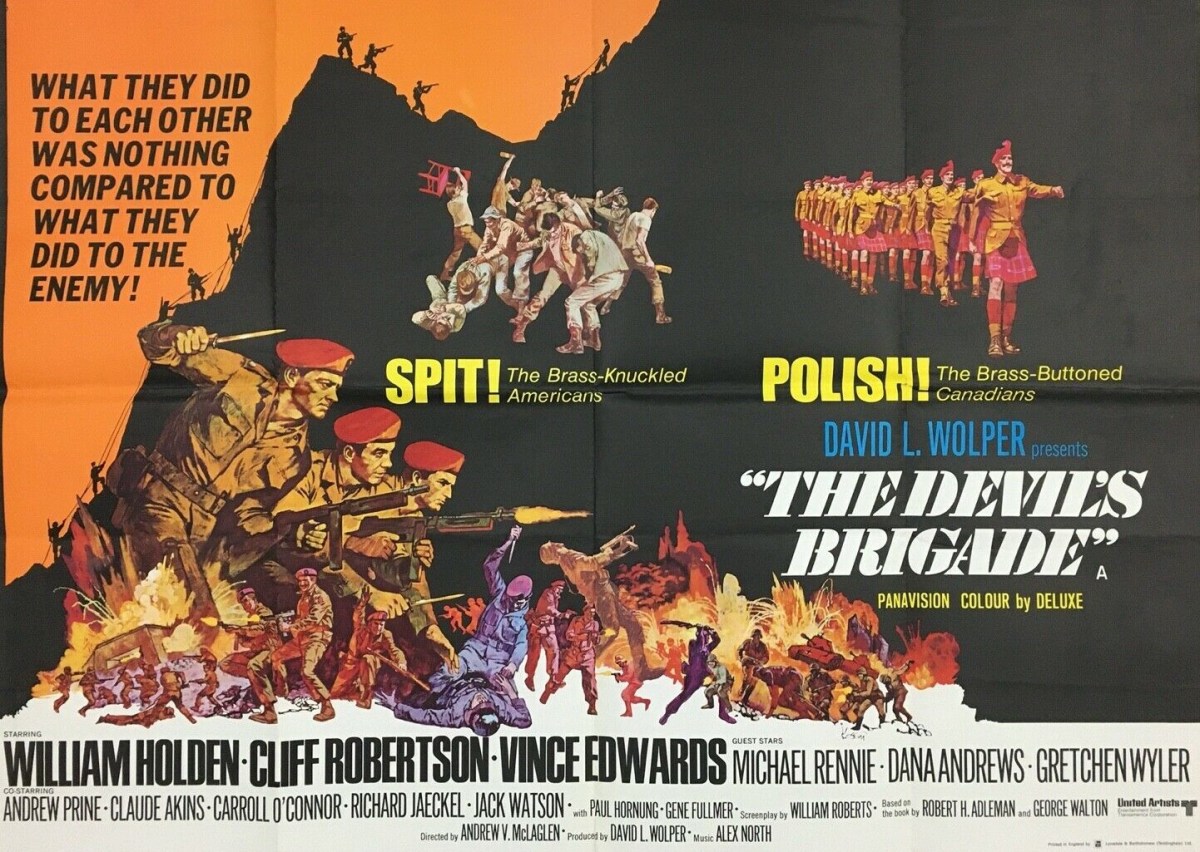
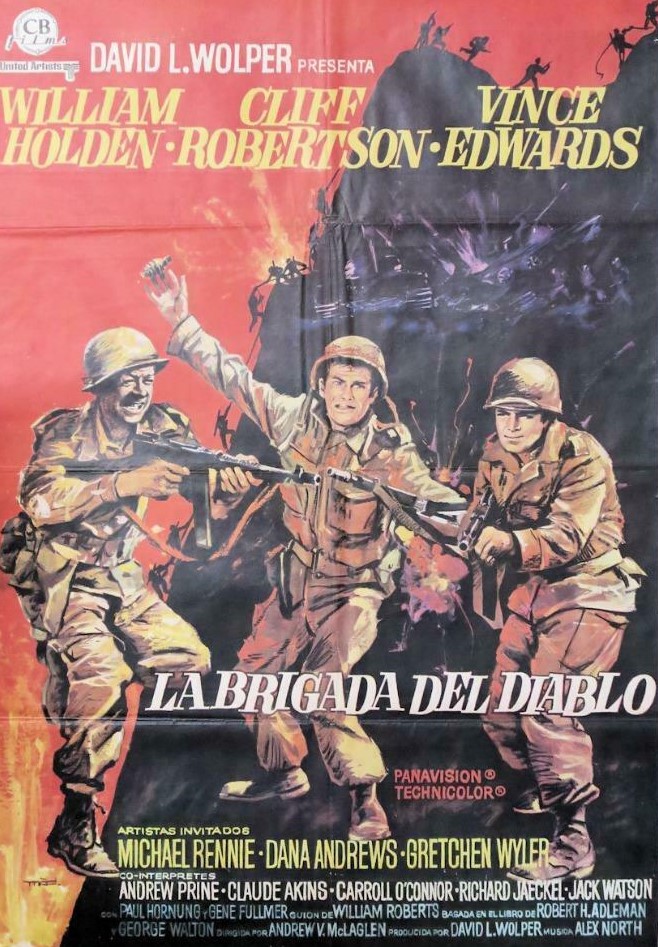
The Devil’s Brigade (1968) ***

I couldn’t get my head around the idea of the U.S. Army recruiting a bunch of undisciplined misfits, many with jail time, in order to link them up with a crack Canadian outfit. Turns out this part of the film was fictional, the Americans in reality responding to advertisements at Army posts which prioritized men previously employed as forest rangers, game wardens, lumberjacks and the like which made sense since the original mission was mountainous Norway.  I should also point out the red beret the soldiers wear is also fictional and while depicted on the poster sporting a moustache commanding officer Lt. Col. Frederick (William Holden) is minus facial hair in the film.

But, basically, it follows a similar formula to The Dirty Dozen (1967), training and internal conflict followed by a dangerous mission. The conflict comes from a clash of cultures between spit-and-polish Canucks and disorderly/juvenile Yanks though, as with the Robert Aldrich epic, the leader taking some of the brunt of the discontent.  Collapsible bunk beds, snakes under the sheets and a tendency to fisticuffs are the extent of the antipathy between the units, which is all resolved, as with The Dirty Dozen, when they have to take on people they jointly hate, in this case local bar-room brawlers in Utah.

The movie picks up once they are sent to Italy. Initially employed on reconnaissance, Frederick challenges Major-General Hunter (Carroll O’Connor) who wants to do things by the book and sets out to take an Italian position by trekking two miles up a riverbed, creeping into town by stealth and capturing the location without firing a shot. 

Next up is the impregnable Monte la Difensa. Taking a leaf out of the Lawrence of Arabia playbook, in a brilliant tactical move, the Americans attack the mountainous stronghold from the rear by way of a mile-high cliff.  But that’s the easy part. The rest is trench-by-trench, pillbox-by-pillbox, brutal hand-to-hand fighting.

The battle scenes are excellent and the training section would be perfectly acceptable except for the high bar set by The Dirty Dozen. That said, there is enough going on with the various shenanigans to keep up the interest, but we don’t get to know the characters as intimately as in The Dirty Dozen and there is certainly nobody in the supporting cast to match the likes of Telly Savalas, Charles Bronson, Jim Brown and John Cassavetes. That also said, the men do bond sufficiently for some emotional moments during the final battle.

At this point William Holden’s career was in disarray, just one leading role (Alvarez Kelly, 1966) and a cameo (Casino Royale, 1967) in four years, and although his screen persona was more charming maverick than disciplined leader he carries off the role well, especially solid when confronting superiors, exhibiting the world-weariness that would a year later in The Wild Bunch put him back on top. Ironically, Cliff Robertson was coming to a peak and would follow his role as the strict disciplinarian Major Crown, the Canadian chief, with an Oscar-winning turn as Charly (1968). Vince Edwards (Hammerhead, 1968) as cigar-chomping hustler Major Bricker makes an ill-advised attempt to steal scenes.

This was the kind of film where the supporting cast were jockeying for a breakout role that would rocket them up the Hollywood food chain – as it did with The Dirty Dozen. Jack Watson (Tobruk, 1967) is the pick among the supporting cast, but he has plenty of competition from Richard Jaeckel (The Dirty Dozen), Claude Akins (Waterhole 3, 1967), Jeremy Slate (The Born Losers, 1967), Andrew Prine (Texas Across the River, 1966), Tom Stern (Angels from Hell, 1968) and Luke Askew (Cool Hand Luke, 1967). Veterans in tow include Dana Andrews (The Satan Bug, 1965) and Michael Rennie (Hotel, 1966).

William Roberts (The Magnificent Seven, 1960) adapted the bestselling book by Robert H. Ableman and George Walton. Director Andrew V. McLaglen (Shenandoah, 1965) was more at home with the western and although there are some fine sequences and the battle scenes are well done this lacks the instinctive touch of some of his other films.

Discover WordPress

A daily selection of the best content published on WordPress, collected for you by humans who love to read.

The Atavist Magazine

by Brian Hannan

WordPress.com News

The latest news on WordPress.com and the WordPress community.