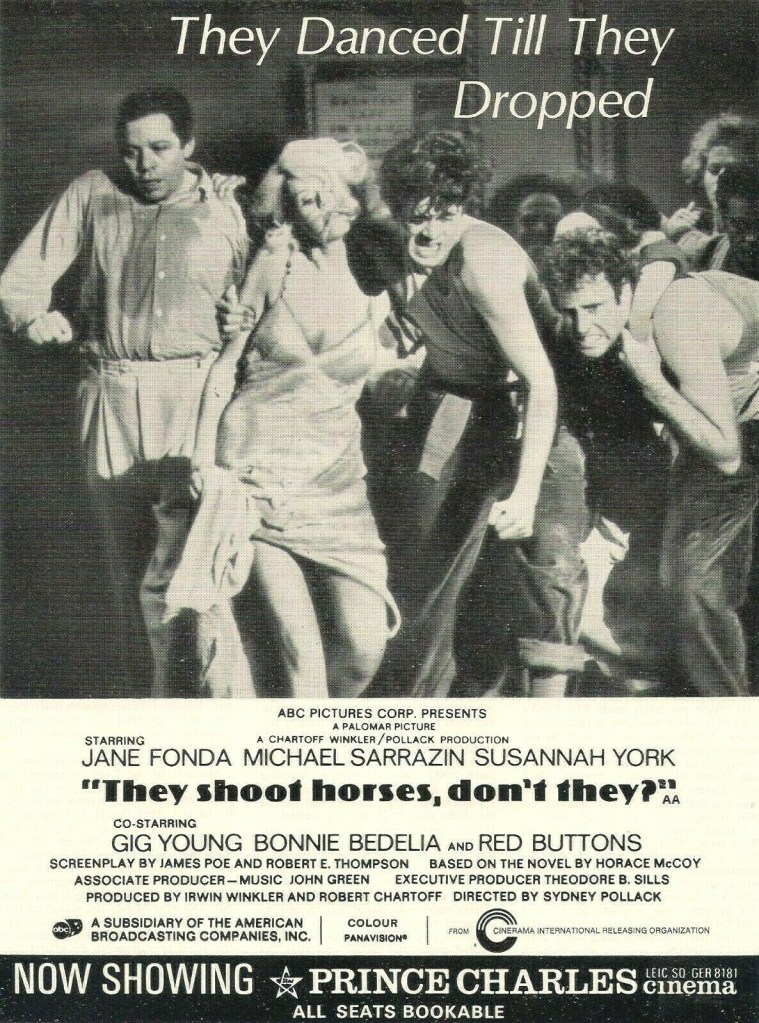
They Shoot Horses, Don’t They (1969) *****

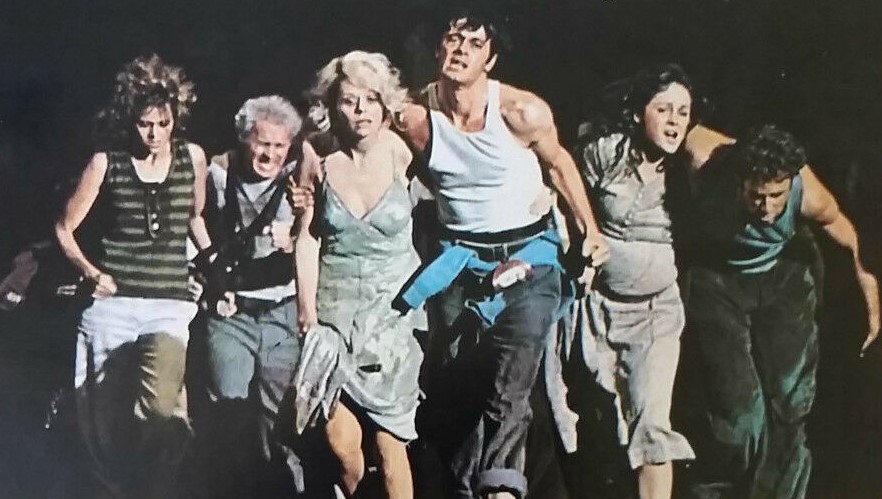
Fans of reality television shows will be only too aware how participants volunteer for ritual humiliation, but swallowing a few locusts and being stuck with a couple of snakes has nothing on the realities facing individuals during the Great Depression who would literally dance non-stop for days on end with a ten-minute break every two hours. It’s impossible to imagine that anybody could think of dreaming up such a degrading circus to take advantage of the desperate. But then this is America, land of opportunity and the MC Rocky  (Gig Young) continues to spout aphorisms and continues to promote the American Dream even as it disintegrates in front of him.

When the partner of Gloria (Jane Fonda), out-of-work actress and one of the more physical and cynical of the candidates hoping to scoop the $1,500 first prize (no prizes for coming second, of course), is ruled out through bronchitis – in case he passes it on to others rather than more any humane consideration – she pairs up with dreamer Robert who initially wanders in as spectator rather than participant. Glamorous platinum blonde aspiring actress Alice (Susannah York) is already coming apart. Sailor (Red Buttons) is a former war hero and James (Bruce Dern) drags his heavily pregnant wife (Bonnie Bedelia) around the dance floor.

There is not a great deal of story except to watch everyone grow mentally and physically incapacitated. There is betrayal and lust and survival instinct leads characters into sexual situations. When Alice seduces Robert, in retaliation Gloria dumps him and then has sex with Rocky, while attempting to retain control of that situation, but clearly needing at the very least consolation and confirmation of her attractiveness and at best some sign of favoritism.

As well as non-stop dancing, Rocky throws in stunts to keep the audience, who can sponsor a pair, interested. So there are 10-minute races, the last three to be eliminated. So determined are some of the competitors they will even lug their dead partner over the finishing line. Another of Rocky’s wheezes is to have Gloria and Robert marry, worth $200 in terms of the gifts they will receive from a sentimental audience, in the middle of the dance floor.

They are literally dancing for hours, over 1,000 in over 40 days so gradually the dance floor becomes less crowded as dancers collapse from exhaustion or cannot take it anymore. The spectators, we are reminded, are only there because “they want to see someone worse than them.” Just when you think nothing can shock you any more, it is revealed that the first prize is minus the cost of feeding, sheltering and looking after the winner.

Those who think they are tough find that the demands of mental and physical endurance are beyond them. This is a shocking film and there’s no doubt it will stay with you for a long time. I saw it first when it came out but not again until now and thank goodness for forgetfulness otherwise I doubt if I would have chosen to sit through it again.

It’s doubtful if any actress had achieved such a speedy transition from glamorous leading lady to serious actress as Jane Fonda. From stripping in space in Barbarella (1968) to stripping away the last vestiges of her humanity here. Suddenly, she appears in a brand-new screen persona with the grating voice, the chip on the shoulder, the feistiness and worthy inheritor of father Henry’s acting genes. It’s also a bold role for Susannah York, in an extension of the weak character she essayed in Sands of the Kalahari (1965) but far more delusional, believing in a rainbow that will never appear. Michael Sarrazin (In Search of Gregory, 1969) initially appears out of his league but his character calls for a gentle innocence that is well within his scope.

Gig Young steals the picture, offered the opportunity to bring alive a multi-faceted character, as big a spiel-merchant who ever crossed the screen, but engaging in a marathon of optimism, and at some points, such as when coaxing a demented Alice out of the shower, earning our sympathy.  Red Buttons (Stagecoach, 1966), Bruce Dern (Castle Keep, 1969) and Bonnie Bedelia (Die Hard, 1988) also put in sterling work.

The movie received nine Oscar nominations but was ignored in the Best Picture category. Only Gig Young won for Best Supporting Actor.  Jane Fonda and Susannah York both received their first Oscar nominations, for Fonda the first of many, for York the one and only. It was also a debut nomination for Pollack, a future winner.

Sydney Pollack directs with simplicity, concentrating on the indignities of the event and focusing mostly on the personalities draining away, and even the drama is undercut, most of those scenes directed in straightforward style. However, Pollack plays around with the innovative fast forward – flashes into scenes that have not yet taken place. James Poe (Lilies of the Field, 1963), at one time down to direct, and Robert E. Thompson, a television writer making his first venture on the big screen, wrote the screenplay from the Horace McCoy novel.

Check out the Behind the Scenes article on this one.

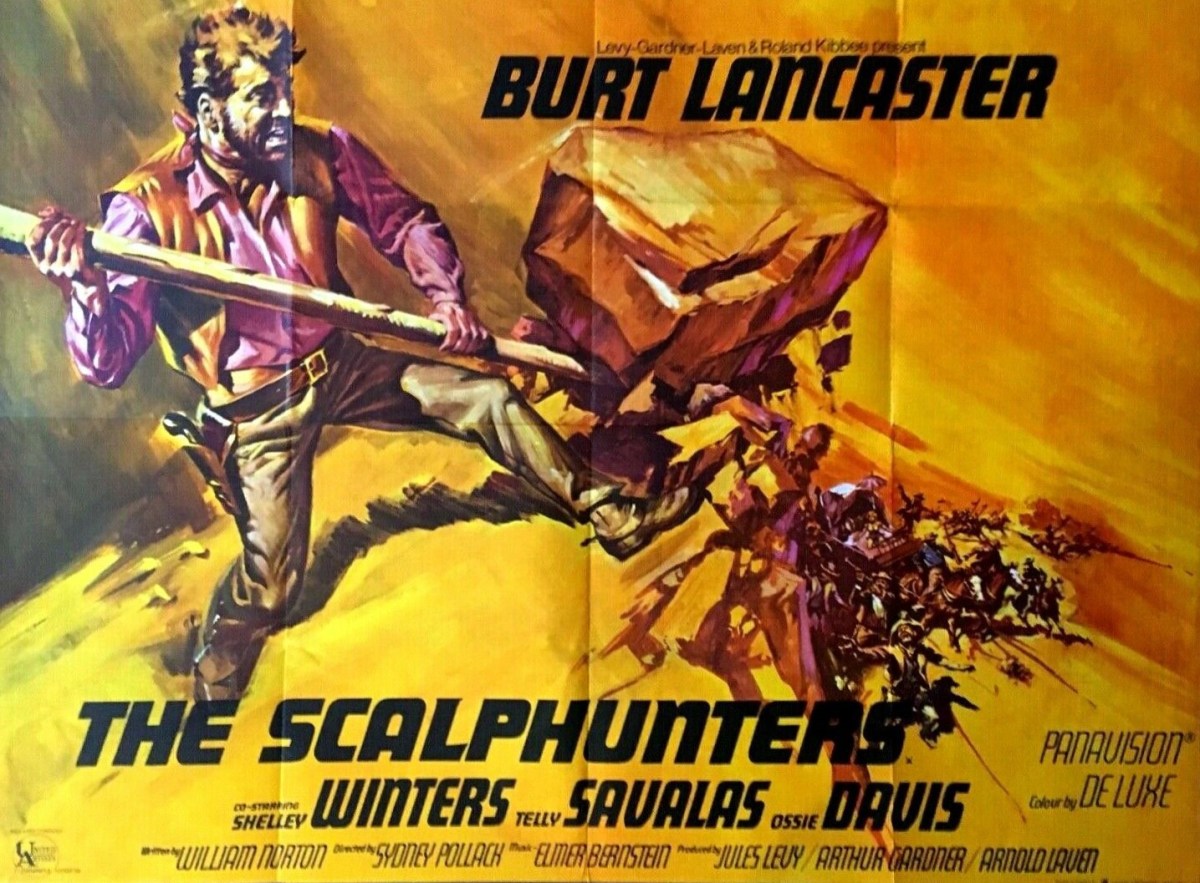
The Scalphunters (1968) ****

If ever a film deserves reassessment, this is it. This western, marketed as a vehicle for Burt Lancaster in the wake of hugely successful The Professionals (1966), sees the star playing  cussed trapper Joe Bass trying to retrieve furs stolen first by Native Americans and then by outlaws. That the serious race issues tackled here were dressed up in very broad comedy and typical western action ensured it missed out on the kind of recognition that critics would assign a straightforward drama and lost its rightful place as a pivotal picture of the decade.

In theory, a somewhat unusual Burt Lancaster western. In reality something else entirely. For large chunks of the movie Lancaster is absent as the story follows the fortunes of Black slave Joseph Lee (Ossie Davis) as he achieves not just freedom but genuine equality. Joseph is introduced as a slave of the Kiowa, left behind when the Indians steal Joe Bass’s furs. In compensation for his loss, Bass plans to sell Lee in the slave market in St Louis and in the meantime enrols him to help recover his furs.

However, a band of outlaws, specializing in collecting Native American scalps (hence the title) and selling them at $25 a time, get to the furs first as a by-product of a raid on the Kiowas. In pursuit with Bass, Lee falls into a river at the outlaw encampment and becomes the slave of Jim Howie (Telly Savalas) who also aims to sell him. Lee plans to escape until discovering Howie’s large troop is headed for Mexico where the slave would automatically become free. With clever talk, beauty-treatment skills and knowledge of astrology and ecology, Lee insinuates himself into the wagon of Howie’s paramour Kate (Shelley Winters).

With Bass still in pursuit, there are several excellent action scenes as the outnumbered trapper seeks to outwit Howie who turns out to be just as devious. But the main question is not whether Bass will recover his stolen property but which side will Lee pick. Will he act as spy to help Bass get back his furs or will he disown Bass and remain with the murderous genocidal gang who could provide a prospct of freedom? Either in the company of Bass or Howie, he is constantly reminded of his status, taking a beating from one of Howie’s thugs, Bass refusing to share his whisky because he views him not just as a slave who “picked his master” but as a coward refusing to fight back when attacked and beaten up.

The film comes to a very surprising ending but by that time through his own actions Lee is accepted as an equal by Bass and the issue of slavery dissolved. In effect, it is a tale of self-determination. Lee effects liberty by taking advantage of situations and standing up for his own cause.

Lee is one of the most interesting characters to appear on the western scene for a long time. Exactly where he acquired his education is unclear and equally hazy are how – and from where – he escaped and how he ended up as slave of the Commanches before they traded him to the Kiowa. However he came to be in the thick of the story, his tale is by far the most original. But he’s not the only original. The fearless Bass was an early ecological warrior with an intimate understanding of living off the wild, not in normal genre fashion of killing anything that moves, but in knowing how to find sustenance from plants. That in itself would endear him to modern lovers of alternative lifestyles.

Normally the derogatory term “scalphunters” would be reference to Native Americans, but here it is American Americans who exploit this market. Despite being the leader of a vicious bunch, Howie turns out to be a bit of a romantic and Kate a bit more interested in the world than your average female sidekick.

Director Sydney Pollack (The Slender Thread, 1965) does a marvelous job not just in fulfilling action expectations and taking widescreen advantage of the locations but in allowing Lee to take center stage when, technically, according to the credits, Ossie Davis was only the fourth most important member of the cast. Burt Lancaster was approaching an acting peak, following this with The Swimmer (1968) and Castle Keep (1969), happy to take risks on all three pictures, especially here where for most of the movie he is outwitted and ends up in a mud bath.

Both Telly Savalas (Sol Madrid, 1968) and Shelley Winters (A House Is Not a Home, 1964) rein in their normal more exuberant personas.  Savalas, in particular, cleaves closer to his straightforward work in The Slender Thread than the over-the-top performance of The Dirty Dozen (1967). Winters, usually feisty, is here more winsome and vulnerable, apt to be taken in by sweet-talking men.

But Ossie Davis (The Hill, 1965) is the standout, his repartee spot-on. It is a hugely rounded performance, one minute wheedling, the next sly, boldness and cowardice blood brothers, and while his brainpower gives him the advantage over all the others he is only too aware that such superiority counts for nothing while he remains a slave.

It’s dialog rich and it’s a shame it wasn’t a big hit for that would have surely triggered a sequel – especially in the wake of the following year’s buddy-movie Butch Cassidy and the Sundance Kid – because the banter between Lee and Bass is priceless. For the dialog thank the original screenplay by future convicted gun-runner William W. Norton (Brannigan, 1975), father of director Bill Norton (Cisco Pike, 1971).

Go see.

The Slender Thread (1965) ****

Hollywood paranoia in the 1970s ensured that any type of electronic surveillance was treated with suspicion. Cops, too, were almost certain to be corrupt. Although he would subscribe to such paranoia and implicit corruption in Three Days of the Condor (1973), in his movie debut director Sydney Pollack turns these concepts on their head.

Crisis center volunteer Alan (Sidney Poitier) faces a battle against time to save potential suicide Inga (Anne Bancroft), using his own powers of empathy and persuasion, but helped more than a little by dedicated policemen and the system of tracking calls. On the one hand the ticking clock ensures tension remains high, on the other Alan own’s battle with his nascent abilities brings a high level of anxiety to the proceedings especially as we learn of the particular circumstances driving Inge.

Alan is studying to be a doctor and he carries within him the arrogance of his profession, namely the power to cure. But that is within the realms of the physical. When it comes to dealing with the mental side of a patient he discovers he is ill-equipped. The intimacy he strikes up with Inga ensures he cannot seek relieve by handing over the problem to anyone else, the fear being that the minute he introduces another voice the spell will be broken. His medical training means only that he knows far better than a layman the effect of the pills the woman has taken and can accurately surmise how long she has to live. In the process he experiences a wide range of emotions from caring and sympathetic to angry and frustrated.

By sheer accident Inga’s otherwise loving husband, Mark (Steven Hill), skipper of a fishing vessel, has discovered that their son is not his. On being rejected, she has nothing to live for.

The simple plotline is incredibly effective. The two main characters never meet but we discover something of Inga’s life through flashbacks as her life gradually unravels and elements of insanity creep in. Alan, meanwhile, is shut in a room, relying on feedback from colleagues such as psychiatrist Dr Coburn (Telly Savalas) and others monitoring the police investigation attempting to discover where she is. 

The fact that there actually was a suicide crisis center operating in Seattle (where the film is set) will have come as news to the bulk of the audience for whom suicide was a taboo subject and virtually never discussed in public or in the media. The fact that the telephone network could be used so effectively to trace calls would not have been such a surprise since it was an ingredient of previous cop movies, but it had never been so realistically portrayed as here, results never instant but the  consequence  of dogged work.

Initially, the movie treats Seattle as an interesting location with aerial shots over the credits and other scenes on the shore or seafront, but gradually the picture withdraws into itself, the city masked in darkness and the principals locked in their respective rooms.

Sidney Poitier is superb, having to contain his emotions as he tries to deal with a confused woman, at various times thinking he is over the worst only to discover that he is making little headway and if the movie had gone on for another fifteen minutes might have reflected how impotent he had actually been. Anne Bancroft (The Pumpkin Eater, 1964) matches him in excellence, in a role that charts her disintegration.

The fact that their character never met and that their conversations were conducted entirely by telephone says a lot about their skills as actors in conveying emotion without being in the same room as the person with whom they are trying to communicate. Telly Savalas (The Dirty Dozen, 1967) delivers a quieter performance than you might expect were you accustomed to his screen tics and flourishes. Ed Asner (The Venetian Affair, 1966) and Steven Hill, in his last film for 15 years, are effective.

The bold decision to film in black-and-white pays off, ensuring there is no color to divert the eye, and that dialog, rather than costumes or scenery, dominates. Pollack allows two consummate actors to do their stuff while toning down all other performances, so that background does not detract from foreground.

Winning the Oscar for Lilies of the Field (1963) had not turned Sidney Poitier into a leading man and in fact he took second billing, each time to Richard Widmark, in his next two pictures.  Anne Bancroft was in similar situation after being named Best Actress for The Miracle Worker (1962) and although she took top billing in The Pumpkin Eater (1964) it was her first film after her triumph and, besides, had been made in Britain. And for both 1967 would be when they were both elevated to proper box office stardom. Written by Stirling Silliphant (In the Heat of the Night, 1967) based on a newspaper article by Shana Alexander.

Given the greater awareness of suicide today, this will strike a contemporary chord.

As the High Noon of the psychological thriller this more than delivers. Gripping stuff. And it’s worth considering the courage required to undertake such subject matter for your first movie.

o

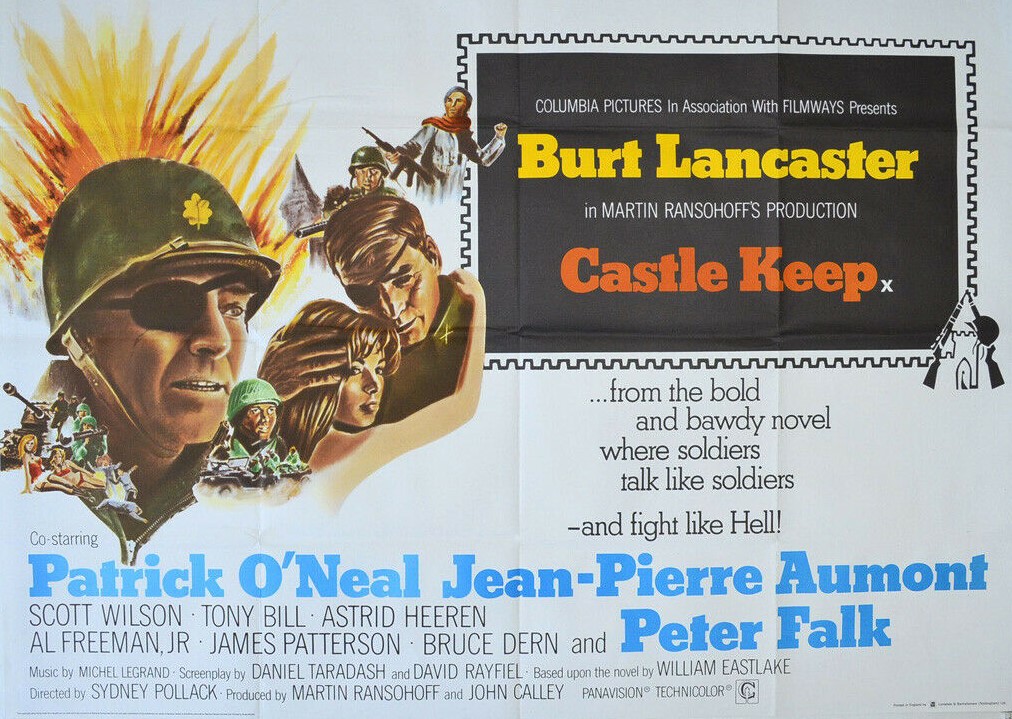
Castle Keep (1969) ****

A bit more directorial bombast and this could have matched Apocalypse Now (1979) in the surrealist war stakes. Never mind the odd incidents surrounding a small unit of G.I.s  taking over a magnificent Belgian castle towards the end of World War II prior to what turned out to be the Battle of the Bulge, this has on occasion such a dreamlike quality you wonder if it is all a figment of the imagination of one of the characters, wannabe writer Private Benjamin (Al Freeman Jr.). Throw in a stunning image, for the beleaguered soldiers at the start, of a horsewoman charging by in a yellow cloak, so out of place that it carries as much visual impact as the unicorn in Blade Runner (1982), and we are in definite cult territory.

One of the unusual elements is that, in this unexpected respite from battle, the soldiers are defined by character traits rather than dialogue or bravery as would be the norm. This ranges from baker Sergeant Rossi (Peter Falk) taking over the boulangerie and bedding the baker’s wife (Olga Bisera), mechanic Corporal Clearboy (Scott Wilson) diving into a lake to rescue a Volkswagen and the troops receiving a lecture on art history from Captain Beckman (Patrick O’Neal).

Commander Major Falconer (Burt Lancaster) is not only brilliant in the art of war, but calmly  mentors Beckman through a firefight with an enemy airplane, teaches local sex workers how to make Molotov cocktails and, evoking ancient aristocratic tradition, enjoys conjugal relations with the conquered countess (Astrid Heeren), whose impotent husband (Jean-Pierre Aumont) encourages the relationship since the castle needs an heir.  

There is wistful revelation, Beckman clearly hankering after his turn with the countess, a minister who wishes he had the courage to join the boys in the brothel, the young soldiers there being treated as children rather than customers. And there are juvenile pranks – moustaches are painted on statues, wine bottles used for ten-pin bowling practice.

But the surreal moments keep mounting up. The Volkwagen, though riddled with bullets, refuses to sink in the lake, a hidden German reveals himself by playing the same tune on a flute as one of the soldiers. The countess often appears as an ethereal vision.

Through it all is rank realism. Falconer knows a German previously shared the countess’s bed. The count will do anything to safeguard his castle and maintain the family line, even to the extent of incest, since his wife is actually his niece. But above all, while his troops believe the war is at an end and enjoy the pleasures at hand, Major Falconer prepares for rearguard action by the Germans, filling the moat with gasoline, planning to pull up the drawbridge and control the high ground.

The battle, when it comes, is vivid and brutal, the initial skirmish a hand-to-hand battle in the village before the Germans begin their siege of the castle.

Burt Lancaster (The Swimmer, 1968) is superb, far removed from his normal aggressive or athletic persona, slipping with pragmatic ease from the countess’s bed to battle stations. War films in the 1960s were full of great individual conflicts often won on a twist of ingenious strategy but seldom have we encountered a soldier like Falconer who knows every detail of war, from where and how the enemy will approach, to the details of the range of weaponry, and knows that shooting dead four soldiers from a German scouting mission still leaves one man unaccounted for.

Patrick O’Neal (Alvarez Kelly, 1966) also leaves behind his usual steely-eyed screen persona, here essaying a somewhat timid and thoughtful character. Peter Falk’s (Machine Gun McCain, 1969) baker is a beauty, a man who abandons war, if only temporarily, for a second “home,” baking bread, adopting a wife and child. In a rare major Hollywood outing French actor Jean-Pierre Aumont (Five Miles to Midnight, 1962) carries off a difficult role as a count willing to accept the humiliation of being cuckolded if it improves his chances of an heir. In one of only four screen appearances German actress Astrid Heeren (The Thomas Crown Affair, 1968) makes the transition from a woman going to bed with whoever offers the greatest chance of saving the beloved castle to one gently falling in love.

There is an excellent supporting cast. Bruce Dern (Support Your Local Sheriff, 1969) makes the most of a standout role as a conscientious objector.  You will also find Scott Wilson (In Cold Blood, 1967), Al Freeman Jr. (The Detective, 1968), future director Tony Bill (Ice Station Zebra, 1968) and Michael Conrad (Sol Madrid / The Heroin Gang, 1968).

Two top-name writers converted William Eastlake’s novel into a screenplay – Oscar-winning Daniel Taradash (Hawaii, 1966) and newcomer David Rayfiel who would work with Lancaster again on Valdez Is Coming (1971) and with Pollack on Three Days of the Condor (1973) and Havana (1990)

Sydney Pollack (This Property Is Condemned, 1966), who had teamed up with Lancaster on western The Scalphunters, 1968), does a terrific job of marshalling the material, casting an hypnotic spell in pulling this tantalising picture together, giving characters space and producing some wonderful images, but more especially for having the courage to leave it all hanging between fantasy and reality.

Expressions like  “we have been here before,” “once upon a time,” “the supernatural” and “a thousand years old” take solid root as the narrative develops and will likely keep spinning in your mind as you try to work out what it’s all about.

Behind the Scenes: Edward Zwick Uncensored

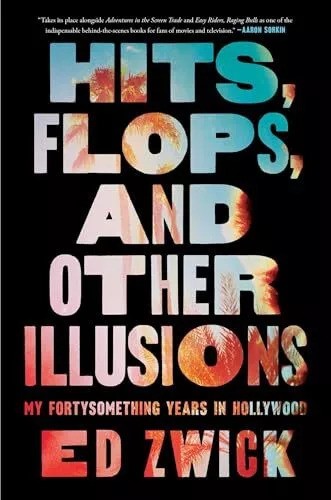
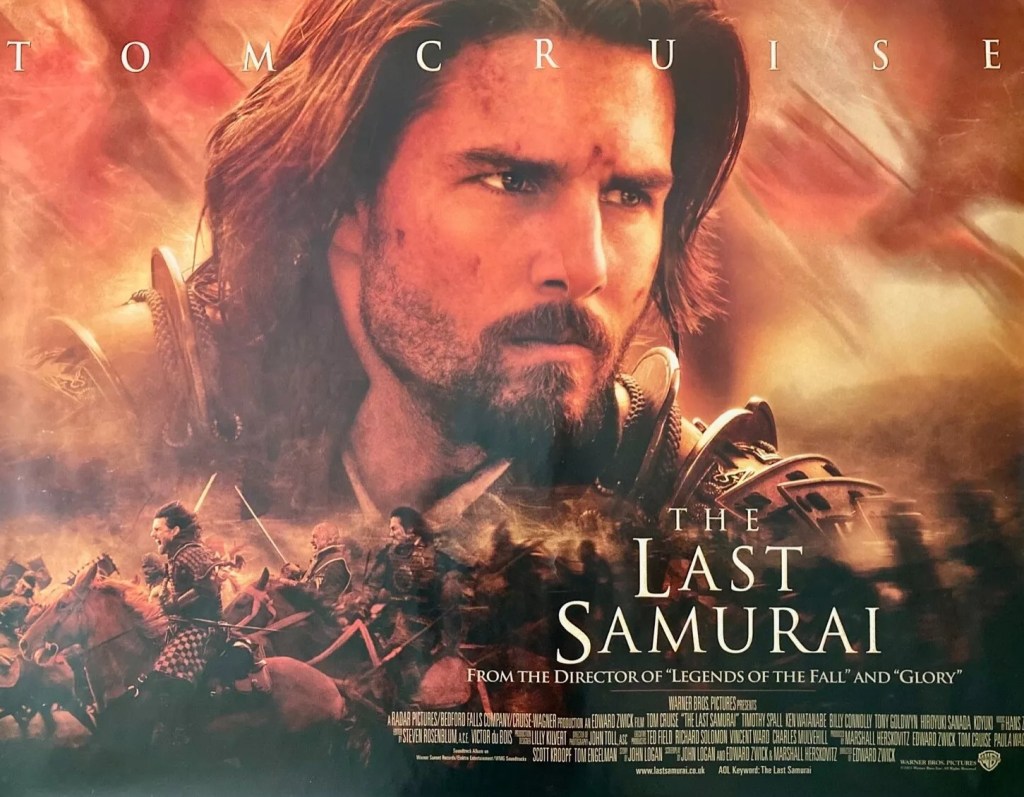
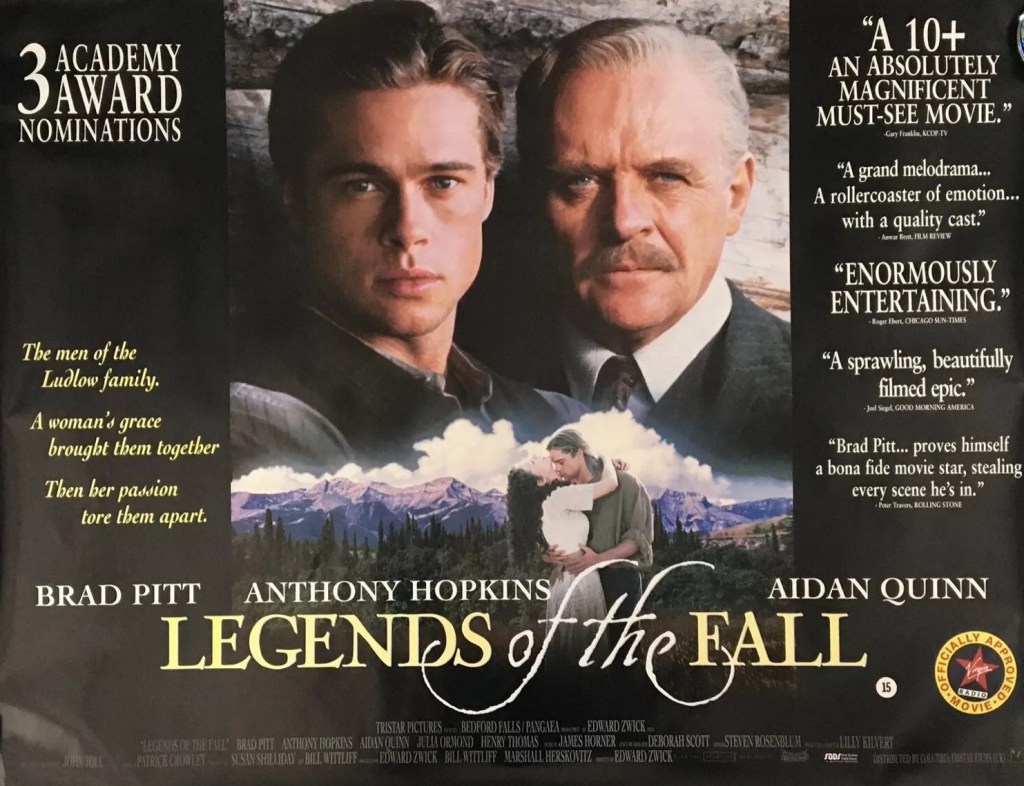
“I will never forget how casually Maria (Schneider of Last Tango in Paris fame) unbuttoned Joey’s shirt to hold her breast in one hand while eating a bagel with the other,” is just one of the memorable lines in director Ed Zwick’s (of Glory fame) memoir,  a very candid portrait of working in Hollywood. Glamor and grit ride side by side as he goes from being a celebrity-struck newcomer to dragging tears out of Harvey Weinstein, hearing all about Julia Roberts’s love life, endless battles on set with Brad Pitt, being offered a beer by Paul Newman in the star’s house and digging into the untapped emotional reservoir of Tom Cruise.

His mentor, director Sydney Pollack, allowed Zwick to observe as he prepped Out of Africa (1985). Pollack had a complicated relationship with Robert Redford. The star “was infallibly late.” Opposite personalities. Pollack was “voluble, excitable and punctilious” while Redford was “taciturn, laconic and laid-back.” Dealing with a proper star can be disconcerting. Asked what it was like to direct Barbra Streisand in A Star Is Born (1976), Frank Pierson said, “I wouldn’t know.”

Pollack offered Zwick sound advice about screenwriting. “Plot is the rotting meat the burglar throws to the dogs so he can climb over the fence and get the jewels, which are the characters.” Zwick’s first script, with writing partner Marshall Herskowitz, for Tri-Star, was a drama, Drawing Fire, about a Secret Service agent’s relationship with a corrupt cop. Dustin Hoffman wanted to play the lead. In conversation, Hoffman took “damn long to get to the point.” His involvement collapsed over his fee.

Jonathan Demme was originally slated for About Last Night (1986), an adaptation of David Mamet’s play Sexual Perversity in Chicago. When he pulled out, Zwick got the gig. If stars Rob Lowe and Demi Moore seemed very comfortable with the intimate scenes, that was because they had previously been an item. The movie did surprisingly well.

For a follow-up, Zwick passed on Thelma and Louise (1991) in favor of a different road picture, Leaving Normal (1992), originally set to star Cher and Holly Hunter. Jessica Lange entered the frame when Cher dropped out. After Hunter quit, Zwick signed up Christine Lahti and Meg Tilly. The picture bombed.

Next up was Shakespeare in Love with a script by Marc Norman and Tom Stoppard to star Julia Roberts who, as it happened, couldn’t help falling in love with her co-stars, that included by now Kiefer Sutherland, Dylan McDermott and Liam Neeson. To play William Shakespeare, she wanted Daniel Day-Lewis, sending him a card that said, “Be My Romeo,” but he was already committed to My Left Foot. Casting for her co-star was cancelled while she maintained that, actually, Day-Lewis had agreed. Only, when Zwick contacted him, that turned out to be fantasy.

With casting renewed, Zwick and Roberts saw, among others, Ralph Fiennes, Russell Crowe. Hugh Grant, Colin Firth and Sean Bean. But none clicked with the star, although oddly enough she later teamed with Grant in Notting Hill (1999). It could conceivably have gone ahead with Paul McGann. A full screen test was arranged. However, it was obvious at that point that Roberts hadn’t nailed her English accent. She quit, leaving Universal $6 million out of pocket.

The movie remained in cold storage for two years. Then Harvey Weinstein came calling. But not at the price Universal demanded. For the next few years, Zwick kept trying to interest actors with the requisite marquee heft such as Kenneth Branagh, Winona Ryder, Jude Law, even Mel Gibson and Johnny Depp. By coincidence, Ryder was best buds with Gwyneth Paltrow and showed her the script. Since Paltrow was Weinstein’s go-to actress, she convinced the producer to come back in. But the consequence of that was that Zwick was pushed out. Or so Weinstein believed, until he was sued. Which meant that when the movie was awarded Best Picture at the Oscars Zwick was on the stage.

Comments Zwick wryly, “ As I stand there…listening to Harvey’s prepared, saccharine, self-serving acceptance, it occurs to me to shove him over the edge of the stage into the orchestra pit. Faced with the choice of committing an act of violence before a worldwide audience of 100 million movie fans or false modesty, I make the wrong choice.”

Alvin Sargent (Paper Moon, 1973) signed up for a “hefty fee” to adapt Jim Harrison’s novella Legends of the Fall (1994). Not only was he “maddeningly slow” but after a year’s work he “hadn’t been able to figure out how to do it.” William D. Wittliff (Country, 1984) was next to take a crack before Zwick called on Marshall Hershowitz’s wife Susan Shilliday – who had been story consultant and story editor on Zwick’s television show thirtysomething – to do a rewrite. Tom Cruise and Robert Duvall were briefly interested. Brad Pitt rode to the rescue.

“It’s not enough,” muses Zwick, “that a movie star be handsome; good-looking actors are a dime a dozen. And it’s not just the way the light and shadow plays on someone’s bone structure. It’s the unmistakeable thing behind their eyes, suggesting a fascinating inner life. We don’t know what’s going on inside their heads, but we definitely want to and that’s enough.”

Pre-production Tri-Star got cold feet and demanded Zwick knock $2 million off the budget. Instead, the director and Pitt halved their fees in exchange for a bigger backend. Four weeks before shooting was due to commence, they were short of a female lead, though Paltrow, among others, had read for the part, ending up with relative newcomer Julia Ormond (The Baby of Macon, 1993). Days before shooting, Pitt quit. Or tried to. He could go as long as he paid all the costs of preparation. So Pitt remained. After two weeks of shooting, Zwick was $1 million over budget, largely due to costume issues.

“There are all sorts of reasons an actor will pick a fight,” notes Zwick, and he had more than his fair share of them with Pitt. Although the movie’s resultant commercial success doubled both their salaries, they didn’t talk for a year – and never worked together again.

Denzel Washington didn’t want to do Courage under Fire (1996) until Zwick introduced the idea of Post Traumatic Stress Disorder, a new idea at the time. Matt Damon really did almost fall out of a helicopter. As Washington and Damon did a scene together “it was as if a spell had been cast over the set,” all watching the birth of new screen great. Screen improvisation isn’t all about fashioning new lines. It’s about an actor finding “emotion in an authentic way.” For the scene where Washington returns home, Zwick placed a bike along the walkway. Washington’s reaction to this unexpected obstacle was to pick it up and set it upright.

Tom Cruise originally passed on the John Logan script for The Last Samurai (2003) that Zwick felt was “still uncooked.” Uncooked or not, Russell Crowe, incidentally, was interested  in the Japanese lead. Zwick did a rewrite. Cruise liked the rewrite. “What struck me most as I got to know him was his insatiable appetite to keep improving.” Cruise was one of the actors whose involvement was an automatic green light for a studio. After completing another draft with  Hershowitz, Zwick got a call to go see Robert Towne (Chinatown, 1973). He went in dread. Towne “had an informal arrangement with Tom whereby he sometimes quietly rewrote his movies.” Instead of confrontation, Towne was encouraging. “Apparently, he just wanted to take my measure.”

There’s an animatronic horse – costing a million bucks – that appears for a few seconds in The Last Samurai in order for it to appear to the audience that in fact a horse was falling on Tom Cruise for a scene that would not have been possible, in the days before CGI, just with a stuntman. Zwick’s biggest problem on the picture was how to puncture Cruise’s self-assurance, get him to the “right emotional place…to touch some vulnerable part in him.” Zwick realized that simply asking the actor to go deeper wouldn’t work. It would look forced.

So just before shooting the critical scene, Zwick asked Cruise about his eight-year-old son, Connor. “I watched as he looked inward, and a window seemed to open and his eyes softened.” Zwick gently nudged him into position. “Go.”

Movie fans often wonder how a director gets into the movies. Usually, each tale is as odd as the last, a lucky break, meeting the right studio executive at the right time, coming across a studio hungry for your type of picture just at the ideal moment. Zwick has an odd an introduction. Living in Paris on a fellowship to observe experimental theater, he managed to creep onto the set of Love and Death (1975) and pepper Woody Allen with questions and he had a sneak preview of the Annie Hall (1977) script.

On returning to the U.S., he was accepted onto the American Film Institute’s director program. There were 26 pupils in the class, Zwick was one of six invited back for a second year. There, he struck up a lifelong friendship with Marshall Hershowitz. While studying, he read 10 scripts a week for United Artists, fell in with a merry band of more experienced Hollywood hands including Paul Schrader, Michael and Julia Phillips and Oliver Stone. After an improbable series of coincidences, he got  was employed as story editor for the tv series Family (1976-1980). Still aiming for a movie slot, he watched in horror as David Puttnam (Chariots of Fire, 1981) lasted for only six minutes of a private screening of Zwick’s 30-minute student film.

There’s not one of Zwick’s movies where he doesn’t regale you with an interesting anecdote about a star. More importantly, he provides insights into how movies are made, often touching on details that would not be obvious to anyone outside the business.

Ed Zwick, Hits, Flops and Other Illusions, My Fortysomething Years in Hollywood (Gallery Books) is available in print and kindle.

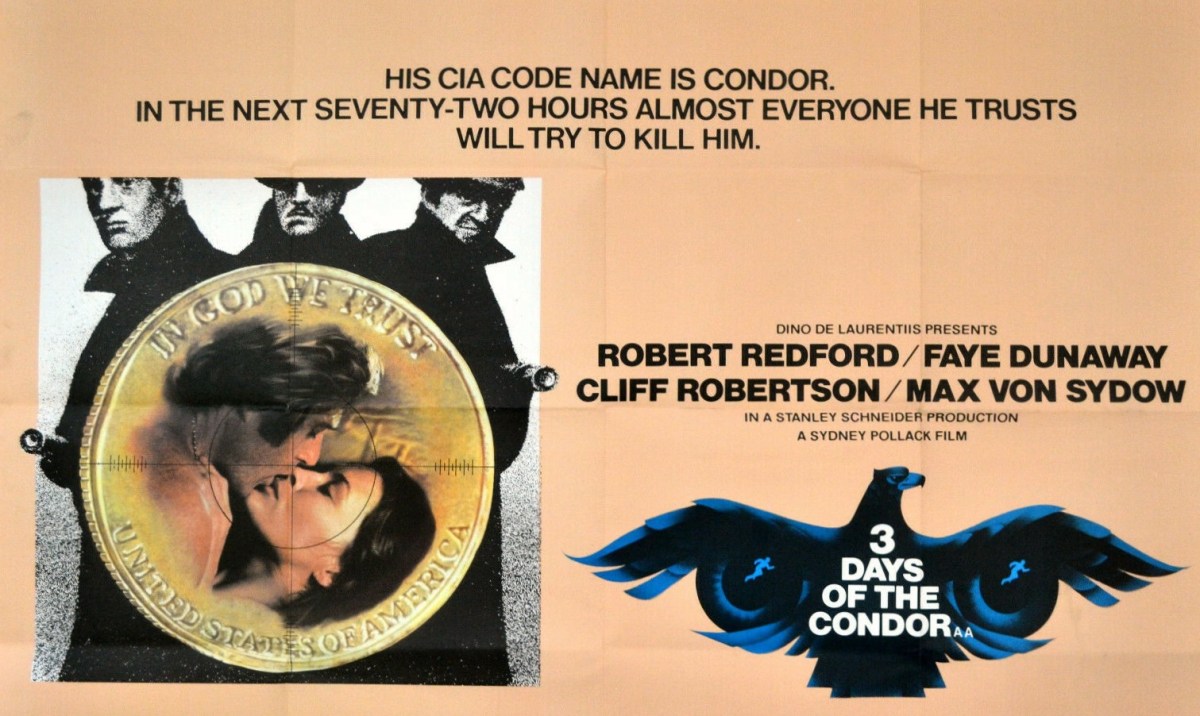
Three Days of the Condor (1975) *****

Outstanding thriller in the paranoia vein with Robert Redford delivering one of his best performances. Never mind the terrific score by Dave Grusin (Tell them Willie Boy Is Here, 1969), the soundtrack to this tale of political chicanery involving the C.I.A. is the chattering of computer printers.

Joe Turner (Robert Redford) is an amiable geek – beanie hat, unfashionable Solex moped – working in an obscure department of the C.I.A. (although one where the receptionist has a gun in her desk drawer) looking for codes in novels. He doesn’t quite conform to type, irritating his rules-conscious colleagues, late for work, illicitly using the back door instead of the front. On returning from collecting lunch, he finds the entire department massacred. His  Washington boss Higgins (Cliff Robertson) promises to bring him in but instead arranges an ambush.
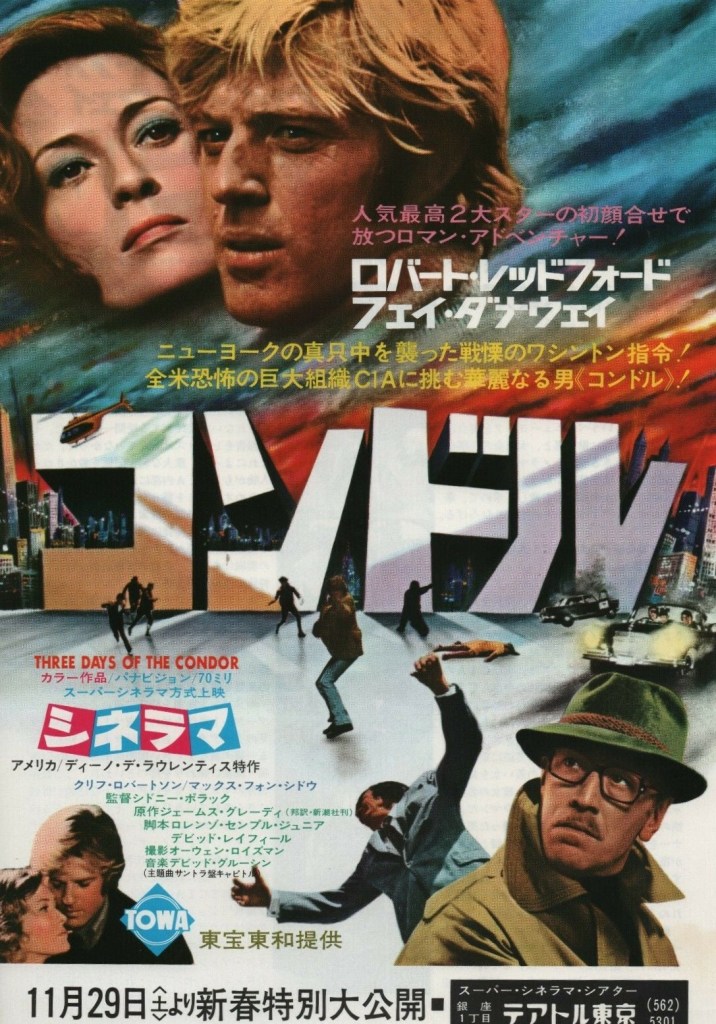
On the run, unable to return to his own apartment, his girlfriend Janice (Tina Chen) among those murdered, he kidnaps photographer Kathy (Faye Dunawaye) at first content to find somewhere to hole up but then using her to help him resolve the issues. It’s soon apparent  that Turner, in his desk job, has stumbled upon a secret organisation deep within the C.I.A. In a touch of the Hitchcocks, director Sydney Pollack (The Scalphunters, 1968) lets the audience know what Turner does not, that Higgins and his bosses Wabash (John Houseman) and Atwood (Addison Powell) are out for his blood, assassin Joubert (Max von Sydow) the triggerman.  

But as Joubert points out, Turner is an amateur and that makes him unpredictable. The killers believe Turner will easily be dealt with. But he’s not as stupid or unresourceful as they might expect. The opening section reveals just how handy he is: fixing a computer, knowledgeable about plants and for some reason the weather, working out an insoluble murder in a book, and most important of all has learned to trust nobody especially his bosses. It turns out he’s got a few of his own tricks up his sleeve, not least how to work a telephone exchange to his advantage and how to flush out his adversaries.

There’s a terrific game of cat-and-mouse and in possibly the only picture in the early cycle of conspiracy pictures the first character capable of harnessing technology.

You often read about character-driven movies but that’s only usually in the sense of dramatic flaws or preferring exploring personality to action. This is character-driven in an entirely different way. Turner’s life depends on him being able to read character, to notice what’s wrong or false in a given situation, to assess the qualities of those around him. For much of the dialogue, Turner is observing as much as listening, watching for behavioural clues.

Even without the presence of Kathy, this would have been a highly satisfactory thriller. But the tentative romance takes it to another level. Unusually, she is a loner, whose photographic metier is loneliness. That they bond at all is surprising, that they do so with such touching emotion brings unexpected intimacy.

There’s a very contemporary feel to the politics, not just American authorities doing what they want but the idea that liberal values will vanish the moment there is genuine threat to loss of the high living standards citizens enjoy or, worse, oil or gas rationing or famine. “Do we have plans to invade the Middle East?” Turner demands of Higgins. And at one point Turner uses unsuspecting people as a human shield.

For such a fast-moving picture, time is taken out to understand the characters involved, Higgins not quite as far up the espionage tree as he should be, Joubert’s hobby the meticulous painting of model soldiers. A peck on the cheek is all the information we are given that Tina, a work colleague, is Turner’s girlfriend.  

As Kathy moves from indignant captive to welcome participant, you can see that she represents the desire of many liberals to give the authorities a bloody nose. There is one brilliant moment at the end where Turner’s fears overcome his feelings and the devastation of what she perceives as emotional betrayal is seen on her face.

But this is Robert Redford’s picture. He was on an almighty box office roll – Jeremiah Johnson (1972), The Sting (1973), The Way We Were (1973), The Great Gatsby (1974), The Great Waldo Pepper (1975) and on the horizon All the President’s Men (1976). Every minute of the movie his face or body are working hard, eyes constantly involved in the character observation I mentioned. He goes from being light-hearted and handsome at the start to serious and deadly at the end. And there are some superb bits of business. When the rain stops, for example, he checks his watch to see it has ended when he predicted. When he returns after lunch, he peers down over the steps to see that his moped that earlier some kids had tried to steal was still there.

This is probably the quietest you’ll ever see Faye Dunaway (A Place for Lovers, 1968). She is an enigma, the puzzle only uncovered in her photographs. But as a photographer, she is also an observer, and she soon likes what she sees in Turner. The strong supporting cast includes Cliff Robertson (Masquerade, 1965), Max von Sydow (The Quiller Memorandum, 1966), John Houseman (Seven Days in May, 1964), Tina Chen (Alice’s Restaurant, 1969) and Addison Powell (The Thomas Crown Affair, 1968).

Sydney Pollack does an exceptional job, cutting between the pursuers and the pursued. The opening sequence itself is quite superb as the director sets up the massacre which is carried out in silence, machine guns fitted with suppressors, while providing insight into Turner. Based on the bestseller Six Days of the Condor by James Grady, the intelligent screenplay by Lorenzo Semple Jr.(Fathom, 1967, and The Parallax View, 1974) and David Rayfiel (Castle Keep, 1969) keeps everyone on their toes.

More straightforwardly enjoyable than Coppola’s self-conscious The Conversation (1974) and Pakula’s occasionally opaque The Parallax View (1974) with computer surveillance, giving this another contemporary edge, a key factor in the way the tale that switches between pursued and pursuer
You can catch this on Netflix.  

Behind the Scenes: “They Shoot Horses, Don’t They” (1969)

Dream Team Number One: Clark Gable and Jean Harlow. This was of course a good 30 years before the movie actually got made. The Horace McCoy novel was purchased in 1935 by MGM as a big-budget project teaming Clark Gable and Jean Harlow. This was despite Variety proclaiming it was “not screen material.” The premature death of Harlow put paid to the idea. Next, actor Wallace Ford (Freaks, 1932) bought it with Broadway in mind. A production was scheduled to open in 1939, but never did.  

Dream Team Number Two: Charlie Chaplin and Marilyn Monroe. When the comedian purchased the rights in the early 1950s he intended Marilyn Monroe to play the leading female. Although she was a mere starlet Chaplin had form in building up newcomers. Author McCoy had by that point become an accomplished screenwriter with over 30 credits including Gentleman Jim (1942), film noir Kiss Tomorrow Goodbye (1950) and The Lusty Men (1952) That concept fell by the wayside when Chaplin was effectively banished from America while launching Limelight (1951) in Britain.

It was another 14 years before interest in the novel was revived by screenwriter James Poe, who purchased the rights from the McCoy estate. Although most famous within the trade for being accused of fraudulent behaviour in relation to his screenplay for Around the World in 80 Days (1956). Despite an Oscar for the film he was sued for $250,000. However, he had a sterling body of work including Cat on a Hot Tin Roof (1958), Sanctuary (1960), Lilies of the Field (1963), The Bedford Incident (1965) and Riot (1969) and two other Oscar nominations.

In 1965 he had signed a multi-picture writer-director deal with Columbia. He was either going to make his directorial on The Gambler or They Shoot Horses, Don’t They. It turned out to be the latter. Failing to get the movie off the ground with Columbia or under his own steam, he turned to new studio Palomar, which was a production entity set up by the ABC television network, which bought over his rights as well as his script but kept Poe on as director.

Dream Team Number Three: Faye Dunaway. Yep, one big star, not two. Poe’s screenplay, while not eliminating the male lead, spun on a female star. Dunaway, hot after Bonnie and Clyde (1967), was offered $600,000 to play the role. Mia Farrow was also in contention, for $500,000. The only problem was, the budget could not remotely stretch to that. As helmed by Poe, it was to cost no more than $900,000. The film was scheduled to begin shooting in spring 1968 but a month later the start date shifted to June.

Two relative newcomers Robert Chartoff and Irwin Winkler were brought in as producers to move the project along. Later they would be responsible for such classics as Rocky (1976), The Raging Bull (1980), The Wolf of Wall Street (2013) and The Irishman (2018), but at this point they had just three pictures under their belt, although that included Point Blank (1967), Their first task: persuade Poe to rewrite the script. They felt the third act needed work with restructuring elsewhere to make the pay-off work.

But Poe, believing his position was sacrosanct, refused to discuss a rewrite. He refused to discuss anything, period, treating the producers as his assistants rather than people with some power within the studio. According to Irwin Winkler, “Poe seemed unaware of the of the normal process of preparation, even though he’d been around movie sets for decades.”

Realising that getting a star on their budget was impossible, Chartoff and Winkler changed tack and talked to good actors, but even then few were interested. A less dramatic star than Jane Fonda you could not imagine, her resume filled with light comedies, French films that utilised her sexuality or the extravaganza that went by the name of Barbarella (1968). But the pregnant Fonda was keen on change. The film was delayed until after she had given birth. Michael Sarrazin should have been out of the equation. John Schlesinger had lined him up for the Jon Voigt role in Midnight Cowboy (1969) but Universal, to whom he was under contract, asked too much to send him out on loan.

With no sign of the rewrites, the producers became antsy about the director. However, they showed their true mettle as producers, convincing Palomar there was no way the original budget would cover the ballroom set, huge number of extras, live orchestra and salaries. It would need to at least triple.

In a picture of one predicament following another, there was one crisis the producers had not foreseen. They were going to be fired. Apart from anything else, they were only executives on the picture with any experience, it being not only Poe’s first movie but that of Chartoff and Winkler’s superiors at the studio. The outcome – the guy who had told the pair they were being fired was shown the door instead.

Susannah York was cast after the producers saw a sneak of The Killing of Sister George (1969) at the Robert Aldrich studios. She had committed to Peter O’Toole vehicle Country Dance/Brotherly Love (1970), written by her cousin James Kennaway (Tunes of Glory, 1960). After too many delays on They Shoot Horses she planned to pull out in favour of the other film. Although Sally Kellerman (Mash, 1970) was set as a last-minute replacement, the issue was resolved by asking MGM to delay the start on the rival picture.

Believing Poe was in no position to helm such a big-budget picture enterprise, Chartoff and Winkler began the process of removing him only for Jane Fonda to dig her heels in. She changed her mind after witnessing first-hand Poe’s directorial skills – or lack of them – when she took part in a screen test for Bonnie Bedelia. Winkler recollected, “On the set Jane asked Poe questions about the blocking of the scene, why she moves in one direction rather than another, why in front of a sofa rather than behind it etc. He couldn’t answer her questions and told her to talk to the cameraman.” Exit Poe.

In terms of a replacement, Chartoff and Winkler set their sights of Sydney Pollack (The Scalphunters, 1968) with whom they had previous dealings, and William Friedkin, then being hailed for The Homecoming (1968) – luckily The Night They Raided Minsky’s (1968) had yet to be released. But studio executives had a third director in mind, Jack Smight (No Way to Treat a Lady, 1968). Friedkin should have been in pole position, having only received $75,000 for The Homecoming. His agent, sensing an opportunity, demanded $200,000. Jack Smight’s agent also got greedy and wanted $250,000. Pollack’s agent was happy with the $150,000 on offer.

When Poe was eased out, filming was announced as beginning on February 17, 1969, the budget having now increased to $3.2 million – including $400,000 for extras. However, acoustic issues – seawater had eaten away the bottom of the pier – prevented use of the old Aragon ballroom in Santa Monica. That set was constructed on the Warner lot.

Pollack then turned it down. He had reservations about the script, which had still never been rewritten. When Robert E. Thompson, a television writer but “a Horace McCoy expert,” was mooted, Pollack changed his mind. The new script contained the “flash forward” scenes that prepared audiences for the shock ending. However, the new scenes and delays in starting increased the budget which now ballooned to $4.7 million.

It turned out the director was the best actor of all. “I was impressed with Sydney Pollack’s ease on the set,” recalled Irwin Winkler. “He never seemed to be working hard and yet was able to get marvelous performances out of the actors. Everybody in the company adored him.” Asked by Winkler how he remained so calm dealing with the actors and all the extras and the complicated camera set-ups, he replied, “it was really quite easy.” That same afternoon he collapsed on set and was diagnosed with “nervousness.”

The studio, the stars, the producers, all seemed confident about the picture. All they had to do was convince the audience. But at the first preview in San Francisco the audience roared with laugher at the climactic scene. That shocked the studio to the core until the producers were able to reassure the head honchos that the “fast forwards” would smooth over that problem. Which they did.

It was nominated for nine Oscars – Best Director, Best Screenplay, nods for Jane Fonda, Gig Young and Susannah York among others. Only Gig Young won.  

SOURCES: Irwin Winkler, A Life in Movies, (Abrams Press, New York, 2019) p34-47;  “Tough Stuff,” Variety, August 7, 1935, p59; “Ford Buys for B’Way,” Variety, September 11, 1939, p42; “Dance Marathon Reprise,” Variety, August 3, 1966, p24;  “IT&T In No Way Slowing Down Theatrical Feature Program of ABC,” Variety, January 10, 1968, p4; “Crowded Slate for Palomar,” Variety, February 28, 1968, p18; “Bob Evans Chips-Service To Writers As Stars At Paramount,” Variety, May 1, 1969, p19; “Jane Fonda Gets Top Role in Palomar’s Horses,” Box Office, July 22, 1968, pW1; “Palomar Horses on W7 Space,” Variety, October 23, 1968, p3; “Jan 6 Filming Date for They Shoot Horses,” Box Office, December 16, 1968, pW5; “Cheery Side of Delay on Horses,” Variety, January 15, 1969, p21; “Winkler Wants Films With Social Comment,” Box Office, January 19, 1970, pW1.

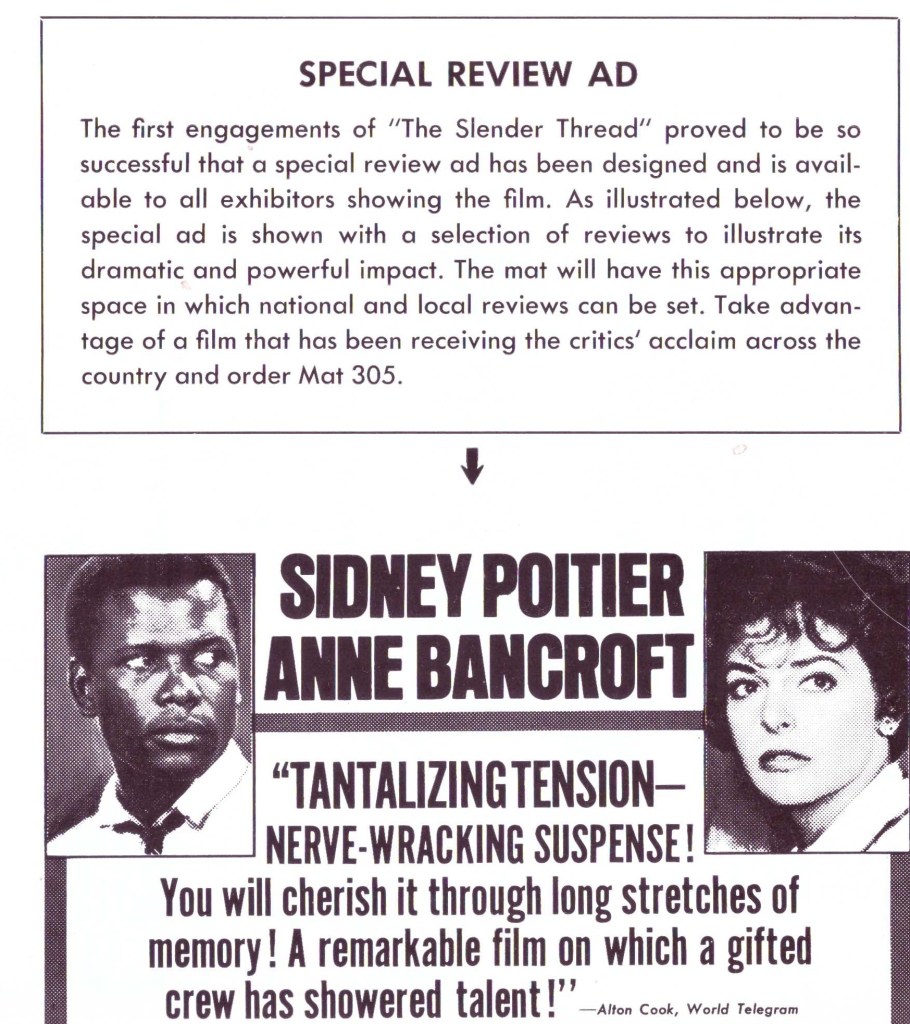
Selling Oscar Winners – Pressbook for “The Slender Thread” (1965)

Just how do you sell a movie about a suicide to an audience for whom such a subject is still taboo? The answer is – you don’t. Instead, you fall back on your stars – and the fact that they are both Oscar winners.

We are pretty used these days to advertising campaigns, especially trailers, focusing on Academy Award recognition – The House of Gucci (2021), for example, boasting umpteen winners and nominees – but it was far rarer in the 1960s when exhibitors expected Pressbooks to provide them with sufficient marketing information to lure in the customers. Oscar success might have been mentioned in passing, forming part of a participant’s biography, but it would not be the entire focal point of the campaign.

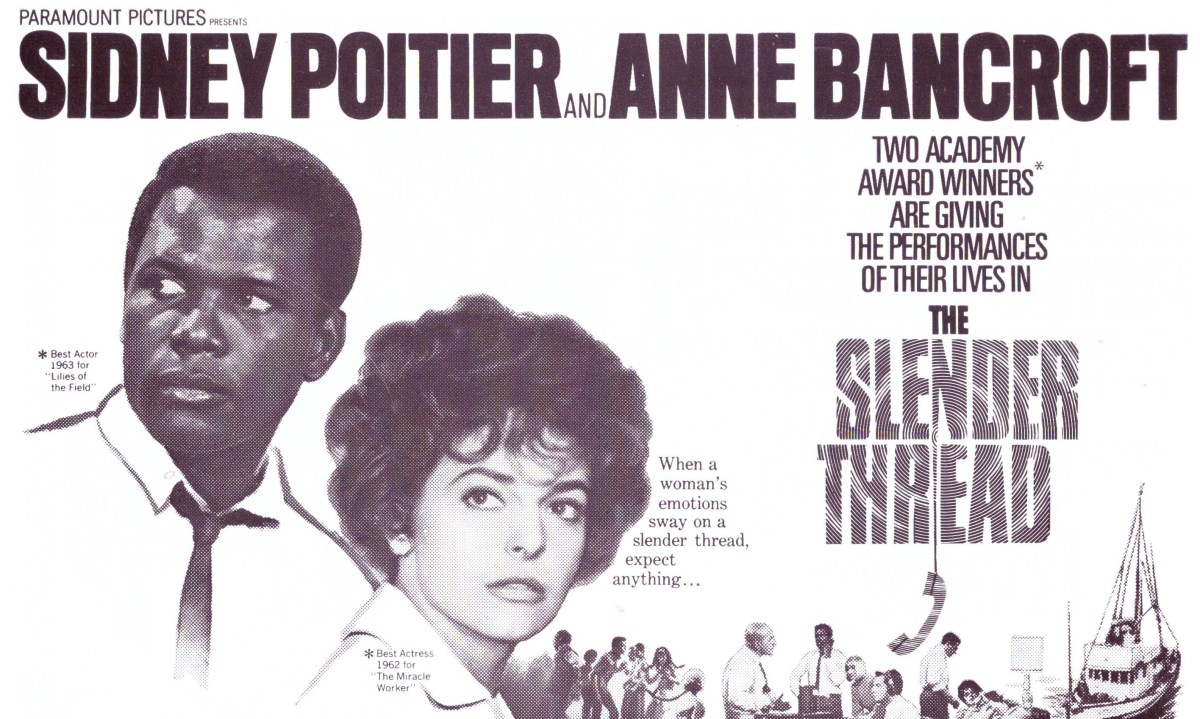
The 16-page A3 Pressbook for The Slender Thread does nothing but. There was, of course, a link between the two stars in that Anne Bancroft recipient of the Best Actress Oscar for The Miracle Worker in 1962 had the following year presented Sidney Poitier with his Best Actor gong for Lilies of the Field (1963).

“Two Academy Award winners giving the performances of their lives” is pretty much as far as the tagline writers went in providing exhibitors with something to sell. The subsidiary tagline “when a woman’s emotions sway on a slender thread expect anything” offer little in the way of explaining the film’s content. An image of a phone plays a prominent role in artwork but again without clarifying its purpose. In much smaller writing, at the end of another reference to the Oscars, is the mention of “a motion picture rarely, if ever, surpassed in suspense” but again minus clarification.

You might actually come away with the notion that the drama takes place on the high seas since a ship features in the advertising.

The only other assistance given exhibitors came in the form of reviews which make more mention of suspense. Cue magazine termed it “gripping, bristling tension and suspense all the way.” Kate Cameron in the Daily News concurred – “a high tension suspense film” as did Alton Cook of the World Telegram (“Tantalizing Tension! Nerve-Wracking Suspense!). Nobody mentioned what caused the tension and suspense.

The best bet for tie-ins came from record stores since record label Mercury has organised a “giant merchandising campaign” promoting the Quincy Jones soundtrack. The studio took the chance that exhibitors might take it into their own hands to organise some tie-ups with beauty salons, telephone companies and discotheques since these make an appearance in the picture.     

Quite how 16 pages of the same repeated artwork was meant to inspire exhibitors into, first all, booking the picture, and then, consequently, selling it to moviegoers is never explained.

Castle Keep (1969) ****

A bit more directorial bombast and this could have matched Apocalypse Now (1979) in the surrealist war stakes. Never mind the odd incidents surrounding a small unit of G.I.s  taking over a magnificent Belgian castle towards the end of World War II prior to what turned out to be the Battle of the Bulge, this has on occasion such a dreamlike quality you wonder if it is all a figment of the imagination of one of the characters, wannabe writer Private Benjamin (Al Freeman Jr.). Throw in a stunning image, for the beleaguered soldiers at the start, of a horsewoman charging by in a yellow cloak, so out of place that it carries as much visual impact as the unicorn in Blade Runner (1982), and we are in definite cult territory.

One of the unusual elements is that, in this unexpected respite from battle, the soldiers are defined by character traits rather than dialogue or bravery as would be the norm. This ranges from baker Sergeant Rossi (Peter Falk) taking over the village boulangerie and bedding the baker’s wife (Olga Bisera), mechanic Corporal Clearboy (Scott Wilson) diving into a lake to rescue a Volkswagen he has adopted and the troops receiving a lecture on art history from Captain Beckman (Patrick O’Neal).

Commander Major Falconer (Burt Lancaster) is not only brilliant in the art of war, but calmly  mentors Beckman through a firefight with an enemy airplane, teaches local sex workers how to make Molotov cocktails and, evoking ancient aristocratic tradition, enjoys conjugal relations with the conquered countess (Astrid Heeren), whose impotent husband (Jean-Pierre Aumont) encourages the relationship since the castle needs an heir.   

There is wistful revelation, Beckman clearly hankering after his turn with the countess, a trainee minister who wishes he had the courage to join the boys in the brothel, the young soldiers there being treated as children rather than customers. And there are juvenile pranks – moustaches are painted on statues, wine bottles used for ten-pin bowling practice.

But the surreal moments keep mounting up. The Volkwagen, though riddled with bullets, refuses to sink in the lake, a hidden German reveals himself by playing the same tune on a flute as one of the enemy, the countess often appearing as an ethereal vision.

Through it all is rank realism. Falconer knows a German previously shared the countess’s bed. The count will do anything to safeguard his castle and maintain the family line, even to the extent of incest, since his wife is actually his niece. But above all, while his troops believe the war is at an end and enjoy the pleasures at hand, Major Falconer prepares for rearguard action by the Germans, filling the moat with gasoline, planning to pull up the drawbridge and control the high ground. The battle, when it comes, is vivid and brutal, the initial skirmish hand-to-hand in the village before the Germans advance to the castle.

Burt Lancaster (The Swimmer, 1968) is superb, far removed from his normal aggressive or athletic persona, slipping with pragmatic ease from the countess’s bed to battle stations. War films in the 1960s were full of great individual conflicts often won on a twist of ingenious strategy but seldom have we encountered a soldier like Falconer who knows every detail of war, from where and how the enemy will approach, to the details of the range of weaponry, and knows that shooting dead four soldiers from a German scouting mission still leaves one man unaccounted for.

Patrick O’Neal (Alvarez Kelly, 1966) also leaves behind his usual steely-eyed screen persona, here essaying a somewhat timid and thoughtful character. Peter Falk’s (Machine Gun McCain, 1969) baker is a beauty, a man who abandons war, if only temporarily, for a second “home,” baking bread, adopting a wife and child. In a rare major Hollywood outing French actor Jean-Pierre Aumont (Five Miles to Midnight, 1962) carries off a difficult role as a count willing to accept the humiliation of being cuckolded if it improves his chances of an heir. In one of only four screen appearances German actress Astrid Heeren (The Thomas Crown Affair, 1968) makes the transition from a woman going to bed with whoever offers the greatest chance of saving the beloved castle to one gently falling in love.

There is an excellent supporting cast. Bruce Dern (Support Your Local Sheriff, 1969) makes the most of a standout role as a conscientious objector.  You will also find Scott Wilson (In Cold Blood, 1967), Al Freeman Jr. (The Detective, 1968), future director Tony Bill (Ice Station Zebra, 1968) and Michael Conrad (Sol Madrid / The Heroin Gang, 1968).

Two top-name writers converted William Eastlake’s novel into a screenplay – Oscar-winning Daniel Taradash (Hawaii, 1966) and newcomer David Rayfiel who would work with Lancaster again on Valdez Is Coming (1971) and with Pollack on Three Days of the Condor (1973) and Havana (1990)

Sydney Pollack (This Property Is Condemned, 1966), who had teamed up with Lancaster on western The Scalphunters, 1968), does a terrific job of marshalling the material, casting an hypnotic spell in pulling this tantalising picture together, giving characters space and producing some wonderful images, but more especially for having the courage to leave it all hanging between fantasy and reality.

Expressions like  “we have been here before,” “once upon a time,” “the supernatural” and “a thousand years old” take solid root as the narrative develops and will likely keep spinning in your mind as you try to work out what it’s all about.

Discover WordPress

A daily selection of the best content published on WordPress, collected for you by humans who love to read.

The Atavist Magazine

by Brian Hannan

WordPress.com News

The latest news on WordPress.com and the WordPress community.