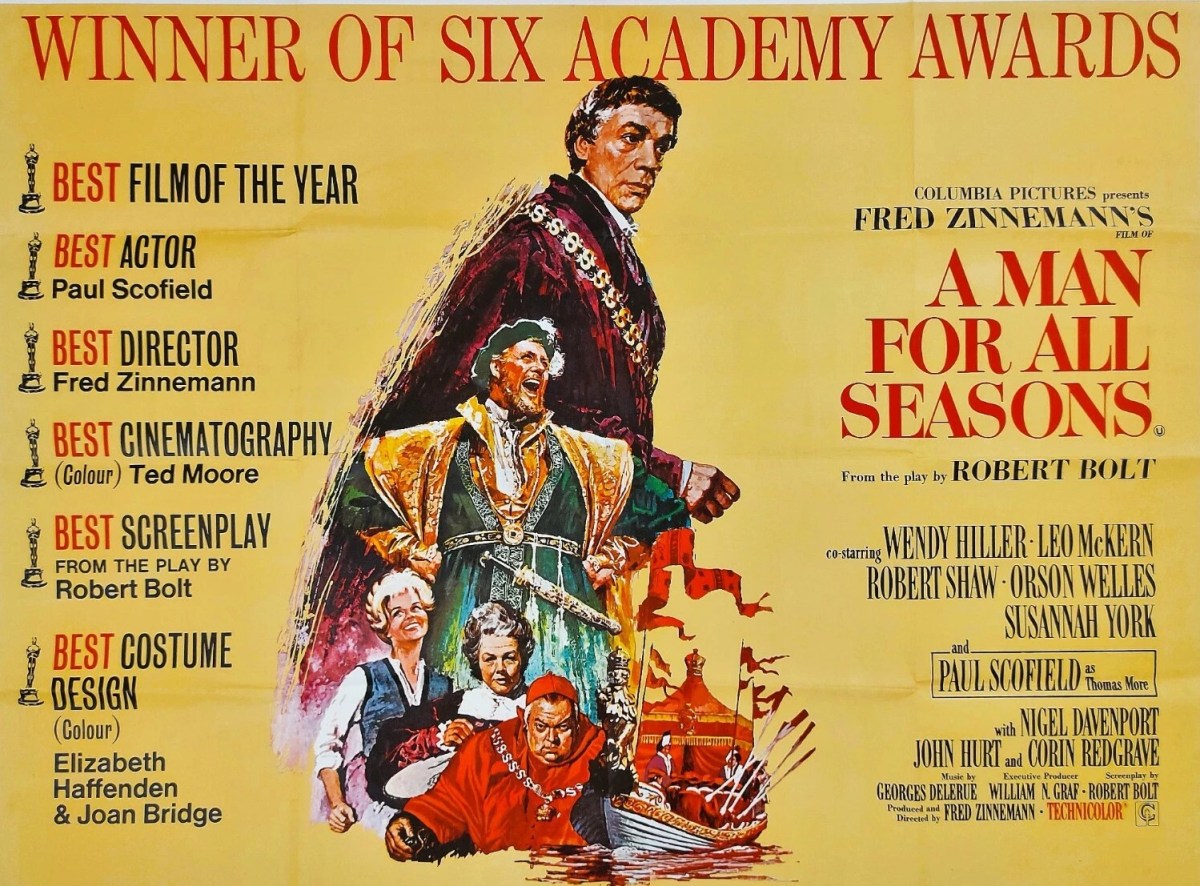
Columbia offset the gamble of turning an award-winning play with a stage star with no movie marquee luster, a co-star who had just about the same pulling power for audiences, and a host of actors nobody had ever heard of by cutting the budget to the bone – the $ 2million spent would barely be enough for a mid-level Hollywood production – even though director Fred Zinnemann belonged in the upper reaches of the Oscar hierarchy with one win and six nominations to his name.
You could even argue that the best-known person in the cast was female lead Susannah York (Sands of the Kalahari, 1965, The 7th Dawn, 1964) or the legendary Orson Welles or even screenwriter Robert Bolt, acclaimed for his work on Lawrence of Arabia (1962) and Doctor Zhivago (1965).
Movie audiences of the period would be hard put to even recognize male lead Paul Scofield, in only his second major screen role after The Train (1964), while Robert Shaw had little more popularity unless you were familiar with From Russia with Love (1963) in which he played a bad guy and Battle of the Bulge (1965). There was a fair chance that Scofield could hit the mark among the upscale stage audiences in London and New York, where he had won a Tony. The play, by Robert Bolt, had proved substantially more popular in terms of length of run and critical esteem in New York than London.
But Zinnemann hadn’t made a picture in six years, not since The Sundowners (1960), having become embroiled in two projects The Day Custer Died (never made) and Hawaii (made but without him) without anything to show for it.
This was a virtue-signaling picture long before the term became over-used. England’s Lord Chancellor Sir Thomas More (Paul Scofield) makes a principled stand against King Henry VIII (Robert Shaw). From today’s perspective, the principled stand is more complex. The idea that the ruler of a country would have to bend the knee to the leader of a religion would not sit well today. You might be unlikely to blame Henry VIII for wanting to break the rules, given he was in dire need of a male heir that his current wife could not supply, especially as without said heir the country would most likely fall into civil war.
You could make a case for Henry VIII being the heroic one, standing up to the Pope, who, for political reasons, as much as anything else, refused to annul the king’s existing marriage. When the Pope didn’t see it the king’s way, Henry VIII decided the only alternative was to break away from the Catholic Church and set himself up as the secular head of the church in England.
And although Thomas More has a fair following today for his philosophy – he wrote Utopia – Robert Bolt was guilty of leaving out aspects of his character which were more unsavory. He was a prime mover in the persecution of Protestants, condemned as “heretics,” but that’s been excised from the story told here in order to present Thomas More as a man of conscience.
Apart from the verbal duel between More and Henry VIII, there’s a rich backdrop of political machination bringing in such names as Thomas Cromwell (Leo McKern) – of Wolf Hall fame – Cardinal Wolsey (Orson Welles), the Duke of Norfolk (Nigel Davenport), William Roper (Corin Redgrave) and Richard Rich (John Hurt). There’s corruption, bribery and betrayal and at times it appears that More is the only one to place any significance on the law.
But More’s no innocent, he’s well used to playing the political game and arguing his case. He only becomes undone by his stand against a king who will brook no opposition.
Paul Scofield has a fine time of it with a well-developed character, gently spoken, appealing to sense and sensibility, and generally well loved by the populace. Although in retrospect I think other Oscar nominees Richard Burton for Who’s Afraid of Virginia Woolf and Michael Caine for Alfie might have been more deserving of the Oscar gong.
Robert Shaw makes a fine opponent, tempering the monarch’s known bluster with a sense of humor. While Paul Scofield tended to steer clear of Hollywood except for films like Scorpio (1973), Robert Shaw went immediately into the male lead in Custer of the West (1967) and eventually became a genuine draw.
The uncredited Vanessa Redgrave (Blow-Up, 1966) was otherwise the star-picker’s pick. Future years would invest greater luster in the supporting cast. John Hurt (Sinful Davey, 1969) the first to be given a tilt at marquee splendor. Leo McKern (Assignment K, 1968) achieved small-screen deification through Rumpole of the Bailey (TV series, 1978-1992). Colin Blakely (The Vengeance of She, 1968) played Dr Watson in Billy Wilder’s The Private Life of Sherlock Holmes (1970).
Robert Bolt deserved his Oscar for the considerable work he put in to converting his stage version for the screen. The staging looks quite stagey to me, but Zinnemann did an excellent job of adding the necessary richness and ensuring the tale was rounded-out.
Not sure I’d place it in the Top Fifty Best-Ever British Films, but it’s still enjoyable even though you might take issue with the issues presented.
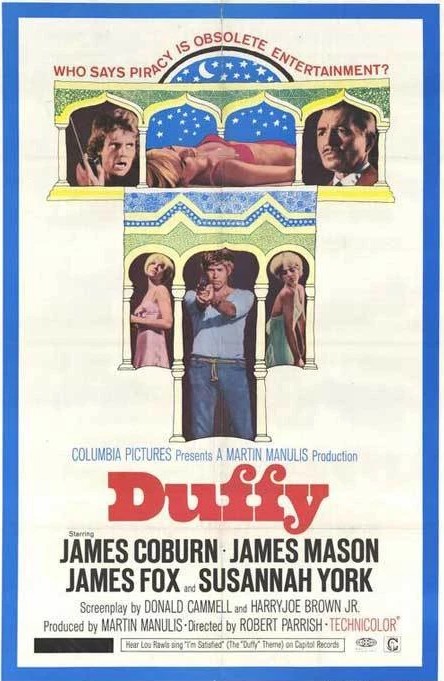
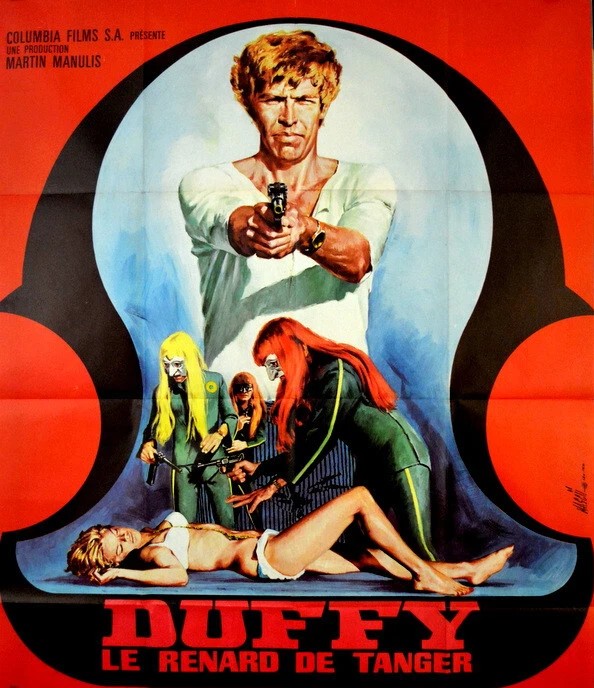
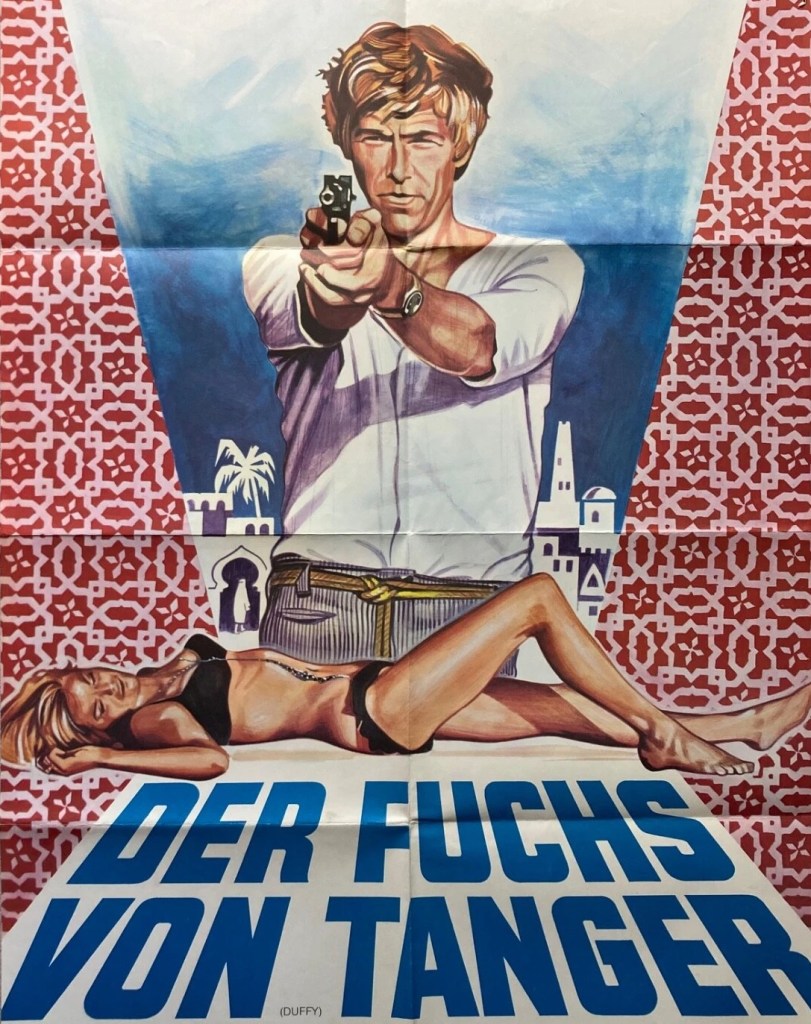
Star James Coburn wasn’t keen on the title. Had it been made today it would have been a contender for the sobriquet of The Nepo Heist. I’m sure many heirs would quite like a large chunk of their inheritance put in their hands long before it was handed over after the death of the father/mother. Luckily, this isn’t about blatant greed. It’s presented as more of a game, a duo of half-brothers, same father/different mother, trying to put one over their arrogant father.
Millionaire businessman J.C. Calvert (James Mason) is as keen on keeping the kids in their place, constantly deriding as incompetent Antony (John Alderton) – an accurate assessment it has to be said – and more than willing to challenge Stefane (James Fox) to any game of skill, even darts, especially if it involves money.
The sons set out to steal £1 million ($3 million) from a shipment of cash their father is transporting aboard the passenger ship Osiris to Naples. To that end they recruit hippy smuggler Duffy (James Coburn). Stefane’s girlfriend Segolene (Susannah York) might have been included as a makeweight except she takes a fancy to Duffy. Given that betrayal is a standard trope of any heist, you are kept wondering if she is, in fact, no matter how she protests her independence, a plant.
It takes quite a while for the plot to gather any steam what with dilly-dallying around Tangier and making considerable adjustments to a yacht. No time is spent either in the planning of the crime, the action just unfolds. The theft itself requires little of the unique set of skills that most thieves possess, nothing more than going on board the Osiris in disguise, both Stefane and Segolene decked out in religious garments, and putting on masks for their incursion into the room containing the safe. The only moment of real tension comes in having to extract the code to the safe.
The escape is better thought-out. The cash is chucked overboard in buoyant bags, connected to Duffy by means of a fisherman’s line which, when reaching the safety of their yacht, transformed for the time being into a fishing boat, Duffy reels in. A helicopter magically appears from the hold and they blow up the yacht before escaping, stashing the loot in 30ft of water in a cove near Tangier.
Assuming J.C. would be able to claim on his insurance then no great harm would be done to the family coffers, and the sons, as well as filling their pockets, would have the pleasure of making a fool of their old man. As you might expect, there’s double crossing still to come. And it’s a gem of a twist. Calvert has been in on the crime from the outset, thanks to the connivance of Segolene who turns out to be his girlfriend.
However, that scam is undone in another twist and it’s Duffy who comes out trumps, though far short of a millionaire.
Relies more than most crime pictures on the charm of the three main characters, with Antony there for nuisance value. However, the will-she-won’t-she games Segolene plays with Duffy and Stefane would have had more impact if Stefane had not been so nonchalant about their romance, and if she had not been so strident as regards her independence and unwillingness to become attached to any man.
That said, she turns out to be the cleverest of the lot, stringing along the two younger men while making a better play for the older one. But there’s something missing in the construction of the picture, so her triumph seems to come out of left field, almost a twist for the sake of it.
James Coburn (What Did You Do In The War, Daddy?, 1966) gives his screen persona an almighty about-turn, and although he appears useful with a pistol, he comes across more as a free-living hippy of the period, with a penchant for erotic pop art, though he has little regard for ecology, literally littering the planet, chucking wrappers and bottles everywhere.
James Fox (King Rat, 1965) has a whale of a time as an insouciant aristocrat, a character trait he clearly inherits from James Mason (Age of Consent, 1969) as his father while Susannah York (Sands of the Kalahari, 1965) swans around in cool attire all the more to make herself appear nothing more than a mild distraction rather than a criminal genius.
Leisurely directed by Robert Parrish (Journey to the Far Side of the Sun, 1969) from a screenplay by Donald Cammell (Performance, 1971) and Pierre de la Salle and Harry Joe Brown Jr.
You know the score: plane crashes in inhospitable territory (in this case a desert), personalities clash as food/water is rationed, tempers run high and/or depression sets in as attempts to attract attention fail, someone goes for help, someone else has an ingenious idea and eventually everyone rallies round in common cause. That template worked fine in The Flight of the Phoenix (1965).
It doesn’t here. This is not quite as inhospitable. There is water. Caves offer shelter from the blazing sun. There is food – lizards trapped, game hunted with telescopic rifle. But the food is lean, not fattened through farming for human consumption. And you have to watch out for marauding baboons not to mention scorpions. And this group is split, two alpha males intent on exerting dominance with little interest in common cause.
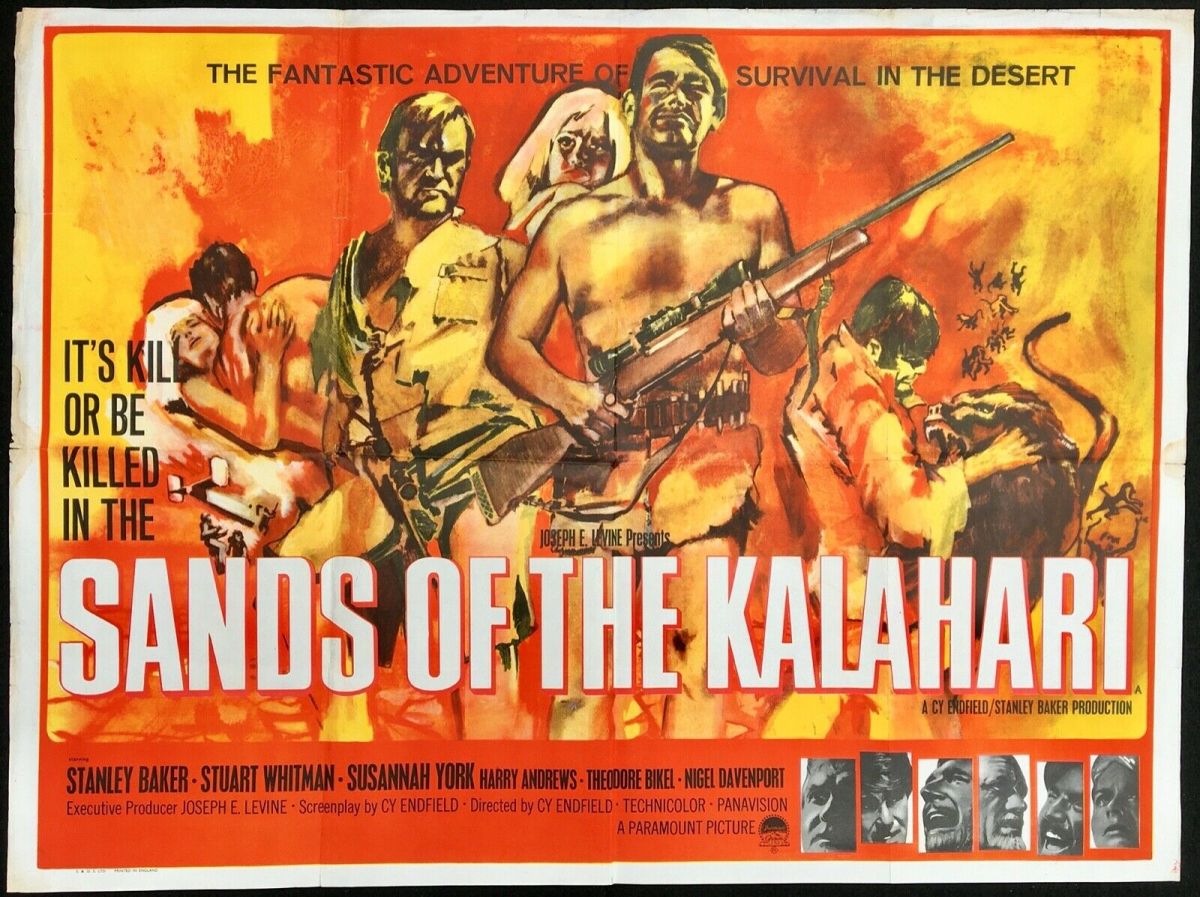
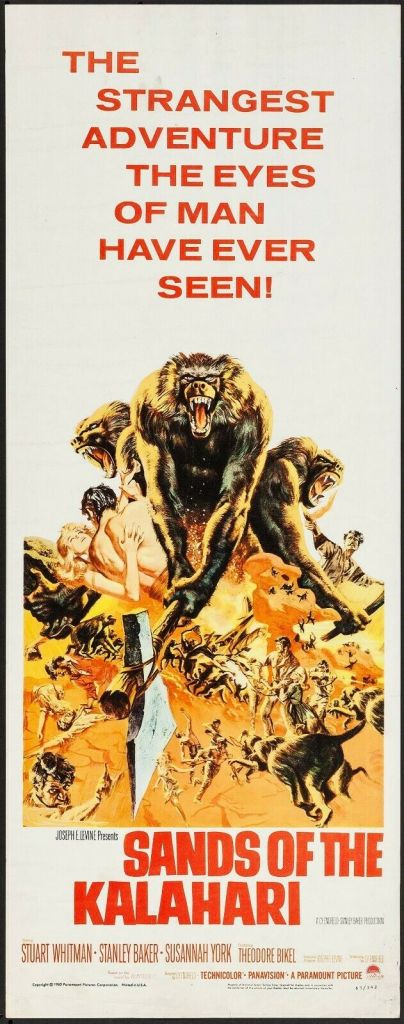
Producer Joseph E. Levine came up with the poster without close examination of the picture’s content.
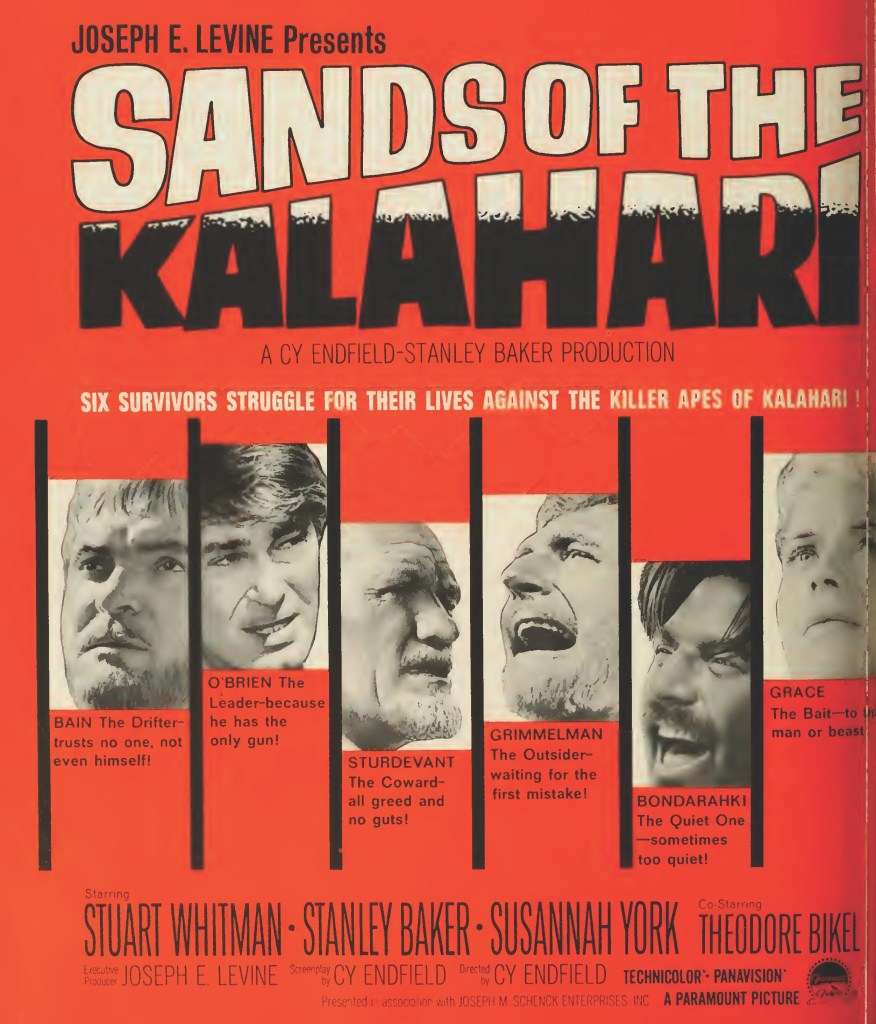
Of the six survivors of this crash, Sturdevan (Nigel Davenport) decides his leadership status entitles him to sole claim over the only woman, Grace (Susannah York). But when he accepts the genuine responsibilities of leadership, he sets off across the desert to get help. That leaves Grace to fall into the hands of O’Brien (Stuart Whitman), so alpha he could be auditioning for Tarzan, shirt off all the time.
It soon transpires O’Brien has a rather unusual idea of survival – getting rid of his companions so that he will have no shortage of food until rescue arrives. It takes a while for the others to catch on to his plan. And then rather than common cause and camaraderie, it becomes every man/woman for himself, a battle for individual survival, a return to the primeval.
The most likely challenger to O’Brien’s authority is Bain (Stanley Baker), but he has been badly injured in the crash and no match for the other man’s brawn or his weapon. So it becomes a game of cat and mouse. Except it’s in the desert, it’s the law of the jungle and the rule of autocracy brought home with sudden force to people accustomed to the comforts of civilization and democracy.
The movie’s structure initially takes us down the obvious route of common purpose – Grimmelman (Harry Andrews) knows enough survival lore to devise a method of water transportation that would permit the group to escape the desert, Dr Bondrachai (Theodore Bikel) formulates a method of trapping lizards, and O’Brien, at least at first, appears willing to take on the role of protector, warding off baboons with his gun.
The change into something different is subtle. While the others are desperate to escape, it becomes apparent that O’Brien has found his metier. We discover little about the lives of each individual prior to being stranded. Whatever O’Brien’s standing in society, it would not have been as high as here, where his superior skills stand out. Reveling in his supremacy, he doesn’t particularly want to go home.
Like any psychopath Bain knows how to manipulate so at first it seems his decisions are for the greater good. And only gradually does it emerge that he blames others for his own mistakes and intends to eliminate his rivals for the food supply one by one. Because he is so handsome, it is impossible to believe he could be so devious or so evil.
The three principals all play against type. Stanley Baker (Zulu, 1963) and Stuart Whitman (Murder Inc., 1960) made their names playing heroic types. Here Baker is too ill for most of the picture to do any good and Whitman plays a ruthless killer. But Susannah York (Sebastian, 1968) is the big revelation. Audiences accustomed to her playing glamorous, perhaps occasionally feisty, gals will hardly recognize this portrayal of a coward, not just abjectly surrendering to the alpha male but seeking him out for protection and guilty of betrayal.
Even though this picture is set in the days before gender equality and the independent woman was a rarity, Grace’s acquiescence to the powerful male is disturbing, in part because it takes us back to the days when a woman was impotent in the face of male dominance. Such is York’s acting skill that rather than despise this woman, she earns our sympathy.
While for the most part Harry Andrews (Danger Route, 1967) and Nigel Davenport (Sebastian, 1968) appear in their usual screen personas of strong males, here their characters both are changed by the circumstances. Theodore Bikel (A Dog of Flanders, 1960) has the most interesting supporting role, the only one who takes delight in the adventure.
Director Cy Endfield (Zulu) – who also wrote the screenplay based on the William Mulvehill novel – delivers a spare picture. There is virtually no music, just image. Aerial shots show tiny figures in a landscape. The absence of character background frames the story in the present. As a reflection on the animal instinct, how close to the primordial a human being still operates, no matter how enlightened, this works exceptionally well, and melds allegory with thriller.
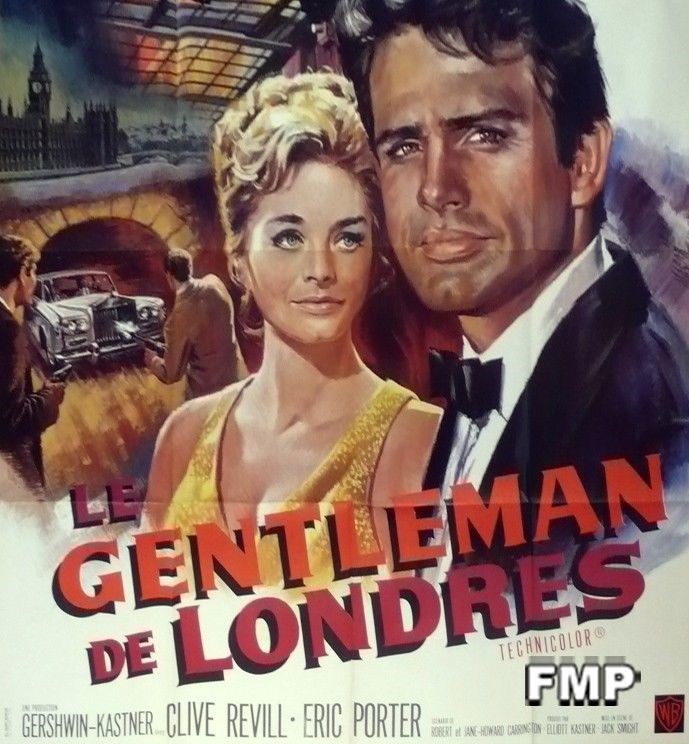
Amazing the tension that emanates from the turn of a card. Or, more correctly, waiting for one. Only problem is we’re two-third through the movie before high-stakes poker begins – the pot nudging £250,00 (close on a cool £5 million now). Mostly, the earlier tension derives from not knowing what the hell is going on in this enjoyable thriller made at the height of the Swinging Sixties as playboy gambler Barney (Warren Beatty), a walking Carnaby St model driving an Aston Martin DB5, tilts the odds dramatically in his favor.
Barney is a gambler but the problem with gambling is the odds. They can be against you too much. So Barney decides to turn himself into a burglar, the kind that can clamber over rooftops, abseil between buildings, and break into – a printing business called Kaleidoscope. This just happens to print the playing cards supplied to all the major European casinos. So Barney does a little doctoring of the master printing plates. Bingo, the odds are a bit more even now that he knows what cards are coming out of the shoe – he plays chemin de fer (as it is known in posh casinos, pontoon or 21 to you and me).
While cleaning up he bumps again into fashion designer Angel (Susannah York) – their original meet-cute taking place in a traffic jam – who he dated once in London. Unbeknownst to him, she is on a scouting mission, looking to snare the kind of high-rolling gambler who can take on and completely fleece the drugs kingpin Harry (Eric Porter) being pursued by cop Manny (Clive Revill), her father who, rather than waste so much time collecting the required evidence to put the villain behind bars, decides it would easier done by making him broke. Unable to pay his debts, some other villain would put him out of business in the traditional cemented-boot fashion.
It takes a while for the movie to line up all its ducks in a row, mainly by holding on to the information the audience requires. But the audience is privy to details of the way Manny works that Barney is not. Even for ruthless villains, Manny has a peculiar calling card, one that would make any gambler think twice about entering his lair. Of course, it doesn’t take long for Manny to rumble Barney’s game so the stakes are much higher than the charming gambler imagines.
Throw in as much fashion as London was capable of generating at this time, the burgeoning romance, some exotic European locations, a castle with a moat, and the usual tourist guide stuff of red buses, Big Ben, Piccadilly Circus, pubs and Tower Bridge and you have all the ingredients of an easy on the eye thriller.
It’s a movie that relies on star power but Beatty and York deliver. That is, if you don’t need Beatty to do much more than be Beatty, all teeth and charm. At this point in his career Beatty looked as if his career was fast approaching its end. The box office success of Splendor in the Grass (1961) had been followed by a string of flops, romantic dramas and comedies that should have had audiences queuing up plus an occasional wild card like Arthur Penn’s Mickey One (1965), the biggest flop of all. He does make an engaging crook, and he never loses his screen charisma here, but there ain’t quite the right number of twists that moviegoers weaned on the likes of Topkapi (1964) had come to expect.
Hollywood had been doing its best to position Susannah York as a top box office attraction and she had snagged the female lead in The 7th Dawn (1964) opposite William Holden and Stanley Baker in Sands of the Kalahari (1965) but she was recovering from the colossal flop of Scruggs (1965) by ‘poet of the cinema’ David Hart. Kaleidoscope offered the kind of role York could do with her eyes closed. So while the screen pair were not exactly sleep-walking it was not the kind of story that was going to create sparks.
Character actor Clive Revill (Fathom, 1967) and Eric Portman (The Pumpkin Eater, 1964) take more leeway with their roles, the latter almost chewing he scenery, the former content with just chewing his lips. Look out for Jane Birkin (Blow-Up, 1966) and British television stalwarts Yootha Joyce, George Sewell and John Junkin.
The title would have been more enigmatic, original meaning of images twisted out of shape, had it not also applied, straightforwardly, to the card-making company. Giving Harry the surname of Dominion seems overkill.
Director Jack Smight (No Way to Treat a Lady, 1969) came to this after twisty private eye picture Harper/The Moving Target (1966), a big hit starring Paul Newman. This is too lightweight a feature to command such interest, but he does keep the story rolling along and it’s an effortless watch and it has a certain offbeat quality. The screenplay was fashioned by Robert Harrington and Jane-Howard Harrington, making their movie debut, who also co-wrote Wait until Dark (1967). It was also the debut for Winkast Productions, the Jerry Gershwin-Elliott Kastner production team who went on to make Where Eagles Dare (1968).
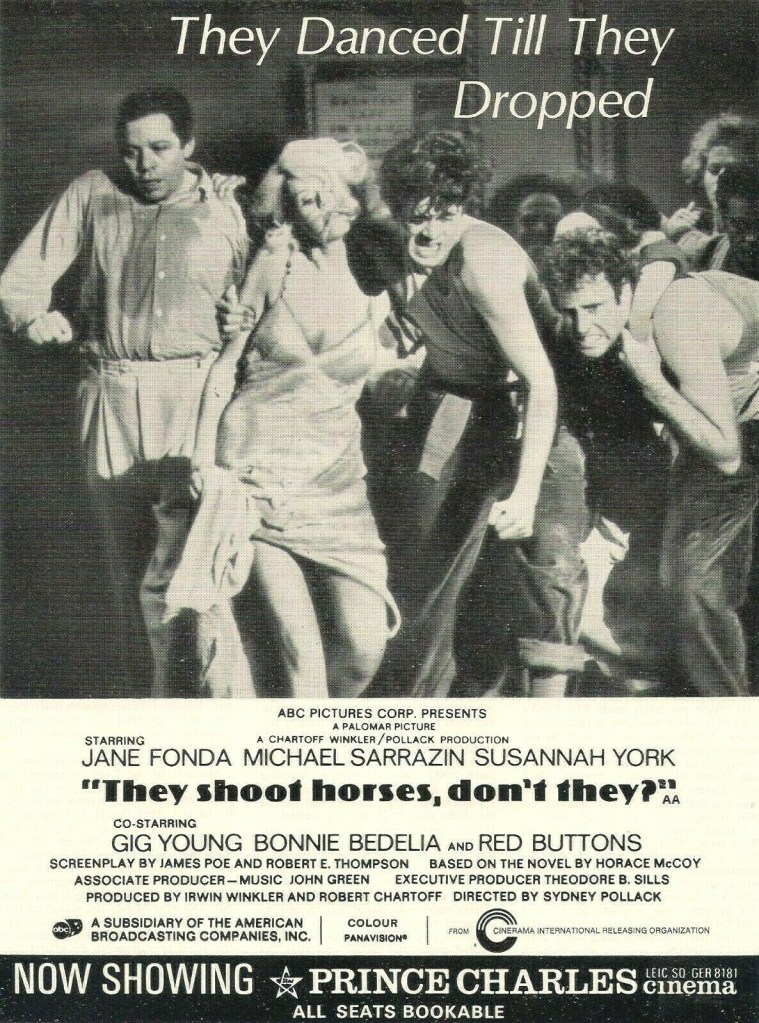
Fans of reality television shows will be only too aware how participants volunteer for ritual humiliation, but swallowing a few locusts and being stuck with a couple of snakes has nothing on the realities facing individuals during the Great Depression who would literally dance non-stop for days on end with a ten-minute break every two hours. It’s impossible to imagine that anybody could think of dreaming up such a degrading circus to take advantage of the desperate. But then this is America, land of opportunity and the MC Rocky (Gig Young) continues to spout aphorisms and continues to promote the American Dream even as it disintegrates in front of him.
When the partner of Gloria (Jane Fonda), out-of-work actress and one of the more physical and cynical of the candidates hoping to scoop the $1,500 first prize (no prizes for coming second, of course), is ruled out through bronchitis – in case he passes it on to others rather than more any humane consideration – she pairs up with dreamer Robert who initially wanders in as spectator rather than participant. Glamorous platinum blonde aspiring actress Alice (Susannah York) is already coming apart. Sailor (Red Buttons) is a former war hero and James (Bruce Dern) drags his heavily pregnant wife (Bonnie Bedelia) around the dance floor.
There is not a great deal of story except to watch everyone grow mentally and physically incapacitated. There is betrayal and lust and survival instinct leads characters into sexual situations. When Alice seduces Robert, in retaliation Gloria dumps him and then has sex with Rocky, while attempting to retain control of that situation, but clearly needing at the very least consolation and confirmation of her attractiveness and at best some sign of favoritism.
As well as non-stop dancing, Rocky throws in stunts to keep the audience, who can sponsor a pair, interested. So there are 10-minute races, the last three to be eliminated. So determined are some of the competitors they will even lug their dead partner over the finishing line. Another of Rocky’s wheezes is to have Gloria and Robert marry, worth $200 in terms of the gifts they will receive from a sentimental audience, in the middle of the dance floor.
They are literally dancing for hours, over 1,000 in over 40 days so gradually the dance floor becomes less crowded as dancers collapse from exhaustion or cannot take it anymore. The spectators, we are reminded, are only there because “they want to see someone worse than them.” Just when you think nothing can shock you any more, it is revealed that the first prize is minus the cost of feeding, sheltering and looking after the winner.
Those who think they are tough find that the demands of mental and physical endurance are beyond them. This is a shocking film and there’s no doubt it will stay with you for a long time. I saw it first when it came out but not again until now and thank goodness for forgetfulness otherwise I doubt if I would have chosen to sit through it again.
It’s doubtful if any actress had achieved such a speedy transition from glamorous leading lady to serious actress as Jane Fonda. From stripping in space in Barbarella (1968) to stripping away the last vestiges of her humanity here. Suddenly, she appears in a brand-new screen persona with the grating voice, the chip on the shoulder, the feistiness and worthy inheritor of father Henry’s acting genes. It’s also a bold role for Susannah York, in an extension of the weak character she essayed in Sands of the Kalahari (1965) but far more delusional, believing in a rainbow that will never appear. Michael Sarrazin (In Search of Gregory, 1969) initially appears out of his league but his character calls for a gentle innocence that is well within his scope.
Gig Young steals the picture, offered the opportunity to bring alive a multi-faceted character, as big a spiel-merchant who ever crossed the screen, but engaging in a marathon of optimism, and at some points, such as when coaxing a demented Alice out of the shower, earning our sympathy. Red Buttons (Stagecoach, 1966), Bruce Dern (Castle Keep, 1969) and Bonnie Bedelia (Die Hard, 1988) also put in sterling work.
The movie received nine Oscar nominations but was ignored in the Best Picture category. Only Gig Young won for Best Supporting Actor. Jane Fonda and Susannah York both received their first Oscar nominations, for Fonda the first of many, for York the one and only. It was also a debut nomination for Pollack, a future winner.
Sydney Pollack directs with simplicity, concentrating on the indignities of the event and focusing mostly on the personalities draining away, and even the drama is undercut, most of those scenes directed in straightforward style. However, Pollack plays around with the innovative fast forward – flashes into scenes that have not yet taken place. James Poe (Lilies of the Field, 1963), at one time down to direct, and Robert E. Thompson, a television writer making his first venture on the big screen, wrote the screenplay from the Horace McCoy novel.
Check out the Behind the Scenes article on this one.
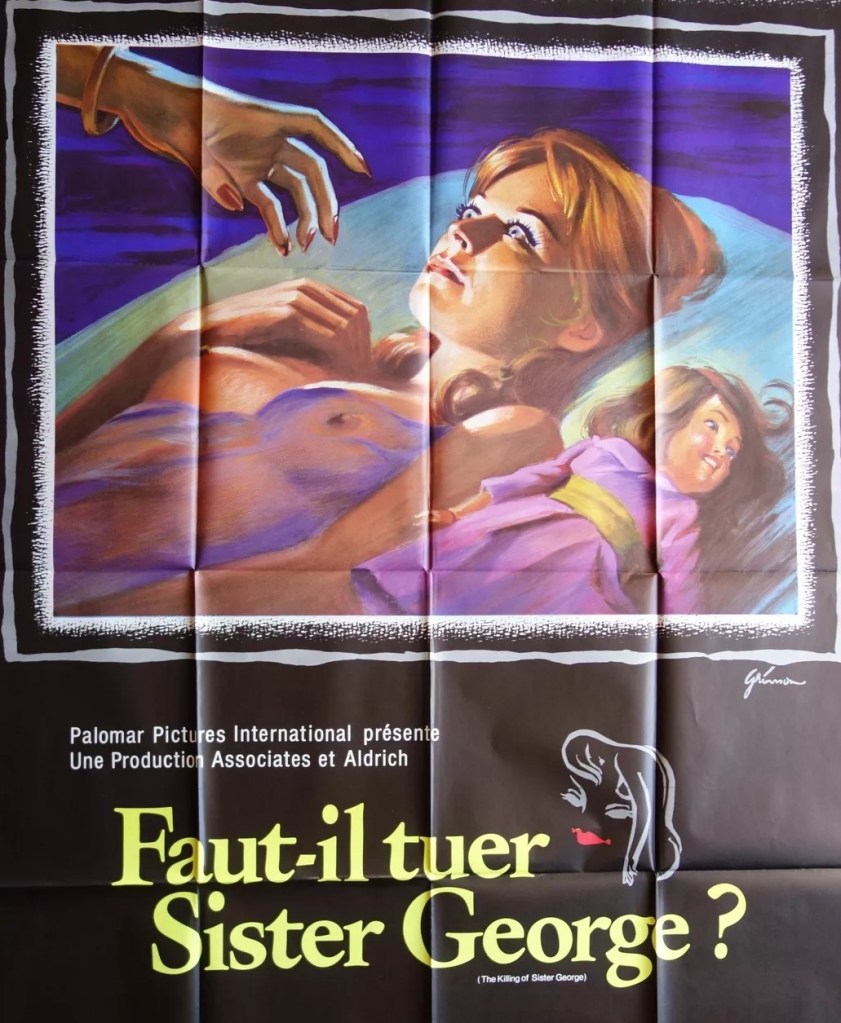
Somewhere between camp classic, hilarious comedy and bitchiness-on-speed, loaded down with a May-December narrative, too much of the genuine soap opera element of the filming of a soap opera but lifted up by some very touching moments. This started life as a black comedy and its stage antecedents are only too obvious, many scenes running way too long for a movie, and in the unlikely hands of director Robert Aldrich – at this point best known for male actioner The Dirty Dozen (1967) rather than the equally bitchy Whatever Happened to Baby Jane (1962) – asks audiences to ingest a great deal more seriousness.
The sex scene was so shocking in its day that, in the reformed U.S. censorship system, earned one of the first mainstream X-certificates, thus torpedoing its box office potential as newspapers routinely refused to accept adverts for such. Yet while it is tender, and to some extent galvanized by the astonishment of older lesbian Mercy Croft (Coral Browne), a high-ranking television executive, at having such a young and adorable lover as Alice (Susannah York), it is sabotaged by Alice’s gurning.
Whereas Beryl Reid’s performance as aging soap opera actress June (aka Sister George) about to be cut adrift by the television production which has made her name is pretty much spot on as a drunken, insecure, needy, dominant, older lover. Susannah York (They Shoot Horses, Don’t They, 1969) just seems out of control as the bonkers dumb blonde. While same sex relationships between men had only just become legal in England, and the specter of blackmail, public scandal or imprisonment that had hung over many generations now removed, there had never been a correlative for women. Though a newspaper headline might well kill a career.
The best sequence in terms of the harmonious gay relationship comes in the gay club where women hold each other for a slow dance and it seems so normal and touching. Of course, relationships, straight or gay, don’t necessarily run smoothly, but the longstanding affair between June and Alice belongs to the Who’s Afraid of Virginia Woolf (1966) playbook. Alice may well be a gold-digger for all she does, but since the May-December aspect of male-female relationships was a standard Hollywood trope it seems fair enough to apply the same rationale to a single-sex partnership.
There’s some uncomfortable sadism when, as punishment for mild misdemeanor, Alice is forced to eat a cigar butt and told in no uncertain terms just how stupid she is. There had been a recent rash of on-set bitchiness, star tantrums and studio power struggles from pictures like The Carpetbaggers (1964), Harlow (1965), Inside Daisy Clover (1965), The Oscar (1966) and Aldrich’s own The Legend of Lylah Clare (1968), so none of production shenanigans bring anything new to the table.
However, when June lets rip, embarrassing management or forcing her fellow actors to laugh during a tragic scene, this is comedy gold. Her alcohol intake and arrogance aside, it seems a step too far for June to attempt to sexually assault two nuns in a taxi – this unseen sequence key to her downfall. You might be inclined to question how Alice came into the sexual orbit of June and Mercy in the first place, and wonder if the two older women are not guilty of what would be termed these days inappropriate behavior in taking advantage of clearly a vulnerable young woman.
Beryl Reid (The Assassination Bureau, 1969) walks a fine line between self-indulgence and character insight. I felt Susannah York’s over-acting got in the way. The tight-lipped Coral Brown (The Legend of Lylah Clare) was too close to the cliché for my liking.
Robert Aldrich just about gets away with it. Lukas Heller (The Dirty Dozen) adapted Frank Marcus’s play.
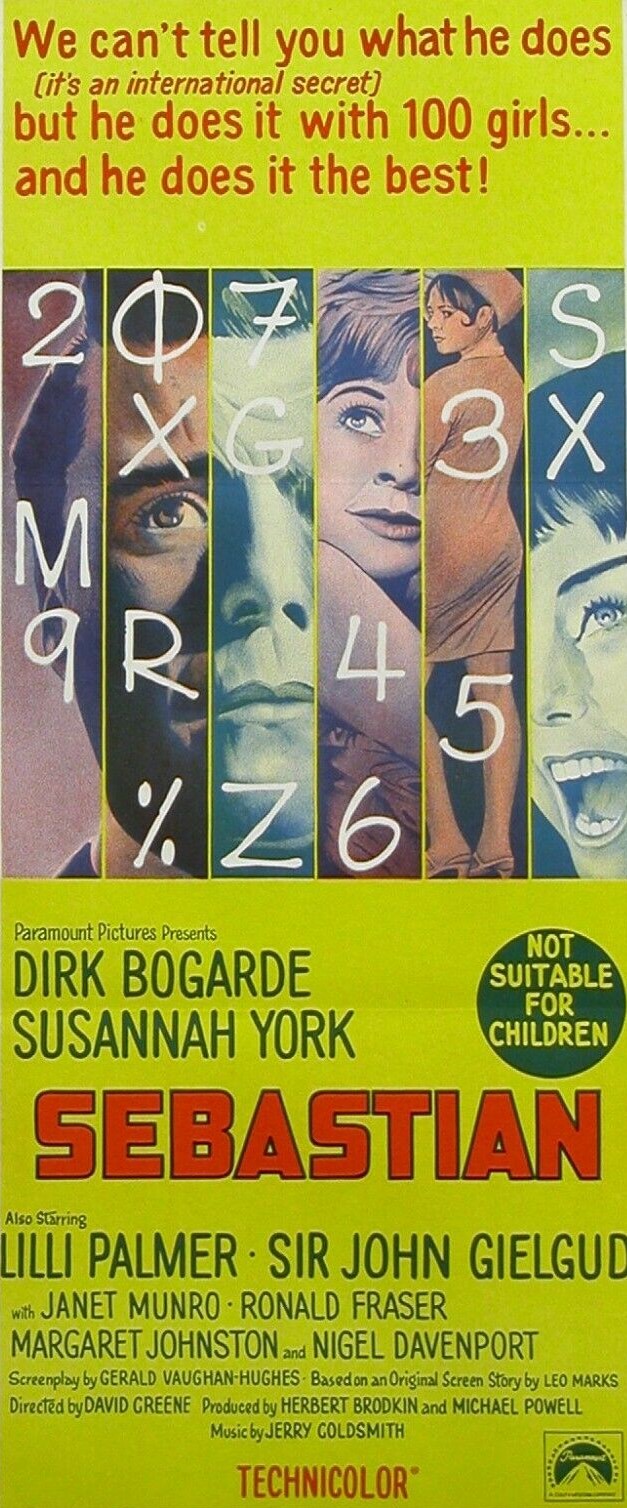
Decoding the emotional life of mathematics professor Sebastian (Dirk Bogarde) lies at the heart of a spy thriller mainlining on loyalty and trust. The presence of a flotilla of potential Bond girls has opened this picture up to charges of being a spoof, but I saw the mini-skirted incredibly-bright lasses as being a reversal of the standard secretarial pool. And a supposed representation of the “swinging sixties” would hold true if shot in the environs of Carnaby St rather than the bulk of locations being arid high-rise buildings.
In roundabout fashion, intrigued after literally bumping into him in Oxford, Rebecca (Susannah York) is recruited into an espionage decoding department staffed entirely by gorgeous (but brainy) women. Among the older employees is chain-smoking left-winger Elsa (Lili Palmer) whom security chief General Phillips (Nigel Davenport) suspects of passing on secrets. When romance ensues with SY, Sebastian dumps dumb pop singer girlfriend Carol (Janet Munro) who is already having an affair and spying on Sebastian.
Although there is no actual beat-the-clock codes to be unraveled, tensions remains surprisingly high as in best Turing manner, breakthroughs are slow. There’s an undercurrent of electronic surveillance, eavesdropping on recruits, bugs planted in the houses of even the apparently most trusted personnel, seeds of distrust easily sowed, codes shifting from numbers to sounds. The occasional nod to the contemporary, a disco, pop songs, Rebecca doing a fashion shoot in the middle of traffic, is background rather than center stage
Sebastian, though worshipped by is female staff, is “more whimsical than predatory.” Nonetheless, introspective and often morose, unable to deal with emotions, it falls to Rebecca to take on the task of sorting him out which naturally leads to complications.
Most reviewers at the time complained it was a victory of style over substance, but somehow they managed to overlook the essential questions about trust the picture asked. That said, it does follow an odd structure, the third act dependent on directorial sleight-of-hand.
Dirk Bogarde (Hot Enough for June/ Agent 8 ¾, 1964) is always highly watchable and Susannah York (Sands of the Kalahari, 1965) catches the eye with an impulsive, slightly kooky character who turns out to be down-to-earth. Nigel Davenport (Play Dirty, 1969) brings his usual cynical malevolence to the party but with the twist of not knowing whose side he is really on. John Gielgud (Becket, 1964) is a delight. There’s a brief appearance by a pipe-smoking Donald Sutherland (The Dirty Dozen, 1967). Miss World Ann Sidney is one of “Sebastian Girls”
David Greene’s (The Shuttered Room, 1967) direction is mostly competent but the opening aerial tracking shots set the precedence for occasional bursts of style. Jerry Fielding supplied the score. Written by Leo Marks (Peeping Tom, 1960) and Gerard Vaughan-Hughes (The Duellists, 1977).
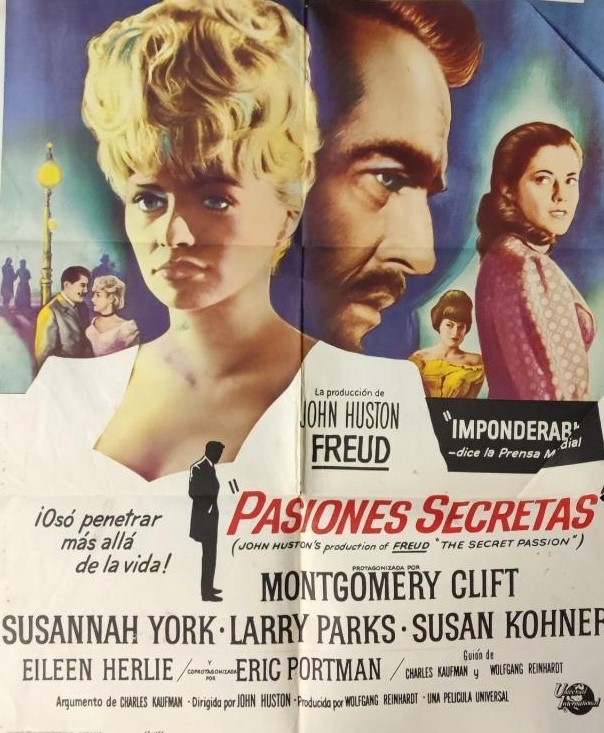
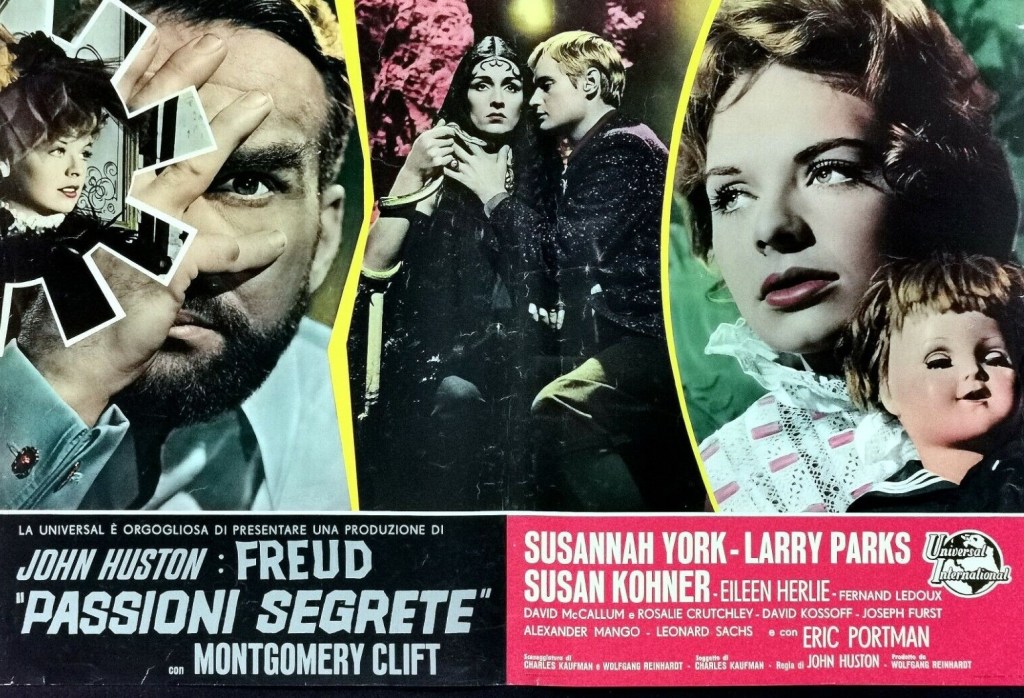
Your leading man is an alcoholic drug-addled star with substantially impaired sight. Your leading lady, in her first major role, decides she knows more about acting than the very experienced director. But in the world of victimhood, who gets the blame? Not of course Montgomery Clift (The Defector, 1964) or Susannah York (Sands of the Kalahari, 1965), but director John Huston (The Night of the Iguana, 1964).
Huston had been trying to put together a movie about the flawed god of psychiatry, Sigmund Freud, for 13 years. In 1949, with a screenplay by Charles Kaufman and backed by Twentieth Century Fox, it was going to be called Dr Freud. That version was still on the stocks a couple of years later. It wasn’t the first attempt to put the Viennese genius’s life on film, in 1940 Warner Brothers announced Edward G. Robinson in The Life of Freud with a script by Gary Endore.
Huston began serious work on the movie in 1956, but it was only greenlit two years later, after he signed a five-picture $20 million deal with new production unit Seven Arts, set up by Ray Stark and Eliot Hyman, future kingpins at Columbia and Warner Bros, respectively. It was to follow The Man Who Would Be King (not finally made until 1975), for which Huston was scouting locations in Afghanistan. At that point Freud was scheduled for 1959. Then it was Unforgiven (1960) and The Misfits (1961) that came first.
Mostly, the delay was caused by the screenplay. Huston had handed the task to celebrated French philosopher and playwright, who with what amounts to contempt for Hollywood, had written a 300-page script. His next attempt was 780-pages. Read that and weep, Christoper Nolan and Martin Scorsese, this was a 10-hour movie. When questioned, Sartre retorted “so make a 10-hour film.” Huston contemplated turning the script into two unrelated movies, perhaps in the vein of Young Tom Edison and Edison, the Man (both 1940).
Sartre spent two weeks at Huston’s home in Ireland, with Reinhardt on hand as well, trying to condense the material. But he spoke so rapidly that Huston confessed “I could barely follow even his basic thought processes….sometimes I’d leave the room in desperation, on the verge of exhaustion from trying to follow what he was saying.” Huston could not fault Sartre’s diligence. The playwright rose at 5am and would have 20-25 pages ready for discussion five hours later.
Sartre was paid $40,000 for his screenplay. Kaufman was brought back on board but his work didn’t gel with Huston’s vision. Wolfgang Reinhardt, whose name also appeared as producer, was more involved on the script. His relationship with Huston went back to Juarez (1939) on which they were co-writers and Dr Ehrlich’s MagicBullet (1940), for which Huston was credited with one-third of the script and Reinhardt was producer. But Reinhardt hadn’t received a screenplay credit since Juarez and his last Hollywood picture as a producer was Caught (1953). More recently, he had found work in Germany on The Trapp Family (1956). According to Huston, he was “misunderstood, distrusted and ill-used in Hollywood.”
Eliot Hyman questioned Reinhardt’s contribution. In addition to snagging $30,000-$35,000 and a 7.5 per cent profit share for his producer duties, Reinhardt was being paid $300 a week plus expenses for screenwriting, fees Hyman considered “out of line.”
Huston was determined that “Freud’s descent into the unconscious should be as terrifying as Dante’s descent into Hell.” Sartre was viewed as having not just objectivity but as someone who knew Freud’s work intimately. But clearly major work was required to trim the Sartre script. It took six months to reduce the material into a workable script. Naturally, Sartre objected to the reworking and wanted his name removed.
Eventually, with the project at an impasse, Huston turned to leading British psychiatrist Dr David Stafford-Clark to provide clarification. Clift, who as a patient had considerable experience of psychiatrists, insisted on joining their discussions, but “his presence served only to delay and confuse.” When asked to leave, he stood outside the door and cried, then “drank himself unconscious.”
That should have been warning enough. Having worked with an equally addled Montgomery Clift on The Misfits (1961), Huston might have thought twice about going back into the lion’s den. But, while not covered in box office glory, The Misfits was superlative, with all three principles turning in excellent performances. And in any case, Clift was the go-to actor for the tortured character.
Eva Marie Saint (The Stalking Moon, 1969) was first choice for the role of troubled teenager Cecily and after she turned it down Huston approached Marilyn Monroe whose psychiatrist advised against it. So, it went to 22-year-old English actress Susannah York, who had attracted Hollywood’s attention after two British films – Tunes of Glory (1960) and Loss of Innocence / The Greengage Summer. Unusually, this was not a romantic part, treatment of this patient critical to Freud’s analytical breakthrough. Karl Malden (Pollyanna, 1960) was offered the second male lead, but due to his unavailability it provided a comeback for Larry Parks (The Jolson Story, 1946) who hadn’t worked in Hollywood since 1954.
Huston recalled, “He had deteriorated to a shocking degree… I should have dropped Monty…but I didn’t. I thought that when we got on the set and he had lines he would be all right.”
Clift continually tried to rewrite the movie. He had got hold of previous copies of the script and produced his own indecipherable version and spoke the lines in an infantile manner. “Finally, I realized this was primarily a stall for time,” said Huston. “Monty was having difficulty memorizing the lines. I was surprized at this because he had done so well during The Misfits.” But those lines were simple compared to the long, complicated speeches of Freud.
“I’m sure Monty had almost no conception of what he said in the picture – yet he had the ability to make you believe what he did.” Eventually, his lines were written on boards, on the labels of bottles, door frames and other places on the set. Added Huston, “There was a mist between him and the rest of the world that you simply couldn’t penetrate.”
Huston also encountered problems with York. “Susannah was the personification of the uninformed arrogance of youth. Shortly, under Monty’s influence, she became convinced she was entitled to scientific opinions regarding a subject of which she was woefully ignorant.”
She and Monty would collaborate to rewrite their scenes. York refused to do a scene as originally written until a call to her agent changed her tune.
It took all Huston’s experience to hold onto his temper but a confrontation with Clift in his dressing-room resulted in a door slammed so hard it shattered a mirror. That was later conflated into Huston smashing furniture and tearing the couch apart. Huston was also blamed for Clift receiving rope burns during the climbing sequence. In fact, the shots were arranged so that after just holding on to the rope for the short period required, the actor could let go and land a few feet down on a pile of mattresses. Instead, he slid down the rope, holding on with his hands.
“My reputation for cruelty appears to stem directly from this one scene,” complained Huston, convinced the rope burns were Clift “for his own reasons beating himself up.”
Cinematographer Douglas Slocombe developed a technique of three-plane camerawork to help audiences distinguish between reality, dreams and memory. Scenes where characters recalled memories were shot through a small clear-glass plate mounted on the lens matte box. Dreams acquired an extreme black-and-white effect with chalky faces and other details standing out as luminous in tunnels of darkness. This was achieved through a combination of dramatic contrast in photography, stock and lab work.
The production spent five weeks at the Bavaria Studios in Munich before shifting to Vienna, which included 10 days of night shooting.
Universal underwrote the movie, and with To Kill a Mockingbird (1962) also on its roster, intended to celebrate its golden anniversary in fine style with “record rentals” from a raft of movies appealing to the public and the critics.
Freud’s daughter Anna and son Ernest didn’t take kindly to Hollywood’s interpretation of their father’s life and disassociated themselves from the movie and the Viennese hierarchy objected to the film’s louche elements.
Filming began in August 21, 1961, including three weeks on location in Vienna, and was due to wrap on December 5. That it took another two months to complete, (final shooting date was February 10, 1962) inflating the budget, was laid at the foot of Clift. Never mind the drink and drugs he was consuming in mighty proportions, he had cataract problems and could hardly see.
Universal sued Clift for $686,000 for not acknowledging his cataract problems prior to filming, an issue that prevented him memorizing his lines. Clift counter-sued for the remaining $150,000 owed from his $200,000 fee, claiming the problems had developed during filming. “I refuse to accede to the defendant’s demand that this condition…was responsible for delays to the picture.” Firemen’s Fund Insurance, whose policy covered the actor for a year from April 1, 1961, with the proviso the movie finished by December 5, 961, denied liability.
Universal was concerned that the title would mean little to the general public and pre-release toyed with changing the title to Freud: The Dark Passion but agreed, in the end, not to “tamper” with it. However, exhibitors disagreed. And once Minneapolis second-run and neighborhood cinema owners refused to book it under the existing title, it was changed to The Secret Passion, which at least got it through the door with bookers even if the public remained wary. On posters, The Secret Passion part of the title grew bigger and bigger until the Freud element almost disappeared. The film was cut after initial release but the DVD shows the full version.
Despite critical approval and a 12-week run in New York and some decent runs in smaller houses in the country’s bigger cities, it was a flop, not managing the $1 million in rentals required to earn a spot on Variety’s annual box office chart.
SOURCES: John Huston, An Open Book (Columbus books, 1988) p294-305; “Memo from Eliot Hyman,” July 15, 1959, United Artists Archive, University of Wisconsin, Box 7, Folder 7; “Endore for Freud,” Hollywood Reporter, February 24, 1940, p2; “Robinson As Freud,” Box Office, March 2, 1940, p2”; “Dr Freud Bio On Fox Docket,” Box Office, September 17, 1949, p19; “20th Lead with Five in Biopic Sweepstakes,” Variety, January 24, 1951, p5; “Freud Biopic 1st Hyman 7-Arter,” Variety, July 30, 1958, p3; “John Huston’s Next Spot – Afghanistan,” Variety, October 15, 1958, p19; “Huston Seeks Saint,” Hollywood Reporter, November 10, 1958, p2; “Universal Unchained,” Variety, August 19, 1959, p5; “Huston in on Freud Biography,” Variety, October 28, 1959, p11; “Sartre Script on Freud: 780 Pages,” Variety, June 29, p3; “Freud Rolls August 21,” Variety, July 26, 1961, p5; “Freud Moves Location,” Hollywood Reporter, October 12, 1961, p6; “Freud on Night Shift,” Hollywood Reporter, October 24, 1961, p3; “Freud Film Not To Liking of Kin,” Variety, November 1, 1961, p2; “Three-Plane Photography Developed for Freud,” Hollywood Reporter, December 19, 1961, p11; “Huston’s Freud Ends Photo Phase,” February 14, 1962, p4; “Universal Sues for $600,000,” Hollywood Reporter, April 30, 1962, p3 “Montgomery Clift’s Eye Trouble,” Variety, June 5, 1963, p5; “U’s Insurance Claim on Monty Clift,” Variety, June 27, 1962, p7; “It’s Plain Freud, U Won’t Tamper,” Variety, October 3, 1962, p3; “Never Heard of Freud,” Variety, October 9, 1963, p5; ’“Top Rental Films of 1963,” Variety, January 8, 1964, p37.
Director Lewis Gilbert’s career was at an impasse. He had made his name primarily in a string of typically British stiff upper lip World War Two pictures including Reach for the Sky (1956) and Sink the Bismarck! (1960). It will come as a surprise to many British people to learn that virtually no British movie, not even the WW2 films that were big hits domestically, made any impact at the U.S. box office, Sink the Bismarck! a rare exception.
Ferry to Hong Kong (1959) starring Orson Welles had flopped and WW2 comedy Skywatch/ Light Up the Sky (1960) had died the death.
British director Victor Saville, who had made a name for himself in Hollywood with Greer Garson sequel The Miniver Story (1950) and Kim (1950) starring Errol Flynn, had turned producer, purchasing the rights to the bestseller by Rumer Godden (Black Narcissus, 1947).
Saville had entered into a partnership with veteran independent producer Edward Small (Solomon and Sheba, 1959) who had a deal with United Artists. The duo had three films on their slate, the others being movie version of The Mousetrap (delayed due to the length of a stage run that still prevents it being turned into a movie) and Legacy of a Spy (never made). Cary Grant was initially touted as the lead for Loss of Innocence.
When that deal foundered, it shifted from UA to Columbia after the intervention of British producer John Woolf (The African Queen, 1951), a relation of Saville, who had an ongoing relationship with Columbia. The script found its way to Kenneth More (Sink the Bismarck!) still a highly-rated draw at the British box office. He had to lose weight for the role. Later, Gilbert intimated he was not right for the part and would have preferred Dirk Bogarde.
More’s wife Mabel was friends with Gilbert’s wife Hylda and it was at the former’s suggestion that Lewis was roped in. Gilbert was initially wary of working with Saville who, although highly respected as a director, had a reputation of being difficult to work with. A director turned producer was all too likely to have ideas about the direction rather than sticking to the production side. As it turned out, Savile “didn’t interfere at all.”
Hayley Mills (The Family Way, 1966) was first choice for the female lead. Her Disney contract was not exclusive and at 15 she might have been ideal casting. But such a role would almost certainly impact on her future with Disney.
Mrs Gilbert was instrumental in the casting of Susannah York (aged 21) having called her husband down the stairs to see the young actress in a television production of Arthur Miller’s The Crucible. As it happened, Saville was on the same page, also having witnessed that performance, calling the director the following day to suggest York. Coincidentally, the Gilberts had been invited to dinner with Sylvia Syms, female lead in Ferry to Hong Kong, only to find York was a guest. Auditioned for the role of Jos, the oldest of the four sisters stranded at a chateau in France after their mother is taken ill, York won the part.
“The hard part to cast,” according to Gilbert, was Hester, Jos’s younger sister, wise beyond her 14 years “who can see trouble where Jos couldn’t.” Contrary to received wisdom, the bulk of children who attended stage schools were working class. “Their parents needed the income. Middle-class parents, preferring their children to be properly educated, discouraged them from going to stage schools.”
In consequence, the bulk of the girls turning up for auditions spoke Cockney whereas the part called for a “nicely-spoken girl.” Just as Gilbert was about to give up on the process, he received a phone call from an agent, promising a new discovery. “Her name was Jane Asher…a pretty 14-year-old with long red hair.”
Other casting gambles didn’t work out so well. Seeking a young man to play a French gardener, Gilbert hit on the notion of hiring a real Frenchman, having found a young lad with curly hair who appeared just right for the part. The only problem was – he couldn’t speak English. But it didn’t seem so insurmountable since he was cast three months before shooting began. But when the cameras rolled “he was unintelligible.”
Gilbert surmised that “someone so chaotic as that curly-haired Frenchman would never amount to anything.” He was wrong. The man was Claude Berri, later the highly successful screenwriter and producer of Jean de Florette (1986).
The movie’s original title – The Greengage Summer – caused a massive problem. Naturally, it was expected that greengages (plums) would feature prominently in the background. But there were no greengages thanks to a blight that had ruined the harvest all across France. As a consequence, British greengages were used, removed from their sacks by the thousands and sewn onto trees by the art department.
Susannah York created another problem when, in her naivety, she decided that the most authentic way to play drunk was to be drunk. Gilbert tried to dissuade her, explaining that the scene would go on all day not just last five minutes and in order to play a drunk you needed your wits about you. York ignored the advice and a day’s filming was ruined. Filming, split between England and France, began in August 1960.
Although it received “extraordinarily good notices” in both Britain and America it failed to light a spark with audiences in either country. Gilbert’s retrospective assessment, citing previous movies like Billy Wilder’s Love in the Afternoon (1957) with Gary Cooper and Audrey Hepburn and Sabrina (1954) with Bogart and Hepburn, was that “very few films where you get a young girl in love with an older man have ever been successful.”
SOURCES: Lewis Gilbert, All My Flashbacks (Reynolds and Hearn, 2010) p207-210; Kenneth More, More or Less, (Hodder and Stoughton, 1978); Roy Fowler, “Interview with Lewis Gilbert,” British Entertainment History Project; Philip K. Scheuer, “Saville to Resume Producing Career; Godden Novel First of Three,” Los Angeles Times, November 3, 1958, pC13; Richard Nason, “Small and Saville Planning Dear Spy,” New York Times, October 7, 1957, p47; Stephen Vagg, “Movie Star Cold Streaks, Hayley Mills”, Filmink, March 19, 2022.
The alternative title assumed nobody in America knew what a greengage was – it’s a type of plum – but the new title was actually pretty apposite. Until then director Lewis Gilbert had been known mostly for Second World War pictures like Reach for the Sky (1954) and Carve Her Name with Pride (1955) so this was a considerable change of pace, and filmed on location in France.
Joss (Susannah York) takes center stage as a girl on the brink of womanhood who experiences powerful emotions for the first time – love and its perpetual bedfellow jealousy – as well as rite-of-passage experiences like getting hammered on champagne. She is the oldest of four siblings stranded in a French chateau when their mother takes ill.
Left to her own devices, she promptly falls for the suave and much older Eliot (Kenneth More) who has interceded on their behalf when the hotel owner is against putting up with a bunch of motherless children. Matters are complicated because Eliot is having an affair with chateau owner Zizi (Danielle Darrieux) and by Joss attracting the attention of Paul (David Saire), a hotel worker closer to her own age. In short time, the situation is brimming over with suppressed emotion.
Hester (Jane Asher), suddenly aware of the romantic havoc being wreaked by her older sister, is going through her own transformation, jealous that the unrequited love of Paul is not directed towards her, her emotions flying off the handle when she triggers a violent altercation with a local lad.
Despite the distributor’s best efforts – the tagline promises “A Summer of Evil” – by modern standards this is a gentle tale, but not without a harsh undercurrent. York is superb as she undergoes a transformation from uncertain schoolgirl to a woman realizing the power her beauty can exert. She flares from child to adult and back again in seconds.
The main U.S. poster and this one seem determined to add seediness to the tale.
Susannah York (They Shoot Horses, Don’t They, 1969) had won her big break after a sparkling performance in a small role in Tunes of Glory (1960) and she floats effortlessly between chalet school pranks and more serious misdemeanors including drunkenness.
Sometime child actor Jane Asher (still better known as Paul McCartney’s girlfriend or for her cakes rather than stunning turns like Deep End, 1970) also achieves a career breakthrough and you could argue that she edges out York in a role that calls for more balance.
Kenneth More (Sink the Bismarck!, 1960) was at his charming best in the kind of affable role he had generally moved away from, but his character has a darker side. More importantly, as an older adult infatuated with a young girl, he manages to steer well clear of any inherent creepiness. There is no sense of him exploiting the situation, rather trying to guide the young woman in the art of love.
The dialogue is surprisingly good and Danielle Darrieux (better known as one of Darryl F. Zanuck’s girlfriends rather than for the likes of Romain Gary’s The Birds Go To Die in Peru, 1968) is convincing as an aging beauty willing to do anything to hold onto her man. There is an interesting under-developed subplot too dangerous to explore at this point in the decade of the hotel manager Madame Corbet (Claude Nollier) clearly being in love with Zizi.
The young Elizabeth Dear (The Battle of the Villa Florita, 1965), making her debut, also enhances her career and British character actor Maurice Denham (Danger Route, 1967) has a small role.
Lewis Gilbert’s subtle direction set his career on a new course that would ultimately deliver an Oscar nomination for Alfie (1966). The Howard Koch (The Fox, 1967) screenplay draws heavily on the source novel by Rumer Godden, an expert in the suppressed complexities of female life, best displayed in Black Narcissus (1947) and The Battle of the Villa Florita
The scenery is a bonus as are the snatches of provincial French life. All in all, an engaging piece of work, with Susannah York delivering a star-is-born kind of turn.










 The Magnificent 60s