The Slender Thread (1965) ****

Hollywood paranoia in the 1970s ensured that any type of electronic surveillance was treated with suspicion. Cops, too, were almost certain to be corrupt. Although he would subscribe to such paranoia and implicit corruption in Three Days of the Condor (1973), in his movie debut director Sydney Pollack turns these concepts on their head.

Crisis center volunteer Alan (Sidney Poitier) faces a battle against time to save potential suicide Inga (Anne Bancroft), using his own powers of empathy and persuasion, but helped more than a little by dedicated policemen and the system of tracking calls. On the one hand the ticking clock ensures tension remains high, on the other Alan own’s battle with his nascent abilities brings a high level of anxiety to the proceedings especially as we learn of the particular circumstances driving Inge.

Alan is studying to be a doctor and he carries within him the arrogance of his profession, namely the power to cure. But that is within the realms of the physical. When it comes to dealing with the mental side of a patient he discovers he is ill-equipped. The intimacy he strikes up with Inga ensures he cannot seek relieve by handing over the problem to anyone else, the fear being that the minute he introduces another voice the spell will be broken. His medical training means only that he knows far better than a layman the effect of the pills the woman has taken and can accurately surmise how long she has to live. In the process he experiences a wide range of emotions from caring and sympathetic to angry and frustrated.

By sheer accident Inga’s otherwise loving husband, Mark (Steven Hill), skipper of a fishing vessel, has discovered that their son is not his. On being rejected, she has nothing to live for.

The simple plotline is incredibly effective. The two main characters never meet but we discover something of Inga’s life through flashbacks as her life gradually unravels and elements of insanity creep in. Alan, meanwhile, is shut in a room, relying on feedback from colleagues such as psychiatrist Dr Coburn (Telly Savalas) and others monitoring the police investigation attempting to discover where she is. 

The fact that there actually was a suicide crisis center operating in Seattle (where the film is set) will have come as news to the bulk of the audience for whom suicide was a taboo subject and virtually never discussed in public or in the media. The fact that the telephone network could be used so effectively to trace calls would not have been such a surprise since it was an ingredient of previous cop movies, but it had never been so realistically portrayed as here, results never instant but the  consequence  of dogged work.

Initially, the movie treats Seattle as an interesting location with aerial shots over the credits and other scenes on the shore or seafront, but gradually the picture withdraws into itself, the city masked in darkness and the principals locked in their respective rooms.

Sidney Poitier is superb, having to contain his emotions as he tries to deal with a confused woman, at various times thinking he is over the worst only to discover that he is making little headway and if the movie had gone on for another fifteen minutes might have reflected how impotent he had actually been. Anne Bancroft (The Pumpkin Eater, 1964) matches him in excellence, in a role that charts her disintegration.

The fact that their character never met and that their conversations were conducted entirely by telephone says a lot about their skills as actors in conveying emotion without being in the same room as the person with whom they are trying to communicate. Telly Savalas (The Dirty Dozen, 1967) delivers a quieter performance than you might expect were you accustomed to his screen tics and flourishes. Ed Asner (The Venetian Affair, 1966) and Steven Hill, in his last film for 15 years, are effective.

The bold decision to film in black-and-white pays off, ensuring there is no color to divert the eye, and that dialog, rather than costumes or scenery, dominates. Pollack allows two consummate actors to do their stuff while toning down all other performances, so that background does not detract from foreground.

Winning the Oscar for Lilies of the Field (1963) had not turned Sidney Poitier into a leading man and in fact he took second billing, each time to Richard Widmark, in his next two pictures.  Anne Bancroft was in similar situation after being named Best Actress for The Miracle Worker (1962) and although she took top billing in The Pumpkin Eater (1964) it was her first film after her triumph and, besides, had been made in Britain. And for both 1967 would be when they were both elevated to proper box office stardom. Written by Stirling Silliphant (In the Heat of the Night, 1967) based on a newspaper article by Shana Alexander.

Given the greater awareness of suicide today, this will strike a contemporary chord.

As the High Noon of the psychological thriller this more than delivers. Gripping stuff. And it’s worth considering the courage required to undertake such subject matter for your first movie.

o

Lilith (1964) *****

You couldn’t make this now. What top-ranked actor would be willing to play a character who takes sexual advantage of a vulnerable young woman? You’d find it even harder to get a marquee name to play a female with paedophiliac tendencies, predatory sexual instincts and thinks it fine to drive a lovelorn young man to suicide.

That it was feasible back in the day was largely due to the restraints imposed by the much-maligned Production Code. Most of the issues are delicately probed, the problematic themes only touched upon, so that the result is quite amazing, the director turning to the lyrical,  rendered by its intensity a metaphor for internal conflict.

War veteran Vincent (Warren Beatty) takes a job as an occupational therapist at an upmarket mental institution, the kind that looks more like a country club or grand hotel with extensive manicured grounds. Few of the inmates are of the type found in the normal hospitals for the insane, the worst cases a woman with a maniacal laugh and another who treats a doll like a baby, but he is warned insane women are more “sinister” than crazy men.

One of his charges is the withdrawn Lilith (Jean Seberg) whom he gradually coaxes out of her shell, soon believing that it is his innate skill that brings about the possibility that such a high-risk individual could possibly achieve something akin to cure, or at least a greater degree of normality. You can hardly blame him for missing the obvious – that Lilith is using him – for the young woman is every inch the winsome innocent seeking guidance from the more mature responsible male.

It’s mostly shorn of obvious metaphor but there is one scene, compelling in itself, where Vincent plays the knight on horseback, complete with lance, winning a contest of skills for his lady, that completes his idealisation in her eyes. But he is already halfway there, with unexpected dexterity he frees her hair caught in loom, the kind of scene that in an otherwise more romantically-inclined movie would be the meet-cute.

And this isn’t one of those films about a madwoman in an attic or an apparently sane person turning demented. Instead, considerable time is spent analysing the condition of the schizophrenic, either through clinical lead Dr Lavrier (James Patterson) expounding his theories or through Vincent discussing individual patients with his boss Dr Brice (Kim Hunter). The idea of opening up a new realm to an audience is crystallised in one scene where Lavrier explains that even spiders go mad, resulting in asymmetrical webs rather than the typical formations to which we are more accustomed.

And by using one of the oldest tricks in the book, an inexperienced young man negotiating a new world, disbelief is suspended. But just when we think we are seeing everything from Vincent’s perspective, we are thrown into a heightened intensity linked to the lyrical – a river, a waterfall – the madness of ecstasy, what used to be called rapture, as Lilith stares and stares at nature.

But there are warnings about the personality of both characters. Lilith bears a startling resemblance to Vincent’s dead mother. He has difficulty committing, lack of communication while away at war resulting in girlfriend Yvonne (Anne Meacham) marrying someone else.

And there is plenty that is disconcerting about Lilith that only the besotted would overlook. She leads on lovelorn Stephen (Peter Fonda) to potential disasters he cannot foresee. Angry at Vincent, “I show my love for all of you and you despise me,”  she seduces vulnerable older patient Laura (Jessica Walter). But the worst aspect of her character is that she perceives no boundaries to behavior. She exhibits inappropriate attitudes to young boys, inviting one to rub his finger along her lower lip.

However, for most of the film the skilful direction of Robert Rossen (The Hustler, 1961) has you rooting for the young lovers. Even while never falling back on the cliché of the doctor-type saving the ill person, there is enough in Vincent’s earnestness and Lilith’s innocence to make that a distinct possibility, were it not for the other discordant elements of her character.  The picture is wrapped in natural sound – the river, waterfall, a flute playing mournful tune, ping-pong ball hitting bat, reeds or branches parting, rain, footsteps, a ticking clock, and the bulk of the music emanates from Stephen’s radio. And then he will twist it slightly, reflections are seen upside-down in the river, or a shot of the waterfall is held for too long, the sound of water increasing, or Lilith standing in the river bends down to kiss the surface, or at a picnic she eats a leaf irrespective of whether it might be poisonous.

Usually, when you get so much detail it’s a surfeit, and ends up drowning the viewer. But that’s not the case here. Either it builds or expands. And there is even a throwaway that mocks the notion of containing madness in an institution. The best, most revealing, line in the  picture is not spoken by either of the two principals, but secondary character Yvonne, seen only at the beginning and end. When for unspecified reasons Vincent turns up at her house and her husband (Gene Hackman) leaves them on their own, she says, “I told you I’d never really let you make love to me until I was married,” (pause), “well, I’m married now.”

Jean Seberg (Moment to Moment, 1966) is just superb, coming across as a young woman entering adulthood full of fears and insecurities, only suggesting the darker side of her character, and never giving in to the temptation of overplaying. Warren Beatty (Kaleidoscope, 1966) can’t quite match her for subtlety or kick those acting mannerisms – lowered head, looking away – but his stupefied expression towards the end as he realizes just what he has taken on is priceless.

There’s an outstanding cast of rising stars. Peter Fonda (Easy Rider) as the preppy insecure victim is excellent while Jessica Walter suggests the qualities that would make her the prime candidate for the femme fatale in Play Misty for Me (1971). Gene Hackman, in his movie debut and still working on his trademark chuckle, provides early evidence of his immense talent.  

Robert Rossen, who wrote the screenplay (from the novel by J.R. Salamanca) and also produced, couldn’t have wished for a better epitaph. This was his final film in a relatively short career – he only directed 10 films.

Despite contemporary reservations about the content this is a beautifully observed piece and well worth a look.

A Man Called Otto (2023) ****

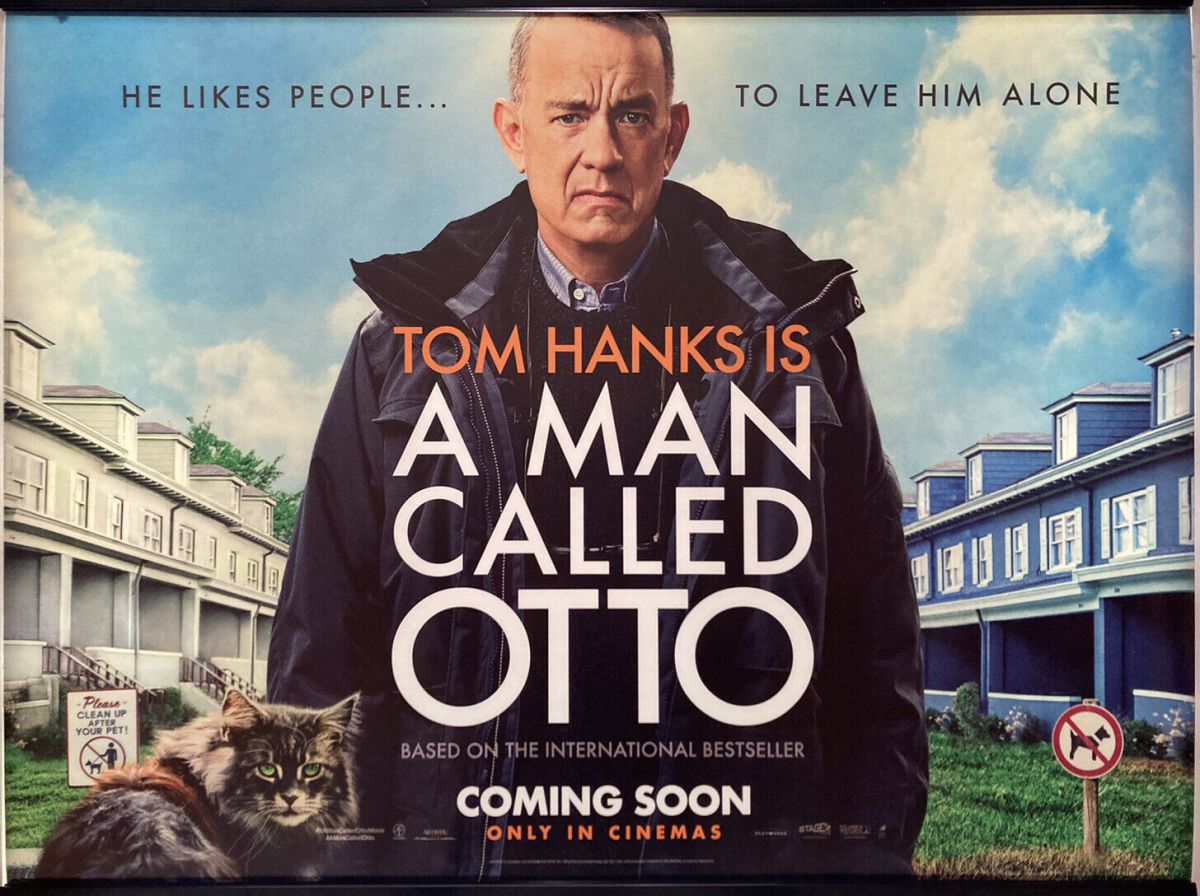
Heart-warming tale of a suicide wannabe. Yep, the studio didn’t know how to sell it either, and the trailer had originally put we off, a gurning Tom Hanks and the annoying neighbor from hell. And it just shows what a sick character I must be that I was chuckling all the way through. Because, yes, and without any attempt at black comedy, Otto (Tom Hanks) spends the first half of the picture trying to commit suicide, depressed, we later discover, at the death of his wife.

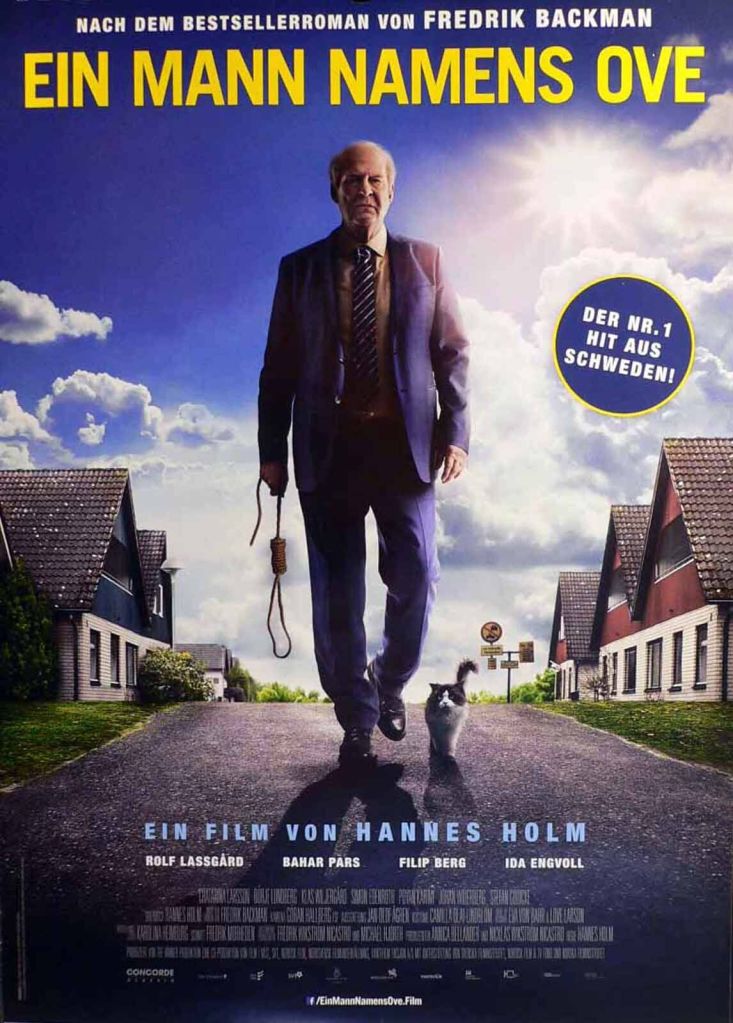
As if a riff on The Marriage of Figaro, we first encounter Otto when he is measuring rope for a noose with which to hang himself. But being a truculent nit-picking type of guy – the Everyman you would cross the street to avoid – he gets into an argument with the store manger on account of not being to buy exactly the length of rope he wants. Suffice it to say that this homespun guy who otherwise can fix anything and has every tool known to man can’t grasp the mechanics of suicide. He’s one foot in the grave when he would clearly prefer two.

The more ominous original – note the noose.

While he’s failing at this one simple task he’s getting annoyed to pieces by the new pregnant neighbor Marisol (Mariana Trevino) and her hapless husband Tommy (Manuel Garcia-Rulfo) who can’t fix anything and by virtually everyone else in his universe who can’t follow simple rules like displaying your car sticker in the proper position. He’s an artisan trapped in a world controlled by idiots, blasting away at the inanities and inequities of modern life.

It takes such a long time to warm up you think it’s never gone to manage the switch into feel-good movie, what with so many numbskulls getting in the way, and Otto being the kind of guy who will fall out with his best friend because he bought the wrong kind of car. And it takes so long because it’s hardly gentle stuff, instead mostly biting, or inexplicable especially when Marisol takes off on a great riff of Mexican words.

His past opens up, courtesy of mementoes, and we realise he wasn’t always this kind of walking rulebook keep-off-the-grass poster boy.

Critics have been pretty sniffy about this but audiences know better and are turning out in bigger droves than for Tar, Babylon or The Fabelmans because it’s what audiences have been crying out for for so long – a good well-made drama that touches on some pretty awful feelings and doesn’t take the easy way out. Otto is made to work pretty hard to find community among people he automatically despises.

I’m not sure we need the flashbacks where a younger cuter Otto (Truman Hanks, yep even here, nepo abounds) romances his wife, because Otto gets over the line on his own within his grumpier shell without reverting to the nicer, shy guy he once was, cute as that tale is. And there’s an equally unnecessary nod to contemporary tropes, what with Otto showing his kinder side by taking in a trans and social media demonstrating how much it can be a boon – rather than a menace – to society when Otto decides to take up the cudgels against real estate villains.

Cutesville – for the book.

The characters are all so – what’s the word I’m looking for – real. Even the dumbest of them, initially portrayed in somewhat cartoon fashion,  turn out to be just human.

As I said, I was chuckling or straight out laughing all the way through and I’m glad to say that Marisol and I connected on the sickest joke of all, the one about the big heart (I’m not going to give that one away).

Given I had no idea what I was letting myself in for, all advertising having carefully avoided any mention of the S-word, and was really only squeezing this into my weekly triple bill because of limited choice, and the trailer did it no favors, my heart sank as that esteemed outfit the British Board of Film Censors stepped in where Hollywood marketing persons feared to tread and announced, in its apparently regulatory slot, that this movie contained “suicide theme.”

That certainly got my attention, but did nothing for my confidence in a piece of entertainment, wondering if I had been mis-sold or misled, but within a few minutes Otto’s antics had me in stitches.

Tom Hanks (Elvis, 2022) is back to his best after a few dodgy characterisations and in too many films that seemed to disappear into the maw of the streamer. And it says a lot for his creative juices that he chose a part that played very much against type. But Mariana Trevino (Polvo, 2019) is the bonus here, a comedienne of genius.

Marc Forster (Monster’s Ball, 2001) is back on form, too, totally in command of a movie that could so easily have slipped sideways into a vat of treacle or the other way into the outer space of black comedy. David Magee (Lady Chatterley’s Lover) wrote the screenplay based on Fredrik Backman’s A Man Called Ove which had been turned into a film in 2015.

Ignore the critics, go see.

Selling Oscar Winners – Pressbook for “The Slender Thread” (1965)

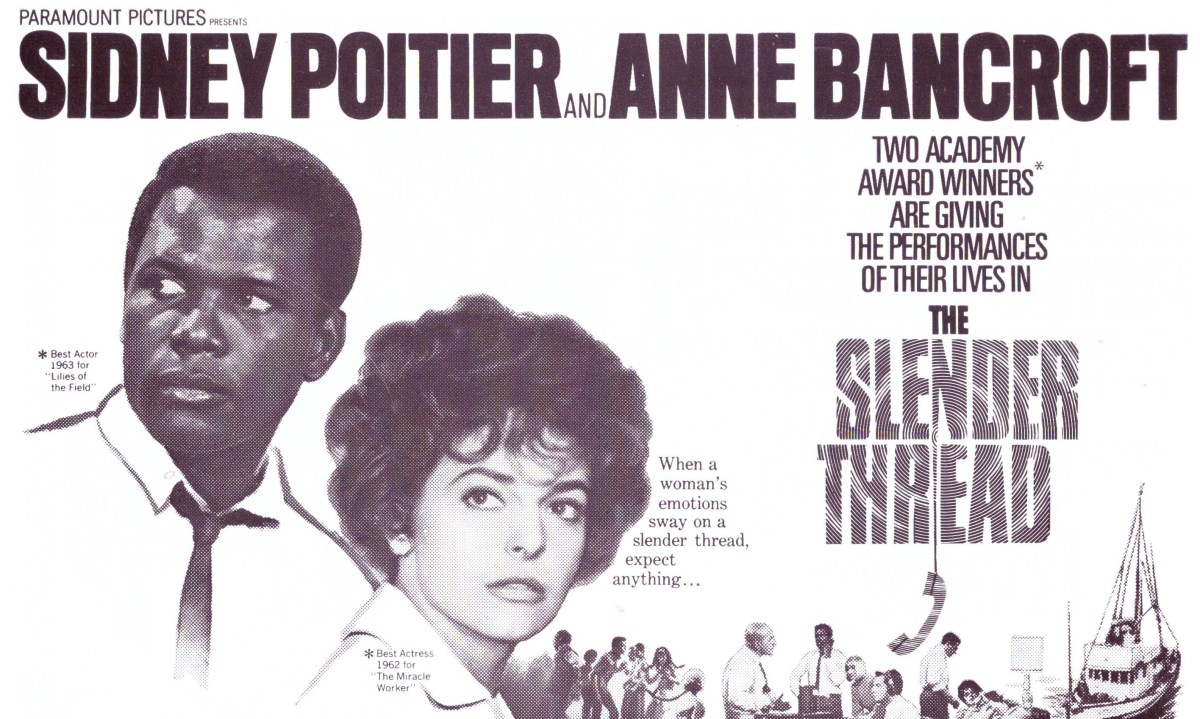
Just how do you sell a movie about a suicide to an audience for whom such a subject is still taboo? The answer is – you don’t. Instead, you fall back on your stars – and the fact that they are both Oscar winners.

We are pretty used these days to advertising campaigns, especially trailers, focusing on Academy Award recognition – The House of Gucci (2021), for example, boasting umpteen winners and nominees – but it was far rarer in the 1960s when exhibitors expected Pressbooks to provide them with sufficient marketing information to lure in the customers. Oscar success might have been mentioned in passing, forming part of a participant’s biography, but it would not be the entire focal point of the campaign.

The 16-page A3 Pressbook for The Slender Thread does nothing but. There was, of course, a link between the two stars in that Anne Bancroft recipient of the Best Actress Oscar for The Miracle Worker in 1962 had the following year presented Sidney Poitier with his Best Actor gong for Lilies of the Field (1963).

“Two Academy Award winners giving the performances of their lives” is pretty much as far as the tagline writers went in providing exhibitors with something to sell. The subsidiary tagline “when a woman’s emotions sway on a slender thread expect anything” offer little in the way of explaining the film’s content. An image of a phone plays a prominent role in artwork but again without clarifying its purpose. In much smaller writing, at the end of another reference to the Oscars, is the mention of “a motion picture rarely, if ever, surpassed in suspense” but again minus clarification.

You might actually come away with the notion that the drama takes place on the high seas since a ship features in the advertising.

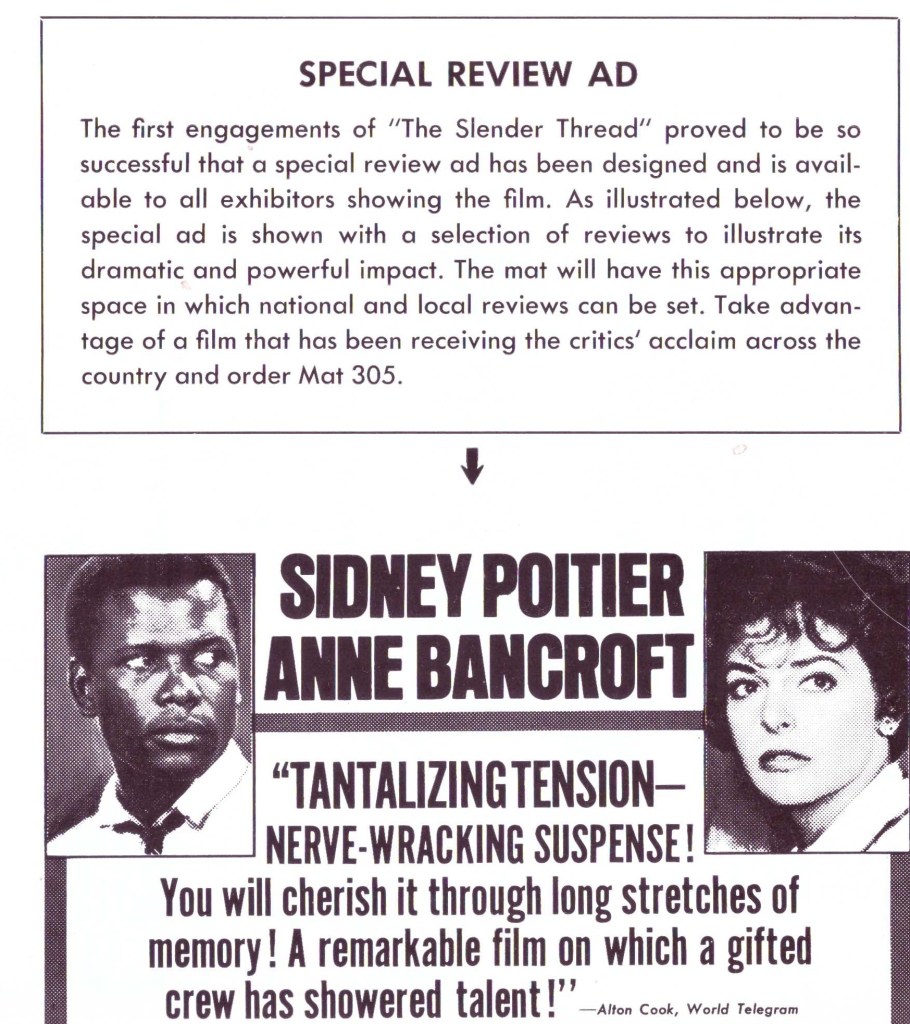
The only other assistance given exhibitors came in the form of reviews which make more mention of suspense. Cue magazine termed it “gripping, bristling tension and suspense all the way.” Kate Cameron in the Daily News concurred – “a high tension suspense film” as did Alton Cook of the World Telegram (“Tantalizing Tension! Nerve-Wracking Suspense!). Nobody mentioned what caused the tension and suspense.

The best bet for tie-ins came from record stores since record label Mercury has organised a “giant merchandising campaign” promoting the Quincy Jones soundtrack. The studio took the chance that exhibitors might take it into their own hands to organise some tie-ups with beauty salons, telephone companies and discotheques since these make an appearance in the picture.     

Quite how 16 pages of the same repeated artwork was meant to inspire exhibitors into, first all, booking the picture, and then, consequently, selling it to moviegoers is never explained.

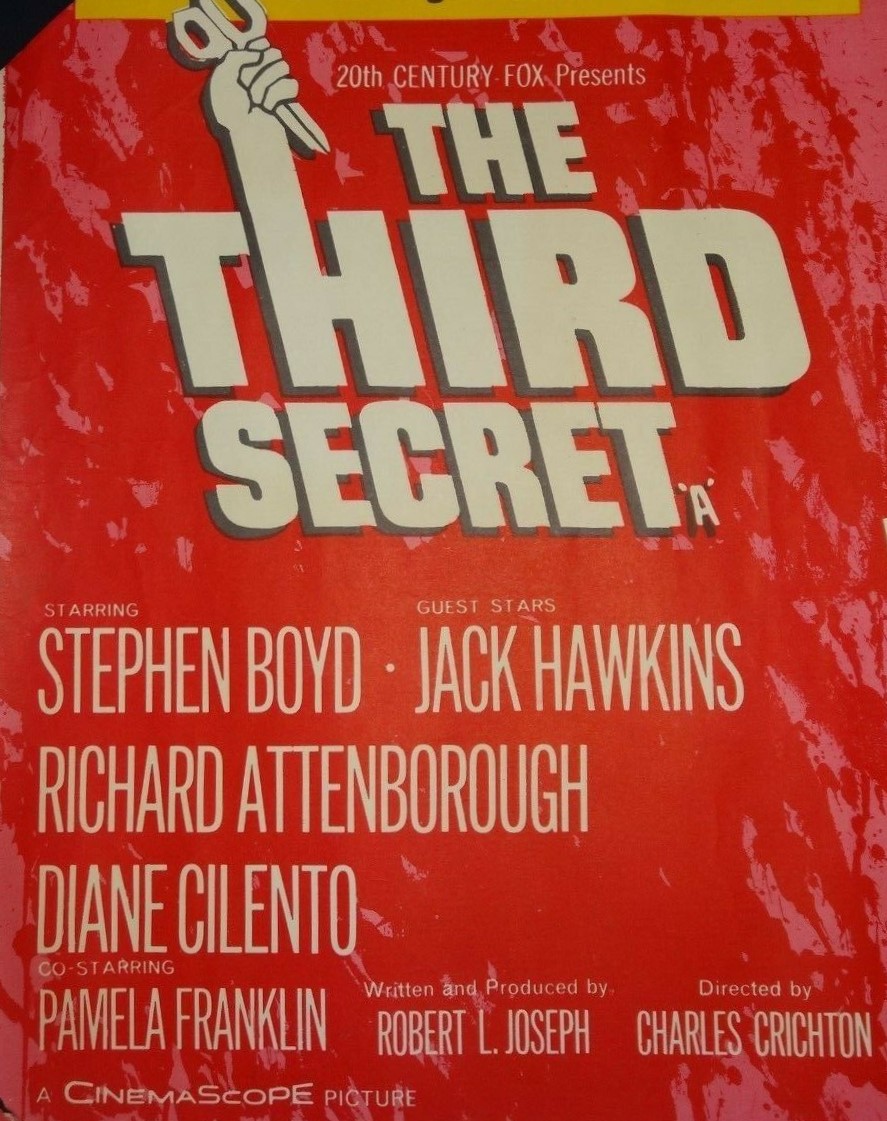
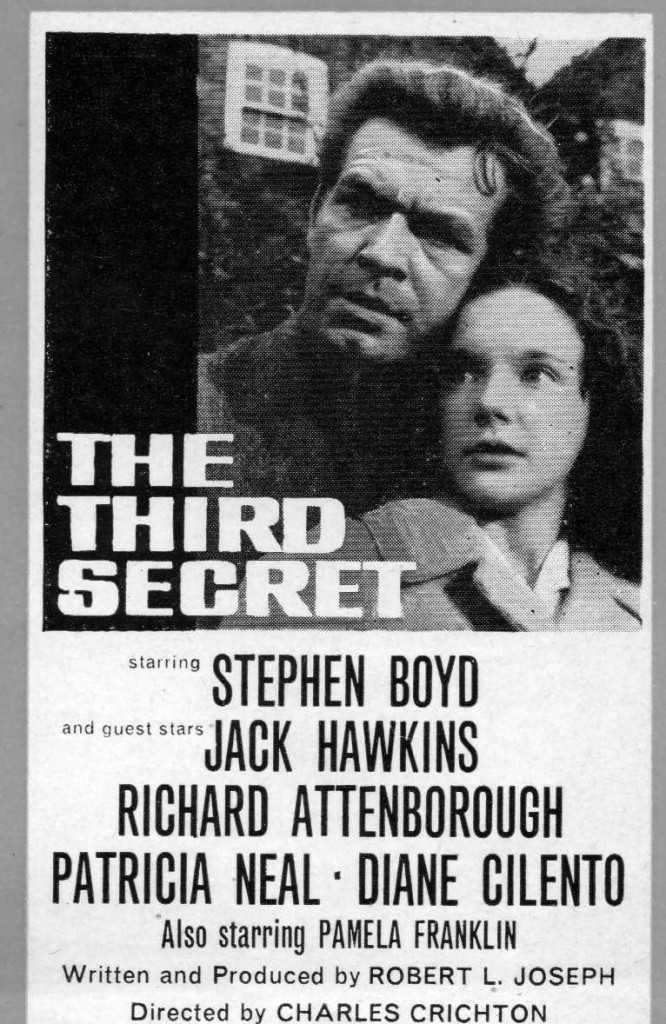
The Third Secret (1964) ***

Non-exploitative films about the psychologically vulnerable were thin on the ground during the 1960s and although The Third Secret is a bit talky nonetheless it does explore issues normally dealt with in heavy-handed fashion. Catherine Whitset (Pamela Franklin) the young daughter of a famous psychiatrist convinces television journalist Alex Stedman (Stephen Boyd) to investigate her father’s supposed suicide. Whitset needs the murder verdict because otherwise she will lose her home (no insurance payout on suicide). Stedman, Whitset’s patient, wants a similar outcome because his world would be turned upside down if the psychiatrist had committed a deed which he appeared steadfastly opposed.

The main suspects are all patients of the dead doctor – judge (Jack Hawkins), gallery owner (Richard Attenborough) and secretary (Diane Cilento). Although all outwardly successful socially-functioning upstanding members of society each is mired in mental agony – anger management, sexual inadequacy, depression, low self-esteem among problems addressed – defenses against which are perilously thin. Under sustained pressure each of the individuals will crack to reveal the cowering creature underneath.

But are they the killer or just condemned to torment? With the one man who could keep them sane removed from their lives, who knows what carnage they can self-inflict. All, even Stedman – given to bouts of terrible rage and drunkenness – seem capable of murder and there is every likelihood (as any viewer will guess) that his investigation could lead back to himself.

Director Charles Crichton (The Lavender Hill Mob, 1951) might have been suffering from low self-esteem himself having been unceremoniously dumped from The Birdman of Alcatraz (1962) and certainly the atmosphere is one of severity, not just characters teetering on the brink, but the black-and-white photography rendering London a wasteland, the tide on the Thames always out so the shore is just mud. However, his compositions do have style. The title’s explanation by the way is that the first secret is what you keep from the public, the second is what you hide from yourself, but the third is the truth.

Boyd (Ben-Hur, 1959) and Franklin (The Innocents, 1961) appear often on the point of hysteria, the girl’s high-pitched voice set against his growling outbursts. Attenborough (fresh from the heroics of The Great Escape, 1963) plays against type as a hand-wringing wannabe artist stuck in a role he despises. Hawkins, too, more used to heroic roles, is convincing as a man trying to escape his past. The neurotic Cilento has the best scenes, touching in her efforts to cling to normality. Judi Dench makes her debut in a bit part. The investigation takes the form of character analysis rather than “where were you on the night of…” which gives the picture an unique flavor, but best to know that going in rather than complain about the slow pace. If the psychological does not keep you hooked, there are sufficient twists to keep you watching.

Discover WordPress

A daily selection of the best content published on WordPress, collected for you by humans who love to read.

The Atavist Magazine

by Brian Hannan

WordPress.com News

The latest news on WordPress.com and the WordPress community.