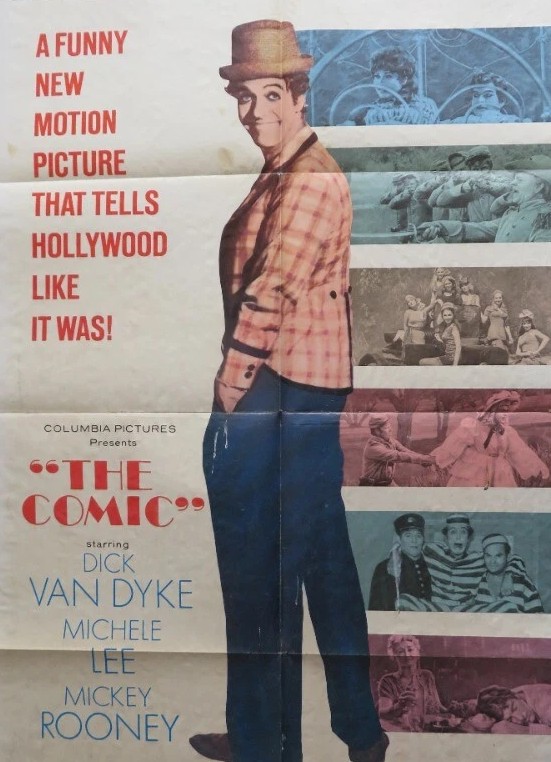
It’s a Hollywood trope that successful screen comedians invariably want to test their mettle in more dramatic circumstances. Studios tend to cave in to such self-indulgence, usually with the proviso that the star makes another couple of laff fests with them, but audiences tend to give such enterprises the thumbs down. Dick Van Dyke (Divorce American Style, 1967), on a commercial roll for most of the decade, took the, theoretically at least, easier option of limiting the drama on this one.
Silent films were also on a commercial roll, the oldies having made a comeback via compilation reissues and through slapstick homages such as It’s A Mad, Mad, Mad, Mad World (1963) and The Great Race (1965) so setting the picture in that era in Hollywood’s history seemed a sure thing.
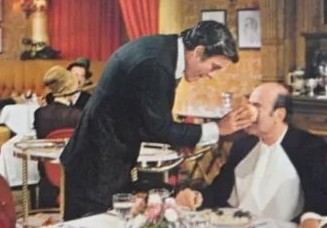
And it starts off bang on the money. A eulogy delivered at a funeral is interrupted by a pie in the face and (as seen above) that device can be utilized at any point.
I’d be telling you to give this complete misfire a miss if it wasn’t for an exceptional final third. The first two-thirds is made up of far too many silent film sequences starring Billy Bright (Dick Van Bright) who goes from vaudeville clown to major star complete with, at the height of his fame, being accorded the honor of a having a clockwork toy made of him.
When it’s not diverted into yet another silent movie sequence, which only serves to show that a modern comedian lacks whatever smarts the silent movie comedians had, the drama takes roughly the same approach, with scenes that could have come from a silent movie if not quite to the utmost.
Thanks to a multitude of affairs Billy burns his way through marriage to Mary (Michele Lee) and thanks to an overfondness for the bottle nearly kills off his career before the arrival of the talkies does that for him.
Eventually, and suddenly, we switch to an entirely different picture, a proper drama, very bold indeed for the time for its portrayal of old age and loneliness – a representation that would chime very much with today’s audiences. You don’t quite warm to this old fella because he wasn’t particularly sympathetic to begin with, but still, in its rawness, this section exerts a very emotional pull.
And, indeed, for Dick Van Dyke it was an incredible piece of acting. He morphs from young, tall, and fit with a head full of hair to an old bloke, bent over, shuffling and with the kind of comb-over that would put Bobby Charlton to shame. He’s been abandoned by everyone except sidekick Martin (Mickey Rooney) whose career has also gone south. They tell lies to each other to keep up their spirits.
The highlight of Billy’s life is getting a set of false teeth and setting the alarm for 4.30am so he can get up and watch reruns of his old movies on television. He lives on boiled eggs and milk.
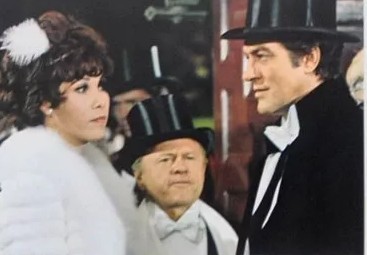
And he’s still dumb enough to be rooked by a gold-digger. He’s placed an ad in Variety, drawing attention to the fact that he’s still alive, which wins him a spot on a TV chat show which turns into a gig for a commercial which leads a much younger woman to think he must be loaded. He ends up marrying her while in an oxygen tent, but she vanishes when she discovers his newfound fame has led to nothing.
In theory, this is about the side effects of fame, the temptations which few can avoid, and the sudden collapse in income and public awareness when the well runs dry. But, in reality, setting aside the Hollywood overtones, the last third could have been about any lonely old man.
A film of three thirds for the star, in the first two there’s nothing much to hold onto, in the last one he excels. Nobody else has much to do. Directed by Carl Reiner (The Jerk, 1979) and written by him and Aaron Ruben. Reiner had been the writer of The Dick Van Dyke Show so presumably that played a part in him getting the gig.
Died an absolute death at the box office. Not released outside America for decades and then only on DVD.
If it hadn’t been for the final third this would have been rated a one-star effort, it’s such an ill-conceived concept, and disastrous in its execution, but that final third makes it very worthwhile indeed if you can stick with it.
 The Magnificent 60s