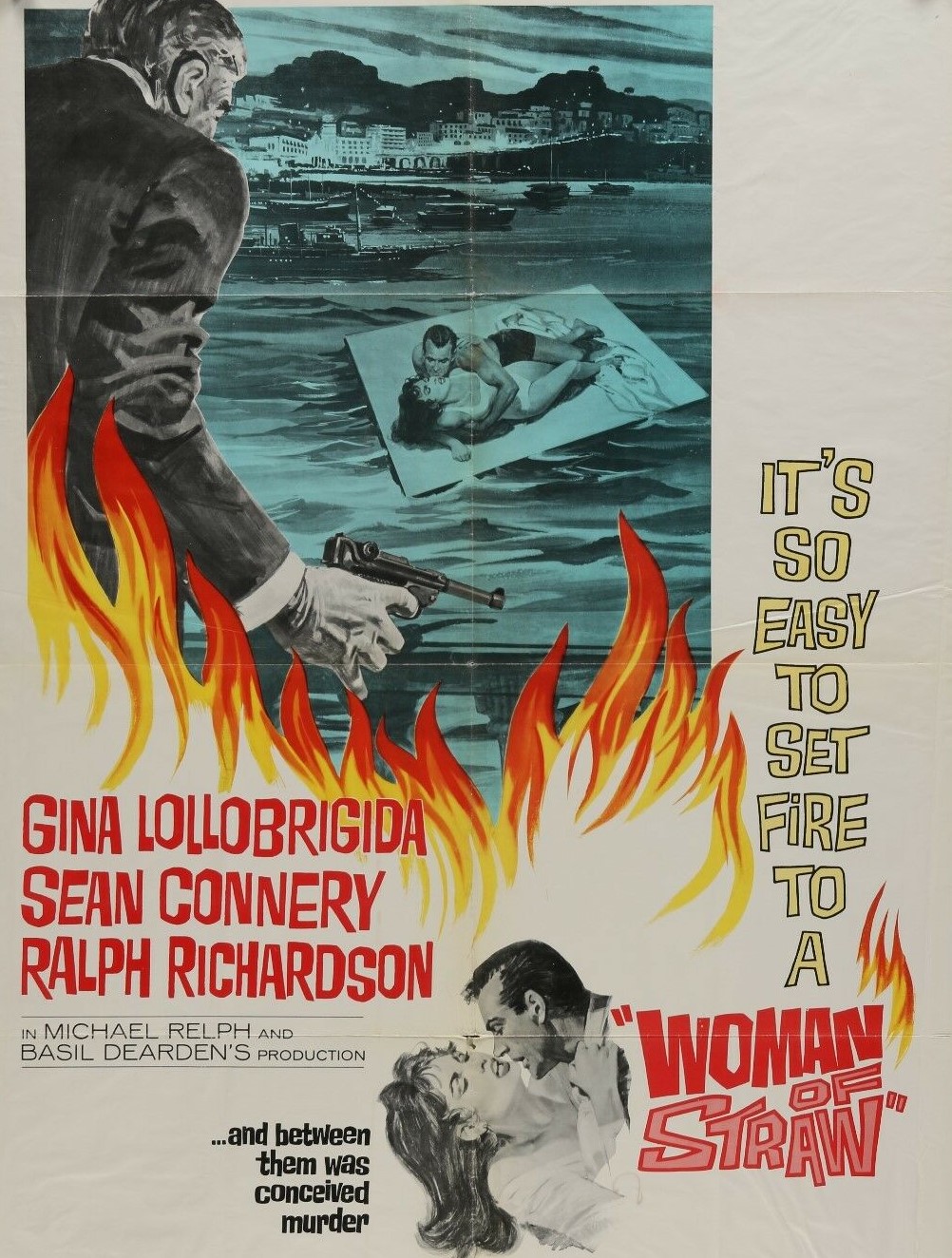
Woman of Straw (1964) ***

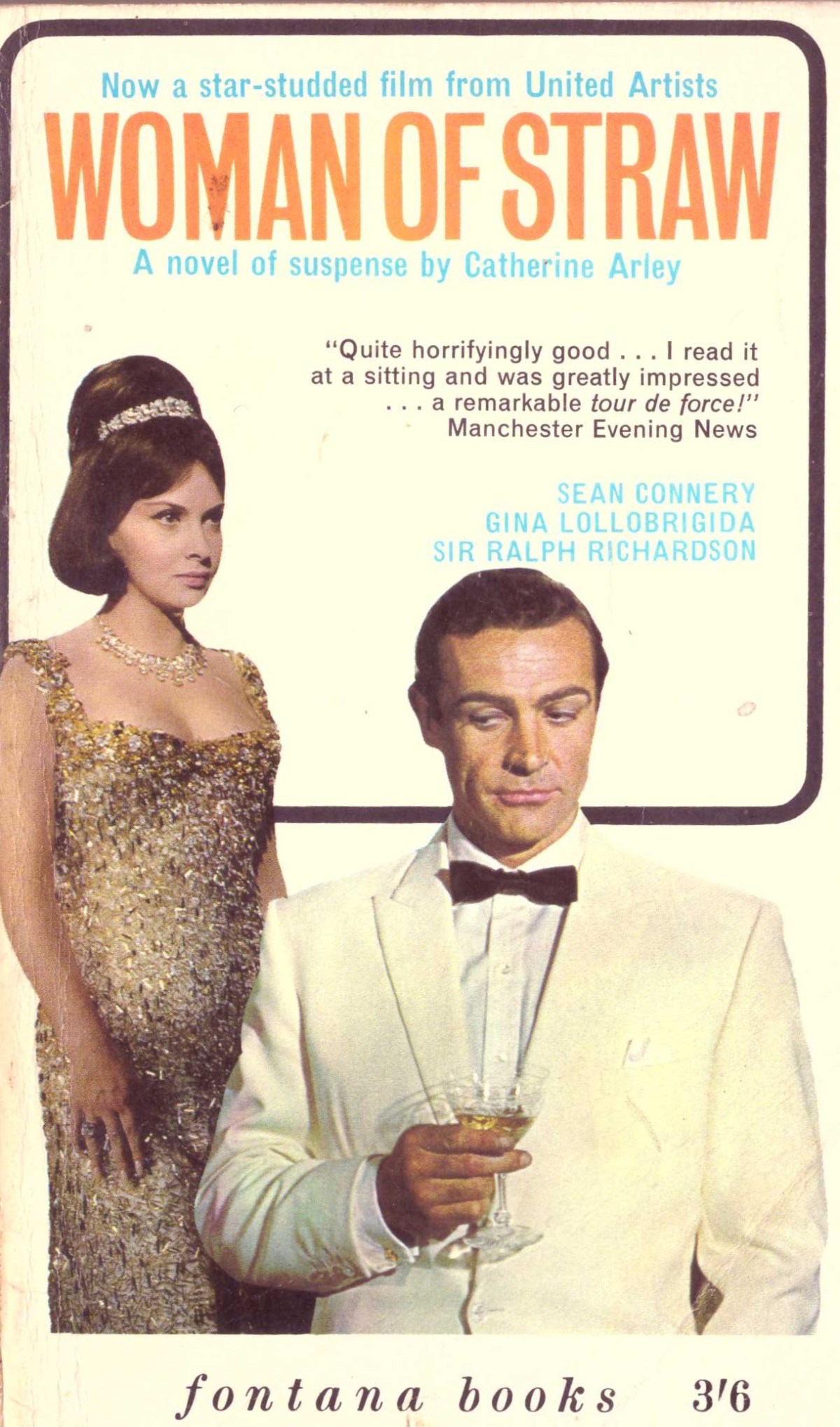
In a plot worthy of Hitchcock without that director’s sly malice, rich playboy Tony (Sean Connery) conspires with not-so-innocent nurse Maria (Gina Lollobrigida) to rid himself of  heinous upper-class racist misogynistic bully Charles (Ralph Richardson), his uncle. Beyond  a savage case of entitlement, Tony has good reason to hate the wheelchair-bound multi-millionaire, blaming him for his father’s suicide and for seducing his widowed mother, now dead. Tony’s ploy, in part by opposing the very idea, is to get Maria to marry Charles, inherit his fortune and provide himself a £1 million finder’s fee when the seriously ill old man dies.

Maria’s refusal to kowtow to the old man and her initial resistance to Tony make her all the more desirable to both. When Maria saves the old man from a potential heart attack, he is moved enough to marry her and draw up exactly the will the pair want. But when he suddenly dies, Maria surprises herself by the depth of emotion she feels.
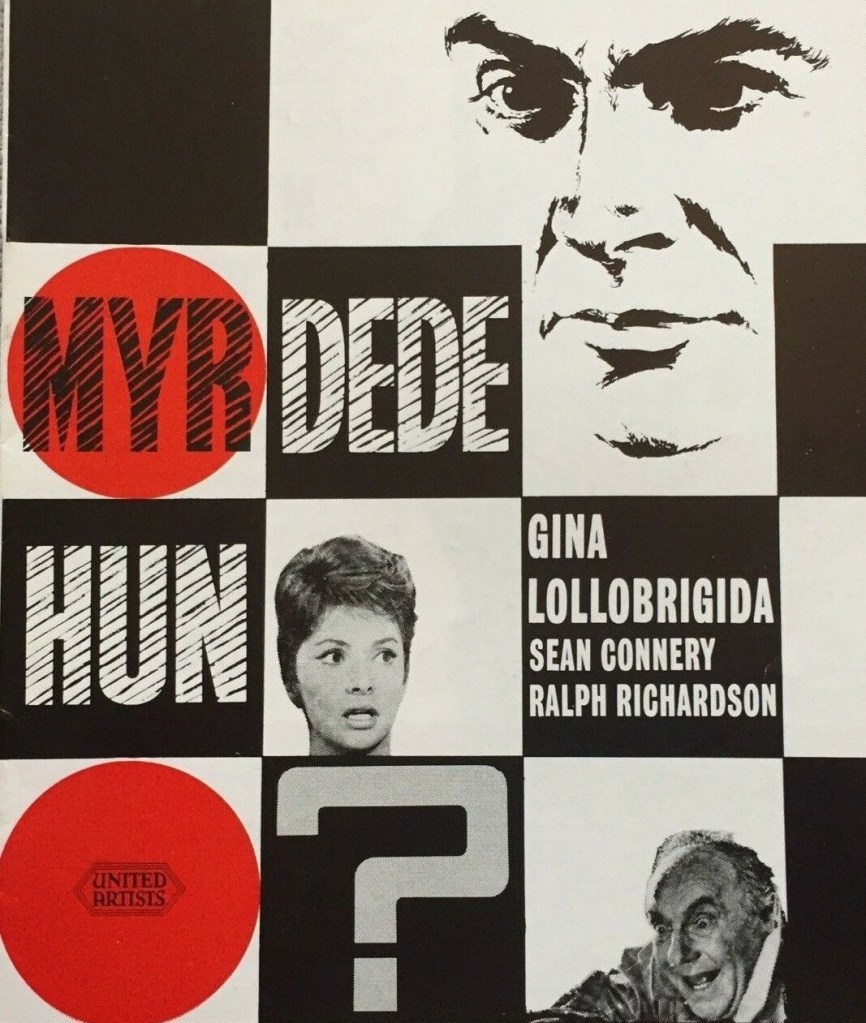
But that soon changes when she comes under suspicion. A bundle of complications swiftly change the expected outcome. A police inspector (Alexander Knox) doubts cause and place of death.

The first half is the set-up, the various figures being moved into place, not quite as easily as might have been anticipated, which adds another element of tension. Charles is such a hideous person nobody could lament his passing, but still his vulnerability, not just his wheelchair confinement but his love of music, his better qualities coming to the fore as the result of Maria’s presence, accord him greater sympathy than you would imagine.

That the otherwise gallant Tony’s entitled life depends entirely on his uncle’s good wishes lends him an appealing frailty. The nurse’s principles safeguard her against being taken in by riches alone, but there is a sense that she has used her physical attraction in the past to her advantage.

After the first two James Bond pictures, this was Sean Connery’s first attempt to move away from the secret agent stereotype and in large part he is successful. As amoral as Bond, he could as easily be a Bond villain, smooth and charming and larger than life and superbly gifted in the art of manipulation, the kind of putting all the pieces in place that Bond villains excelled in.
It will come as a surprise to contemporary viewers that he is merely the leading man, not the star. Gina Lollobrigida (Go Naked in the World, 1961) receives top-billing because she carries the emotional weight, initially perhaps as cold as Tony, but her attitude to Charles changing after marriage, meeting a need that Tony would not consider his to fulfill, and beginning to regret going along with any devious plan. That she then discovers she may merely be a pawn rather than a partner creates the dilemma on which the final section of the film depends for tension.

Both actors are excellent, exuding star wattage, the screen charisma between them evident, and audiences craving the pairing of Connery with an European female superstar will be well satisfied. Lollobrigida has the better role, requiring greater depth, but it is romance as duel most of the way. Ralph Richardson (Khartoum,1966) has never been better as one of the worst human beings ever to grace a screen. Johnny Sekka (The Southern Star, 1969) brings dignity to the maligned servant and Alexander Knox (Khartoum) is a crusty cop. 

A slick offering from Basil Dearden (The Mind Benders, 1963), with one proviso – see seaparate article for the racism in this film. Written by Robert Muller (The Beauty Jungle, 1964) and Stanley Mann (The Collector, 1965) based on the novel by Catherine Arley.

Could have done with expending less time on the set-up and getting to the meat of the thriller quicker.

The Mark (1961) ****

Despite an exceptional and Oscar-nominated performance by Stuart Whitman (Rio Conchos, 1964) , I suspect modern audiences will take less kindly to this tale of convicted child molester trying to come to terms with his feelings. At least it’s considerably more honest than the creepier May December (2023) where the criminal steadfastly contended her innocence.

And I suspect, too, that Whitman’s square jaw and muscular physique got in the way of his attracting the parts for which the depths of vulnerability he was able to exhibit were most suited. He came to this straight after an action role, as the charming bad-good-guy of The Commancheros (1961) where, as far as audiences were concerned, what he did with his fists was more important that what he expressed through his eyes.

There’s a bit of a grey area that lends the convicted Jim Fuller (Stuart Whitman) the benefit of the doubt. He was found guilty of intent not of actual molestation and a goodly part of the picture is spend on examining why he went down that route, either in a group exercise in prison or one-on-one with a psychiatrist, chain-smoking Irishman Dr McNally (Rod Steiger) in both instances.

I’m not sure how the psychiatric evidence adds up, but basically, with a dominant mother who bullied his father, he grew up frightened of women, despite being attracted and attractive to them, and sought out someone with whom he felt more comfortable, less challenging, leading him to spend too much time watching children at play and eventually buying a young girl an ice cream and going out on walks with her.

It would have been too much for audiences of the time – as it even was with May December – to go into the technicalities of what he intended to do so we are left to trust his own word that he never intended to instigate anything sexual, though why kidnap a child in the first place. The second element that would fill modern audiences with alarm is that though he manages to begin a sexual relationship with a woman of his own age, secretary Ruth Leighton (Maria Schell), she is a widow with a young daughter. Most people would instantly come to the conclusion he was using mother to groom daughter.

However, the film takes the tack that he’s using the daughter to explore a normal relationship with a child, the joy of having a daughter, and the delight and happiness that a young person can bring into a dour repressed life. Dr McNally keeps on banging on that Fuller is “cured” but it’s a very uneasy watch trying to work out if he is or not.

In the event, the first time he’s alone with the girl he is photographed by a local journalist who sticks the photo on the front page, destroying the life Fuller has carefully rebuilt. He has found employment as an accountant with a sympathetic business owner Andrew Clive (Donald Wolfit), fitting in so well he is promoted, though at odds with another senior employee Roy Milne (Paul Rogers). He is chucked out of his accommodation, loses his job and although Ruth initially stands by him the minute she sees Fuller with her daughter her instincts are hostile.

There would be no point in an actor trying to gain sympathy for such an unsympathetic character by playing to the gallery with bouts of temper or floods of self-pitying tears, but even so, the vulnerable husk Whitman presents, his struggles with his self-contempt, his understanding of the feelings he must invoke, his determination to live as quietly as possible, almost in that determined English manner of never being heard nor seen, is what makes this film. Interestingly, he replaced Richard Burton, who pulled out at the last minute (as did Jean Simmons) and you could easily imagine with those trademark quick intakes of breath and deep growls how that actor would have played the part.

Whitman doesn’t go near any grandstanding. It’s just a heartfelt performance of a man who’s lost his way and knows he might never find his way back, haunted by his past, unable to trust himself, unable to believe that he is, in fact, cured. Probably, the biggest issue is that the movie comes down on his side, especially when he becomes one of the usual suspects in another crime involving children, though he did not commit that, and tries to suggest that a child molester will find salvation through living with a mother and child in the normal fashion. As I said, this is not my subject of expertise, thankfully, and that may be well what’s advocated rather than staying away from children altogether.

While the approach might be considered a shade naïve at the same time it does examine issues surrounding reintegration and avoids the obvious trap of attempting some kind of character redemption.

Apart from Whitman, there are good performances all round. Maria Schell, whose career within a decade would go from roadshow blockbuster Cimarron (1960) to WIP epic 99 Women (1969), subsumes her normal more glamorous persona to play a believable working mother. With his chain-smoking, Rod Steiger (The Pawnbroker, 1964) is allowed to fidget to his heart’s content but even such obvious scene-stealing only places more emphasis on the quieter Whitman. Donald Wolfit (Life at the Top, 1965), too, reins in his usual bluster.

Guy Green (The Magus, 1968) directed from a screenplay by Sidney Buchman (The Group, 1966) and Stanley Mann (The Collector, 1965) from the bestseller by Charles E. Israel.

In this instance, given the Oscar nom, Stuart Whitman could hardly be considered under-rated but over the years seems to have disappeared from sight.

Worth a look to see what he could do with the right material.

We Need To Talk About Sir Sean, Part II: Who Wrote That Heinous Racist Scene: Book into Film – “Woman of Straw” (1964)

You can blame one of the screenwriters, either Robert Muller (Contest Girl, 1964) or Stanley Mann (The Collector, 1965), for coming up with the scene in Woman of Straw where the grotesque millionaire Charles Richmond (Ralph Richardson) forces his two black servants to pretend to be dogs to show his own dogs how to jump over each other. It’s not in the book. However, in fairness to the screenwriters they must have thought this preferable to the scene in the original book by Catherine Arley where Richmond offers a gold watch to the best imitation of a dog by his servants. This includes them getting down on all fours and eating food like a dog. Disgusting though this is, it is tempered by being a competition with a more than decent reward (a gold watch) for the winner.

The offensive scene in “Woman of Straw.”

And now we get into a difficult position since one of the most highly-praised episodes of Succession involved employees of grotesque millionaire Logan Roy (Brian Cox) being forced to get down on the floor and pretend to be boars and eat sausages like a boar (Boar on the Floor, Succession, Season Two, Episode Two). This sequence has a 94% rating on Rotten Tomatoes, the critical accumulation website. The episode won an Emmy for director Andrij Parekh. Scott Tobias of Vulture gave it five stars and Randall Colburn of The A.V. Club an A-minus. Various commentators referenced the Stanford Experiments, the culture of fear inherent in working with wealthy individuals, and the animalistic collapse of civilization.

So that has left me wondering if my objection to Woman of Straw was merely on racist grounds and to wonder if there would have been an outcry if the Succession episode had featured a black person grovelling on the ground.

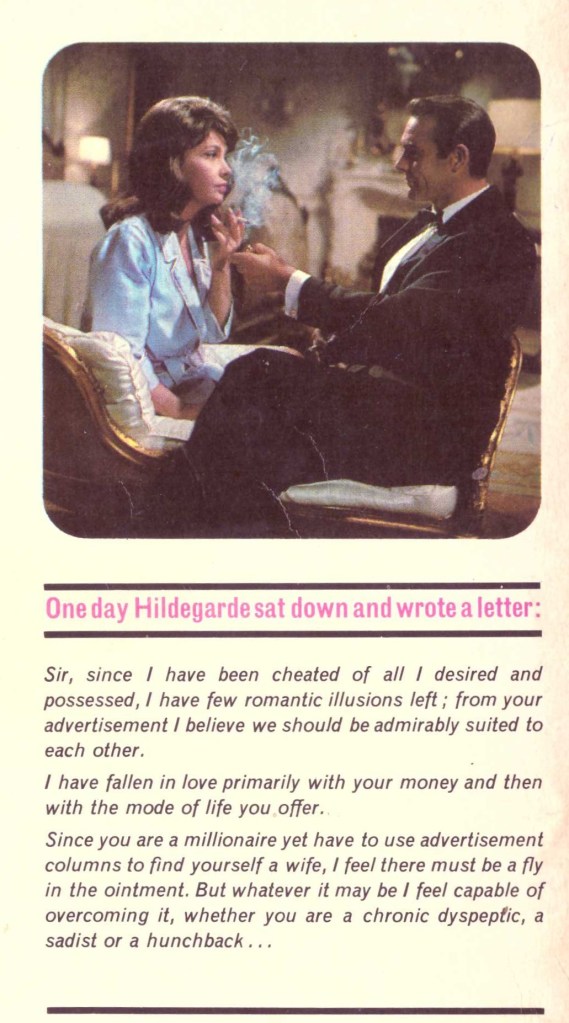
The screenwriters made significant changes to the source novel. For a start in the book both the woman and the millionaire were German. Hildegarde Meiner in the book becomes the Italian Maria (Gina Lollobrigida) in the film. But Hildegarde is not a relatively innocent nurse as in the film. Instead, she is an out-and-out gold-digger, determined to marry a wealthy man in order to make up for a desperate life in the aftermath of the Second World War.

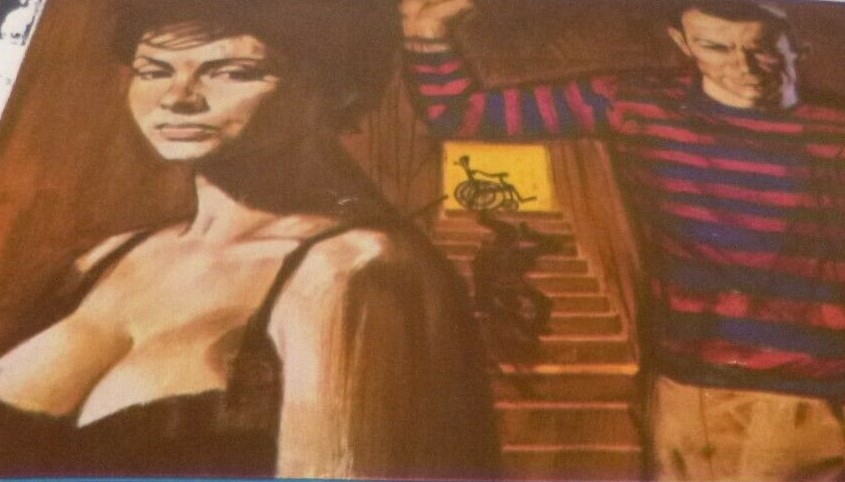
Back cover of the movie tie-in edition of the British paperback.

In the book the villain of the piece is also German, Korff, not British like Sean Connery. And he is simply the millionaire’s secretary not his nephew. The pivotal element of the story is the same, Tony Richmond (Connery) feeling he is owed much more of the old man’s fortune than the pittance provided for him in the will. Korff is also 60 years old and although Hildegarde makes a play for him, any romantic liaison is out of the question because the secretary wants to adopt her as his daughter.  Korff sets Hildegarde up as the nurse and instructs her to play it aloof and principled. Hildegarde does not fall into the category of beauty but, with better clothes and professional make-up, oozes class.

The rest of the story plays out much like the film except there is no rescue at sea and the millionaire does not listen to classical music. The novel narrative, while not in the first person, is told from the woman’s perspective. However, Korff is more devious than Anthony Richmond, ensuring in several ways that the nurse will take the rap.

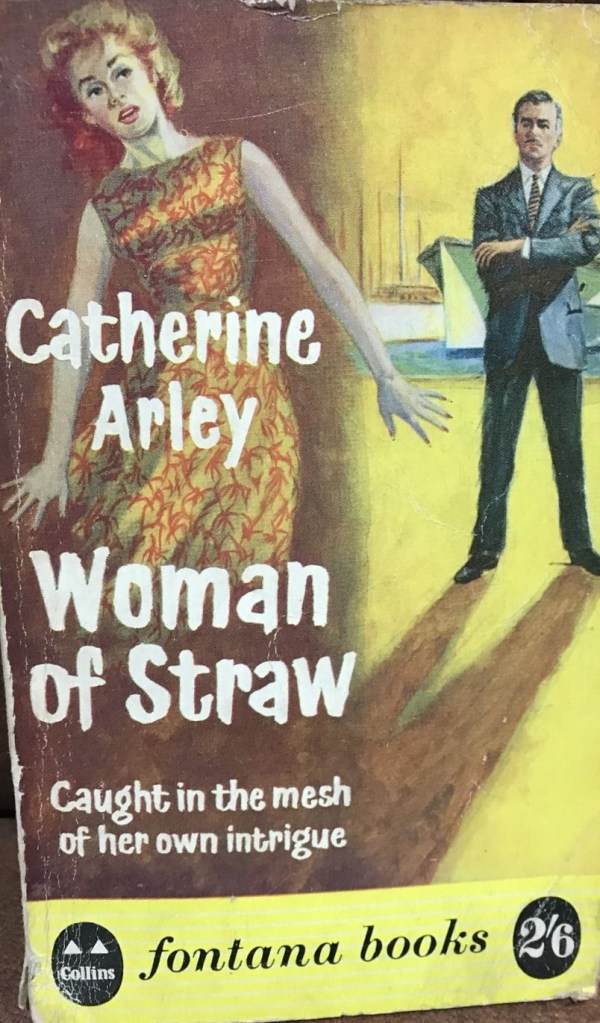
Front over of earlier British paperback, not a movie tie-in.

The film’s ending is driven by the need for some kind of happy resolution, for the guilty to be brought to justice, the dupe exonerated to some extent. But the book belongs more to the film noir genre and the ending is quite different, the villain getting away with and Hildegarde seeing no way out but to commit suicide.

The deprivations that Hildegarde has undergone as a consequence of her Hamburg family being killed during the war and her struggle for survival thereafter and her desperation to find a wealthy white knight make her a more  sympathetic character.

The book is an excellent thriller in its own right.

Discover WordPress

A daily selection of the best content published on WordPress, collected for you by humans who love to read.

The Atavist Magazine

by Brian Hannan

WordPress.com News

The latest news on WordPress.com and the WordPress community.