A huge flop at the time given both Richard Burton and Rex Harrison trousered $1 million. Now, primarily of historical interest, hailing from a time when homosexuals could be jailed. A man dressing up in woman’s clothing, as here, could be summoned in front of the magistrates. It’s the kind of movie that would work better if, as with the American idiom, the dialog of two people of any sex engaged in a long-term relationship was spattered with brilliant one-liners rather than a series of sarcastic putdowns.
Even so, there’s more here than originally met the eye. The fact that the hairdressers Charlie (Rex Harrison) and Harry (Richard Burton) have remained, like a married couple, together for twenty years says a lot about their enduring, if fractious, relationship. While Charlie has a daughter he never sees – and never wants to – Harry pines after a child. And there is some gentle complaint about why, in the eyes of the law, Harry would neither be permitted to adopt a child not to love a man, but those aspects are never in your face except that Charlie is awaiting his summons for the crime outlined above.
There’s not as much mincing and preening as you’d expect. Charlie is the better looking and has retained his good looks with the help of considerable pampering but Harry has lost his hair thanks to alopecia and rather than wearing a wig opts for a bandage.
It’s one of those movies where nothing happens based on a play (by Charles Dyer) where nothing happens, what little tension there is reliant on waiting (for the summons and the threat of an appearance by Charlie’s daughter). But while the stage can get away with two actors at the top of their game (Paul Scofield and Patrick Magee in London’s West End, Eli Wallach and Milo O’Shea on Broadway), that’s a far harder trick to pull off on screen.
So it’s to the credit of both actors than they make it work and we empathize with their immediate and ongoing circumstances. While Charlie sees his role as being the scathing dismissive one, leaving Harry to be supportive and apparently still in love, nonetheless his true feelings come out when he thinks his partner has had a heart attack.
In male-female terms, this would come across as just another middle-aged couple stuck in a humdrum marriage, and indeed there’s nothing elevated about the relationship between Charlie and Harry who live a very working class life in London’s East End, the former’s ambitions to become an actor long since dashed.
There’s not much director Stanley Donen (Surprise Package, 1960) can do to open up the play beyond sticking a few of the scenes outdoors and there’s one sequence that would raise eyebrows these days when Charlie ogles half-naked male teenagers playing in the sun. The worst reason for adapting a play for Hollywood is that, unless farce raises its head or there’s a string of one-liners or hilarious circumstance, the verbosity plays against the possibility of there being outstanding cinematic sequences. Luckily, it ends with one, when Harry takes a frightened Charlie by the arm.
I’m not sure I’d actually recommend it because there’s not much going on and the performances are not in the Oscar league, but it is much better than I thought. Rex Harrison (The Honey Pot, 1967) has the showier role, Richard Burton (Anne of the Thousand Days, 1969) reining himself in.
Commercially, nobody came out of this well. Rex Harrison didn’t make another film for eight years, Burton finding it more difficult to extract a million bucks from producers, and Stanley Donen continuing his run of poor box office. And harder for any British audience to take this seriously once comic pair Morecambe and Wise started sharing a bed in their sketches.
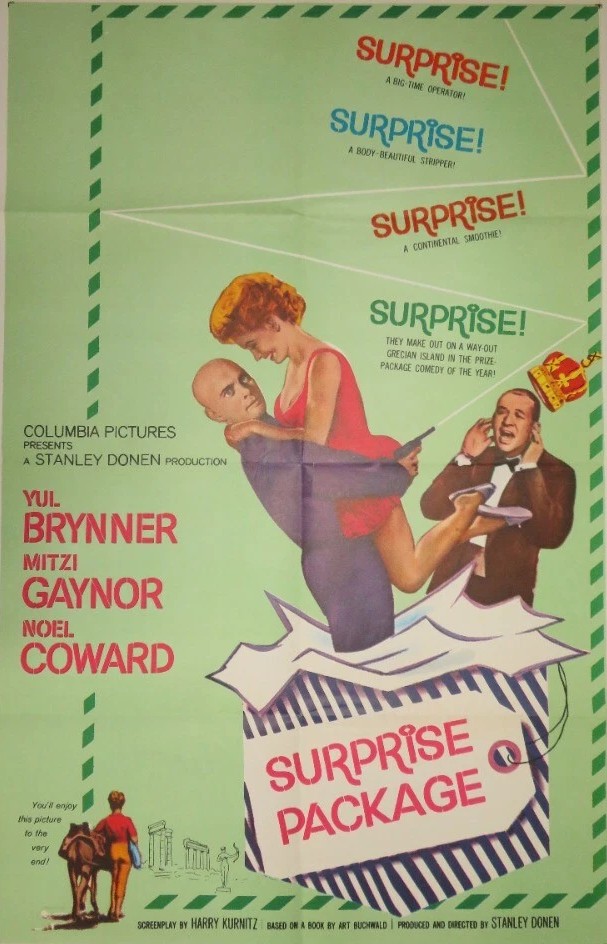
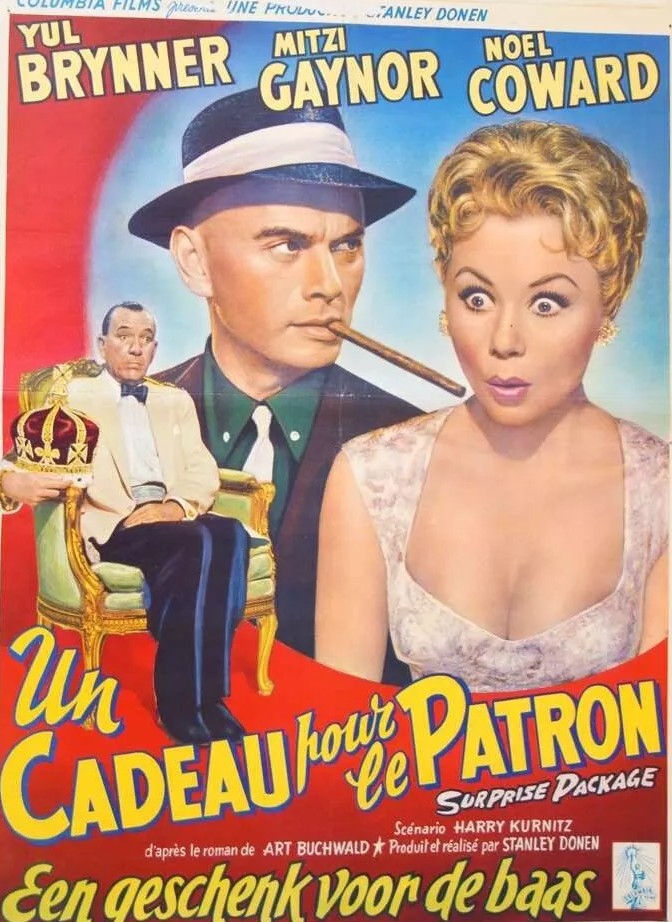
Poses two questions. Is this every bit as bad as Once More with Feeling, Stanley Donen’s previous picture? Yep, sorry, it’s every bit as wretched. The second question is: how on earth did Donen go from this mess to sublime romantic thriller Charade three years later? Well, the answer might simply be in the casting. Yul Brynner is no Cary Grant. And in this movie he’s not even Yul Brynner.
My guess is he’s meant to be a humorous twist on the Brynner screen persona. But playing a gangster with a thick Noo Yoik accent was always the preserve of the dumb supporting actor not the star. And since Yul Brynner isn’t any more convincing in this than in Once More with Feeling the project is in trouble from the start.
We’re given too much of this faux gangster drivel at the start when mob kingpin Nico (Yul Brynner) is collecting tributes from his underlings. Then, for no particular reason, he is deported, sent back into exile to his homeland of Greece. There he encounters the only smart guy in the picture, the corrupt chief of police Stefan (Eric Pohlmann) who’s so astute in the bribery department that all Nico receives in return for his thousand dollar bribe is to be told he won’t be arrested for bribery.
Stefan sets up Nico to meet another exile, deposed King Pavel II (Noel Coward), whose accent makes no sense either unless he was exclusively raised in high class British society, schooled at Eton, a member of upper class clubs etc etc, otherwise how to explain the plummy tones unless this is also meant to be as over-the-top gag as Nico’s Noo Yoik accent. Nico plans to buy the king’s crown for a million bucks. But the boys back home stiff him and instead of the cash send him instead his girlfriend – the surprise package of the title – mob moll Gabby (Mitzi Gaynor), and the ongoing gag here is that, what with Nico trying to elevate himself in society, Gabby’s table manners and speech let him down.
So with no cash forthcoming, what’s a gangster to do to pad out his exile? So Nico decides to steal the crown. And if there had been either a hint of the classic heist a la Grand Slam (1960) or Topkapi (1964) or its alternative, the totally inept thief, then we might have been onto something. But instead we’ve got much what we might expect from such a poor piece – not much. And in any case, the laffs are meant to come from another party, representing the king’s citizens, and led by Dr Panzer (George Coulouris) who wants the crown restored to its proper home. Two crooks chasing the same prize? What a crazy idea. But this works as well as the rest of the picture.
Thanks to Gabby’s principles, the crown goes in neither’s pockets. To make a buck, Nico and the king transform the latter’s villa into a casino with Gabby, now Mrs Nico, employed as the hat check girl.
Stanely Donen made three pictures in 1960 and then not another man for three years, which suggested he was a) working on too many projects at once and b) that break sure refreshed his cinematic skills. Just like Once More with Feeling he gets wrong virtually most of the directorial decisions, beginning with the accents and ending up with the storyline and characters you don’t care a button for, which wouldn’t have mattered if they could generate a laugh.
Yul Brynner followed this up with his iconic performance in The Magnificent Seven (1960) so perhaps he can be excused. This pretty much killed off the career of Mitzi Gaynor (South Pacific, 1958) – it was another three years till she appeared on screen again, and that was her final picture. It took Noel Coward (Bunny Lake Is Missing, 1965) four years to get another screen role.
Written by Harry Kurnitz (Once More with Feeling) from the Art Buchwald novel so I am assuming this was greenlit before the results of the previous Donen-Brynner teaming were known.
At the very least I had thought, given the involvement of classy director Stanley Donen (Charade, 1963) that this might go down as a glorious failure rather than just a straightforward glossy dud thanks to the woeful miscasting of Yul Brynner (The Double Man, 1967) and a bizarre plot. Am sure it must have appeared a welcome change of pace from a string of heavyweight dramas for the actor.
Adapted from the Broadway success by playwright Harry Kurnitz (Goodbye Charlie, 1964) this never escapes its stage origins, too many dramatic entrances, faked dramatic faintings, unwelcome guests ushered out. That would all have been manageable had Yul Brynner shown the slightest instinct for comedy. Bluster doesn’t compensate. Playing a tyrannical orchestra conductor would hardly take any acting for a performer who radiated intensity.
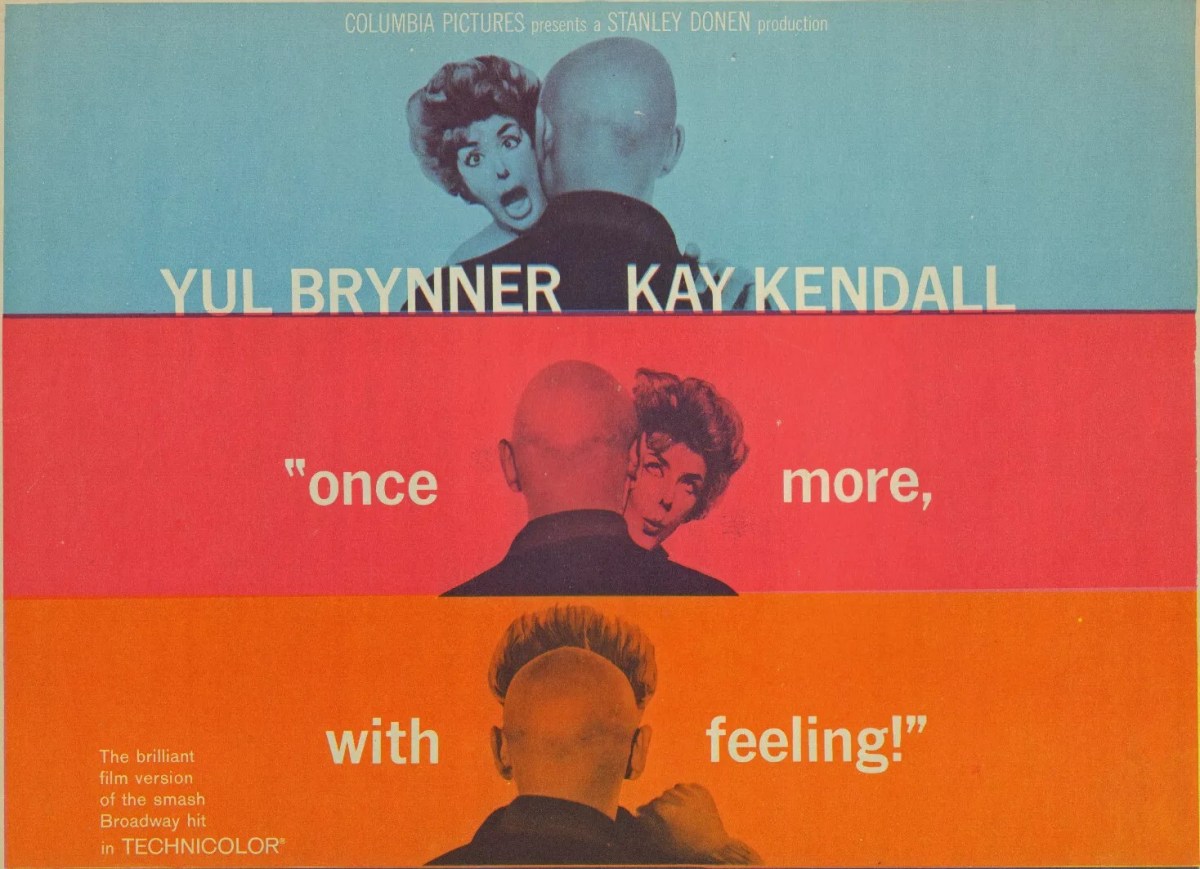
Victor Fabian (Yul Brynner), as egomaniacal and temperamental as you’d expect from a top conductor, is caught in flagrante by harpist wife Dolly (Kay Kendall) with young musician Angela (Shirley Anne Field). After she storms out, he loses his mojo. Worse, his orchestra loses its most efficient fundraiser, since Dolly is the one who keeps donors sweet.
Dolly has wasted no time acquiring a new admirer, esteemed physicist Richard (Geoffrey Toone), and wants a divorce in order to marry him. But wait, there’s a catch. Not the obvious one that Victor turns over a new leaf and determines to win her back, abandoning arrogance in favor of humble ardent wooing.
No, she can’t leave him because, wait for it, they never married. Well that’s not so jaw-dropping as the consequence. He insists that she can’t get a divorce unless she marries him and during an agreed short period together presumably that will give him time to flex his romantic muscles and win her back.
I can only assume that in the sophisitcated circles in which they run, the idea that they have been living in sin might cause her considerable embarrassment. But I’m perplexed at the notion, even for the less permissive times, that this would provoke sufficient scandal – more scandal than getting divorced in the first place? Or that they would expect nobody to notice the sudden marriage and wonder how they have managed to so openly live together? This seems nothing more than a jumbled-up head-over-heels barmy plot strand.
Anyway, she agrees, and he does his best to win her back even to the extent of playing a piece of music, beloved of a sponsor, that he detests.
The plot belongs to the golden age of the screwball comedy but the picture doesn’t play it that way. There’s more to being frenetic in pursuit of laffs than just being frenetic and this never takes off.
While Brynner is strictly one-note and never manages to bring a suggestion of genuine romance into the proceedings, the director is equally at a loss to inject any oomph or style and it looks as if he’s done little more than film a stage show with all its cinematic limitations.
Kay Kendall (Les Girls, 1957) in her final role – she died of leukemia – is equally constricted by a character who huffs and flounces and never embraces the comedy side of screwball.
This was the first of two straight comedies pairing Donen and Brynner and I’m dreading its successor Surprise Package (1960). Kurnitz adapted his own play which had been a decent success on Broadway, so the movie failure can’t all be blamed on him.
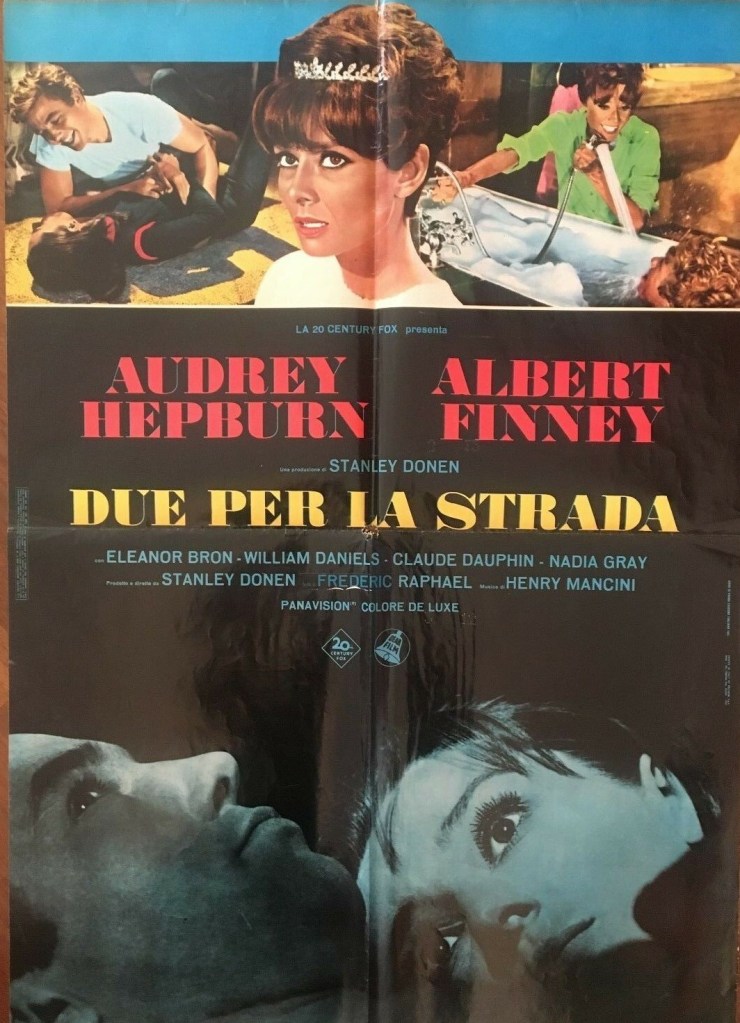
This film had everything. The cast was pure A-list: Oscar winner Audrey Hepburn (Breakfast at Tiffany’s, 1961) and Oscar nominee Albert Finney (Tom Jones, 1963). The direction was in the capable hands of Stanley Donen (Arabesque, 1966), working with Hepburn again after the huge success of thriller Charade (1963). The witty sophisticated script about the marriage between ambitious architect Mark Wallace (Albert Finney) and teacher wife Joanna (Audrey Hepburn) unravelling over a period of a dozen years had been written by Frederic Raphael, who had won the Oscar for his previous picture, Darling (1965). Composer Henry Mancini was not only responsible for Breakfast at Tiffany’s – for which he collected a brace of Oscars – but also Charade and Arabesque. And the setting was France at its most fabulous.
So what went wrong? You could start with the flashbacks. The movie zips in and out of about half a dozen different time periods and it’s hard to keep up. We go from the meet-cute to a road trip on their own and another with some irritating American friends to Finney being unfaithful on his own and then Hepburn caught out in a clandestine relationship and finally the couple making a stab at resolving their relationship. I may have got mixed up with what happened when, it was that kind of picture.
A linear narrative might have helped, but not much, because their relationship jars from the start. Mark is such a boor you wonder what the attraction is. His idea of turning on the charm is a Humphrey Bogart imitation. There are some decent lines and some awful ones, but the dialog too often comes across as epigrammatic instead of the words just flowing. It might have worked as a drama delineating the breakdown of a marriage and it might have worked as a comedy treating marriage as an absurdity but the comedy-drama mix fails to gel.
It’s certainly odd to see a sophisticated writer relying for laughs on runaway cars that catch fire and burn out a building or the annoying whiny daughter of American couple Howard (William Daniels) and Cathy (Eleanor Bron) and a running joke about Mark always losing his passport.
And that’s shame because it starts out on the right foot. The meet-cute is well-done and for a while it looks as though Joanna’s friend Jackie (Jacqueline Bisset) will hook Mark until chicken pox intervenes. But the non-linear flashbacks ensure that beyond Mark overworking we are never sure what causes the marriage breakdown. The result is almost a highlights or lowlights reel. And the section involving Howard and Cathy is overlong. I kept on waiting for the film to settle down but it never did, just whizzed backwards or forwards as if another glimpse of their life would do the trick, and somehow make the whole coalesce. And compared to the full-throttle marital collapse of Who’s Afraid of Virginia Woolf (1966) this was lightweight stuff, skirting round too many fundamental issues.
It’s worth remembering that in movie terms Finney was inexperienced, just three starring roles and two cameos to his name, so the emotional burden falls to Hepburn. Finney is dour throughout while Hepburn captures far more of the changes their life involves. Where he seems at times only too happy to be shot of his wife, she feels more deeply the loss of what they once had as the lightness she displays early on gives way to brooding.
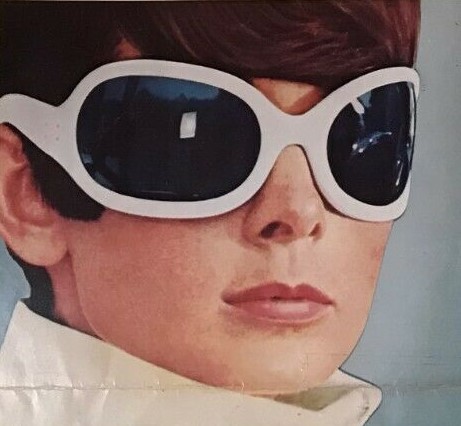
Hepburn as fashion icon gets in the way of the picture and while some of the outfits she wears, not to mention the sunglasses, would not have been carried off by anyone else they are almost a sideshow and add little to the thrust of the film.
If you pay attention you can catch a glimpse, not just of Jacqueline Bissett (The Sweet Ride, 1968) but Romanian star Nadia Gray (The Naked Runner, 1967), Judy Cornwell (The Wild Racers, 1968) in her debut and Olga Georges-Picot (Farewell, Friend, 1968). In more substantial parts are William Daniels (The Graduate, 1968), English comedienne Eleanor Bron (Help!, 1965) woefully miscast as an American, and Claude Dauphin (Grand Prix, 1966).
Hepburn’s million-dollar fee helped put the picture’s budget over $5 million, but it only brought in $3 million in U.S. rentals, although the Hepburn name may have nudged it towards the break-even point worldwide.
By this point in the 1960s, Gregory Peck’s career was pretty much at a standstill. Prestige had not saved Behold a Pale Horse (1964) from commercial disaster, thriller Mirage (1965) went the same way, other projects – The Martian Chronicles, Ice Station Zebra – failed to get off the ground or like The Bells of Hell Go Ting-a-Ling-a-Ling were abandoned once filming began. So, he was the main beneficiary of Cary Grant’s decision to retire.
Stanley Donen had Grant, with whom he had made the highly successful thriller Charade (1963), in mind for the role of the hieroglyphics professor caught in in a web of intrigue in Arabesque. In some ways Peck was an adequate replacement but lacked the older actor’s gift for comedy and failed to master the art of the double-take. Arabesque was almost a counterpoint to Charade. In the earlier movie Audrey Hepburn is continually suspicious of Cary Grant. The new movie sees a gender reversal, Peck constantly puzzled as to where Sophia Loren’s loyalties lie.
The story itself is quite simple. A code has been put inside a hieroglyphic and a variety of people are trying to get hold of it either to decipher the secret within or to stop someone else finding out what it contains. When the scientist who has the code is killed, the man who ordered the killing, the sinister Beshraavi (Alan Badel), approaches Prof Pollock (Gregory Peck) to unravel the code, but is turned down. The professor is then kidnapped by Arab prime minster Hassan Jena (Carl Duering), whom he admires, to ask him to take up the job. Beshraavi’s provocatively-dressed wife Yazmin (Sophia Loren), flirting outrageously with Pollock, is also after the code.
There follows more twists and double-crosses than you could shake a stick at, leaving the amenable Pollock mightily confused. “What is it about you,” he asks Yazmin at one point, “that makes you so hard to believe?” It looks like director Donen is playing a variation of the famous Raymond Chandler maxim, that when a plot begins to flag, “have a man come through the door with a gun in his hand.” Sometimes, there is actually a gun or similar weapon, but mostly it’s just another twist. If Pollock doesn’t know what the hell is going on, then the audience is in the same boat.
But it is stylish, set in appealing parts of Britain (antique university, Ascot), Yazmin decked out in glamorous Dior outfits and even Pollock gets to wear a morning suit. Drop in a couple of action sequences, Hitchcock-style chases in a zoo and pursuit by a combine harvester, Pollock nearly run over by horses in a race, and the pair of them having strayed into a builder’s yard facing demolition by the British equivalent of a wrecking ball. But the standout scene is when Yazmin hides the professor in her shower (curtain drawn) while being interrogated by her suspicious husband and then steps in naked and then they play footsie with dropped soap. And she proceeds to expound, “If I was standing stark naked in front of Mr Pollock, he’d probably yawn.”
Beshraavi’s jealousy over his wife’s flirtation with Pollock adds another element of tension. Beshraavi is a very sinuous, sensuous bad guy, who can turn a harmless massage into a matter of life and death. He also has a pet falcon with a habit of ripping people’s cheeks. But even in the face of obvious threats, Pollock holds his own. In one scene as Beshraaavi attempts to retrieve what he believes is the code from Pollock’s dinner plate, where it has fallen from the hiding place in the professor’s clothing, Pollock taps the man’s invading fingers with the sharp tines of his fork.
And there is some accomplished dialogue. When Pollock offers the falcon a date and is brusquely told the bird of prey only eats meat, he responds, “I thought he looked at it rather wistfully.” Beshraavi retorts, sharply, “It must have been your fingers.”
Donen had not made a film in the three years since Charade, so there was some critical feeling that he was a bit rusty and used experimentation – big close-ups, odd camera angles – to cover this up. He was living in London by this point and had been for nearly a decade. But there was very little that fazed him in any genre, and he had switched from musicals like Singing in’ the Rain (1952) to romantic drama (Indiscreet, 1958) and comedy (The Grass Is Greener, 1960). And though there is no question the film would have been better with Cary Grant, Peck proves a reasonable substitute.
The movie’s main drawback is the lack of romance since falling in love with someone you believe is either a traitor or a compulsive liar is a hard trick to pull off. But if you like the idea of pitting your wits against the screenwriters – Peter Stone (Charade), Julian Mitchell (Another Country, 1984) and Stanley Price (Gold, 1974), the latter pair in their movie debuts – then this is one for you.
Arguably the slickest thriller ever made. Two stars at the top of their game, three rising stars giving notice of their talent, more twists than you could shake a Hitchcock at, the chance to frighten the life out of the most fashionable actress of her generation, and standout scene after standout scene.
Three characters are presented upfront as bad guys, but whole enterprise is so laden with suspicion you are not all surprised when the finger points at Peter (Cary Grant) and Reggie (Audrey Hepburn), not least because Peter keeps changing his name, but also because audiences with lingering memories of film noir could easily imagine Reggie as a femme fatale especially when she comes on to a man whose got three decades on her.
Basic story: Reggie returns from a ski holiday where she met divorced Peter to find her husband dead and Parisian apartment empty. She is menaced by three men – Tex (James Coburn), Herman (George Kennedy) and Leopold (Ned Glass) – convinced she knows the whereabouts of $250,000 they lay claim to. Bartholomew (Walter Matthau) of the C.I.A. also stakes a claim. Tex has a nasty habit of throwing lighted matches at her, Herman threatening her with his steel hand. And there are doubts about Peter, initially perceived as a savior.
It is a film of such constant twists, you never know quite where you are, and forced to follow the lead of a befuddled and confused Reggie you question everything, so it’s an unsettling watch. Given the permutations, you could easily come up with a number of different endings.
And although this is virtually thrill-a-minute stuff it has the most endearing light romance, full of beautifully-scripted sparkling cross-purpose banter, and managing to work in marvellous scraps of Parisian atmosphere, some tourist-hinged (a market, boat ride on the Seine), others (a subway chase) less exhilarating. At times, Reggie turns spy and comes up with clever ruses to evade pursuit.
You can have this amount of conflict – baffling clues, perplexed French Inspector Grandpierre (Jacques Marin) kidnap, rooftop fight – without corpses soon mounting up. Alleviating the tension are a myriad of little jokes: a small boy with a water pistol, time out in a night club to play the rather frisky orange game, Peter showering with his clothes on. The romance might have helped except every time Reggie trusts Peter he gives her good reason to distrust him. And, of course, she could as easily have squirreled the money away herself.
The whole ensemble is delivered with such style and attention to detail (a bored man at a funeral clips his nails, cigarettes are expensive in France, voices echo when a boat passes under a bridge, phone booths are both refuges and traps) that it’s as if every single second was storyboarded to achieve the greatest effect.
It’s not just the entrance of the bad guys, door slamming in an empty church, that signals a director alert to every nuance, but the fact they all proceed, in different ways, to check Reggie’s husband is actually dead. A man has drowned in his bed. “I sprained my pride,” explains Peter after coming off worse in a fight. Apart from the core tale of suspicion, betrayals, theft and murder, everything else in the thriller genre is completely revitalized, in dialog and visuals this is nothing you have ever seen before.
The principals invest it with a rare freshness. Cary Grant (Walk, Don’t Walk, 1966) and Audrey Hepburn (Two for the Road, 1967) are such natural screen partners you wonder why (expense apart) the exercise was never repeated. And in typical John Wayne fashion, to minimise the May-December romance element, it’s Hepburn who makes all the running in that department, and you get the impression that she had been married to an older man anyway. Grant’s character is surprisingly adept at the old fisticuffs while Hepburn is more feisty than helpless, and devious, too, not above using the old screaming routine as a device to bring Grant running for romantic reasons.
James Coburn has his best role since The Magnificent Seven (1960), Walter Matthau (Lonely Are the Brave, 1962), at this point not considered comedian material, brings very human touches to his role, and George Kennedy (Mirage, 1965) presents a memorable villain.
And that’s not forgetting an absolutely outstanding score by Henry Mancini (Hatari!, 1962), jaunty one minute, romantic the next, and for the most thrilling sequences creating the type of effect David Shire achieved in All the President’s Men (1976) of steadily mounting tension rather than instruments shrieking terror. And the Saul Bass-style title credits were actually conceived by Maurice Binder of James Bond fame.
Outside of his musicals, this is the peak of Stanley Donen’s (Two for the Road) career. The gripping screenplay was the work of Peter Stone (Mirage), based on a story by Marc Boehm (Help!, 1965).
One of the few twist-heavy thrillers that rises effortlessly above the material.
Cary Grant was coming off a commercial career peak, comedy Houseboat (1958) with Sophia Loren, Hitchcock thriller North by Northwest (1959) and war comedy Operation Petticoat (1959) all among the top box office hits of their years. He was in enormous demand. In 1960 Jerry Wald wooed him for Tender Is the Night, eventually made in 1962 with Jason Robards. He went so far along considering Can-Can (1960) that he began working with a voice coach and passed on Let’s Make Love (1960).
The prospect of Lawrence of Arabia – he had been lined up to play the lead over two decades before – reared his head with producer Sam Spiegel eyeing him up for Allenby (played in the 1962 picture by Jack Hawkins). He turned down Lolita and a remake of The Letter. The biggest letdown was John Huston’s The Man Who Would Be King which would have teamed him with Clark Gable. Of the screenplay, Grant commented: “I’ve read it twice and am still uncertain whether it’s fair, good, or perhaps, even excellent.” (It would not be filmed until 1975.)
Also in the pipeline was an intriguing original screenplay in which he and Ingrid Bergman would essay dual roles and his alternative company, Granart, also purchased The Day They Robbed the Bank. (Neither project was made.)
In the face of such indecision it’s not surprising he decided to play safe. The Grass Is Greener would be made by his own company, Grandon, a production outfit set up with director Stanley Donen – they had previously made Indiscreet (1957) – at that point still best known for musicals including Singin’ in the Rain (1951), though he had also directed Grant in the comedy Kiss Them for Me (1957).
Initially Grant cast himself as the American, with Rex Harrison (The Honey Pot, 1967) and his real-life wife Kay Kendall (Once More with Feeling, 1960, also directed by Donen) the titled British couple. Harrison would certainly have brought more natural acidity to the part but he pulled out after his wife died prematurely. Deborah Kerr, the most English of actresses, was ideal for the Earl’s wife.
Robert Mitchum, with whom Kerr had just appeared in The Sundowners (1960), was a late addition as the Yank even though it meant him dropping to third billing for the first time in over a decade. For The Sundowners he had ceded top billing to Kerr on the basis it would be better for the poster, not realizing he would be viewed as the male lead rather than the acknowledged star (not quite as subtle a difference as you might imagine in the cut-throat credits business). Kerr was at an artistic peak, winning her sixth Oscar nomination for The Sundowners. Mitchum, by contrast, nominated in a supporting role for The Story of G.I. Joe (1945) had nary a sniff of peer recognition since.
Jean Simmons (Spartacus, 1960) was a surprise choice for Grant’s character’s ex-lover but was willing to accept lower billing because she was desperate to extend her range by doing comedy. The foursome already had considerable experience working with each other, Mitchum paired with Simmons for Angel Face (1952) and She Couldn’t Say No (1953) while Kerr and Grant had dallied in Dream Wife (1953) and An Affair to Remember (1957). To round things off Kerr had played opposite Mitchum in Heaven Knows, Mr. Allison (1957) and, as mentioned, The Sundowners.
Although the picture was financed by Universal, director Donen was more of a Columbia favorite. On top of Once More with Feeling and Surprise Package for the latter studio, he was contracted to make another four, all to be filmed abroad, the director having set up home in London. Deborah Kerr was involved in Cakes and Ale, based on the Somerset Maugham novel, with George Cukor and was announced as starring in Behind the Mirror (neither film made). Mitchum was also diversifying, the first of a three-picture deal between United Artists and his company being North from Rome (never made), based on the Helen MacInnes thriller.
Shooting began at Shepperton in London on April 4, 1860, but this time round, the personalities did not quite gel. Simmons complained that Grant was “a fuss-budget, everything must be just so.” Although she did admit that his preparation worked wonders. “He’d come forth with the most amusing, polished take, everything so effortless.” Mitchum complained Grant lacked a sense of humor. “He’s very light and pleasant but his humor is sort of old music-hall jokes.”
Despite the high-class cast, Grant had very definite ideas about his star status. In one scene that called for both actresses to be bedecked in expensive jewelry, he instructed the jewels be removed in case the audience was distracted from him.
Grant and Mitchum had one thing in common, a liking for experimenting with drugs. Mitchum’s preference for marijuana was well-known. Although he had been previously jailed for his “addiction,” Mitchum still grew his own. Grant’s drug of choice, on the other hand, was LSD. He had been on a course of LSD treatment since 1958 and was in the middle of coming off the drug. “He was a little weird,” noted Mitchum.
Fittingly, their personality clash was very English, “a mild, undeclared, rivalry.” The battleground was costume, Grant perturbed that Mitchum’s laid-back style was making him look over-dressed while Mitchum complained that he was a glorified feed, employed simply to make non-committal comments in the middle of a Grant monologue.
Grant’s parsimony was also a bit extreme. As part of his invoice for doing publicity on the picture, “not only did he turn in his hotel bills and meal receipts for those four extra days but also the costs of the suits” he had had made in Hong Kong. In other words, he billed his own company. Money paid for these expenses would be deducted from any potential profit he would receive.
Kerr, however, had no complaints. “Between Cary’s superb timing and Bob’s instinctive awareness of what you’re trying to do, this was a very happy film.” But there was one other source of contention. The British media were barred from the set on by Stanley Donen on the grounds that journalists of the more sensation-seeking newspaper were apt to needle actors. Grant softened the blow by arranging to be interviewed once filming was complete.
However, Variety was able to give the picture a publicity boost by hailing stately home tourism as “a new type of British show business,” reckoning the 400 operations raked in $4 million a year. Average admission prices of 35 cents meant over 10 million visitors a year.
Ironically, the infidelity theme cost The Grass Is Greener a lucrative Xmas launch at the prestigious Radio City Music Hall in New York. The cinema felt the content was not in keeping with Yuletide and opted for The Sundowners instead, the Donen picture shifting to the much smaller and semi-arthouse Astor. Just how important the Hall was to a movie’s public reception could be judged by the takings the previous year for Operation Petticoat (a Granart release), a whopping $175,000 opener. The point was made when The Sundowners grossed $200,000 in its first week, three times as much as The Grass Is Greener.
SOURCES: Scott Eyman, Cary Grant, A Brilliant Disguise (Simon & Schuster, 2020) p339-343,363-368; Lee Server, Robert Mitchum, Baby I Don’t Care (Faber and Faber, 2002) p204-207, 429; Eric Braun, Deborah Kerr (WH Allen, 1977) p176-177; “Deborah’s Cakes & Ale,” Variety, July 15, 1959, p3; “Grant in Original, with Himself and Bergman in Dual Roles,” Variety, September 30, 1959, p10; “Nativity and Grant Combo at Hall,” Variety, December 9, 1959, p9; “Maugham-Hurst Film Location in Tangier,” Variety, January 6, 1960, p167; “Col Extending Donen,” Variety, May 25, 1960, p20; “400 Stately Homes of England,” Variety, June 1, 1960, p2; “Needling and Smartalec British Interviewers Not Allowed In By Donen,” Variety, June 22, 1960, p2; “Infidelity Theme Cancels Grant’s Comedy at Hall,” Variety, September 21, 1960, p7; “Cary Grant’s,” Variety, November 9, 1960, p20; “B’Way soars,” Variety, December 28, 1960, p9.
A genuine all-star cast goes off-piste in what used to be called – and maybe still is – a comedy of manners. A chance encounters at the stately home owned by Victor (Cary Grant), an Earl who makes ends meet by opening up his home to tourists, sees his wife Lady Hilary (Deborah Kerr), who helps make ends meet by selling home-grown mushrooms, fall in love with American oil millionaire Charles (Robert Mitchum).
Victor is far too English and posh to go off in the deep end and after considering allowing her to indulge in an affair until she gets bored, comes up with a strategy to ensure it’s her lover who is shooed away. Hilary’s best friend, the glamorous and often barmy Hattie (Jean Simmons), all Dior outfits and full-on make-up, meanwhile, steps in to attempt to rekindle her romance with former lover Charles.
Needless to say, this scene does not exist in the film.
While it’s peppered with epigrams and clever lines and several twists, what’s most memorable is the acting, the initial scene between Charles and Hilary a masterpiece of nuance, what’s shown in the face opposite to what they say. And there’s another peach of a scene where the most important element is what’s conveyed by a sigh. And by Robert Mitchum of all people, an actor not known for nuance.
But it’s let down by the staginess – it was based on a hit play – the very dated by now notion of showing the comic differences between British and Americans and the pacing. The theatrical element, thankfully, doesn’t resort to farce but with a whole bunch of entrances at unexpected moments you occasionally feel it’s heading in that direction. There are minor attempts to open up the play, a scene in the river, some location work in London and upmarket tourist haunts, but mostly it’s a picture that takes place on a couple of sets.
The British vs American trope just becomes tiresome after a while except that essentially the two men trade cultures, Victor exhibiting the kind of ruthlessness you might expect (in the old cliched fashion) from an American while Charles displays the kind of subtlety you would more likely find in an Englishman.
The pacing’s the biggest problem. The actors deliver lines at such speed that no time is allowed for the audience to laugh. The three British characters are almost manic in their urgency, while the Yank so laid-back he might belong to a different century.
Late on, a couple of subplots brighten up proceedings, a joke played on Hilary by Victor over the contents of a suitcase that she has devised an elaborate cover story to explain, and a betrayal of Hilary by her friend. Devilishly clever though it is, the duel scene almost belongs to a different picture. There’s also an amusing butler Sellers (Moray Watson), a wannabe writer, who believes, as is obvious, he is being under-employed, and pops up when the movie requires straightforward comic relief.
It starts off, via the Maurice Binder (Goldfinger, 1964) credits with babies, occasionally in the buff, unspooling film and indulging in other humorous activities. The only characters established before the plot kicks in are the Earl and the butler, Victor shown as tight-fisted, literally counting the pennies (although, literally, these are actually half-crowns, the price of admission to the stately home), the efficient Sellers revealed as otherwise baffled by life. The joke of a wealthy couple forced to rely on the income from visitors was not even much of a joke by then.
Perhaps what’s most interesting is that this movie essentially about immorality failed to click with U.S. audiences while an equally immoral picture The Apartment (1960) did superb business, the difference less relating to star quality than directorial ability, Billy Wilder’s work always having a greater edge than the confections of Stanley Donen.
It’s the supporting cast – if stars can be so termed – who steal the show. Robert Mitchum (Man in the Middle/The Winston Affair, 1964) is just marvelous, one of his best acting jobs, relying far more on expression to carry a scene. He delivers a masterclass in how little an actor needs to do. Jean Simmons (Rough Night in Jericho, 1967) is also excellent for the opposite reason, an over-the-top mad-as-a-hatter conniving ex-lover with an eye on the main chance. That’s not to say Cary Grant (Walk, Don’t Run, 1966) and Deborah Kerr (The Arrangement, 1969) are not good, just overshadowed, and Kerr’s first scene with Mitchum, where she, too, realizes she is falling instantly in love is remarkably underplayed.
Stanley Donen (Arabesque, 1966) should have done more, pre-filming, to tighten up the script and expand the production. Hugh Williams and Margaret Vyner adapted their own play. It’s entertaining enough but I was more taken by the acting than the picture.
This film had everything. The cast was pure A-list: Oscar winner Audrey Hepburn (Breakfast at Tiffany’s, 1961) and Oscar nominee Albert Finney (Tom Jones, 1963). The direction was in the capable hands of Stanley Donen (Arabesque, 1966), working with Hepburn again after the huge success of thriller Charade (1963). The witty sophisticated script about the marriage between ambitious architect Mark Wallace (Albert Finney) and teacher wife Joanna (Audrey Hepburn) unravelling over a period of a dozen years had been written by Frederic Raphael, who had won the Oscar for his previous picture, Darling (1965). Composer Henry Mancini was not only responsible for Breakfast at Tiffany’s – for which he collected a brace of Oscars – but also Charade and Arabesque. And the setting was France at its most fabulous.
So what went wrong? You could start with the flashbacks. The movie zips in and out of about half a dozen different time periods and it’s hard to keep up. We go from the meet-cute to a road trip on their own and another with some irritating American friends to Finney being unfaithful on his own and then Hepburn caught out in a clandestine relationship and finally the couple making a stab at resolving their relationship. I may have got mixed up with what happened when, it was that kind of picture.
A linear narrative might have helped, but not much, because their relationship jars from the start. Mark is such a boor you wonder what the attraction is. His idea of turning on the charm is a Humphrey Bogart imitation. There are some decent lines and some awful ones, but the dialogue too often comes across as epigrammatic instead of the words just flowing. It might have worked as a drama delineating the breakdown of a marriage and it might have worked as a comedy treating marriage as an absurdity but the comedy-drama mix fails to gel.
It’s certainly odd to see a sophisticated writer relying for laughs on runaway cars that catch fire and burn out a building or the annoying whiny daughter of American couple Howard (William Daniels) and Cathy (Eleanor Bron) and a running joke about Mark always losing his passport.
And that’s shame because it starts out on the right foot. The meet-cute is well-done and for a while it looks as though Joanna’s friend Jackie (Jacqueline Bisset) will hook Mark until chicken pox intervenes. But the non-linear flashbacks ensure that beyond Mark overworking we are never sure what caused the marriage breakdown. The result is almost a highlights or lowlights reel. And the section involving Howard and Cathy is overlong. I kept on waiting for the film to settle down but it never did, just whizzed backwards or forwards as if another glimpse of their life would do the trick, and somehow make the whole coalesce. And compared to the full-throttle marital collapse of Who’s Afraid of Virginia Woolf (1966) this was lightweight stuff, skirting round too many fundamental issues.
It’s worth remembering that in movie terms Finney was inexperienced, just three starring roles and two cameos to his name, so the emotional burden falls to Hepburn. Finney is dour throughout while Hepburn captures far more of the changes their life involves. Where he seems at times only too happy to be shot of his wife, she feels more deeply the loss of what they once had as the lightness she displays early on gives way to brooding.
Hepburn as fashion icon gets in the way of the picture and while some of the outfits she wears, not to mention the sunglasses, would not have been carried off by anyone else they are almost a sideshow and add little to the thrust of the film.
If you pay attention you can catch a glimpse, not just of Jacqueline Bissett (Bullitt, 1969) but Romanian star Nadia Gray (The Naked Runner, 1967), Judy Cornwell (The Wild Racers, 1968) in her debut and Olga Georges-Picot (Farewell, Friend, 1968). In more substantial parts are William Daniels (The Graduate, 1968), English comedienne Eleanor Bron (Help!, 1965) woefully miscast as an American, and Claude Dauphin (Grand Prix, 1966).
Hepburn’s million-dollar fee helped put the picture’s budget over $5 million, but it only brought in $3 million in U.S. rentals, although the Hepburn name may have nudged it towards the break-even point worldwide.








 The Magnificent 60s