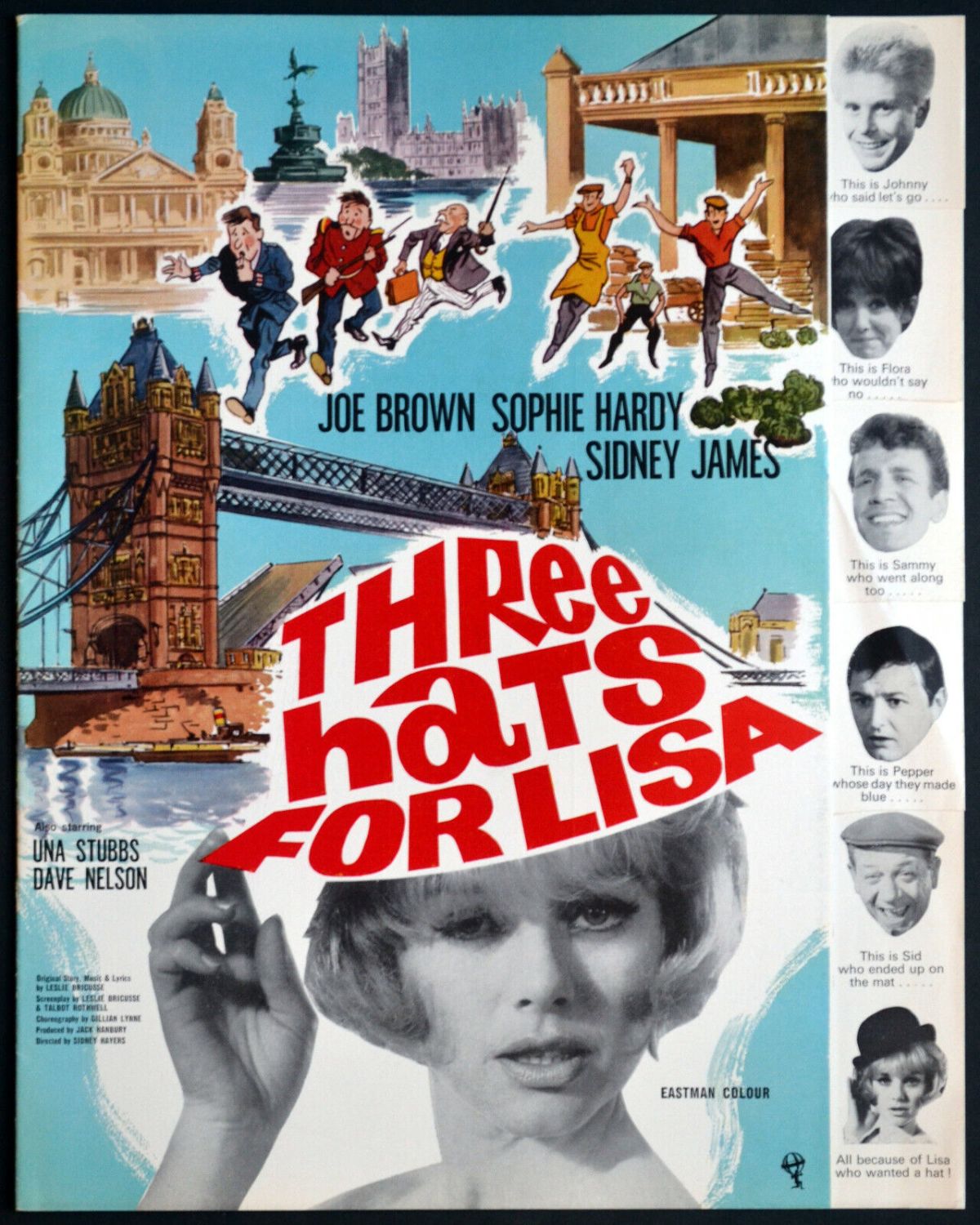
Three Hats for Lisa (1965) ***

Until the triumphant arrival of Oliver! (1968), the bar for British musicals was set very low. This just about scrapes through, thanks primarily to the enthusiastic cast and a rare opportunity to hear Sid James warble, though that may well be a detrimental factor.

At this point the British movie musical was kept aloft by pop stars, Cliff Richard (Summer Holiday, 1963) injecting box office life into a moribund mini-genre, The Beatles (A Hard Day’s Night, 1964) adding artistic credibility. Any pop star could front a musical, hence Ferry Across the Mersey (1965) starring Gerry and the Pacemakers, or if you filled the picture with enough stars (Gonks Go Beat, 1964) that was deemed sufficient.
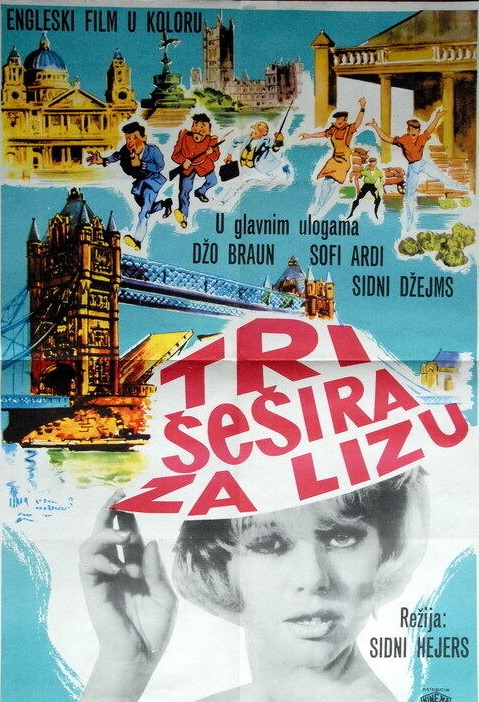
You would be hard put to place Joe Brown, leading man of Three Hats for Lisa, in the Cliff Richard/Beatles class and no British effort could come close to West Side Story (1961), Gigi (1958) or South Pacific (1958).  Despite a paucity of hit singles – three Top Ten hits in 1962-1963 the extent of his chart success, Brown, voted UK Vocal Performer for 1962, and with a distinctive brush-cut, had already starred in What a Crazy World (1963), an adaptation of a stage musical, directed by Michael Carreras (The Lost Continent, 1968) which featured singers Susan Maugham, Marty Wilde and Freddie and the Dreamers.

But there was an emergent generation of stage songsmiths led by Lionel Bart (Oliver!, stage debut 1960) and Leslie Bricusse (Stop the World I Want To Get Off, stage debut 1961) and even the venerated John Barry (The Passion Flower Hotel, stage debut 1965) had tried his hand. Bricusse, on a publicity high after co-writing the lyrics for Goldfinger (1964), already had a movie musical to his name, Charley Moon (1956).

If Joe Brown had no proven box office cachet he was in good company. Frenchwoman Sophie Hardy had little musical experience that I’m aware of (unlike namesake Francoise Hardy), was making her English-speaking debut (as an Italian) and was best-known for Max Pecas’ number The Erotic Touch of Hot Skin (1964), a title that suggested far more than presumably the picture delivered. Una Stubbs, later famous for Till Death Us Do Part comedy series, was equally unknown.
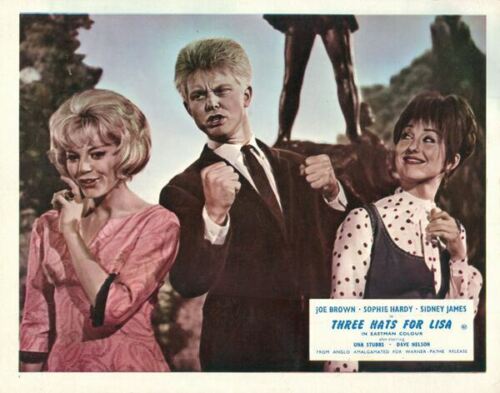
Joe Brown is the one in the middle.

Narrative was the least consideration when crafting a British movie musical. This gets by on the notion that three irrepressible Cockneys – Johnny (Joe Brown), Flora (Una Stubbs) and Sammy (Dave Nelson) – somehow get entangled with a sexy Italian movie star Lisa (Sophie Hardy) who wants to dodge out of work commitments and collect a selection of typical British hats: a bowler, a busby (bearskin) and policeman headgear. Taxi driver Sid (Sidney James) is along, literally, for the ride. The rest of the time it’s a Swinging Sixties London travelog, an opening aerial shot of the capital, iconic sites to the fore, setting the scene, and subsequently cramming in as many tourist attractions as possible.

Every couple of minutes, for no particular reason, they burst into song and faux-West Side Story choreography. In fact, it’s stuffed with songs, fourteen over a short running time. Some are clearly spoofs – “The Boy on the Corner of the Street Where I Live” for example, or “Bermondsey” and none are particularly hummable. On the plus side, all the song-and-dance numbers are exteriors, though presumably because it was cheaper than hiring studio space. That London remained dry enough to accommodate such spectacles is probably the only miracle on show.

It’s far from dreary, and the story is daft enough, in the vein of 1940s Hollywood musicals, to get by, and the young cast fling themselves about quite splendidly, and there’s certainly an innocence to the proceedings, Johnny settling for just a kiss on the cheek from Lisa, and it would have probably stretched the imagination even more had serious romance beckoned. It seems a shame to mark down such effervescence, and though it’s in reality a two out of five, it’s not in the execrable league so I’m giving it the benefit of the doubt especially as it was directed by Sidney Hayers (Night of the Eagle/Burn, Witch, Burn, 1962) who usually manages to salvage something from unprepossessing material. And also because neither Sid James nor Talbot Rothwell, the Carry On series resident writer, give in to the temptation of the double entendre.

Burn, Witch, Burn / Night of the Eagle (1962) ****

That rare event, a piece of cinematic alchemy. None of the principals had any particular form yet it all comes together quite splendidly.

Director Sidney Hayers was a journeyman, for every Circus of Horrors (1960) or Southern Star (1969) there was Cliff Richard vehicle  Finders Keepers (1966) or Three Hats for Lisa (1965) starring pop star Joe Brown. Apart from The Innocents (1961), Peter Wyngarde did not make another movie for nearly two decades and fame eluded him until he grew one of television’s most iconic moustaches for Department S (1969).

Janet Blair was attempting to revive a moribund career that had stopped dead with The Fuller Brush Man (1948). Ditto Margaret Johnston, nothing since Touch and Go (1955).

More prominent names were attached to the script: Richard Matheson had made B-movie waves with The Fall of the House of Usher (1960) and The Pit and the Pendulum (1961) and Charles Beaumont for The Premature Burial (1962). But the script itself, an adaptation of Fritz Lieber Jr.’s novel Conjure, Wife, was not in itself extraordinary.

Instead, it’s a prime example of what a director can bring to material. It begins with credits on one side of the screen and a wide-open eye on the other. Scenes brim with suspense yet often we have no idea what’s going on and with only music to guide us are sucked into a devilish plot. Most of the time Hayers concentrates on eyes, reaction, rather than lengthy scenes of dialog.

The fact that Hollywood ignored the depth of Wyngarde’s performance seems beyond belief. And you might be interested to know it was one of the earliest feminist pictures, the wife in control, acting as protector for the husband.

Norman Taylor (Peter Wyngarde) is a handsome successful college professor in the running for promotion. While he locks horns with lazy pupil Fred (Bill Mitchell), he charms others to the point of infatuation, witness Margaret (Judith Stott). But after a bridge party at their home his wife Tansy (Janet Blair) becomes obsessed with finding something. Upstairs, by accident Norman comes across a dead spider that she claims is a good luck charm from a holiday in Jamaica.

Eventually, while he’s asleep, she finds what she’s looking for, hidden in a lampshade and burns it. Later, a suspicious Norman uncovers all sorts of strange objects. All three scenes of the characters looking are filled with suspense and masterpieces if you like of how to use a camera and hook an audience, no explanation given, just a background of increasingly ominous music.

Confronted, Tansy admits she is a witch, that decision triggered by an incident in which her husband nearly died. Her spells, she claims, have brought him not just good luck, but protected him from bad sorcery, his success not just down to his charm. He insists on burning all her material, including, to her horror, a locket with his picture. And no time is spent, a la The Devil Rides Out (1968), in explaining the intricacies of the occult.

From then on his life turns sour. He is nearly run over by a van. Fred makes a complaint against him and then comes after him with a gun, Margaret claims he raped her. Gradually, Norman, an atheist where the Devil is concerned, believing that neurosis causes the wrong kind of faith, comes to realise he is a victim.

They are both up against someone more powerful. Some of the events have a supernatural tinge – doors that swing open in a storm, Tansy praying to “let me die in his place” – but others appear severe accentuations of the normal, a loudspeaker blaring out his voice from a tape recording over the college grounds, an eagle that hunts him down, big enough (in one astonishing scene) to break through a door, and with a 9ft wing span appearing enormous in a corridor.

The curse plays out to a fabulous end, a tremendous finale, full of human drama, emotions ripped apart, confrontation, Norman’s failed schemes to save his wife.

To say I was mesmerised was an under-statement. Just a brilliantly-done little picture with cracking direction and excellent acting all round.

Not only is the picture ripe for reassessment you would have thought it was well worth a remake.

Discover WordPress

A daily selection of the best content published on WordPress, collected for you by humans who love to read.

The Atavist Magazine

by Brian Hannan

WordPress.com News

The latest news on WordPress.com and the WordPress community.