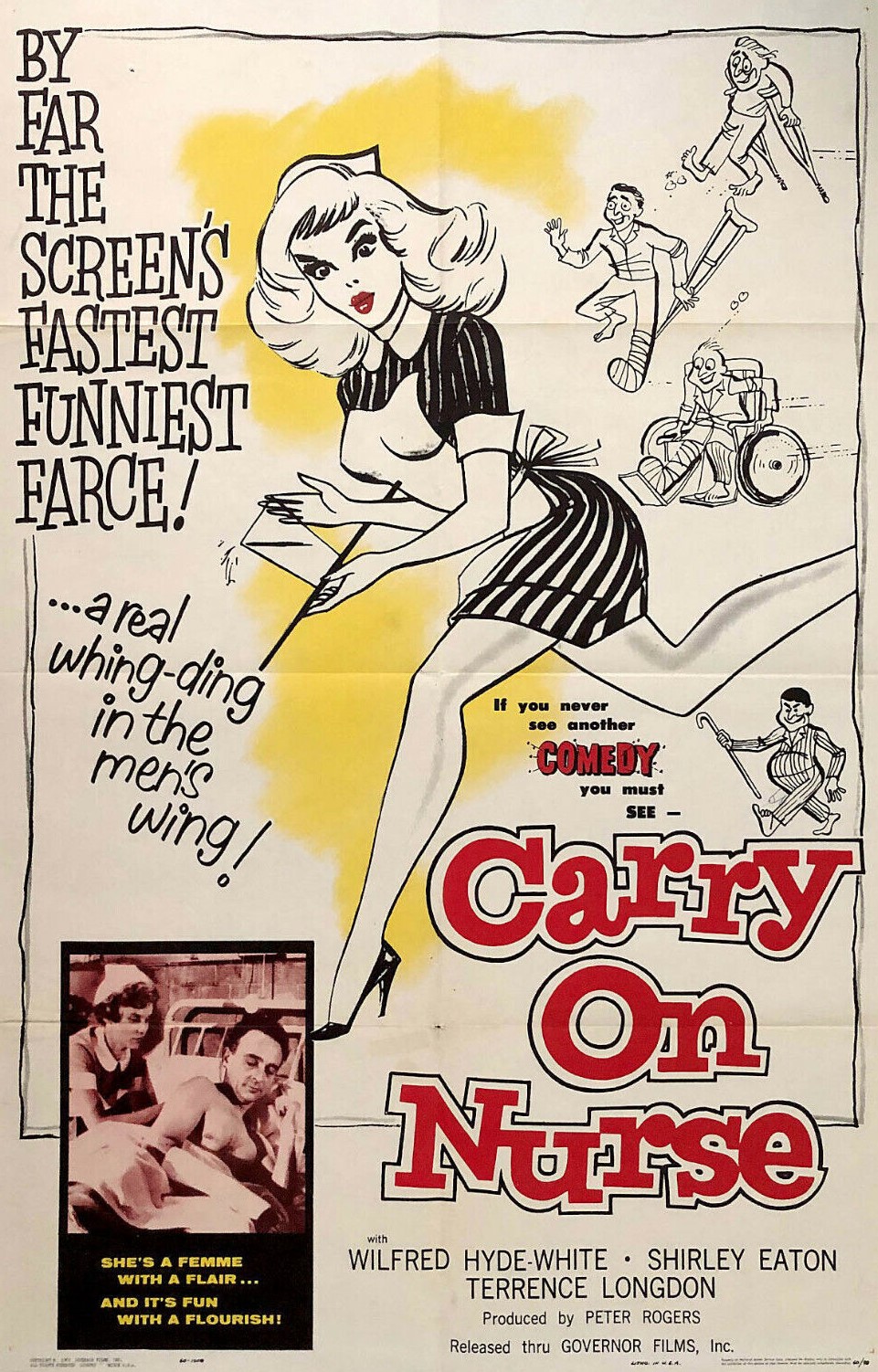
Carry On Nurse (1960) ***

There was no greater divide between audiences and critics in Britain than the long-running comedy “Carry On” series (outside of an occasional satirical bulls-eye like Carry On Up the Khyber, 1968). And a similar gulf existed between the type of audiences the movies attracted in Britain and those in America. In Britain they were vastly popular general releases while in America their usual habitat was the arthouse as if they were seen as the natural successors to the Ealing comedies. And there was a third chasm – between the endearing risqué early comedies and the more lascivious later versions.

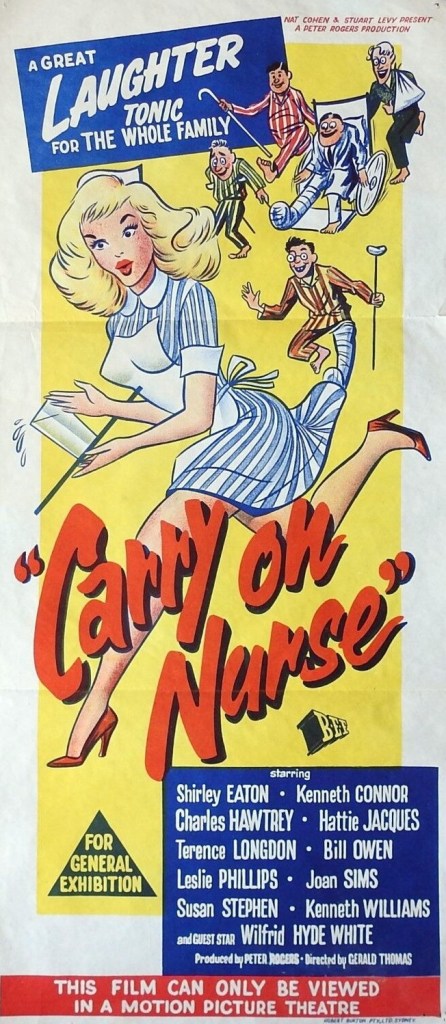
Carry On Nurse fell into the endearing camp. The humor was gentle rather than forced, the emphasis on misunderstanding and innuendo and smooth seducers like Leslie Phillips rather than exposed female flesh and the grasping likes of the ever-chortling Sid James. Perhaps you could define this earlier film as pre-nasal Kenneth Williams, his peculiar type of delivery not yet at full throttle. Here there is innocence rather than lust and the males quake in fear not just of the indomitable Hattie Jacques in brusque matron mode but of the other efficient nurses led by Shirley Eaton who have the measure of their rather hapless patients, although student nurse Joan Sims – making her series debut – is an accident-prone soul.
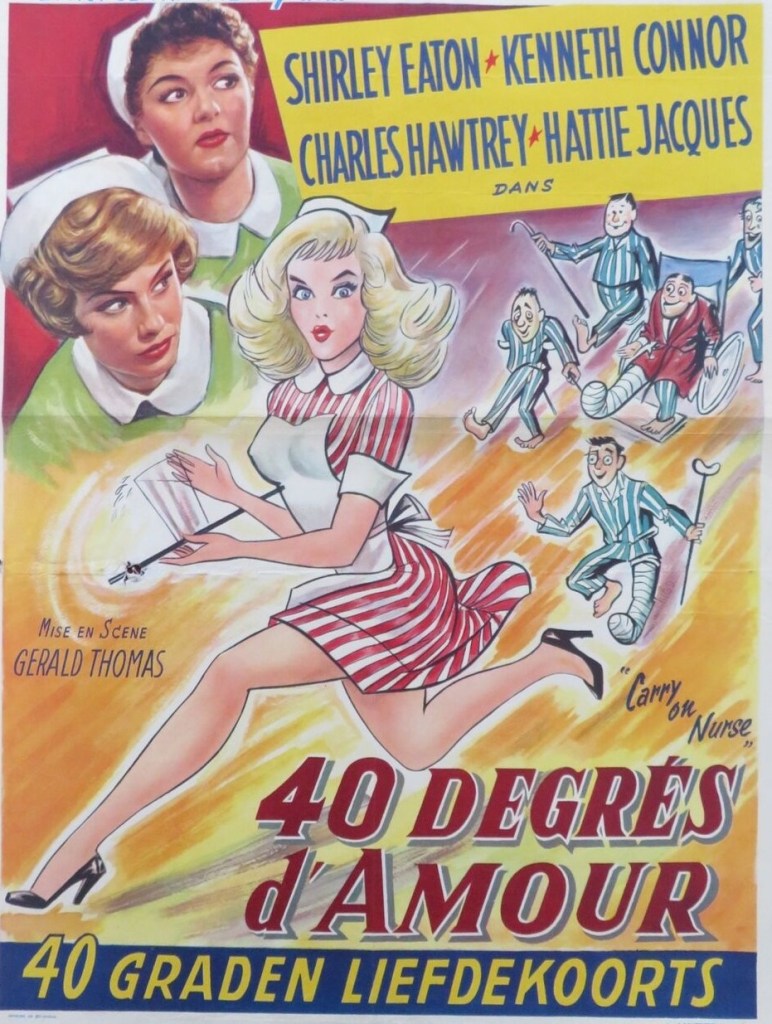
And they say comedy doesn’t travel.

The action is mostly confined to a male ward. There are plenty of gags – alarms rung by mistake, boiling catheters burned to a turn, medication making a patient go wild, patients intoxicated by laughing gas and the famous replacement of a rectal thermometer by a daffodil. Wilfred Hyde-White as a constant complainer and obsessive radio listener Charles Hawtrey provide further ongoing amusement. 

But the thrust of the story is romance. Journalist Terence Longdon fancies Shirley Eaton but his initial advances are spurned as she is in love with a doctor. In a role far removed from his later brazen characters, Williams plays a shy intellectual who finally comes round to the charms of Jill Ireland (later wife of Charles Bronson). Although Leslie Phillips is his usual suave self, he makes no designs on the female staff since he has a girlfriend elsewhere and  his ailment – a bunion on the bum – makes him an unlikely candidate for a hospital liaison.  

Hattie Jacques is in imperious form, Shirley Eaton shows what she is capable of, Kenneth Williams playing against type is a revelation. 

British critics hated the “Carry On” films until late in the decade when Carry On Up the Khyber (1968) hit a satirical note. Critics felt the movies pandered to the lowest common denominator and were a poor substitute for the Ealing comedies which had given Britain an unexpected appreciation among American comedy fans.

It was a well-known fact the comedies did not always travel. Apart from Jacques Tati, the more vulgar French comedies featuring the likes of Fernandel were seen as arthouse fare. Unless they featured a sex angle or the promise of nudity, coarse Italians comedies struggled to find an international audience. The “Carry On” films were bawdy by inclination without being visually offensive
Carry On Sergeant (1958), the first in the series, had been a massive success in Britain. Distributor Anglo-Amalgamated was so convinced it would find a similar response in the U.S. that it was opened in New York at a first run arthouse. Although comedies were hardly standard arthouse fare, this was generally the route for low-budget British films.  The picture lasted only three weeks and taking that as proof of its dismal prospects other exhibitors ignored it. 

The follow-up Carry On Nurse (1959) took an entirely different route when launched in America in 1960. This time New York would be virtually the last leg of its exhibition tour.  Instead it opened on March 10 at the 750-seat Crest in Los Angeles. Away from the New York spotlight, the little movie attracted not just good notices but decent audiences.

Instead of being whipped off screens after a few weeks, it developed legs. In Chicago it ran for 16 weeks in first run before transferring to a further 50 theaters. Within a few months of opening it had been released in 48 cities. In Minneapolis it was booked as a “filler” at the World arthouse, expected to run a week and no more. Instead, it remained for six weeks and when it shifted out to the nabes out-grossed Billy Wilder’s big-budget comedy The Apartment (1960) with a stellar cast of Jack Lemmon and Shirley Maclaine.

In its fourth month at the 600-seat Fox Esquire in Denver where it opened in May, it set a new long-run record for a non-roadshow picture. It had been taking in a steady $4,000 a week since opening.

SOURCES: “How To Nurse a Foreign Pic That’s Neither Art nor Nudie: Skip N.Y.,” Variety, Aug 24, 1960, 3; “British Carry On Nurse A Sleeper in Mpls With Long Lopp Run, Nabe Biz,” Variety, Aug 24, 1960, 18;

Note: by and large this blog follows American release dates so although Carry On Nurse was shown in Britain in 1959 it did not reach America until 1960.
https://amzn.to/3G1h1Ei

Three Hats for Lisa (1965) ***

Until the triumphant arrival of Oliver! (1968), the bar for British musicals was set very low. This just about scrapes through, thanks primarily to the enthusiastic cast and a rare opportunity to hear Sid James warble, though that may well be a detrimental factor.

At this point the British movie musical was kept aloft by pop stars, Cliff Richard (Summer Holiday, 1963) injecting box office life into a moribund mini-genre, The Beatles (A Hard Day’s Night, 1964) adding artistic credibility. Any pop star could front a musical, hence Ferry Across the Mersey (1965) starring Gerry and the Pacemakers, or if you filled the picture with enough stars (Gonks Go Beat, 1964) that was deemed sufficient.

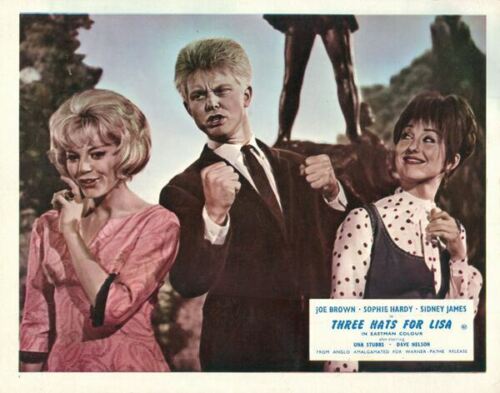
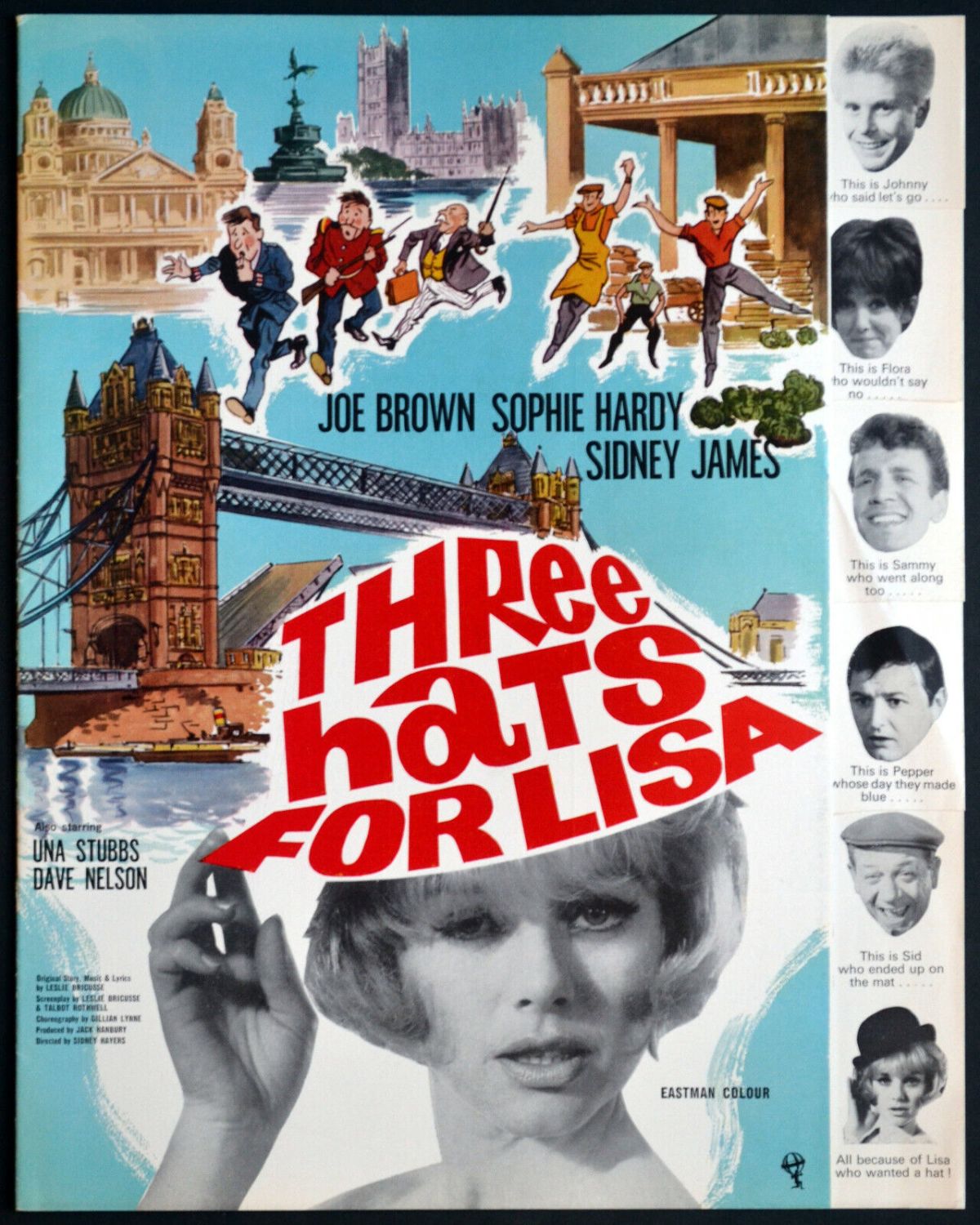
You would be hard put to place Joe Brown, leading man of Three Hats for Lisa, in the Cliff Richard/Beatles class and no British effort could come close to West Side Story (1961), Gigi (1958) or South Pacific (1958).  Despite a paucity of hit singles – three Top Ten hits in 1962-1963 the extent of his chart success, Brown, voted UK Vocal Performer for 1962, and with a distinctive brush-cut, had already starred in What a Crazy World (1963), an adaptation of a stage musical, directed by Michael Carreras (The Lost Continent, 1968) which featured singers Susan Maugham, Marty Wilde and Freddie and the Dreamers.

But there was an emergent generation of stage songsmiths led by Lionel Bart (Oliver!, stage debut 1960) and Leslie Bricusse (Stop the World I Want To Get Off, stage debut 1961) and even the venerated John Barry (The Passion Flower Hotel, stage debut 1965) had tried his hand. Bricusse, on a publicity high after co-writing the lyrics for Goldfinger (1964), already had a movie musical to his name, Charley Moon (1956).

If Joe Brown had no proven box office cachet he was in good company. Frenchwoman Sophie Hardy had little musical experience that I’m aware of (unlike namesake Francoise Hardy), was making her English-speaking debut (as an Italian) and was best-known for Max Pecas’ number The Erotic Touch of Hot Skin (1964), a title that suggested far more than presumably the picture delivered. Una Stubbs, later famous for Till Death Us Do Part comedy series, was equally unknown.

Joe Brown is the one in the middle.

Narrative was the least consideration when crafting a British movie musical. This gets by on the notion that three irrepressible Cockneys – Johnny (Joe Brown), Flora (Una Stubbs) and Sammy (Dave Nelson) – somehow get entangled with a sexy Italian movie star Lisa (Sophie Hardy) who wants to dodge out of work commitments and collect a selection of typical British hats: a bowler, a busby (bearskin) and policeman headgear. Taxi driver Sid (Sidney James) is along, literally, for the ride. The rest of the time it’s a Swinging Sixties London travelog, an opening aerial shot of the capital, iconic sites to the fore, setting the scene, and subsequently cramming in as many tourist attractions as possible.

Every couple of minutes, for no particular reason, they burst into song and faux-West Side Story choreography. In fact, it’s stuffed with songs, fourteen over a short running time. Some are clearly spoofs – “The Boy on the Corner of the Street Where I Live” for example, or “Bermondsey” and none are particularly hummable. On the plus side, all the song-and-dance numbers are exteriors, though presumably because it was cheaper than hiring studio space. That London remained dry enough to accommodate such spectacles is probably the only miracle on show.

It’s far from dreary, and the story is daft enough, in the vein of 1940s Hollywood musicals, to get by, and the young cast fling themselves about quite splendidly, and there’s certainly an innocence to the proceedings, Johnny settling for just a kiss on the cheek from Lisa, and it would have probably stretched the imagination even more had serious romance beckoned. It seems a shame to mark down such effervescence, and though it’s in reality a two out of five, it’s not in the execrable league so I’m giving it the benefit of the doubt especially as it was directed by Sidney Hayers (Night of the Eagle/Burn, Witch, Burn, 1962) who usually manages to salvage something from unprepossessing material. And also because neither Sid James nor Talbot Rothwell, the Carry On series resident writer, give in to the temptation of the double entendre.

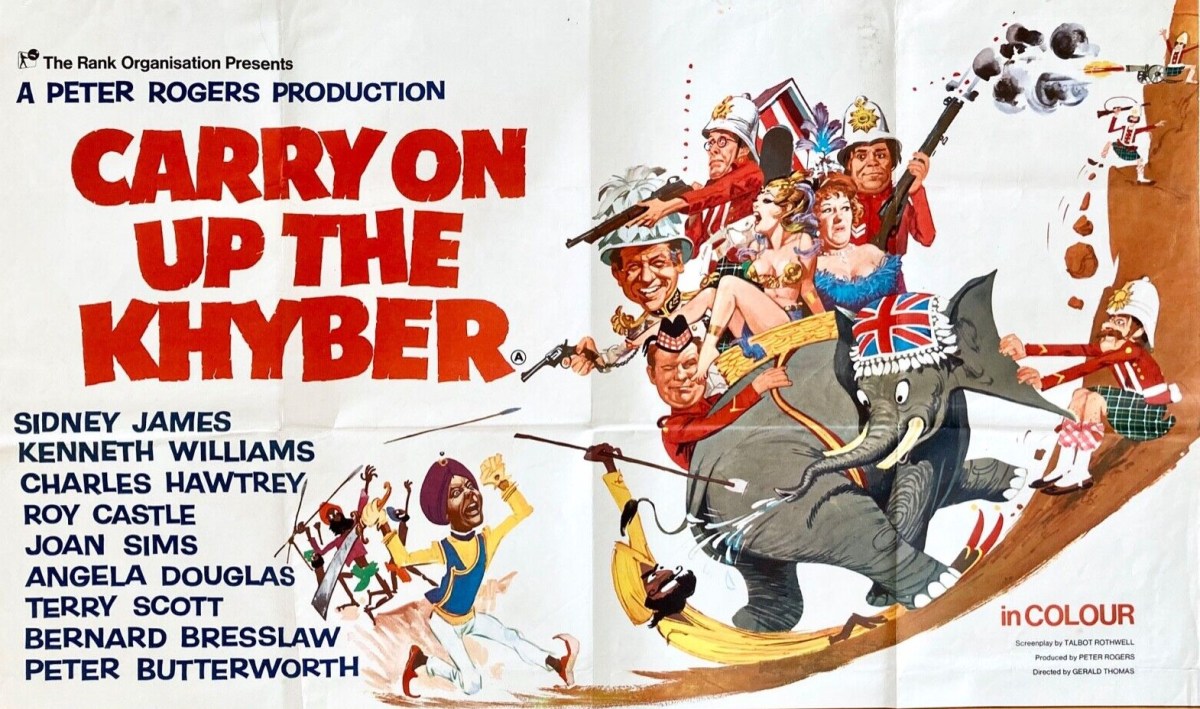
Carry On Up the Khyber (1968) ***

After a spate of serious pictures I thought I’d treat myself to some lighter fare and indulge in double entendres and lavatorial humor. I didn’t realise I had picked the only Carry On picture with serious undertones, exploring the hypocrisy endemic among leadership as much as witnessed in The Charge of the Light Brigade (1969), taking a distinct anti-colonial stance, and poking fun at military inefficiency.  

Despite the need to keep up appearances, British governor Sir Sidney Ruff-Diamond (Sidney James) despises Indian counterpart The Khasi of Kalabar (Kenneth Williams), the truth of their feelings towards each other revealed in muttered asides. Appearances are all that stand between the British and an Indian revolution, the natives fearing the Scottish regiments, the famed kilt-wearing “devils-with-skirts.”

The notion that any army would run a mile from a pair of bollocks – unless of course they had the faint-inducing dimensions of a Thor – is of course bollocks but that’s the film’s central conceit. But when the Indians discover that the British actually wear cotton undergarments as protection against the windy privations of the northernmost parts of the country, and, through the treacherous Lady Ruff-Diamond (Joan Sims), gain potential access to photographic proof, the status quo is threatened.

Lady Ruff-Diamond, furious at her husband’s constant infidelities, has set her eye on the Khasi, and is willing to betray her country for a bit of what could be termed “the other.” A squad of the usual British misfits, despatched to recover the incriminating evidence, naturally enough finds itself in a harem while Sir Ruff has to keep the British end up by entertaining native lasses by the score (he keeps count). When war does break out, the British, under siege, do what they are famous for, which is nothing.

You might have to be British to grasp many of the jokes, Khyber Pass and Khazi both have toilet associations, for example, but other visual gags would not be out of place in a Charlie Chaplin sketch. “Please close the gate” reads a sign on the border. Outside the Governor’s mansion is another sign “No Hawkers.” And you might at times believe the entire production was Chaplinesque, some of the jokes being ancient – “call me an elephant” orders Sir Sidney, referring to the mode of transport, only to be hit by the rejoinder “you’re an elephant.”

Many set-ups are obvious – black-faced British troops tumble into a bath. The double entendres are occasionally inspired – fakir, bullocks and shot among the perfectly innocent words so rendered. But the jokes come so thick and fast that by the time you’ve complained about a poor one an absolute cracker is on the way. Some contemporary notes are struck, references to cuts (at a time when Britain was suffering economically) and a muscular servant striking a gong (reference to the introduction to all films made by British studio Rank).

However, the political insight, if that’s not too complimentary, is not sustained and it soon collapses into more straightforward Carry On territory. A film like this comes of course with multiple warnings about sexism, racial stereotypes, blackface and anything else that could possibly offend, since that was the team’s denoted purpose, and, as you will be aware, it couldn’t be made nowadays so enjoy it – or as much of it as you can stomach – while you can.

Prior to the emergence of the Bond goldmine this was the closest thing the British movie industry had to a solid-gold franchise, this being the 16th in the series. Gerald Thomas directs from a Talbot Rothwell screenplay and the cast involves usual suspects Sidney James, Kenneth Williams, Joan Sims, Charles Hawtrey and Peter Butterworth. Angela Douglas (The Comedy Man, 1964) supplies the glamour and you might spot Wanda Ventham (The Blood Beast Terror, 1968) and Valerie Leon (Blood from the Mummy’s Tomb, 1971) in walk-on parts.

Oddly enough, the early Carry On pictures, seen as the natural successors to Ealing, if somewhat ruder, achieved minor cult status in the United States, Carry On Nurse (1960), the flagship, playing for over 40 weeks in Denver and clocking up $2 million in nationwide rentals (“Carry On Nurse US Rentals Run Over $2,000,000,” Variety, February 14, 1962, p3). However, no others approached that peak and “never received any hard sell to the U.S. and it remained for audiences to discover their buffoonery on double bill programs usually playing second fiddle to reissues of major British  hits” (“Carry On Mostly Discovered By Yankee Fans,” Variety, February 5, 1969, p22). Despite a positive review in Variety (Dec 25, 1968, p18) which deemed it a “beautifully timed and very funny piece of comedy film-making,” Carry On Up the Khyber made little impact on U.S. audiences recording just about $100,000 in rentals (“Variety B.O. Charts 1969 Results,” Variety, April 29, 1970, p26), that figure achieved by rounding up in the normal fashion.

Discover WordPress

A daily selection of the best content published on WordPress, collected for you by humans who love to read.

The Atavist Magazine

by Brian Hannan

WordPress.com News

The latest news on WordPress.com and the WordPress community.