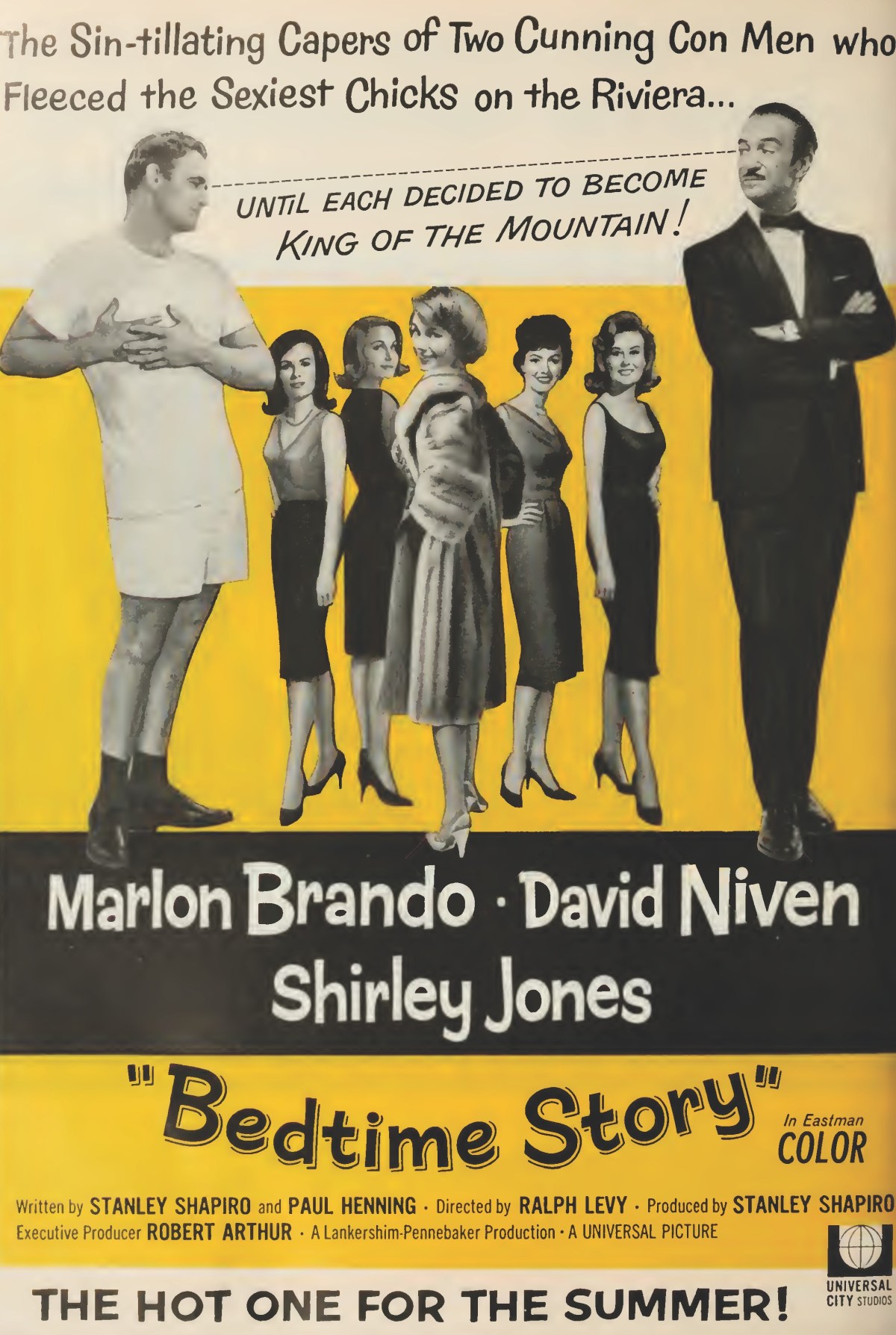
Con men at opposite ends of the grifter divide face off in a duel over territoriality in the French Riviera. Freddy Benson (Marlon Brando) is a low-level scam artist who is happy to scrounge a meal or talk his way into an innocent damsel’s bed. Lawrence Jameson (David Niven) is his polar opposite, posing as an impoverished aristocrat to relieve gullible women of their wealth, seduction an added extra.
Initially, Jameson gets the better of their encounters until Benson realizes just what a killing the Englishman is making. Initially, too, Benson is happy to pair up with Jameson, although that involves demeaning himself as a supposed mad brother kept in a dungeon, until the Englishman dupes him out of his share. Eventually, they agree a winner-take-all battle – whoever can swindle heiress Janet Walker (Shirley Jones) out of $25,000 shall inherit the shyster kingdom.
Benson takes the sympathy route to the woman’s heart, turning up in a wheelchair, while James adopts a psychological approach, persuading Ms Walker that Benson’s illness is psychosomatic for which he has the cure for the small consideration of $25,000. And then it’s one devious twist after another as the pair attempt to out-maneuver, out-think and generally embarrass the other. Both have a despicable attitude towards women, whom they view as dupes, but it is woman who proves their undoing.
Most comedies rely on familiar tropes and you can usually see the twists coming, but this is in a different imaginative league and once the pair are in their stride I defy you to work out what they will come up with next. It is full of clever quips and small dashes of slapstick and because neither actor chases the laughs but plays their roles straight it is a very effective and entertaining morsel.
Director Ralph Levy in his movie debut knows more than where to just point a camera since he had decades of experience extracting laughs in television with top comedians like Jack Benny and Bob Newhart. Brando (The Chase, 1966) free of the shackles of the angst he normally incorporates into his dramatic performances, looks as if he is having a ball and while teetering occasionally on the edge of mugging never quite overplays his hand.
David Niven (Prudence and the Pill, 1968) was born with a stiff upper lip in his mouth and while this kind of aristocratic character is a doddle for an actor of his stature the portrayal here is much more like the sharpest tool in the box. While oozing charm, Niven exhibits deadly spite.
Screenwriters Stanley Shapiro and Paul Henning had previously collaborated on Lover Come Back (1961) and Shapiro particularly made his bones on the Doris Day-Cary Grant-Rock Hudson axis so it is interesting to see him shift away from the romantic comedy cocoon into something that is a good deal sharper.
Enjoyable and original with excellent performances from the two principles and great support from Shirley Jones (The Music Man, 1962) as the mark and Egyptian Aram Stephan (55 Days at Peking, 1963) as an only too congenial French policeman.
The one element that every movie requires – advance publicity – was denied Elmer Gantry. Shooting took place on a closed set with all visitors carefully screened. Only six actors were given access to a complete screenplay while a general synopsis was denied distributors and cinema owners.
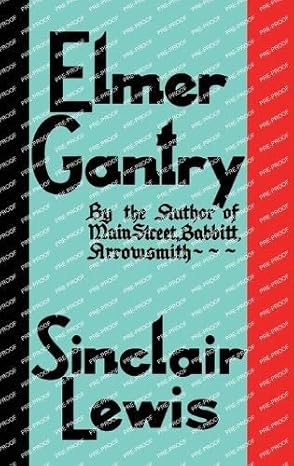
Over 30 years after publication of the source novel by Sinclair Lewis, its contents were considered so volatile and contentious that, rather than be pre-judged by the industry on expectations of what the movie may contain, director Richard Brooks took to issuing baffling statements such as describing Elmer Gantry as “The All-American Boy.”
Even the 12-page A3 Pressbook/Campaign Book, the prime source of marketing contact between studio and theater owner, was niggardly in the extreme. Narrative detail was limited to “the story of a spellbinding evangelist” rather anything approaching a synopsis.
Stuck with how to woo an audience in advance, United Artists fell back on a teaser campaign comprising six separate ads. The sequence was as follows: “Elmer Gantry Is Coming!” / “Sinners! Elmer Gantry Is Coming!” / “Sinners! Elmer Gantry Is Coming! starring Burt Lancaster”/ “Sinners! Elmer Gantry Is Coming! Starring Jean Simmons” / “Sinners! Elmer Gantry Is Coming! starring Burt Lancaster and Jean Simmons”. The last advert was coupled with a quote from the New York Times with the final salvo the same ad repeated but with a different quote from the New York Post.
The New York campaign – in those days a movie might take a few months to spread out from initial opening locale to other cities allowing promotional ideas that worked in one area to be publicized – relied on the first two teasers. But they went out in saturation – in railroad stations, subways, buses and race tracks with additional displays on poles, stilts and drums.
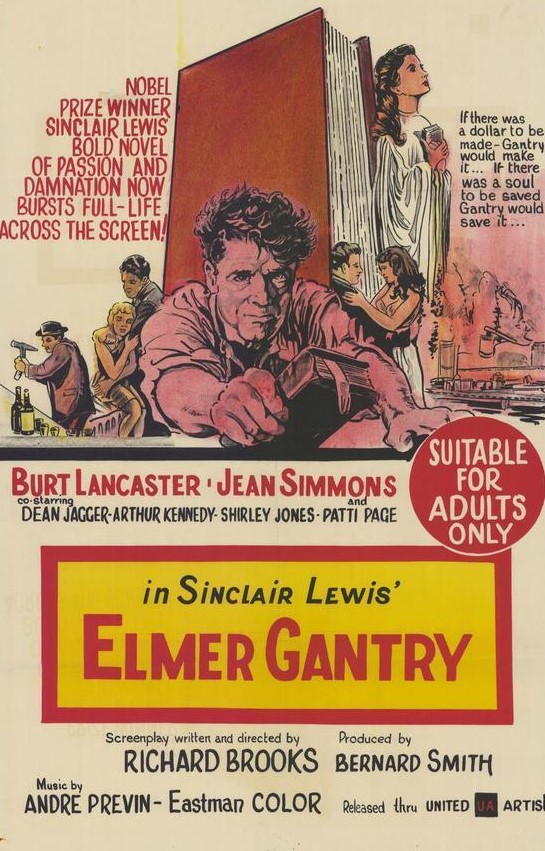
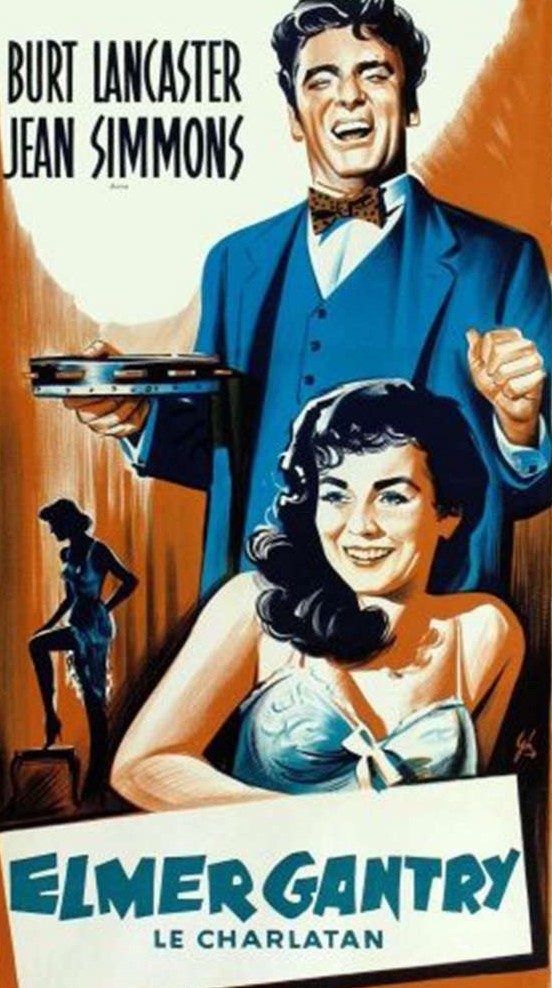
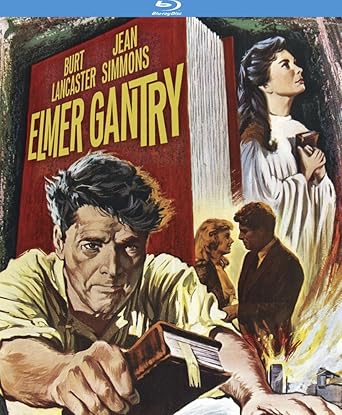
The major print advertising onslaught was led by two bold large-sized adverts intended to run facing each other on the same page. “Bless Him! Tens of thousands of believers shouted his praises!” was accompanied by the iconic illustration, Bible in hand, of Burt Lancaster. “Damn Him! Three women damned his soul” showed Lancaster grappling with Jean Simmons with Shirley Jones and Patti Paige in the background in more revealing clothing. But these two elements could also be fitted into the one ad, as shown above.
There were nearly a dozen full-size advertisements with a range of taglines. In all Lancaster is shown in the same pose with the Bible while Simmons is presented clutching a Bible and gazing heavenward. Shirley Jones appears in even skimpier outfits.
As was standard at the time, taglines could stand on their own or mix and match. Snippets for other ads were edited from this main ad: “Nobel Prize Winner Sinclair Lewis’ Bold Novel Of Passion And Damnation Bursts Full-Life Across The Screen! If there was a dollar to be made – Gantry would make it…If there was a soul to save -Gantry would save it…”
“Sinner! Elmer Gantry Wants You!” ran another ad backed up by “Are you ready, sinner? He wants you to know all about heaven…but not about his whiskey and his women!” Other adverts were fashioned from taglines like: “You’re all sinners…you’ll all burn in Hell! Tell ‘em Gantry…save ‘em from sin…lead ‘em to salvation…tell ‘em about everything…but not about your whiskey and your women!” Or included: “From the book that shook a nation with its sledgehammer theme…from a Nobel Prize-winning author…comes the raging story of a man who used the Holy Bible and broke every rule in it!”
Rarely have so many exclamation marks been employed in so short a space, but equally, rarely has a marketing team encapsulated so vividly a movie with a difficult subject matter, all tease and no substance.
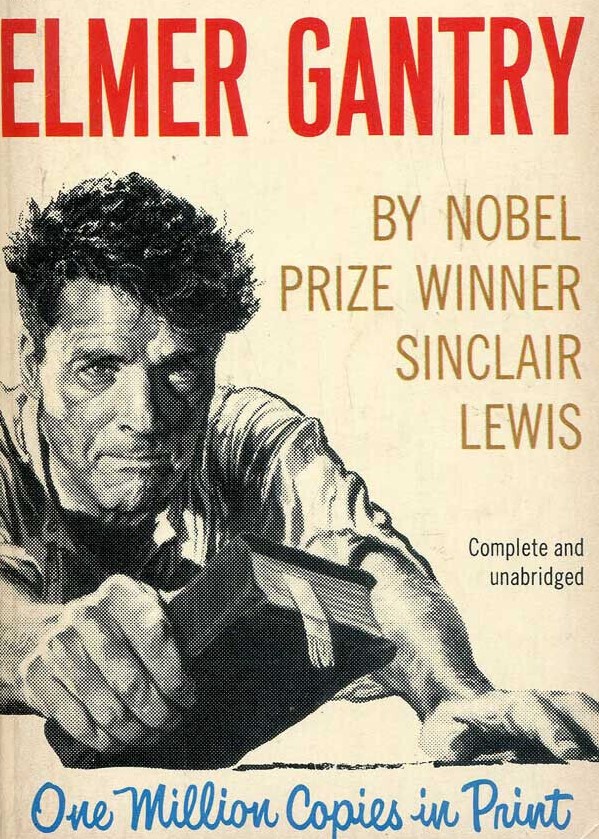
Out-with the usual marketing routes, the marketing team were able to take advantage of various ancillary promotional opportunities. Dell organized a massive paperback book tie-in in thousands of bookstores and newsstands, Burt Lancaster dominating the front cover with Simmons and Jones pictured on the back. Music retailers also played their part, United Artists Records launching the Andre Previn soundtrack album while Mercury released an album of revival tuness sung by Patti Paige, who made her movie debut in the film. With record sales exceeding 35 million, Paige’s host of fan clubs were a natural target for contact and if there was none in the local vicinity cinema managers were encouraged to start one by the simple device of setting up “a giant postcard in the lobby” and inviting fans to attach their signatures.
Department stores were called upon to run 1920s Fashion Shows.
Anniversaries, so important today, helped out. It was 30 years since Sinclair Lewis was awarded the Nobel Prize, the first American author so recognized, and 1960 was the 75th anniversary of his birth. But the promoters also played upon the book’s initial controversy, hoping to re-ignite the debate as a promotional tool.
With the bulk of the Pressbook given over to advertising and promotional ideas, barely little more than a single page was devoted to the stars, but even then there was little of the usual soft-focus puff pieces. The kind of journalistic nuggets that might help an editor fill a vacant space were limited. All we learned of Burt Lancaster, who had worked with Richard Brooks before on Brute Force (1947), was that – as if this was a mark of respect – he agreed to read the screenplay twice. Of Jean Simmons it was pointed out she had played an evangelist in Guys and Dolls (1955) but the Pressbook erroneously states that she played a nun in Black Narcissus (1947); in fact, she was a beggar girl. Arthur Kennedy is mentioned in relation to his Oscar nominations.
Shirley Jones was the most likely to attract column inches as a result of explaining how she made the transition from more demure roles in Oklahoma (1955) and April Love (1957). “It feels just fine – now,” she told the Pressbook interviewer. “At first, well, I really don’t wear much except what you see. A slip, these shoes with the green frills, and slinky black silk wrap-around that’s transparent.
“Usually, I walk into a movie set wearing my bustle and petticoats and some of the boys turn round as I go by and say, ‘Hiya, Shirl.’ But when I walked in dressed like this the fellows all just turned round and didn’t say anything. They never turned round like that before. Well, not really. It did take some getting used to after provoking the big brother reactions for so long.
“But I guess every girl dreams of being a conversation stopper some day. This is my chance. Of course, I am embarrassed sometimes…or maybe it’s inhibited.”
Brooks rewrote the script eight times before “he felt he had captured the essence” of Gantry. Most of the scenes were filmed on sound stages or adapted from an assortment of 1920s vintage streets from the backlots of other studios. The tabernacle was constructed out of an ice skating rink on a beach pier in Santa Monica.
Art director Edward Carerre spent $6,500 erecting and furnishing a genuine evangelist tent rented from Canvas Specialty. It was slightly trimmed to fit onto two combined sound stages on the Columbia lot. A total of 400 benches each measuring eight- or ten-feet were constructed by studio carpenters to provide seating for 1,000 – the tent accommodated another 2,000 standing. The stage required 500lb of imported sawdust and banners 30ft long were specially made to incorporate Biblical quotations. Where most movies required a maximum of 15-20 sets, Elmer Gantry boasted 62.
The climactic scene, conflagration in a tent, took five days to film. Soaking the set in kerosene would not supply the instant flash of flame the director demanded. So, instead, he turned to old film footage, including some frames from It Happened One Night (1934). “We’re burning film to make film,” quipped Brooks.
Burt Lancaster gives the performance of his life as the eponymous burnt-out salesman finding financial redemption in the salvation business in Richard Brooks’ riveting examination of the revivalist boom. While replete with hypocrisy, old-style religion brought succour to the rural poor, but the director takes such an even-handed approach to the subject matter, carefully nurturing a marvellous parade of characters, that you are totally sucked in.
Brooks made his name adapting famous novels but only here and In Cold Blood (1967) does he exhibit complete mastery of the material. In fact, he pulls out a cinematic plum in having the audience, who might initially have mocked the obvious manipulation of the poor, suddenly taking the side of the itinerant preachers when they come up against the more sophisticated religious operators in the big towns.
Elmer Gantry (Burt Lancaster) has some previous in the preaching business, but only for as long as it took for him to be chucked out of divinity school for seducing the principal’s daughter, so when by accident he comes upon a touring revivalist meeting he discovers his metier as a fast-talking brazen preacher. He doesn’t quite usurp the star of the show, Sister Sharon (Jean Simmons), and in fact their styles complement one another, he preaching hell and damnation, she the love of God.
Beneath the demure guise, Sharon is anything but a push-over. Not only does she see through him right away and consistently knock him back but she is quite the businessperson, though her methods of keeping civic officials in line often rely on blackmail. But then who are the hypocritical, allowing speakeasies and prostitution to run rampant, to attempt to rein in revivalists who need account to no one for how they spend their revenue?
Eventually, of course, Elmer’s ardent wooing wins over the virgin Sharon who easily forgives his dalliance with her doe-eyed follower Sister Rachel (Patti Paige). Burgeoning romance is scuppered by a chance encounter with prostitute Lulu (Shirley Jones), the principal’s daughter. That’s just the spark needed for anti-religious fervor to take over and the enterprise ends in disaster.
But what’s so good about a film that could as easily just relied on taking pot-shots at religion is that Brooks gives equal space to the good and bad in each character. Sure, Elmer’s confession of his sins might be construed as a seduction device, but that’s tempered by a genuine ruefulness and remorse over his previous actions. And while his grand-standing in front of an audience could be interpreted as merely an actor revelling in a role, you can see that religion has as easily taken over him and provided him with an identity that he finds rewarding. He might still be a salesman but he’s selling the hell out of the product.
Sharon’s uncanny hold over a congregation may be a true skill, and she’s definitely a believer, but that is borne out of fiction. She has reinvented herself, given herself a new name and identity, that furnished her with business opportunity in a male-dominated world, but love of God has come at the expense of love of man.
Perhaps what’s best about the picture’s construction is the array of supporting characters. Journalist Jim (Arthur Kennedy) might appear the pick, ingratiating himself with the touring company only to write a searing expose, but drawing the line, and incurring the wrath of his editor, at writing the kind of tawdry tale he believes is a fabrication. While still holding a torch for Elmer, Lulu has none of the cliché prostitute’s heart of gold. Initially rejected by Elmer, she goes along with a scheme to bring him down, only to change her mind and change it again, left only with remorse.
And Brooks manages to weave in a ton of detail, sometimes in dramatic fashion, such as the church elders in big city Zenith debating the value of backing the revivalists (the touring operation usually signs up hundreds of people to local parishes), and sometimes just as background, such as when Jim dictates his front-page lead in the newspaper office, whipping it off a page at a time to throw in front of the editor.
There’s also a little-commented-upon affinity between Shirley and Elmer. She, too, is coming to the end of the line. She is approaching burn-out. The endless travel, the responsibility for her payroll, financing accommodation, dealing with officials, seeing all the people she has returned to the fold being handed over to local churches, is taking its toll. And she wants the stability of her own church, where she can soothe her congregation on a weekly basis and live a more temperate life.
If ever a movie suited Burt Lancaster’s physicality, this is it. Allowed to channel his inner dominance, every gesture overpowers and by the same token makes him more potent when at his most abject. Lancaster (The Swimmer, 1968) was in a rich vein of form that would see him deliver a series of majestic performances throughout the decade. He deservedly won the Oscar.
Jean Simmons (Rough Night in Jericho, 1967) is, effectively, both a villain, duping everyone by her creation of Sister Sharon, and the epitome of the American Dream, a girl from shantytown who makes her way bigtime. Shirley Jones (Two Rode Together, 1961) is afforded more dramatic beats and hers is a sure-footed performance, leading you to believe she will react one way and then go another. Oddly, Arthur Kennedy (Joy in the Morning, 1965) missed out on adding to his five Oscar nominations for supporting actor.
Nothing in this movie has aged. If anything, this was way ahead of its time in daring to pick holes in organized religion (The Cardinal and The Shoes of the Fisherman were a good few years away and in TheNight of the Hunter a few years before Robert Mitchum only posed as a preacher).
Extraordinary movie by Richard Brooks at the top of his form.
Never quite considered top drawer John Ford, yet it should rank alongside Stagecoach (1939), The Searchers (1956) and The Man Who Shot Liberty Valance (1962). I’ve been talking recently about a movie completed in a single take (Grenfell, 2023) and the power of a single scene (The Manchurian Candidate, 1962), and now I’m touching upon another piece of cinematic dexterity – the fixed-camera seqeunce.
This is a beauty and it lasts four minutes. Yep, for a four-minute medium-shot scene featuring the two major characters the camera doesn’t move. Lawman Guthrie McCabe (James Stewart) and Cavalry officer Jim Gary (Richard Widmark) take a break from the 40-mile journey back to the fort. You think this is where Gary is going to spring upon McCabe exactly why his presence is so necessary for Army business. But instead, the scene, driven by Gary, is set up to discover why McCabe is so agreeable to taking a temporary leave of absence from an exceptionally comfortable lifestyle back in his small town.
Sure, this scene boasts a bit of business, the waving about of cigars and some pointing and McCabe’s head bobbing around, but otherwise the camera just observes. First of all we discover that McCabe earns $20 a month more than the soldier – that is, when the officer is paid at all, three months since he saw any money – and that McCabe is on the mean side and sarcastic with it. McCabe starts puffing on a long cigar and has to be nudged to offer Gary one. “You can afford matches,” he notes when Gary produces a packet.
McCabe has temporarily upped sticks it transpires because he’s getting unwelcome heat from his hotel owning lover Belle (Annelle Hayes), on the sticky subject of marriage. The subject was brought up with a woman’s “animal cunning” when Belle asked why he was content with just taking 10 per cent of her income when, through entering into a partnership via marriage, he could receive 50 per cent. Gary is taken aback that his old pal is getting a slice off the top. And then somewhat shocked to learn that McCabe takes the same percentage from every business in town. McCabe is surprised to learn this comes as news to Gary. How else could the marshal support his lifestyle.
This mild interrogation is interrupted by a nugget about Belle. She has a stiletto strapped to her leg. That’s not news to Gary. McCabe is perturbed. How did he know. You just told me is the speedy retort. That takes a moment to sink in before McCabe’s suspicions are aroused and then allayed.
In other hands, this scene could have lasted a minute. Some speedy dialog would have got to the point faster. But that’s not the point. You can’t attempt this length of fixed camera scene unless you have two wonderful actors. It might appear indulgent but the director wants us to be sucked in by the affable McCabe.
Not sure where they got the image of the women in red being hanged – must be from another movie.
Because until now it has been all economy. The movie opens with a well-heeled fella dozing on a hotel veranda being woken up by a waiter bringing him beer and a cigar, candle at the ready to light the tobacco. The stage arrives. Two cowboys approach asking where they can get a decent drink. The man pulls back his jacket to reveal his badge. The mention of his name, Guthrie McCabe, is enough to make the pair reconsider staying.
A cavalry troop arrives with Gary at the head. Gary’s uniform is covered in dust, so thick you can hardly beat it off, so thick that unless accompanied by McCabe he would have been forbidden entry to the hotel by the owner. There’s snippy dialog here but it’s all delivered by Belle as she provides a series of sharp observations about men. Uninvited, she joins the pair as they sit down, Gary somewhat vague about his mission. Outside, we encounter McCabe’s dumb deputy, escorting a bunch of prisoners back to the jail because the judge was too drunk to appear in the courtroom – it’s that kind of town. McCabe, seeking re-election shortly for his position, sets them free and buys them a drink. Then we’re off on the 40-mile trip.
Still, we don’t know why McCabe’s presence at the fort is so important. John Ford doesn’t usually fall back on mystery as a narrative device unless it’s some personal secret hidden by a character. So McCabe is astonished to be hailed as a conquering hero, cheered by the people inhabiting an encampment outside the fort. One woman even says she can see his halo. What the…
Inside, it transpires Gary is merely doing his superior’s dirty work. And it’s cynical stuff at that. Major Frazer (John McIntyre) wants rid of the rabble who are giving him grief over their sons and daughters long ago kidnapped by the Commanche. Due to the current treaty, the Cavalry can’t just wade in and collect the kids, grown-up by now some of them. So he needs someone who is on nodding terms with the tribal chief (Henry Brandon) and negotiate their release.
McCabe’s first thought is how much he would be paid, given a cavalry officer’s salary would hardly keep him in cigars, reckoning it would be worth $500 a skull. “Whatever the market can bear,” insists McCabe. Both officers are appalled and even more so when McCabe reckons he’ll screw the money out of the distraught families. And that’s what he does. Affable has suddenly turned callous. The camera in this next scene focuses on Gary’s face, until he can take no more of his old buddy’s blatant greed.
Sucker punch number two. McCabe is as mercenary as the later Man With No Name. but he’s not the only one displaying cynicism. To appease his second wife Henry J. Ringle (Willis Bouchey) will cough up $1,000 if McCabe can bring back any child, not the actual one lost, because the kid was so young when kidnapped that his wife won’t know the difference and he has to get her off his back because it’s interfering with his business.
But there’s more sucker punches to come. McCabe won’t accept Gary’s leadership and won’t even agree to work out their approach together. But when it comes to action, it’s soon pretty clear that McCabe is the tougher character, can anticipate the enemy reaction. And he’s right to be cynical because when Elena (Linda Cristal) is returned to the fold, she is despised, all the fort wives want to know is how many Native American braves she slept with, and why she didn’t commit suicide instead.
There’s a sting in the tale for McCabe when he returns home and finds Belle has taken decisive action in his absence.
McCabe is a superb creation, none of that risking your life for nothing in his game plan, possibly the most realistic character in the Ford oeuvre, who doesn’t care a whit what people think about him, as long as he is paid what he feels is his due. Sure, he puts his life on the line, but you can be guaranteed that’s not much of a gamble, he is so accomplished with the gun and can outwit any foe. As corrupt as he is, he’s a lot more straightforward than the apparently high-principled wives and officers who treat Elena so abominably.
There’s a good bit more to this picture than I’ve described. I’ll pass over the usual punch-up to which Ford appears addicted. Gary’s romance with civilian Marty (Shirley Jones) is well done, she carrying the burden of surviving Indian attack when her younger brother was taken, and she is an accomplished pioneer, in another superb scene Gary congratulates her on pitching her tent out of the wind, far enough for the creek to escape mosquitoes and near a dead tree to get firewood.
And there’s another brilliant scene, revolving around a music box, that could have been a cliché but in another sucker punch takes a different, quite awful, direction.
This is so beautifully written and directed I’m just astonished it wasn’t met with acclaim at the time or since. The typical western has ever been so undercut nor typical action met with such dire consequence, the soft underbelly of life at the fort never so cruelly exposed.
You might think James Stewart was taking a chance in assuming the mantle of the man who killed Liberty Valance in order to advance his political career when in reality he did no such thing. But this character is light years away from that simple theft. His character in that Ford picture was exactly the high-principled guy you had come to expect from Stewart, even if, at the last instant, succumbing to a lie.
In the hands of another director McCabe would have been played by a sleazy Lee Marvin or another actor who could not rise above his bad-guy persona. This must be James Stewart’s finest hour, making an unattractive character appealing, so much so you almost appreciate his point of view in relation to the corruption and his antipathy to matrimony, and taking pains to conceal not the goodness underneath but his understanding of the harsher realities of Western life, at which he is more than adept at dealing.
Richard Widmark (The Secret Ways, 1961) also discards his normal screen persona, his job to act as observer to the Stewart character, to lead audience disapproval, and to be hoodwinked as much as McCabe by the cynical Major while enjoying none of the reward. He is gentler than usual, more resigned to his job, expecting little. Good supporting cast including Oscar-winner Shirley Jones (Bedtime Story, 1964), Linda Cristel (The Alamo, 1960) and especially, in her only movie, Annelle Hayes, as an extremely savvy character who gets the better of her slippery lover.
Brilliant film. And if like me you come to the four-minute scene you might just rewind once or twice to enjoy what Ford, Widmark and Stewart achieve. I was so taken with the entire film, which I’d never seen before, that I watched it again the next night.
Vastly under-rated, critically dismissed at the time, this early reflection on feminism has now come into its own. Yet it starts out as a completely different picture. At first it appears as ruthless a depiction of the self-destructive alcoholic as the later Leaving Las Vegas (1995). In passing, skewering the conventions of marriage in an era or strata of society where divorce was not a convenient option. And a time when women, chained to the home but craving attention, might risk the humiliation of being turned away by a secretary on visiting their husband at the office.
When love had turned into transactional sex. Where women hid out in beauty parlors, sanctuaries which men would dare not invade, to drink and play cards in peace. Or, indulging in the working aspect of such places, underwent breast augmentation or brutal hair removal or other procedures with a view to holding on to their men, seen as daily riding a wave of temptation in the Mad Men world of cocktails and expense account living. For this class of men the word “inappropriate” has never been invented as they paw at any female within reach.
From snow-kissed romance and champagne to….
A largely redundant and lengthy (eight minutes, for goodness sake) montage (including credits and a post-credits – what! – theme song) serves to emphasize the part Hollywood played in reinforcing the celluloid image of initial romance being the mere prelude to happy ever after. The reality was a much whiter shade of pale.
Facing up to their sixteenth wedding anniversary – their marriage, topically, spanning the birth of Prince Charles and his anointing as Prince of Wales, seen via cinema newsreel and television news – alcoholic middle-aged housewife Mary (Jean Simmons) re-evaluates her stultifying life. Lawyer husband Fred (John Forsythe) jokingly refers to himself as “the F.B.I.” but the surveillance he undertakes to ensure his wife has not fallen off the wagon would have earned him a gold star in that particular organization. He has housemaid Agnes (Nanette Fabray) snoop on his wife, goes through all her drawers and clothes until he finds the mercifully unopened bottle of vodka hidden in a boot, checks up on her movements at the hairdresser and even knows which bar she is likely to frequent.
Although managing to refrain from drinking anything alcoholic, Mary’s behavior take her perilously close. She drinks tomato juice from a champagne glass, buys a fellow alcoholic a whisky in a bar just to savor him drinking it. And for all her husband’s attempts to keep her away from the stuff gets pretty loaded himself at times and the catering table at a previous anniversary party fairly groaning with booze has proved a temptation too far. She’s been an extreme player – her stomach pumped out in flashback.
…anything that comes in a glass or a bottle. She even has booze secreted in a bottle of perfume.
Husband’s control extends to finance. She is denied credit card, cheque book and ready cash. Even her mother (Teresa Wright) refuses to lend her money. Unable to go through with putting another good face on their marriage via the anniversary party she pawns a necklace and jaunts off to the Bahamas. On the plane she meets old buddy Flo (Shirley Jones) who is enjoying a clandestine affair with a married man. Mary dips her toe in those illicit waters but her flight has sobered her up enough to face up to her dilemma and not cover all the wounds with alcohol.
I’m not planning to spoil the story by telling you the ending but the ending is the whole point. While the movie’s title is initially perceived as an ironic tilt at the state of marriage – the traditional movie “happy ending” – in reality the ending Mary chooses for herself is the feminist one of self-determination, independent of a man, her self-worth not tied up in his appreciation of her, and she takes the extremely bold decision to quit the marriage, not for another man as might have been de rigeur and in some ways more acceptable within society, but to find herself.
This was a terrible flop, the worst in director Richard Brooks’ career which at the time had reached the commercial and critical peaks of The Professionals (1966) and In Cold Blood (1967), for which he was Oscar-nominated. Audiences failed to respond despite Jean Simmons (Rough Night in Jericho, 1967) receiving her second Oscar nomination.
And you can see why it sank. If people didn’t walk out during the interminable montage sequence, then for the most part it was interminably depressing. The only thing worse than watching an alcoholic getting drunk is watching an alcoholic desperate to get drunk, holding back from indulging as if standing on the edge of a precipice, almost willing themselves to fall over for the sheer relief of oblivion.
And yet it is extremely watchable as the couple play out their marital game, Fred, the ostensible loving husband, protecting his wife from herself, Mary blaming her drinking for their marital problems rather than the other way round.
Jean Simmons is a compelling watch. This is really a tremendous performance and a shame she lost out to the more showy acting of Maggie Smith in The Prime of Miss Jean Brodie. As good as that was, it was pretty much all surface, Smith playing a character who was pure invention, for the most part sashaying through life by force of her incredible personality, not a woman grasping at straws from the outset, damned by all in sight who were only too aware of her affliction, unable to come to terms with herself, denied all that was casually tossed to often worthless men.
John Forsythe (Topaz, 1969), who grits his teeth so much they appear likely to puncture his cheeks, is as good as I’ve ever seen him in a whale of a part that calls upon him to play two roles effectively, the dutiful husband restrained by having to watch over his errant wife, and a man who, out of her sight, can still enjoy himself, and, it is hinted, has been illicit himself with colleague’s wife Helen (Tina Louise).
Structurally, it’s very cleverly done, and Richard Brooks continues with the façade of the happy marriage and the wife’s drinking being the root cause of their dual unhappiness before letting rip late on with the incipient feminism.
Con men at opposite ends of the grifter divide face off in a duel over territoriality in the French Riviera. Freddy Benson (Marlon Brando) is a low-level scam artist who is happy to scrounge a meal or talk his way into an innocent damsel’s bed. Lawrence Jameson (David Niven) is his polar opposite, posing as an impoverished aristocrat to relieve gullible women of their wealth, seduction an added extra.
Initially, Jameson gets the better of their encounters until Benson realizes just what a killing the Englishman is making. Initially, too, Benson is happy to pair up with Jameson, although that involves demeaning himself as a supposed mad brother kept in a dungeon, until the Englishman dupes him out of his share. Eventually, they agree a winner-take-all battle. Whoever can swindle heiress Janet Walker (Shirley Jones) out of $25,000 shall inherit the shyster kingdom.
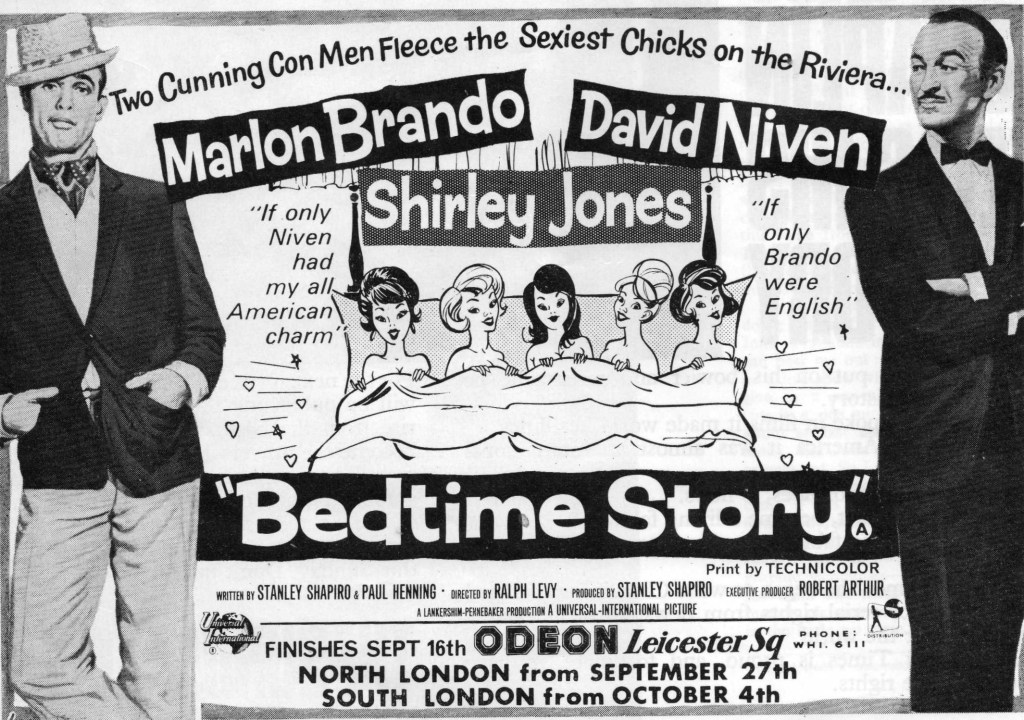
An example of the older style of British movie distribution. The prints started off in one section of London the first week and switched to another sector the following week. Even if the film was a big hit, it could not be retained since the prints were already promised elsewhere. Only after it had played London, would general release follow in the provinces. There was no point watching West End release dates for an idea of when a new movie would play in your local city, it would not be anywhere near you until it had completed the North and South London runs.
Benson takes the sympathy route to the woman’s heart, turning up in a wheelchair, while James adopts a psychological approach, persuading Ms Walker that Benson’s illness is psychosomatic for which he has the cure for the small consideration of $25,000. And then it’s one devious twist after another as the pair attempt to out-maneuver, out-think and generally embarrass the other. Both have a despicable attitude towards women, whom they view as dupes, but it is a woman who proves their undoing.
Most comedies rely on familiar tropes and you can usually see the twists coming, but this is in a different imaginative league and once the pair are in their stride I defy you to work out what they will come up with next. It is full of clever quips and a small dash of slapstick and because neither actor chases the laughs but plays their roles straight proves a very effective and entertaining morsel.
Director Ralph Levy in his movie debut knows more than where to just point a camera since he had decades of experience extracting laughs in television with top comedians like Jack Benny and Bob Newhart. Brando (Mutiny on the Bounty, 1962), free of the shackles of the angst he normally incorporated into his dramatic performances, looks as if he is having a ball and while teetering occasionally on the edge of mugging never quite overplays his hand. This was a conscious effort by Brando, whose company Pennebaker was involved on the production side, to shift his screen persona.
David Niven (The Pink Panther, 1963) was born with a stiff upper lip in his mouth and while this kind of aristocratic character is a doddle for an actor of his stature the portrayal here is much more like the sharpest tool in the box. While oozing charm, Niven exhibits deadly spite. Screenwriters Stanley Shapiro and Paul Henning had previously collaborated on Lover Come Back (1961) and Shapiro particularly made his bones on the Doris Day-Cary Grant-Rock Hudson axis so it is interesting to see him shift away from the romantic comedy cocoon into something with considerably more edge.
Enjoyable and original with excellent performances from the two principals and great support from Shirley Jones (The Music Man, 1962) as the mark and Egyptian Aram Stephan (55 Days at Peking, 1963) as an only too congenial French policeman.
Originally, it was lined up with a quite a different cast – Gregory Peck, Tony Curtis and Tippi Hedren. It was remade as Dirty Rotten Scoundrels (1988) with Steve Martin and Michael Caine.
CATCH-UP: The Blog has previously featured Brando in more dramatic vein in The Chase (1966) and The Appaloosa (1966) and also the dramatic side of David Niven in The Guns of Navarone (1961), Guns of Darkness (1962) and 55 Days at Peking (1963).







 The Magnificent 60s