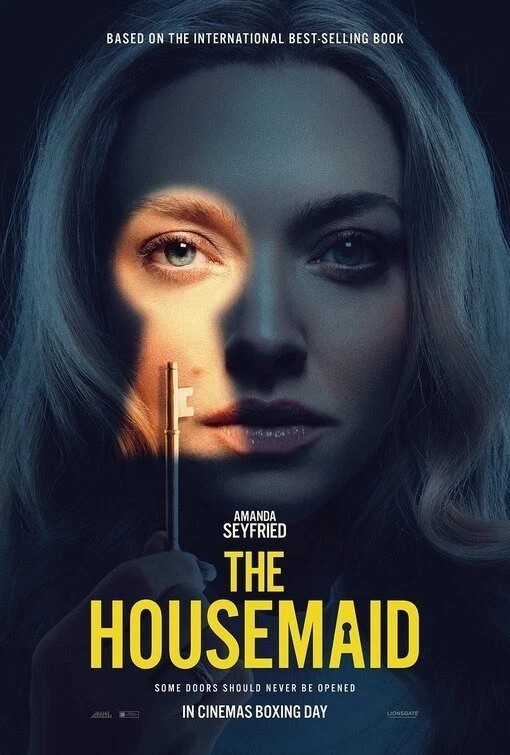
Behind the Scenes: Book into Film – “The Housemaid” (2025)

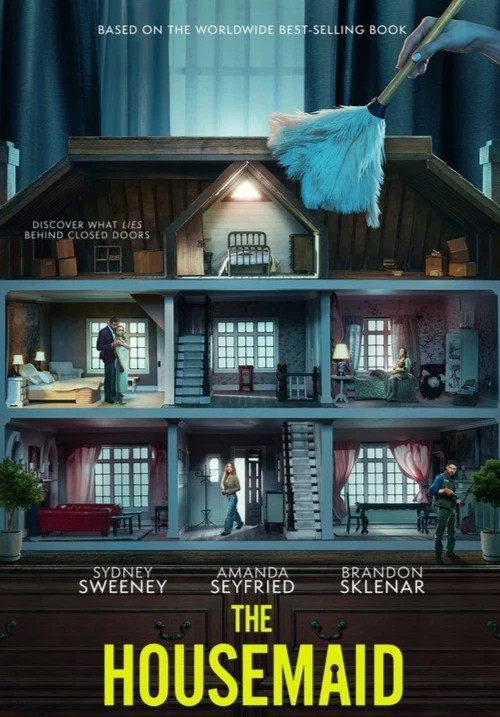
Now that Hollywood is waking up to the surprise hit of the season – worldwide gross now pushing $300 million – it’s equally surprising to discover just how much work went into converting a bestseller with a very enticing hook into a runaway success. The pitch is a stunner – abused wife grooms housemaid to take her place and, potentially, put her abusive husband in his place.

Screenwriter Rebecca Sonnenshine (The Keeping Hours, 2017) does a quite superb job of tailoring the bestseller by Freida McFadden. It would have seemed, on the face of it, with such a killer premise, you wouldn’t have to do much tampering. But you’d be wrong. What Sonnenshine removes and adds and touches up are a template for the art of screenwriting.
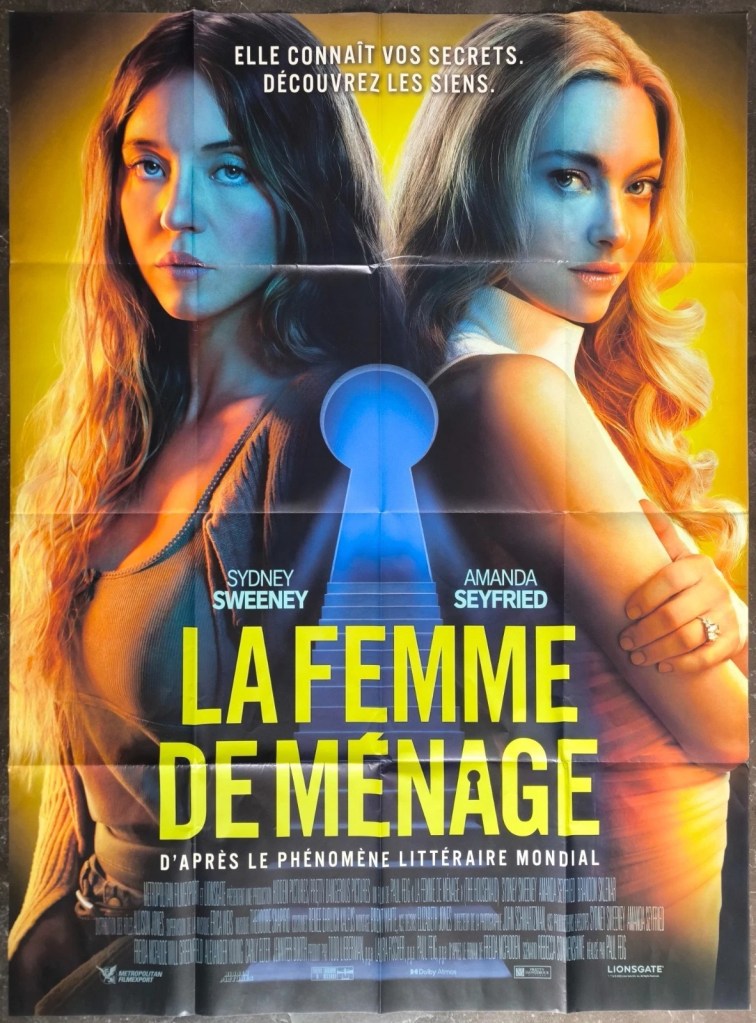
Major changes: the climax is completely changed and the role of handyman Enzo (Michele Morrone) considerably reduced, especially the icky section where our valiant housemaid Millie (Sydney Sweeney) looking for a no-strings-attached one-night-stand comes on to Enzo only to be rejected; and the screenwriter takes the “privilege” line that doesn’t appear until well into the book and brings it in much earlier, to add gentle menace.

Minor changes: just about everything.

The filling out begins at the start. In the book, there’s very little detail regarding the job interview and the grandeur of the house except that it’s grand. Here’s what Sonnenshine adds – the “W” on the gate, the display of enticing food that employer Nina (Amanda Seyfried) lays on for a prospective employee, the emphasis on the obnoxious child Cece (Indiana Elle) as a potential ballerina, the cops rousting Millie when she’s asleep in her car. Here’s what Sonnenshine immediately removes: the attic is smaller in the book, tiny, compressed, more ominous; an immediate warning from Enzo; and we don’t learn right away that Millie is a killer.

If you want to know the difference between taut narrative and drama, follow Sonnenshine. In the book, Millie meets husband Andrew (Brandon Sklenar) and child at the interview. In the film, it’s on her first day on the job when Cece introduces herself as the most obnoxious child, taking the new employee to task right away.

Other simple changes: in the book Millie starts work the next day, in the film she starts immediately following the job offer. In the book, Millie arrives overloaded with baggage that Nina doesn’t offer to help carry, in the film she brings very little and Nina does offer to help.

Major change: the heirloom plates. That’s pure Sonnenshine invention. They don’t appear in the book, and husband Andrew’s mother (Elizabeth Perkins) is scarcely in sight.
Sonnenshine also dumps Millie’s apparent first big mistake. In the book Millie makes Cece a peanut butter sandwich only for Nina to go ballistic because the child is apparently allergic. That’s too obvious a schematic and Sonnenshine opts for something better.

Right away, over the “dirty glass” issue, Sonnenshine brings in the first use of the “privilege” weapon long before as I said I was used in the book and never by the child. But she takes out the point about Millie’s glasses / contact lens. In the book this is a contentious issue – Nina accuses Millie of lying over wearing contact lens and glasses.

Also Nina gives her old clothes to Millie very early on whereas Sonnenshine dramatizes this so that it’s seen as an apology.

It’s Sonnenshine who adds drama to Millie’s visit to her probation officer and gives the probation officer the icky line asking Millie about her sex life. Nor, in the book, is Andrew mad keen on Stanley Kubrick’s Barry Lyndon (1975). That’s another Sonnenshine touch, to fill out Andrew’s character. “Hot saint” is another of Sonnenshine’s lines. In the book it’s Andrew who suggests going to the Broadway show, not Nina, so that’s a nice gesture rather than with Nina, another apology. I should also point out that in the book Nina is about 50lb heavier than in the film. The ballet isn’t so dominant, either, Cece in the book attending a range of classes.

In the book, Andrew and Millie don’t get separate rooms at the hotel. They are all over each other in the cab to the hotel. It’s Sonnenshine who adds the dramatic urgency and ratchets up the tension in that in the film Millie tries to avoid intimacy and it’s only when she thinks she’s been fired by mobile phone that she falls into Andrew’s arms.

The film’s killer twisty line of “did you learn to cook in prison?” is better than the book’s “what’s prison food like?” Sonnenshine’s other big switch is that in the book Millie’ in juvenile detention not a scholarship kid as a private school when she commits murder. In the book Nina’s discovery of the Playbill program for the Broadway play is more discreetly done. But Sonnenshine turns it more dramatic with Nina coming down the stairs holding the magazine.

Nina’s immediate revenge in the book is to have Millie suspected of shoplifting after an anonymous phone call to a supermarket. Again, in the film it’s ratcheted up, Millie arrest for stealing her boss’s car and handcuffed and more roundly humiliated that provides the grounds for Andrew to chuck his wife out. The book cuts Millie out of the confrontation between husband-and-wife which results in Nina leaving.

And the book has no equivalent to Nina howling in her car apparently in despair at being chucked out, nor, in a marvelous twist, once we discover what hell awaits Millie, to cutting back to that scene and Nina turn that wail into a whoop of delight at being free.

Nina having to compensate for not getting her roots done by pulling a hundred strands of her hair out twice is in the book. But since the book didn’t include anything to do with priceless heirloom crockery, Millie’s first punishment is, frankly, a lot less interesting. Millie has to balance a stack of heavy books on her stomach for hours at a time. Honestly, that’s nothing, and visually zero, compared to having to rip your stomach open with the sharp end of a broken piece of crockery, which must be one of the most horrific scenes committed to celluloid.

And it’s not a cake knife left in the attic deliberately by Nina that allows Millie to escape, it’s the remains of a pepper spray that had formed part of one of Nina’s punishments. Stabbing someone in the neck with a knife versus blinding them with a pepper spray – what’s the more visual? You don’t need me to tell you.

His punishment in the book is rather long-winded especially bearing in mind that there’s no heirloom plates and assorted crockery to up the ante. So first of all in the book, Millie tortures Andrew by making him bear the weight of the books for hours at a time. It’s only days later, in fact, that in the book Millie instructs Andrew to pull out a tooth. Bear in mind, too, there’s been no lead-up to this, not in the book, which is why the screenwriter places such emphasis on his teeth and smile.

Sonnenshine tosses away the book’s ending. And you can see why. It’s not remotely cinematic. Sure, Nina returns to help. But in the book little help is needed. By the time Nina returns several days later, Andrew has already starved to death, or dead by dehydration, technically. That would be more easily explained to the cops given the problems with the door and Andrew in the house alone except in the book Millie has had her fun and made him pull out four teeth.

So, Sonnenshine opts for another course of action. He’s not dead when Nina returns. She makes the mistake of thinking it’s Millie locked in the attic and inadvertently frees her husband and then after some coming and going Millie pushes him over the banister and down about 50ft to his death.

Sonnenshine adds a happier postscript, Nina giving Millie $100,000.

I read the book after I saw the film so I was amazed at the quality of the script, the changes, the omissions, the additions and especially the nuances, the rounding out of every character. I doubt if anyone voting for the Best Adapted Screenplay Oscar ever reads the source material and that will probably count against Rebecca Sonnenshine come next year’s awards when virtue-signaling will probably win the day once again.

Other additions by the screenwriter: the toy troll, and therefore Cece stealing it from Nina’s bedroom, the creepy dolls house, and therefore Cece playing with it.

Much as I enjoyed the plot-heavy book, I enjoyed far more what the screenwriter made of it and I think Sonnenshine has played an enormous role in making the film such an appealing attraction.

The movie’s still going to be playing for weeks now, so if you get the chance check it out.
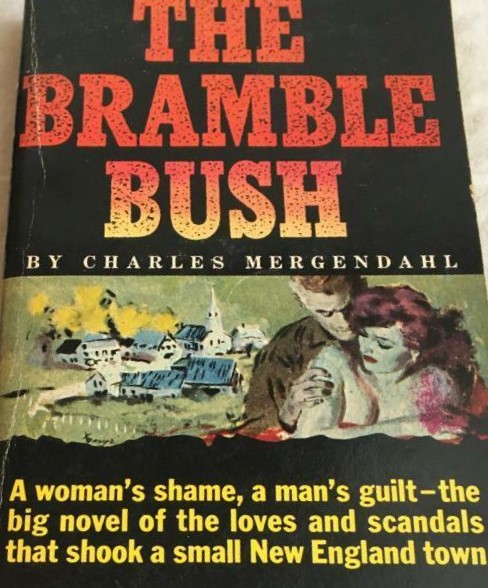
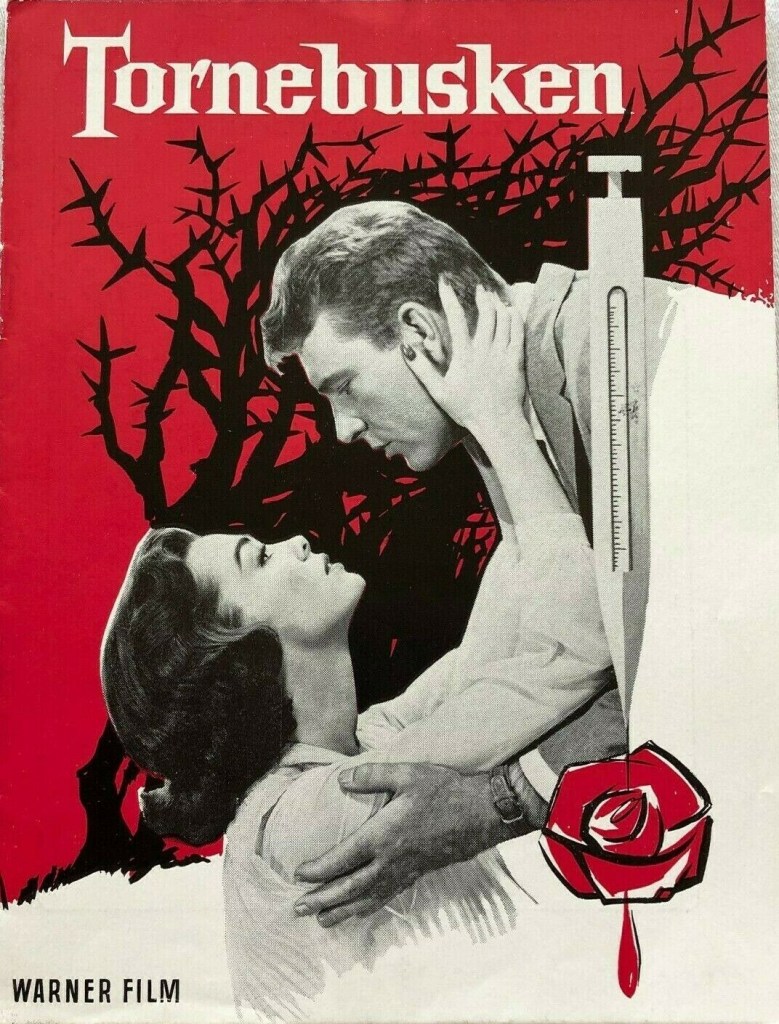
Book into Film: “The Bramble Bush” (1960)

Few novels have been as abruptly shorn as Charles Mergendahl’s massive bestseller – seven million copies sold – The Bramble Bush. The last quarter of the original story was just dumped. For screenwriters seeking to heighten every emotion this was a very strange decision for it is in the last section that the book delivers huge dramatic punch.

The film – SPOILER ALERT – ends with Guy (played in the film by Richard Burton) judged not guilty of the murder of dying best friend Larry. Guy’s one-night stand with Larry’s wife Margaret (Barbara Rush) has made her pregnant but now widowed she leaves him on the grounds that he will be unable to live with what he has done. It’s a sad enough ending but it’s nothing compared to the book.

The trial section takes place three-quarters of the way through the novel. In the film, it is placed much closer to the end so there are only five minutes or so to tidy up in a rather ho-hum manner, nothing highly dramatic, no floods of tears, just Margaret leaving him behind.  

Following the trial in the book, however, Margaret’s departure is much more sudden. There is no goodbye. She just vanishes. While judged innocent of murder, Guy has lost his license to practice so in the absence of professional commitments is free to spend months hunting for her. And find her he does.

The dramatic point you would have thought would be simply whether she can ever accept as a lover the man who has injected her husband with a fatal dose of morphine regardless of whether this was done with the best of intentions and could be construed as a mercy killing. But the author isn’t finished with these characters yet. Yes, they are reconciled and in fact get married.

But it’s too late. Margaret has tuberculosis – a considerably more dangerous condition in those days than now, and in some cases as untreatable as the incurable Hodgkin’s Disease that afflicted her husband. That puts both her life and that of her unborn child in danger. Guy faces another dilemma, just as he did with her husband. If he has to choose, whose life would he want to save.

The baby is born, and both survive. But only for the time being. Margaret’s TB has not abated. Since Guy’s license has by now been restored, they return to the town. But he’s in for a shock. The town is outraged. The public which had stoutly defended him and the jury which had set him free now turn against both, aware through the arrival of the child that they must have had an affair while the husband was still alive, which therefore clouds the issue of exactly why Guy committed euthanasia.

But before Guy can decide to move elsewhere and nurse his sickly wife and care for his newborn child – called Larry after the dead husband – Margaret dies.

That turns the book into a three-handkerchief tragedy that the film never was. Except for running time, you wonder why the screenwriters elected to miss all this out. Maybe the movie would have run over the two-hour mark, perhaps two hours fifteen minutes, but that would hardly make it so undesirable to exhibitors nor so offensive to the public given the ending was so much more dramatic.

Even then, the author isn’t finished. He provides an ironic ending The rejected Fran – dumped also by this point by Bert, Guy’s lawyer– determines that she will look after the child, allowing Guy to recover from his ordeal. And there is the hope – although she would not press her love for Guy on him – that in due course he will come to appreciate her and reciprocate her love.

Quite a different ending indeed from that foisted on moviegoers. Hard to say whether readers were disappointed, but when a novel is such a huge success it is generally because the public likes the story the author has devised. So to rob them of that seems extremely odd.

The novel had raced to the screen. The book was published in September 1958 and the film opened in February 1960, barely seventeen months later. When the gap between novel and movie is so short, it generates feverish public anticipation. And it seems almost perverse to deny the waiting audience the movie they expected.

Naturally, in the transition from book to screen there are other eliminations – and additions. And there is also the usual welter of changes made for no particular reason, for example the town of East Dereham becomes East Norton in the film.

Certainly, the aim of a movie being to heighten drama and combine disparate elements into a more cohesive whole, you can see why in the film it raises the stakes for the lawyer Bert Mosley (Jack Carson) to already be campaigning for district attorney rather than, as in the novel, only dreaming about it. Although both his parents are dead, Guy came from far more prosperous stock in the film than the book, the hospital named after his father in the film but not the novel.

Some of the changes must have seemed to create more drama, but I’m not so sure. What difference did it make whether it was Guy or the dying Larry (Tom Drake) to be the one returning home? In the film it’s Guy, in the book Larry. In the book Guy is kind to the town drunk Stew (James Dunn) but it’s the opposite in the book, hostile and physical abusive to him from the outset. In the book we learn why – Stew was Guy’s mother’s lover and their affair triggered the suicide of his father – from an internal monologue, but in the film this plays out in more dramatic fashion when Margaret confronts Guy about what she sees as his unfair treatment of the older man.

There’s an elimination that’s so shocking you can’t understand why it was left out by the screenwriters. In the book we discover that Stew is in fact Guy’s father, a fact ignored in the film. And in the last section of the book when Guy is tracking down Margaret in different towns he takes Stew’s surname as his own. And one core element of the film – Larry pushing Guy and Margaret together – is the screenwriters’ invention. (Perhaps audiences would view Guy in a lesser light if he simply took advantage of his friend’s illness to sleep with his wife). And to tie things up more neatly, it’s Guy in the film who prescribes sedatives for Margaret whereas in the book that’s not part of his role.

On the other hand Larry’s father Sam is hostile to Guy for reasons that are kept from us in the film – but in the book we find out it’s because Sam blames Guy’s father (also a doctor) for his wife dying in childbirth, an incident that caused him to lapse into the insanity mentioned in the trial scene in the film.

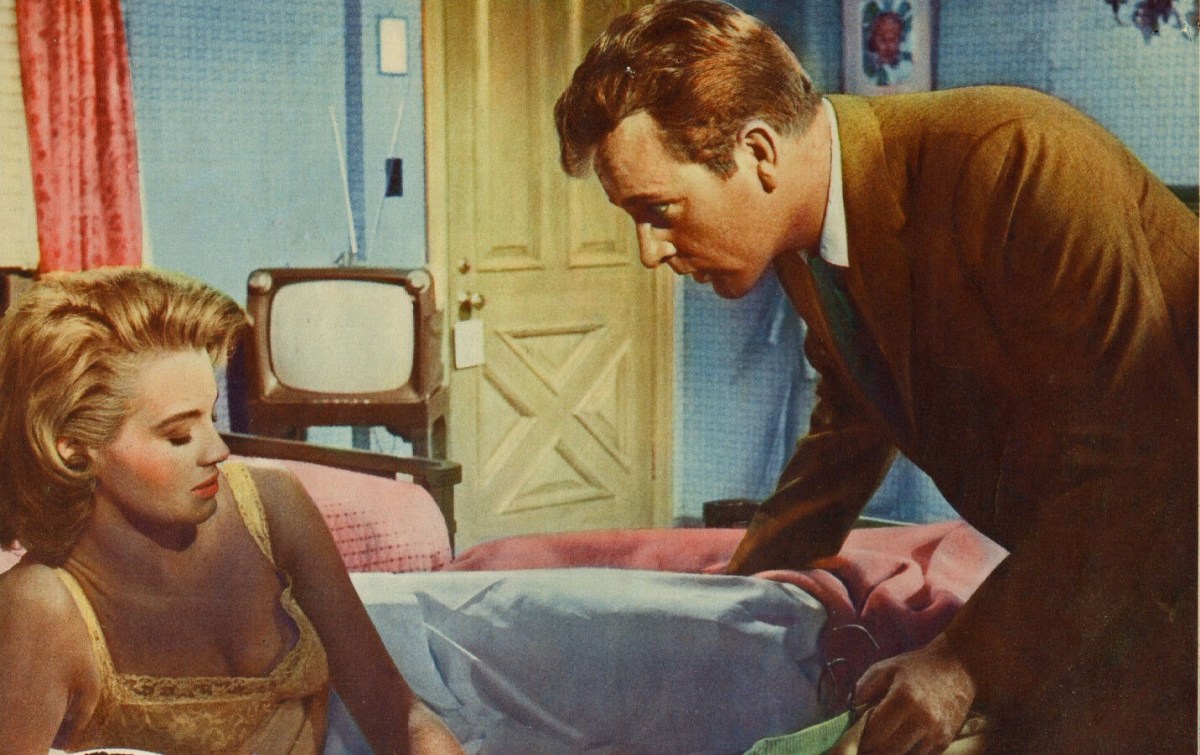
You can see why some elements of the book are not included. The creepy newspaperman Welk (Henry Jones) who blackmails Fran (Angie Dickinson) into posing nude for him later dupes his assistant into doing the same. Bert falls for a tough Boston reporter Sylvia for whom he quits town and dumps Fran.  On discovering she is pregnant by Guy, Margaret’s initial reaction is to seek an abortion. And there’s a section where hospital chief Dr Kelsey and Fran discuss the various ethical ways doctors have of letting exceptionally ill babies die.  The judge suggests to the jury that Guy could be acquitted due to temporary insanity. And there is a bunch of peripheral characters whose main purpose is to highlight the jealousies inherent in small-towns.

But there are two character turnarounds the screenwriters choose to ignore. The first is that the drink-sodden Stew becomes a recovering alcoholic after discovering he is a grandfather. The second is more touching. After Fran was rejected early on by Guy and later dumped by Bert she had resigned herself to a life of “doing terribly immoral things.” But the book ends with, as mentioned above, her taking a huge emotional leap by giving herself the task of nursing both motherless child and widowed father.

It’s always fascinating to see how screenwriters tee up a book for the big screen treatment, deciding what to leave in and what to take out, occasionally (as in Mirage, for example) using little more than the title and the original idea and jettisoning the rest. Of course, limitations may be imposed on the screenwriters of which we are unaware, star demands or budget impositions and other factors. Here, I felt that screenwriters Milton Sperling (also the producer) and Philip Yordan did not get the best out of the book.

Book Into Film – The Venetian Affair

Sometimes I wonder if studio executives ever read a book before they purchase the rights or whether they just rely on the assumption that a bestseller must have a storyline worth adapting for the movies. I always had the impression that in many instances producers were simply buying up what they saw as a ready-made audience, that if a novel sold a few million copies enough of those satisfied readers would turn up to see the adaptation which would more than pay for what the book cost to buy (not counting the automatic marketing bounty that came from bookstore displays). These days we are used to films rigidly following the storylines of bestselling novels, even expanding the movie version into two parts to accommodate it.

But that was far from the case in the 1960s. As shown previously in this Blog, some films – Fathom (1967) a classic example – bore little resemblance to the source material while others such as The Flight of the Phoenix (1965) were more faithful renderings and others (example: The Quiller Memorandum, 1966) built on what the author had originally created. I often wondered at the reaction of a screenwriter handed an adaptation of a bestseller. Is he/she instructed to junk the whole thing and start again, retaining only the title, or asked to see what they can make of it, making other stuff up as they go along?

Sales of Helen MacInnes books increased as the 1960s wore on with The Double Image in 1966 and The Salzburg Connection in 1968 both making the annual Top Ten list, the latter the last of her books to be filmed.

In this case, producer E. Jack Neuman hired himself as the writer so I’m guessing he already knew that, beyond a simplified version of the storyline and some of the characters, he was going to dump virtually every aspect of the Helen MacInnes novel.

There were two explanations for this. The first was Neuman’s record as a creative force and it occurred to me he saw his version of the MacInnes leading man as a potential movie series character. This was his movie screenwriting debut but he had been churning out episodes of television series – including Wagon Train, The Untouchables and The Twilight Zone – for over a decade. More importantly, he was showrunner of three series – two dramas Sam Benedict (1962-1963) and Mr Novak (1963-1965) and a western A Man Called Shenandoah (1965-1966) which between them clocked up over 100 episodes – so he knew how to keep a good character going.

The second issue was the difficulty in adapting the work of MacInnes. The Scottish writer had been turning out bestselling espionage novels long before Ian Fleming, Alistair MacLean and John le Carre picked up a pen, but only two had ever been turned into pictures. And the reason was simple. The plots were anything but simple. Not so much twist after twist but complication after complication. The Venetian Affair is dense and in particular, consists, in many scenes, of exposition with characters explaining to other characters what the hell is going on.

In fact, the plot for The Venetian Affair is so obtuse – although strangely enough, quite contemporary – that it would never have worked on film. The C.I.A. are trying to get hold of a fake letter that will implicate the U.S. and Britain in a plot to assassinate French President Charles de Gaulle (fake news in today’s parlance). So that was never going to work in a movie. Preventing an assassination, yes, but, of course, what a preposterous idea to think anyone could kill de Gaulle without having a time machine that could flash forward to Day of the Jackal. In any case, the C.I.A. only find out about the letter’s existence because someone picks up the wrong overcoat – so that’s not going to play either.

However, what the book does have is a good title. Venice is an excellent locale for a spy movie. The only problem is only half the novel is set there. The first half takes place in Paris. What else the book has from a screenwriter’s perspective is that the ex-wife, Sandra Fane (Elke Sommer), of the central character Bill Fenner (Robert Vaughn) is a Communist defector who is considering defecting back and to achieve that requires the presence of her former husband.

So that formed the emotional heart of the film, potential reunion or further betrayal, that Fane is just going to dupe him a second time. And that’s about as much as Neuman takes from the book. The rest of the plot – the bombing, Fane disguised as a nun, virtually all the action, the bad guy, the brainwashing, the mouse sequence – is the invention of Neuman.

In the book Fenner is not an alcoholic but it’s more dramatic in the film if he is. Some of the characters from the book such as hard ass CIA boss Rosenfeld (Edward Asner) appear on screen much as described. Others have characters enhanced – Vaugiround (Boris Karloff) here a global kingpin is a mere moral philosopher in the book. The character of Claire Connor (Felicia Farr) is hardest done by. In the book, she is a central figure, the widow of an agent, teamed up with Fenner in a pretend romance that turns real. But in the film, she has become the mistress of a diplomat.  

I had already enjoyed the movie but my appreciation of the creative endeavor that went into its making increased by reading the original material screenwriter Neuman had to work with.  

Discover WordPress

A daily selection of the best content published on WordPress, collected for you by humans who love to read.

The Atavist Magazine

by Brian Hannan

WordPress.com News

The latest news on WordPress.com and the WordPress community.