I deserve a slap on the wrist. I wrote an enormous book (250,000 words including notes) on the history of movie reissues, revivals, encore premieres, call them what you will, and I didn’t know there was, at least in Britain, a constant source of reissue on a weekly basis, namely the “Sunday Cinema” program.
In Britain in the 1960s, movies ran from Monday to Saturday (Mon-Wed/Thu-Sat if a split week) not the current system of Friday to Thursday. So it made little sense to tag on a Sunday as the last day of a run unless the cinema was involved in roadshow presentation. On Sundays, cinemas, if they opened at all, tended to show older movies, revivals of horror pictures or ones with a sensationalist slant.

Sunday showings were a contentious issue anyway. According to the Sunday Entertainment Act of 1932, cinemas could only show movies on Sundays subject to certain conditions. The first of which was that cinema owners had to agree to give over a certain percentage of their takings to charity. And not even a charity of their choice, but one chosen by the local authority. Secondly, they could not, should they wish, show movies all day, or from the usual starting point of between 1pm and 2pm, in case that got in the way of children attending Sunday School. Though, theoretically, cinemas could open from 4pm, most cinemas restricted showings to one full program in the evening. Lastly, should enough of the local populace object to Sunday opening, that could put a stop to the process.
On the other hand, there was one advantage to Sunday opening. Operators paid a flat fee for movies, not a percentage of receipts as they did for the rest of the week. That made it a lot easier to work out costs and potential profits, i.e. whether it was worthwhile opening at all.
With the downturn in cinema attendances in part triggered by the availability of movies on television – in Britain there was a five-year restriction but few pictures except for Bond films and certain roadshows and big hits could resist the temptation of the extra cash that television could bring – cinemas were annoyed at still having to give money to charity and by the end of the decade the government nullified that condition.
There was a ready supply of older movies available on a non-percentage basis. Programs invariably comprised double bills, though often the complete program ran well under three hours.
I did a survey of suburban cinemas in my home town of Glasgow, Scotland, over three separate months – January, June and October – in 1969 and found that certain films were in constant circulation through the year.
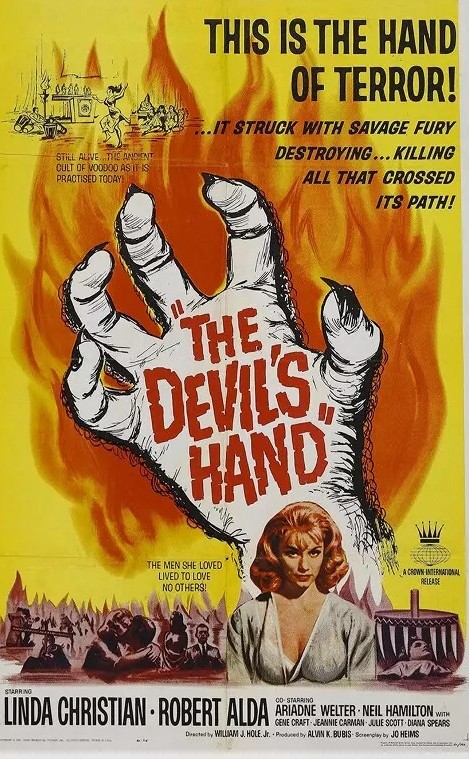
Hammer’s The Gorgon (1964) starring Christopher Lee, Peter Cushing and Barbara Shelley was shown variously with thriller Recoil (1953), occult The Devil’s Hand (1961) and sci fi 20 Million Miles To Earth (1957). But The Devil’s Hand was also the support for several bookings of horror portmanteau Twice Told Tales (1963) with Vincent Price and Recoil I found supporting The Curse of the Mummy’s Tomb (1964).

Blood beasts were on the rampage. You could choose from Roger Corman’s Night of the Bloodbeast (1958) supporting Cage of Doom (aka Terror from the Year 5000, 1958) or Revenge of the Bloodbeast plus peplum/horror mash-up Goliath and the Vampires (1961). Edgar Allan Poe was represented by The Raven (1963), The Masque of the Red Death (1964) and The Fall of the House of Usher (1960), all the main feature, all headlining Vincent Price. City of the Dead (1960) went out variously with Screaming Skull (1958) and Cage of Doom
Other popular items included Italian occult item Sexy Party (aka Death on the Fourposter, 1964) coupled with Search for Venus and British exploitationer Beat Girl (1961) doubled up with sci fi Unearthly Stranger (1965)
It wasn’t all horror and sci fi. Gangsters occasionally put in an appearance – The Bonnie Parker Story (1958) on a killing spree with Charles Bronson as Machine Gun Kelly (1958). Westerns were rare but there was room for James Stewart in The Far Country (1954) teamed with Louis L’Amour’s Taggart (1964) and Robert Wagner in White Feather (1955) paired with exploitationer The Young Sinners (aka High School Big Shot, 1959). Just as out of place were the ultra daring, but censor-permissible, Nudes of the World (1962), espionage picture Death Is a Woman (1966) and Alan Ladd in Hell Below Zero (1954).
But what horror or sci fi aficionado could resist Invasion of the Hell Creatures (aka Invasion of the Saucer Men, 1957) and She Demons of the Swamp (aka Attack of the Giant Leeches, 1959)? Or The Brain Machine (1955) coupled with Strangler of the Swamp (1945)? Or A Bucket of Blood (1959)/ The Evil Force (aka 4D Man, 1959)?
Despite her proven marquee pull Claudia Cardinale in French-made Swords of Blood (aka Cartouche, 1962) played second fiddle to, variously, Italian-made Perseus vs the Monster (aka Perseus the Invincible, 1963) and The Exterminators (aka Coplan FX 18, 1965).
You could catch up with – or enjoy again – such fare as The Brain Eaters (1958), The Day the World Ended (1955), The Amazing Colossal Man (1957), Deborah Kerr in The Innocents (1961), Joan Fontaine in The Witches (1966), Jack the Ripper (1959), The Sorcerers (1967) with Boris Karloff and Barbara Shelley as Cat Girl (1957).
Those were the days.
 The Magnificent 60s